To “appify” old media, we need a new approach — from gigaom.com

The publishing industry is keeping its formerly inky fingers crossed that mobile devices, including the seemingly ubiquitous iPad, will save its behind. With the mobile market still in its infancy, it’s a tad early to be calling definitive trends, but there is one interesting tendency underway that may endure long-term — and that is the “appification” of media content.

This “appification” is being driven by one question — what is it that the audience wants? And the answer resoundingly is this: don’t just replicate the brand, give us something different.

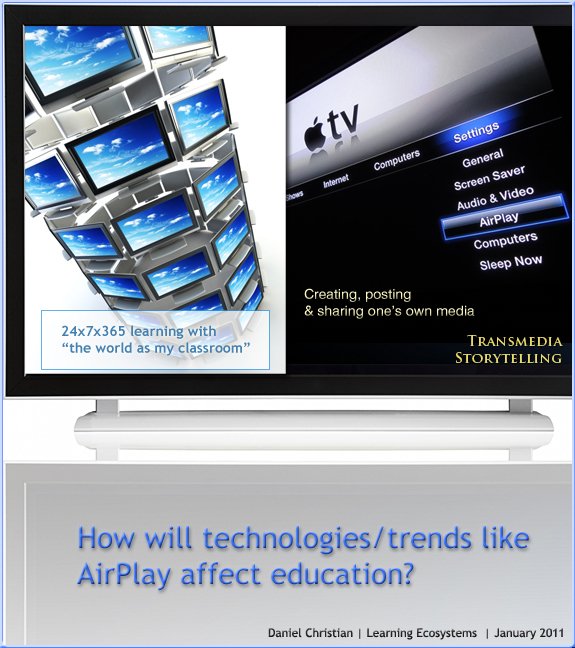
How will technologies like AirPlay affect education? I suggest 24x7x365 access on any device may be one way. By Daniel S. Christian at Learning Ecosystems blog-- 1-17-11.

.


Addendum on 1-20-11:
The future of the TV is online
— from telegraph.co.uk
Your television’s going to get connected, says Matt Warman


Alibris launches marketplace for books, movies and music — from ProgrammableWeb.com by Romin Irani

Alibris, an online marketplace that brings together Indepenent sellers of popular, collectible and bargain books, music and movies has launched a Developer Network. The company is inviting developers to use its API to not only build applications but earn commissions via its affiliate program. The Alibris API exposes most of its data like current books, music and movies on sale, item information, seller information and item/seller reviews.

10muses.com

10muses.com

Per Mark Macho:

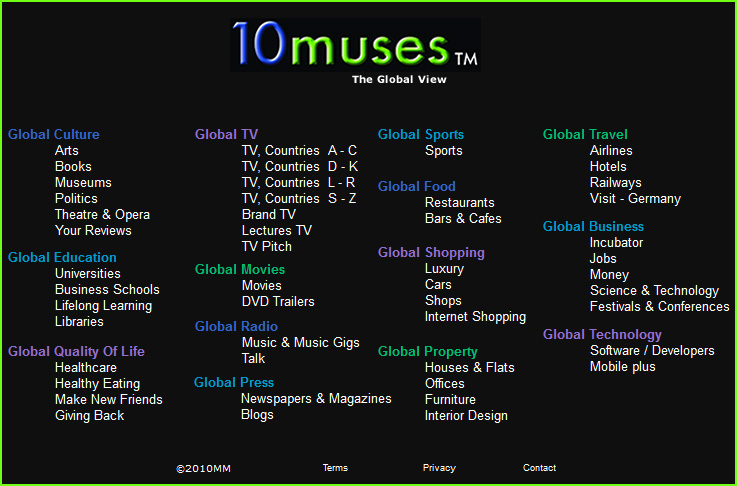
You and your students might enjoy www.10muses.com. There is instant access to the TVchannel sites of the whole world for a starter, arts around the world and much else, popular fun but also a simple way to learn about how others around the world perceive our time and its innovations.

Our tagline is ‘the global view.’

If you look at ,say the New York Times, you will get news from China, but filtered through an American reporter and an American editor. We grouped media so someone could see what the Chinese themselves are saying.

We provide the links to the preeminent publications. But whether it is about design or politics it is all ‘straight from the horse’s mouth.’

I am American and I think our inability or rather failure to really see other perspectives is harming us in every way–in the wallet, in defense, in noticing developments.

As you will notice there is a place on every topic to ask questions and get an answer from someone on the ground who really knows. What is the best club for House music in Moscow?…for instance. We have team members from every continent.

From DSC:
I don’t know much about this site, but being able to get another perspective — from someone in another country — seems like a good thing to me. Thanks Mark for the resource.


Tagged with: • • • • • •  

Cutting the Pay TV Cord, Chapter 5: Unlimited Internet TV — from Phil Leigh

philblueheadshot

In short, often there is no reason why modern flat panel TV screens cannot function as giant monitors for up-do-date computers.

Thus a growing number of us are attaching computers to our TVs.  The trend is especially prevalent for WiFi enabled computers because they can connect over a home network and thence to the Internet. In such configurations computers – commonly dedicated laptops – function as Internet gateways for televisions. They transform TVs into dual function devices normally controlled from a comfortable viewing distance with ordinary TV remote units.

Also see:

‘My Generation’ iPad app syncs with TV — from CNN.com by John D. Sutter

A new app for Apple’s tablet computer will listen to the ABC television series “My Generation” with you, and serve up content to augment the experience.

Using the iPad’s built-in microphone, the free “My Generation Sync” app literally syncs up with the TV show so it can give you information about what’s happening at that very moment on the television.

Apples announcements from 9-1-2010
.
Also see:

  • iPod Touch Adds Video Calling, HD Recording
  • Apple introduces new Apple TV and iPods
  • From Live from Apple’s fall product launch
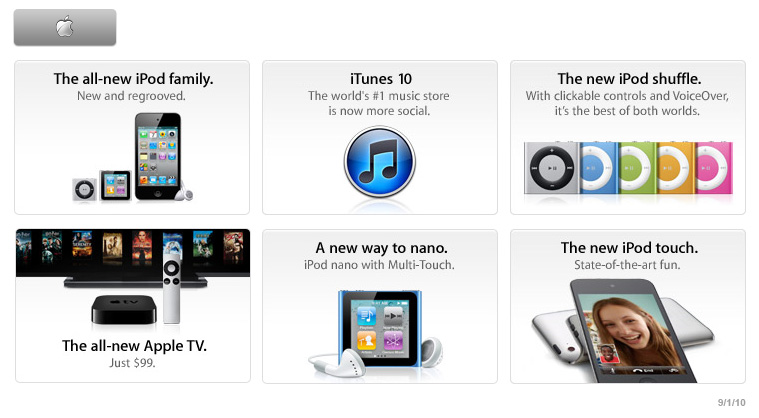
    In sum, Steve Jobs delivered on most of the rumored new products and services. The headlines:

    • A new $99 Apple TV that streams (rather than downloads) $4.99 movie rentals and 99-cent TV rentals from ABC and Fox
    • A new lineup of iPods, chief among them the iPod touch equipped with two cameras, one a front-facing camera that can do Facetime video chats
    • A new version of iTunes with a social networking feature called Ping that tracks the downloads of friends and celebrities
    • A new version of iOS 4.2, promised for November, that will bring multitasking, folders and other goodies to the iPad.
  • Addendum from Analysts weigh in on the new Apple TV
    Piper Jaffray’s Gene Munster:
    We see the Apple TV as an important step toward an all-in-one Apple television. We continue to expect Apple to launch an all-in-one Apple television in CY12. As consumers gain comfort with connected TVs and apps on their TVs, we believe Apple will eventually take its all-in-one philosophy to the digital living room like it has with the iMac and the iTunes ecosystem.

Leveraging digital media across the higher education campus
Phil Ice, Ed.D., Dir. of Course Design, R&D, American Public University System
Sebastian Diaz, Ph.D., J.D., Assoc.Professor, Technology, Learning and Culture, West Virginia University
Ellen Wagner, Ph.D., Executive Director, WCET

Note: This webinar from earlier today was sponsored by Adobe. This is the white paper from that webinar, which contains the below excerpts:

The Multimedia Landscape in Higher Education
In higher education, the effective integration of rich multimedia assets and platforms (and the requisite design and development skills demanded for their effective use) has become an expectation from schools of design, art, and communications. Engineering and journalism programs have recognized that as technology transforms industries, students with design and development proficiencies are in high demand. The obvious value of improving analytical and digital communications for teachers is now being addressed through initiatives such as the i3 Fund. Relatively less attention has typically been given to the integration and use of multimedia in other disciplines.

Emerging New Media Literacy in Academia
This paper has thus far explored the implications that collaborative, creative software solutions have on how we evaluate academic work. Just as importantly, one needs to consider the changing nature of how we communicate that work within the Academy. As the prices for video cameras continue to fall, the expectations for manifesting our work in new media formats will continue to rise. Given the availability of software such as Adobe Premiere Pro, we are finding that it is increasingly quite reasonable to expect that students possess the tools and skills necessary to produce representations of their work in dynamic visual formats, as is evidenced by www.YouTube.com. Although for a while it was believed that YouTube was an online version of America’s Favorite Home Videos, it is dangerous to assume that this phenomenon is merely a fad among the younger generation. Today’s YouTube is a marketing machine used by commercial and nonprofit entities alike, an online school and a news portal as well. YouTube serves as an accurate indicator of how newer generations will express themselves personally, artistically, and academically through what is commonly referred to as new media literacy.

Conclusion
Members of the Academy should anticipate that in the future conventionally printed papers will be replaced by much more dynamic multimedia representations of academic work. This applies not only to student assignments, examinations, and theses; it also applies to faculty work. Even as we begin to struggle with the fundamental shift from paper-based publication of work to electronic formats on the Internet, we also need to anticipate that in the near future, this research will take on new media formats. To help our faculty prepare for these changes, academic institutions must develop formal and informal faculty development initiatives to address the changes. In anticipation of these changes, it is imperative that academic departments and colleges begin to embrace technologies like Adobe Creative Suite such that we continue to develop our own intellectual capital as well as that of our respective institutions and the Academy.

From DSC:
I appreciated this well-done webinar. I also appreciate the work Adobe has done in the past and is currently doing.

I must say though, I struggle with how much we can load onto 1 person’s plate — i.e. the faculty member. We need a more team-oriented approach I think…as the bar continues to get higher and higher…and 1 person just can’t do it all anymore.

.
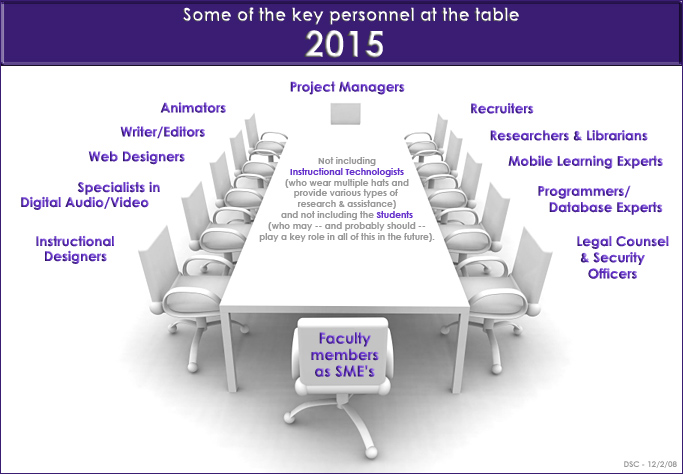
Daniel Christian -- higher ed needs to move towards the use of team-created and delivered content


Netflix app for iPhone and iPod Touch launched — from thenextweb.com by Jeff Cormier

Fans of Netflix with an iPhone and/or iPod Touch, the time has come. As promised at the unveiling of iPhone 4 in June, Netflix has lauched their app for the iPhone and iPod Touch. Get the free app here.

Netflix has been available on the iPad since its launch, and is one of my favorite apps as an iPad owner. The iPhone and iPod Touch version is equally as grand, albeit on a smaller screen.

.

Netflix now available on the ipad, ipod and iphone

.

Tagged with: • •  
© 2025 | Daniel Christian