Paper (Tuition) Cuts — from insidehighered.com by Ry Rivard

Excerpt (emphasis DSC):

A spate of small private liberal arts colleges are dramatically slashing their sticker prices in an effort to, they say, tell the truth about the real cost of college, help families and attract new students.

The price cuts – which, for some students, may be more on paper than actual reductions in out-of-pocket expenses – are not a new phenomenon, but the rate at which small colleges are adopting the maneuver, as well as tuition freezes, appears to be picking up speed.

…

“We realized just how incredibly affordable we were once you cut through all the published rates,” said President Betsy Fleming.

Some students and families, of course, didn’t realize that either, and so may have shied away from applying. “We looked at it as being very confusing,” she said, “saying, Well, we cost this much, but don’t worry, we’ll help you figure out how to make it affordable.”


From DSC:
It’s about time! I’ve been suggesting for the last 5 years that there’s a Walmart of Education developing — i.e. degrees at 50%+ discounts from what they once were.  This  development — in the forms of MOOCs, partnerships, consortia, other — has caused an enormous downward pressure on the price of a degree. 

While I realize this won’t affect what many students are paying out-of-pocket anyway, I’m still hopeful that this trend will:

  • Encourage those students on the fence about attending college to still go to college
  • Continue and that it will encourage other colleges and universities to do the same
  • Force colleges and universities to innovate/experiment more, to be more responsive and in much more significant ways
  • Significantly lessen the “sticker shock” experienced by many people out there when considering what to do about their sons’/daughters’ educations
  • Lessen the needs to devote a significant amount of time to understanding the labyrinth of financial aid packages and options out there

 This is a welcome and long overdue step.


Addendum from DSC:
I just ran across “Colleges in U.S. offer highest-ever discount to entice students”, which encourages me further.


How not to mint more engineers — from linkedin.com by Lynda Weinman

Excerpts (emphasis DSC):

Let’s tackle the economics of the situation head on — and not based on theory, but on experience. When lynda.com opened in 1997, it was a physical school that taught web design. We charged $1,500 per person for a single week of instruction. In those days, the world economy was robust and people came from every continent to study with us, enabling our business to grow and thrive. It was a heady time—until 2001, when the dotcom bubble burst and people and companies lost their budgets.

It was scary to witness the sudden demise of a business model that had worked so incredibly well up until then. In response, we could have simply raised our prices, and targeted a much smaller, more elite audience, hoping to keep our doors open. Instead, we did something crazy. We closed our eyes and leapt into something that was, at that time, unproven: We put our lessons online in video format for $25 per month.

While it took a few years to make as much money as the school did, it eventually far surpassed the earning power of the brick and mortar we started with. Instead of serving 80 people or so a week at our physical school, we started serving thousands in the virtual world, and today that number is in the millions every year.

…

The solution? Take the teachers who are experts and thought leaders and memorialize their lectures and materials via videos and other rich media to share those ideas broadly. Pay them royalties for this, the same as if they published a popular textbook. Leverage in-person class time for projects, collaborations, discussions, reviews, and presentations—the types of activities that are better experienced in person than online.


The Professors’ Big Stage — op-ed from the New York Times by Thomas Friedman

Excerpt:

I just spent the last two days at a great conference convened by M.I.T. and Harvard on “Online Learning and the Future of Residential Education” — a k a “How can colleges charge $50,000 a year if my kid can learn it all free from massive open online courses?”

The education of corporate America  — from huffingtonpost.com by Brian Mitchell

Excerpt (emphasis DSC):

The first step in the negotiated settlement may be for America’s business leadership to hold out the olive branch by word and action. So many of them sit on college boards of trustees and advisory councils that business leaders should be perfectly positioned to seek common ground. Many of them already live in both worlds. They now need to connect the dots.

These business leaders can speak not only to the number of engineers needed but also the types of skills needed to attract successful engineers. To meet their workforce needs, America’s business leadership should be the most articulate about the value of the education that they received, whether at public or independent colleges and universities. After all, business leaders are where they are today in large part because of what they learned and who they became in their formative years in college.
…

If there is to be a new American education agenda, America’s business leadership must step forward to work with higher education to prepare a well-educated workforce. Its foundation is the liberal arts. Its pathway is access to higher education. And its future will determine where the American economy — and American society — will stand by the middle of the 21st century.

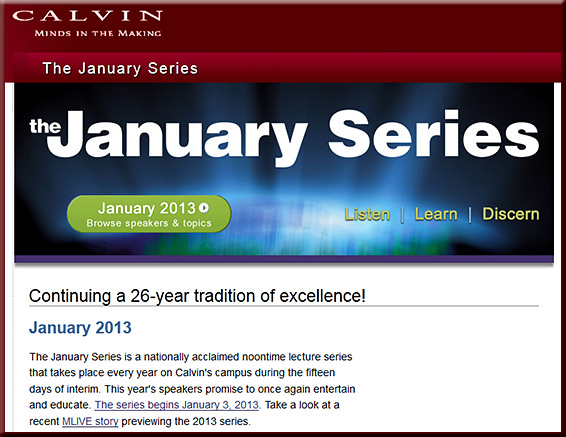
CalvinsJanuarySeries2013


Calvin College: The January Series
Presentations begin 12:30 p.m. EST (11:30 a.m. CST, 10:30 a.m. MST, 9:30 a.m. PST)
NOTE: Due to contractual restrictions, a few of these presentations will not be recorded or archived.

More details here, but a listing of the speakers/topics include:

Thursday, January 3
Jeremy Courtney – “Restoring Hearts in Iraq”

Friday, January 4
Sheryl WuDunn – “Half the Sky: Turning Oppression into Opportunity for Women Worldwide”

Monday, January 7
Roberta Green Ahmanson – “Dreams Become Reality: Inspiration through the Arts”

Tuesday, January 8
Jenny Yang – “Welcoming the Stranger: Justice, Compassion and Truth in the Immigration Debate”

Wednesday, January 9
Richard J. Mouw & Robert Millet – “Evangelicals and Mormons: A Conversation and Dialogue”

Thursday, January 10
Peter Diamandis – “Abundance: The Future is Better Than You Think”

Friday, January 11
Captain Scotty Smiley – “Hope Unseen”

Monday, January 14
Jeff Van Duzer – “Why Business Matters to God”

Tuesday, January 15
Rebecca Skloot – “The Immortal Life of Henrietta Lacks”

Wednesday, January 16
Cokie Roberts – “An Insider’s View of Washington DC”

Thursday, January 17
W. Dwight Armstrong – “Feeding the World and the Future of Farming”

Friday, January 18
Garth Pauley – “Rituals of Democracy: Inaugural Addresses in American History”

Monday, January 21
Robert Robinson – “Celebration through Gospel Music” in honor of Dr. Martin Luther King, Jr. Day

Tuesday, January 22
Mike Kim – “North Korea-China: A Modern Day Underground Railroad”

Wednesday, January 23
Chap Clark – “Sticky Faith”in partnership with the Calvin Institute of Christian Worship

The Service Patch — from The New York Times, OP-ED piece by David Brooks

Let’s put it differently. Many people today find it easy to use the vocabulary of entrepreneurialism, whether they are in business or social entrepreneurs. This is a utilitarian vocabulary. How can I serve the greatest number? How can I most productively apply my talents to the problems of the world? It’s about resource allocation.

People are less good at using the vocabulary of moral evaluation, which is less about what sort of career path you choose than what sort of person you are.

In whatever field you go into, you will face greed, frustration and failure. You may find your life challenged by depression, alcoholism, infidelity, your own stupidity and self-indulgence. So how should you structure your soul to prepare for this? Simply working at Amnesty International instead of McKinsey is not necessarily going to help you with these primal character tests.

Furthermore, how do you achieve excellence? Around what ultimate purpose should your life revolve? Are you capable of heroic self-sacrifice or is life just a series of achievement hoops? These, too, are not analytic questions about what to do. They require literary distinctions and moral evaluations.

When I read the Stanford discussion thread, I saw young people with deep moral yearnings. But they tended to convert moral questions into resource allocation questions; questions about how to be into questions about what to do.


Also see:

Excerpt:
If you’re in college, or happen to be about to graduate, and you’ve been mocked for getting a liberal arts degree, here’s a piece of welcome news: You’re actually in more demand than those who are getting finance and accounting degrees. That’s one of the findings of a new survey of 225 employers issued today by Millennial Branding and Experience Inc.


From DSC:
My thanks to Mr. Will Katerberg, Dir. Mellema Program and Professor of History at Calvin College, for these resources


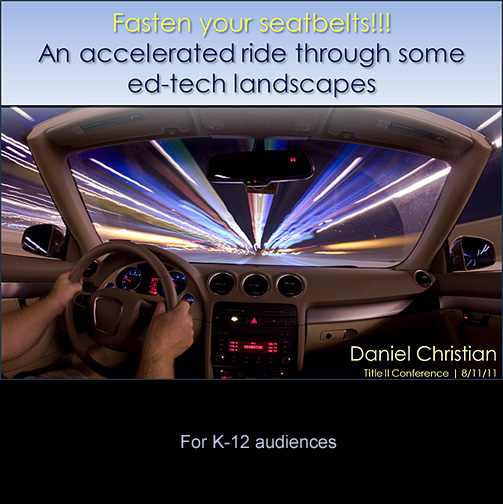
From Daniel Christian: Fasten your seatbelts! An accelerated ride through some ed-tech landscapes.


From DSC:
Immediately below is a presentation that I did for the Title II Conference at Calvin College back on August 11, 2011
It is aimed at K-12 audiences.


Daniel S. Christian presentation -- Fasten your seatbelts! An accelerated ride through some ed-tech landscapes (for a K-12 audience)


From DSC:
Immediately below is a presentation that I did today for the Calvin College Fall 2011 Conference.
It is aimed at higher education audiences.


 Daniel S. Christian presentation -- Fasten your seatbelts! An accelerated ride through some ed-tech landscapes (for a higher ed audience)


Note from DSC:

There is a great deal of overlap here, as many of the same technologies are (or will be) hitting the K-12 and higher ed spaces at the same time. However, there are some differences in the two presentations and what I stressed depended upon my audience.

Pending time, I may put some audio to accompany these presentations so that folks can hear a bit more about what I was trying to relay within these two presentations.


Tagged with: • • • • • • • • • • • • • • • • • • • • • • • • • • • • • • • • • • • • • • • • • • • • • • • • • • • • • • • • • • • • • • • • • • • • • • • • • • • • • • • • • • • • • • • • • • • • •  
Steve Jobs has resigned as Apple CEO "effective immediately"


From DSC:
I want to post a thank you note to Mr. Steven P. Jobs, whom you most likely have heard has resigned as Apple’s CEO. Some articles are listed below, but I want to say thank you to Steve and to the employees of Apple who worked at Apple while he was CEO:

  • Thank you for working hard to enhance the world and to make positive impacts to our world!
  • Thank you for painstakingly pursuing perfection, usability, and excellence!
  • Thank you for getting back up on the horse again when you came out of a meeting with Steve, Tim and others and you just got reamed for an idea or implementation that wasn’t quite there yet.
  • Thanks go out to all of the families who were missing a dad or mom for long periods of time as they were still at work cranking out the next version of ____ or ____.
  • Thanks for modeling what a vocation looks like — i.e. pursuing your God-given gifts/calling/passions; and from my economics training for modeling that everyone wins when you do what you do best!

Thanks again all!


Key education issues dividing public, college presidents, study finds — from the WSJ by Kevin Helliker

The general public and university presidents disagree about the purpose of college, who ought to pay for it and whether today’s students are getting their money’s worth.

But university presidents and the average American agree that the cost of higher education now exceeds the reach of most people.

Those are broad findings from a pair of surveys released late Sunday from the nonprofit Pew Research Center. The surveys took place this March and April, one posing college-related questions to 2,142 American adults, the other to 1,055 presidents of colleges large, small, public, private and for-profit. The two surveys contained some identical questions and some peculiar to each group.

Excerpt of report:

As is the case with all Center reports, our research is not designed to promote any cause, ideology or policy proposal. Our only goal is to inform the public on important topics that shape their lives and their society.

Higher education is one such topic. The debate about its value and mission has been triggered not just by rising costs, but also by hard economic times; by changing demands on the nation’s workforce; by rising global competition; by growing pressures to reduce education funding; and by the ambitious goal set by President Obama for the United States to lead the world by 2020 in the share of young adults who have a college degree.


Is the Four-Year, Liberal-Arts Education Model Dead?

.IMPORTANT NOTES FROM DSC:

I went through a liberal arts degree in college (Economics) and I work for a Christian liberal arts college. As such, one can tell that I greatly endorse and believe in the benefits of a liberal arts education; such an education is extremely valuable and helpful, no matter which career path(s) a student may choose to pursue after college.

However, it has become clear that the costs of education are getting out of hand — and out of the reach of a growing number of people. Now with the Internet and alternative methods of delivery in the mix — and the current model continuing to show itself as being vulnerable and unsustainable for a growing number of people —  there is a potent equation for change in the air.

So…if you don’t believe we are in a game-changing environment, how do you explain this (increasingly-prevalent) line of questioning? (Though most of the articles I’ve seen do not use the word “dead”, the flavor/meaning of such articles and postings is much the same.)


Educause Quarterly -- 33, 3 -- Fall 2010

Digital Humanities – Why Now?

Digital Humanities–Why Now? — from NITLE

Why launch a digital humanities initiative now? Yesterday, when I introduced NITLE’s new initiative, I spent some time defining digital humanities and digital scholarship. Today, I’ll take a crack at the “why now” question, specifically for liberal arts colleges. (Tomorrow, I’ll explore why the digital humanities matter for liberal arts colleges and offer some ways for those at small liberal arts colleges to get involved and take action.)

Why now?

So, why should we look at the digital humanities now, especially on the small liberal arts college campus? To answer this question, first we must look at the larger context of higher education. The digital humanities have been moving through the academy.

Tagged with: • •  

A discussion of higher education on the Diane Rhem show

.

Two professors examine the American higher education system and explain how students and parents can get the most for their money.

Andrew Hacker
Professor of Political Science at Queens College, New York, and co-author of “Higher Education? How Colleges Are Wasting Our Money and Failing Our Kids – And What We Can Do About It”

Mark Taylor
Chair of the Department of Religion at Columbia University, professor of philosophy of religion at Union Theological Seminary, and professor emeritus of humanities at Williams College. His latest book is titled, “Crisis on Campus: A Bold Plan for Reforming our Colleges and Universities.”

.

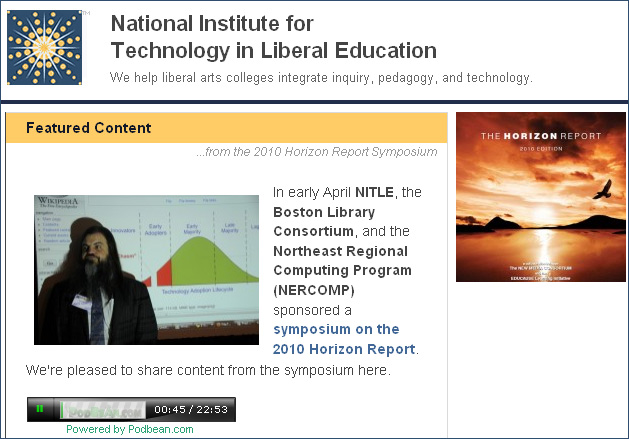
Recording of symposium re: the 2010 Horizon Report

In early April NITLE, the Boston Library Consortium (BLC), and the Northeast Regional Computing Program (NERCOMP) co-sponsored a symposium on the 2010 Horizon Report. Bryan Alexander, NITLE’s Director of Research, led more than 50 people through the 2010 Horizon Report (produced by the New Media Consortium, cosponsored by Educause, ELI). Participants reflected on and responded to trends and issues highlighted by the report as the most critical technologies currently emerging for the academy. We are pleased to share content from the Symposium on the NITLE website (www.nitle.org), and invite you to listen to the audio recording.

© 2025 | Daniel Christian