[Opinion] Why America’s obsession with STEM education is dangerous — from washingtonpost.com by

Excerpt:

This dismissal of broad-based learning, however, comes from a fundamental misreading of the facts — and puts America on a dangerously narrow path for the future. The United States has led the world in economic dynamism, innovation and entrepreneurship thanks to exactly the kind of teaching we are now told to defenestrate. A broad general education helps foster critical thinking and creativity. Exposure to a variety of fields produces synergy and cross fertilization. Yes, science and technology are crucial components of this education, but so are English and philosophy. When unveiling a new edition of the iPad, Steve Jobs explained that “it’s in Apple’s DNA that technology alone is not enough — that it’s technology married with liberal arts, married with the humanities, that yields us the result that makes our hearts sing.”


 Excerpt (con’td)

But technical chops are just one ingredient needed for innovation and economic success. America overcomes its disadvantage — a less-technically-trained workforce — with other advantages such as creativity, critical thinking and an optimistic outlook.


How Google and Coursera may upend the traditional college degree — from brookings.edu by

Excerpt:

Recently, the online education firm Coursera announced a new arrangement with Google, Instagram and other tech firms to launch what some are calling “microdegrees” – a set of online courses plus a hands-on capstone project designed in conjunction with top universities and leading high-tech firms. Coursera is one of America’s leading MOOC developers (Massive Open Online Courses).
…
Why does this announcement suggest such a shakeup is likely? Several reasons. Here are just four:

  • MOOCs are moving from novel sideshow to serious competition.
  • The partnership between online education and employers is likely a game-changer.
  • Accreditation as a restriction on competition is eroding.
  • Microdegrees are likely the pathway to customized degree programs.


Also see:

Top companies work with university partners to help create capstone projects with real world applications — from blog.coursera.org

Excerpt:

Experts at top companies like Google and Instagram have joined Coursera to help develop the final projects — called “Capstones” — for Coursera Specializations.

Combining a curated series of courses with a final Capstone Project, Specializations help you master new skills with the best of university teaching and the real-time market perspective of top industry partners. Hundreds of thousands of learners have enrolled in Specializations since their launch in January 2014.


But partnerships like Coursera’s include employers actually certifying groups of courses as meeting industry’s standards for skills and knowledge – essentially an end-run around traditional accreditation as a measure of quality.


Also see:


From DSC:

First of all, that piece about the end-around traditional accreditation should make those of us working within higher ed veeeeerrrrry nervous — and much more responsive — as accreditation has been what’s kept traditional institutions of higher ed in the game. If that goes, well…hmmm…things could get very interesting.

Secondly, those who talk of the demise of MOOCs are waaayyy too premature in their assessment/conclusion. Technologies and vendors such as IBM (Watson), Apple (Siri), Google (Deepmind), and Microsoft (Cortana and Azure Machine Learning) could bake their products into MOOCs. Also, what happens if vendors involved with developing personalized learning platforms and/or those vendors specializing with big data start approaching MOOC providers? (See Will micro-credentialing be an example of the use of big data in education and training?) The resulting offerings could have an enormous impact on how people learn and make a living in the future. Again, if those types of technologies get baked into MOOCs, I’m pretty sure that people won’t be discounting MOOCs any longer.

Also, it’s because of items like those mentioned above that sometimes make me wonder if online education and digitally-related delivery mechanisms are what will save the liberal arts.  People could pick up courses in the liberal arts throughout their lifetimes — obtaining degrees…or not. (As a brief aside, I wonder to what extent faculty members will develop their own brands.)  Anyway, it’s getting to the point that many people can’t afford the campus experience.  But could they afford something online…? It could be…depending upon the pricing and associated business models involved. My guess is that those institutions who practice a team-based approach will survive and thrive — if they keep a steady eye on their pricing. 


Does Studying Fine Art = Unemployment? Introducing LinkedIn’s Field of Study Explorer — from LinkedIn.com by Kathy Hwang

Excerpt:

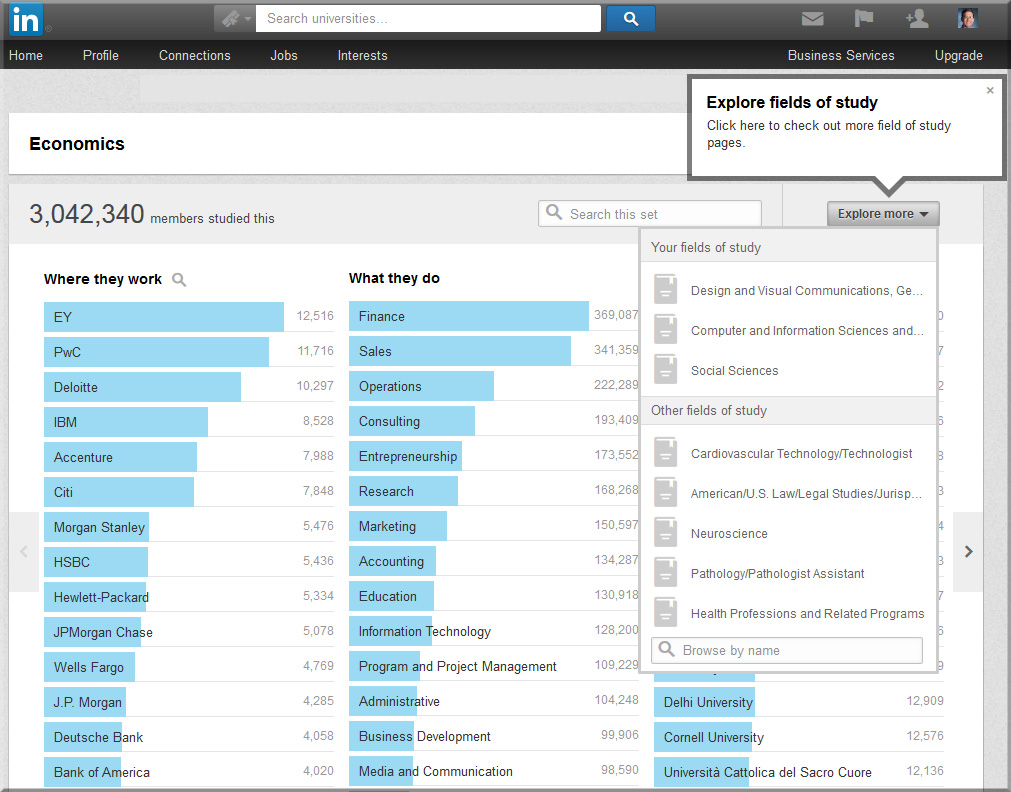
[On July 28, 2014], we are pleased to announce a new product – Field of Study Explorer – designed to help students like Candice explore the wide range of careers LinkedIn members have pursued based on what they studied in school.

So let’s explore the validity of this assumption: studying fine art = unemployment by looking at the careers of members who studied Fine & Studio Arts at Universities around the world. Are they all starving artists who live in their parents’ basements?


LinkedInDotCom-July2014-FieldofStudyExplorer


Also see:

The New Rankings? — from insidehighered.com by Charlie Tyson

Excerpt:

Who majored in Slovak language and literature? At least 14 IBM employees, according to LinkedIn.

Late last month LinkedIn unveiled a “field of study explorer.” Enter a field of study – even one as obscure in the U.S. as Slovak – and you’ll see which companies Slovak majors on LinkedIn work for, which fields they work in and where they went to college. You can also search by college, by industry and by location. You can winnow down, if you desire, to find the employee who majored in Slovak at the Open University and worked in Britain after graduation.


OnlineChristianColleges-Aug2014


Per Dan Schuessler, Chief Affordability Officer, Affordable Colleges Foundation:

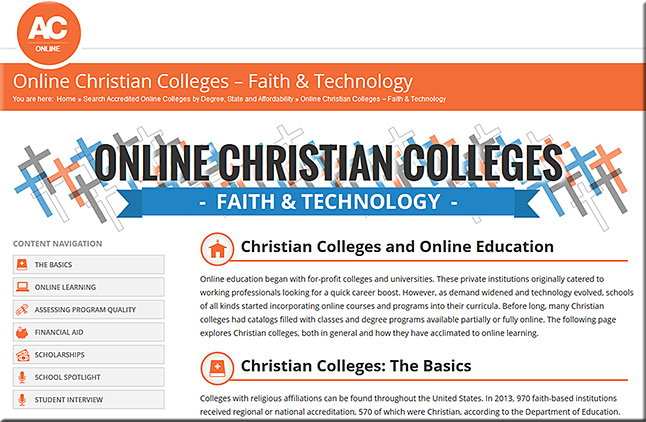
While the guide covers the basics about what to it expect at a Christian college, it also goes deeper by offering expert interviews from administrators at several universities so that students can get inside look at what it means to attend a Christian institution. We also explored unique and insightful information related to the evolution of online programs at Christian colleges, and how the religious aspects of the education are weaved into online learning. Lastly the guide provides actionable affordability tips, scholarship opportunities, and additional resources.

Another somewhat related resource:


“I actually don’t know any of the people you just mentioned . . .”  — from Management & Strategy in Digital Higher Ed by Dr. Keith Hampson

Excerpt:

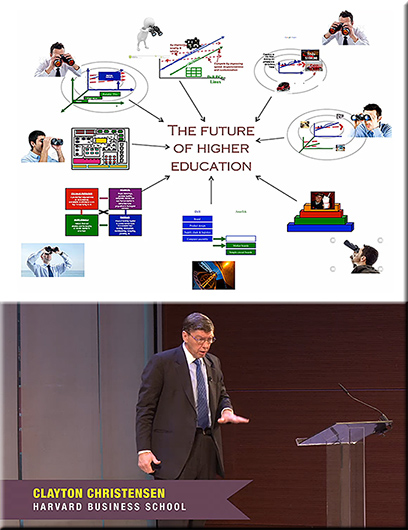
Colgate University hosted an event last week. “Innovation + Disruption Symposium“. The keynote was none other than Clay Christensen, the Godfather of Disruption Innovation. Following his talk, seven University Presidents of private universities fielded questions from the moderator.

…

But a few moments stood out; here’s my favourite. Clay Christensen – having done his bit on disruptive innovation in higher education – was sitting in the audience listening to the Presidents field questions. He rose and noted, half-jokingly, that everyone on the panel disagreed with everything he had just said about the coming disruption in higher education. Laughs ensued. He then asked the panel to imagine that a second panel was on stage with them. This second panel included the Founder of the Khan Academy, Paul Leblanc of Southern New Hampshire University, the President of Western Governors University, and others that are commonly believed to be leading the changes that are unfolding in higher education. Christensen asked the panel to consider what this second, imaginary panel might say that is different from what he had been hearing.

The response? David Oxtoby, President of Pomona College fielded the question: “I actually don’t know any of the people you just mentioned, but . . .”

You can’t make this stuff up. I don’t recall ever hearing or reading anything that so succinctly illustrates the existence of different worlds and perspectives within higher education.


Also see:

  • Question of the day: How worried should higher education leaders be about the future? — from news.colgate.edu by Barbara Brooks on May 5, 2014
    Excerpt:
    After Clayton Christensen predicted that half of higher education institutions will either be facing bankruptcy or in liquidation within 10 to 15 years, six liberal arts presidents expressed varying degrees of concern, ranging from “no­t worried” (Georgia Nugent, president emeritus of Kenyon College) to “only the paranoid survive” (Colgate President Jeffrey Herbst).


FutureOfHigherEd-ColgateMay52014


From DSC:
I love Keith’s line:  “You can’t make this stuff up.”  Then later on in his posting, “Yet, the President of a university – having accepted an invitation to an event to talk about disruptive innovation in higher education – has not heard of many of the people behind these changes. Wow. Just wow.”  Thanks Keith — right on!

My comment is this:
Too many presidents and those in leadership waaaay underestimate what can be done online. They didn’t grow up with many of the technologies we have today and, quite frankly, they aren’t sold on them. Nor have many of them taken an online course recently (or ever) themselves, I’d guess.They also have very vested interests in keeping things the way they are; they have to guard/craft their public-facing words very carefully.

Many leaders throughout higher education also neglect to highlight/mention/recognize that online learning doesn’t come with multimillion dollar, physical plant-related expenses.  Online learning can be expensive, depending upon the level of sophistication one wants to achieve.  However, there are no buildings to maintain. There are no elevators to fix.  There are no lawns to mow.  There are no sidewalks to repair.  There are no heating bills.  There are no lightbulbs/fixtures to maintain…walls to paint…etc., etc.   Adding additional storage space or purchasing a new server is much more affordable than developing a new building. Online learning doesn’t care much about the buildings “arms race.”

So I wonder, how will face-to-face learning be able to compete in the future?  Or…is that not even the question? Many have asked another question, “Will only the very wealthy be able to afford an on-campus experience?” 


In defense of a liberal arts degree — from fastcompany.com by Andrew Benett
They might be getting overshadowed by STEM degrees in the news, but liberal arts degrees have a lot to offer their students.

Excerpt:

I know a lot of liberal arts graduates. I have hired a bunch of them. And I am one myself, having studied both psychology and art history. What I have found is that people with degrees in subjects such as history and literature–and, yes, even philosophy–tend to possess many of the qualities, skill sets, and aptitudes that are in highest demand in my own industry (marketing communications) and in others that rely on creative thinking and foresight.

In my experience, these are the areas in which liberal arts graduates really stand apart:

— Agility and adaptability
— Storytelling and persuasion
— Historical consciousness


Management and the Liberal Arts
Management is a liberal art.

Management is what tradition used to call a liberal art — “liberal” because it deals with the fundamentals of knowledge, self-knowledge, wisdom, and leadership; “art” because it deals with practice and application. Managers draw upon all of the knowledges and insights of the humanities and social sciences on psychology and philosophy, on economics and history, on the physical sciences and ethics. But they have to focus this knowledge on effectiveness and results-on healing a sick patient, teaching a student, building a bridge, designing and selling a “user-friendly” software program.

ACTION POINT:
What is your plan to develop yourself in the humanities and social sciences? Develop such a plan today.

The New Realities


Drucker, P. (2004). The Daily Drucker (p. 15). New York, NY: HarperBusiness.


Cross-college collaboration — from insidehighered.com by Megan Rogers

Excerpt:

Faced with increasingly tight budgets, liberal arts colleges are looking to share resources to reduce costs and expand programs. But when the end goal is collaboration and not a merger, how should administrators decide which services are appropriate to share?

St. Olaf and Carleton Colleges, both liberal arts colleges in Northfield, Minn., have received a $1.4 million grant from the Andrew W. Mellon Foundation to increase collaboration over the next four years, but are drawing the line at sharing career services departments. And it’s hard to imagine the colleges collaborating in areas where they are competitors, such as fund-raising or admissions, St. Olaf President David Anderson said.


From DSC:
In order to survive within higher ed — and if things migrate to more of a team-based approach to content creation and delivery — I’ve often wondered if the following will occur:

  • The necessity of sharing/pooling resources — especially those involving the creation and delivery of courses (i.e. one college contributes X courses, another contributes Y courses)
  • The requirement to form partnerships for most institutions of higher education (vendors, especially), as the unbundling of higher education continues
  • The need to form consortia


A Rebirth of Liberty and Learning — from imprimis.hillsdale.edu by Larry Arnn, President, Hillsdale College, with thanks to Mr. Andy Thorburn for this resource

Excerpt:

At Hillsdale College students read a lot of old books, including Plato’s Republic. In the Republic they read the story of Gyges’ ring—a ring that makes the wearer of it invisible. One of Socrates’ interlocutors in the Republic, a young man named Glaucon, raises the question: Why would a man in possession of such a ring not use it to do and obtain whatever he wishes? Why would he not use the ring’s powers, for instance, to become a tyrant? In response, Socrates turns the discussion to another question: What is the right way for a man to live? What is just by nature and what is unjust?

These Socratic questions were once at the center or core of education, and they remain at the center or core of education at Hillsdale College. But in American education as a whole, these questions have been abandoned.

…

Bereft of the kind of questions posed by Socrates in the Republic—or the kind of questions raised in the Bible, or in the plays of Shakespeare—modern education treats students chiefly as factors of production, as people to be trained for productive jobs. And although we all wish productive jobs for our children, as parents we know that they are not chiefly job seekers or factors of production. After all, how many of us, if we were given the choice of our children earning a lot of money and being bad, or struggling economically and being good, would choose the former?


From DSC, a portion of my thoughts back to Andy Thorburn on this were:

A great article, and highly relevant.  It’s also timely, as the jury is starting to come in for me re: the Common Core.  I’m not a big fan of it, because of how it was created and who developed it (few if any teachers were involved with creating it; I’ve been reading the postings from Anthony Cody for his research on these topics; example here), and the devastating impact it could have on students who are already struggling with school as it is.

Re: K-12 education:
I’m disheartened to see what education has/is becoming — packing people into molds (by age) and not helping students identify and develop their passions, gifts, abilities. I’d like to see us provide students with more choice, and more control over their own learning. We’re all into lifelong learning now, so it seems to me that if someone enjoys learning, they will have a more enjoyable/productive lifetime.

Hal Plotkin, at his keynote speech for the Sloan Consortium, said that we shouldn’t use the term “drop outs.” Instead, we should use the term “pushed outs” as that would help people better understand the dynamics at play.

Re: higher education:
I think the issue we have these days is that the price of education has forced the situation upon students/families that we find ourselves in — i.e. that when you are paying $100K-$250+ for an education, a student these days can’t help but be concerned about what job they are going to get, what vocation they are going into, how they are going to pay off their debt (which as of 2013 averages ~$30,000 per student), etc.   If the total price of an education were $10,000, one could take it easier on that front and pursue the type of education Larry Arnn discussed; which is a great education, by the way.
 

From DSC:
First, some items:


Thinking for the future — from nytimes.com by David Brooks

Excerpt:

We’re living in an era of mechanized intelligence, an age in which you’re probably going to find yourself in a workplace with diagnostic systems, different algorithms and computer-driven data analysis. If you want to thrive in this era, you probably want to be good at working with intelligent machines. As Tyler Cowen puts it in his relentlessly provocative recent book, “Average Is Over,” “If you and your skills are a complement to the computer, your wage and labor market prospects are likely to be cheery. If your skills do not complement the computer, you may want to address that mismatch.”

So our challenge for the day is to think of exactly which mental abilities complement mechanized intelligence. Off the top of my head, I can think of a few mental types that will probably thrive in the years ahead.


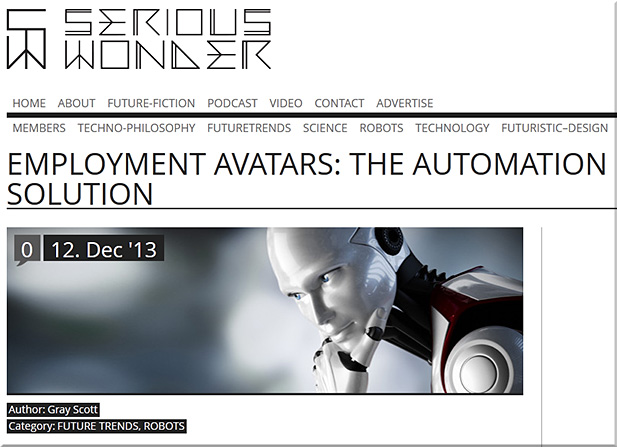
EmploymentAvatars-12-12-13

Excerpt:

Create your own employment avatar robot to replace you at work. Fight fire with fire. Could this be the solution to the coming robotic automation revolution?

…

The question on everyone’s mind is “If all the jobs are automated, who will have money to buy the products from these corporations?”  This is not just a blue-collar issue. Predictive analytics in soft A.I. robots could replace creative jobs as well.


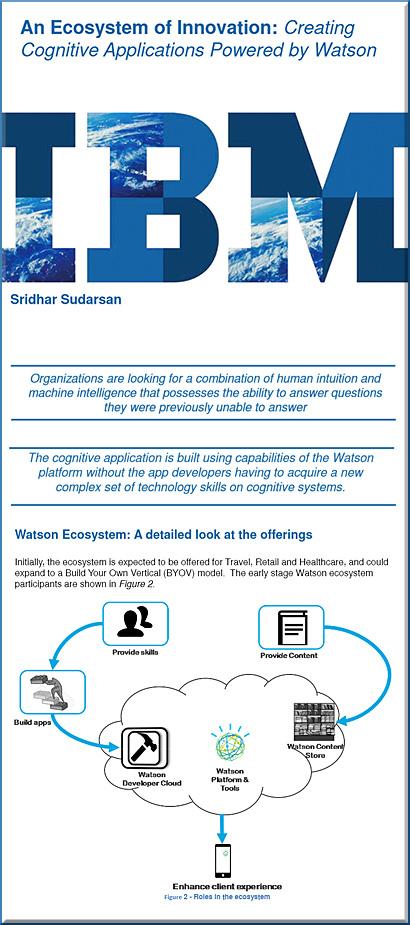
IBM-AnEcosystemOfInnovation-Watson-2013


Siri says ‘dump him’? How mobile devices could run (or ruin) your life — from CNN.com by futurist Gerd Leonhard

Excerpt:

(CNN) — The Web is set to change our lives dramatically over the next decade. This will also raise questions about the use of personal data and the need to balance new powers with ethics.  Here are five ways you can expect the explosion in technology to impact you:


From DSC:
These items caused me to reflect…they made me wonder…

  • How should we educate our youth in this age of automation?
  • How should our curricula respond/change/adapt to these trends?
  • Or should we even be talking about curricula? Perhaps we should rather be curating and providing streams of content — and doing so on a lifelong basis…?
  • How should we reinvent ourselves and keep ourselves marketable?


Addendum:


Top 10 most stunning art installations in 2013 — from mymodernmet.com

 Example:


Infinity Mirrored Room – The Souls of Millions of Light Years Away by Yayoi Kusama


Also see:


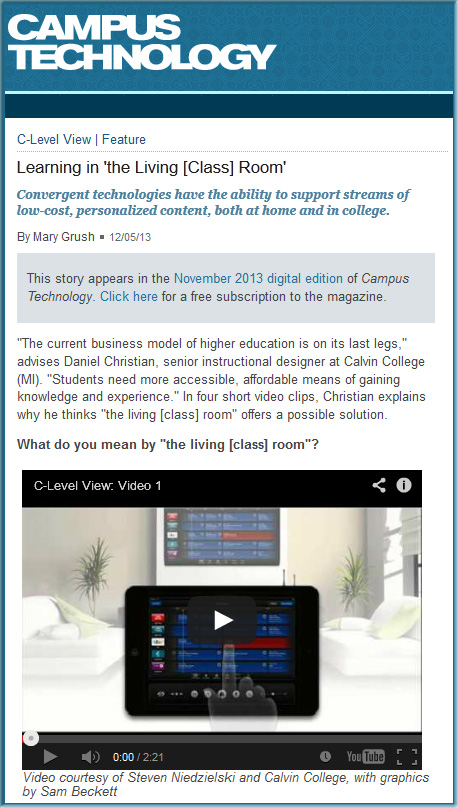
Learning from the Living (Class) Room [Grush & Christian]

CampusTechnology-12-5-13-DSCLivingClassRoom


Learning in ‘the Living [Class] Room’
From campustechnology.com by Mary Grush and Daniel Christian
Convergent technologies have the ability to support streams of low-cost, personalized content, both at home and in college.


“Learning in the Living [Class] Room” — as explained by Daniel Christian [Campus Technology]

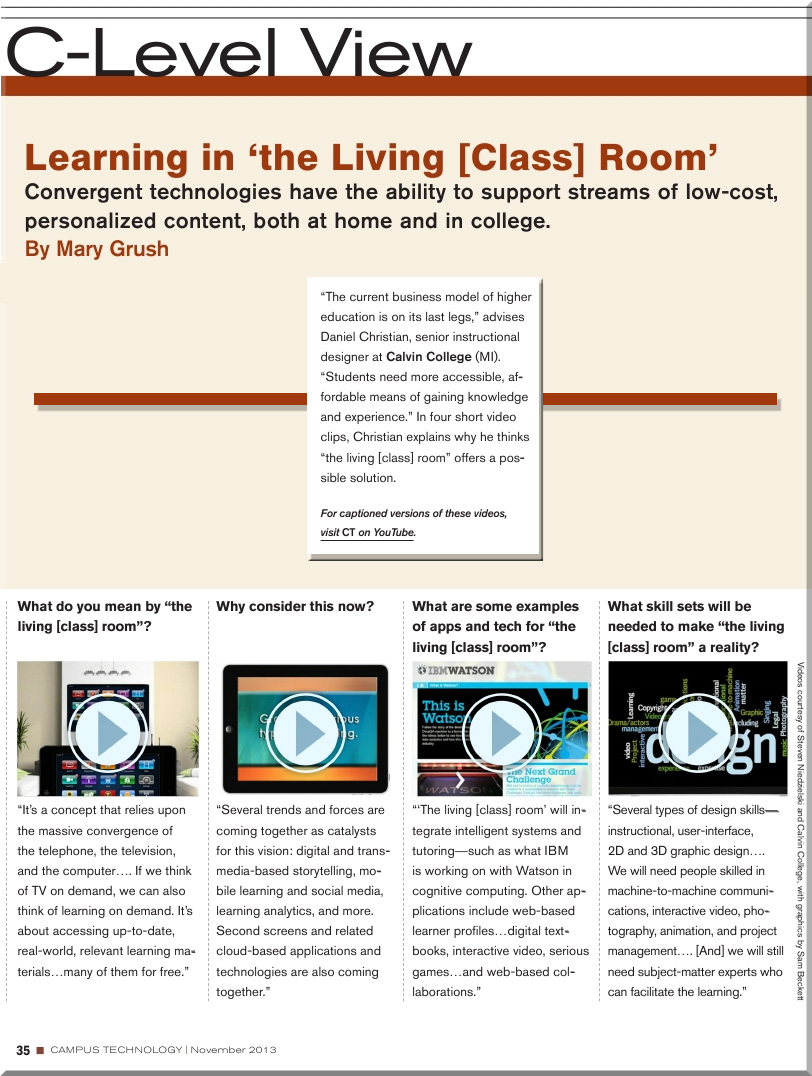
Learning from the Living [Class] Room  — from Campus Technology by Daniel Christian and Mary Grush; with a huge thanks also going out to Mr. Steven Niedzielski (@Marketing4pt0) and to Mr. Sam Beckett (@SamJohnBeck) for their assistance and some of the graphics used in making these videos.

From DSC:
These 4 short videos explain what I’m trying to relay with a vision I’m entitling, Learning from the Living [Class] Room.  I’ve been pulse checking a variety of areas for years now, and the pieces of this vision continue to come into fruition.  This is what I see Massive Open Online Courses (MOOCs) morphing into (though there may be other directions/offshoots that they go in as well).

After watching these videos, I think you will see why I think we must move to a team–based approach.

(It looks like the production folks for Campus Technology had to scale things way back in terms of video quality to insure an overall better performance for the digitally-based magazine.) 


To watch these videos in a higher resolution, please use these links:


  1. What do you mean by “the living [class] room”?
  2. Why consider this now?
  3. What are some examples of apps and tech for “the living [class] room”?
  4. What skill sets will be needed to make “the living [class] room” a reality?


Alternatively, these videos can be found at:


DanielSChristianLearningFromTheLivingClassRoom-CampusTechnologyNovember2013

.


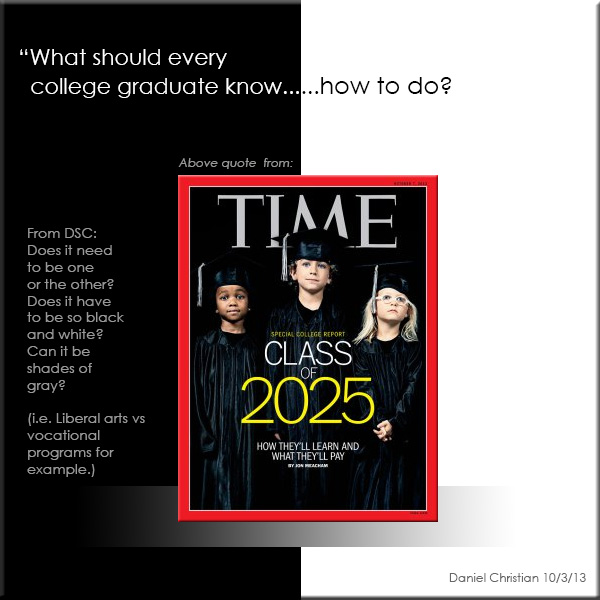
What colleges will teach in 2025 — from nation.time.com by Jon Meacham (@jmeacham); with thanks to Brian Bailey (@EdTechEmpowers) for posting this resource on Twitter
America must resolve the conflict between knowledge and know-how

Excerpt:

At the heart of the debate between traditionalists (who love a core) and many academics (who prefer to teach more specialized courses and allow students more freedom to set their own curriculums) is a tension between two different questions about the purposes of college. There are those who insist that the key outcome lies in the answer to “What should every college graduate know?”—perhaps minimizing the chances that future surveys will show that poor John Roberts is less recognizable than Lady Gaga. Others ask, What should every college graduate know how to do?

Those three additional words contain multitudes. The prevailing contemporary vision, even in the liberal arts, emphasizes action: active thought, active expression, active preparation for lifelong learning. Engaging with a text or question, marshaling data and arguments and expressing oneself takes precedence over the acquisition of general knowledge.

From DSC:
The article prompted me to create the graphic below, asking…


WhatShouldEveryCollegeGraduateKnowHowToDo-Time-Oct2013


© 2025 | Daniel Christian