BREAKING: Google introduces Guided Learning — from aieducation.substack.com by Claire Zau
Some thoughts on what could make Google’s AI tutor stand out

Another major AI lab just launched “education mode.”

Google introduced Guided Learning in Gemini, transforming it into a personalized learning companion designed to help you move from quick answers to real understanding.

Instead of immediately spitting out solutions, it:

  • Asks probing, open-ended questions
  • Walks learners through step-by-step reasoning
  • Adapts explanations to the learner’s level
  • Uses visuals, videos, diagrams, and quizzes to reinforce concepts

This Socratic style tutor rollout follows closely behind similar announcements like OpenAI’s Study Mode (last week) and Anthropic’s Claude for Education (April 2025).


How Sci-Fi Taught Me to Embrace AI in My Classroom — from edsurge.com by Dan Clark

I’m not too naive to understand that, no matter how we present it, some students will always be tempted by “the dark side” of AI. What I also believe is that the future of AI in education is not decided. It will be decided by how we, as educators, embrace or demonize it in our classrooms.

My argument is that setting guidelines and talking to our students honestly about the pitfalls and amazing benefits that AI offers us as researchers and learners will define it for the coming generations.

Can AI be the next calculator? Something that, yes, changes the way we teach and learn, but not necessarily for the worse? If we want it to be, yes.

How it is used, and more importantly, how AI is perceived by our students, can be influenced by educators. We have to first learn how AI can be used as a force for good. If we continue to let the dominant voice be that AI is the Terminator of education and critical thinking, then that will be the fate we have made for ourselves.


AI Tools for Strategy and Research – GT #32 — from goodtools.substack.com by Robin Good
Getting expert advice, how to do deep research with AI, prompt strategy, comparing different AIs side-by-side, creating mini-apps and an AI Agent that can critically analyze any social media channel

In this issue, discover AI tools for:

  • Getting Expert Advice
  • Doing Deep Research with AI
  • Improving Your AI Prompt Strategy
  • Comparing Results from Different AIs
  • Creating an AI Agent for Social Media Analysis
  • Summarizing YouTube Videos
  • Creating Mini-Apps with AI
  • Tasting an Award-Winning AI Short Film

GPT-Building, Agentic Workflow Design & Intelligent Content Curation — from drphilippahardman.substack.com by Dr. Philippa Hardman
What 3 recent job ads reveal about the changing nature of Instructional Design

In this week’s blog post, I’ll share my take on how the instructional design role is evolving and discuss what this means for our day-to-day work and the key skills it requires.

With this in mind, I’ve been keeping a close eye on open instructional design roles and, in the last 3 months, have noticed the emergence of a new flavour of instructional designer: the so-called “Generative AI Instructional Designer.”

Let’s deep dive into three explicitly AI-focused instructional design positions that have popped up in the last quarter. Each one illuminates a different aspect of how the role is changing—and together, they paint a picture of where our profession is likely heading.

Designers who evolve into prompt engineers, agent builders, and strategic AI advisors will capture the new premium. Those who cling to traditional tool-centric roles may find themselves increasingly sidelined—or automated out of relevance.


Google to Spend $1B on AI Training in Higher Ed — from insidehighered.com by Katherine Knott

Google’s parent company announced Wednesday (8/6/25) that it’s planning to spend $1 billion over the next three years to help colleges teach and train students about artificial intelligence.

Google is joining other AI companies, including OpenAI and Anthropic, in investing in AI training in higher education. All three companies have rolled out new tools aimed at supporting “deeper learning” among students and made their AI platforms available to certain students for free.


5 Predictions for How AI Will Impact Community Colleges — from pistis4edu.substack.com by Feng Hou

Based on current technology capabilities, adoption patterns, and the mission of community colleges, here are five well-supported predictions for AI’s impact in the coming years.

  1. Universal AI Tutor Access
  2. AI as Active Teacher
  3. Personalized Learning Pathways
  4. Interactive Multimodal Learning
  5. Value-Centric Education in an AI-Abundant World
 

One-size-fits-all learning is about to become completely obsolete. — from linkedin.com by Allie Miller


AI in the University: From Generative Assistant to Autonomous Agent This Fall — from insidehighered.com by
This fall we are moving into the agentic generation of artificial intelligence.

“Where generative AI creates, agentic AI acts.” That’s how my trusted assistant, Gemini 2.5 Pro deep research, describes the difference.

Agents, unlike generative tools, create and perform multistep goals with minimal human supervision. The essential difference is found in its proactive nature. Rather than waiting for a specific, step-by-step command, agentic systems take a high-level objective and independently create and execute a plan to achieve that goal. This triggers a continuous, iterative workflow that is much like a cognitive loop. The typical agentic process involves six key steps, as described by Nvidia:


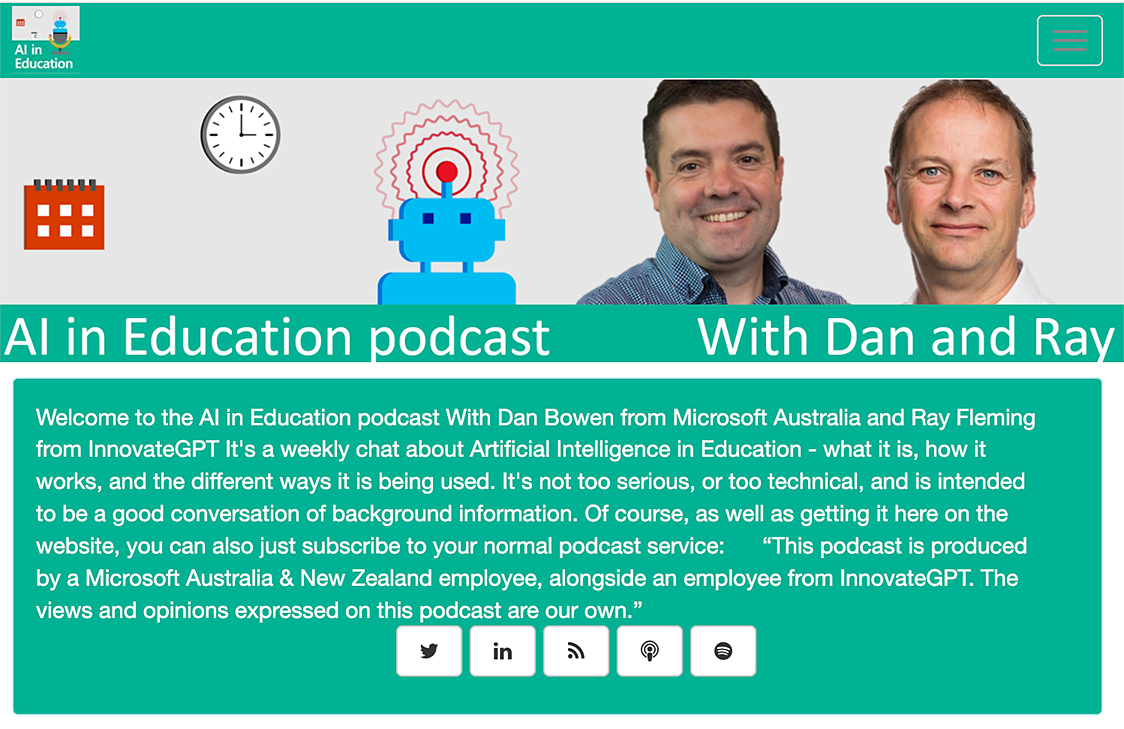
AI in Education Podcast — from aipodcast.education by Dan Bowen and Ray Fleming


The State of AI in Education 2025 Key Findings from a National Survey — from Carnegie Learning

Our 2025 national survey of over 650 respondents across 49 states and Puerto Rico reveals both encouraging trends and important challenges. While AI adoption and optimism are growing, concerns about cheating, privacy, and the need for training persist.

Despite these challenges, I’m inspired by the resilience and adaptability of educators. You are the true game-changers in your students’ growth, and we’re honored to support this vital work.

This report reflects both where we are today and where we’re headed with AI. More importantly, it reflects your experiences, insights, and leadership in shaping the future of education.


Instructure and OpenAI Announce Global Partnership to Embed AI Learning Experiences within Canvas — from instructure.com

This groundbreaking collaboration represents a transformative step forward in education technology and will begin with, but is not limited to, an effort between Instructure and OpenAI to enhance the Canvas experience by embedding OpenAI’s next-generation AI technology into the platform.

IgniteAI announced earlier today, establishes Instructure’s future-ready, open ecosystem with agentic support as the AI landscape continues to evolve. This partnership with OpenAI exemplifies this bold vision for AI in education. Instructure’s strategic approach to AI emphasizes the enhancement of connections within an educational ecosystem comprising over 1,100 edtech partners and leading LLM providers.

“We’re committed to delivering next-generation LMS technologies designed with an open ecosystem that empowers educators and learners to adapt and thrive in a rapidly changing world,” said Steve Daly, CEO of Instructure. “This collaboration with OpenAI showcases our ambitious vision: creating a future-ready ecosystem that fosters meaningful learning and achievement at every stage of education. This is a significant step forward for the education community as we continuously amplify the learning experience and improve student outcomes.”


Faculty Latest Targets of Big Tech’s AI-ification of Higher Ed — from insidehighered.com by Kathryn Palmer
A new partnership between OpenAI and Instructure will embed generative AI in Canvas. It may make grading easier, but faculty are skeptical it will enhance teaching and learning.

The two companies, which have not disclosed the value of the deal, are also working together to embed large language models into Canvas through a feature called IgniteAI. It will work with an institution’s existing enterprise subscription to LLMs such as Anthropic’s Claude or OpenAI’s ChatGPT, allowing instructors to create custom LLM-enabled assignments. They’ll be able to tell the model how to interact with students—and even evaluate those interactions—and what it should look for to assess student learning. According to Instructure, any student information submitted through Canvas will remain private and won’t be shared with OpenAI.

Faculty Unsurprised, Skeptical
Few faculty were surprised by the Canvas-OpenAI partnership announcement, though many are reserving judgment until they see how the first year of using it works in practice.


BREAKING: OpenAI Releases Study Mode — from aieducation.substack.com by Claire Zau
What’s New, What Works, and What’s Still Missing

What is Study Mode?
Study Mode is OpenAI’s take on a smarter study partner – a version of the ChatGPT experience designed to guide users through problems with Socratic prompts, scaffolded reasoning, and adaptive feedback (instead of just handing over the answer).

Built with input from learning scientists, pedagogy experts, and educators, it was also shaped by direct feedback from college students. While Study Mode is designed with college students in mind, it’s meant for anyone who wants a more learning-focused, hands-on experience across a wide range of subjects and skill levels.

Who can access it? And how?
Starting July 29, Study Mode is available to users on Free, Plus, Pro, and Team plans. It will roll out to ChatGPT Edu users in the coming weeks.


ChatGPT became your tutor — from theneurondaily.com by Grant Harvey
PLUS: NotebookLM has video now & GPT 4o-level AI runs on laptop

Here’s how it works: instead of asking “What’s 2+2?” and getting “4,” study mode asks questions like “What do you think happens when you add these numbers?” and “Can you walk me through your thinking?” It’s like having a patient tutor who won’t let you off the hook that easily.

The key features include:

  • Socratic questioning: It guides you with hints and follow-up questions rather than direct answers.
  • Scaffolded responses: Information broken into digestible chunks that build on each other.
  • Personalized support: Adjusts difficulty based on your skill level and previous conversations.
  • Knowledge checks: Built-in quizzes and feedback to make sure concepts actually stick.
  • Toggle flexibility: Switch study mode on and off mid-conversation depending on your goals.

Try study mode yourself by selecting “Study and learn” from tools in ChatGPT and asking a question.


Introducing study mode — from openai.com
A new way to learn in ChatGPT that offers step by step guidance instead of quick answers.

[On 7/29/25, we introduced] study mode in ChatGPT—a learning experience that helps you work through problems step by step instead of just getting an answer. Starting today, it’s available to logged in users on Free, Plus, Pro, Team, with availability in ChatGPT Edu coming in the next few weeks.

ChatGPT is becoming one of the most widely used learning tools in the world. Students turn to it to work through challenging homework problems, prepare for exams, and explore new concepts. But its use in education has also raised an important question: how do we ensure it is used to support real learning, and doesn’t just offer solutions without helping students make sense of them?

We’ve built study mode to help answer this question. When students engage with study mode, they’re met with guiding questions that calibrate responses to their objective and skill level to help them build deeper understanding. Study mode is designed to be engaging and interactive, and to help students learn something—not just finish something.


“The AI-enhanced learning ecosystem” [Jennings] + other items re: AI in our learning ecosystems

The AI-enhanced learning ecosystem: A case study in collaborative innovation — from chieflearningofficer.com by Kevin Jennings
How artificial intelligence can serve as a tool and collaborative partner in reimagining content development and management.

Learning and development professionals face unprecedented challenges in today’s rapidly evolving business landscape. According to LinkedIn’s 2025 Workplace Learning Report, 67 percent of L&D professionals report being “maxed out” on capacity, while 66 percent have experienced budget reductions in the past year.

Despite these constraints, 87 percent agree their organizations need to develop employees faster to keep pace with business demands. These statistics paint a clear picture of the pressure L&D teams face: do more, with less, faster.

This article explores how one L&D leader’s strategic partnership with artificial intelligence transformed these persistent challenges into opportunities, creating a responsive learning ecosystem that addresses the modern demands of rapid product evolution and diverse audience needs. With 71 percent of L&D professionals now identifying AI as a high or very high priority for their learning strategy, this case study demonstrates how AI can serve not merely as a tool but as a collaborative partner in reimagining content development and management.
.


How we use GenAI and AR to improve students’ design skills — from timeshighereducation.com by Antonio Juarez, Lesly Pliego and Jordi Rábago who are professors of architecture at Monterrey Institute of Technology in Mexico; Tomas Pachajoa is a professor of architecture at the El Bosque University in Colombia; & Carlos Hinrichsen and Marietta Castro are educators at San Sebastián University in Chile.
Guidance on using generative AI and augmented reality to enhance student creativity, spatial awareness and interdisciplinary collaboration

Blend traditional skills development with AI use
For subjects that require students to develop drawing and modelling skills, have students create initial design sketches or models manually to ensure they practise these skills. Then, introduce GenAI tools such as Midjourney, Leonardo AI and ChatGPT to help students explore new ideas based on their original concepts. Using AI at this stage broadens their creative horizons and introduces innovative perspectives, which are crucial in a rapidly evolving creative industry.

Provide step-by-step tutorials, including both written guides and video demonstrations, to illustrate how initial sketches can be effectively translated into AI-generated concepts. Offer example prompts to demonstrate diverse design possibilities and help students build confidence using GenAI.

Integrating generative AI and AR consistently enhanced student engagement, creativity and spatial understanding on our course. 


How Texas is Preparing Higher Education for AI — from the74million.org by Kate McGee
TX colleges are thinking about how to prepare students for a changing workforce and an already overburdened faculty for new challenges in classrooms.

“It doesn’t matter if you enter the health industry, banking, oil and gas, or national security enterprises like we have here in San Antonio,” Eighmy told The Texas Tribune. “Everybody’s asking for competency around AI.”

It’s one of the reasons the public university, which serves 34,000 students, announced earlier this year that it is creating a new college dedicated to AI, cyber security, computing and data science. The new college, which is still in the planning phase, would be one of the first of its kind in the country. UTSA wants to launch the new college by fall 2025.

But many state higher education leaders are thinking beyond that. As AI becomes a part of everyday life in new, unpredictable ways, universities across Texas and the country are also starting to consider how to ensure faculty are keeping up with the new technology and students are ready to use it when they enter the workforce.


In the Room Where It Happens: Generative AI Policy Creation in Higher Education — from er.educause.edu by Esther Brandon, Lance Eaton, Dana Gavin, and Allison Papini

To develop a robust policy for generative artificial intelligence use in higher education, institutional leaders must first create “a room” where diverse perspectives are welcome and included in the process.


Q&A: Artificial Intelligence in Education and What Lies Ahead — from usnews.com by Sarah Wood
Research indicates that AI is becoming an essential skill to learn for students to succeed in the workplace.

Q: How do you expect to see AI embraced more in the future in college and the workplace?
I do believe it’s going to become a permanent fixture for multiple reasons. I think the national security imperative associated with AI as a result of competing against other nations is going to drive a lot of energy and support for AI education. We also see shifts across every field and discipline regarding the usage of AI beyond college. We see this in a broad array of fields, including health care and the field of law. I think it’s here to stay and I think that means we’re going to see AI literacy being taught at most colleges and universities, and more faculty leveraging AI to help improve the quality of their instruction. I feel like we’re just at the beginning of a transition. In fact, I often describe our current moment as the ‘Ask Jeeves’ phase of the growth of AI. There’s a lot of change still ahead of us. AI, for better or worse, it’s here to stay.


AI-Generated Podcasts Outperform Textbooks in Landmark Education Study — form linkedin.com by David Borish

A new study from Drexel University and Google has demonstrated that AI-generated educational podcasts can significantly enhance both student engagement and learning outcomes compared to traditional textbooks. The research, involving 180 college students across the United States, represents one of the first systematic investigations into how artificial intelligence can transform educational content delivery in real-time.


What can we do about generative AI in our teaching?  — from linkedin.com by Kristina Peterson

So what can we do?

  • Interrogate the Process: We can ask ourselves if we I built in enough checkpoints. Steps that can’t be faked. Things like quick writes, question floods, in-person feedback, revision logs.
  • Reframe AI: We can let students use AI as a partner. We can show them how to prompt better, revise harder, and build from it rather than submit it. Show them the difference between using a tool and being used by one.
  • Design Assignments for Curiosity, Not Compliance: Even the best of our assignments need to adapt. Mine needs more checkpoints, more reflective questions along the way, more explanation of why my students made the choices they did.

Teachers Are Not OK — from 404media.co by Jason Koebler

The response from teachers and university professors was overwhelming. In my entire career, I’ve rarely gotten so many email responses to a single article, and I have never gotten so many thoughtful and comprehensive responses.

One thing is clear: teachers are not OK.

In addition, universities are contracting with companies like Microsoft, Adobe, and Google for digital services, and those companies are constantly pushing their AI tools. So a student might hear “don’t use generative AI” from a prof but then log on to the university’s Microsoft suite, which then suggests using Copilot to sum up readings or help draft writing. It’s inconsistent and confusing.

I am sick to my stomach as I write this because I’ve spent 20 years developing a pedagogy that’s about wrestling with big ideas through writing and discussion, and that whole project has been evaporated by for-profit corporations who built their systems on stolen work. It’s demoralizing.


These parents are ‘unschooling’ their kids. What does that mean? — from usatoday.com by Adrianna Rodriguez

“My goal for them is for them to love learning,” Franco said. “It’s realizing you can educate your child beyond the school model.”

Some parents say their children are thriving in the unschooling environment, fueling their confidence and desire to learn.

But not all students find success in unschooling. Some former students say the lack of structure and accountability can lead to educational neglect if parents don’t have the resources to make it work. Some kids who were unschooled feel they were left unprepared for adulthood and had fewer career opportunities.


What Is ‘Unschooling’ and Why Are More Parents Doing It? — from bckonline.com byTiffany Silva

Unschooling is a growing alternative education movement where children learn through life experiences instead of traditional classroom instruction. As more parents seek personalized and flexible learning paths, unschooling is gaining popularity across the U.S. and here’s what you need to know!

So, just what exactly is unschooling? Well, Unschooling is a form of homeschooling that breaks away from the idea of following a set curriculum. Instead, it centers the child’s interests, passions, and pace.

The belief is that learning doesn’t have to be separate from life because it is life. Unschooling functions on the premise that when kids are given the freedom to explore, they develop deep, authentic understanding and a lifelong love of learning.


The Public Microschool Playbook — from gettingsmart.com

School systems today face a complex challenge: how to personalize learning while responding to the rapidly shifting needs of students, families, and communities. Enter the Public Microschool Playbook—a new, field-tested resource co-created by Getting Smart, Learner-Centered Collaborative, and Transcend to help public education leaders reimagine learning from the ground up.

This isn’t just about launching new schools. It’s about designing dynamic, student-centered ecosystems that live inside our public systems and reflect the aspirations of the communities they serve. With an intentional focus on access and opportunity, microschools offer more than just flexibility—they offer a path to more relevant, sustainable, and empowering learning for all.

Grounded in three key phases—Planning, Designing, and Implementing—the Playbook equips district leaders, charter networks, and innovators with real-world tools and insights to launch microschools that meet local needs and drive systemic transformation. From policy navigation and budgeting to learner-centered design elements like advisory, PBL, and multi-age cohorts, this guide is a blueprint for creating purpose-built environments that make learning personal and powerful.


Also from Getting Smart, see:

The Reboot of Readiness: It’s Time to Take Action in Renovating CTE from the Ground Up — from gettingsmart.com by Adam Kulaas

Key points:

  • CTE programs need to move beyond traditional frameworks and adopt the Career Clusters Framework to better prepare students for real-world opportunities.
  • It’s crucial to integrate career readiness into the entire educational experience, making it an intentional and structured pathway from early education through high school.


Outdated Microschool Laws Turn Parents into Criminals — from educationnext.org by Erica Smith Ewing
By over-regulating the pandemic-era schooling alternative, states ignore families’ constitutional rights

Public schools do not work for everyone. But options have increased since 1922, when Oregon tried to ban private education. The Supreme Court shut down that scheme fast. But now, after more than 100 years, political insiders are rallying again to stop a new source of choice.

The target this time is microschooling, a Covid-era alternative that has outlasted the pandemic. Key players in the movement will gather May 8–9, 2025, at the International Microschools Conference in Washington, D.C. I will join them.

Most likely, I will meet educators running all kinds of programs in all kinds of community spaces. Microschools blur the lines between home, public, and private schooling—combining elements from all three models.

The result is a fourth category of schooling that hinges on flexibility. Some parents pool their resources and hire outside instructors. Other groups rotate teaching duties among themselves, gathering daily or perhaps only once or twice per week. These are the do-it-yourselfers. Professionals also get involved with standalone enterprises and national networks.


AI in K12: Today’s Breakthroughs and Tomorrow’s Possibilities (webinar)
How AI is Transforming Classrooms Today and What’s Next


Audio-Based Learning 4.0 — from drphilippahardman.substack.com by Dr. Philippa Hardman
A new & powerful way to leverage AI for learning?

At the end of all of this my reflection is that the research paints a pretty exciting picture – audio-based learning isn’t just effective, it’s got some unique superpowers when it comes to boosting comprehension, ramping up engagement, and delivering feedback that really connects with learners.

While audio has been massively under-used as a mode of learning, especially compared to video and text, we’re at an interesting turning point where AI tools are making it easier than ever to tap into audio’s potential as a pedagogical tool.

What’s super interesting is how the solid research backing audio’s effectiveness is and how well this is converging with these new AI capabilities.

From DSC:
I’ve noticed that I don’t learn as well via audio-only based events. It can help if visuals are also provided, but I have to watch the cognitive loads. My processing can start to get overloaded — to the point that I have to close my eyes and just listen sometimes. But there are people I know who love to listen to audiobooks and prefer to learn that way. They can devour content and process/remember it all. Audio is a nice change of pace at times, but I prefer visuals and reading often times. It needs to be absolutely quiet if I’m tackling some new information/learning. 


In Conversation With… Ashton Cousineau — from drphilippahardman.substack.com by Dr. Philippa Hardman
A new video series exploring how L&D professionals are working with AI on the ground

In Conversation With… Ashton Cousineau by Dr Philippa Hardman

A new video series exploring how L&D professionals are working with AI on the ground

Read on Substack


The Learning Research Digest vol. 28 — from learningsciencedigest.substack.com by Dr. Philippa Hardman

Hot Off the Research Press This Month:

  • AI-Infused Learning Design – A structured approach to AI-enhanced assignments using a three-step model for AI integration.
  • Mathematical Dance and Creativity in STEAM – Using AI-powered motion capture to translate dance movements into mathematical models.
  • AI-Generated Instructional Videos – How adaptive AI-powered video learning enhances problem-solving and knowledge retention.
  • Immersive Language Learning with XR & AI – A new framework for integrating AI-driven conversational agents with Extended Reality (XR) for task-based language learning.
  • Decision-Making in Learning Design – A scoping review on how instructional designers navigate complex instructional choices and make data-driven decisions.
  • Interactive E-Books and Engagement – Examining the impact of interactive digital books on student motivation, comprehension, and cognitive engagement.
  • Elevating Practitioner Voices in Instructional Design – A new initiative to amplify instructional designers’ contributions to research and innovation.

Deep Reasoning, Agentic AI & the Continued Rise of Specialised AI Research & Tools for Education — from learningfuturesdigest.substack.com by Dr. Philippa Hardman

Here’s a quick teaser of key developments in the world of AI & learning this month:

  • DeepSeek R-1, OpenAI’s Deep Seek & Perplexity’s ‘Deep Research’ are the latest additions to a growing number of “reasoning models” with interesting implications for evidence-based learning design & development.
  • The U.S. Education Dept release an AI Toolkit and a fresh policy roadmap enabling the adoption of AI use in schools.
  • Anthropic Release “Agentic Claude”, another AI agent that clicks, scrolls, and can even successfully complete e-learning courses…
  • Oxford University Announce the AIEOU Hub, a research-backed research lab to support research and implementation on AI in education.
  • “AI Agents Everywhere”: A Forbes peek at how agentic AI will handle the “boring bits” of classroom life.
  • [Bias klaxon!] Epiphany AI: My own research leads to the creation of a specialised, “pedagogy first” AI co-pilot for instructional design marking the continued growth of specialised AI tools designed for specific industries and workflows.

AI is the Perfect Teaching Assistant for Any Educator — from unite.ai by Navi Azaria, CPO at Kaltura

Through my work with leading educational institutions at Kaltura, I’ve seen firsthand how AI agents are rapidly becoming indispensable. These agents alleviate the mounting burdens on educators and provide new generations of tech-savvy students with accessible, personalized learning, giving teachers the support they need to give their students the personalized attention and engagement they deserve.


Learning HQ — from ai-disruptor-hq.notion.site

This HQ includes all of my AI guides, organized by tool/platform. This list is updated each time a new one is released, and outdated guides are removed/replaced over time.


How AI Is Reshaping Teachers’ Jobs — from edweek.org

Artificial intelligence is poised to fundamentally change the job of teaching. AI-powered tools can shave hours off the amount of time teachers spend grading, lesson-planning, and creating materials. AI can also enrich the lessons they deliver in the classroom and help them meet the varied needs of all students. And it can even help bolster teachers’ own professional growth and development.

Despite all the promise of AI, though, experts still urge caution as the technology continues to evolve. Ethical questions and practical concerns are bubbling to the surface, and not all teachers feel prepared to effectively and safely use AI.

In this special report, see how early-adopter teachers are using AI tools to transform their daily work, tackle some of the roadblocks to expanded use of the technology, and understand what’s on the horizon for the teaching profession in the age of artificial intelligence.


Your AI Writing Partner: The 30-Day Book Framework — from aidisruptor.ai by Alex McFarland and Kamil Banc
How to Turn Your “Someday” Manuscript into a “Shipped” Project Using AI-Powered Prompts

With that out of the way, I prefer Claude.ai for writing. For larger projects like a book, create a Claude Project to keep all context in one place.

  • Copy [the following] prompts into a document
  • Use them in sequence as you write
  • Adjust the word counts and specifics as needed
  • Keep your responses for reference
  • Use the same prompt template for similar sections to maintain consistency

Each prompt builds on the previous one, creating a systematic approach to helping you write your book.


Using NotebookLM to Boost College Reading Comprehension — from michellekassorla.substack.com by Michelle Kassorla and Eugenia Novokshanova
This semester, we are using NotebookLM to help our students comprehend and engage with scholarly texts

We were looking hard for a new tool when Google released NotebookLM. Not only does Google allow unfettered use of this amazing tool, it is also a much better tool for the work we require in our courses. So, this semester, we have scrapped our “old” tools and added NotebookLM as the primary tool for our English Composition II courses (and we hope, fervently, that Google won’t decide to severely limit its free tier before this semester ends!)

If you know next-to-nothing about NotebookLM, that’s OK. What follows is the specific lesson we present to our students. We hope this will help you understand all you need to know about NotebookLM, and how to successfully integrate the tool into your own teaching this semester.


Leadership & Generative AI: Hard-Earned Lessons That Matter — from jeppestricker.substack.com by Jeppe Klitgaard Stricker
Actionable Advice for Higher Education Leaders in 2025

AFTER two years of working closely with leadership in multiple institutions, and delivering countless workshops, I’ve seen one thing repeatedly: the biggest challenge isn’t the technology itself, but how we lead through it. Here is some of my best advice to help you navigate generative AI with clarity and confidence:

  1. Break your own AI policies before you implement them.
  2. Fund your failures.
  3. Resist the pilot program. …
  4. Host Anti-Tech Tech Talks
  5. …+ several more tips

While generative AI in higher education obviously involves new technology, it’s much more about adopting a curious and human-centric approach in your institution and communities. It’s about empowering learners in new, human-oriented and innovative ways. It is, in a nutshell, about people adapting to new ways of doing things.


Maria Anderson responded to Clay’s posting with this idea:

Here’s an idea: […] the teacher can use the [most advanced] AI tool to generate a complete solution to “the problem” — whatever that is — and demonstrate how to do that in class. Give all the students access to the document with the results.

And then grade the students on a comprehensive followup activity / presentation of executing that solution (no notes, no more than 10 words on a slide). So the students all have access to the same deep AI result, but have to show they comprehend and can iterate on that result.


Grammarly just made it easier to prove the sources of your text in Google Docs — from zdnet.com by Jack Wallen
If you want to be diligent about proving your sources within Google Documents, Grammarly has a new feature you’ll want to use.

In this age of distrust, misinformation, and skepticism, you may wonder how to demonstrate your sources within a Google Document. Did you type it yourself, copy and paste it from a browser-based source, copy and paste it from an unknown source, or did it come from generative AI?

You may not think this is an important clarification, but if writing is a critical part of your livelihood or life, you will definitely want to demonstrate your sources.

That’s where the new Grammarly feature comes in.

The new feature is called Authorship, and according to Grammarly, “Grammarly Authorship is a set of features that helps users demonstrate their sources of text in a Google doc. When you activate Authorship within Google Docs, it proactively tracks the writing process as you write.”


AI Agents Are Coming to Higher Education — from govtech.com
AI agents are customizable tools with more decision-making power than chatbots. They have the potential to automate more tasks, and some schools have implemented them for administrative and educational purposes.

Custom GPTs are on the rise in education. Google’s version, Gemini Gems, includes a premade version called Learning Coach, and Microsoft announced last week a new agent addition to Copilot featuring use cases at educational institutions.


Generative Artificial Intelligence and Education: A Brief Ethical Reflection on Autonomy — from er.educause.edu by Vicki Strunk and James Willis
Given the widespread impacts of generative AI, looking at this technology through the lens of autonomy can help equip students for the workplaces of the present and of the future, while ensuring academic integrity for both students and instructors.

The principle of autonomy stresses that we should be free agents who can govern ourselves and who are able to make our own choices. This principle applies to AI in higher education because it raises serious questions about how, when, and whether AI should be used in varying contexts. Although we have only begun asking questions related to autonomy and many more remain to be asked, we hope that this serves as a starting place to consider the uses of AI in higher education.


60 Minutes Overtime
Sal Khan wants an AI tutor for every student: here’s how it’s working at an Indiana high school — from cbsnews.com by Anderson Cooper, Aliza Chasan, Denise Schrier Cetta, and Katie Brennan

“I mean, that’s what I’ll always want for my own children and, frankly, for anyone’s children,” Khan said. “And the hope here is that we can use artificial intelligence and other technologies to amplify what a teacher can do so they can spend more time standing next to a student, figuring them out, having a person-to-person connection.”

“After a week you start to realize, like, how you can use it,” Brockman said. “That’s been one of the really important things about working with Sal and his team, to really figure out what’s the right way to sort of bring this to parents and to teachers and to classrooms and to do that in a way…so that the students really learn and aren’t just, you know, asking for the answers and that the parents can have oversight and the teachers can be involved in that process.”


Nectir lets teachers tailor AI chatbots to provide their students with 24/7 educational support — from techcrunch.com by Lauren Forristal

More than 100 colleges and high schools are turning to a new AI tool called Nectir, allowing teachers to create a personalized learning partner that’s trained on their syllabi, textbooks, and assignments to help students with anything from questions related to their coursework to essay writing assistance and even future career guidance.

With Nectir, teachers can create an AI assistant tailored to their specific needs, whether for a single class, a department, or the entire campus. There are various personalization options available, enabling teachers to establish clear boundaries for the AI’s interactions, such as programming the assistant to assist only with certain subjects or responding in a way that aligns with their teaching style.

“It’ll really be that customized learning partner. Every single conversation that a student has with any of their assistants will then be fed into that student profile for them to be able to see based on what the AI thinks, what should I be doing next, not only in my educational journey, but in my career journey,” Ghai said. 


How Will AI Influence Higher Ed in 2025? — from insidehighered.com by Kathryn Palmer
No one knows for sure, but Inside Higher Ed asked seven experts for their predictions.

As the technology continues to evolve at a rapid pace, no one knows for sure how AI will influence higher education in 2025. But several experts offered Inside Higher Ed their predictions—and some guidance—for how colleges and universities will have to navigate AI’s potential in the new year.


How A.I. Can Revive a Love of Learning — from nytimes.com by Anant Agarwal
Modern technology offers new possibilities for transforming teaching.

In the short term, A.I. will help teachers create lesson plans, find illustrative examples and generate quizzes tailored to each student. Customized problem sets will serve as tools to combat cheating while A.I. provides instant feedback.

In the longer term, it’s possible to imagine a world where A.I. can ingest rich learner data and create personalized learning paths for students, all within a curriculum established by the teacher. Teachers can continue to be deeply involved in fostering student discussions, guiding group projects and engaging their students, while A.I. handles grading and uses the Socratic method to help students discover answers on their own. Teachers provide encouragement and one-on-one support when needed, using their newfound availability to give students some extra care.

Let’s be clear: A.I. will never replace the human touch that is so vital to education. No algorithm can replicate the empathy, creativity and passion a teacher brings to the classroom. But A.I. can certainly amplify those qualities. It can be our co-pilot, our chief of staff helping us extend our reach and improve our effectiveness.


Dancing with the Devil We Know: OpenAI and the Future of Education — from nickpotkalitsky.substack.com by Nick Potkalitsky
Analyzing OpenAI’s Student Writing Guide and Latest AI Tools

Today, I want to reflect on two recent OpenAI developments that highlight this evolution: their belated publication of advice for students on integrating AI into writing workflows, and last week’s launch of the full GPTo1 Pro version. When OpenAI released their student writing guide, there were plenty of snarky comments about how this guidance arrives almost a year after they thoroughly disrupted the educational landscape. Fair enough – I took my own side swipes initially. But let’s look at what they’re actually advising, because the details matter more than the timing.


Tutor CoPilot: A Human-AI Approach for Scaling Real-Time Expertise — from studentsupportaccelerator.org by Rose E.Wang, Ana T. Ribeiro, Carly D. Robinson, Susanna Loeb, and Dora Demszky


Pandemic, Politics, Pre-K & More: 12 Charts That Defined Education in 2024 — from the74million.org
From the spread of AI to the limits of federal COVID aid, these research findings captured the world of education this year.

Tutoring programs exploded in the last five years as states and school districts searched for ways to counter plummeting achievement during COVID. But the cost of providing supplemental instruction to tens of millions of students can be eye-watering, even as the results seem to taper off as programs serve more students.

That’s where artificial intelligence could prove a decisive advantage. A report circulated in October by the National Student Support Accelerator found that an AI-powered tutoring assistant significantly improved the performance of hundreds of tutors by prompting them with new ways to explain concepts to students. With the help of the tool, dubbed Tutor CoPilot, students assigned to the weakest tutors began posting academic results nearly equal to those assigned to the strongest. And the cost to run the program was just $20 per pupil.


On Capacity, Sustainability, And Attention — from marcwatkins.substack.com by Marc Watkins

Faculty must have the time and support necessary to come to terms with this new technology and that requires us to change how we view professional development in higher education and K-12. We cannot treat generative AI as a one-off problem that can be solved by a workshop, an invited talk, or a course policy discussion. Generative AI in education has to be viewed as a continuum. Faculty need a myriad of support options each semester:

  • Course buyouts
  • Fellowships
  • Learning communities
  • Reading groups
  • AI Institutes and workshops
  • Funding to explore the scholarship of teaching and learning around generative AI

New in 2025 and What Edleaders Should Do About It — from gettingsmart.com by Tom Vander Ark and Mason Pashia

Key Points

  • Education leaders should focus on integrating AI literacy, civic education, and work-based learning to equip students for future challenges and opportunities.
  • Building social capital and personalized learning environments will be crucial for student success in a world increasingly influenced by AI and decentralized power structures.
 

How many students do microschools serve? — from microschoolingcenter.org by Ashley Soifer

Our 2024 Sector Analysis shows the median average for number of children served by a microschool at launch is 9, at the end of the first year is 12 and currently serving is 16.

What this doesn’t show is all of the ups and downs in between.

It’s not uncommon for first year microschooling founders to see a dip in enrolled students between the start of the year and the end of the year. October and November can be two of the most stressful months for new microschool founders as numbers either dip or don’t grow as anticipated. There are a few things that can be helpful for microschool founders during this time:


The Many Special Populations Microschools Serve — from microschoolingcenter.org. by Don Soifer

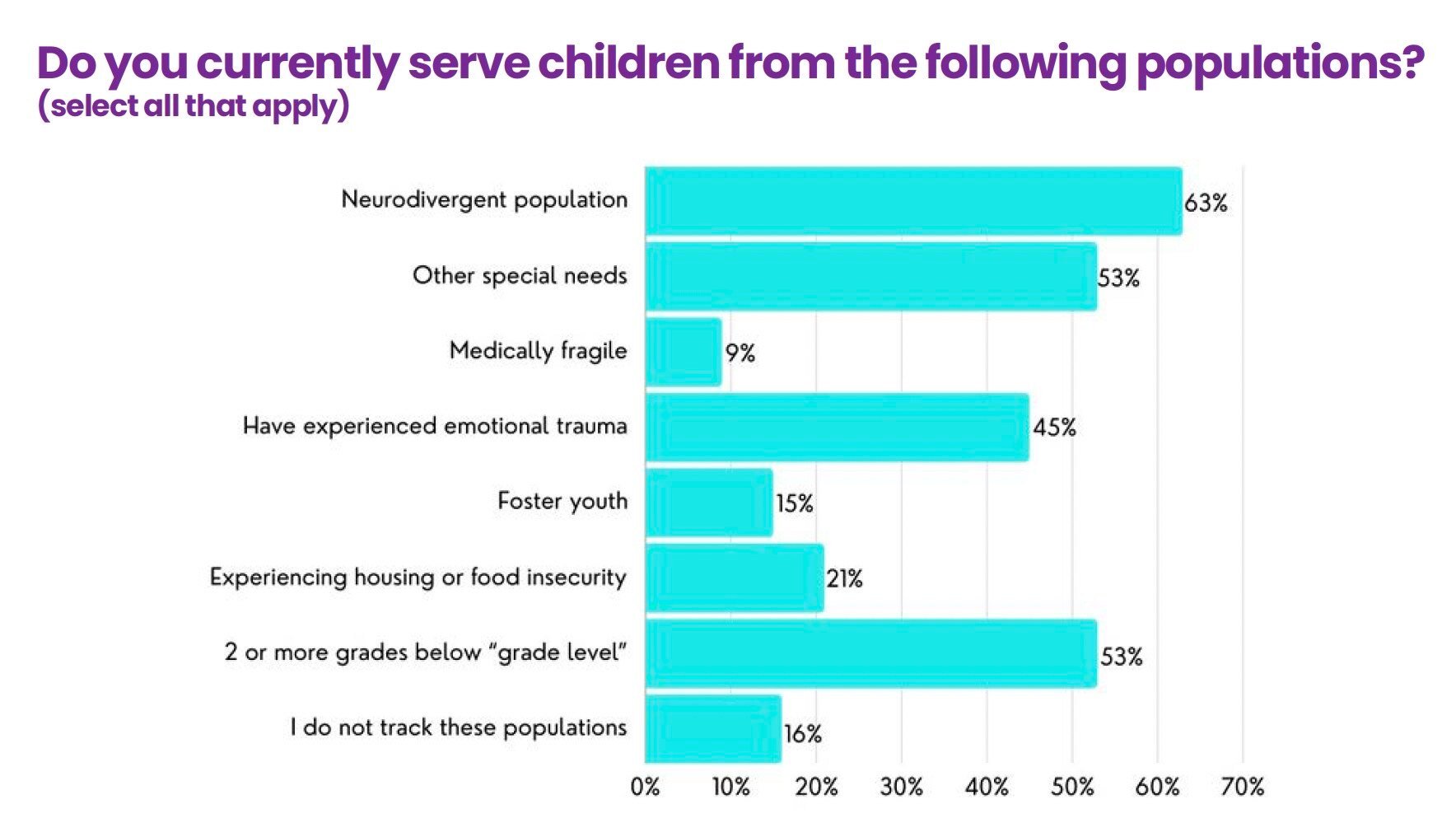
Kids representing a broad range of special populations have a strong presence in today’s microschooling movement. Children with neurodiversities, other special needs, and those coming to microschools at two or more grades below “grade level mastery” as defined by their state all are served by more than 50 percent of microschools surveyed nationally, according to the Center’s 2024 American Microschools Sector Analysis report.

Children who have experienced emotional trauma or have experienced housing or food insecurity are also being served widely in microschools, according to leaders surveyed nationally.

This won’t come as a surprise to most in the microschooling movement. But to those who are less familiar, understanding the many ways that microschooling is about thriving for families and children who have struggled in their prior schooling settings.
.

The many special populations that microschools serve

 
© 2025 | Daniel Christian