4 Simple & Easy Ways to Use AI to Differentiate Instruction — from mindfulaiedu.substack.com (Mindful AI for Education) by Dani Kachorsky, PhD
Designing for All Learners with AI and Universal Design Learning

So this year, I’ve been exploring new ways that AI can help support students with disabilities—students on IEPs, learning plans, or 504s—and, honestly, it’s changing the way I think about differentiation in general.

As a quick note, a lot of what I’m finding applies just as well to English language learners or really to any students. One of the big ideas behind Universal Design for Learning (UDL) is that accommodations and strategies designed for students with disabilities are often just good teaching practices. When we plan instruction that’s accessible to the widest possible range of learners, everyone benefits. For example, UDL encourages explaining things in multiple modes—written, visual, auditory, kinesthetic—because people access information differently. I hear students say they’re “visual learners,” but I think everyone is a visual learner, and an auditory learner, and a kinesthetic learner. The more ways we present information, the more likely it is to stick.

So, with that in mind, here are four ways I’ve been using AI to differentiate instruction for students with disabilities (and, really, everyone else too):


The Periodic Table of AI Tools In Education To Try Today — from ictevangelist.com by Mark Anderson

What I’ve tried to do is bring together genuinely useful AI tools that I know are already making a difference.

For colleagues wanting to explore further, I’m sharing the list exactly as it appears in the table, including website links, grouped by category below. Please do check it out, as along with links to all of the resources, I’ve also written a brief summary explaining what each of the different tools do and how they can help.


Seven Hard-Won Lessons from Building AI Learning Tools — from linkedin.com by Louise Worgan

Last week, I wrapped up Dr Philippa Hardman’s intensive bootcamp on AI in learning design. Four conversations, countless iterations, and more than a few humbling moments later – here’s what I am left thinking about.


Finally Catching Up to the New Models — from michellekassorla.substack.com by Michelle Kassorla
There are some amazing things happening out there!

An aside: Google is working on a new vision for textbooks that can be easily differentiated based on the beautiful success for NotebookLM. You can get on the waiting list for that tool by going to LearnYourWay.withgoogle.com.

Nano Banana Pro
Sticking with the Google tools for now, Nano Banana Pro (which you can use for free on Google’s AI Studio), is doing something that everyone has been waiting a long time for: it adds correct text to images.


Introducing AI assistants with memory — from perplexity.ai

The simple act of remembering is the crux of how we navigate the world: it shapes our experiences, informs our decisions, and helps us anticipate what comes next. For AI agents like Comet Assistant, that continuity leads to a more powerful, personalized experience.

Today we are announcing new personalization features to remember your preferences, interests, and conversations. Perplexity now synthesizes them automatically like memory, for valuable context on relevant tasks. Answers are smarter, faster, and more personalized, no matter how you work.

From DSC :
This should be important as we look at learning-related applications for AI.


For the last three days, my Substack has been in the top “Rising in Education” list. I realize this is based on a hugely flawed metric, but it still feels good. ?

– Michael G Wagner

Read on Substack


I’m a Professor. A.I. Has Changed My Classroom, but Not for the Worse. — from nytimes.com by Carlo Rotella [this should be a gifted article]
My students’ easy access to chatbots forced me to make humanities instruction even more human.


Three Years from GPT-3 to Gemini 3 — from oneusefulthing.org by Ethan Mollick
From chatbots to agents

Three years ago, we were impressed that a machine could write a poem about otters. Less than 1,000 days later, I am debating statistical methodology with an agent that built its own research environment. The era of the chatbot is turning into the era of the digital coworker. To be very clear, Gemini 3 isn’t perfect, and it still needs a manager who can guide and check it. But it suggests that “human in the loop” is evolving from “human who fixes AI mistakes” to “human who directs AI work.” And that may be the biggest change since the release of ChatGPT.


Results May Vary — from aiedusimplified.substack.com by Lance Eaton, PhD
On Custom Instructions with GenAI Tools….

I’m sharing today about custom instructions and my use of them across several AI tools (paid versions of ChatGPT, Gemini, and Claude). I want to highlight what I’m doing, how it’s going, and solicit from readers to share in the comments some of their custom instructions that they find helpful.

I’ve been in a few conversations lately that remind me that not everyone knows about them, even some of the seasoned folks around GenAI and how you might set them up to better support your work. And, of course, they are, like all things GenAI, highly imperfect!

I’ll include and discuss each one below, but if you want to keep abreast of my custom instructions, I’ll be placing them here as I adjust and update them so folks can see the changes over time.


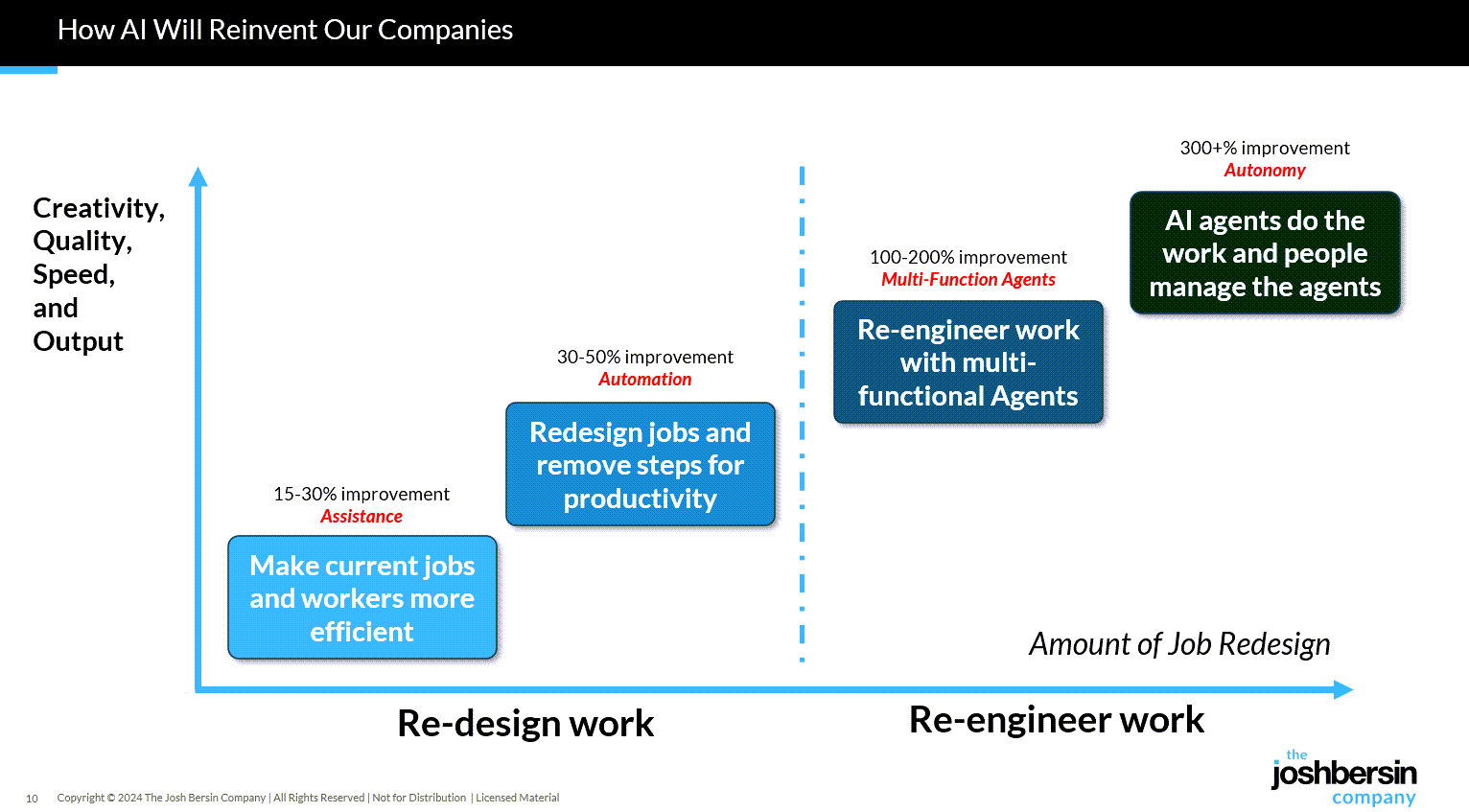
Gen AI Is Going Mainstream: Here’s What’s Coming Next — from joshbersin.com by Josh Bersin

I just completed nearly 60,000 miles of travel across Europe, Asia, and the Middle East meeting with hundred of companies to discuss their AI strategies. While every company’s maturity is different, one thing is clear: AI as a business tool has arrived: it’s real and the use-cases are growing.

A new survey by Wharton shows that 46% of business leaders use Gen AI daily and 80% use it weekly. And among these users, 72% are measuring ROI and 74% report a positive return. HR, by the way, is the #3 department in use cases, only slightly behind IT and Finance.

What are companies getting out of all this? Productivity. The #1 use case, by far, is what we call “stage 1” usage – individual productivity. 

.


From DSC:
Josh writes: “Many of our large clients are now implementing AI-native learning systems and seeing 30-40% reduction in staff with vast improvements in workforce enablement.

While I get the appeal (and ROI) from management’s and shareholders’ perspective, this represents a growing concern for employment and people’s ability to earn a living. 

And while I highly respect Josh and his work through the years, I disagree that we’re over the problems with AI and how people are using it: 

Two years ago the NYT was trying to frighten us with stories of AI acting as a romance partner. Well those stories are over, and thanks to a $Trillion (literally) of capital investment in infrastructure, engineering, and power plants, this stuff is reasonably safe.

Those stories are just beginning…they’re not close to being over. 


“… imagine a world where there’s no separation between learning and assessment…” — from aiedusimplified.substack.com by Lance Eaton, Ph.D. and Tawnya Means
An interview with Tawnya Means

So let’s imagine a world where there’s no separation between learning and assessment: it’s ongoing. There’s always assessment, always learning, and they’re tied together. Then we can ask: what is the role of the human in that world? What is it that AI can’t do?

Imagine something like that in higher ed. There could be tutoring or skill-based work happening outside of class, and then relationship-based work happening inside of class, whether online, in person, or some hybrid mix.

The aspects of learning that don’t require relational context could be handled by AI, while the human parts remain intact. For example, I teach strategy and strategic management. I teach people how to talk with one another about the operation and function of a business. I can help students learn to be open to new ideas, recognize when someone pushes back out of fear of losing power, or draw from my own experience in leading a business and making future-oriented decisions.

But the technical parts such as the frameworks like SWOT analysis, the mechanics of comparing alternative viewpoints in a boardroom—those could be managed through simulations or reports that receive immediate feedback from AI. The relational aspects, the human mentoring, would still happen with me as their instructor.

Part 2 of their interview is here:


How Coworking Spaces Are Becoming The Learning Ecosystems Of The Future — from hrfuture.net

What if your workspace helped you level up your career? Coworking spaces are becoming learning hubs where skills grow, ideas connect, and real-world education fits seamlessly into the workday.

Continuous learning has become a cornerstone of professional longevity, and flexible workspaces already encourage it through workshops, talks, and mentoring. Their true potential, however, may lie in becoming centers of industry-focused education that help professionals stay adaptable in a rapidly changing world of work.
.


.

What if forward-thinking workspaces and coworking centers became hubs of lifelong learning, integrating job-relevant training with accessible, real-world education?

For coworking operators, this raises important questions: Which types of learning thrive best in these environments, and how much do the design and layout of a space influence how people learn?

By exploring these questions and combining innovative programs with cutting-edge technology aligned to the future workforce, could coworking spaces ultimately become the classrooms of tomorrow?


Custom AI Development: Evolving from Static AI Systems to Dynamic Learning Agents in 2025 — community.nasscom.in

This blog explores how custom AI development accelerates the evolution from static AI to dynamic learning agents and why this transformation is critical for driving innovation, efficiency, and competitive advantage.

Dynamic Learning Agents: The Next Generation
Dynamic learning agents, sometimes referred to as adaptive or agentic AI, represent a leap forward. They combine continuous learningautonomous action, and context-aware adaptability.

Custom AI development plays a crucial role here: it ensures that these agents are designed specifically for an enterprise’s unique needs rather than relying on generic, one-size-fits-all AI platforms. Tailored dynamic agents can:

  • Continuously learn from incoming data streams
  • Make autonomous, goal-directed decisions aligned with business objectives
  • Adapt behavior in real time based on context and feedback
  • Collaborate with other AI agents and human teams to solve complex challenges

The result is an AI ecosystem that evolves with the business, providing sustained competitive advantage.

Also from community.nasscom.in, see:

Building AI Agents with Multimodal Models: From Perception to Action

Perception: The Foundation of Intelligent Agents
Perception is the first step in building AI agents. It involves capturing and interpreting data from multiple modalities, including text, images, audio, and structured inputs. A multimodal AI agent relies on this comprehensive understanding to make informed decisions.

For example, in healthcare, an AI agent may process electronic health records (text), MRI scans (vision), and patient audio consultations (speech) to build a complete understanding of a patient’s condition. Similarly, in retail, AI agents can analyze purchase histories (structured data), product images (vision), and customer reviews (text) to inform recommendations and marketing strategies.

Effective perception ensures that AI agents have contextual awareness, which is essential for accurate reasoning and appropriate action.


From 70-20-10 to 90-10: a new operating system for L&D in the age of AI? — from linkedin.com by Dr. Philippa Hardman

Also from Philippa, see:


Your New ChatGPT Guide — from wondertools.substack.com by Jeremy Caplan and The PyCoach
25 AI Tips & Tricks from a guest expert

  • ChatGPT can make you more productive or dumber. An MIT study found that while AI can significantly boost productivity, it may also weaken your critical thinking. Use it as an assistant, not a substitute for your brain.
  • If you’re a student, use study mode in ChatGPT, Gemini, or Claude. When this feature is enabled, the chatbots will guide you through problems rather than just giving full answers, so you’ll be doing the critical thinking.
  • ChatGPT and other chatbots can confidently make stuff up (aka AI hallucinations). If you suspect something isn’t right, double-check its answers.
  • NotebookLM hallucinates less than most AI tools, but it requires you to upload sources (PDFs, audio, video) and won’t answer questions beyond those materials. That said, it’s great for students and anyone with materials to upload.
  • Probably the most underrated AI feature is deep research. It automates web searching for you and returns a fully cited report with minimal hallucinations in five to 30 minutes. It’s available in ChatGPT, Perplexity, and Gemini, so give it a try.


“OpenAI’s Atlas: the End of Online Learning—or Just the Beginning?” [Hardman] + other items re: AI in our LE’s

OpenAI’s Atlas: the End of Online Learning—or Just the Beginning? — from drphilippahardman.substack.com by Dr. Philippa Hardman

My take is this: in all of the anxiety lies a crucial and long-overdue opportunity to deliver better learning experiences. Precisely because Atlas perceives the same context in the same moment as you, it can transform learning into a process aligned with core neuro-scientific principles—including active retrieval, guided attention, adaptive feedback and context-dependent memory formation.

Perhaps in Atlas we have a browser that for the first time isn’t just a portal to information, but one which can become a co-participant in active cognitive engagement—enabling iterative practice, reflective thinking, and real-time scaffolding as you move through challenges and ideas online.

With this in mind, I put together 10 use cases for Atlas for you to try for yourself.

6. Retrieval Practice
What:
Pulling information from memory drives retention better than re-reading.
Why: Practice testing delivers medium-to-large effects (Adesope et al., 2017).
Try: Open a document with your previous notes. Ask Atlas for a mixed activity set: “Quiz me on the Krebs cycle—give me a near-miss, high-stretch MCQ, then a fill-in-the-blank, then ask me to explain it to a teen.”
Atlas uses its browser memory to generate targeted questions from your actual study materials, supporting spaced, varied retrieval.


From DSC:
A quick comment. I appreciate these ideas and approaches from Katarzyna and Rita. I do think that someone is going to want to be sure that the AI models/platforms/tools are given up-to-date information and updated instructions — i.e., any new procedures, steps to take, etc. Perhaps I’m missing the boat here, but an internal AI platform is going to need to have access to up-to-date information and instructions.


There is no God Tier video model — from downes.ca by Stephen Downes

From DSC:
Stephen has some solid reflections and asks some excellent questions in this posting, including:

The question is: how do we optimize an AI to support learning? Will one model be enough? Or do we need different models for different learners in different scenarios?


A More Human University: The Role of AI in Learning — from er.educause.edu by Robert Placido
Far from heralding the collapse of higher education, artificial intelligence offers a transformative opportunity to scale meaningful, individualized learning experiences across diverse classrooms.

The narrative surrounding artificial intelligence (AI) in higher education is often grim. We hear dire predictions of an “impending collapse,” fueled by fears of rampant cheating, the erosion of critical thinking, and the obsolescence of the human educator.Footnote1 This dystopian view, however, is a failure of imagination. It mistakes the death rattle of an outdated pedagogical model for the death of learning itself. The truth is far more hopeful: AI is not an asteroid coming for higher education. It is a catalyst that can finally empower us to solve our oldest, most intractable problem: the inability to scale deep, engaged, and truly personalized learning.


Claude for Life Sciences — from anthropic.com

Increasing the rate of scientific progress is a core part of Anthropic’s public benefit mission.

We are focused on building the tools to allow researchers to make new discoveries – and eventually, to allow AI models to make these discoveries autonomously.

Until recently, scientists typically used Claude for individual tasks, like writing code for statistical analysis or summarizing papers. Pharmaceutical companies and others in industry also use it for tasks across the rest of their business, like sales, to fund new research. Now, our goal is to make Claude capable of supporting the entire process, from early discovery through to translation and commercialization.

To do this, we’re rolling out several improvements that aim to make Claude a better partner for those who work in the life sciences, including researchers, clinical coordinators, and regulatory affairs managers.


AI as an access tool for neurodiverse and international staff — from timeshighereducation.com by Vanessa Mar-Molinero
Used transparently and ethically, GenAI can level the playing field and lower the cognitive load of repetitive tasks for admin staff, student support and teachers

Where AI helps without cutting academic corners
When framed as accessibility and quality enhancement, AI can support staff to complete standard tasks with less friction. However, while it supports clarity, consistency and inclusion, generative AI (GenAI) does not replace disciplinary expertise, ethical judgement or the teacher–student relationship. These are ways it can be put to effective use:

  • Drafting and tone calibration:
  • Language scaffolding:
  • Structure and templates: ..
  • Summarise and prioritise:
  • Accessibility by default:
  • Idea generation for pedagogy:
  • Translation and cultural mediation:

Beyond learning design: supporting pedagogical innovation in response to AI — from timeshighereducation.com by Charlotte von Essen
To avoid an unwinnable game of catch-up with technology, universities must rethink pedagogical improvement that goes beyond scaling online learning


The Sleep of Liberal Arts Produces AI — from aiedusimplified.substack.com by Lance Eaton, Ph.D.
A keynote at the AI and the Liberal Arts Symposium Conference

This past weekend, I had the honor to be the keynote speaker at a really fantstistic conferece, AI and the Liberal Arts Symposium at Connecticut College. I had shared a bit about this before with my interview with Lori Looney. It was an incredible conference, thoughtfully composed with a lot of things to chew on and think about.

It was also an entirely brand new talk in a slightly different context from many of my other talks and workshops. It was something I had to build entirely from the ground up. It reminded me in some ways of last year’s “What If GenAI Is a Nothingburger”.

It was a real challenge and one I’ve been working on and off for months, trying to figure out the right balance. It’s a work I feel proud of because of the balancing act I try to navigate. So, as always, it’s here for others to read and engage with. And, of course, here is the slide deck as well (with CC license).


The above posting on LinkedIn then links to this document


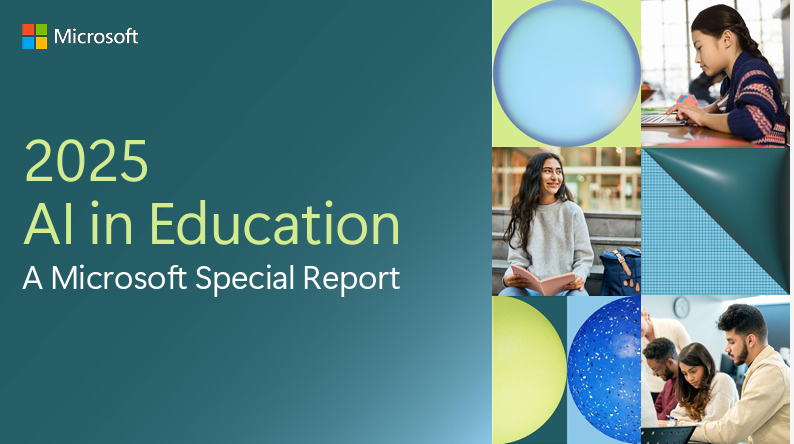
Designing Microsoft 365 Copilot to empower educators, students, and staff — from microsoft.com by Deirdre Quarnstrom

While over 80% of respondents in the 2025 AI in Education Report have already used AI for school, we believe there are significant opportunities to design AI that can better serve each of their needs and broaden access to the latest innovation.1

That’s why today [10/15/25], we’re announcing AI-powered experiences built for teaching and learning at no additional cost, new integrations in Microsoft 365 apps and Learning Management Systems, and an academic offering for Microsoft 365 Copilot.

Introducing AI-powered teaching and learning
Empowering educators with Teach

We’re introducing Teach to help streamline class prep and adapt AI to support educators’ teaching expertise with intuitive and customizable features. In one place, educators can easily access AI-powered teaching tools to create lesson plans, draft materials like quizzes and rubrics, and quickly make modifications to language, reading level, length, difficulty, alignment to relevant standards, and more.


10 Tips from Smart Teaching Stronger Learning — from Pooja K. Agarwal, Ph.D.

Per Dr. Pooja Agarwal:

Combining two strategies—spacing and retrieval practice—is key to success in learning, says Shana Carpenter.


On a somewhat related note (i.e., for Instructional Designers, teachers, faculty members, T&L staff members), also see:


“A new L&D operating system for the AI Era?” [Hardman] + other items re: AI in our learning ecosystems

From 70/20/10 to 90/10 — from drphilippahardman.substack.com by Dr Philippa Hardman
A new L&D operating system for the AI Era?

This week I want to share a hypothesis I’m increasingly convinced of: that we are entering an age of the 90/10 model of L&D.

90/10 is a model where roughly 90% of “training” is delivered by AI coaches as daily performance support, and 10% of training is dedicated to developing complex and critical skills via high-touch, human-led learning experiences.

Proponents of 90/10 argue that the model isn’t about learning less, but about learning smarter by defining all jobs to be done as one of the following:

  • Delegate (the dead skills): Tasks that can be offloaded to AI.
  • Co-Create (the 90%): Tasks which well-defined AI agents can augment and help humans to perform optimally.
  • Facilitate (the 10%): Tasks which require high-touch, human-led learning to develop.

So if AI at work is now both real and material, the natural question for L&D is: how do we design for it? The short answer is to stop treating learning as an event and start treating it as a system.


My daughter’s generation expects to learn with AI, not pretend it doesn’t exist, because they know employers expect AI fluency and because AI will be ever-present in their adult lives.

— Jenny Maxell

The above quote was taken from this posting.


Unlocking Young Minds: How Gamified AI Learning Tools Inspire Fun, Personalized, and Powerful Education for Children in 2025 — from techgenyz.com by Sreyashi Bhattacharya

Table of Contents

Highlight

  • Gamified AI Learning Tools personalize education by adapting the difficulty and content to each child’s pace, fostering confidence and mastery.
  • Engaging & Fun: Gamified elements like quests, badges, and stories keep children motivated and enthusiastic.
  • Safe & Inclusive: Attention to equity, privacy, and cultural context ensures responsible and accessible learning.

How to test GenAI’s impact on learning — from timeshighereducation.com by Thibault Schrepel
Rather than speculate on GenAI’s promise or peril, Thibault Schrepel suggests simple teaching experiments to uncover its actual effects

Generative AI in higher education is a source of both fear and hype. Some predict the end of memory, others a revolution in personalised learning. My two-year classroom experiment points to a more modest reality: Artificial intelligence (AI) changes some skills, leaves others untouched and forces us to rethink the balance.

This indicates that the way forward is to test, not speculate. My results may not match yours, and that is precisely the point. Here are simple activities any teacher can use to see what AI really does in their own classroom.

4. Turn AI into a Socratic partner
Instead of being the sole interrogator, let AI play the role of tutor, client or judge. Have students use AI to question them, simulate cross-examination or push back on weak arguments. New “study modes” now built into several foundation models make this kind of tutoring easy to set up. Professors with more technical skills can go further, design their own GPTs or fine-tuned models trained on course content and let students interact directly with them. The point is the practice it creates. Students learn that questioning a machine is part of learning to think like a professional.


Assessment tasks that support human skills — from timeshighereducation.com by Amir Ghapanchi and Afrooz Purarjomandlangrudi
Assignments that focus on exploration, analysis and authenticity offer a road map for university assessment that incorporates AI while retaining its rigour and human elements

Rethinking traditional formats

1. From essay to exploration 
When ChatGPT can generate competent academic essays in seconds, the traditional format’s dominance looks less secure as an assessment task. The future lies in moving from essays as knowledge reproduction to assessments that emphasise exploration and curation. Instead of asking students to write about a topic, challenge them to use artificial intelligence to explore multiple perspectives, compare outputs and critically evaluate what emerges.

Example: A management student asks an AI tool to generate several risk plans, then critiques the AI’s assumptions and identifies missing risks.


What your students are thinking about artificial intelligence — from timeshighereducation.com by Florencia Moore and Agostina Arbia
GenAI has been quickly adopted by students, but the consequences of using it as a shortcut could be grave. A study into how students think about and use GenAI offers insights into how teaching might adapt

However, when asked how AI negatively impacts their academic development, 29 per cent noted a “weakening or deterioration of intellectual abilities due to AI overuse”. The main concern cited was the loss of “mental exercise” and soft skills such as writing, creativity and reasoning.

The boundary between the human and the artificial does not seem so easy to draw, but as the poet Antonio Machado once said: “Traveller, there is no path; the path is made by walking.”


Jelly Beans for Grapes: How AI Can Erode Students’ Creativity — from edsurge.com by Thomas David Moore

There is nothing new about students trying to get one over on their teachers — there are probably cuneiform tablets about it — but when students use AI to generate what Shannon Vallor, philosopher of technology at the University of Edinburgh, calls a “truth-shaped word collage,” they are not only gaslighting the people trying to teach them, they are gaslighting themselves. In the words of Tulane professor Stan Oklobdzija, asking a computer to write an essay for you is the equivalent of “going to the gym and having robots lift the weights for you.”


Deloitte will make Claude available to 470,000 people across its global network — from anthropic.com

As part of the collaboration, Deloitte will establish a Claude Center of Excellence with trained specialists who will develop implementation frameworks, share leading practices across deployments, and provide ongoing technical support to create the systems needed to move AI pilots to production at scale. The collaboration represents Anthropic’s largest enterprise AI deployment to date, available to more than 470,000 Deloitte people.

Deloitte and Anthropic are co-creating a formal certification program to train and certify 15,000 of its professionals on Claude. These practitioners will help support Claude implementations across Deloitte’s network and Deloitte’s internal AI transformation efforts.


How AI Agents are finally delivering on the promise of Everboarding: driving retention when it counts most — from premierconstructionnews.com

Everboarding flips this model. Rather than ending after orientation, everboarding provides ongoing, role-specific training and support throughout the employee journey. It adapts to evolving responsibilities, reinforces standards, and helps workers grow into new roles. For high-turnover, high-pressure environments like retail, it’s a practical solution to a persistent challenge.

AI agents will be instrumental in the success of everboarding initiatives; they can provide a much more tailored training and development process for each individual employee, keeping track of which training modules may need to be completed, or where staff members need or want to develop further. This personalisation helps staff to feel not only more satisfied with their current role, but also guides them on the right path to progress in their individual careers.

Digital frontline apps are also ideal for everboarding. They offer bite-sized training that staff can complete anytime, whether during quiet moments on shift or in real time on the job, all accessible from their mobile devices.


TeachLM: insights from a new LLM fine-tuned for teaching & learning — from drphilippahardman.substack.com by Dr Philippa Hardman
Six key takeaways, including what the research tells us about how well AI performs as an instructional designer

As I and many others have pointed out in recent months, LLMs are great assistants but very ineffective teachers. Despite the rise of “educational LLMs” with specialised modes (e.g. Anthropic’s Learning Mode, OpenAI’s Study Mode, Google’s Guided Learning) AI typically eliminates the productive struggle, open exploration and natural dialogue that are fundamental to learning.

This week, Polygence, in collaboration with Stanford University researcher Prof Dora Demszky. published a first-of-its-kind research on a new model — TeachLM — built to address this gap.

In this week’s blog post, I deep dive what the research found and share the six key findings — including reflections on how well TeachLM performs on instructional design.


The Dangers of using AI to Grade — from marcwatkins.substack.com by Marc Watkins
Nobody Learns, Nobody Gains

AI as an assessment tool represents an existential threat to education because no matter how you try and establish guardrails or best practices around how it is employed, using the technology in place of an educator ultimately cedes human judgment to a machine-based process. It also devalues the entire enterprise of education and creates a situation where the only way universities can add value to education is by further eliminating costly human labor.

For me, the purpose of higher education is about human development, critical thinking, and the transformative experience of having your ideas taken seriously by another human being. That’s not something we should be in a rush to outsource to a machine.


U.S. Law Schools Make AI Training Mandatory as Technology Becomes Core Legal Skill — from jdjournal.com by Fatima E

A growing number of U.S. law schools are now requiring students to train in artificial intelligence, marking a shift from optional electives to essential curriculum components. What was once treated as a “nice-to-have” skill is fast becoming integral as the legal profession adapts to the realities of AI tools.

From Experimentation to Obligation
Until recently, most law schools relegated AI instruction to upper-level electives or let individual professors decide whether to incorporate generative AI into their teaching. Now, however, at least eight law schools require incoming students—especially in their first year—to undergo training in AI, either during orientation, in legal research and writing classes, or via mandatory standalone courses.

Some of the institutions pioneering the shift include Fordham University, Arizona State University, Stetson University, Suffolk University, Washington University in St. Louis, Case Western, and the University of San Francisco.


Beyond the Classroom & LMS: How AI Coaching is Transforming Corporate Learning — from by Dr Philippa Hardman
What a new HBR study tells about the changing nature of workplace L&D

There’s a vision that’s been teased Learning & Development for decades: a vision of closing the gap between learning and doing—of moving beyond stopping work to take a course, and instead bringing support directly into the workflow. This concept of “learning in the flow of work” has been imagined, explored, discussed for decades —but never realised. Until now…?

This week, an article published Harvard Business Review provided some some compelling evidence that a long-awaited shift from “courses to coaches” might not just be possible, but also powerful.

The two settings were a) traditional in-classroom workshops, led by an expert facilitator and b) AI-coaching, delivered in the flow of work. The results were compelling….

TLDR: The evidence suggests that “learning in the flow of work” is not only feasible as a result of gen AI—it also show potential to be more scalable, more equitable and more efficient than traditional classroom/LMS-centred models.


The 10 Most Popular AI Chatbots For Educators — from techlearning.com by Erik Ofgang
Educators don’t need to use each of these chatbots, but it pays to be generally aware of the most popular AI tools

I’ve spent time testing many of these AI chatbots for potential uses and abuses in my own classes, so here’s a quick look at each of the top 10 most popular AI chatbots, and what educators should know about each. If you’re looking for more detail on a specific chatbot, click the link, as either I or other Tech & Learning writers have done deeper dives on all these tools.


…which links to:

Beyond Tool or Threat: GenAI and the Challenge It Poses to Higher Education — from er.educause.edu by Adam Maksl, Anne Leftwich, Justin Hodgson and Kevin Jones

Generative artificial intelligence isn’t just a new tool—it’s a catalyst forcing the higher education profession to reimagine its purpose, values, and future.

As experts in educational technology, digital literacy, and organizational change, we argue that higher education must seize this moment to rethink not just how we use AI, but how we structure and deliver learning altogether.


At This Rural Microschool, Students Will Study With AI and Run an Airbnb — from edsurge.com by Daniel Mollenkamp

Over the past decade, microschools — experimental small schools that often have mixed-age classrooms — have expanded.

Some superintendents have touted the promise of microschools as a means for public schools to better serve their communities’ needs while still keeping children enrolled in the district. But under a federal administration that’s trying to dismantle public education and boost homeschool options, others have critiqued poor oversight and a lack of information for assessing these models.

Microschools offer a potential avenue to bring innovative, modern experiences to rural areas, argues Keith Parker, superintendent of Elizabeth City-Pasquotank Public Schools.


Are We Ready for the AI University? An AI in Higher Education Webinar with Dr. Scott Latham


Imagining Teaching with AI Agents… — from michellekassorla.substack.com by Michelle Kassorla
Teaching with AI is only one step toward educational change, what’s next?

More than two years ago I started teaching with AI in my classes. At first I taught against AI, then I taught with AI, and now I am moving into unknown territory: agents. I played with Manus and n8n and some other agents, but I really never got excited about them. They seemed more trouble than they were worth. It seemed they were no more than an AI taskbot overseeing some other AI bots, and that they weren’t truly collaborating. Now, I’m looking at Perplexity’s Comet browser and their AI agent and I’m starting to get ideas for what the future of education might hold.

I have written several times about the dangers of AI agents and how they fundamentally challenge our systems, especially online education. I know there is no way that we can effectively stop them–maybe slow them a little, but definitely not stop them. I am already seeing calls to block and ban agents–just like I saw (and still see) calls to block and ban AI–but the truth is they are the future of work and, therefore, the future of education.

So, yes! This is my next challenge: teaching with AI agents. I want to explore this idea, and as I started thinking about it, I got more and more excited. But let me back up a bit. What is an agent and how is it different than Generative AI or a bot?


ChatGPT: the world’s most influential teacher — from drphilippahardman.substack.com by Dr. Philippa Hardman; emphasis DSC
New research shows that millions of us are “learning with AI” every week: what does this mean for how (and how well) humans learn?

This week, an important piece of research landed that confirms the gravity of AI’s role in the learning process. The TLDR is that learning is now a mainstream use case for ChatGPT; around 10.2% of all ChatGPT messages (that’s ~2BN messages sent by over 7 million users per week) are requests for help with learning.

The research shows that about 10.2% of all messages are tutoring/teaching, and within the “Practical Guidance” category, tutoring is 36%. “Asking” interactions are growing faster than “Doing” and are rated higher quality by users. Younger people contribute a huge share of messages, and growth is fastest in low- and middle-income countries (How People Use ChatGPT, 2025).

If AI is already acting as a global tutor, the question isn’t “will people learn with AI?”—they already are. The real question we need to ask is: what does great learning actually look like, and how should AI evolve to support it? That’s where decades of learning science help us separate “feels like learning” from “actually gaining new knowledge and skills”.

Let’s dive in.


CrashCourse on YouTube — via Matt Tower’s The EdSheet Vol. 18

Description:
At Crash Course, we believe that high-quality educational videos should be available to everyone for free! Subscribe for weekly videos from our current courses! The Crash Course team has produced more than 50 courses on a wide variety of subjects, ranging from the humanities to sciences and so much more! We also recently teamed up with Arizona State University to bring you more courses on the Study Hall channel.

And as Matt stated:


From DSC:
I wasn’t familiar with this “channel” — but I like their mission to help people learn…very inexpensively! Along these lines,  I, too, pray for the world’s learning ecosystems — especially those belonging to children.


Here are my favorite back-to-school activities to strengthen learning — from retrievalpractice.org by Pooja K. Agarwal, Ph.D.

Welcome back to school! For most of us (myself included), the whirlwind of lesson prep, meetings, professional development—and of course, teaching—is here. Keep reading for my favorite back-to-school activities to engage students with retrieval practice during the first week of class.

It may (or may not) surprise you to know that my first day of class is full of retrieval practice. Even if you haven’t introduced content yet, use retrieval practice the first day or week of class. Here’s how, with quick activities you can adapt for K–12 students, higher ed courses, and all content areas:


How to Teach a Good First Day of Class — by James Lang; via Dr. Pooja Agarwal’s posting above

What you can expect to find here:

  • I’ll start, as we academics so love to do, with a little bit of theory — specifically, four core principles that can help shape your planning for the first day of your course.
  • Next, I’ll cover the logistics of a successful first day, including managing the space and technology as well as getting to know your students.
  • To show you how to put the principles and the logistics into practice, I will provide examples of what a good set of first-day activities might look like in four disciplines.
  • I’ll finish with some suggestions for how to support the good work you have done on the first day with some follow-up activities.

7 Pieces of Advice for New Teachers — from edutopia.org by Brienne May
Focus on relationships with students and colleagues to make a good start to the year—and remember to ask for what you need.

Too often, teacher preparation programs are rich in theory but light on practical guidance. After working hard through my undergraduate classes, completing student teaching, and spending countless hours laminating and cutting, I still found myself on the first day of school, standing in front of a room full of expectant faces with eager eyes, and realized I had no idea what to do next. I didn’t know what to say to students in that moment, let alone how to survive the following 180 days. Twelve years later, I have collected a trove of advice I wish I could have shared with that fresh-faced teacher.


The Transient Information Effect: Why Great Explanations Don’t Always Stick — from scienceoflearning.substack.com by Nidhi Sachdeva and Jim Hewitt
In this post, Dr. John Sweller describes how the Transient Information Effect can overload student working memory and what teachers can do about it.

Highlights:

  • The Transient Information Effect happens when important information disappears before learners can process and remember it.
  • Dr. John Sweller, who first studied the Transient Information Effect, answers our questions about this overlooked learning challenge.
  • Turning transient information into something students can revisit (like writing key steps on the board) can help explanations stick.

41 Elementary Classroom Jobs to Build Shared Responsibility and Community — from edutopia.org by Donna Paul
Classroom jobs help students feel seen, trusted, and excited to contribute to their classroom community.

Each fall, one of the first routines I introduce is our classroom job board. It’s more than a list of tasks—it helps students feel that they belong and have real roles in our shared space. Over the years, I’ve expanded beyond classic jobs like Line Leader and Pencil Sharpener to include creative roles with quirky titles that engage and resonate with students.

Here are the jobs that have helped my students feel seen, trusted, and excited to contribute.


Guiding Students to Overcome Learned Helplessness — from edutopia.org by Michelle Singh
New teachers can create an environment where students feel supported and understand that mistakes are part of the learning process.


Creating a Kid-Led Hall of Fame for Books — from edutopia.org by Eric Hall
Allowing elementary students to nominate and vote for their favorite books of the year can create a culture of celebration in the classroom.

When I started teaching, I remembered that conversation with my elementary school librarian. I thought, “Why should adults have all the fun?” I wanted my students to experience the excitement of recognizing books they thought were the best. And just like that, the Hallbery Awards were born and continued twice a year for over 15 years. (Why Hallbery? Because my last name is Hall.)


Understanding Diagnostic, Formative, and Summative Assessments — from edmentum.com

Today, we’re taking a look at the three primary forms of assessments—diagnostic, formative, and summative—with the goal of not only differentiating between them but also better understanding the purpose and potential power of each.

At their core, each of the three primary assessment types serves a distinct purpose. Diagnostic assessments are used before instruction to help identify where students are in their comprehension of academic content. Formative assessments are used while content is being taught to understand what students are picking up, to guide their learning, and to help teachers determine what to focus on moving forward. Summative assessments are used after instruction to evaluate the outcomes of student learning: what, or how much, they ultimately learned.


How one state revamped high school to reflect reality: Not everyone goes to college — from hechingerreport.org by Kavitha Cardoza
Indiana’s initial plan for revised graduation requirements was criticized for prioritizing workforce skills over academic preparedness. The state has tried to find a balance between the two

This story is part of Hechinger’s ongoing coverage about rethinking high school. Read about high school apprenticeships in Indiana, a new diploma in Alabama that trades chemistry for carpentry, and “career education for all” in Kentucky.

The “New Indiana Diploma” — which was signed into law in April and goes into effect for all incoming first-year students this academic year — gives students the option to earn different “seals” in addition to a basic diploma, depending on whether they plan to attend college, go straight to work or serve in the military. Jenner describes it as an effort to tailor the diploma to students’ interests, expose students to careers and recognize different forms of student achievement.


How Teachers in This District Pushed to Have Students Spend Less Time Testing — from edweek.org by Elizabeth Heubeck

Students in one Arizona district will take fewer standardized tests this school year, the result of an educator-led push to devote less time to testing.

The Tucson Education Association, backed by the school board and several parents, reached an agreement with the Tucson Unified school system in May to reduce the number of district-mandated standardized assessments students take annually starting in the 2025-26 academic year.

Just 25 percent of educators agreed that state-mandated tests provide useful information for the teachers in their school, according to a 2023 EdWeek Research Center survey of teachers, principals, and district leaders. 


30 Ways to Bring Calm to a Noisy High School Classroom — from edutopia.org by Anne Noyes Saini
From ‘finding the lull’ to the magic of a dramatic whisper, these teacher-tested strategies quickly get high school students focused and back on track.


Approaching Experiential Learning as a Continuum — from edutopia.org by Bill Manchester
Teachers can consider 12 characteristics of experiential learning to make lessons more or less active for students.


Bringing the best of AI to college students for free — from blog.google by Sundar Pichai

Millions of college students around the world are getting ready to start classes. To help make the school year even better, we’re making our most advanced AI tools available to them for free, including our new Guided Learning mode. We’re also providing $1 billion to support AI education and job training programs and research in the U.S. This includes making our AI and career training free for every college student in America through our AI for Education Accelerator — over 100 colleges and universities have already signed up.

Guided Learning: from answers to understanding
AI can broaden knowledge and expand access to it in powerful ways, helping anyone, anywhere learn anything in the way that works best for them. It’s not about just getting an answer, but deepening understanding and building critical thinking skills along the way. That opportunity is why we built Guided Learning, a new mode in Gemini that acts as a learning companion guiding you with questions and step-by-step support instead of just giving you the answer. We worked closely with students, educators, researchers and learning experts to make sure it’s helpful for understanding new concepts and is backed by learning science.


© 2025 | Daniel Christian