Canva’s New AI Wonder Tools — from wondertools.substack.com  by Jeremy Caplan
A magic eraser, a branding kit, AI presentations, and more new features

Excerpt:

Canva launched a bunch of new features at a live event viewed by 1.5 million people globally. The Australian company is no longer an upstart. 125 million people use it monthly, including 13 million paid subscribers yielding $1.4 billion in revenue. Canva’s increasingly competing with Adobe to help people create eye-catching visuals. Here are its most useful new tricks.


Also relevant/see:

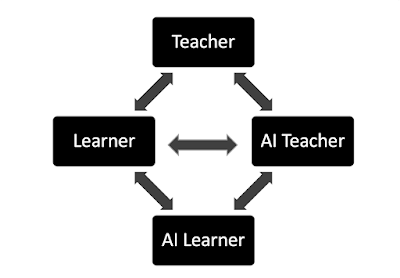
We have moved from Human Teachers and Human Learners, as a diad to AI Teachers and AI Learners as a tetrad.


Nvidia will bring AI to every industry, says CEO Jensen Huang in GTC keynote: ‘We are at the iPhone moment of AI’ — from venturebeat.com by Sharon Goldman

Excerpt:

As Nvidia’s annual GTC conference gets underway, founder and CEO Jensen Huang, in his characteristic leather jacket and standing in front of a vertical green wall at Nvidia headquarters in Santa Clara, California, delivered a highly-anticipated keynote that focused almost entirely on AI. His presentation announced partnerships with Google, Microsoft and Oracle, among others, to bring new AI, simulation and collaboration capabilities to “every industry.”

Introducing Mozilla.ai: Investing in trustworthy AI — from blog.mozilla.org by Mark Surman
We’re committing $30M to build Mozilla.ai: A startup — and a community — building a trustworthy, independent, and open-source AI ecosystem.

Excerpt (emphasis DSC):

We’re only three months into 2023, and it’s already clear what one of the biggest stories of the year is: AI. AI has seized the public’s attention like Netscape did in 1994, and the iPhone did in 2007.

New tools like Stable Diffusion and the just-released GPT-4 are reshaping not just how we think about the internet, but also communication and creativity and society at large. Meanwhile, relatively older AI tools like the recommendation engines that power YouTube, TikTok and other social apps are growing even more powerful — and continuing to influence billions of lives.

This new wave of AI has generated excitement, but also significant apprehension. We aren’t just wondering What’s possible? and How can people benefit? We’re also wondering What could go wrong? and How can we address it? Two decades of social media, smartphones and their consequences have made us leery.    

ChatGPT plugins — from openai.com

Excerpt:

Users have been asking for plugins since we launched ChatGPT (and many developers are experimenting with similar ideas) because they unlock a vast range of possible use cases. We’re starting with a small set of users and are planning to gradually roll out larger-scale access as we learn more (for plugin developers, ChatGPT users, and after an alpha period, API users who would like to integrate plugins into their products). We’re excited to build a community shaping the future of the human–AI interaction paradigm.


Bots like ChatGPT aren’t sentient. Why do we insist on making them seem like they are? — from cbc.ca by Matt Meuse
‘There’s no secret homunculus inside the system that’s understanding what you’re talking about’

Excerpt:

LLMs like ChatGPT are trained on massive troves of text, which they use to assemble responses to questions by analyzing and predicting what words could most plausibly come next based on the context of other words. One way to think of it, as Marcus has memorably described it, is “auto-complete on steroids.”

Marcus says it’s important to understand that even though the results sound human, these systems don’t “understand” the words or the concepts behind them in any meaningful way. But because the results are so convincing, that can be easy to forget.

“We’re doing a kind of anthropomorphization … where we’re attributing some kind of animacy and life and intelligence there that isn’t really,” he said.


10 gifts we unboxed at Canva Create — from canva.com
Earlier this week we dropped 10 unopened gifts onto the Canva homepage of 125 million people across the globe. Today, we unwrapped them on the stage at Canva Create.


Google Bard Plagiarized Our Article, Then Apologized When Caught — from tomshardware.com by Avram Piltch
The chatbot implied that it had conducted its own CPU tests.


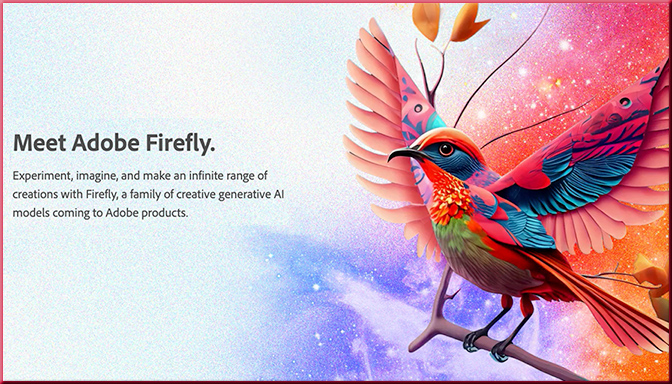
Meet Adobe Firefly. Experiment, imagine, and make an infinite range of creations with Firefly, a family of creative generative AI models coming to Adobe products.

Meet Adobe Firefly. — from adobe.com
Experiment, imagine, and make an infinite range of creations with Firefly, a family of creative generative AI models coming to Adobe products.

Generative AI made for creators.
With the beta version of the first Firefly model, you can use everyday language to generate extraordinary new content. Looking forward, Firefly has the potential to do much, much more.


Also relevant/see:

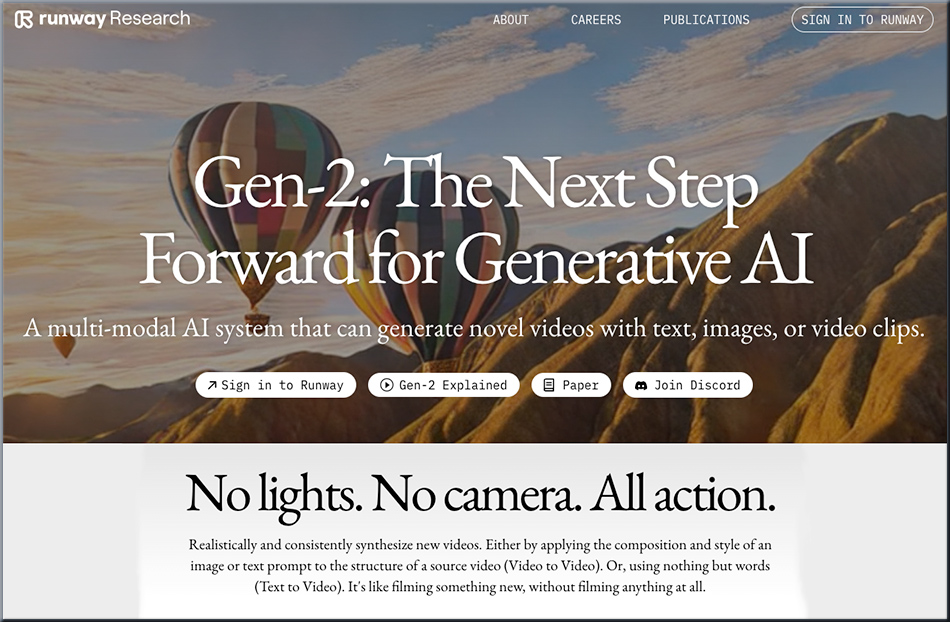
Gen-2 from runway Research -- the next step forward for generative AI

Gen-2: The Next Step Forward for Generative AI — from research.runwayml.com
A multi-modal AI system that can generate novel videos with text, images, or video clips.

Realistically and consistently synthesize new videos. Either by applying the composition and style of an image or text prompt to the structure of a source video (Video to Video). Or, using nothing but words (Text to Video). It’s like filming something new, without filming anything at all.


What Can A.I. Art Teach Us About the Real Thing? — from newyorker.com by Adam Gopnik; with thanks to Mrs. Julie Bender for this resource
The range and ease of pictorial invention offered by A.I. image generation are startling.

Excerpts:

The dall-e 2 system, by setting images free from neat, argumentative intentions, reducing them to responses to “prompts,” reminds us that pictures exist in a different world of meaning from prose.

And the power of images lies less in their arguments than in their ambiguities. That’s why the images that dall-e 2 makes are far more interesting than the texts that A.I. chatbots make. To be persuasive, a text demands a point; in contrast, looking at pictures, we can be fascinated by atmospheres and uncertainties.

One of the things that thinking machines have traditionally done is sharpen our thoughts about our own thinking.

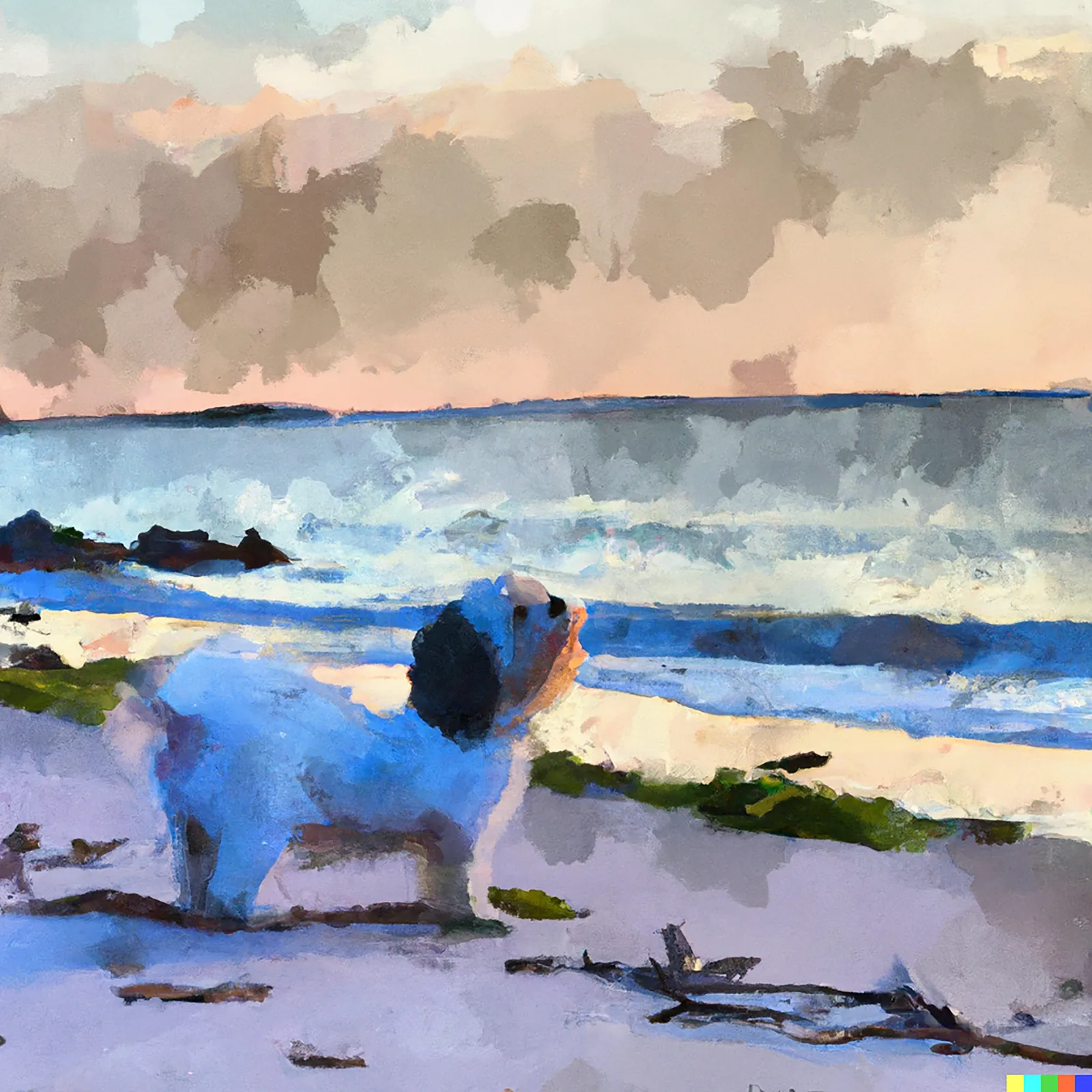
And, so, “A Havanese at six pm on an East Coast beach in the style of a Winslow Homer watercolor”:

A Havanese at six pm on an East Coast beach in the style of a Winslow Homer watercolor
Art work by DALL-E 2 / Courtesy OpenAI

It is, as simple appreciation used to say, almost like being there, almost like her being there. Our means in art are mixed, but our motives are nearly always memorial. We want to keep time from passing and our loves alive. The mechanical collision of kinds first startles our eyes and then softens our hearts. It’s the secret system of art.


Speaking of AI-related items, also see:

OpenAI debuts Whisper API for speech-to-text transcription and translation — from techcrunch.com by Kyle Wiggers

Excerpt:

To coincide with the rollout of the ChatGPT API, OpenAI today launched the Whisper API, a hosted version of the open source Whisper speech-to-text model that the company released in September.

Priced at $0.006 per minute, Whisper is an automatic speech recognition system that OpenAI claims enables “robust” transcription in multiple languages as well as translation from those languages into English. It takes files in a variety of formats, including M4A, MP3, MP4, MPEG, MPGA, WAV and WEBM.

Introducing ChatGPT and Whisper APIs — from openai.com
Developers can now integrate ChatGPT and Whisper models into their apps and products through our API.

Excerpt:

ChatGPT and Whisper models are now available on our API, giving developers access to cutting-edge language (not just chat!) and speech-to-text capabilities.


Everything you wanted to know about AI – but were afraid to ask — from theguardian.com by Dan Milmo and Alex Hern
From chatbots to deepfakes, here is the lowdown on the current state of artificial intelligence

Excerpt:

Barely a day goes by without some new story about AI, or artificial intelligence. The excitement about it is palpable – the possibilities, some say, are endless. Fears about it are spreading fast, too.

There can be much assumed knowledge and understanding about AI, which can be bewildering for people who have not followed every twist and turn of the debate.

 So, the Guardian’s technology editors, Dan Milmo and Alex Hern, are going back to basics – answering the questions that millions of readers may have been too afraid to ask.


Nvidia CEO: “We’re going to accelerate AI by another million times” — from
In a recent earnings call, the boss of Nvidia Corporation, Jensen Huang, outlined his company’s achievements over the last 10 years and predicted what might be possible in the next decade.

Excerpt:

Fast forward to today, and CEO Jensen Huang is optimistic that the recent momentum in AI can be sustained into at least the next decade. During the company’s latest earnings call, he explained that Nvidia’s GPUs had boosted AI processing by a factor of one million in the last 10 years.

“Moore’s Law, in its best days, would have delivered 100x in a decade. By coming up with new processors, new systems, new interconnects, new frameworks and algorithms and working with data scientists, AI researchers on new models – across that entire span – we’ve made large language model processing a million times faster,” Huang said.

From DSC:
NVIDA is the inventor of the Graphics Processing Unit (GPU), which creates interactive graphics on laptops, workstations, mobile devices, notebooks, PCs, and more. They are a dominant supplier of artificial intelligence hardware and software.


Master of Lettering [Biernat]

Master of Lettering — from theawesomer.com by Tomasz Biernat

Also fun/see:

Everyday Situations Take an Amusing Turn in Toon Joosen’s Clever Collages — from thisiscolossal.com by Grace Ebert and Toon Joosen


Californians approve big funding boost for arts education — from apnews.com by Julie Watson; with thanks to Goldie Blumenstyk for this resource

Excerpt:

SAN DIEGO (AP) — California voters on Tuesday approved a ballot measure backed by a celebrity lineup that included Barbra Streisand and Los Angeles-born rappers will.i.am and Dr. Dre that could pump as much as $1 billion a year from the state’s general fund into arts education.

Supporters said it would benefit public school programs that go beyond the traditional art, theater, dance and music classes to include graphic design, computer coding, animation, music composition and script writing.

Also from Goldie Blumenstyk:


Updated Creative Cloud helps you create with precision and speed and collaborate seamlessly — from blog.adobe.com by Scott Belsky

Excerpt:

Over the past few years, creative expression has become a widespread desire. From new social media platforms to our efforts to stand out in school, or at work through our ideas, creativity has become a vital skill for everyone. Our teams at Adobe are on a mission to outfit everyone to create.

The latest version of Adobe Creative Cloud, released [on 10/18/22] at Adobe MAX, includes innovations that support creativity for all.

Also relevant/see:


10 Websites to Have Fun With Your Photos — from Hongkiat.com

Excerpt:

Getting a little bored with how your photos are presented online? How about injecting some fun and humor into it? You don’t really need to be Photoshop literate to edit and add effects to your photos. There’re some really great sites out there that allow you to add effects to your photo by using their existing effect templates.

The best part is – they are free, output is shown immediately on the fly,, and no installation of apps is required. Here’s a collection of ten websites to have fun with your photos, we’ve come to know. You know they don’t really have to be your photos 🙂


Graphic Design Trends 2023 Are Shaping the New Reality — from graphicmama.com by Iveta Pavlova

Excerpt:

Dive into the hottest current graphic design trends in 2023! Read a thorough review of what awaits on the stage of graphic design – well-known or completely revolutionary approaches that are about to shape our new reality.

Remember the times when the world was all about flat, subtle design? “The plainer, the better” was the norm. Well, things have changed. The reign in the graphic design world was slowly but very firmly taken over by big voluminous shapes in screaming colors that offer an alternative reality to the viewer – more vivid than ever!

The newest graphic design trends in 2023 offer us a ride to the future and invite us to observe a world of new depths, colors, and shapes that push the limits.

To-Tem / Pop from My Name is Wendy on Vimeo.


Artificial Intelligence in Video Production — from provideocoalition.com by Iain Anderson

Introduction

Artificial Intelligence has promised so much for so long, and in many ways, it’s been less than perfect. Siri doesn’t quite understand what you’re asking; Google Translate can’t yet seamlessly bridge the gap between languages, and navigation software still doesn’t always offer an accurate route. But it’s getting pretty good. While a variety of AI-based technologies have been improving steadily over the past several years, it’s the recent giant strides made in image generation that’s potentially groundbreaking for post production professionals. Here, I’ll take you through the ideas behind the tech, along with specific examples of how modern, smart technology will change your post workflow tomorrow, or could today.

Also relevant/see:


OpenAI Says DALL-E Is Generating Over 2 Million Images a Day—and That’s Just Table Stakes — from singularityhub.com by Jason Dorrier

Excerpt:

The venerable stock image site, Getty, boasts a catalog of 80 million images. Shutterstock, a rival of Getty, offers 415 million images. It took a few decades to build up these prodigious libraries.

Now, it seems we’ll have to redefine prodigious. In a blog post last week, OpenAI said its machine learning algorithm, DALL-E 2, is generating over two million images a day. At that pace, its output would equal Getty and Shutterstock combined in eight months. The algorithm is producing almost as many images daily as the entire collection of free image site Unsplash.

And that was before OpenAI opened DALL-E 2 to everyone.


From DSC:
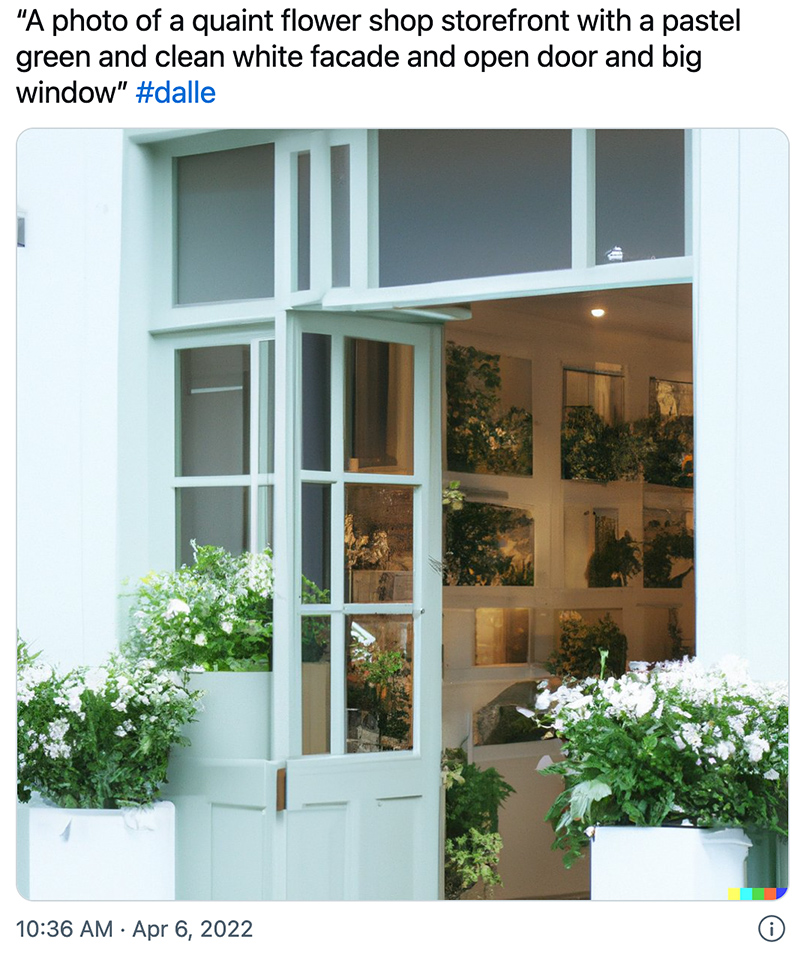
Further on down that Tweet is this example image — wow!
.

A photo of a quaint flower shop storefront with a pastel green and clean white facade and open door and big window

.


On the video side of things, also relevant/see:

Meta’s new text-to-video AI generator is like DALL-E for video — from theverge.com by James Vincent
Just type a description and the AI generates matching footage

A sample video generated by Meta’s new AI text-to-video model, Make-A-Video. The text prompt used to create the video was “a teddy bear painting a portrait.” Image: Meta


From DSC:
Hmmm…I wonder…how might these emerging technologies impact copyrights, intellectual property, and/or other types of legal matters and areas?


© 2025 | Daniel Christian