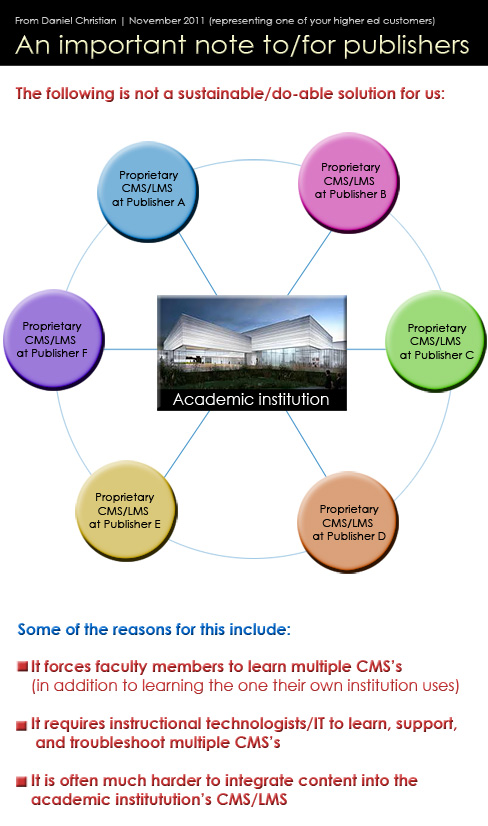
From DSC:
We really need a much more granular approach — like an iTunes for academic content.
From DSC:
We really need a much more granular approach — like an iTunes for academic content.
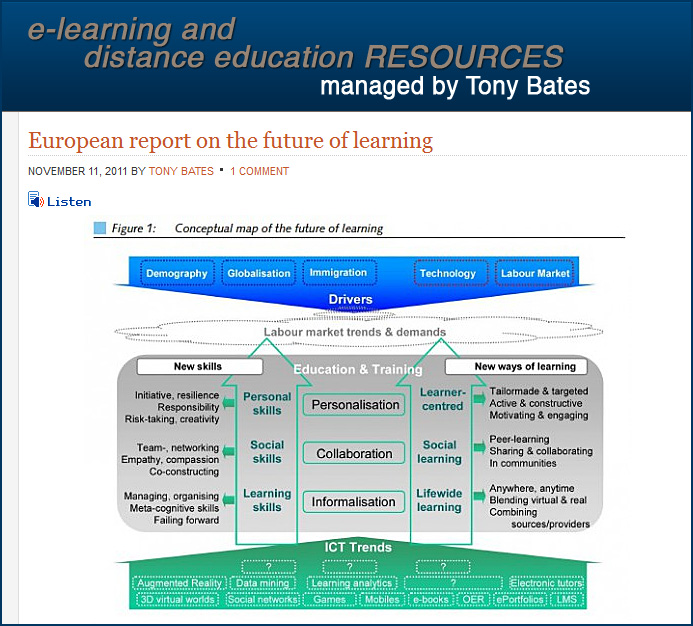

Graphic from:
10 reasons to move to Moodle 2 from Moodle 1.9 — from somerandomthoughts.com by Gavin Henrick
Excerpt:
Presentations
Each presentation will be available on YouTube (slides & voice), the slides on Slideshare. I will be adding them as mp3s later on too.
“10 reasons to move to Moodle 2? (Part 1)
Pearson and Google jump into learning management with a new, free system — from The Chronicle by Josh Fischman
Excerpt:
One of the world’s biggest education publishers has joined with one of the most dominant and iconic software companies on the planet to bring colleges a new—and free—learning-management system with the hopes of upending services that affect just about every instructor, student, and college in the country.
Today Pearson, the publishing and learning technology group, has teamed up with the software giant Google to launch OpenClass, a free LMS that combines standard course-management tools with advanced social networking and community-building, and an open architecture that allows instructors to import whatever material they want, from e-books to YouTube videos. The program will launch through Google Apps for Education, a very popular e-mail, calendar, and document-sharing service that has more than 1,000 higher-education customers, and it will be hosted by Pearson with the intent of freeing institutions from the burden of providing resources to run it. It enters a market that has been dominated by costly institution-anchored services like Blackboard, and open-source but labor-intensive systems like Moodle.
New mentality entering LMS market — from deltainitiative.com by Phil Hill; this was also guest posted on Michael Feldstein’s eLiterate site
Excerpt:
The real significance will be the entrance of a new mentality – one based on new investment (venture capital, private equity, strategic publisher moves), one based on startup companies willing to challenge the status quo with new approaches, and one that is almost naive in its assumptions about giving end users what they want.


Quo vadis, LMS? Trends, predictions, commentary — from CampusTechnology.com
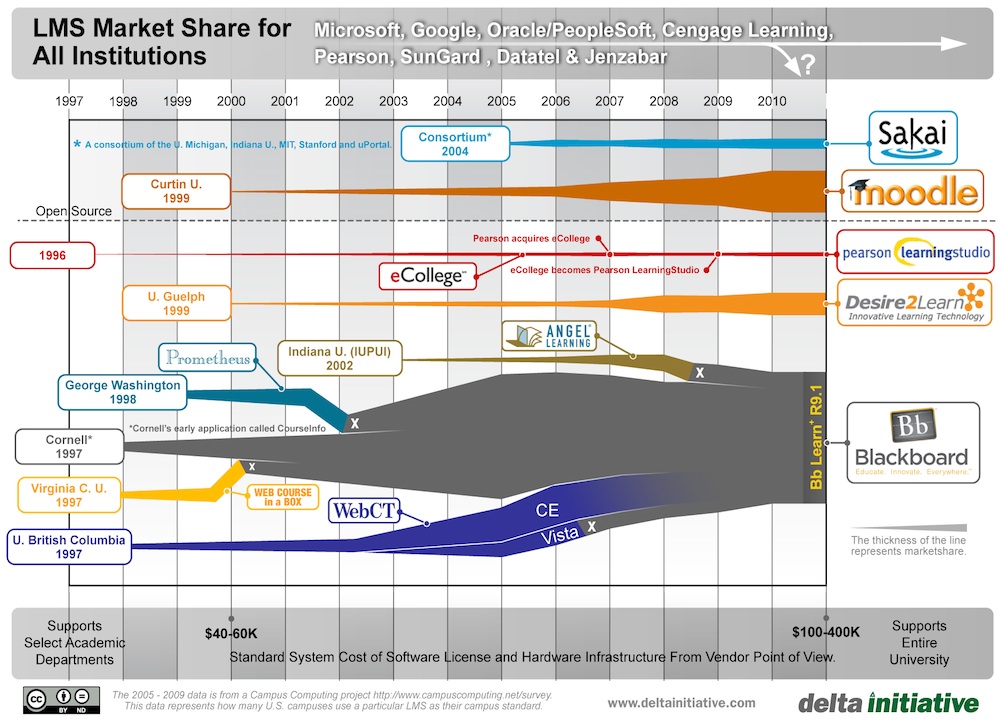
The LMS market is in flux. According to a 2010 survey conducted by the Campus Computing Project, Blackboard‘s dominance of the higher education market declined from 71 percent in 2006 to 57 percent in 2010. Open source alternatives Moodle and Sakai have continued to make inroads, as has Desire2Learn–together they now control over 30 percent of the market. The entry of Instructure, whose Canvas LMS recently scooped up the business of the Utah Education Network, provides an additional plot twist. And hanging over it all is the imminent migration of hundreds of legacy Blackboard clients to new systems as their existing platforms are retired.
Often overlooked in the numbers game, though, are more fundamental–even philosophical–questions about the evolving role of the LMS and its ability to meet the needs of higher education today. If the debate of recent years has been between open source and proprietary systems, the focus is gradually shifting to how all of these systems will tackle the thorny issues of informal learning, social networking, assessment, and a mobile learning environment.
To gauge what the future may hold, CT asked leading educators and vendors for their thoughts on the evolution of the LMS in higher education.
Five common pitfalls of online course design — from Faculty Focus by Elizabeth St. Germain