Magic Quadrant for Corporate Learning Systems — from Gartner

Figure 1.Magic Quadrant for Corporate Learning Systems

Source: Gartner (March 2011)


Market Definition/Description
CLSs continue to expand the functionality and robustness of their components. The five core components that a CLS should provide are:

  • LMS — supports the administration and management of learning programs, such as assessment, records management, provisioning of learning, management of training resources and reporting.
  • LCMS and content authoring tools — enable the creation, storage, delivery and reuse of learning content.
  • Virtual classrooms and multimodal e-learning delivery — underpin various approaches to learning, including formal (for example, instructor-led), structured social, informal and blended styles.
  • Social learning — supports the collaborative learning activities of individuals and teams, as well as the creation and interaction of communities of learners.
  • Professional services — help create custom content, develop learning strategies and support implementation.
10 things you can do with a Moodle webpage [Thibault]

10 things you can do with a Moodle webpage — from MoodleNews.com by Joseph Thibault


Tagged with: •  

Moodle Monday: Forums for individual groups

Moodle Monday: Forums for individual groups — from MoodleNews.com by Tim Dalton


Tagged with: •  

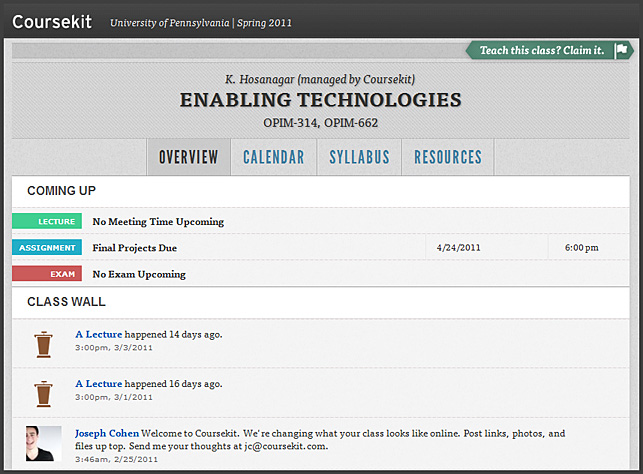
coursekit.com -- from students at the University of Pennsylvania

.

From DSC:
I saw this at Mashable, and I wanted to post it here for a couple of reasons:

  1. Note the consistent interface between their courses — when putting a course online, we are entering into the world of interface design where consistency is very key, very helpful.
  2. Students at the University of Pennsylvania created this — so this provides a glimpse into what these students think a “course” should look like.


Five trends in learning delivery in 2011 — from the Chief Learning Officer by Caroline Avey

  1. Increased Fidelity of Experience
  2. Kiosk Learning
  3. Crowdsourcing for Learning Assignments
  4. Data Mining
  5. The LMS Adds Informal Learning

Blackboard’s next phase

Blackboard’s next phase — from insidehighered.com by Steve Kolowich

Blackboard built its e-learning empire on its learning management system, trading legal blows with some competitors and gobbling up others as it raced to satisfy demand for a technology that had rapidly become de rigueur in higher education.

That period of conquest is now over. Last fall, close to 95 percent of institutions had some learning management system in place, according to the Campus Computing Project. Accordingly, Blackboard’s business strategy is changing: with the company adding four new, separately licensed products to its menu in the last three years, Blackboard expects that it will soon no longer rely on Learn, its popular learning management system, to bring home the bacon.

…

The fact that Blackboard is staking so much of its anticipated growth in the domestic higher education market on the success of its newer products could put colleges in a better position to haggle, Urdan added. “The whole notion of the market being saturated and [Blackboard] being reliant on new products to build their revenue stream — maybe the negotiating power is shifting a little more toward the client and a little bit away from Blackboard,” he said. This might be especially true given the gradual erosion of Blackboard’s market dominance in recent years.
Tagged with: • • •  

Moodle 2.0 integrations – Alfresco

Moodle 2.0 integrations – Alfresco — from Synergy Learning by Joel Kerr

As Moodle 2.0 becomes more established we are finding more and more clients eager to upgrade from their current version.

Not only is the software being recognised for it’s new and improved features, it also makes integrating with third party tools a whole lot easier, opening up a whole new world of possibilities for those moving to Moodle 2.0.

Over the next few blog posts I am going to look at some of these external tools to see what benefits they can bring to your operations….starting with Alfresco.

Alfresco

If you haven’t heard of Alfresco before you might find it a rather useful tool.  It is a Content Management System (CMS), which basically means it can be used for managing the production of electronic content (text files, videos, graphics etc.) via a set of rules, processes and workflows.

Like Moodle and Mahara, Alfresco is Open Source and as a CMS it specializes in:

  1. Document Management
  2. Records Management
  3. Web Content Management
  4. Share
  5. Content Platform
Tagged with: • • • •  

Blackboard vs Moodle 2.0: 100+ metrics compared head to head — from MoodleNews.com by Joseph Thibault
This post is cross-posted at LMSWatch.com (comprehensive news and resources for all Learning Management Systems)

Ralf Otto of Ruhr-Universität, Bochum in Germany provided me with a wonderful resource he’s created recently.  Ruhr-Universität utilizes both Moodle and Blackboard (as a growing number of colleges and higher education institutions are doing) and over the last two weeks was charged with comparing the two LMSs head to head, he said in his message.

The comparison matrix covers 103 different aspects of the LMS and whether or not each is capable (and sometimes how).  How does each measure up?

…

For the full comparison that Ralf created please visit:
http://moodle.ruhr-uni-bochum.de/file.php/1/Feature_Comparison_Moodle-Blackboard.pdf

Tagged with: • • • •  

Cambridge Global Grid for Learning Partner with Moodlerooms
Leading broker and aggregator of digital educational content has established a joint partnership with proven provider of enterprise Moodle-based e-learning solutions to improve access to digital content.

Baltimore, MD — Moodlerooms, Inc., the provider of proven, enterprise Moodle-based e-learning solutions has established a joint partnership with leading broker and aggregator of digital educational content, Cambridge Global Grid for Learning (GGfL), a wholly owned subsidiary of Cambridge University Press, one of the world’s most respected publishers, to further the effort of providing educators and learners across the world with a safe and reliable environment to search, stream and download high quality and copyright-cleared learning resources from multiple content providers.

Over 40 content providers are currently available through GGfL, including Cambridge University Press, Intel, Science Photo Library, Classical Comics, Corbis, Reuters, EduPuzzles, and Bridgeman Education, making it one of the most comprehensive digital educational content collections in the world.

Rest of article…

Tagged with: • • •  
Tagged with: • •  

How e-Learning is flowering

How e-Learning is flowering — by Amit Garg at the Upside Learning blog

elearning flowering

Tagged with: • • • • • • •  

Moodle 2.0.1 released

Moodle 2.0.1 released — from Moodle.org by Martin Dougiamas

Tagged with: •  

Moodle Tool Guide for Teachers

Tagged with: • • • •  

The database activity in Moodle 2.0

The database activity in Moodle 2.0 — from Edutonica by John Patten [via Moodle News by Joseph Thibault]

Tagged with: •  

Mobile App Review – mBook — from moodlenews.com by Joseph Thibault

mBook is the 2nd app for Mobile Moodle developed by MassMedia (MassMedia.hk) from Hong Kong.  This is an expanded version of mPage specifically tailored for use on the iPad (the app is not available on any other OS).  This app is also a hybrid, requiring a purchase from the Apple App Store as well as installed files on your Moodle server (server side installation files are available from http://mbooks.hk/mod/resource/view.php?id=2).  NOTE: the same files for mPage are required for mBook (so installing for one of the apps makes your site ready for the other, which is a plus).

mBook is listed at $3.99 in the Apple App Store.

© 2025 | Daniel Christian