From DSC:
First a posting that got me to wondering about something that I’ve previously wondered about from time to time…

College of Business unveils classroom of the future — from biz.source.colostate.edu by Joe Giordano

Excerpt:

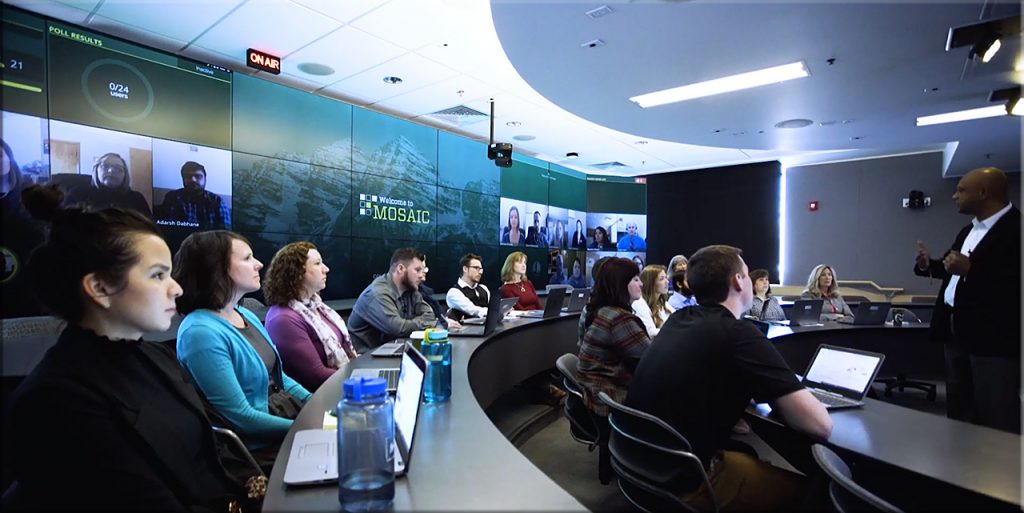
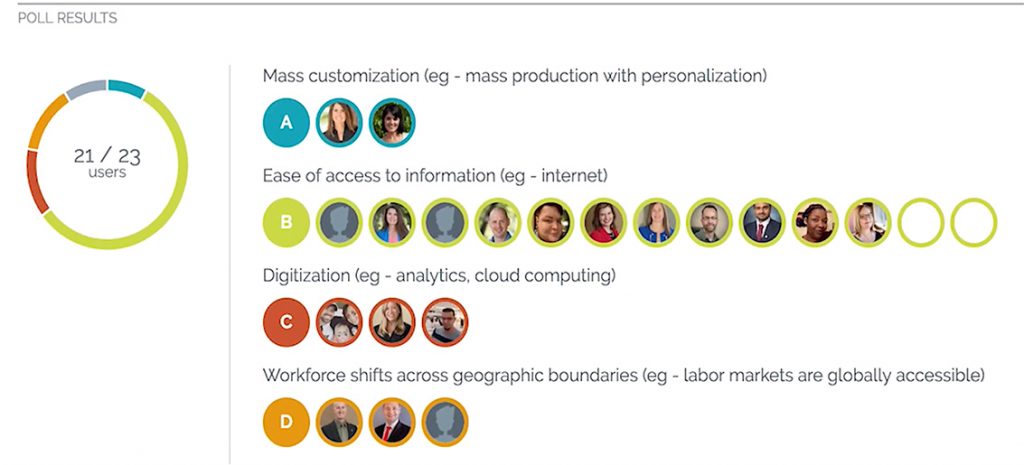
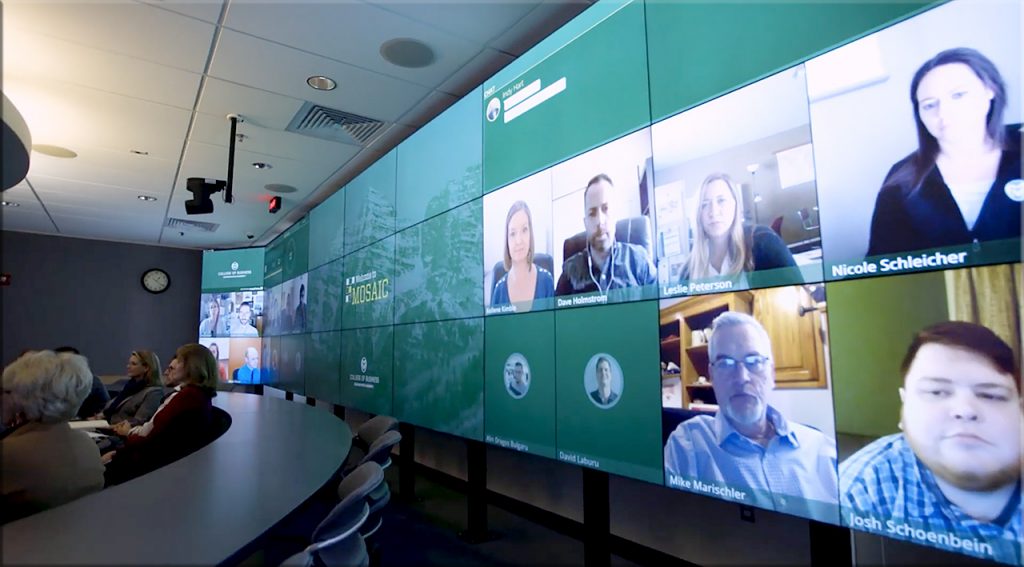
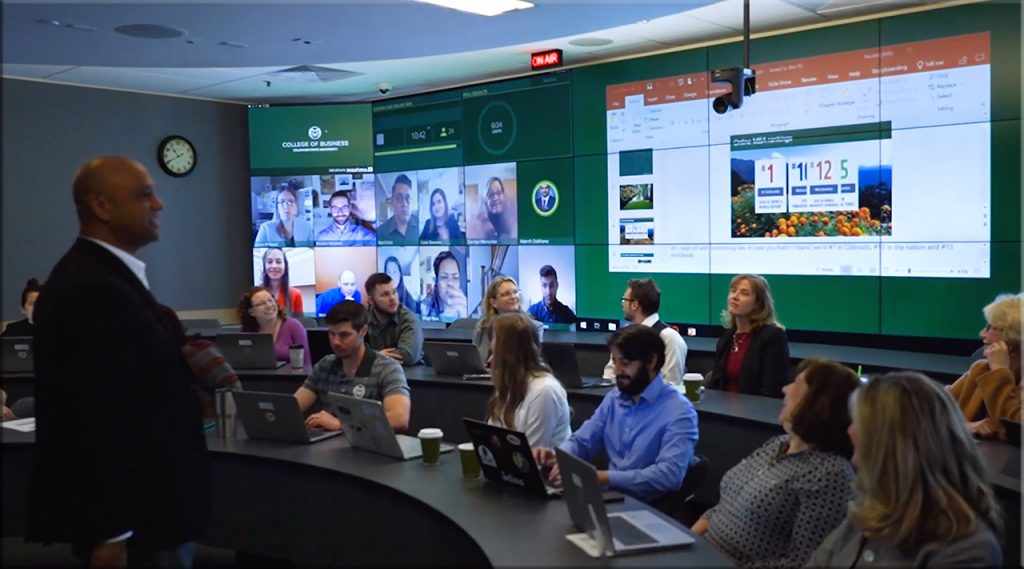
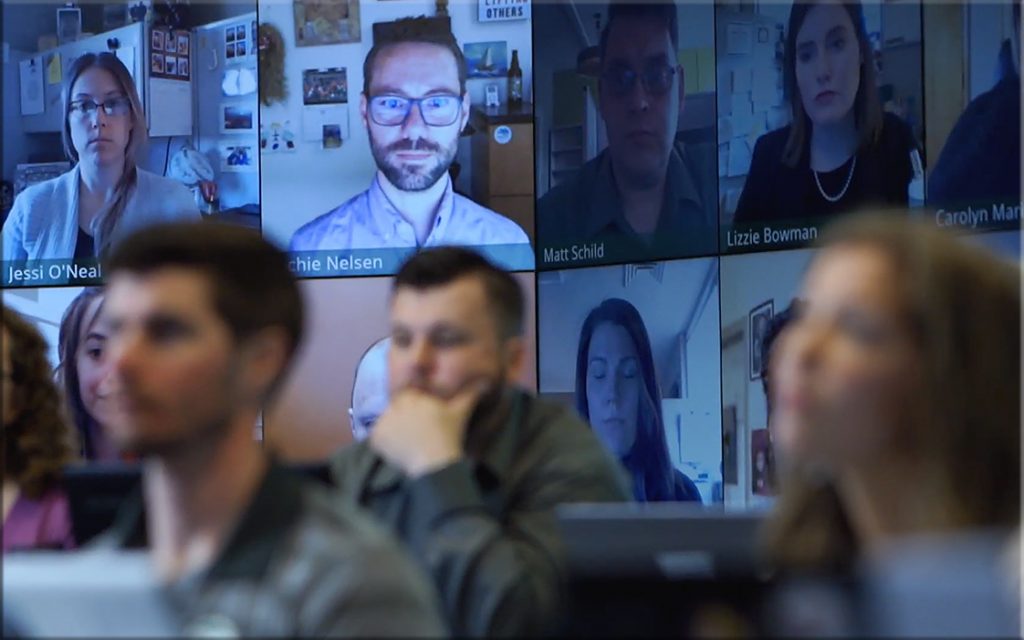
Equipped with a wall of 27 high-definition video screens as well as five high-end cameras, the newest classroom in Colorado State University’s College of Business is designed to connect on-campus and online students in a whole new way.

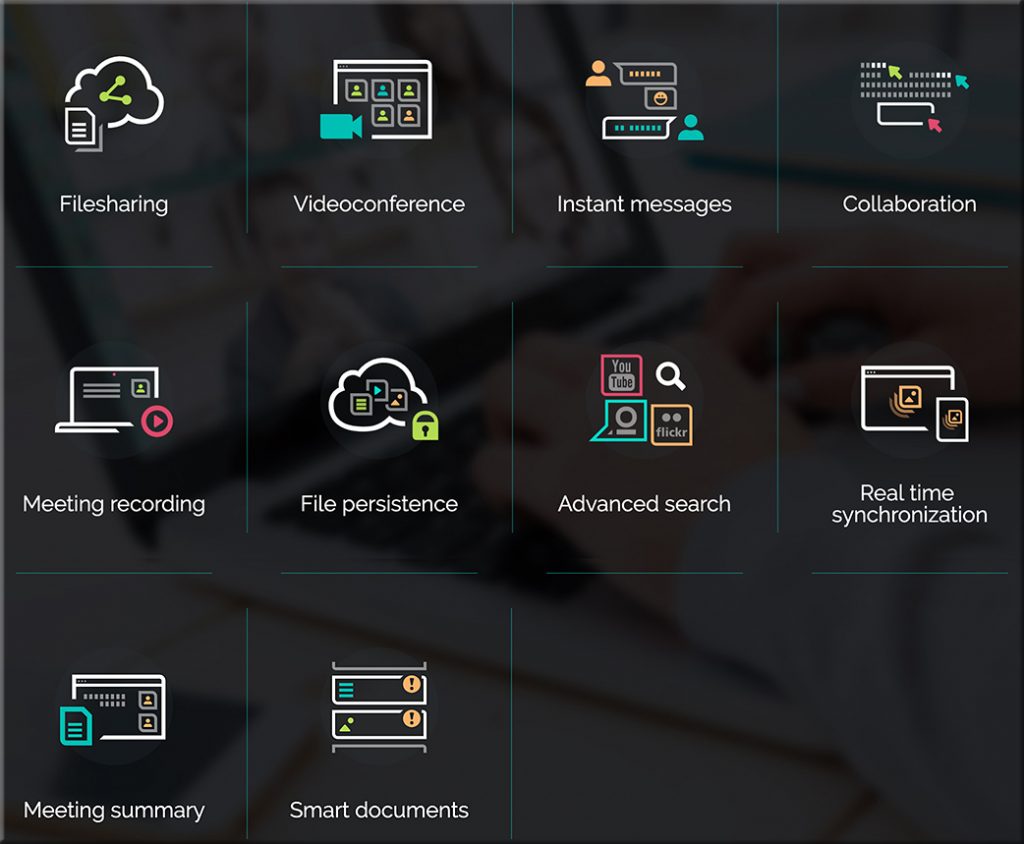
The College of Business unveiled on March 29 the “Room of the Future,” featuring Mosaic, an innovative technology – powered by mashme.io – that creates a blended classroom experience, connecting on-campus and online students in real time.


From DSC:
If the pedagogies could be worked out, this could be a very attractive model for many people in the future as it:

  • Provides convenience.
  • Offers more choice. More control. (Students could pick whether they want to attend the class virtually or in a physical classroom).

If the resulting increase in students could bring down the price of offering the course, will we see this model flourish in the near future? 

For struggling colleges and universities, could this help increase the ROI of offering their classes on their physical campuses?

The technologies behind this are not cheap though…and that could be a show-stopper for this type of an experiment. But…thinking out loud again…what if there were a cheaper way to view a group of other people in your learning community? Perhaps there will be a solution using some form of Extended Reality (XR)…hmmm….


Also see:
 

Also see:
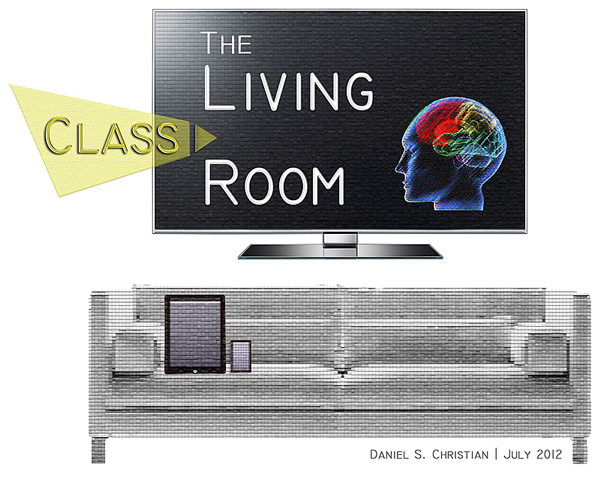
Learning from the Living Class Room


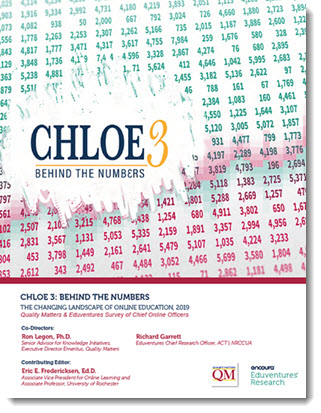
The Changing Landscape of Online Education, 2019 is now available — from qualitymatters.org


The Changing Landscape of Online Education, 2019 is now available from Quality Matters


This report is the continuation of a multi-year study by QM and Eduventures to examine the changing landscape of online education, provide results to those who can use them and help those involved with online education place their institution within a broader context and possibly influence strategic decisions and organizational changes. Please complete the form on this page to gain access to the 2019 CHLOE 3 Report.

CHLOE 3 breaks new ground in identifying a number of different institutional approaches to online learning, as crystallized in the descriptions of five models (e.g. Enterprise Schools, Community Colleges). Major themes in CHLOE 3 include a more complete picture of the growth, prevalence, and scope of the Chief Online Officer position; the emergence of online committees and councils as a component of institutional shared governance; associations between online course structure, student engagement and outcomes; and the widespread neglect of coordinated blended learning.


Examples/excerpts:

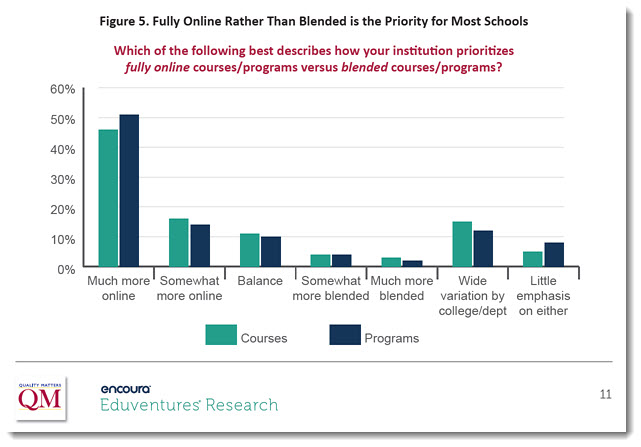
fully online is the priority


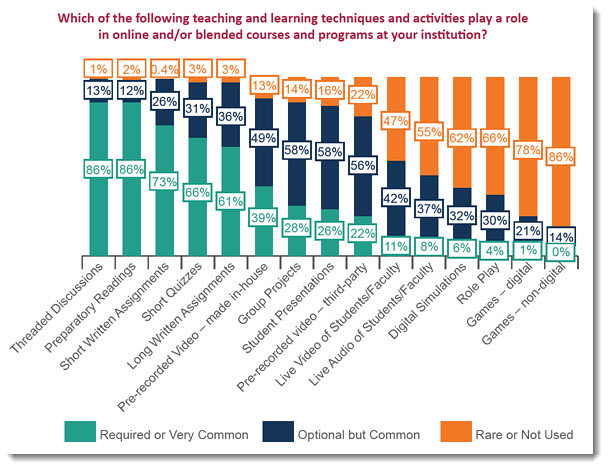
teaching and learning techniques and activities


HBS Online: Why Harvard Business School’s digital rebrand is big news for online learning — from businessbecause.com by Seb Murray
Name change from HBX to Harvard Business School Online symbolizes a maturing market. We speak to Patrick Mullane, executive director of HBS Online, to find out more

Excerpt:

At first glance, it may have seemed like an inconsequential name change: Harvard Business School’s digital learning platform HBX would be called HBS Online.

But commentators have billed the recent rebrand as having the potential for a big impact on online education. For one, the makeover could help to further legitimize the market.

Online learning was initially considered second-rate to campus study, due to concerns about teaching quality and interactivity online. Nitin Nohria, the dean of HBS, saying in 2010 that the school would never go online in his lifetime, appeared to confirm the scepticism.

But he has since admitted he ‘misjudged the potential of online education’ and is…


From DSC:
This is very old hat…but those who haven’t taught online should not judge online teaching and learning. If I gave you the writeups from my students from a class that I have taught in both a face-to-face format as well as in an online format — where I ask them what they learned during the class — I swear that you could not tell which documents represented those courses taught online vs. those taught face-to-face. I guarantee it. So as the saying goes…don’t judge it if you haven’t tried it.

Oh…and by the way, many of the innovations in teaching and learning are happening in the digital/virtual realm. Not all, but many. And we haven’t seen anything yet. 


Huge study finds professors’ attitudes affect students’ grades — and it’s doubly true for minority students. — from arstechnica.com by Scott Johnson

Excerpt:

Instead, the researchers think the data suggests that—in any number of small ways—instructors who think their students’ intelligence is fixed don’t keep their students as motivated, and perhaps don’t focus as much on teaching techniques that can encourage growth. And while this affects all students, it seems to have an extra impact on underrepresented minority students.

The good news, the researchers say, is that instructors can be persuaded to adopt more of a growth mindset in their teaching through a little education of their own. That small attitude adjustment could make them a more effective teacher, to the significant benefit of a large number of students.


Along these lines, also see:


Math Visuals — from mathvisuals.wordpress.com

Examples:


From DSC:
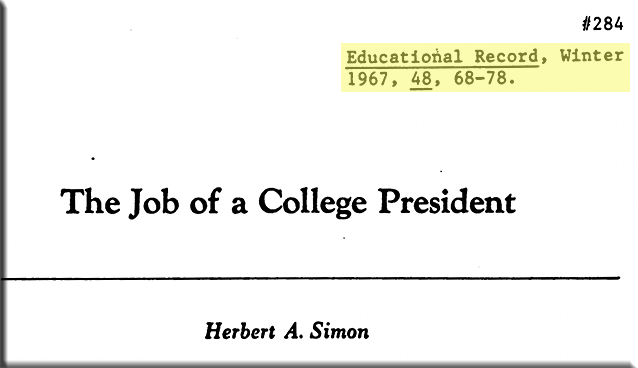
From Mary Grush’s recent article re: Learning Engineering, I learned that back in the late 1960’s, Herbert Simon believed there would be value in providing college presidents with “learning engineers” (see his article entitled, “The Job of a College President”).


An excerpt:

What do we find in a university? Physicists well educated in physics, and trained for research in that discipline; English professors learned in their language and its literature (or at least some tiny corner of it); and so on down the list of the disciplines. But we find no one with a professional knowledge of the laws of learning, or of the techniques for applying them (unless it be a professor of educational psychology, who teaches these laws, but has no broader responsibility for their application in the college).

Notice, our topic is learning, not teaching. A college is a place where people come to learn. How much or how little teaching goes on there depends on whether teaching facilitates learning, and if so, under what circumstances. It is a measure of our naivete that we assume implicitly, in almost all our practices, that teaching is the way to produce learning, and that something called a “class” is the best environment for teaching.

But what do we really know about the learning process: about how people learn, about what they learn, and about what they can do with what they learn? We know a great deal today, if by “we” is meant a relatively small group of educational psychologists who have made this their major professional concern. We know much less, if by “we” is meant the rank and file of college teachers.


What is learned must be defined in terms of what the student should be able to do. If learning means change in the student, then that change should be visible in changed potentialities of behavior.

Herbert Simon, 1967


From DSC:
You will find a great deal of support for active learning in Simon’s article.


Is Teaching an Art or a Science? New Book Takes a Fresh Look at ‘How Humans Learn.’ — from edsurge.com by Jeff Young

Excerpts:

Eyler: That is the perennial question. We actually wrote a post for our Teaching Center’s blog with that title, “Is teaching an art or a science?” It has by far been read more than any other blog post that we’ve written.

My answer might be a little unfulfilling because I think it’s actually both. I think there is a scientific element to teaching. The book is about understanding the science of how we learn, how learning has evolved over time, and the social interactions that shape teaching. And the best teachers also often approach teaching and teaching issues scientifically. They have a hypothesis of what they think will help students learn, and they’re going to test it out and then learn from it and revise.

But if we focus too much on the science, we lose the human element of teaching—what I think of as the art of teaching.

…

What’s the thing that surprised you most in your research or putting this book together?

Much of what surprised me most makes up a lot of the final chapter, which is on failure. As teachers, we don’t get trained to think of failure as a positive thing in any way, even though as researchers we know that failure is a part of the learning process. No one walks into a lab right away and comes up with the Nobel Prize-winning discovery. It’s an iterative cycle.

We have these educational systems that are set up to move in exactly the opposite way. We give students really high-stakes assignments and assessments with very few opportunities to do them.


6 key trends to 21st century teaching — from edsurge.com

Excerpt:

It’s popular these days to complain that college teaching hasn’t changed in hundreds of years. And sure, it’s possible to find some professors on any campus holding yellowed lecture notes, or clinging to dusty chalk. But the reality is that the internet and digital technologies have already brought profound changes to instructional styles and tools in higher education.

So what are the new teaching approaches catching on at today’s campuses? And what are the broader cultural changes around college teaching?

We set out to answer those questions over the past year, with a series of articles and interviews exploring what teaching in the 21st century looks like. Some show the nuances of the challenges of teaching with technology by telling stories of innovative professors, including how a water agency official who teaches an online community college course got started in creating open educational resources when her class was incorporated into a zero-cost textbook degree program. Others dive into research on the culture of teaching, like a talk with an anthropologist studying how professors react to (and sometimes resist) research on teaching practices.


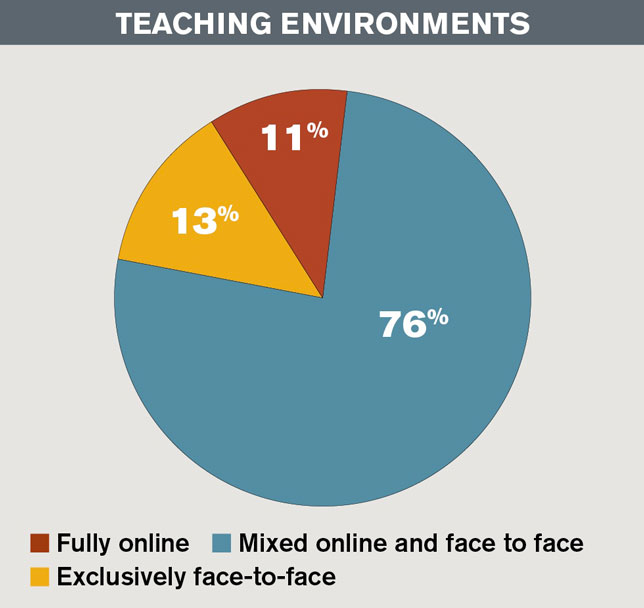
Survey: Online, Blended Dominate Today’s Learning Environments — from campustechnology.com by Rhea Kelly
In our latest Teaching with Technology Survey, the vast majority of faculty members said they teach in either a fully online or blended format.


Most faculty members either teach in a blended or fully online learning environment


However, that doesn’t mean those instructors blend every course. When we asked faculty how many of their classes are blended, 29 percent said they teach all blended classes, while 45 percent blend some of their classes. Six percent said they plan to use the blended model in the next year or are exploring the option.


From DSC:
The article below relays some interesting thoughts on what an alternative syllabus could look like. It kind of reminds me of a digital playlist…

Looking For Syllabus 2.0 — from usv.com by Dani Grant

Excerpt:

There have been several attempts already to curate online resources for learning new topics. Usually they take the form of a list of links. The problem with the list of links approach is that they are static and they are inefficient. You don’t need to read a whole link to get the main point, you want to curate little bits and pieces of open resources: 30 seconds of this podcast, a minute and a half from this youtube video, just these 4 paragraphs from this article.

The thing that is closest to a modern internet syllabi is Susan Fowler’s guide for learning physics (it’s really amazing, go check it out). What if you could have that type of curated guide for many topics that gets updated by the community over time, with inline discussion with other learners?

I think Syllabus 2.0 could look something like this:

…

We’ve created a sample syllabus for this last topic so you can see what we envision in action. It curates 8 hours of podcasts, talks and blog posts into a 30 minute guide.


How to teach a good first day of class — from chronicle.com by James Lang
Four Key Principles | Before the First Day | The First Day of Class | After the First Day | Resources

Excerpt (emphasis DSC):

Do not begin the first day of the semester by immediately handing out the syllabus. Instead, spark their curiosity about the content first, and then demonstrate — with a review of the syllabus — how the course content can help satisfy that curiosity.


From DSC:
I think what’s also implied here is putting one’s case forward about how the content is ***relevant*** today.


Also this is a good practice to do as well, but for the end of the term/semester/quarter/whatever:


EdTechs and Instructional Designers—What’s the Difference? — from er.educause.edu by Pat Reid

Excerpt:

Both edtechs and instructional designers (IDs) work with computer systems and programs, yet their actual duties differ from traditional IT tasks. The resulting confusion over what edtechs and IDs do—and how the two roles differ—is rampant, not least in the sector that needs them most: higher education.


Virtual classes shouldn’t be cringeworthy. Here are 5 tips for teaching live online — from edsurge.com by Bonni Stachowiak (Columnist)

Excerpt:

Dear Bonni: I’m wanting to learn about best practices for virtual courses that are “live” (e.g., using a platform like Zoom). It differs both from face-to-face classroom learning and traditional (asynchronous) online courses. I’d love to know about resources addressing this learning format. —Keith Johnson. director of theological development at Cru. My team facilitates and teaches graduate-level theological courses for a non-profit.

Teaching a class by live video conference is quite different than being in person with a room full of students. But there are some approaches we can draw from traditional classrooms that work quite well in a live, online environment.

Here are some recommendations for virtual teaching…


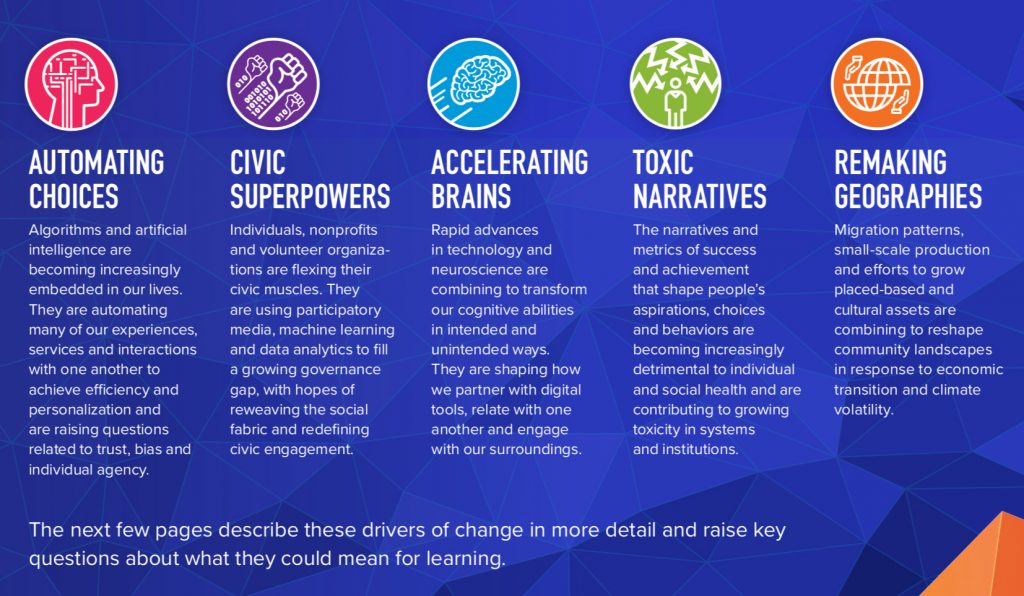
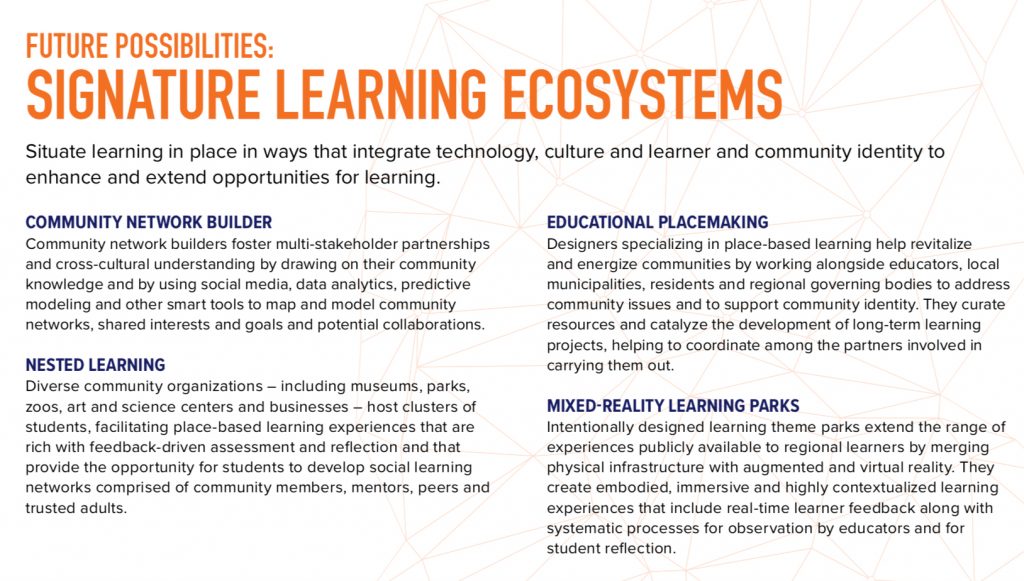
Forecast 5.0 – The Future of Learning: Navigating the Future of Learning  — from knowledgeworks.org by Katherine Prince, Jason Swanson, and Katie King
Discover how current trends could impact learning ten years from now and consider ways to shape a future where all students can thrive.


© 2025 | Daniel Christian