Excerpt from Beyond school choice — from Michael Horn

With the rapid growth in online and mobile learning, students everywhere at all levels are increasingly having educational choices—regardless of where they live and even regardless of the policies that regulate schools.

What’s so exciting about this movement beyond school choice is the customization that it allows students to have. Given that each student has different learning needs at different times and different passions and interests, there is likely no school, no matter how great, that can single-handedly cater to all of these needs just by using its own resources contained within the four walls of its classrooms.

With the choices available, students increasingly don’t need to make the tradeoff between attending a large school with lots of choices but perhaps lots of anonymity or a small school with limited choices but a deeply developed personal support structure.


Excerpt from Cooperating in the open — from Harold Jarche

I think one of the problems today is that many online social networks are trying to be communities of practice. But to be a community of practice, there has to be something to practice. One social network, mine, is enough for me. How I manage the connections is also up to me. In some cases I will follow a blogger, in others I will connect via Google Plus or Twitter, but from my perspective it is one network, with varying types of connections. Jumping into someone else’s bounded social network/community only makes sense if I have an objective. If not, I’ll keep cooperating out in the open.


From DSC:
Perhaps helping folks build their own learning ecosystems — based upon one’s gifts/abilities/passions — should be an objective for teachers, professors, instructional designers, trainers, and consultants alike. No matter whether we’re talking K-12, higher ed, or corporate training, these ever-changing networks/tools/strategies will help keep us marketable and able to contribute in a variety of areas to society.


Addendum on 2/5/13:

.
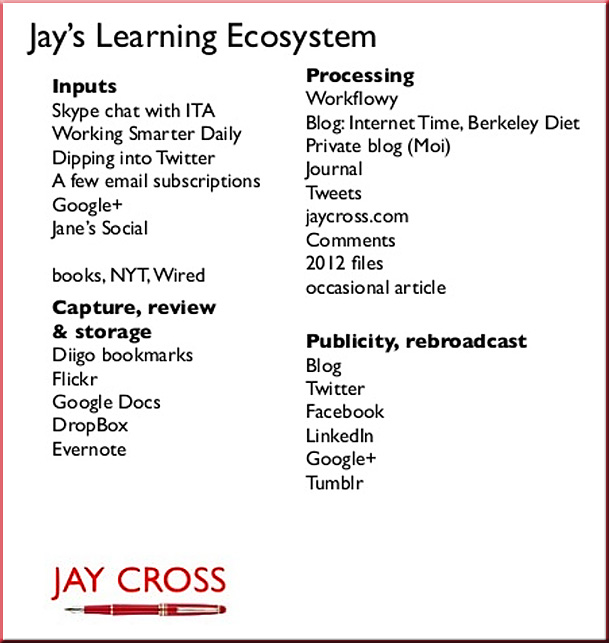
JayCross-LearningEcosystem2013


From DSC:
A solid infographic is out at Knewton.com — of which I want to highlight 2 portions of it (below).

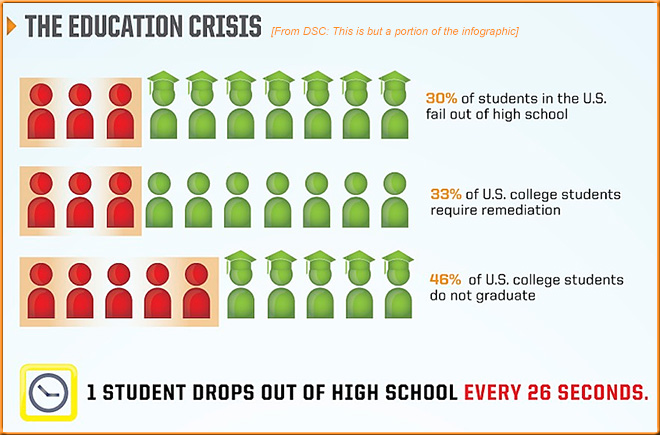
This first excerpt is not to dog teachers but rather it’s meant to support them and to say that we need to change a losing game (at least a part of the solution in ed reform is to get out of the business of focusing so much on standardized tests and another part of the solution resides in the second graphic below):


EducationCrisis-Jan2013


.

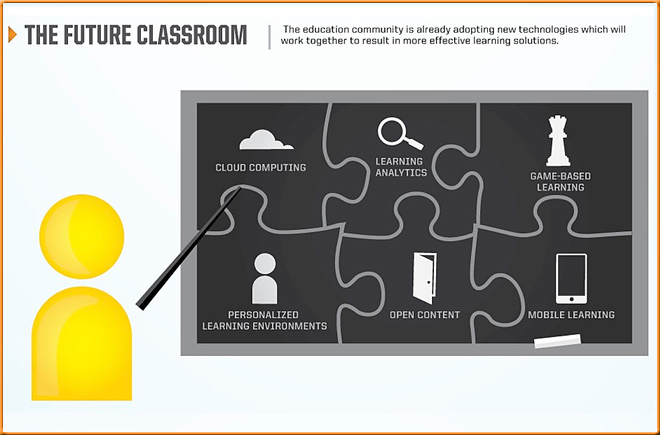
EducationCrisis2-Jan2013


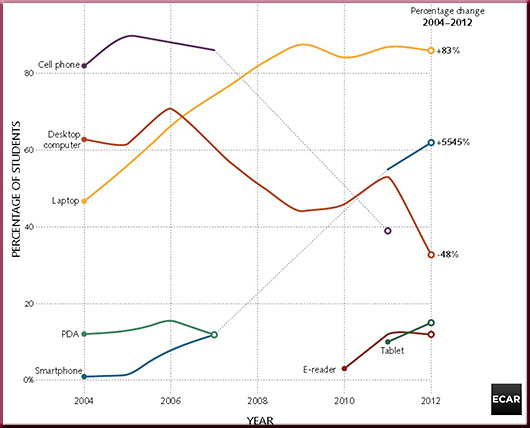
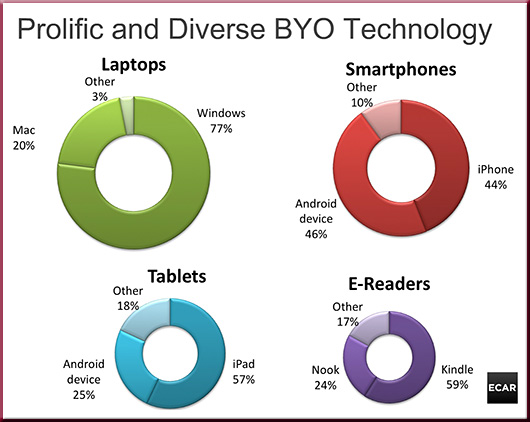
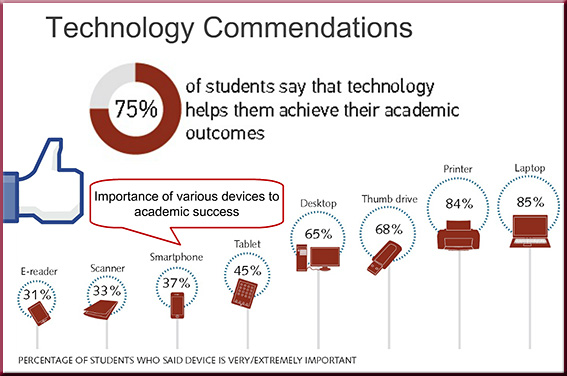
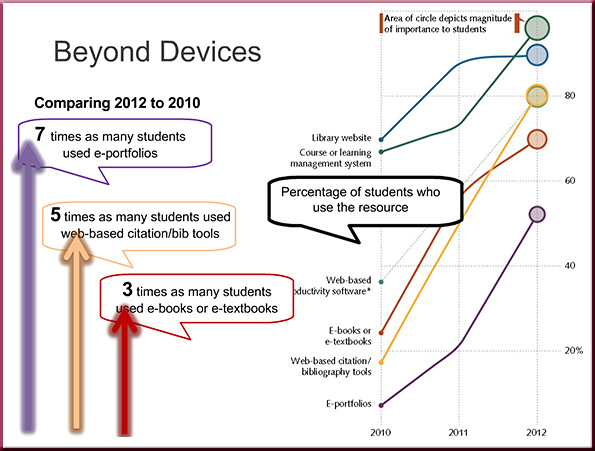
Also relevant see:

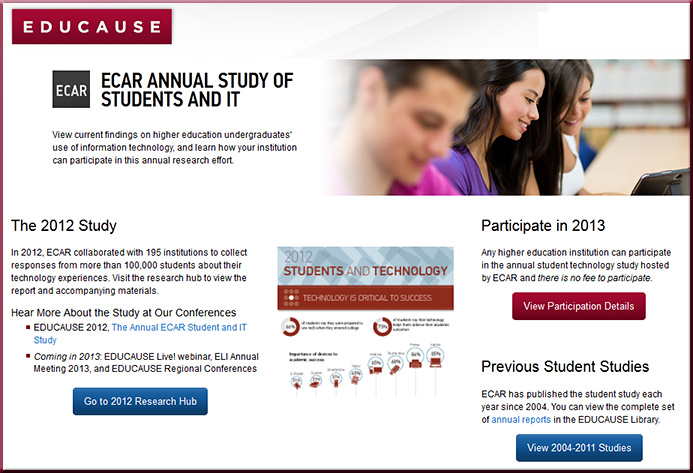
ECAR2012


.


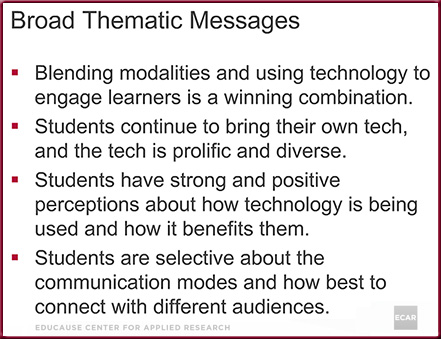
Example slides from today’s presentation:


.

 ECAR2-2012


.

ECAR3-2012


.

 ECAR4-2012


.

ECAR5-2012


.

ECAR6-2012


From DSC:
I also support one of the questions which, paraphrasing, asked, “Do you pulse check students’ expectations?


Tagged with:  

Online Learning: A Manifesto — from hybridpedagogy.com by Jesse Stommel

What we need is to ignore the hype and misrepresentations (on both sides of the debate) and gather together more people willing to carefully reflect on how, where, and why we learn online. There is no productive place in this conversation for exclusivity or anti-intellectualism. Those of us talking about digital pedagogy and digital humanities need to be engaging thoughtfully in discussions about online learning and open education. Those of us in higher ed. need to be engaging thoughtfully with K-12 teachers and administrators. And it’s especially important that we open our discussions of the future of education to students, who should both participate in and help to build their own learning spaces. Pedagogy needs to be at the center of all these discussions.

I have no interest in debating the whether of online learning. That bird has most assuredly flown. What I’d like to do here is outline a pedagogy of online learning — not best practices, but points of departure to encourage a diversity of pedagogies.


Will Richmond on Top 2013 TV Trends [from Videomind by Greg Franzese]

Will Richmond on Top 2013 TV Trends -- from Videomind by Greg Franzese -- 11-29-2012


From DSC:
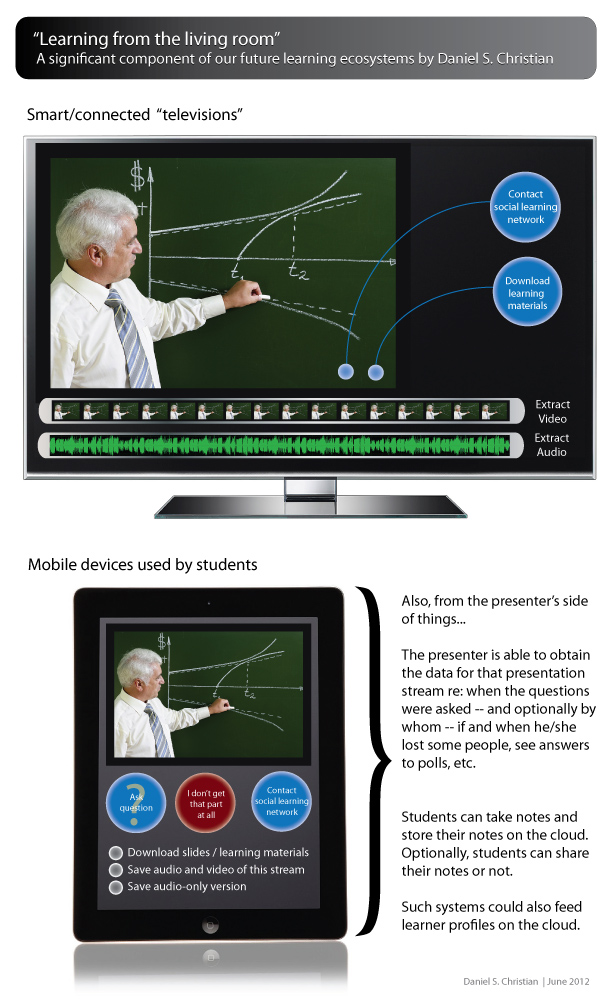
I continue to watch this space as the foundations are being put into place for what I’m calling, “Learning from the Living [Class] Room.”

.

Learning from the living room -- a component of our future learning ecosystems -- by Daniel S. Christian, June 2012


.

Excerpt:

As part of the ongoing Babson Survey Research Group’s online learning reports, we have asked institutional academic leaders questions on their knowledge, use and opinion of OER as part of the 2009 – 2011 surveys.  In addition, we have conducted surveys asking faculty in higher education and academic technology administrators their opinions of these resources.  Finally, our survey of faculty on their use of social media also asked for faculty opinions on OER.  This report contains the results from all these data collection efforts.

Tagged with:  

Book description:

Wired magazine editor and bestselling author Chris Anderson takes you to the front lines of a new industrial revolution as today’s entrepreneurs, using open source design and 3-D printing, bring manufacturing to the desktop.  In an age of custom-fabricated, do-it-yourself product design and creation, the collective potential of a million garage tinkerers and enthusiasts is about to be unleashed, driving a resurgence of American manufacturing.  A generation of “Makers” using the Web’s innovation model will help drive the next big wave in the global economy, as the new technologies of digital design and rapid prototyping gives everyone the power to invent — creating “the long tail of things”.

Also see:

.

3d Printing by Freedom of Creation Monarch Stools in situ How 3D Printing is Disrupting Mainstream Manufacturing Processes


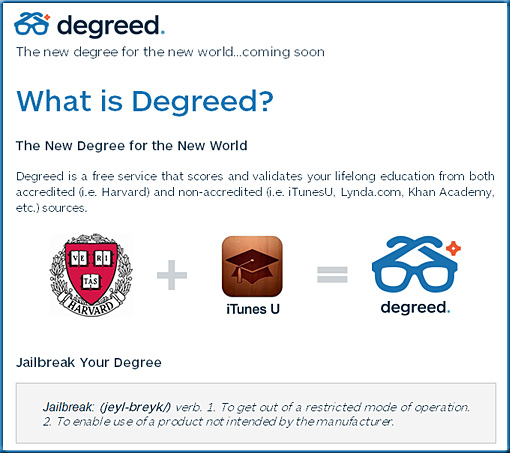
http://degreed.com/about/what_is_degreed


.

Addendums/also see:

  • mooctalk.org from Dr. Keith Devlin, mathematician at Stanford — added 7/17/12
    Excerpt from his blog:
    I’m Dr. Keith Devlin, a mathematician at Stanford University. In fall 2012, I’ll be launching my first free online math course. This blog will chronicle my experiences as they happen, and hopefully garner some feedback and discussion for what can be approached only as a huge, but exciting experiment.
  • One course, 150,000 students — from the New York Times by Tamar Lewin — added 7/19/12
    Excerpt re: “How does this all work with a global enrollment?
    It’s been amazing. You’d see someone post in Brazil looking for other students in Brazil so they could meet and have a study group at a coffee shop. Facebook sites for the course popped up, not all in English. There are people in Tunisia, Pakistan, New Zealand, Latin America. And a professor in Mongolia has a group of students taking the course. He got them all a little laboratory kit, so they’re doing the experiments live along with the course.
  • Democratizing Education: Peter Norvig on Reaching a Global Audience — from techapex.com by Brent Hannify
    Excerpt:
    Norvig delivered a TED Talk titled “The 100,000-student classroom” in which he shared what he and Thrun learned about reaching a global audience through online teaching. He and Thrun worked together to create an online class that would be equal or better than the flagship artificial intelligence class at Stanford … and to also bring it free to anyone who was interested in signing up. Norvig and Thrun watched in amazement as 50,000 people signed up during the first two weeks after the class’s announcement, and grew “a bit terrified” when it reached a total of approximately 160,000 students.

The 40 best sources of free music education online — from onlineuniversities.com

Excerpt:

When considering music education, most people don’t immediately think of studying online. Music is something that lends itself to being learned and experienced in person, but the fact is that excellent online music education is available as well. Many will be amazed by the amount of high quality resources that exist. Full courses, lessons, sheet music, and artistic exhibits are all available to study online for absolutely free, and we’ve found the best of them. Read on and discover 40 incredible sources of free music education.


41 open ed resources kids love — from OEDb.org

Excerpt:

Whether you’re a teacher looking to incorporate new media into a classroom setting, a homeschooling family, or a parent hoping to supplement the day’s formal coursework, the following resources offer some particularly great examples of using digital technology to get kids exploring the universe. They’re fun. They’re free. And they feature a diverse selection of topics and strategies, meaning almost every user will find something of interest.

.

Addendum on 7/9/12:

8 online platforms to help you further your education for free — from BostInno.com by Lauren Landry

Tagged with:  

“Learning from the living room” — Part I [Christian]

Learning from the living room -- a component of our future learning ecosystems -- by Daniel S. Christian, June 2012


Legal size PDF here


Addendum on 7/3/12 from an article I wrote for EvoLLLution.com (for LifeLong Learning):
Establishing better collaboration between the corporate world and higher education [Christian]

In the near future, perhaps we could have second screen-based activities whereby corporate leaders are giving TED-like presentations or expressing the current issues in their worlds via a program on Smart TVs, and the students are communicating and collaborating about these presentations via tablets or smart phones.  Perhaps there will be electronic means whereby students could submit their ideas and feedback to the presenting companies (and whereby selected ideas could be rewarded in terms of free products or services that the company produces).

Open Goldberg Variations: free, open source recording and modern score of classical masterpiece — from boingboing.net/ by Rob Beschizza

.

.

Excerpt:

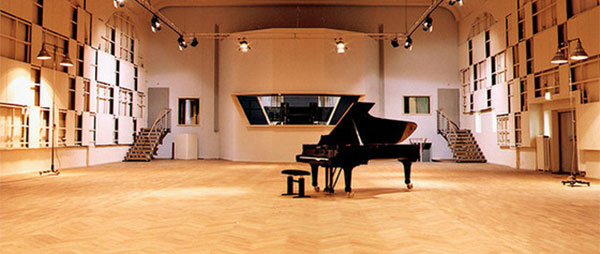
Performed by Kimiko Ishizaka on a Bösendorfer 290 Imperial in Berlin’s Teldex Studio, there’s already plenty to love about a new cut of Bach’s Goldberg Variations. But this one is also the first fan-funded, open source, and completely free recording of it.

“Every part of it is free for you to use, share, and copy,” said Robert Douglass, who launched the successful Kickstarter project behind Werner Schweer’s new version of the classic score and its production.

Tagged with:  

Elite universities’ online play — from insidehighered.com by Steve Kolowich

Excerpt:

Princeton University, the University of Pennsylvania and the University of Michigan at Ann Arbor have teamed up with a for-profit company to offer free versions of their coveted courses this year to online audiences. By doing so, they join a growing group of top-tier universities that are embracing massively open online courses, or MOOCs, as the logical extension of elite higher education in an increasingly online, global landscape.

Princeton, Penn and Michigan will join Stanford University and the University of California at Berkeley as partners of Coursera, a company founded earlier this year by the Stanford engineering professors Daphne Koller and Andrew Ng. Using Coursera’s platform, the universities will produce free, online versions of their courses that anyone can take.

Also see:

© 2025 | Daniel Christian