50 best sources of free STEM education online — from onlineuniversities.com

From DSC:
A solid listing covering universities, lectures, tutorials, educational media, free courses, and reading materials.

Tagged with:  

Blackboard launches Open Source Services Group — from Blackboard
Company will support both commercial & open source systems

WASHINGTON – March 26, 2012 – Blackboard Inc. today announced the launch of Blackboard Education Open Source Services, a new effort to support clients using open source education technologies. With the announcement, the company will continue to focus on its flagship Blackboard Learn platform as well as ANGEL and Edline, while also helping institutions successfully manage open source learning management systems (LMS) including Moodle and Sakai.

The move complements Blackboard’s existing focus on supporting the entire education experience with products and services for learning management as well as mobility, real time collaboration, analytics, campus services and notification, and other needs. Blackboard already serves hundreds of institutions that use Moodle, Sakai and other LMS systems in tandem with these additional education-focused solutions. In extending its focus to include open source options, Blackboard can support a wider variety of approaches to online learning and help institutions increase the value they get from technology of all kinds.

Tagged with:  

A Communiqué from the Horizon Project Retreat [2012]
Building on ten years of research into emerging technology in education

Excerpt:

From these discussions, 28 hugely important metatrends were identified. The ten most significant are listed here and will be the focus of the upcoming NMC Horizon Project 10th Anniversary Report:

  1. The world of work is increasingly global and increasingly collaborative. As more and more companies move to the global marketplace, it is common for work teams to span continents and time zones. Not only are teams geographically diverse, they are also culturally diverse.
  2. People expect to work, learn, socialize, and play whenever and wherever they want to. Increasingly, people own more than one device, using a computer, smartphone, tablet, and ereader. People now expect a seamless experience across all their devices.
  3. The Internet is becoming a global mobile network — and already is at its edges. Mobithinking reports there are now more than 6 billion active cell phone accounts. 1.2 billion have mobile broadband as well, and 85% of new devices can access the mobile web.
  4. The technologies we use are increasingly cloud-based and delivered over utility networks, facilitating the rapid growth of online videos and rich media. Our current expectation is that the network has almost infinite capacity and is nearly free of cost. One hour of video footage is uploaded every second to YouTube; over 250 million photos are sent to Facebook every day.
  5. Openness — concepts like open content, open data, and open resources, along with notions of transparency and easy access to data and information — is moving from a trend to a value for much of the world. As authoritative sources lose their importance, there is need for more curation and other forms of validation to generate meaning in information and media.
  6. Legal notions of ownership and privacy lag behind the practices common in society. In an age where so much of our information, records, and digital content are in the cloud, and often clouds in other legal jurisdictions, the very concept of ownership is blurry.
  7. Real challenges of access, efficiency, and scale are redefining what we mean by quality and success. Access to learning in any form is a challenge in too many parts of the world, and efficiency in learning systems and institutions is increasingly an expectation of governments — but the need for solutions that scale often trumps them both. Innovations in these areas are increasingly coming from unexpected parts of the world, including India, China, and central Africa.
  8. The Internet is constantly challenging us to rethink learning and education, while refining our notion of literacy. Institutions must consider the unique value that each adds to a world in which information is everywhere. In such a world, sense-making and the ability to assess the credibility of information and media are paramount.
  9. There is a rise in informal learning as individual needs are redefining schools, universities, and training. Traditional authority is increasingly being challenged, not only politically and socially, but also in academia — and worldwide. As a result, credibility, validity, and control are all notions that are no longer givens when so much learning takes place outside school systems.
  10.  Business models across the education ecosystem are changing. Libraries are deeply reimagining their missions; colleges and universities are struggling to reduce costs across the board. The educational ecosystem is shifting, and nowhere more so than in the world of publishing, where efforts to reimagine the book are having profound success, with implications that will touch every aspect of the learning enterprise.

These metatrends are the first of much yet to come in the next year. Watch NMC.org for news and more throughout the Horizon Project’s 10th Anniversary. To be part of the discussions, follow #NMChz!


From DSC:
Arguably, Sal Kahn has become the most famous, influential educator on the planet today — his videos are watched millions of times a day now.  The question — which Eric Schmidt answers in the piece — I couldn’t help but ask was, “Why didn’t this type of innovation come from someone who was working in education at the time of their innovation?”

My thanks to Dr. Kate Byerwalter and her colleagues for passing along this resource.
The tags/associated categories for this posting point out the relevant areas covered.
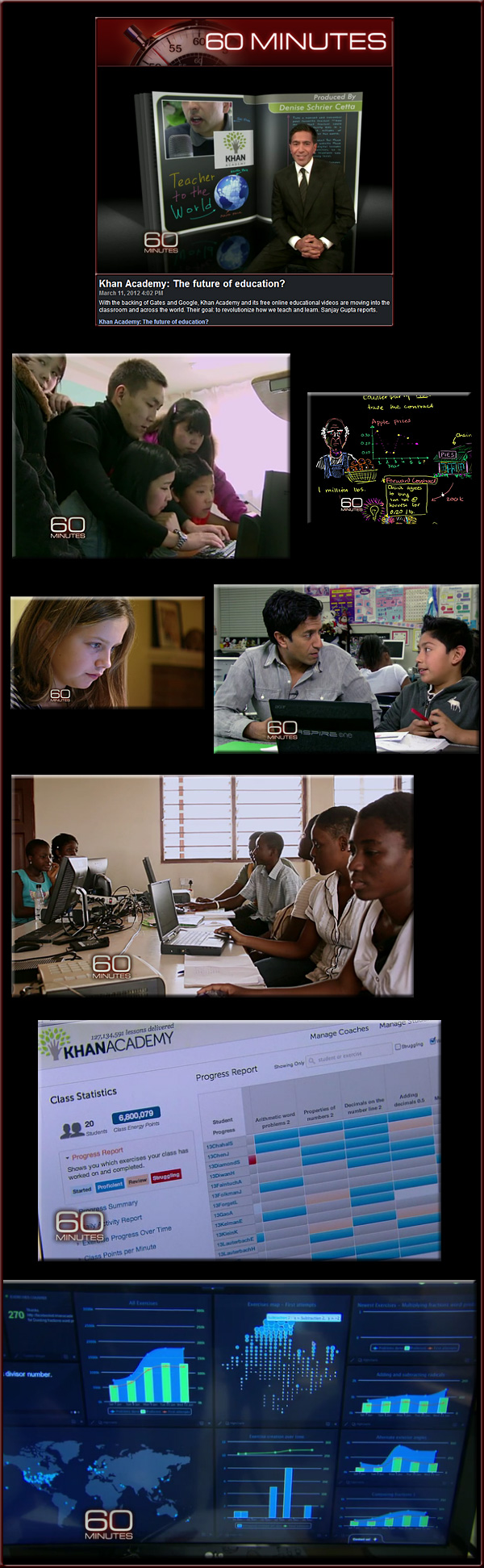
 

Khan Academy: The future of education?

Also see:

  • Khan Academy: The future of education?
    (CBS News) Sal Khan is a math, science, and history teacher to millions of students, yet none have ever seen his face. Khan is the voice and brains behind Khan Academy, a free online tutoring site that may have gotten your kid out of an algebra bind with its educational how-to videos. Now Khan Academy is going global. Backed by Google, Gates, and other Internet powerhouses, Sal Khan wants to change education worldwide, and his approach is already being tested in some American schools. Sanjay Gupta reports.

From DSC:
A relevant graphic comes to mind with what Sal is trying to achieve with analytics:
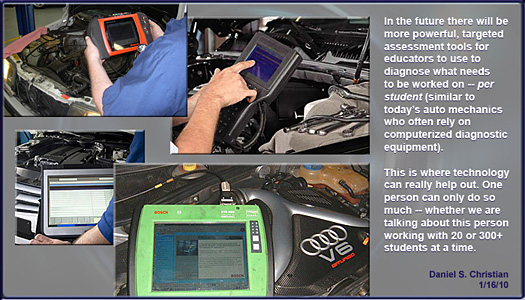
i.e. Highly-effective diagnostic tools for the educators and trainers out there!


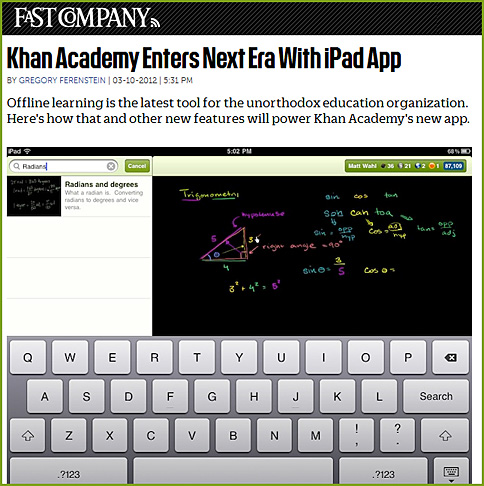
Khan Academy enters next era with iPad app — from FastCompany.com by Greg Ferenstein
Offline learning is the latest tool for the unorthodox education organization. Here’s how that and other new features will power Khan Academy’s new app.
.
Khan Academy now has an iPad-based app
 
.
 

Beyond the college degree, online educational badges— from the New York Times by Tamar Lewin

Excerpt:

With the advent of Massive Open Online Courses and other online programs offering informal credentials, the race is on for alternative forms of certification that would be widely accepted by employers.

By the end of this year, Mr. [David] Wiley predicted, it will become familiar to hear of people who earned alternative credentials online and got high-paying jobs at Google or other high-visibility companies.


Udemy’s Faculty Project nabs 50,000 students and an Ivy league professor — from gigaom.com by Ryan Lawler

Excerpt:

About six weeks ago, educational video startup Udemy launched its Faculty Project, a nonprofit program for distributing streaming university curriculum online. Early results have been pretty successful, with more than 50,000 students signing up for the program. But that’s not all: the Faculty Project is also bringing on ever more prestigious faculty, with its first Ivy League professor soon coming on board.

In contrast to Udemy’s for-profit platform, which enables teachers to create online courses and charges for access to them, the Faculty Project is a free offering that is designed to connect students from around the world with university faculty for high-quality courses online.

Who decides what gets sold in the bookstore? — from paidcontent.org by Seth Godin

Excerpt:

I just found out that Apple is rejecting my new manifesto Stop Stealing Dreams and won’t carry it in their store because inside the manifesto are links to buy the books [at Amazon.com] I mention in the bibliography.


From DSC:
By the way, some nice quotes from the Stop Stealing Dreams page:
  • The economy has changed, probably forever.  School hasn’t.
    .
  • Our kids are too important to sacrifice to the status quo.

From DSC:
This is exactly what I was getting at with The Forthcoming Walmart of Education (2008) and it points out, again, that innovation is much faster and stronger in the online world than it is in the face-to-face world. The tools being developed to engage, track, diagnose, and adapt continue to be developed. What may have once been poo-pooed continues to pick up steam. (Christensen, Johnson, & Horn are right on track.) The trend will be towards more team-based endeavors that can be made available at a greatly reduced price. They will be multimedia-based, highly-interactive, and state-of-the-art (technically and pedagogically).

Treating Higher Ed’s ‘Cost Disease’ With Supersize Online Courses — from The Chronicle by Marc Parry

Excerpt (with emphasis from DSC):

Professors should move away from designing foundational courses in statistics, biology, or other core subjects on the basis of “intuition,” she argues. Instead, she wants faculty to work with her team to put out the education equivalent of Super Bowl ads: expensively built online course materials, cheaply available to the masses.

“We’re seeing failure rates in these large introductory courses that are not acceptable to anybody,” Ms. Thille says. “There has to be a better way to get more students—irrespective of where they start—to be able to successfully complete.”

Her approach brings together faculty subject experts, learning researchers, and software engineers [from DSC — a TEAM-based approach] to build open online courses grounded in the science of how people learn. The resulting systems provide immediate feedback to students and tailor content to their skills. As students work through online modules outside class, the software builds profiles on them, just as Netflix does for customers. Faculty consult that data to figure out how to spend in-person class time.

From DSC:
Such learner profiles will most likely reside in the cloud and eventually standards will be established to insert new data into these profiles. The access to view/edit these profiles will be controlled by the individual learners (hopefully!).  What if learners could selectively grant corporations access to this type of profile as their new resume?

For items concerning team-based approaches, see this recording (June 2009) as well as this collection of items.

For items concerning consortia and pooling resources, see here and here.


Living room video calling users to surpass 16 million in 2015 — from instat.com

Excerpt:

The video calling market can be divided into three sub-markets depending on the device which is being used to make the call: PCs, Mobile, and living room (digital home) devices.  Living room video calling is a nascent market and currently has a relatively small user base. New NPD In-Stat (www.in-stat) research forecasts that total users will increase from 1.5 million in 2011 to 16.4 million in 2015. Asia Pacific will be the largest market for living room video calling by a significant margin as this is the region with the highest video calling enabled device shipments.

.

From DSC:

  1. The massive convergence of the TV, the computer, and the telephone continues
  2. The current model of higher ed has run it’s course — the model is breaking down
  3. The cost of obtaining an education must decrease; new business models are and will continue to come to fruition
  4. One of those business models is what I call “The Forthcoming Walmart of Education
  5. One of the pieces of this “Walmart of Education” will involve “learning from the living room
  6. “Students” will be able to watch one device while interacting with another device (though I could also see everything happening via one device as well)
  7. Learning will likely be more interactive, multimedia-based, available 24x7x365, personalized, customized and backed up by some serious social networking/learning, analytics, artificial intelligence, learning agents, and online-based tutoring
  8. “Textbooks” will flow into the living rooms as well as to tablets, smart phones, and other devices; but they will be more like apps where updates will occur as necessary
  9. Rock-star profs are likely to emerge
  10. Anyway…”stay tuned”


Also see:

A Disrupted Higher-Ed System — from The Chronicle by Jeff Selingo

Excerpt:
Just look at the last month:

  • The Massachusetts Institute of Technology announced that it would create MITx, a self-service learning system in which students can take online tests and earn certificates after watching free course materials posted by the university.
  • StraighterLine, which offers self-paced introductory courses online, said that it would give students access to the Collegiate Learning Assessment and other similar tests, allowing them to take results to employers or colleges to demonstrate their proficiency in certain academic areas.
  • Apple introduced three free pieces of software that allow students to download or create textbooks, and that permit instructors to create a digital curriculum in iTunesU.


Free courses, elite colleges — from InsideHigherEd.com by Steve Kolowich

Excerpt:

Robert Garland, a professor of classics at Colgate University, is not accustomed to discussing Greek religion with the lifeless lens of his MacBook’s built-in video camera. But that was how Garland spent Wednesday afternoon: in his home study, recording lectures on his laptop in 20-minute chunks.

Garland, a novice to online teaching, says it is difficult to think of these solitary sessions as lectures. “I think of them more as chats,” he says.

Garland’s gear is lo-fi: just the laptop, which he owns, and a microphone mailed to him by Udemy, the company that roped him into this.

The Faculty Project

The Faculty Project - January 2012

From DSC:
I originally saw this at:

Tagged with:  


Tagged with:  
© 2025 | Daniel Christian