Netflix CEO: ‘TV in the future will be like a giant iPad’ [Ligaya ]

Netflix CEO: ‘TV in the future will be like a giant iPad’ — from business.financialpost.com by Armina Ligaya

Excerpt (emphasis DSC):

Q: What do you think is going to happen over the next five or 10 years in internet video?

A: Well, you know, the fundamental thing is the internet has been getting faster. And now it’s video capable, which is really a last-five-years phenomenon. And, internet video will be very transformative across all societies for telemedicine, for online learning, for education. For communication of various sorts. And it brings, whether it’s person to person, or a recorded video like a movie or a TV show, to a person it will be very transformative.

And, TV in the future will be like a giant iPad. It will have a bunch of apps on it, each app will have a unique experience.

…

So we’re getting beyond just a stream of video, which is all broadcast technology can do, to really try to be innovative about the interaction.

.

The Living [Class] Room -- by Daniel Christian -- July 2012 -- a second device used in conjunction with a Smart/Connected TV


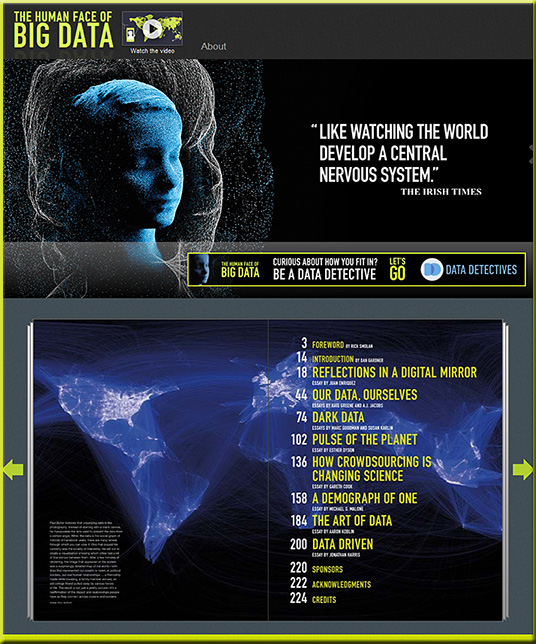
TheHumanFaceOfBigData-May2013


About the book: (emphasis DSC):

The book contains more than 200 stunning images and compelling essays, created by a team of over 100 of the world’s most talented writers, designers and photojournalists, illustrating just some of the ways big data is already helping to shape and address many of the biggest challenges facing our planet. The concept of the book, and of The Human Face of Big Data project, revolves around the idea that our planet is developing a nervous system that many data experts believe will soon have a greater impact on our lives than the Internet. The book is accompanied by an interactive iPad app, which also launched [on 12/4/12]. This ambitious project, conceived by “Day in the Life” series creator Rick Smolan and his partner Jennifer Erwitt is made possible by primary sponsor EMC, along with support from Cisco and FedEx.

“Our goal is to help people better understand, visualize and navigate the wild and uncharted territory of Big Data,” said Rick Smolan. “Big Data is just that – BIG. But, it’s a term that is largely misunderstood and difficult to explain. This book and the accompanying interactive iPad app are designed to take readers on a journey of discovery about a topic that is going to completely transform the world our children will inherit. It’s already enabling our kids to live healthier and happier lives; providing our seniors with independence while keeping them safe; helping us conserve our precious resources like water and energy; allowing us to peer into our own individual genetic makeup, and soon may allow us to alter our own species. All this and we’ve barely scratched the surface of what’s possible.”


The folks needed to create the next generation of learning: Computers can’t touch this. [Christian]

From DSC:
What we need is a major hackathon — or an organization with deep pockets — that can bring together folks from a variety of disciplines including:

  • Subject Matter Experts
  • Instructional Designers
  • Cognitive Psychologists
  • Computer Scientists and/or those exerienced with learning analytics/data mining, Artificial Intelligence (AI)
  • Those gifted in film/media/videography/photography
  • Great storytellers/writers (including writing for transmedia-based learning experiences)
  • Folks who can create engaging, educational games
  • Designers
    • Web
    • Graphic
    • Interface
    • User experience
    • User interaction
    • Those gifted in creating multimedia-based content
  • Musicians
  • Human Computer Interaction (HCI) experts
  • Mobile learning experts
  • Those knowledgeable with second screens/M2M communications
  • Animators
  • Illustrators
  • Social media experts
  • Accessibility experts
  • Researchers
  • Those gifted in creating augmented reality-based apps
  • Legal/copyright experts
  • & others

We need for these specialists to collaborate in order to create the next generation of learning.  Anyone who can bring these skillsets together and experiment with creating materials will have significantly contributed something to the current generations and to future generations! 

And, in the words of M.C. Hammer,  computers “can’t touch this!”  Why? Because “learning is messy!”

What fields did I miss?
Please leave your thoughts and
feedback in the comments section.


BII REPORT: Here’s why the “second screen” industry is set to explode — BusinessInsider.com

BII REPORT: Here’s why the “second screen” industry is set to explode — BusinessInsider.com

Excerpt:

Here’s why the second screen industry will ultimately succeed:

  • Usage is growing rapidly
  • And mass acceptance isn’t even necessary
  • Second screen isn’t really a new activity
  • Second screen apps and sites are bridges


From DSC:
As this article alludes to, I wouldn’t rule the living room out in terms of where interactive, multimedia-based, educationally-related, second screen-based applications will turn up (apps backed up by data mining, AI, and opportunities for social learning). This area is poised for some serious growth. 


The Living [Class] Room -- by Daniel Christian -- July 2012 -- a second device used in conjunction with a Smart/Connected TV


My reflections on “MOOCs of Hazard” – a well-thought out, balanced article by Andrew Delbanco


From DSC: Below are my reflections on MOOCs of Hazard — from newrepublic.com by Andrew Delbanco — who asks:  Will online education dampen the college experience? Yes. Will it be worth it? Well…


.
While I’m not sure that I agree with the idea that online education will dampen the college experience — and while I could point to some amazing capabilities that online education brings to the table in terms of true global exchanges — I’ll instead focus my comments on the following items:


1) Massively Open Online Courses (MOOCs) are recent experiments — ones that will continue to change/morph into something else.
They are half-baked at best, but they should not be taken lightly. Christensen, Horn, Johnson are spot on with their theories of disruption here, especially as they relate to innovations occurring within the virtual/digital realm.  For example, the technologies behind IBM’s Watson could be mixed into the list of ingredients that will be used to develop MOOCs in the future.  It would be a very powerful, effective MOOC indeed if you could get the following parties/functionalities to the table:

  • IBM — to provide Watson like auto-curation/filtering capabilities, artificial intelligence (AI) capabilities, as well as data mining/learning analytics expertise, joined by
  • Several highly-creative firms from the film/media/novel/storytelling industry, who would be further joined by
  • Experts from Human Computer Interaction (HCI)/user interface/user experience design teams, who would be further joined by
  • Programmers and interaction specialists from educational gaming endeavors (and from those who can design simulations), joined by
  • Instructional designers, joined by
  • The appropriate Subject Matter Experts who can be reached by the students as necessary, joined by
  • Those skilled in research and library services, joined by
  • Legal experts to assist with copyright issues, joined by
  • Other specialists in mobile learning,  3D, web development, database administration, animation, graphic design, musicians, etc.

It won’t be long before this type of powerful team gets pulled together — from some organizations(s) with deep pockets — and the content is interacted with and presented to us within our living rooms via connected/Smart TVs and via second screen devices/applications.

2) The benefits of MOOCs
  • For colleges/universities:
    • MOOCs offer some serious marketing horsepower (rather than sound pedagogical tools, at this point in time at least)
    • They are forcing higher ed to become much more innovative
    • They provide great opportunities to build one’s personalized learning networks, as they bring forth those colleagues who are interested in topic A, B, or C
    • They move us closer to team-based content creation and delivery
      .
  • For students:
    • They offer a much less expensive option to go exploring disciplines for themselves…to see if they enjoy (and/or are gifted in) topic A, B or C
    • They provide great opportunities to build one’s personalized learning networks, as they bring forth those colleagues who are interested in topic A, B, or C
    • They provide a chance to see what it’s like to learn about something in a digital/virtual manner

3)  The drawbacks of MOOCs:
  • MOOCs are not nearly the same thing as what has come to be known as “online learning” — at least in the higher ed industry. MOOCs do not yet offer what more “traditional” (can I say that?) online learning provides: Far more support and pedagogical/instructional design, instructor presence and dialog, student academic support services, advising, more student-to-student and student-to-faculty interaction, etc.
    .
  • MOOCs are like drinking from a firehose — there are too many blogs/RSS feeds, twitter feeds, websites, and other resources to review.

4) It would be wise for all of us to be involved with such experiments and have at least a subset of one’s college or university become much more nimble/responsive.


Also see:

My thoughts on the future of higher education -- March 2013 by Daniel Christian


Also, the PDF file of this article is here.

.

From DSC:
Though the title of this article I wrote says 10 years, it may be more or less (and given the pace of change, I would lean towards sooner rather than later).  

If you haven’t read Christensen’s/Horn’s/Johnson’s work re: disruption — such as Disrupting Class and/or The Innovator’s Dilemma — it would be worth your time to do so. They are right on the mark. What they have been asserting is happening within higher education.  The article briefly addresses face-to-face learning and hybrid learning as well.  Readers of this blog will know that I have been pressing for higher ed to reinvent itself in order to stay relevant. There is danger in the status quo, especially when the conversation continues to move away from traditional higher education.

See other perspectives out at evoLLLution.com as well.


Items re: multi-screen media — eventually this trend/convergence enables “Learning from the Living [Class] Room”

PayWizard launches first dedicated payment and subscriber management solution for TV and media industry — from PayWizard

Excerpt:

London, 21 February 2013 – PayWizard, specialists in payment and subscription management, has launched the TV and media industry’s first dedicated, end to end payment and subscription solution. The integrated solution brings together a strong heritage in the Pay-TV market with a deep understanding of the challenges TV operators and media companies face in monetising the multiplatform world.

Using its award-winning modular Payment and Subscription platform, PayWizard combines payment processing, intelligent subscriber management technology and real-time customer service operations to tailor-make solutions that enhance the consumer experience across all screens.

With 16.8 billion video-enabled devices set to be in the global marketplace by 2015, content owners are facing the challenge of enhancing existing services while creating compelling experiences that embrace new routes to market. PayWizard’s comprehensive set of products and services has enabled clients, such as the UK’s biggest commercial broadcaster, ITV, to address these commercial challenges by enabling new monetisation strategies to drive revenue and profitability.


Also see:

.

ConnectedTVSummit-London-2013


.


Nagra-Kudelskidotcom-March2013


.

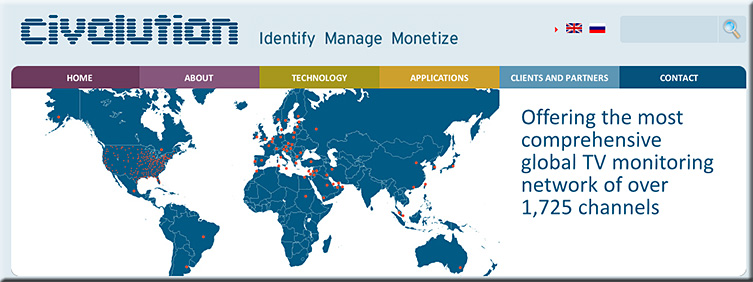
civolution-march2013

.

Also see:


From DSC:
See the categories listed above for the items/topics/disciplines/trends that are relevant here.


Addendum:

Check this out!

Massive Open Online Course offered by UMass Boston to feature the first adaptive MOOC technology
Enables students to be taught according to individual learning strategies

Excerpt from email:

(Boston, MA) – February 27, 2013 – If you’ve ever been in a course and struggled because you just aren’t “getting it,” the reason might be less your ability than the way in which the material is being presented.

New technology is now allowing online course environments to analyze how individual students learn, customizing instruction to individualized learning strategies. The College of Advancing and Professional Studies (CAPS) at the University of Massachusetts Boston has teamed up with USDLA 21st Century Sponsor, Synaptic Global Learning (SGL), to use the new learning management system, Adaptive Mobile Online Learning (AMOL), to deliver the first adaptive Massive Online Open Course (a-MOOC) ever offered. The course launches March 25.

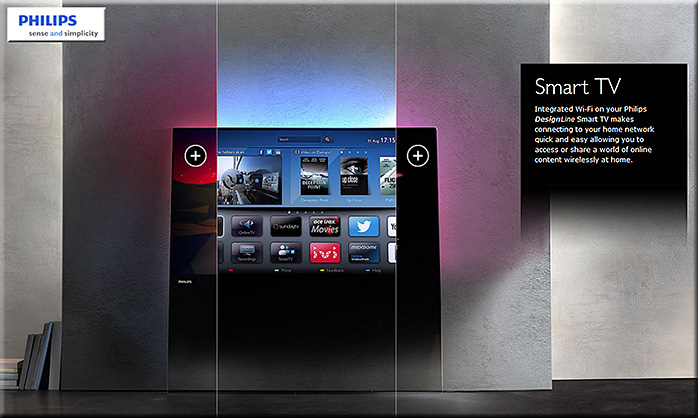
PhilipsSmartTV-March2013

Adaptive machine learning for real-time streaming [Microsoft Research]


The above item is one of several items to check out at this slideshow from networkworld.com. 

Also see:


Addendum on 9/25/13 — with thanks to Mr. Olivier Nano (Microsoft) & Mr. Sathyan Munirathinam (Micron Technology)

The following resources are part of the overall project:

From DSC:
Lynda.com, an excellent resource, now uses digital playlists.

Here’s an idea.  How about, in the future, students will be able to run through a series of digital playlists:

  • Focusing on a particular topic and/or a course from:
    • A particular college or university
    • A consortium of colleges and universities
    • A group of approved subject matter experts

If and when a person gets stumped — and the artificial intelligence has reached the end of its usefulness — provide a way for that student to connect with a TA, a professor, the subject matter expert, and/or with other students.


FAQs vs. Intelligent Virtual Assistants — from nlinews.com


FAQs vs. Intelligent Virtual Assistants


Excerpt:

When we know that 96% of people visit a website before they are willing to pick up the phone to resolve a query, it makes it even more important that they get the online help they need. But remember, satisfactory online customer service isn’t just about whether a correct answer was obtained but also the ease of the experience. The key to delivering great intuitive online customer service lies within your choice of an FAQ page or Intelligent Virtual Assistant.

This table shows you the capabilities of both systems, and I know which one I would go for…


From DSC:
Note the “Hand over to live agent” piece of that table…

#etmooc


Beyond voice recognition: It’s the age of intelligent systems — from forbes.com by Eric Savitz; with thanks to Steve Knode (steveknode.com) for posting this on his recent newsletter

Excerpt:

But the pace of innovation continues. Expect the current generation of virtual personal assistants to evolve into ubiquitous intelligent systems. These will communicate with people through voice, text, vision, touch and gestures and will factor in ambient information like location or motion to understand context, giving greater relevance of every interaction.

Here’s a look at some developments to watch in intelligent systems for 2013…


From DSC:
And I’ll bet they integrate into what MOOCs will morph into.


From DSC:
Below are some reflections after seeing these items:

Image1


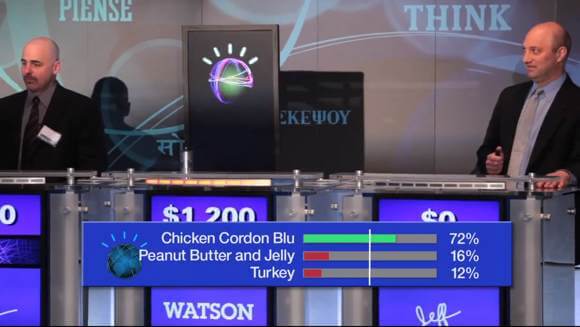
  • Watson supercomputer goes to college, Revenge Of The Nerds style antics imminent — not an exemplary article from geekosystem.com, but the underlying topic has enormous implications
    Excerpt:
    …the team developing Watson is sending the computer to college, where it will bone up on coursework in English and math.
    …
    While the original Watson will be staying put at the IBM research center it calls home, the hardware to run the program is being installed at the Rensselaer Polytechnic Institute in upstate New York, where researchers and grad students will be spend the next three years teaching Watson all they can while also hoping to learn more about how the software learns and make it more effective.


.


Watson-MOOCs-NewTypesCollaboration-DChristian-2-14-13


From DSC:
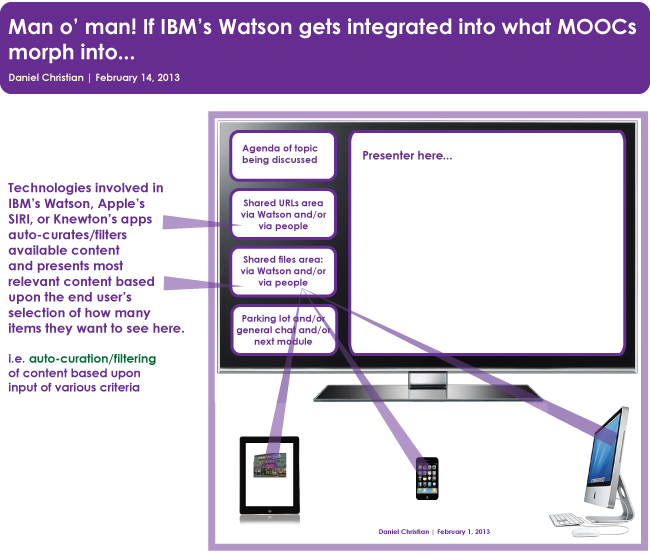
The current set of MOOCs are very powerful, but, like a bush that needs pruning, they can become unwieldy and hard to control.  Not only do the current set of MOOCs help me to see the importance of instructional design, but trying to drink from the firehose often presents problems (i.e. wading through thousands of tweets, hundreds of blog posts, etc.).  How can we still provide openness and yet provide people with better methods/tools for setting their desired level of drinking from this firehose? Tags are helpful, but for most people, they are not doing enough to filter/curate the content at this point.

Enter the technologies being developed in IBM’s Watson, Apple’s SIRI, or in Knewton’s product lines. End-user controllable setting might include:

  • Full throttle — like current form of MOOCs — thousands of tweets, hundreds of blog posts, etc.
  • IBM Watson-enabled curation/filtering only — each individual adjusts how many items they want to see in the various portions of the interface (see above); these settings control how many items and/or streams of content get presented to you

The ideas involving learning agents, artificial intelligence, intelligent tutoring, intelligent systems and more seem to get roped in here…hmm…just thinking out loud and sharing potentially-useful ideas.


College branding: The tipping point — from forbes.com by Roger Dooley

Excerpt:

Change is coming to this market. While there are multiple issues of increasing importance to schools, two stand out as major game-changers.


From DSC:
Important notes for the boards throughout higher education to consider:


Your institution can’t increase tuition by one dime next year. If you do, you will become more and more vulnerable to being disrupted. Instead, work very hard to go in the exact opposite direction. Find ways to discount tuition by 50% or more — that is, if you want to stay in business.

Sounds like the scene in Apollo 13, doesn’t it? It is. (i.e. as Tom Hanks character is trying to get back to Earth and has very little to do it with. The engineers back in the United States are called upon to “do the impossible.”)

Some possibilities:

  • Pick your business partners and begin pooling resources and forming stronger consortia. Aim to reduce operating expenses, share the production of high-quality/interactive online courses, and create new streams of income. Experimentation will be key.
  • Work with IBM, Apple, Knewton and the like to create/integrate artificial intelligence into your LMS/CMS in order to handle 80% of the questions/learning issues. (Most likely, the future of MOOCs involves this very sort of thing.)
  • Find ways to create shorter courses/modules and offer them via online-based exchanges/marketplaces.  But something’s bothering me with this one..perhaps we won’t have the time to develop high-quality, interactive, multimedia-based courses…are things moving too fast?
  • Find ways to develop and offer subscription-based streams of content


The object formerly known as the textbook –– from The Chronicle by Jeff Young

.

Don't Call Them Textbooks 1

Holly Gressley for The Chronicle


Excerpt:

Textbook publishers argue that their newest digital products shouldn’t even be called “textbooks.” They’re really software programs built to deliver a mix of text, videos, and homework assignments. But delivering them is just the beginning. No old-school textbook was able to be customized for each student in the classroom. The books never graded the homework. And while they contain sample exam questions, they couldn’t administer the test themselves.

One publisher calls its products “personalized learning experiences,” another “courseware,” and one insists on using its own brand name, “MindTap.” For now, this new product could be called “the object formerly known as the textbook.”


From DSC:
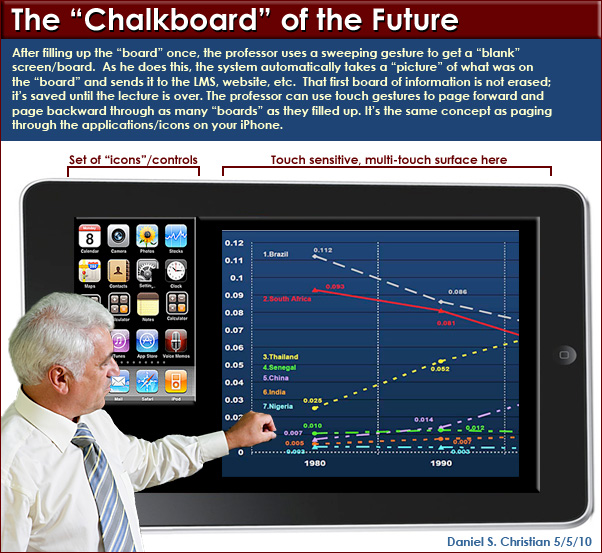
Imagine how this sort of thing might fit into the “chalkboard of the future” — as applications and content flow onto the “board” from open source repositories and/or from the publishers’ cloud-based repositories of content…

.

Daniel Christian: The Chalkboard of the Future

.

or in learning from the living room…

.

The Living [Class] Room -- by Daniel Christian -- July 2012 -- a second device used in conjunction with a Smart/Connected TV


Also see:

From DSC:

In real estate, one hear’s the mantra:
Location. Location. Location.

In higher education, I have it that we’ll be hearing this for a while:
Experimentation. Experimentation. Experimentation.

Consider the following reflections on Steve’ Kolowich’s solid article, The new intelligence (from InsideHigherEd.com)

Excerpt:

And for the largest public university in the country, it is hardly fiction. Arizona State University has become ground zero for data-driven teaching in higher education. The university has rolled out an ambitious effort to turn its classrooms into laboratories for technology-abetted “adaptive learning” — a method that purports to give instructors real-time intelligence on how well each of their students is getting each concept.
.


From DSC:
Besides being used in blended learning environments…some predictions:

  • These technologies will become integrated into what MOOCs eventually morph into and provide a significant piece of the assessment/guidance puzzle
  • Such tools will be a part of one’s future learning ecosystem
  • Such tools will be part of interactive, massively open online educationally-related games
  • Such tools will be integrated into personalized learning agents — spiders/recommendation engines that scan the web for relevant items that one needs to complete one’s cognitive gaps in a subject/topic
  • They will be accessible from your living room as well as from your mobile devices
  • They will integrate into web-based learner profiles

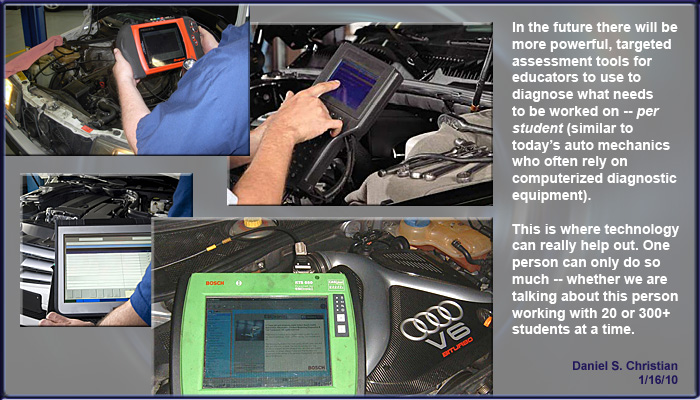
It’s the sort of thing I was trying to get at with this graphic from 3 years ago:
.
Like a mechanic...


Please don’t misunderstand me, the human mind is far beyond the complexity of an engine. But I still think that there will be more tools & technologies developed that will help the teachers/professors in their efforts to guide students into the knowledge of a discipline.

I beseech the corporate world to get involved more here — and not with the end goal of earning profits — but rather, with the aim of making the world a better place and giving a huge gift to the generations yet born. 

I urge the corporate world to reach into their deep pockets (1.X trillion in cash at this point in time) and team up with our youth/teachers/professors/instructional designers/programmers/etc. to develop sophisticated, educationally-related, engaging games that are relevant to the world that our youth will be growing up in; and/or create interactive simulations that provide more choice/more control to the learners. 

I urge more of the corporate world to join Knewton and Pearson and allocate some significant resources to help develop the next gen learning tools.  I’ll bet that we’ll be amazed at what can be produced! Your daughters, sons, granddaughters, and grandsons will really appreciate the work that you did for them!!!


© 2025 | Daniel Christian