DocVerse–Now Google Cloud Connect–Head Shan Sinha Talks About Web-Based Biz Apps — from kara.allthingsd.com
Apple Pushes Into the Cloud — from The Street
DocVerse–Now Google Cloud Connect–Head Shan Sinha Talks About Web-Based Biz Apps — from kara.allthingsd.com
Apple Pushes Into the Cloud — from The Street
Towards a new-digital learning ecosystem based on autonomic Web services — from IEEEXplore Digital Library (emphasis below from DSC)
Abstract
With the latest advances in information and communication technologies, learners can now engage in continuous and rich learning-sessions that characterize today’s digital learning ecosystems. In these ecosystems, learning resources are pervasive and dynamic. A key challenge is to develop a scalable learning system that addresses the inherent complexity of learning sessions and cater for the specific needs and requirements of individual learners. In this paper, we adopt autonomic Web services to capture disparate learning resources and build an autonomic digital learning ecosystem that reconfigures itself in response to changes in the environment such as learners’ profiles, resource availabilities, and type of instructional material. The use of autonomic Web services permits to abstract the learning resources into distributed and uniformly structured objects and to record learners’ attributes into a packaged profile. These Web services sense the learning context and coach learners in their pursuit of constructive instructional sessions. A service-oriented architecture is proposed to connect learning resources, learners’ profiles, and contextual indicators. A prototype is, also, illustrated in the paper to show the feasibility of the proposed solutions.
Also see:
Apple launches Mac App Store today — from Apple.com; also see this article at FastCompany.com
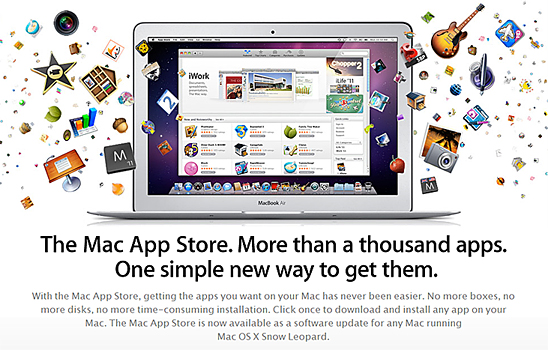
Excerpt from the FastCompany.com article:
The arrival of the App Store is causing much debate online about the changing nature of PC software. Much as the iOS App Store is the key to the iPhone and iPad’s success, and beats its competitors app store efforts, the Mac App Store has massive potential to upend the PC software vending market. Early indications suggest Mac Apps will sell for less than the traditional price brackets Mac software’s been sold at for decades. This could revolutionize the Mac market, turning it into something that could really allow Macs to challenge the traditional Windows market dominance in enterprise or at home–particularly as it’s a one-stop-shop for games, utilities and so on, and even handles updates in a way Windows can’t challenge.
Also see:
How the Mac App Store Changes Everything — from Mashable.com
2011 Cloud Computing Predictions For CIO’s And Business Technology Leaders — from Forbes.com by Ray Wang
The Bottom Line: Cloud Adoption Provides A Path To The Next Generation Enterprise
Cloud adoption is inevitable. Business technology leaders will move beyond “try and buy” across the Cloud Stack for seven reasons:
Six Hot Workplace Trends for 2011 from cio.com by Shane O’Neill
Connections, Clouds, Things & Analytics –– from George Siemens
From DSC:
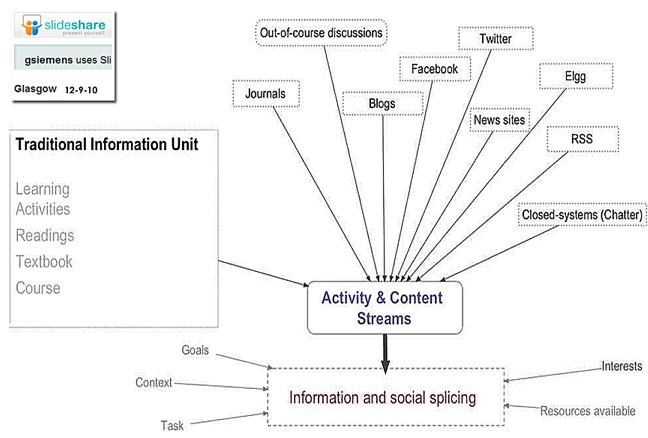
In looking through George’s presentation, the following graphic reminded me of a learning ecosystem. The idea of activity and content streams speaks of constant flow, change, new information. Look are the sources of where learning can come from:
.
As an instructional designer, how do we incorporate all of this?
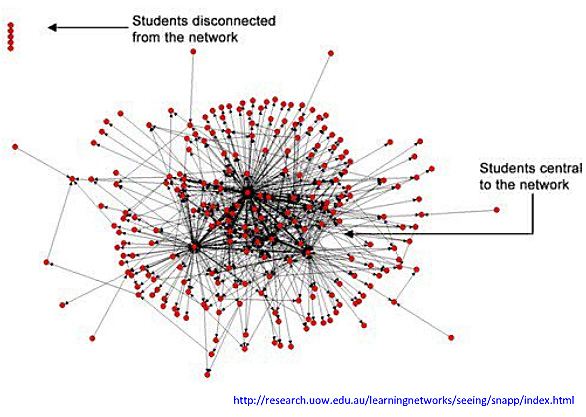
Finally, one other thought, if we are not connected to a network of bloggers (and have a series of RSS feeds keeping us constantly up-to-date) or have some other means of tapping into these streams of activities and sources of content, we will look like this:
Cutting the Pay TV Cord, Chapter 5: Unlimited Internet TV — from Phil Leigh

In short, often there is no reason why modern flat panel TV screens cannot function as giant monitors for up-do-date computers.
Thus a growing number of us are attaching computers to our TVs. The trend is especially prevalent for WiFi enabled computers because they can connect over a home network and thence to the Internet. In such configurations computers – commonly dedicated laptops – function as Internet gateways for televisions. They transform TVs into dual function devices normally controlled from a comfortable viewing distance with ordinary TV remote units.
Also see:
Gartner’s top 10 technologies for 2011 — from GlobalKnowledge.com by Larry Dignan; with special thanks to Mr. Cal Keen, Calvin College, for this resource
The future of Microsoft Windows Azure: Platform as a service — from arstechnica.com by Peter Bright

.
At PDC yesterday, Microsoft unveiled its roadmap for the Windows Azure cloud computing platform. Moving beyond mere Infrastructure-as-a-Service (IaaS), the company is positioning Windows Azure as a Platform-as-a-Service offering: a comprehensive set of development tools, services, and management systems to allow developers to concentrate on creating available, scalable applications.
Over the next 12-18 months, a raft of new functionality will be rolled out to Windows Azure customers. These features will both make it easier to move existing applications into the cloud, and enhance the services available to cloud-hosted applications.
From DSC:
In reading Ray Ozzie’s views of the future (Ray is the departing high-level visionary at Microsoft), it was interesting to note that Ray points out the dangers of complexity — at least in the world of computing/software development. Quotes from both 2005 and 2010 are below:
Complexity kills. It sucks the life out of developers, it makes products difficult to plan, build and test, it introduces security challenges, and it causes end-user and administrator frustration. Moving forward, within all parts of the organization, each of us should ask “What’s different?”, and explore and embrace techniques to reduce complexity.
Complexity kills. Complexity sucks the life out of users, developers and IT. Complexity makes products difficult to plan, build, test and use. Complexity introduces security challenges. Complexity causes administrator frustration.
Top 100 Tools for Learning 2010: Final list, presentation and more — from Jane Knight
Yesterday I finalised the Top 100 Tools for Learning 2010 list. Many thanks to the 545 people who shared their Top 10 Tools for Learning and contributed to the building of the list. Although this list is available online, I also created this presentation which provides the information as a slideset – embedded below.
Jane Hart, a Social Business Consultant, and founder
of the Centre for Learning & Performance Technologies.