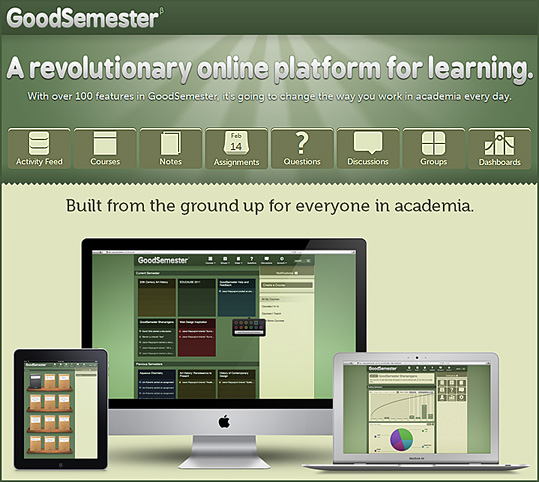
GoodSemester.com

 .

https://www.goodsemester.com/?p=featuretour

From DSC:

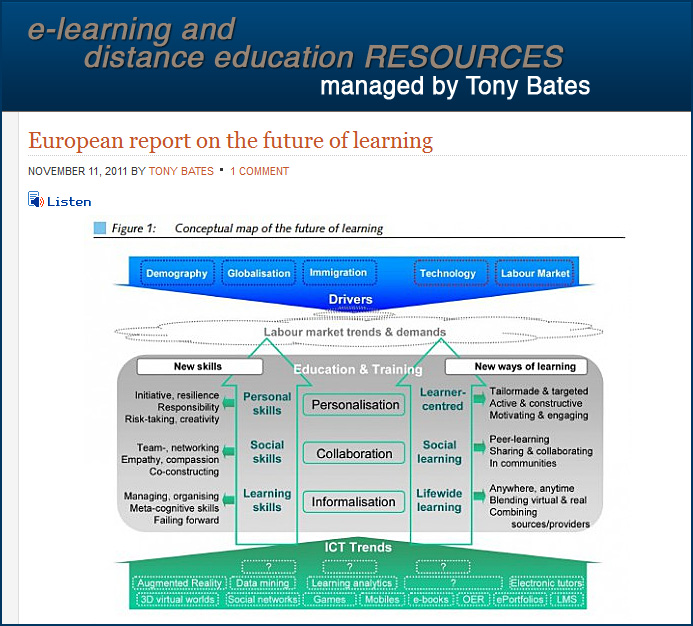
  • Tie this type of cloud-based platform in with learning analytics, new types of certifications/assessments/badges, web-based learner profiles, and the ability to continue building your own cloud over a lifetime, and you may find yourself enjoying a very powerful learning ecosystem!!!


Living room video calling users to surpass 16 million in 2015 — from instat.com

Excerpt:

The video calling market can be divided into three sub-markets depending on the device which is being used to make the call: PCs, Mobile, and living room (digital home) devices.  Living room video calling is a nascent market and currently has a relatively small user base. New NPD In-Stat (www.in-stat) research forecasts that total users will increase from 1.5 million in 2011 to 16.4 million in 2015. Asia Pacific will be the largest market for living room video calling by a significant margin as this is the region with the highest video calling enabled device shipments.

.

From DSC:

  1. The massive convergence of the TV, the computer, and the telephone continues
  2. The current model of higher ed has run it’s course — the model is breaking down
  3. The cost of obtaining an education must decrease; new business models are and will continue to come to fruition
  4. One of those business models is what I call “The Forthcoming Walmart of Education“
  5. One of the pieces of this “Walmart of Education” will involve “learning from the living room“
  6. “Students” will be able to watch one device while interacting with another device (though I could also see everything happening via one device as well)
  7. Learning will likely be more interactive, multimedia-based, available 24x7x365, personalized, customized and backed up by some serious social networking/learning, analytics, artificial intelligence, learning agents, and online-based tutoring
  8. “Textbooks” will flow into the living rooms as well as to tablets, smart phones, and other devices; but they will be more like apps where updates will occur as necessary
  9. Rock-star profs are likely to emerge
  10. Anyway…”stay tuned”


Also see:

A Disrupted Higher-Ed System — from The Chronicle by Jeff Selingo

Excerpt:
Just look at the last month:

  • The Massachusetts Institute of Technology announced that it would create MITx, a self-service learning system in which students can take online tests and earn certificates after watching free course materials posted by the university.
  • StraighterLine, which offers self-paced introductory courses online, said that it would give students access to the Collegiate Learning Assessment and other similar tests, allowing them to take results to employers or colleges to demonstrate their proficiency in certain academic areas.
  • Apple introduced three free pieces of software that allow students to download or create textbooks, and that permit instructors to create a digital curriculum in iTunesU.


Press release: Datatel & SunGard Higher Education close transactions to combine their businesses — from ecampusnews.com
New Company to Help Institutions Succeed in Changing Education Environment

Excerpt:

SAN FRANCISCO, FAIRFAX, Va., and WAYNE, Pa. – January 23, 2012 – Hellman & Friedman, Datatel+SGHE, and SunGard Data Systems today announced that the transactions to combine the businesses of Datatel and SunGard Higher Education have closed. As a result, more than 3,000 employees will be dedicated exclusively to delivering solutions to education institutions in 40 countries.

The newly formed company will have a new name, which will be launched in the first half of 2012. Until that time, it will be referred to as Datatel+SGHE.


Tagged with: • •  

From DSC:
I would also add that being able to program — and extract data from — educationally-related  apps will be a key skill to have as well.  Analytics in education continues to build up steam — though I wish such efforts and investments in analytics would be more focused on creating personalized/customized learning — and not so much on mining data for standardized testing and reporting for the legislators and administrations to review.

.

Pearson and Knewton charge ahead with adaptive courses — from The Journal by Dian Schaffhauser

Excerpt:

“Personalized learning is a linchpin for the overall future of education,” said Greg Tobin of Pearson. “Incorporating Knewton’s technology into our MyLab/Mastering programs is leading the industry’s charge toward this new era of customized and personalized education.”

“Students generate a tremendous amount of high-stakes data that Knewton can analyze to ensure they learn in the most effective and efficient way for each. It is a new frontier in education,” added Jose Ferreira, founder and CEO of Knewton.


.

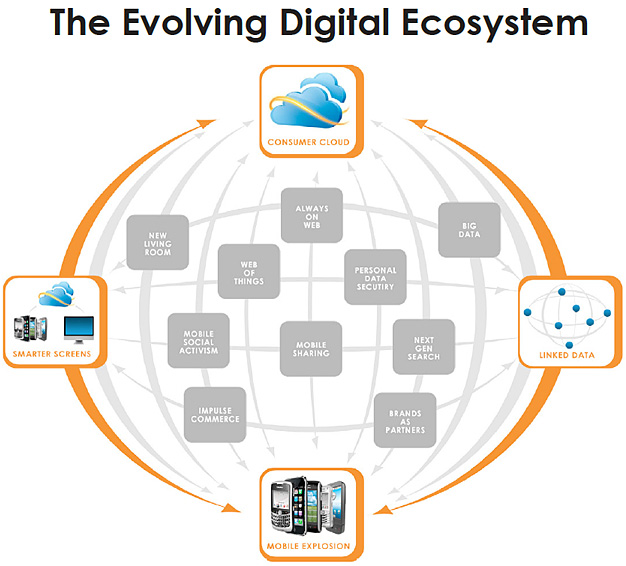
The Evolving Digital Ecosystem - from Moxie's Trends for 2012

  • The Always On Web
  • Web of Things
  • Big Data
  • Next Gen Search
  • Mobile Sharing
  • Mobile Social Activism
  • Impulse Commerce
  • Brands As Partners
  • The New Living Room  <– From DSC: This is one of those key areas that I’m trying to keep a pulse check on for re: our learning ecosystems of the future 
  • Personal Data Security


Also see:


Recording everything: Digital storage as an enabler of authoritarian governments — by John Villasenor, a nonresident senior fellow in Governance Studies and in the Center for Technology Innovation at Brookings. He is also professor of electrical engineering at the University of California, Los Angeles.

Excerpt (emphasis DSC):

Within the next few years an important threshold will be crossed: For the first time ever, it will become technologically and financially feasible for authoritarian governments to record nearly everything that is said or done within their borders – every phone conversation, electronic message, social media interaction, the movements of nearly every person and vehicle, and video from every street corner. Governments with a history of using all of the tools at their disposal to track and monitor their citizens will undoubtedly make full use of this capability once it becomes available.

The Arab Spring of 2011, which saw regimes toppled by protesters organized via Twitter and Facebook, was heralded in much of the world as signifying a new era in which information technology alters the balance of power in favor of the repressed. However, within the world’s many remaining authoritarian regimes it was undoubtedly viewed very differently. For those governments, the Arab Spring likely underscored the perils of failing to exercise sufficient control of digital communications and highlighted the need to redouble their efforts to increase the monitoring of their citizenry.

…

Declining storage costs will soon make it practical for authoritarian governments to create permanent digital archives of the data gathered from pervasive surveillance systems. In countries where there is no meaningful public debate on privacy, there is no reason to expect governments not to fully exploit the ability to build databases containing every phone conversation, location data for almost every person and vehicle, and video from every public space in an entire country.

This will greatly expand the ability of repressive regimes to perform surveillance of opponents and to anticipate and react to unrest. In addition, the awareness among the populace of pervasive surveillance will reduce the willingness of people to engage in dissent.

Analytics goes to the head of the class — from Northwestern.edu
Northwestern in collaboration with IBM offers degrees for next generation careers

Armonk, NY and Evanston, Ill. — Northwestern University and IBM have announced they are collaborating on new business and technology curricula to help students gain the latest skills in business analytics. The new courses of study, Masters of Science degree programs with analytics concentrations in the McCormick School of Engineering and Applied Science and the School of Continuing Studies, will better prepare students, and current professionals, who are seeking new analytics skills for today’s competitive job market.

The U.S. Bureau of Labor Statistics predicts that there will be a 24 percent increase in demand for professionals with management analysis skills over the next eight years. The need for this specialized talent is being fueled by an increased use of business analytics by companies to better understand the explosion of data generated online, via social networks and mobile devices, or through real time sensors. With so much data residing within, and shared across, these digital sources, organizations are seeking new ways to understand, measure, act and even predict outcomes based on customer and social sentiment.

…

This fully online, part-time program is designed to help adult students, expand their existing skills or gain new capabilities to transition into new careers.

The two-year MSPA program offers students a thorough grounding in data mining concepts and applications. It also focuses on developing the strategic, project-management and communication skills that leaders utilize to effectively forecast and implement new initiatives. Advanced data analysis, advanced statistics, database management, web analytics, predictive modeling and marketing analytics are just some of the program’s areas of study. The program also includes electives in fraud detection and web analytics. For example, helping students learn how predictive analytics can root out fraud at insurance companies, predict energy usage, or improve customer buying experiences.

Tagged with: •  

Next on TV: Data driven programming — from wired.co.uk by Matt Locke

Excerpt:

Quiz shows such as The Million Pound Drop Live on Channel 4 use real-time data from hundreds of thousands of online players to feed interesting stats and observations to host Davina McCall. [From DSC: What if this related to an online-based learning exercise/class/module/training session?]

…

This is the real revolution that is about to hit TV production — data is moving off the servers and in front of the cameras. With this comes a new generation of creative talent — data storytellers for whom the spreadsheet is as important as a script when it comes to content. TV is no longer stuck behind the screen — around 60 per cent of people in the UK watch with a “second screen” (a mobile or laptop) at the same time, and a lot of them are talking online about what they’re watching. TV is now back in the crowd, and if you make, commission or distribute content right now, you’d better learn to love data, and fast.

Also see:

  • What comes after Siri? A web that talks back — from gigaom.com by Stacey Higginbotham
    Siri may be the hottest personal assistant since I Dream of Jeannie, but Apple’s artificial intelligence is only the tip of the iceberg as we combine ubiquitous connectivity, sensor networks, big data and new methods of AI and programming into a truly connected network.
  • Ball State University Center for Media Design to Host Workshop Session — from thetvoftomorrowshow.com
    Entitled “Researching the Second Screen and Social Viewing: Two Recent Studies,” the workshop will see CMD researchers summarizing the findings from: 1) an eye-tracking study of viewers’ distribution of visual attention between the TV and second screen during use of two commercially released second-screen apps; and 2) a study of show-specific Twitter traffic rates during programming and ad pods for multiple episodes of three shows from different genres.

How ‘big data’ is transforming business — from McKinseyQuarterly.com

Excerpt:

Right now at your own company, it’s quite possible that sensors in process machinery are collecting operational data, marketers are using location data from smartphones to demystify teenagers’ buying quirks, and data exchanges are creating networks with your supply chain partners. As an explosion of data transforms processes, corporate ecosystems, and approaches to innovation, it’s important to remember that new technologies and tools raise productivity not only because companies adopt them but also, more critically, because they enable new management practices and organizational structures. So in this month’s newsletter, we highlight a package of articles that can help executives navigate the era of big data.


Gartner adds Big Data, Gamification, and Internet of Things to its Hype Cycle — from readwriteweb.com by Joe Brockmeier

Excerpt:

Gartner is once again taking a look at the “hype cycle” for technologies and trying to assess where technologies lie along the bumpy road from technology trigger to productivity. This year, Gartner is adding big data, Internet of Things, gamification and consumerization to the Hype Cycle that weren’t present in 2010. According to Gartner, private cloud computing has reached the peak level of hype, and cloud/Web platforms are slipping into the “trough of disillusionment” in the face of Platform as a Service (PaaS).


Also see:


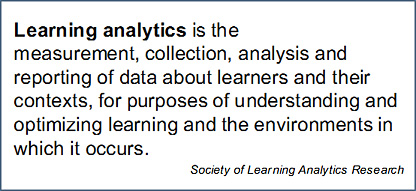
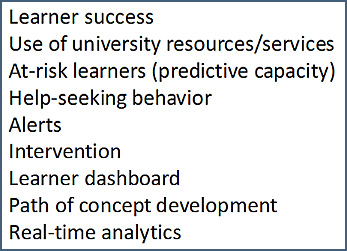
George Siemens 10-21-11 Presentation: Transforming Learning Through Analytics


Sample slides/excerpts:


George Siemens 10-21-11 Presentation: Transforming Learning Through Analytics


© 2025 | Daniel Christian