From DSC:
Readers of this blog will know that I am pro-technology — at least in most areas. However, as our hearts can sometimes become hardened and our feet can sometimes find themselves on slippery ethical ground, we really need hearts, minds, and consciences that prompt us to care about other people — and to do the right thing as a result of that perspective.


Example articles that brought this to my mind recently include:


7 sinister technologies from Orwell’s 1984 that are still a threat — from dvice.com by Hal Rappaport

Excerpt (emphasis DSC):

Technology is a wonderful thing, but in the words of Spider-Man’s Uncle Ben, “With great power, comes great responsibility.” If we are not careful, the technology we know and love could be used against us, even subtly. In the year 1984, Apple thought IBM was the bringer of “Big Brother.” In reality, the technology of today better resembles George Orwell’s dystopian vision than a 1980s era PC.

Every day we are in the process of becoming a more connected society. With social networks, cloud computing and even more specific, less-thought-about tech such as Internet-connected home surveillance systems, we may find ourselves in a delicate balance of trust and paranoia.

…

While we are grateful that we don’t live in a world as bleak as Orwell’s Oceana, it’s clear that the technology now exists to make his world possible if we let it. Keeping our paranoia in check, we should all be mindful of our technology and how it’s used. Security is a good thing and so is saving money, but consider how much of each your personal freedom is worth.

Wiping away your Siri “fingerprint” — from technologyreview.com by David Talbot
Your voice can be a biometric identifier, like your fingerprint. Does Apple really have to store it on its own servers?

Excerpt:

“What I’ve discovered through building and running very targeted online ad campaigns using this data is that users respond favorably to ads that are more targeted, but only if the ads don’t make it clear that I’m targeting sensitive information about them,” he said. “What’s most interesting, and what I’m learning, are which attributes are considered too creepy, and which ones are acceptable.”

“Google Now” knows more about you than your family does – are you OK with that? — from readwriteweb.com by Mark Hachman

Excerpt (emphasis DSC):

Google Now aggregates the information Google already collects about you on a daily basis: accessing your email, your calendar, your contacts, your text messages, your location, your shopping habits, your payment history, as well as your choices in music, movies and books. It can even scan your photos and automatically identify them based on their subject, not just the file name (in the Google I/O demo, Google Now correctly found a picture of the Great Pyramid). About the only aspect of your online life that Google hasn’t apparently assimilated yet is your opinions expressed on Google+. But that’s undoubtedly coming.

Social network privacy settings compared — from techhive.com by Nick Mediati

Excerpt (emphasis DSC):

It should go without saying that protecting your privacy online is kind of a big deal. While people are generally good at not giving out their personal information to just any website that asks for it, those same people can be found filling their Facebook accounts with everything from their birthday to where they live and work. Putting this sensitive information onto a social network not only leaves your data exposed to third-parties (advertisers and so forth), but also to anyone who happens across your profile.

Facebook, Google+, and Twitter all have settings that let you tweak what others can see on your profile—but navigating them can be a bit of a mess. Not all social networks give you complete control over your privacy online, so here’s a quick overview of what Facebook, Google+, and Twitter allow you to do.

U.S. companies lost at least $13 billion to espionage last year — from ieee.org by Robert Charette

Google Glass & Now: Utopia or Dystopia? — from extremetech.com by Sebastian Anthony

Excerpt (emphasis DSC):

If you didn’t watch the Google I/O keynote presented by Vic Gundotra, Hugo Barra, and Sergey Brin, let me quickly bring you up to speed.  Google Now is an Android app that uses your location, behavior history, and search history to display “just the right information at just the right time.”  For example, if you regularly search for a certain sports team, Now will show you a card with the latest scores for that team.  When Now predicts or detects that you’re leaving home in the morning, it will display a card with any relevant traffic information.  If you have a lunch meeting in your Google Calendar, Now will show you the route you need to take to get there — and when you need to leave to get there on time.  If you search Google for an airline flight, Now will show a card with the flight details (and any delays).

Big e-reader is watching you — from PaidContent.org  by Laura Hazard Owen

Why privacy is big business for trial lawyers — from technologyreview.com by Antonio Regalado
Tech companies that make privacy mistakes can expect a lawsuit.

Legal discovery: The billboard is imaginary, but the trend is real.
Trial lawyers are ramping up lawsuits over online privacy breaches.
Flickr Creative Commons | AdamL212 and istock/stocknroll


Addendums
On 7/6/12:
  • Your e-book is reading you — WSJ.com by Alexandra Alter
    Digital-book publishers and retailers now know more about their readers than ever before. How that’s changing the experience of reading.

On 7/16/12:

On 7/23/12:

Bridging Our Future, envisioned by Intel  -- June 2012


Description:

By connecting education with smarter technology, Intel offers a look into the future of K-12 education. Watch as students use technology to collaborate with peers and industry experts to build a bridge model, from the initial design phase through the final structure testing. Intel’s education solutions help teachers provide innovative, personalized and secure learning environments to prepare students for successful futures in the 21st century.

I originally saw this at


“Learning from the living room” — Part I [Christian]

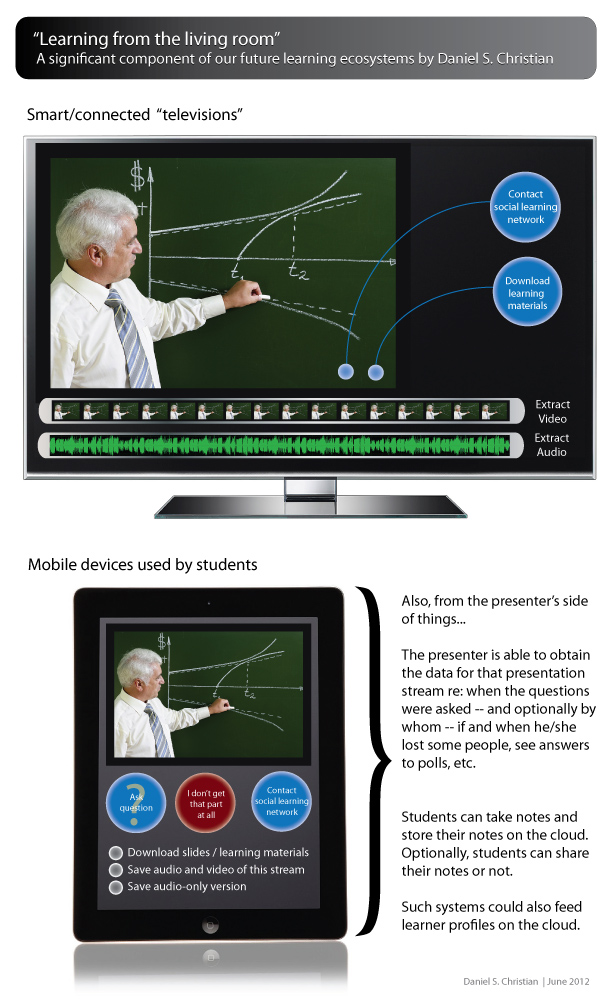
Learning from the living room -- a component of our future learning ecosystems -- by Daniel S. Christian, June 2012


Legal size PDF here


Addendum on 7/3/12 from an article I wrote for EvoLLLution.com (for LifeLong Learning):
Establishing better collaboration between the corporate world and higher education [Christian]

In the near future, perhaps we could have second screen-based activities whereby corporate leaders are giving TED-like presentations or expressing the current issues in their worlds via a program on Smart TVs, and the students are communicating and collaborating about these presentations via tablets or smart phones.  Perhaps there will be electronic means whereby students could submit their ideas and feedback to the presenting companies (and whereby selected ideas could be rewarded in terms of free products or services that the company produces).


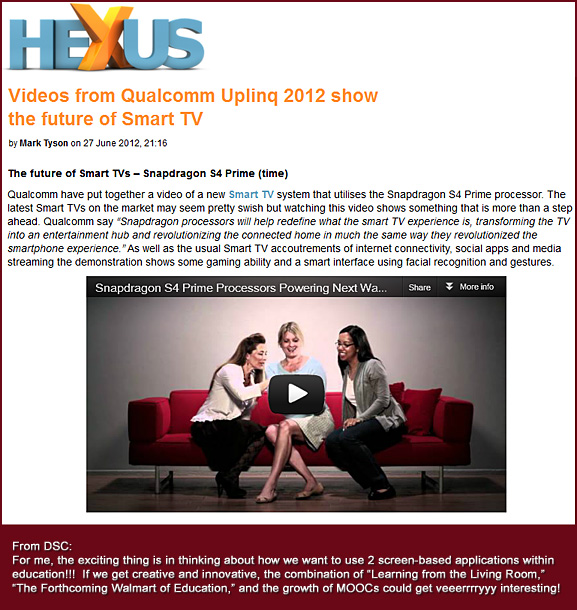
Videos from Qualcomm Uplinq 2012 show the future of Smart TV
— from hexus.net by Mark Tyson

Excerpt:
Here are the feature highlights of these “redefined” Smart TVs:

  • Console quality gaming
  • Concurrency of apps
  • Miracast wireless technology allowing smartphone and tablet screens to partake in multi-screen interactivity
  • Personalisation and facial recognition
  • Gestures
  • HD picture quality
  • HD video calling


From DSC:
…and add to that list the power of customized learning and analytics!


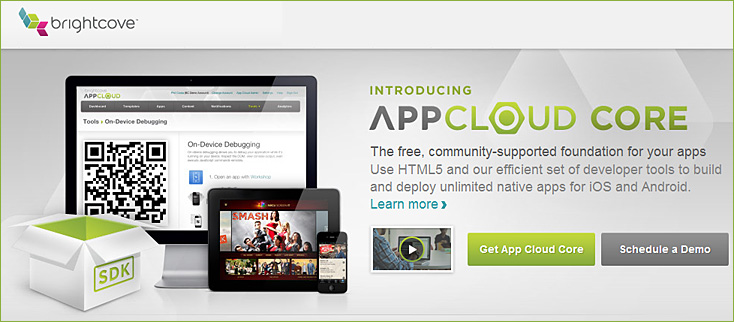
Introducing App Cloud Core – Build and Deploy Mobile Apps for Free

.

brightcove.com/en/content-app-platform

.

Also see:


Also see:

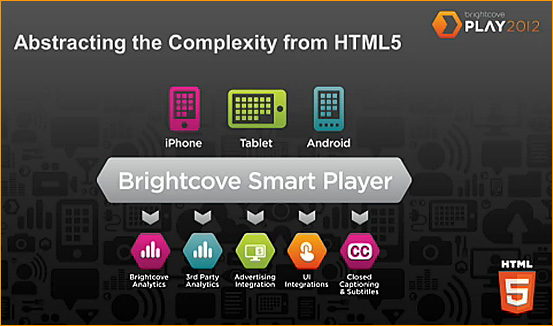
  • Brightcove PLAY is a global gathering of Brightcove customers, partners and industry leaders at the forefront of the digital media revolution. On June 25-27, hundreds of media companies, marketers and developers from around the world will convene in Boston for three action-packed days of hands-on learning, in-depth strategy sessions, next-generation product demos, all-star keynotes, and networking.

The Secret Life of Data in the Year 2020 –– from The World Future Society by Brian David Johnson, a futurist at Intel Corporation, where he is developing an actionable vision for computing in 2020.

Excerpt:

Why will most people think that their data has a life of its own? Well, because it’s true. We will have algorithms talking to algorithms, machines talking to machines, machines talking to algorithms, sensors and cameras gathering data, and computational power crunching through that data, then handing it off to more algorithms and machines. It will be a rich and secret life separate from us and for me incredibly fascinating.

But as we begin to build the Secret Life of Data, we must always remember that data is meaningless all by itself. The 1s and 0s are useless and meaningless on their own. Data is only useful and indeed powerful when it comes into contact with people.

This brings up some interesting questions and fascinating problems to be solved from an engineering standpoint. When we are architecting these algorithms, when we are designing these systems, how do we make sure they have an understanding of what it means to be human? The people writing these algorithms must have an understanding of what people will do with that data. How will it fit into their lives? How will it affect their daily routine? How will it make their lives better?

Also see:

Preview of Future Inventions—Futurists: BetaLaunch 2012 — from The World Future Society by Kenneth J. Moore
The World Future Society’s second annual innovation competition will allow WorldFuture 2012 attendees to preview a few of the life-changing and society-altering artifacts of the future.

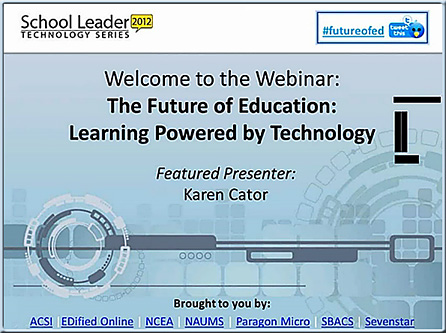
The Future of Education - Learning Powered by Techonology -- Karen Cator -- May 2012

.

Featured presenters:

  • Karen Cator, Dir. Office of Education Technology, U.S. Department of Education
  • Dr. Barrett Mosbacker, Superintendent, Briarwood Christian School

Excerpts re: trends:

  • Mobility — 24/7 access
  • Social interactions for learning
  • Digital content
  • Big data


From DSC:
As Brian Crosby points out in the title of his blog — “Learning is Messy.” 

There is no silver bullet in the world of education that can be used to effectively teach everyone. In fact, if you were to get 100 instructional designers/teachers/professors/instructors/trainers in the same room, you will not be able to find anything close to a strong agreement on what constitutes the best and most effective learning theory as well as the practical implementations of applying that learning theory (even if we were to be talking about the same age range of students). In my Master’s work, I was looking for that silver bullet…but I never found one.

It is very difficult for a professor or a teacher to deliver truly personalized/customized learning to each student in their classroom:

  • How can a teacher consistently know and remember what motivates each particular student?
  • Because so much of learning depends upon prior learning, what “hooks” exist — per student — that he/she can use to hang new information on?
  • Then, what’s the most effective method of delivering the content for each particular student that might shift the content from their working memories to their long-term memories? (And in the process, do so in a way that develops a love for learning that will serve the student well over his lifetime)
  • What’s the best way to assess the learning for each student?
  • Which students cognitive loads are being eaten up due to the nervousness around being assessed?
  • What are the best methods of passing along those learnings onto the students’ future teachers’ for the students’ benefit?

In my estimation, the way we have things setup throughout most K-16 education, this is an impossible task. When there’s typically only 1-2 teachers trying to teach to 20-30 students at a time, how can this type of personalized instruction occur?

However, I believe digital learning and its surrounding tools/ecosystems hold enormous promise for delivering truly customized/personalized learning opportunities.  Such technologies will be able to learn where a student is at, how to motivate them, how fast to push them, and how they best progress through a type of content.  Such tools will provide real-time, learning-related, diagnostic dashboards for professors or teachers to leverage in order to guide and optimize a student’s education.

.

.

So I believe that the promise is there for delivering truly customized/personalized learning opportunities available 24x7x365 — even though we aren’t completely there yet.  But think of the power a teacher would have if he or she had IBM’s Watson AI-based analysis on each student at their disposal! A “guide on the side” using such diagnostic tools could be a ***potent*** ally for a student.*

As such, I see innovative approaches continuing to come to fruition that will harness the power of serious games, analytics, web-based learner profiles, and multimedia-based/interactive learning content. Eventually, a piece of this type of personalized education will enter in via the Smart/Connected TVs of our living rooms…but that’s a post I’m building out for another day in the near future.

.

*Another hope I have here is that such technologies will
enable students to identify and pursue their passions.


Some items that reinforced this notion for me include:


The key link from Bloom (1913-1999) one e-learning paper you must read plus his taxonomy of learning — an excellent item from Donald Clark Plan B (also see Donald’s archives for postings re: 50 top learning theorists)

The 2 Sigma Problem: The Search for Methods of Group Instruction as Effective as One-to-One Tutoring
Benjamin Bloom
University of Chicago | Northwestern University

Excerpt:
Most striking were the differences in final achievement measures under the three conditions. Using the standard deviation (sigma) or the control (conventional) class, it was typically found that the average student under tutoring was about two standard deviations above the average of the control class (the average tutored student was above 98% of the students in the control class). The average student under mastery learning was about one standard deviation above the average of the control class(the average mastery learning student was above 84% of the students in the control class).

Two key items from EdNet Insight’s Anne Wujcik:

Mapping a Personalized Learning Journey – K-12 Students and Parents Connect the Dots with Digital Learning — from Project Tomorrow

Personalizing Learning in 2012 — The Student & Parent Point of View [infographic] — from Project Tomorrow
Excerpt from Anne’s posting:

This first report focuses on how today’s students are personalizing their own learning, and how their parents are supporting this effort. That personalization centers around three student desires: including how students seek out resources that are digitally-rich, untethered and socially-based. The report share the unfiltered views of K-12 students and parents on these key trends and documents their aspirations for fully leveraging the technologies supporting these trends to transform their learning lives.

McGraw-Hill report demonstrates power of adaptive learning technology to personalize education and support needs of 21st century students — prnewsire.com
Report illustrates how personalized learning is the key to engage, retain and graduate students and prepare them for the global workforce

Excerpt:

NEW YORK, April 12, 2012 /PRNewswire/ — A new report released today by the McGraw-Hill Education characterizes adaptive learning technology as the lynchpin in personalizing education in today’s K-12 and higher education classrooms. According to the report, adaptive learning technology, also known as a computer-assisted smart tutor, helps teachers tailor instruction for every student in the class, effectively creating a “class of one” and significantly improving learning outcomes.

…

The authors highlight three of McGraw-Hill’s adaptive programs:

  • LearnSmart is the leading interactive study tool for higher education that adaptively assesses students’ skill and knowledge levels to track which topics students have mastered and which require further instruction and practice. It then adjusts the learning content based on students’ strengths and weaknesses…
  • Power of U is a revolutionary, digitally rich personalized middle school math pilot program that uses real-time assessment data to group students in ways that allow them to learn at their own pace, in their own style, using the medium that works best for them…
  • ALEKS®, one of the pioneer products to use adaptive learning technology, is a web-based assessment and learning system created by the ALEKS Corporation and exclusively distributed by McGraw-Hill Higher Education to colleges and universities.

.

From DSC:
These are the types of technologies that will make their way into courses that you can take from your Smart/Connected TV (i.e. “learning from your living room” and “The Forthcoming Walmart of Education” trends continue to develop and are moving one step closer to reality).  


Items re: the connected living room; relates to what I call a future “learning from the living room” environment

The human voice, as game changer — from nytimes.com by Natasha Singer


Matthew Cavanaugh for The New York Times

Vlad Sejnoha demonstrated Nuance’s Dragon TV system, which obeys spoken commands to
flip channels, for example, or shop on screen on Amazon.com.

Apple’s iCloud will teach Apple’s Smart TV remote new tricks — from patentlyapple.com

6 answers about your next TV, with or without Apple — from forbes.com by Michael Humphrey

10 tech commandments for the TV industry — from thenextweb.com by Martin Bryant

Smart TVs are growing in popularity — from business-news.thestreet.com by Steve Adams

smartTV Quincy gh 032112-284-wihr.jpg

Image from Gary Higgins/The Patriot Ledger

Paul Berrini, a salesman at Hancock T.V.& Appliance in Quincy, demonstrates
some of the new features of “smart” televisions, Wednesday, March 21.

.

10 AirPlay-ready iPad apps that make Apple TV worth it — from  readwriteweb.com by John Paul Titlow

Entertainment and Streaming Media – The Recent Past and the Future — from homesystemintegration.com by Alan Ruby

Connected Living Room 1

.

TVs may soon be used to spy on you — from smartplanet.com by Tuan C. Nguyen


Big-data related items

The online future is personal, and that requires big data — from gigaom.com by Mathew Ingram

.What can you do with a supercomputer? –– from extremetech.com by Sebastian Anthony


IBM supercomputer (p690 cluster)

.

What big data really needs is security — from gigaom.com by Ryan Lawler

BigDataWeek plans lots of meetings in April around the world –– from ReadWriteCloud.com by David Strom

.

Tagged with: • •  

From DSC:
Arguably, Sal Kahn has become the most famous, influential educator on the planet today — his videos are watched millions of times a day now.  The question — which Eric Schmidt answers in the piece — I couldn’t help but ask was, “Why didn’t this type of innovation come from someone who was working in education at the time of their innovation?”

My thanks to Dr. Kate Byerwalter and her colleagues for passing along this resource.
The tags/associated categories for this posting point out the relevant areas covered.


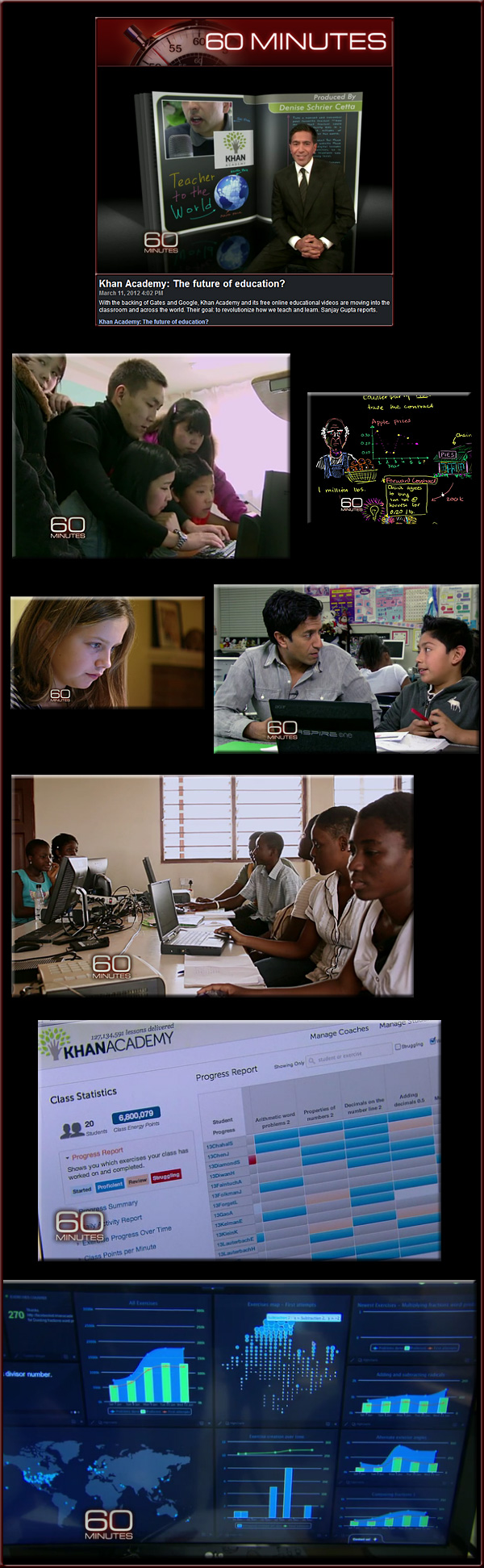
Khan Academy: The future of education?

Also see:

  • Khan Academy: The future of education?
    (CBS News) Sal Khan is a math, science, and history teacher to millions of students, yet none have ever seen his face. Khan is the voice and brains behind Khan Academy, a free online tutoring site that may have gotten your kid out of an algebra bind with its educational how-to videos. Now Khan Academy is going global. Backed by Google, Gates, and other Internet powerhouses, Sal Khan wants to change education worldwide, and his approach is already being tested in some American schools. Sanjay Gupta reports.

From DSC:
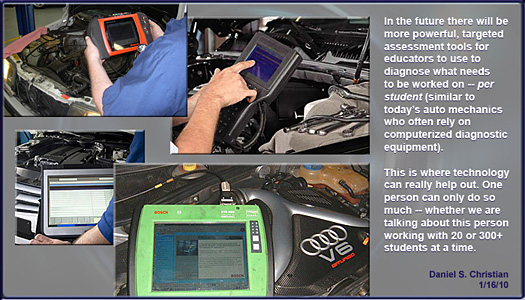
A relevant graphic comes to mind with what Sal is trying to achieve with analytics:

i.e. Highly-effective diagnostic tools for the educators and trainers out there!


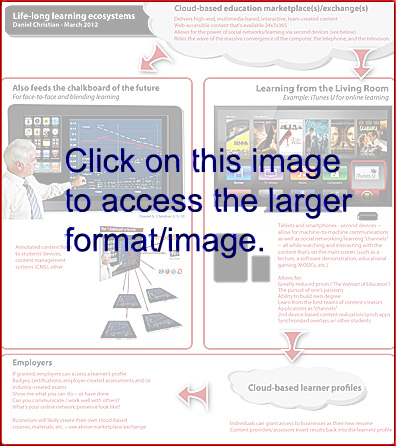
Lifelong learning ecosystems!!! A powerful vision for our future [Daniel Christian]

From DSC:
The vision below involves:
(click on the image below to access it)
 

  • The convergence of the telephone, the television, and the computer
  • Cloud-based education stores/marketplaces/exchanges
  • Second screen devices and machine-to-machine communications
  • Social networking/learning
  • Smart classrooms/learning spaces
  • Content recognition/synchronization applications
  • Apps as “channels”
  • Web-based learner profiles
  • Video overlays
  • New business models in higher ed
  • New jobs/needs for the future
  • A new way for employers to hire highly-effective employees/contractors/consultants
  • …and more


Click this thumbnail image to access the larger image / vision

.


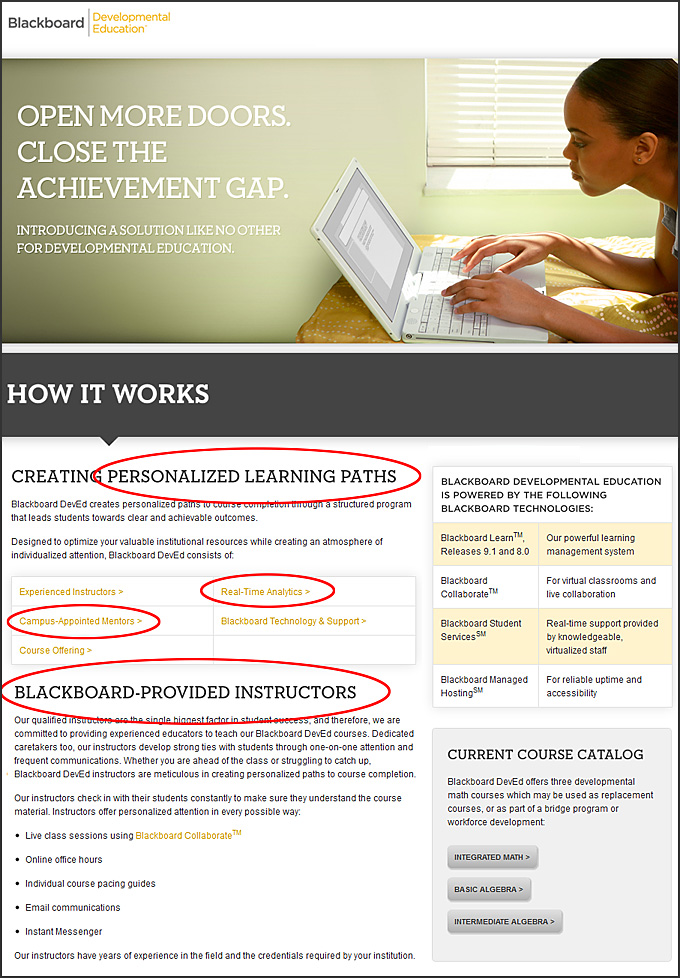
Blackboard launches solution to improve developmental education
Fully online courses now include built-in assessment, analytics tools

Excerpt:

WASHINGTON – February 22, 2012 – Blackboard Inc. today announced the official launch of Blackboard Developmental Education™ (Blackboard DevEd), an innovative approach aimed at improving student outcomes and increasing completion rates in an area where many institutions have struggled. The solution, which was first piloted by several institutions in the fall, now includes built-in assessment and analytics tools that enable course instructors to further personalize their instruction.

.

Blackboard Developmental EducationTM (Blackboard DevEd) is a comprehensive program of blended instruction and online remedial courses designed to improve student achievement levels cost-effectively.

Early reflections from DSC:

  • First of all, my congratulations go out to Blackboard for innovating! Nice work.
  • This is another example of the innovation occurring in the online/digital learning world — yet more tools and diagnostic powers are being made available to online-based teaching and learning environments
  • This should be another shot across the bow of how institutions of higher education are training our future teachers — student teachers NEED to know how to teach online!!!
  • Too early to tell how such endeavors will affect career paths (for teachers, administrators, counselors, nurses, and such)


Also see:

© 2025 | Daniel Christian