Excerpt:

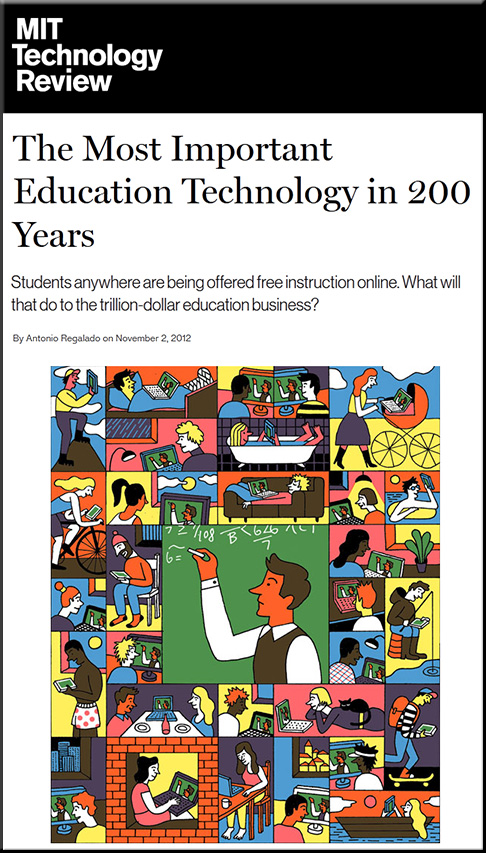
Agarwal believes that education is about to change dramatically. The reason is the power of the Web and its associated data-crunching technologies. Thanks to these changes, it’s now possible to stream video classes with sophisticated interactive elements, and researchers can scoop up student data that could help them make teaching more effective. The technology is powerful, fairly cheap, and global in its reach. EdX has said it hopes to teach a billion students.

.

Which brings me to this graphic:


asdfsadf


Also see:


IBM’s Watson expands commercial applications, aims to go mobile  — from singularityhub.com by Jason Dorrier

.

From DSC:
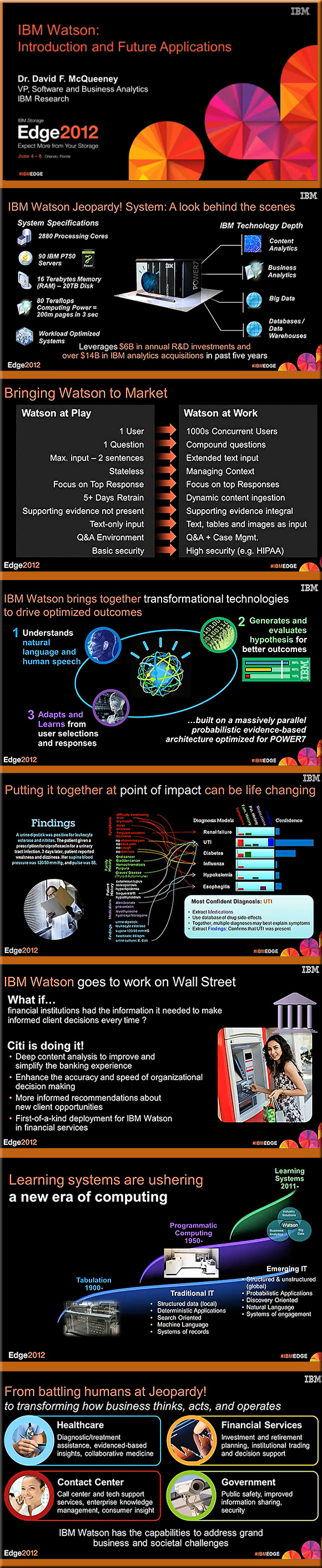
This relates to what I was trying to get at with the posting on mobile learning.  I would add the word “Education” to the list of industries that the technologies encapsulated in Watson will impact in the future. Combine this with the convergence that’s enabling/building the Learning from the Living [Class] Room environment, and you have one heck of an individualized, data-driven, learning ecosystem that’s available 24 x 7 x 365 — throughout your lifetime!!!

.


IBM Watson-Introduction and Future Applications


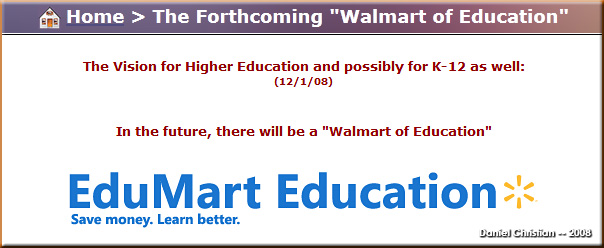
Also relevant here are some visions/graphics I created from 2012 and from 2008:


.

The Living [Class] Room -- by Daniel Christian -- July 2012 -- a second device used in conjunction with a Smart/Connected TV


.


.

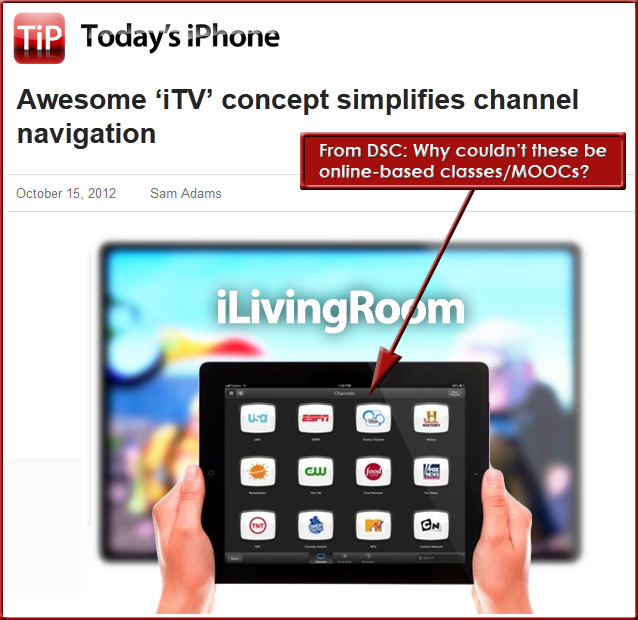
Why couldn't these channels represent online-based courses/MOOCs? Daniel Christian - 10-17-12


.


Big Data in K-12: Attack of the Recommendation Engines – Part I –– from EdNetInsight.com by Nelson B. Heller, President, The HellerResults Group — Friday, October 12, 2012

Excerpt:

Big Data Meets Education
A wave of K-12 entrepreneurial initiatives sees the application of “big data” as the key to instructional technology’s Holy Grail—intelligent real-time differentiated instruction akin to working one-on-one with a brilliant personal instructor. Investors, aware of the powerful strides made in recommendation engines by Internet giants Google, Amazon, LinkedIn, Netflix, and Zynga, as well as for a host of military and commercial applications, see in big data education’s “next big thing.” In this and my next article, I’m going to explore what’s happening in this arena and in voice recognition technology, which, if you look under the hood, can be thought of as being driven by the same advances in data science and recommendation engines. These articles are based in part on my recent View From the Catbird Seat presentation at EdNET 2012. Read on to see what threats and opportunities this new frontier represents for your own organization.

Tagged with: • • • • •  

The power and possibility of mobile learning — as cross posted from evoLLLution.com (for LifeLong Learning)
Daniel S. Christian | October 2012

As I sat down to write about mobile learning, I struggled with narrowing down the scope of what I was going to attempt to address.  Which angle(s) should I take?

And then I reflected on my morning so far. I helped my daughter wake up to the sounds of a song coming from my iPhone.  She opened one eye, then the other, and soon, she was dancing around the room.  Success!

I then proceeded to listen to my iPhone as I drove my car into work – it gave me the energy I needed to start my internal engines.  (By the way, the idea of automobile-based technologies continues to grow, opening up further possibilities; but that’s a topic for another day.)

Then I caught up with a friend for coffee and he reached for his iPad.  He showed me an app for the local Art Prize competition that’s currently going on in our area.  He mentioned that if a person wasn’t in the immediately vicinity of the Art Prize event, that person could not vote on any of the pieces.  However, if the GPS-based coordinates were within the approved range, a person could use that app to:

  • Vote on which pieces of artwork that they liked
  • Find out where the artwork was located (at numerous locations on a map)
  • Learn more about the pieces themselves – what the pieces were made of, hear the artists’ thoughts on why they created what they created, etc.

So by the time I pulled up to my PC at 9:00am, I had already been positively impacted by mobile technology in several ways.  The common words and phrases that are often used to describe mobile learning and mobile technologies rang true and popped back into my mind: ubiquitous, always on, always connected, 24x7x365, convenient, etc.

As I enjoy peering into the future as well as pulse checking a variety of items, I would like to ask the following questions concerning the potential power and possibility of mobile learning as well as the relevant, emerging set of technologies that enable it:

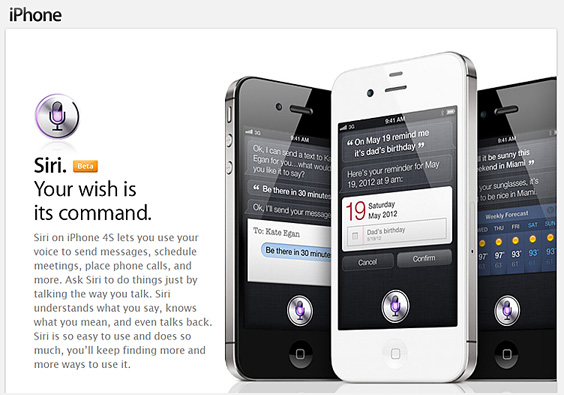
  • Q:  What happens when the technologies behind IBM’s Watson and Apple’s Siri get perfected and integrated into learning-based products and services? What types of devices will be able to tap into those products and services?
    A:  IBM’s Watson beat the best human players in a game of Jeopardy and is now being used as a data analytics engine for the medical community, wading through terabytes of patient healthcare information and research data in order to determine how best to treat illnesses.  So, such technologies hold some serious promise in terms of at least addressing the lower to mid-levels of Bloom’s Taxonomy. For 2012, tablets, smart phones, laptops, notebooks would be likely candidates of accessing these types of products/services. But we are just at the embryonic stages of the Smart/Connected TV, and I have it that such a device will become an important and commonly-used mechanism for accessing such cloud-based applications and services in the future.
    .
  • Q: Will students of all ages have access to their own virtual tutors so to speak? From any device at any time?
    A: Yes; this is highly likely, especially given the current (and increasing) levels of investments being made in educational technology related areas.  It’s very feasible to think that Apple, IBM, Google, Microsoft, McGraw-Hill, Pearson, or some other organization with deep pockets will develop such virtual tutoring products and services.
    .
  • Q:  What will happen when a virtual tutor is unable to resolve or address the student’s issue to the student’s satisfaction?  Will the student be able to instantly access a human tutor – with the option of keeping the existing work/issue/problem visible to the human tutor?
    A:  Yes, again…highly likely. This will open up new opportunities for faculty members, teachers, instructors, trainers, and tutors.  Getting experience in teaching online is a solid career move at this point in history.  (Also relevant will be those people creating applications and technically supporting them. An understanding of web-based videoconferencing and collaboration tools will be helpful here.)
    .
  • Q:  How will the convergence of the television, the computer, and the telephone impact what can be done with learning-based applications and experiences?
    A:  We are just beginning to see the ecosystems changing and adapting to deal with the convergence of the television, the computer, and the telephone.  The Smart/Connected TV – along with “second screen” based applications – is being driven by innovations involving the entertainment, marketing, and advertising industries.  But it’s not a stretch to think that educationally-related content will be right behind such innovative solutions.
    .
  • Q:  How will the multiple screens phenomenon affect how content can be consumed and discussed?
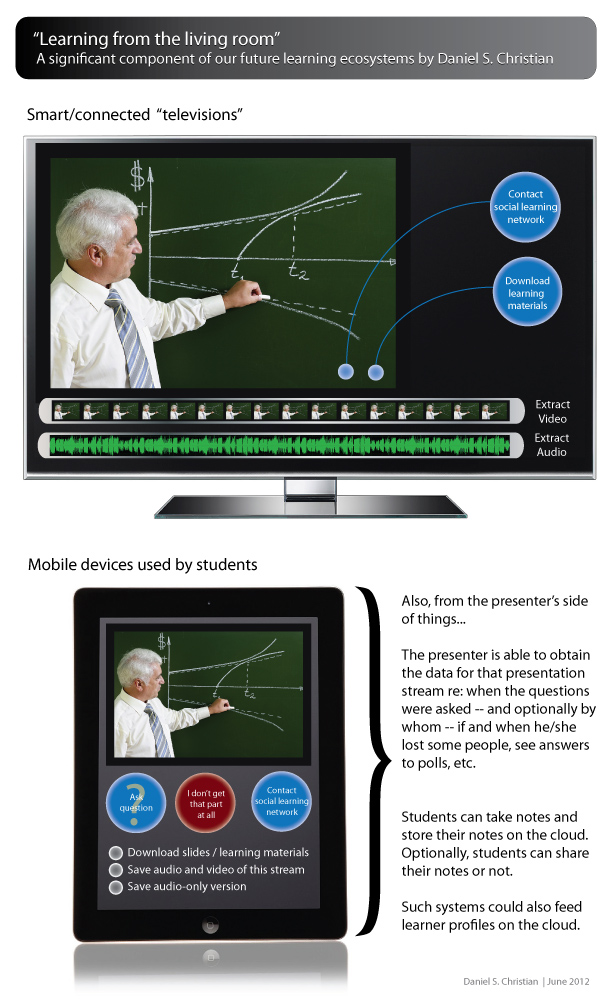
    A:   I created a couple of graphics along these lines that attempt to capture a potential vision here. I call it “Learning from the Living [Class] Room,” and it continues to develop in front of our eyes. We could be watching a “lecture” on a big screen and simultaneously interacting with people throughout the world on our smaller screens.

The Living [Class] Room -- by Daniel Christian -- July 2012 -- a second device used in conjunction with a Smart/Connected TV


.

Learning from the living room -- a component of our future learning ecosystems -- by Daniel S. Christian, June 2012

  • Q:  How will mobile conferencing affect what can be achieved?
    A:  Mobile-based conferencing will provide 24x7x365 opportunities for learning – and communications – to occur.  Such technologies have applications even in more traditional face-to-face classroom settings.  For a few possibilities here, see how mobile technologies are used in this vision by Intel  as well as in this vision by Corning.


Great vision from Intel!

.

Great vision from Corning!

.

  • Q:  What sort of creative doors are opened when a story can be told across a variety of “channels” and means?  And what sorts of skill sets do we need to start building – or continue to build – in order to help students find work in these emerging fields?
    A:  Create a Google Alert on transmedia and/or transmedia-based storytelling and you will get a sense of what’s happening in this arena.  There will be huge opportunity for creative, innovative folks out there!  Being versed in new media would be a solid idea if one hopes to pursue careers in these burgeoning fields. That is, building at least a rudimentary skill set of how to creatively use text, graphics, animations, digital audio, digital video, and interactive programming to deliver and obtain information would be very beneficial here.
    .
  • Q:  What types of analytics will be tracked and fed into one’s cloud-based learner profile?
    A:  It will depend upon where we want such technologies to take us.  However, think about the applications and implications of this approach if a web-based profile were used to:

    • Feed a workplace-based exchange – matching buyers and sellers of services
    • Inform a learning agent on which topics/disciplines that person wants to learn more about – helping that person obtain a highly-personalized, customized, relevant, engaging, productive learning experience with a solid ROI
    • Inform a cloud-based app on what prior knowledge one has and where to begin the “next lesson”
      .
  • Q:  Will courses become apps?  Will what we know of TV programs become apps and, if so, how will that affect what each of us can contribute to our own communities of practice?
    A:  Just as the web has enabled individuals to deliver their own podcasts, information, etc. – essentially becoming their own radio stations to a degree – the ecosystems being built up around the Smart/Connected TVs could help each of us become our own TV station. The potential is huge in terms of further developing and sharing knowledge within communities of practice.
    .
  • Q:  Will educational gaming dove-tail nicely with mobile learning and emerging technologies such as augmented reality, 3D, and connected television?
    Yes, the synergies and foundational pieces are already coming into place.
    .
  • Q:  How will the bring-your-own-device (BYOD) situation affect what can occur in the face-to-face classroom?
    A:  Students will be able to seamlessly and efficiently contribute content to the discussions in a face-to-face classroom without breaking the flow of the classroom.  An example graphic can be found here.
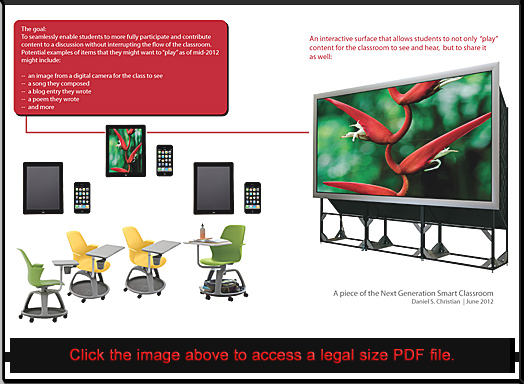
 

A piece of the Next Generation Smart Classroom -- Daniel Christian -- June 2012


The topics and potential routes that additional articles could take are almost endless.  But I think it’s safe to say that mobile, lifelong learning is here to stay.

Listed below are some recent articles and resources if you are interested in pursuing the topic of mobile learning.  I also have a section on my Learning Ecosystems blog dedicated to mobile learning.

If you are interested in what I’m calling Learning from the Living [Class] Room, you might be interested in these postings.


Some recent articles/resources regarding mobile learning:


Addendum:


Tagged with:  

Higher education used to be on deck, but is now at bat. [Christian]


From DSC:
My way of thinking about what’s happening to higher education these days borrows from the sport of baseball: Higher education used to be on deck; but now, we’re at bat.

I’ve watched as the former power brokers throughout many other industries reluctantly got out of the dugout, nervously began their warm up on deck, and then timidly moved up to bat as well. They were trying to cling to the status quo. Which didn’t work. We’ve all seen the results. There are new power brokers in those industries now. (Which is I why I assert that there is danger in the status quo — our organizations need to always be at the work of reinventing ourselves.)

…

If I had to pick the top 2 forces driving change throughout the higher education landscape, I would have to say the cost of obtaining a degree and technology-enabled innovation.

…

Control is an illusion; people will find a way.


Google’s answer to Siri thinks ahead — from technologyreview.com by Tom Simonite
The company’s data stockpile and investment in AI means a smartphone helper that answers queries before you even ask them.

Tagged with: • • • •  

Summary of Analytics 3-Day Sprint --  from educause

Tagged with: • •  

Your future TV is not about Tele-Vision — from FastCompany.com by Kit Eaton

Excerpt (emphasis below from DSC; also see the above categories to see how I see this as a highly-relevant component to our future learning ecosystems):

Then imagine what a hybrid of Apple’s tech and efforts like GetGlue, Shazam, and other interactive systems will be like when they’re more integrated into your 2017 smart TV. The big screen in your living room won’t be a one-way window into another world you can’t touch anymore. It’ll be a discovery engine, a way to learn facts, interact with the world, talk to people, find new and surprising content to absorb. Advertisers will love it, and companies like Nielsen–which largely has to guess all those stats about who watches which show at primetime nowadays–will be able to get accurate data…which may mean more appealing shows.


The Living [Class] Room -- by Daniel Christian -- July 2012 -- a second device used in conjunction with a Smart/Connected TV


Also see:

Who’s reading your research? Academia.edu offers an analytics dashboard for scholars  — from hackeducation.com by Audrey Watters

Excerpt:

Academia.edu, a social network for scholars, is unveiling a new feature today that its founder Richard Price hopes will help address part of the “credit gap” for research. Academia.edu allows users to upload and share their research papers, and the site is launching its Analytics Dashboard for Scientists today that Price says will let scholars see the “real-time impact” of their work.

Tagged with: • • •  

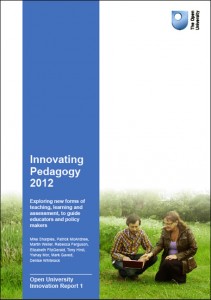
Sharples, M., McAndrew, P., Weller, M., Ferguson, R., FitzGerald, E., Hirst, T., Mor, Y., Gaved, M. and Whitelock, D. (2012). Innovating Pedagogy 2012: Open University Innovation Report 1. Milton Keynes: The Open University.

.

Exploring new forms of teaching, learning and assessment, to guide educators and policy makers


Contents

  • Executive summary 3
  • Introduction 6
  • New pedagogy for e-books
    Innovative ways of teaching and learning with next-generation e-books 8
  • Publisher-led short courses
    Publishers producing commercial short courses for leisure and professional development 11
  • Assessment for learning
    Assessment that supports the learning process through diagnostic feedback 13
  • Badges to accredit learning
    Open framework for gaining recognition of skills and achievements 16
  • MOOCs
    Massive open online courses 19
  • Rebirth of academic publishing
    New forms of open scholarly publishing 21
  • Seamless learning
    Connecting learning across settings, technologies and activities 24
  • Learning analytics
    Data-driven analysis of learning activities and environments 27
  • Personal inquiry learning
    Learning through collaborative inquiry and active investigation 30
  • Rhizomatic learning
    Knowledge constructed by self-aware communities adapting to environmental conditions 33

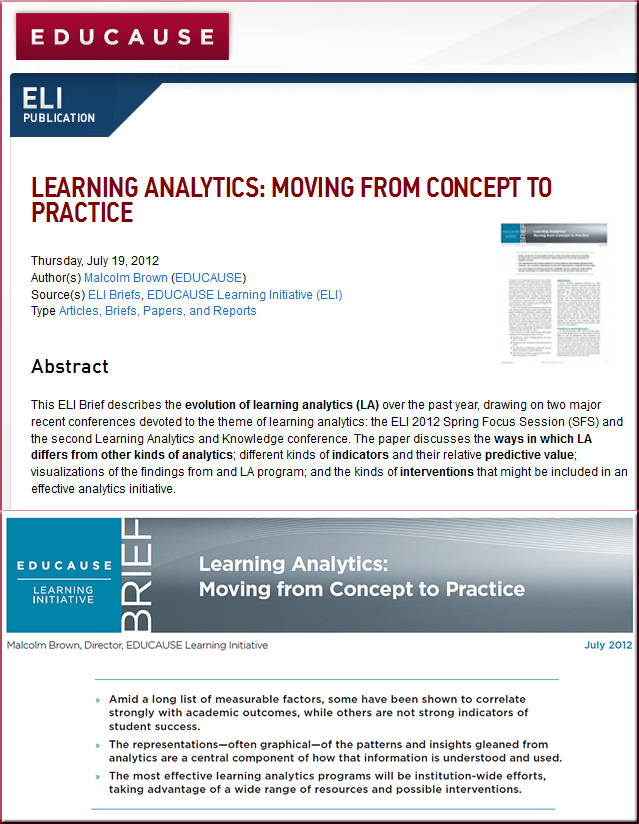
Learning Analytics -- Moving from Concept to Practice -- Malcolm Brown -- Educause ELI -- July 2012

Tagged with: • •  

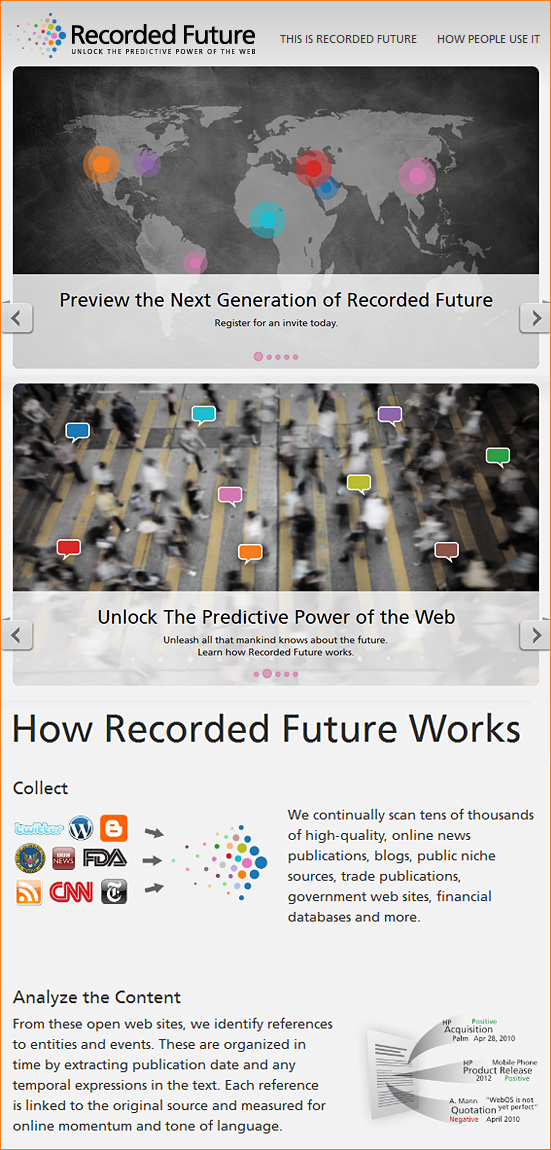
Recorded Future dot com

Tagged with: • • •  

When the technologies behind Watson and Siri get perfected and integrated into the “Learning from the Living [Class] Room” environment [Christian]


From DSC:

When the technologies behind IBM’s Watson and Apple’s Siri get perfected and integrated into products and services that will make up the near future “Learning from the Living [Class] Room” environment— there will be:


  • A high degree of personalization and customization — available 24x7x365 on multiple kinds of devices
    .
  • The option to turn on tracking and analytics — reporting from which can be moved into the learner’s cloud-based profile upon completion of the unit/activity/badge
    .
  • Students of all ages will have access to their own virtual tutors so to speak
    .
  • When a virtual tutor is unable to resolve or address the student’s issue to the student’s satisfaction, the student will be able to instantly access a human tutor (with the option of keeping the existing work/issue/problems visible to the human tutor)


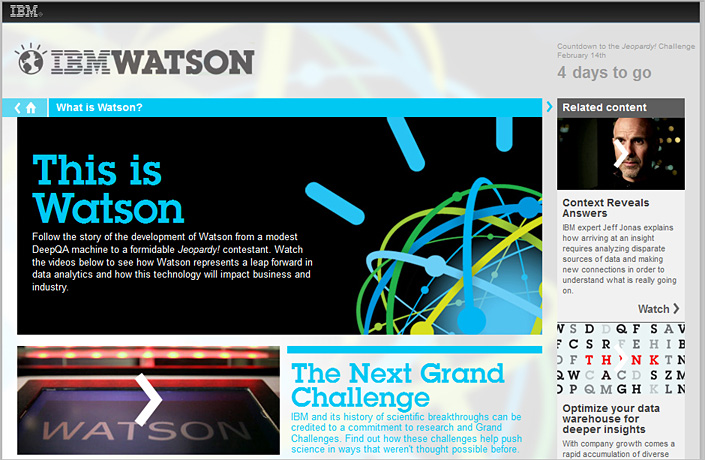
IBM's Watson -- incredible AI!


The Living [Class] Room -- by Daniel Christian -- July 2012 -- a second device used in conjunction with a Smart/Connected TV


.

Addendums:


Higher Ed Tech" Where K-12 & Consumer Collide - Frank Catalano - March 2012


Excerpt:

What’s our agenda? It’s basically in three parts:

  1. What student expectations are
  2. Where innovation is coming from and what’s driving it
  3. And what it’s developing into over the next three years – in 5 transcendent trends that span K-20


Also see:

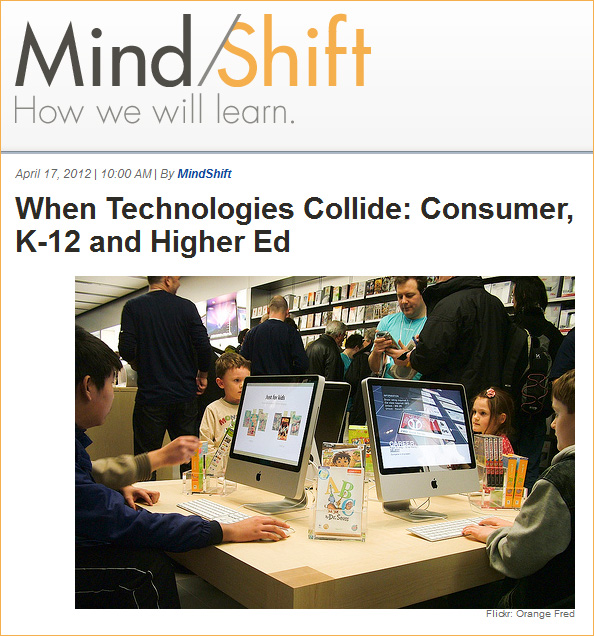
When Technologies Collide: Consumer, K-12 and Higher Ed -- by Frank Catalano -- April 2012

© 2025 | Daniel Christian