The Social Learning Handbook is now available — Jane Hart

“It is becoming apparent that we are at the beginning of a fundamental shift in the way that both learning and working is happening in organisations. The revolution that is social media means that now everyone can have access to the Social Web and a range of services and applications to support their own as well as their team’s learning, performance and productivity.

This should not be seen as a threat to the L&D profession, but as an opportunity to take on the new challenges it offers. The first step will be to understand the changes that are taking place, and then become immersed in the new social media tools that are underpinning this change in order to help others in the organization work and learn smarter. Social Learning, after all, is not something you just talk or read about; it’s something you do!”

Survey points to radical makeover of traditional education — from free press release center
Online education is booming according to longtime online higher education pioneer, Dr. Fred DiUlus.

Excerpt:

January 23, 2011 (FPRC) — Online education is booming according to longtime online higher education pioneer, Dr. Fred DiUlus. As the founder and CEO of online university builder, Global Academy Online, he has witnessed first-hand the exponential growth of the online education industry. Traditional educators are just now beginning to seriously pull back the layers of opportunity that exist within the virtual world for today’s technologically savvy students.

Many traditionalists have complained over the years about what they perceive as the inadequacy of virtual education. They believe that somehow online education would destroy rigor and academic accomplishment if universities even dared to adopt online protocols in a major way. The father of modern management, the late Peter Drucker, predicted that schools as we know them will cease to exist in a generation replaced by their virtual counterparts.

Skeptics in higher education have long questioned Drucker’s ominous prediction. Global Academy Online’s own statistical research over the past eight years appears to bear out Drucker’s forecast contrary to what others in the field think and perhaps sooner than even Drucker expected. In 2002, the Academy began collecting statistical data from students attending traditional colleges and universities. The results of the eight-year survey are so startling that it now appears proof positive of the inevitability of Drucker’s prophecy.

.

The pace has changed significantly and quickly

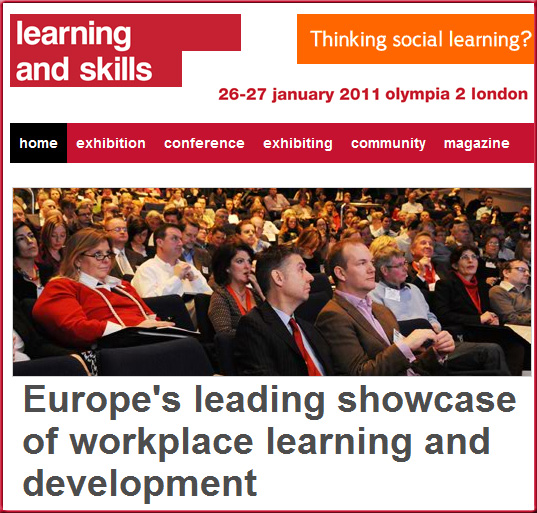
Learning Technologies 2011 and Learning and Skills 2011 | London

24-Jan-2011 » Training Press Releases » Europe’s largest organisational learning event kicks off at London Olympia on Wednesday this week and over 4,000 L&D professionals are expected to attend on 26-27 January.

Also see:

Learning and Skills 2011 -- January 26-27, 2011

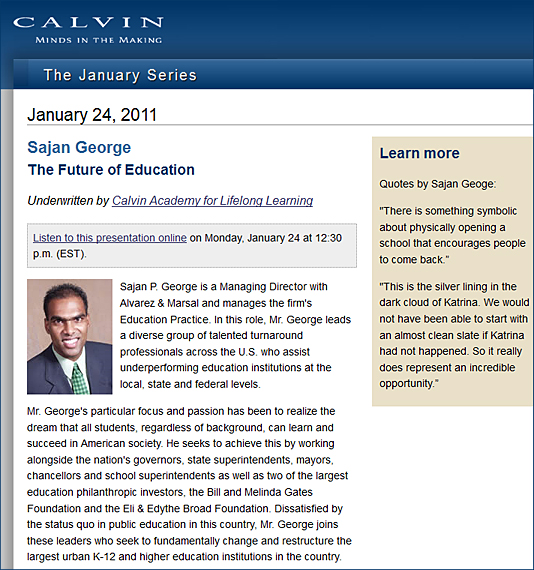
The Future of Education -- by Sajan George at Calvin College -- 1-24-11.

From DSC:
It shouldn’t surprise anyone who knows my work when I say that I think Sajan George is right on the mark!   🙂

For example, below are the main points of what I heard him say (with some graphics of my own that back up what I have been saying):

Sajan George: The Future of Education
January Series at Calvin College (January 24, 2011)

We are living in a new age, the Conceptual Age — primary skill sets that we now need are for creators and empathizers. Why? Because those two skillsets aren’t easily automated or outsourced (Sajan referenced Dan Pink’s work).

We built our education system in between the agricultural and industrial ages; mass production model was built during a much different time with different needs.

Speed and acceleration of change has greatly increased.  At a phenomenal pace!

From DSC:
You may have seen me post this graphic a few times:

The pace has changed significantly and quickly

Sajan gave an example that focused on an older model of a coffee maker vs. a newer model: Coffee Maker 1.0 vs. Coffee Maker 2.0. Point was that we still need skills, but design, esthetic, and emotion have become more important.

Also, we live in a society that demands Coffee Maker 2.0 — but our educational systems are still offering Education 1.0.  We are still batching kids by age, using a 1-to-many model, etc.

We still are offering “Education 1.0” where

  • Content is king
  • Collaboration is cheating
  • Poor performance gets you an F – discouraging
  • Teacher role = expert

…but we are living in a “Society 2.0” world

  • Experience is king
  • Collaboration is encouraged
  • Performance is rewarded; like game designers, encouraged to try again
  • Teacher and student roles are interchangeable; teacher more of a facilitator

Also, our current methods of educating students is not scalable, not sustainable!

Previous attempts at changing our educational systems have failed because they’ve been trying to fix the status quo of education! It’s a design problem.

From DSC:
You may have seen me post this graphic a few times:
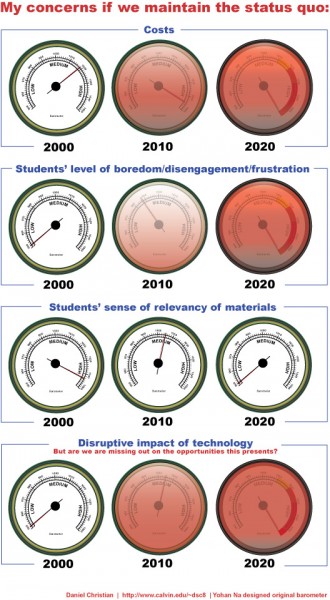
Daniel S. Christian: My concerns with just maintaining the status quo

Current educational system needs to be completely blown up and redesigned! We live in a digital world, yet kids sitting in analog world.

Technology that customizes learning – recommendation engines, adaptive learning; personalized/customized learning.

Online learning is scalable, sustainable – while offering instantaneous feedback. Per Sajan, “But it’s happening on the fringes; home school kids; supplemental, etc.”

Hybrid environment – hoping to nationally launch this year

  • Each student gets 2 teachers
  • Netbook w/ curriculum – w/ lessons loaded
  • Learning management system progresses each child at that student’s pace
  • Bulk is in online engine
  • Teachers don’t have to lesson plan, grade, etc. – so what do they do? The role of the teacher changes to being a facilitator of learning – a coach, mentor, a guide. Can build better, closer relationships.

Use data to differentiate instruction.

Design problem in education.

Hybrid learning <– Sajan’s current work promoting this model; brings power of human interaction with the customization that technology can bring.

From DSC:
You may have seen this graphic I’ve posted a few times — that aims to capture the best of both worlds:
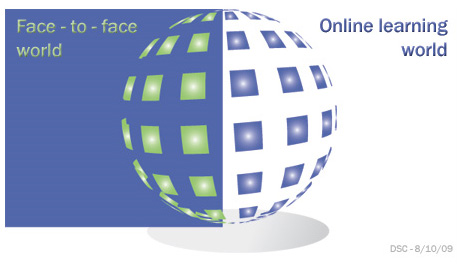
Let's take the best of both worlds -- online learning and face-to-face learning

When trying to change things, you need a compelling vision of what you are trying to build/achieve.

From DSC:
You may have seen the vision I was trying to relay here.

From Q&A session…with a hybrid mode:

  • Not labeling some kids as struggling students; teachers forced to leave some behind while trying to keep the plates spinning over there for kids who are getting it

Connected they write: The lure of writing on the web — from dmlcentral.net by Raquel Recuero

Connected They Write: The Lure of Writing on the Web Blog Image
Tagged with:  

E-Learning Trends 2011 — ASTD

Excerpt:
Learning Circuits recently polled readers on how they’re using e-learning in their organizations. Here’s what they had to say.

How does your company use e-learning? (check all that apply)

Customer service training 34.2%
Enterprise transformations 12.7%
External customers/clients 20.3%
General business skills (leadership, sexual harassment, etc.) 30.4%
IT (end user/desktop applications) 39.2%
IT (network.infrastructure) 12.7%
IT (programming languages) 6.3%
Keeping staff up-to-date on acquisitions 6.3%
Military 2.5%
Product updates and rollouts 20.3%
Regulatory/compliance issues 35.4%
Salesforce training 20.3%
Supply chain or channel partner training 5.1%
Task-specific skills 35.4%
Technical/manufacturing issues 15.2%
We are in initial stages of implementing e-learning 15.2%
Other (please specify) 13.9%

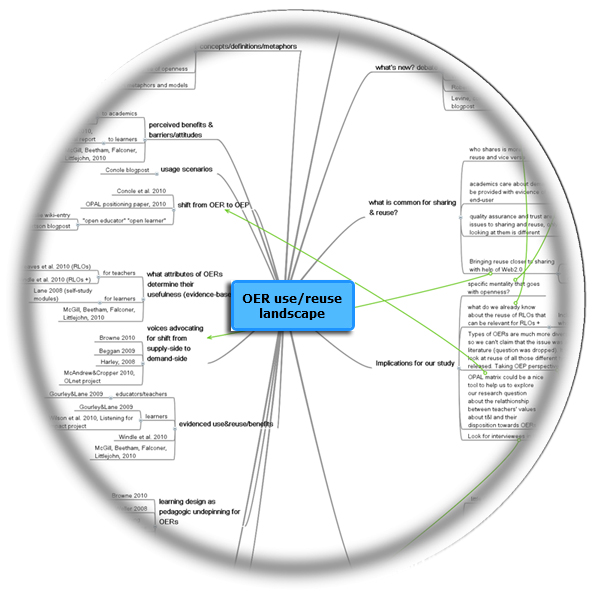
OER reuse landscape — from the TALL blog at the University of Oxford

See the published map:

OER reuse -- University of Oxford

Tagged with:  

Creating an Interactive Portfolio with InDesign — from Layers Magazine by Terry White

Tagged with:  
Tagged with:  

Who wants a self-paced, free, world class education? — from OpenSesame.com

From DSC:
I work within higher education…so why am I posting this? For several reasons:

  1. To help those folks who may not have the funding to attend a college or university.
  2. To help those students who are already in a college or university and who want further resources on a particular discipline.
  3. For lifelong learners — and for those who love to learn — who want to pick up further knowledge re: a discipline.
  4. To prompt leadership/management within higher education to talk about their strategies in how to respond to this game-changing trend/environment. Such disruptive trends can be opportunities or threats.
  5. It’s published at OpenSesame.org — an organization that is forming another online marketplace/exchange that involves education.
  6. It relates to my thoughts on The Forthcoming Walmart of Education (and also here). Something that all universities and colleges will have to deal with…sooner or later.

Assessing and developing metacognitive skills — from Faculty Focus by MaryEllen Weimer

Excerpt:

Metacognition is easily defined: “[It] refers to the ability to reflect upon, understand and control one’s learning,” (Schraw and Dennison, p. 460) or, even more simply, “thinking about one’s thinking.” Despite straightforward definitions, metacognition is a complicated construct that has been the object of research for more than 30 years.

Research supports theories that separate metacognition into two major components: knowledge of cognition and regulation of cognition. Knowledge of cognition “describes an individual’s awareness of cognition at three different levels: declarative (knowing about things), procedural (knowing about how to do things), and conditional (knowing why and when to do things).” (Cooper and Sandi-Urena, p. 240) Regulation of cognition relates to how learners control their learning. Relevant regulatory activities include planning, monitoring, and evaluating.

Tagged with:  
Tagged with:  
© 2025 | Daniel Christian