Gobles (Michigan, USA) third-graders get smartphones — from WoodTV8.com by Tony Tagliavi;  my thanks to Mr. L. Andrew Thorburn for this resource
Phone function disabled; used as handheld computer

GOBLES, Mich. (WOOD) – More than 60 Gobles Elementary School third-graders are spending at least part of their classroom time with their own smartphones.

“It’s amazing,” 8-year-old Halli Davidson said Tuesday before showing a reporter a diagram she drew to help understand multiplication. “You feel like you’re in your own little personal world in here.”

The phone function actually has been disabled, principal Terry Breen told 24 Hour News 8. The students are using the smartphones as handheld computers, complete with filtered wireless Internet, dubbed “mobile learning devices.”

Tuesday was the second day for the $44,000 Gobles pilot program, 75% of which Breen said was paid for with grant funds.

…

But these new devices, according to teacher Chris Quist, are “exciting and fun and engaging. And even in two days, I’ve noticed the amount of on-task time and the quiet time.”

Students could use the devices to watch videos to tie in with their Michigan history lessons, Breen said. And Quist said the simple fact that the phones can show photos and other presentations in color — unlike most classroom handouts — is significant.

…

West Michigan school systems including Allendale, Caledonia and Coopersville — along with Grand River Prep, and Holland Christian Schools — offer one-to-one laptops for at least some grades.

Hopkins Public Schools rolled it out this year with small Internet laptops called netbooks for middle and high school students.

…

If it is expanded, the principal said administrators will determine which device is best — from smartphones to tablet computers such as iPads or laptops — for the needs of students at each grade level.


Tagged with: • • •  

Challenges Seen in Moving to Multimedia Textbooks — from edweek.org by Katie Ash
Supporting the use of multimedia-rich and interactive textbooks in K-12 will require much more digital bandwidth

“Right now, as long as all we’re doing is PDF files, the bandwidth and infrastructure in Virginia isn’t going to be a problem,” says Lan W. Neugent, the assistant superintendent of technology, career, and adult education for the Virginia Department of Education.

“But we’re going to see books become multimedia extravaganzas,” he says, “and the minute that happens, then suddenly the bandwidth is going to be pitiful.”

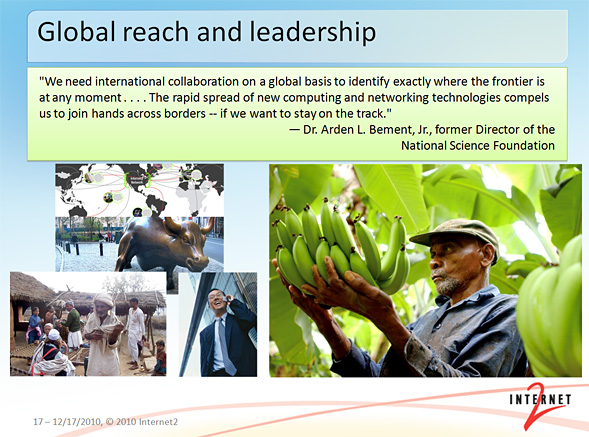
This slide was from an EDUCAUSE Live! Webcast on 16 Dec 2010 by H. David Lambert, president and CEO, Internet2:

The importance of being connected

.

From DSC:
To me, it again reinforces the great need to be connected to networks of subject matter experts (SME’s) within a discipline. Without such personal learning networks, there is a chance that what  a professor is teaching may not be entirely accurate and up-to-date.


.

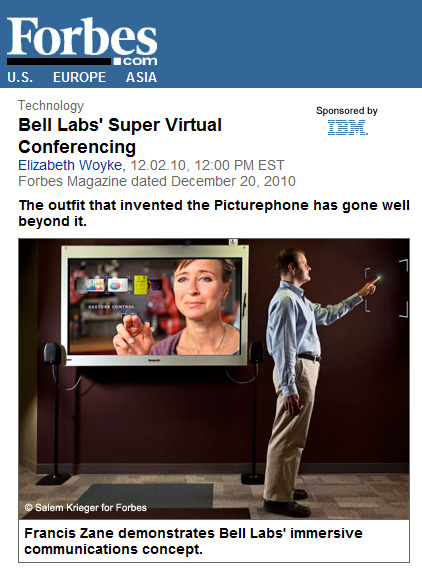
Gee Rittenhouse sees a future in which an executive running late for a meeting pulls his car to the side of the road and calls into a videoconference. He sets his phone on the dash and adjusts the settings so his image appears to the others as if he were in the same boardroom with everyone else. He chats with the people onscreen and pulls up a virtual PowerPoint, flipping through slides with a gestural swipe through the air. When it’s over, these people separated by thousands of miles go back to their physical surroundings having spent the last half hour feeling like they were a few feet apart in a conference room.

This vision is becoming reality at Bell Labs, where Rittenhouse is research chief. Alcatel-Lucent’s innovation shop, the same one that brought you the Picturephone in the 1960s under AT&T,  recently unveiled its great-grandchild, an application called immersive communications. It combines all the “realities” into one: physical, virtual and augmented (reality superimposed with sound or graphics).

Gartner says worldwide mobile phone sales grew 35% in third quarter 2010; Smartphone sales increased 96% — from Gartner.com

Table 1
Worldwide Mobile Terminal Sales to End Users in 3Q10 (Thousands of Units)

Company 3Q10

Units

3Q10 Market Share (%) 3Q09

Units

3Q09 Market Share (%)
Nokia 117,461.0 28.2 113,466.2 36.7
Samsung 71,671.8 17.2 60,627.7 19.6
LG 27,478.7 6.6 31,901.4 10.3
Apple 13,484.4 3.2 7,040.4 2.3
Research In Motion 11,908.3 2.9 8,522.7 2.8
Sony Ericsson 10,346.5 2.5 13,409.5 4.3
Motorola 8,961.4 2.1 13,912.8 4.5
HTC 6,494.3 1.6 2,659.5 0.9
ZTE 6,003.6 1.4 4,143.7 1.3
Huawei Technologies 5,478.1 1.3 3,339.7 1.1
Others 137,797.6 33.0 49,871.1 16.1
Total 417,085.7 100.0 308,894.7 100.0

Source: Gartner (November 2010)

gartner_nov

Tagged with: • • • • •  

Damaka extends enterprise video conferencing to major smartphones and tablet endpoints — from finance.yahoo.com
Mobile UCC solution offers industry-first interoperability with enterprise video conferencing endpoints, including Tandberg and Polycom

RICHARDSON, Texas, Oct. 18 /PRNewswire/ — Damaka®, a technology pioneer in Mobile Unified Communications and Collaboration (UCC), today unveiled Enterprise Mobile Video™, delivering enterprise video conferencing to smartphones and tablets.

Symposium on Progress in Information and Communication Technology (SPICT’10)

Conference date: 12-13 Dec,2010
Conference venue:
The Royale Bintang, Kuala Lumpur
Conference country:
Malaysia

SPICT’10 aims to bring together scientists, industry practitioners and students to exchange the latest fundamental advances and trends, and identify emerging research topics in the field of information and communication technology.

Activities:

* Agent & Multi-agent Systems
* Antennas & Propagation
* Artificial Intelligence
* Bioinformatics & Scientific Computing
* Business Intelligence
* Communication Systems and Networks
* Complex Systems: Modeling and Simulation
* Computer Vision
* Database and Application
* Geographical Information Systems
* Grid and Utility Computing
* Image Processing
* Information indexing & retrieval
* Information Systems
* Intelligent Systems
* Internet Technology
* Knowledge Management
* Mobile Communication Services
* Multimedia Technology and Systems
* Natural Language Processing
* Network Management and services
* Ontology and Web Semantic
* Optical Communications and Networks
* Parallel and Distributed Computing
* Pattern Recognition
* Pervasive Computing
* Real-Time and Embedded Systems
* Remote Sensing
* Robotic Technologies
* Security and Cryptography
* Sensor Networks
* Service Computing
* Signal Processing
* Software Engineering
* Strategic Information Systems

FCC heralds a new era of super wi-fi
.

(CNN) — It’s more powerful than your current home network — able to leap through tall buildings from a single port.

Look, up in the sky.

It’s “SUPER Wi-Fi!”

At least that’s what U.S. Federal Communications Commission Chairman Julius Genachowski is calling a new class of bigger-faster-better internet connections, which could jump from fiction to reality after a commission vote on September 23.

Rise of the ‘Apps Culture’ — Pew Research Center Publications

Cell phone use in the U.S. has increased dramatically over the past decade. Fully eight-in-10 adults today (82%) are cell phone users, and about one-quarter of adults (23%) now live in a household that has a cell phone but no landline phone.

Along with the widespread embrace of mobile technology has come the development of an “apps culture.” As the mobile phone has morphed from a voice device to a multi-channel device to an internet-accessing mini-computer, a large market of mobile-software applications, or “apps,” has arisen.

Among the most popular are apps that provide some form of entertainment (games, music, food, travel and sports) as well as those that help people find information they need and accomplish tasks (maps and navigation, weather, news, banking). With the advent of the mobile phone, the term “app” has become popular parlance for software applications designed to run on mobile phone operating systems, yet a standard, industry-wide definition of what is, and is not, an “app” does not currently exist. For the purpose of this report, apps are defined as end-user software applications that are designed for a cell phone operating system and which extend the phone’s capabilities by enabling users to perform particular tasks.

The most recent Pew Internet & American Life Project survey asked a national sample of 1,917 cell phone-using adults if they use apps and how they use them. Broadly, the results indicate that while apps are popular among a segment of the adult cell phone-using population, a notable number of cell owners are not yet part of the emerging apps culture.

Cisco seeking to acquire Skype: TechCrunch — Yahoo News

WASHINGTON (AFP) – US networking giant Cisco has made an offer to acquire Internet communications firm Skype, technology blog TechCrunch said Monday. TechCrunch, citing what it described as “one of our more reliable sources,” said the San Jose, California-based Cisco is seeking to acquire Skype before the Internet telephony company makes an initial public offering or IPO.

“Google was also rumored to be sniffing around Skype,” TechCrunch said, “but antitrust concerns may have persuaded them not to make an actual offer.”

Addendum from 9/2/10:

Tagged with: • • • •  
© 2025 | Daniel Christian