From DSC: Expectations, today, are getting hard to beat

Since Apple’s event yesterday, I’ve heard some conversations on the radio and reviewed several blog postings and articles about Apple’s announcements…many with a sense of let down (and some with the usual critical viewpoints by the backseat drivers out there who have never tried to invent anything, but who sure like to find fault with everyone else’s inventions and innovations).

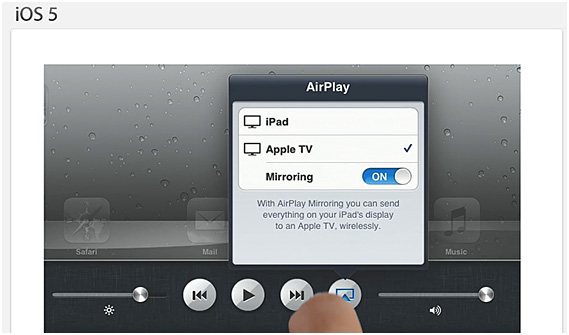
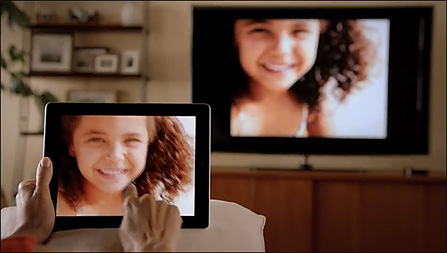
It made me reflect on how high our expectations are becoming these days!  It wasn’t enough that iCloud is coming on 10/12 (and who knows the directions that will take society in). It wasn’t enough to introduce some serious software-based innovations such as Siri (which bring some significant advancements in the world of artificial intelligence) or AirPlay for the iPhone.  It wasn’t enough to enter into the multi-billion dollar card industry with their new Cards app for the iPhone.  Wow…tough crowd.

What might these announcements — and expectations — mean for education? 
Well…I can see intelligent tutoring, intelligent agents, machine-to-machine communications, the continued growth of mobile learning, learning from the living room, the initiation of programs/events caused by changes in one’s location, continued convergence of the television/computer/telephone, continued use of videoconferencing on handheld devices, cloud-based textbooks/apps, and more.
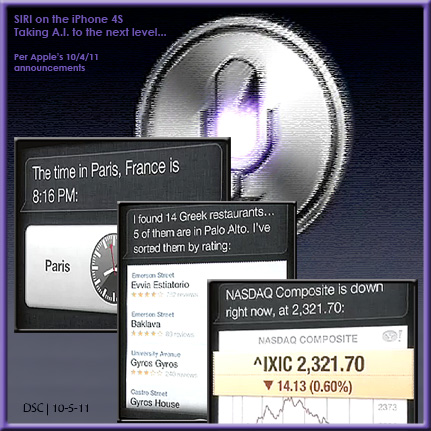

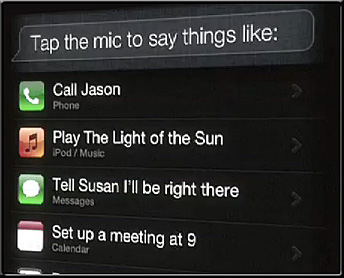
 

Siri on the iPhone 4S -- October 4, 2011


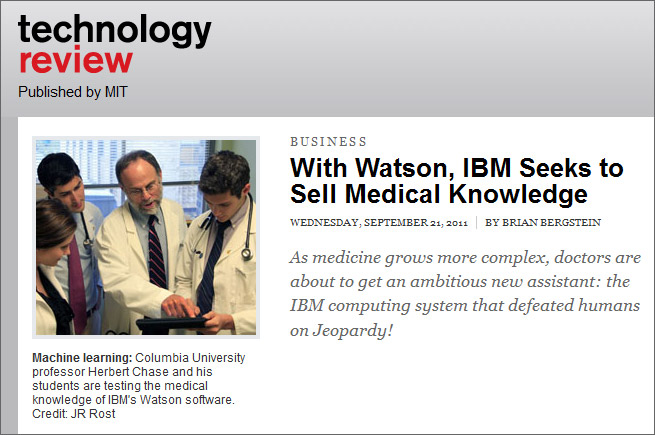
With Watson, IBM seeks to sell medical knowledge


Originally saw this at Steve Knode’s newsletter, which stated:

With Watson, IBM Seeks to Sell Medical Knowledge – Watson is the supercomputing engine that beat the top two human competitors on the quiz show Jeopardy! this year, and Daniels is on the IBM team developing the software’s first commercial application as what could be a stunningly useful diagnostic assistant for doctors. If it works as envisioned, Watson could help doctors identify what is afflicting any patient and suggest a course of treatment.

Tagged with: • • • • • •  
 

Robot financial workers to replace human traders, report says — from innovationnewsdaily.com by Jeremy Hsu

Excerpt:

Human financial traders complicit in precipitating the Great Recession may soon find themselves as unemployable as many others, put out of work by robots as if they were factory workers or stevedores.

…

Of course, like the human world of high finance, the new world of robot financial trading comes with some risks. Better self-regulation is needed to prevent short-sighted, computer-driven market swings such as the “Flash Crash” of May 6, 2010, that wiped out $800 billion on the U.S. equity market in five minutes, and then recovered most of the loss within 30 minutes. Disturbingly, the report found very few studies that examine how human and robot traders interact with one another.

The evolution of next-generation trading algorithms that can learn and adapt without human involvement may also make their behavior “very difficult to predict or control,” the report says. That unpredictability would extend to world financial markets dominated by such robot traders.

Still, there is one likely upside for any college graduates and job seekers of today and tomorrow — computer programmers who can develop such algorithms will certainly remain in high demand.


Addendum on 9-13-11:

Steve Jobs has resigned as Apple CEO "effective immediately"


From DSC:
I want to post a thank you note to Mr. Steven P. Jobs, whom you most likely have heard has resigned as Apple’s CEO. Some articles are listed below, but I want to say thank you to Steve and to the employees of Apple who worked at Apple while he was CEO:

  • Thank you for working hard to enhance the world and to make positive impacts to our world!
  • Thank you for painstakingly pursuing perfection, usability, and excellence!
  • Thank you for getting back up on the horse again when you came out of a meeting with Steve, Tim and others and you just got reamed for an idea or implementation that wasn’t quite there yet.
  • Thanks go out to all of the families who were missing a dad or mom for long periods of time as they were still at work cranking out the next version of ____ or ____.
  • Thanks for modeling what a vocation looks like — i.e. pursuing your God-given gifts/calling/passions; and from my economics training for modeling that everyone wins when you do what you do best!

Thanks again all!


IBM unveils cognitive computing chips — from IBM.com

Excerpt:

ARMONK, N.Y., – 18 Aug 2011: Today, IBM researchers unveiled a new generation of experimental computer chips designed to emulate the brain’s abilities for perception, action and cognition. The technology could yield many orders of magnitude less power consumption and space than used in today’s computers.

In a sharp departure from traditional concepts in designing and building computers, IBM’s first neurosynaptic computing chips recreate the phenomena between spiking neurons and synapses in biological systems, such as the brain, through advanced algorithms and silicon circuitry. Its first two prototype chips have already been fabricated and are currently undergoing testing.

Called cognitive computers, systems built with these chips won’t be programmed the same way traditional computers are today. Rather, cognitive computers are expected to learn through experiences, find correlations, create hypotheses, and remember – and learn from – the outcomes, mimicking the brains structural and synaptic plasticity.


20 most impressive science fair projects of all time — from onlineuniversities.com
 

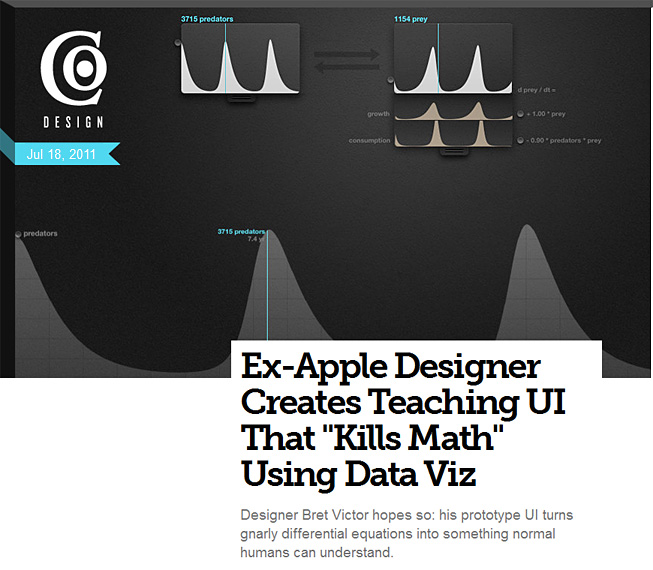
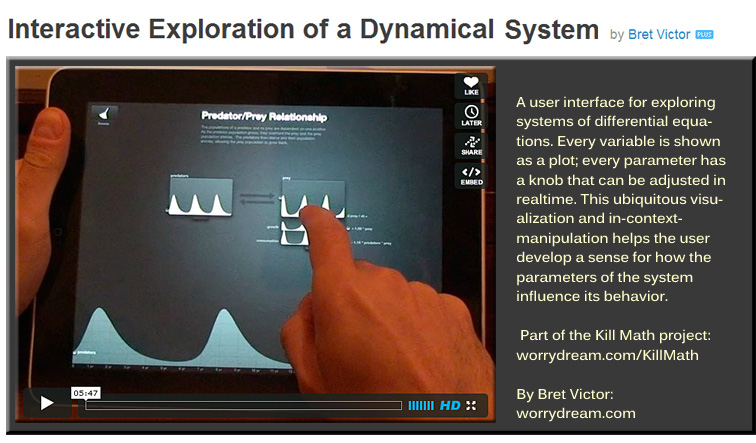
From Brett Victor’s “Kill Math” page

The power to understand and predict the quantities of the world should not be restricted to those with a freakish knack for manipulating abstract symbols.

When most people speak of Math, what they have in mind is more its mechanism than its essence. This “Math” consists of assigning meaning to a set of symbols, blindly shuffling around these symbols according to arcane rules, and then interpreting a meaning from the shuffled result. The process is not unlike casting lots.

This mechanism of math evolved for a reason: it was the most efficient means of modeling quantitative systems given the constraints of pencil and paper. Unfortunately, most people are not comfortable with bundling up meaning into abstract symbols and making them dance. Thus, the power of math beyond arithmetic is generally reserved for a clergy of scientists and engineers (many of whom struggle with symbolic abstractions more than they’ll actually admit).

We are no longer constrained by pencil and paper. The symbolic shuffle should no longer be taken for granted as the fundamental mechanism for understanding quantity and change. Math needs a new interface.

Also see:


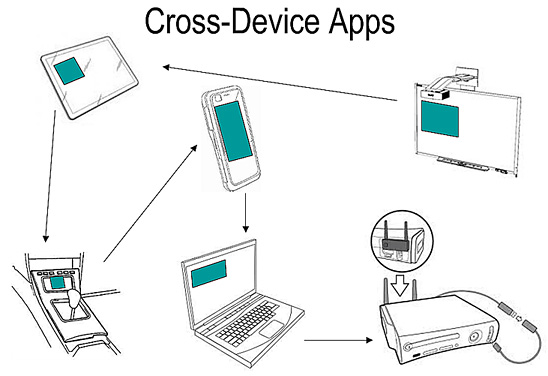
Cross platform mobile app development — from Tribal Labs (UK) by Geoff Stead
A review and comparison of the top tools for true cross platform app development


Tagged with: • • •  

Microsoft advances natural UI with Kinect SDK — from cnet.com by Jay Greene


Oregon State University student Alex Wiggins gestures to Kinect, which in turn makes a remote-control
toy helicopter take off while teammates Ruma Paul (left) and Fabio Matsui (right) look on. (Credit: Microsoft)


How Apple will draft everyone into the cloud. Or else. — from FastCompany.com by E.B. Boyd
Pity the poor programmer whose software doesn’t automatically sync every digital thing you own across all of your devices instantly. Thanks to Apple, if you’re not in the cloud soon, you’re buried.

Excerpt:

And so we at Fast Company expect the same to happen with the cloud. Apple has just introduced an attractive system for a whole range of things consumers care about. Sure, cloud solutions previously existed for some of the things Apple introduced Monday–like documents (Google Docs) and music (Amazon). But it is the comprehensiveness and elegance of the iCloud system that will unleash a tipping point.

Soon users will become used to how much easier their lives become with iCloud. All my stuff is everywhere I want it to be, instantly. I download a song from iTunes, and it’s instantly on all my devices. I put down the book I was reading on my iPad at home, get on the subway, open up my iPhone, and presto, the book is not only on my phone, it opens up to the exact place where I stopped reading on the tablet.

Documents, photos, email, contacts, calendars–users will get used to moving fluidly between all of them on different devices

And as soon as consumers become used to things acting this way, they’ll start actually expecting things to act this way. And when that happens, beware any software company that doesn’t deliver the same experience. In the new world Apple will create, to ask a user to manually sync files between different devices will be the equivalent, back in the ’80s, of asking a bunch of home computer users used to interacting with GUI’s, to use command lines instead.


Apple’s new video regarding their iOS 5 operating system


Apple's video regarding their new iOS5


Apple's video regarding their new iOS5


From DSC:
I have it that these technologies will be used for educationally-related purposes/materials as well; including digital storytelling, transmedia storytelling, transmedia-based interactive/participative educational materials and more.


iCloud, iOS5, and OS X Lion


Some more pics:


© 2025 | Daniel Christian