IBM Watson Education and Pearson to drive cognitive learning experiences for college students — from prnewswire.com

Excerpt:

LAS VEGAS, Oct. 25, 2016 /PRNewswire/ — IBM (NYSE: IBM) and Pearson (FTSE: PSON) the world’s learning company, today announced a new global education alliance intended to make Watson’s cognitive capabilities available to millions of college students and professors.

Combining IBM’s cognitive capabilities with Pearson’s digital learning products will give students a more immersive learning experience with their college courses, an easy way to get help and insights when they need it, all through asking questions in natural language just like they would with another student or professor. Importantly, it provides instructors with insights about how well students are learning, allowing them to better manage the entire course and flag students who need additional help.

For example, a student experiencing difficulty while studying for a biology course can query Watson, which is embedded in the Pearson courseware. Watson has already read the Pearson courseware content and is ready to spot patterns and generate insights.  Serving as a digital resource, Watson will assess the student’s responses to guide them with hints, feedback, explanations and help identify common misconceptions, working with the student at their pace to help them master the topic.
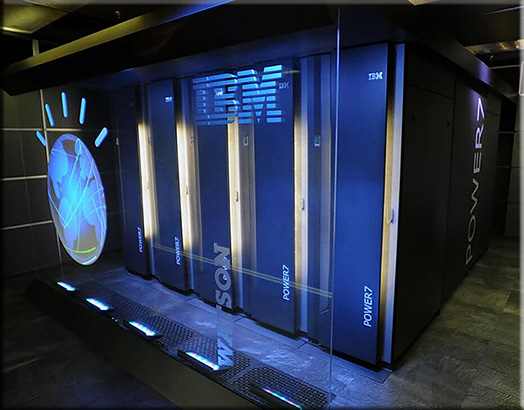


ibm-watson-2016


Udacity partners with IBM Watson to launch the AI Nanodegree — from venturebeat.com by Paul Sawers

Excerpt:

Online education platform Udacity has partnered with IBM Watson to launch a new artificial intelligence (AI) Nanodegree program.

Costing $1,600 for the full two-term, 26-week course, the AI Nanodegree covers a myriad of topics including logic and planning, probabilistic inference, game-playing / search, computer vision, cognitive systems, and natural language processing (NLP). It’s worth noting here that Udacity already offers an Intro to Artificial Intelligence (free) course and the Machine Learning Engineer Nanodegree, but with the A.I. Nanodegree program IBM Watson is seeking to help give developers a “foundational understanding of artificial intelligence,” while also helping graduates identify job opportunities in the space.


The Future Cognitive Workforce Part 1: Announcing the AI Nanodegree with Udacity — from ibm.com by Rob High

Excerpt:

As artificial intelligence (AI) begins to power more technology across industries, it’s been truly exciting to see what our community of developers can create with Watson. Developers are inspiring us to advance the technology that is transforming society, and they are the reason why such a wide variety of businesses are bringing cognitive solutions to market.

With AI becoming more ubiquitous in the technology we use every day, developers need to continue to sharpen their cognitive computing skills. They are seeking ways to gain a competitive edge in a workforce that increasingly needs professionals who understand how to build AI solutions.

It is for this reason that today at World of Watson in Las Vegas we announced with Udacity the introduction of a Nanodegree program that incorporates expertise from IBM Watson and covers the basics of artificial intelligence. The “AI Nanodegree” program will be helpful for those looking to establish a foundational understanding of artificial intelligence. IBM will also help aid graduates of this program with identifying job opportunities.


The Future Cognitive Workforce Part 2: Teaching the Next Generation of Builders — from ibm.com by Steve Abrams

Excerpt:

Announced today at World of Watson, and as Rob High outlined in the first post in this series, IBM has partnered with Udacity to develop a nanodegree in artificial intelligence. Rob discussed IBM’s commitment to empowering developers to learn more about cognitive computing and equipping them with the educational resources they need to build their careers in AI.

To continue on this commitment, I’m excited to announce another new program today geared at college students that we’ve launched with Kivuto Solutions, an academic software distributor. Via Kivuto’s popular digital resource management platform, students and academics around the world will now gain free access to the complete IBM Bluemix Portfolio — and specifically, Watson. This offers students and faculty at any accredited university – as well as community colleges and high schools with STEM programs – an easy way to tap into Watson services. Through this access, teachers will also gain a better means to create curriculum around subjects like AI.


IBM introduces new Watson solutions for professions — from finance.yahoo.com

Excerpt:

LAS VEGAS, Oct. 25, 2016 /PRNewswire/ — IBM (NYSE:IBM) today unveiled a series of new cognitive solutions intended for professionals in marketing, commerce, supply chain and human resources. With these new offerings, IBM is enabling organizations across all industries and of all sizes to integrate new cognitive capabilities into their businesses.

Watson solutions learn in an expert way, which is critical for professionals that want to uncover insights hidden in their massive amounts of data to understand, reason and learn about their customers and important business processes. Helping professionals augment their existing knowledge and experience without needing to engage a data analyst empowers them to make more informed business decisions, spot opportunities and take action with confidence.

“IBM is bringing Watson cognitive capabilities to millions of professionals around the world, putting a trusted advisor and personal analyst at their fingertips,” said Harriet Green, general manager Watson IoT, Cognitive Engagement & Education. “Similar to the value that Watson has brought to the world of healthcare, cognitive capabilities will be extended to professionals in new areas, helping them harness the value of the data being generated in their industries and use it in new ways.”


IBM says new Watson Data Platform will ‘bring machine learning to the masses’ — from techrepublic.com by Hope Reese
On Tuesday, IBM unveiled a cloud-based AI engine to help businesses harness machine learning. It aims to give everyone, from CEOs to developers, a simple platform to interpret and collaborate on data.

Excerpt:

“Insight is the new currency for success,” said Bob Picciano, senior vice president at IBM Analytics. “And Watson is the supercharger for the insight economy.”

Picciano, speaking at the World of Watson conference in Las Vegas on Tuesday, unveiled IBM’s Watson Data Platform, touted as the “world’s fastest data ingestion engine and machine learning as a service.”

The cloud-based Watson Data Platform, will “illuminate dark data,” said Picciano, and will “change everything—absolutely everything—for everyone.”


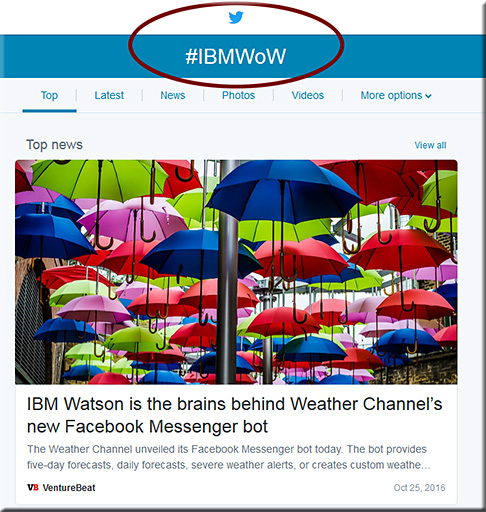
See the #IBMWoW hashtag on Twitter for more news/announcements coming from IBM this week:
 

ibm-wow-hashtag-oct2016


Previous postings from earlier this month:


  • IBM launches industry first Cognitive-IoT ‘Collaboratory’ for clients and partners
    Excerpt:
    IBM have unveiled an €180 million investment in a new global headquarters to house its Watson Internet of Things business.  Located in Munich, the facility will promote new IoT capabilities around Blockchain and security as well as supporting the array of clients that are driving real outcomes by using Watson IoT technologies, drawing insights from billions of sensors embedded in machines, cars, drones, ball bearings, pieces of equipment and even hospitals. As part of a global investment designed to bring Watson cognitive computing to IoT, IBM has allocated more than $200 million USD to its global Watson IoT headquarters in Munich. The investment, one of the company’s largest ever in Europe, is in response to escalating demand from customers who are looking to transform their operations using a combination of IoT and Artificial Intelligence technologies. Currently IBM has 6,000 clients globally who are tapping Watson IoT solutions and services, up from 4,000 just 8 months ago.


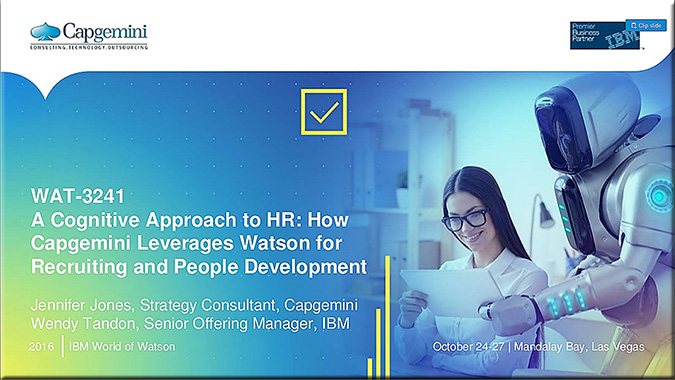
cognitiveapproachhr-oct2016


Silicon Valley comes to Naples: Apple prepares to open Italian academy — from theguardian.com by Stephanie Kirchgaessner
With 200 pupils set to start training, the mood is high in the unlikely suburb chosen for tech giant’s latest venture


Excerpt:

And yet it is this spot – a corner of the sprawling city of Naples that never quite recovered after a major food-packing factory shut its doors in the 1980s – where the Apple chief executive, Tim Cook, and the Italian prime minister, Matteo Renzi, hope the best and brightest young minds in the world will come to develop into leaders in the new app economy.

This week, Apple, the biggest technology company in the world, will open a new academy here – the first of its kind – that will teach 200 mostly southern Italian students how to write code and launch apps on Apple technology by the end of the year.
Apple moves UK HQ to Battersea power station boiler room in London
Read more

Each student at the iOS Developer Academy will be handed the latest iPhone, iPad and Macbook at the start of the nine-month course, which is being offered free of charge following a joint investment of about €10m by Apple and University of Naples Federico II, one of the oldest universities in the world, which is hosting the tuition.


Addendum on 10/12/16:


Women of Foresight: Changes in Education for Future Student Success — from leadingthought.us.com by Dr. Liz Alexander


Excerpt:

Education. A topic that remains hotly debated all over the world. Especially now, as we struggle to find our footing as our futures hurtle towards us, faster and more profoundly different than ever before.

What changes do existing schools and colleges need to make to better prepare students for the trends we already see? Together with those “weak signals” that suggest other, possible futures? In “trying to adapt education for what the American economy is evolving into,” is mandating “coding classes” part of the answer?  Are we doing enough to take into account contrarian perspectives like this one? Who gets to decide what the purpose of education should be, in any case?

These are just some of the questions everyone–from policy makers to parents, academics to students themselves–need to think about.

Intrigued as to what the global futurist and foresight communities might have in mind, I posed them the following question:

If there was one thing I could change in education to better prepare students for the future of work, it would be…

The twenty women that responded to my call are either professional futurists or apply foresight in their roles as leaders in global firms and consultancies, think tanks and foundations. They’re from countries as geographically disperse as Australia, Egypt, Germany, India, New Zealand, Norway, United Arab Emirates, United Kingdom, and United States.

(If you’re wondering why I only asked women, it was a deliberate move to broaden commentary on “our futures,” so people don’t think it’s the sole purview of older, white men. Also, because I believe women’s natural inclinations toward relationships and collaboration, communities and mutual support, are the future!)


One example/answer:

“…to put more emphasis on HOW students will contribute, rather than WHAT their expertise will be, by helping them answer these three questions:

  • How do I most want to contribute to something larger than myself, aka my ‘mission in life’?
  • In what work environment will I be able to make the meaningful contributions I’m capable of?
  • How do I interact with others? What might derail my ambitions, dreams, and wishes? What can I do about it?”


From chatbots to Einstein, artificial intelligence as a service — from infoworld.com by Yves de Montcheuil

Excerpt:

The recent announcement of Salesforce Einstein — dubbed “artificial intelligence for everyone” — sheds new light on the new and pervasive usage of artificial intelligence in every aspect of businesses.


Powered by advanced machine learning, deep learning, predictive analytics, natural language processing and smart data discovery, Einstein’s models will be automatically customized for every single customer, and it will learn, self-tune, and get smarter with every interaction and additional piece of data. Most importantly, Einstein’s intelligence will be embedded within the context of business, automatically discovering relevant insights, predicting future behavior, proactively recommending best next actions and even automating tasks.


…
Chatbots, or conversational bots, are the “other” trending topic in the field of artificial intelligence. At the juncture of consumer and business, they provide the ability for an AI-based system to interact with users through a headless interface. It does not matter whether a messaging app is used, or a speech-to-text system, or even another app — the chatbot is front-end agnostic.

Since the user does not have the ability to provide context around the discussion, he just asks questions in natural language to an AI-driven backend that is tasked with figuring this context and looking for the right answer.


IBM is launching a much-awaited ‘Watson’ recruiting tool — from eremedia.com by Todd Raphael

Excerpt:

For many months IBM has gone to recruiting-industry conferences to say that the famous Watson will be at some point used for talent-acquisition, but that it hasn’t happened quite yet.

It’s here.

IBM is first using Watson for its RPO customers, and then rolling it out as a product for the larger community, perhaps next spring. One of my IBM contacts, Recruitment Innovation Global Leader Yates Baker, tells me that the current version is a work in progress like the first iPhone (or perhaps like that Siri-for-recruiting tool).

There are three parts: recruiting, marketing, and sourcing.


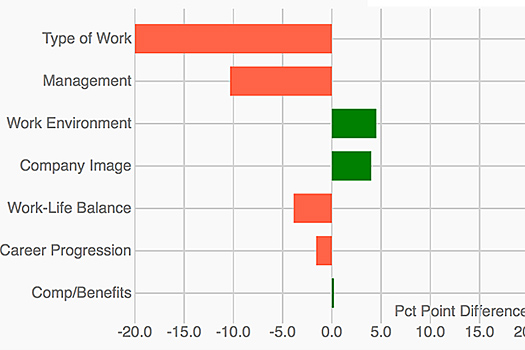
watsonrecruitingtool-sept2016


Apple’s Siri: A Lot Smarter, but Still Kind of Dumb — from wsj.com by Joanna Stern
With the new MacOS and Apple’s AirPods, Siri’s more powerful than ever, but still not as good as some competitors

Excerpt:

With the new iOS 10, Siri can control third-party apps, like Uber and WhatsApp. With the release of MacOS Sierra on Tuesday, Siri finally lands on the desktop, where it can take care of basic operating system tasks, send emails and more. With WatchOS 3 and the new Apple Watch, Siri is finally faster on the wrist. And with Apple’s Q-tip-looking AirPods arriving in October, Siri can whisper sweet nothings in your inner ear with unprecedented wireless freedom. Think Joaquin Phoenix’s earpiece in the movie “Her.”

The groundwork is laid for an AI assistant to stake a major claim in your life, and finally save you time by doing menial tasks. But the smarter Siri becomes in some places, the dumber it seems in others—specifically compared with Google’s and Amazon’s voice assistants. If I hear “I’m sorry, Joanna, I’m afraid I can’t answer that” one more time…


IBM Research and MIT Collaborate to Advance Frontiers of Artificial Intelligence in Real-World Audio-Visual Comprehension Technologies — from prnewswire.com
Cross-disciplinary research approach will use insights from brain and cognitive science to advance machine understanding

Excerpt:

YORKTOWN HEIGHTS, N.Y., Sept. 20, 2016 /PRNewswire/ — IBM Research (NYSE: IBM) today announced a multi-year collaboration with the Department of Brain & Cognitive Sciences at MIT to advance the scientific field of machine vision, a core aspect of artificial intelligence. The new IBM-MIT Laboratory for Brain-inspired Multimedia Machine Comprehension’s (BM3C) goal will be to develop cognitive computing systems that emulate the human ability to understand and integrate inputs from multiple sources of audio and visual information into a detailed computer representation of the world that can be used in a variety of computer applications in industries such as healthcare, education, and entertainment.

The BM3C will address technical challenges around both pattern recognition and prediction methods in the field of machine vision that are currently impossible for machines alone to accomplish. For instance, humans watching a short video of a real-world event can easily recognize and produce a verbal description of what happened in the clip as well as assess and predict the likelihood of a variety of subsequent events, but for a machine, this ability is currently impossible.


Satya Nadella on Microsoft’s new age of intelligence — from fastcompany.com by Harry McCracken
How the software giant aims to tie everything from Cortana to Office to HoloLens to Azure servers into one AI experience.

Excerpt:

“Microsoft was born to do a certain set of things. We’re about empowering people in organizations all over the world to achieve more. In today’s world, we want to use AI to achieve that.”

That’s Microsoft CEO Satya Nadella, crisply explaining the company’s artificial-intelligence vision to me this afternoon shortly after he hosted a keynote at Microsoft’s Ignite conference for IT pros in Atlanta. But even if Microsoft only pursues AI opportunities that it considers to be core to its mission, it has a remarkably broad tapestry to work with. And the examples that were part of the keynote made that clear.


10 Incredible Uses of Virtual Reality — from fortune.com by Rose Leadem
It’s not just for video games.

Excerpt:

Virtual reality technology holds enormous potential to change the future for a number of fields, from medicine, business, architecture to manufacturing.

Psychologists and other medical professionals are using VR to heighten traditional therapy methods and find effective solutions for treatments of PTSD, anxiety and social disorders. Doctors are employing VR to train medical students in surgery, treat patients’ pains and even help paraplegics regain body functions.

In business, a variety of industries are benefiting from VR. Carmakers are creating safer vehicles, architects are constructing stronger buildings and even travel agencies are using it to simplify vacation planning.

Check out these 10 amazing uses of VR.


Visit the U.K. Prime Minister’s Home in This Virtual 10 Downing Street Experience — from uploadvr.com by

Excerpt:

Google has unveiled a new interactive online exhibit that take users on a tour of 10 Downing street in London — home of the U.K. Prime Minister.

The building has served as home to countless British political leaders, from Winston Churchill and Margaret Thatcher through to Tony Blair and — as of a few months ago — Theresa May. But, as you’d expect in today’s security-conscious age, gaining access to the residence isn’t easy; the street itself is gated off from the public. This is why the 10 Downing Street exhibit may capture the imagination of politics aficionados and history buffs from around the world.

The tour features 360-degree views of the various rooms, punctuated by photos and audio and video clips.


Microsoft’s HoloLens Now Helps Elevator Technicians Work Smarter — from uploadvr.com by Charles Singletary

Excerpt:

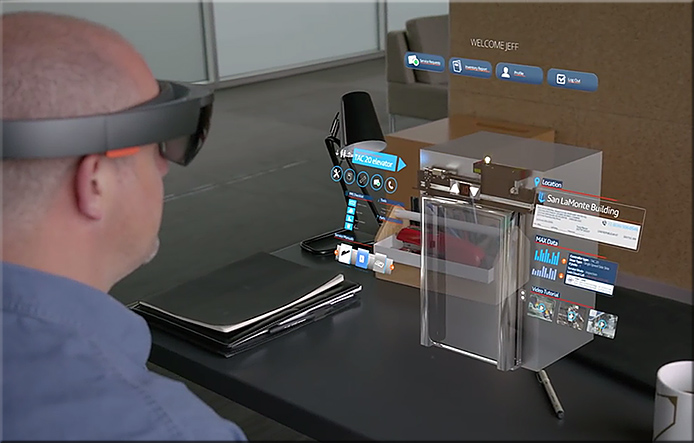
In a slightly more grounded environment, the HoloLens is being used to assist technicians in elevator repairs.

Traversal via elevator is such a regular part of our lifestyles, its importance is rarely recognized…until they’re not working as they should be. ThyssenKrupp AG, one of the largest suppliers for elevators, recognizes how essential they are as well as how the simplest malfunctions can deter the lives of millions. Announced on their blog, Microsoft is partnering with Thyssenkrupp to equip 24,000 of their technicians with HoloLens.


ms-hololens-thyssenkrupp-sept2016

Insert from DSC re: the above piece re: HoloLens:

Will technical communicators need to augment their skillsets? It appears so.


Phiona: A Virtual Reality Portrait of ‘Queen of Katwe’ — from abcnews.com by Angel Canales and Adam Rivera


vr-queenofkatwe-2016


Get a front-row seat in Harvard’s largest class, thanks to virtual reality — from medium.freecodecamp.com by Dhawal Shah

harvard-cs50-sep2016

Intro video here: This is CS50 2016


The future of mobile video is virtual reality — from techcrunch.com by Mike Wadhera

Excerpt:

But in a world where no moment is too small to record with a mobile sensor, and one in which time spent in virtual reality keeps going up, interesting parallels start to emerge with our smartphones and headsets.

Let’s look at how the future could play out in the real world by observing three key drivers: VR video adoption, mobile-video user needs and the smartphone camera rising tide.


Now, a virtual reality programme to improve social skills in autistic kids — from cio.economictimes.indiatimes.com by
The VR training platform creates a safe place for participants to practice social situations without the intense fear of consequence.

Excerpt:

“Individuals with autism may become overwhelmed and anxious in social situations,” research clinician Dr Nyaz Didehbani said.

“The virtual reality training platform creates a safe place for participants to practice social situations without the intense fear of consequence,” said Didehbani.

The participants who completed the training demonstrated improved social cognition skills and reported better relationships, researchers said.


Also see:


AI chatbot apps to infiltrate businesses sooner than you think — from searchbusinessanalytics.techtarget.com by Bridget Botelho
Artificial intelligence chatbots aren’t the norm yet, but within the next five years, there’s a good chance the sales person emailing you won’t be a person at all.

Excerpt:

In fact, artificial intelligence has come so far so fast in recent years, Gartner predicts it will be pervasive in all new products by 2020, with technologies including natural language capabilities, deep neural networks and conversational capabilities.

Other analysts share that expectation. Technologies that encompass the umbrella term artificial intelligence — including image recognition, machine learning, AI chatbots and speech recognition — will soon be ubiquitous in business applications as developers gain access to it through platforms such as the IBM Watson Conversation API and the Google Cloud Natural Language API.


3 corporate departments that chatbots will disrupt — from venturebeat.com by Natalie Lambert

Excerpt:

  1. Customer Service
  2. Human Resources
  3. Marketing


Facebook Messenger’s 11,000 chatbots are much more interactive — from androidcentral.com by Harish Jonnalagadda

Excerpt:

Facebook introduced chatbots on Messenger three months ago, and the search giant has shared today that over 11,000 bots are active on the messaging service. The Messenger Platform has picked up an update that adds a slew of new features to bots, such as a persistent menu that lists a bot’s commands, quick replies, ability to respond with GIFs, audio, video, and other files, and a rating system to provide feedback to bot developers.


Chatbots are coming to take over the world — from telecom.economictimes.indiatimes.com

Excerpts:

In another example, many businesses use interactive voice response (IVR) telephony systems, which have limited functionalities and often provide a poor user experience. Chatbots can replace these applications in future where the user will interact naturally to get relevant information without following certain steps or waiting for a logical sequence to occur.
…
Chatbots are a good starting point, but the future lies in more advanced versions of audio and video bots. Apple’s Siri, Amazon’s Alexa, Microsoft’s Cortana, Google with its voice assistance, are working in the same direction to achieve it. Bot ecosystems will become even more relevant in the phase of IoT mass adoption and improvement of input/output (I/O) technology.


With big players investing heavily in AI, Chatbots are likely to be an increasing feature of social media and other communications platforms.


Everything You Wanted to Know About Chatbots But Were Afraid to Ask — from businessinsider.com by Andrew Meola

Excerpt:

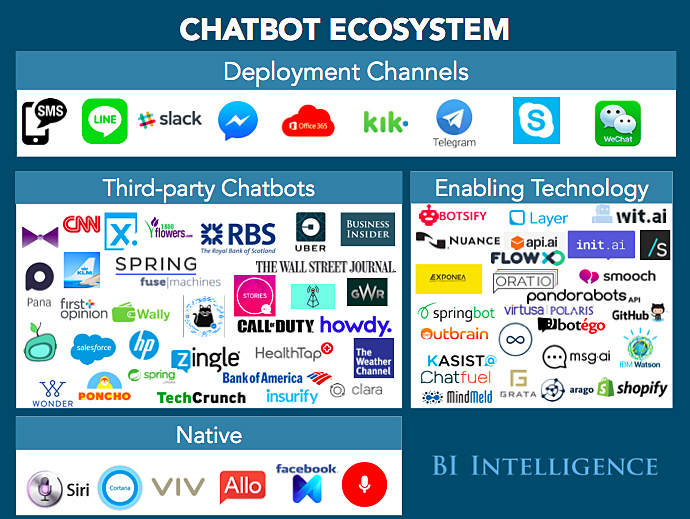
Chatbots are software programs that use messaging platforms as the interface to perform a wide variety of tasks—everything from scheduling a meeting to reporting the weather, to helping a customer buy a sweater.

Because texting is the heart of the mobile experience for smartphone users, chatbots are a natural way to turn something users are very familiar with into a rewarding service or marketing opportunity.

And when you consider that the top 4 messaging apps reach over 3 billion global users (MORE than the top 4 social networks), you can see that the opportunity is huge.


chatbotecosystem-businsider-sept2016


Microsoft taught a computer to make ‘chit chat’ — and now 40 million people love it — from businessinsider.com by Matt Weinberger

Excerpt:

The Xiaoice chat bot — pronounced “Shao-ice” and translated as “little Bing”  — born as an experiment by Microsoft Research in 2014, reaches 40 million followers in China, who often literally talk with her for hours.

At her most active, Xiaoice is holding down as many 23 conversations a session, says Microsoft Research NExT leader Dr. Peter Lee. It’s even evolved to become a nice little sideline business for Microsoft, thanks to a partnership with Chinese e-retailer JD.com that lets users buy products by talking to Xiaoice.

The reason Xiaoice is so successful is she was born of a different kind of philosophical experiment: Instead of building a chat bot that was useful, Microsoft simply tried to make it fun to talk to.


Why every college campus needs a chatbot — from venturebeat.com by John Brandon

Excerpts:

Dropping a child off at college is a stressful experience. I should know — I dropped off one last week and another today. It’s confusing because everything is so new, your child (who is actually a young adult, how did that happen?) is anxious, and you usually have to settle up on your finances.

This situation happens to be ideal for a chatbot, because the administrative staff is way too busy to handle questions in person or by phone. There might be someone directing you in the parking lot, but not everyone standing around in the student center knows how to submit FAFSA data.
…
One of the main reasons for thinking of this is that I would have used one myself today. It’s a situation where you want immediate, quick information without having to explain all of the background information. You just need the campus map or the schedule for the day — that’s it. You don’t want any extra frills.


From DSC:
My question is:

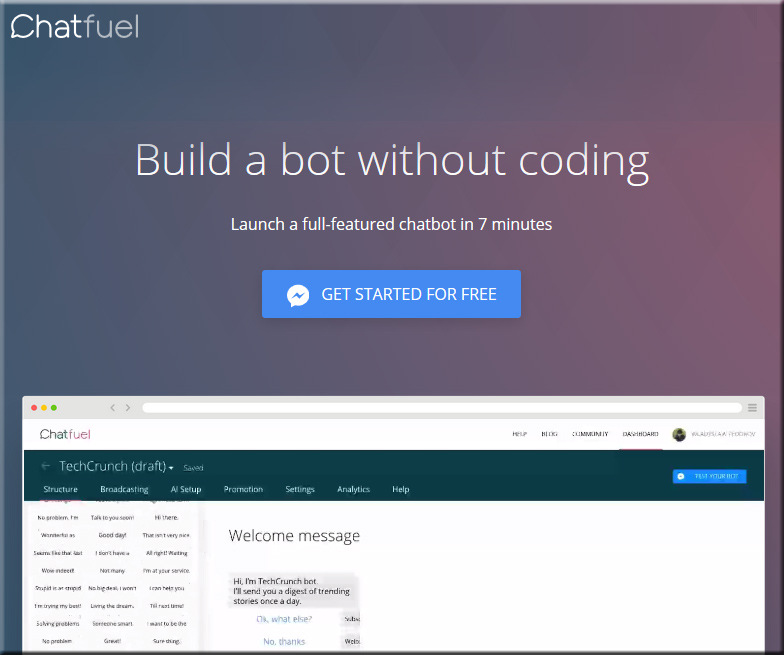
Will Instructional Designers, Technical Communicators, e-Learning Designers, Trainers, (and other positions as as well) going to have to know how to build chatbots in the future? Our job descriptions could be changing soon. Or will this kind of thing require more programming-related skills? Perhaps more firms like the one below could impact that situation…


Chatfuel-Aug2016


FACT SHEET: ED Launches Initiative for Low-Income Students to Access New Generation Of Higher Education Providers — from ed.gov

Excerpt:

[On 8/16/16], the U.S. Department of Education (ED) is inviting eight selected partnerships between institutions of higher education and non-traditional providers to participate in the EQUIP (Educational Quality through Innovation Partnerships) experiment.

These partnerships will allow students—particularly low-income students—to access federal student aid for the first time to enroll in programs offered by non-traditional training providers, in partnership with colleges and universities, including coding bootcamps, online courses, and employer organizations. The goals of the experiment are to: (1) test new ways of allowing Americans from all backgrounds to access innovative learning and training opportunities that lead to good jobs, but that fall outside the current financial aid system; and (2) strengthen approaches for outcomes-based quality assurance processes that focus on student learning and other outcomes. The experiment aims to promote and measure college access, affordability, and student outcomes.


Obama Administration to Fund Nontraditional Training for Students — from wsj.com
Education Department will give up to $17 million in loans and grants for training at eight entities that aren’t traditional colleges

Excerpt:

WASHINGTON—The Obama administration will inject millions of dollars into a group of nontraditional education providers to address a vexing problem: Many Americans are leaving college with debt but without skills the economy needs.

The administration is turning to the private sector for help. In a novel experiment, the Education Department announced Tuesday up to $17 million in loans and grants for students to undergo training at eight entities that aren’t traditional colleges. Most are for-profit companies. They include coding academies such as New York startup Flatiron School and Portland, Ore.-based Epicodus, as well as websites such as Study.com and StraighterLine that provide online courses at reduced costs.

The one that stands out from the group is corporate giant General Electric Co., which won’t receive funds directly but will provide training at one of its jet-engine plants under the program.

The program, called Educational Quality through Innovative Partnerships, or Equip, is designed to enable low-income Americans to learn skills in areas where colleges often fall short, such as learning how to write computer code, or using new software to operate high-tech manufacturing equipment to make jet engines.


Can’t Afford Coding Camp? The Feds May Have a Loan for You — from wired.com by Issie Lapowsky

Excerpt:

A new Department of Education program focused on skills training aims to address that second part. Announced last year, the so-called Educational Quality through Innovation Partnerships program will offer federal student aid to students enrolled at non-traditional institutions like coding bootcamps and skills-training programs.

[On 8/16/16], the Department of Education revealed the eight organizations and educational institutions with programs that will be covered as part of the EQUIP pilot program. For now, the programs are located on both coasts and in Texas. They include bootcamps like The Flatiron School, as well as newly launched training programs from companies like General Electric. The Department of Education chose the programs from dozens of applications, and each organization will partner with an established, accredited college or university. Meanwhile, third-party quality assurance partners have signed up to monitor students’ results.


A call to arms against the hacker hordes — from sloanreview.mit.edu by Theodore Kinni

Excerpt (emphasis DSC):

Attribution and retribution in the fight against cybercrime: Imagine being enthroned at the end of the long table in the C-suite. You’ve got riches beyond imagination at your disposal; tens of thousands of vassals are toiling day and night for you. Your knights surround you, awaiting your command. And, at this very moment, some evil-minded jester with a computer and an Internet connection is breaching the castle walls.

But wait, is that a war horn you hear in the distance? Yes, it’s the lawyers from Steptoe & Johnson riding to your rescue. Enough, says partner Stewart Baker and trusty clerk Victoria Muth in an article for Brink. “It’s pretty clear that building higher walls around our networks is a dead end. So is tighter scrutiny and control over what happens on the network,” they write. “Government is failing us…, too.” The solution? Fight back.

Attribution and retribution are the weapons in this counterattack. “It might mean building ‘beacons’ into documents so that when they are opened by attackers, they phone home to alert defenders that their information was compromised,” suggest Baker and Muth. “It might mean using information provided by beacons to compromise the attackers’ network and gather evidence as to the attackers’ identities. It might mean stopping a DDOS attack by taking over the botnet, or by patching the vulnerability by which the botnet conscripted third-party machines.”


Also see:

Machine Learning – New Weapon in the Hacking Wars?  — from by Ed Featherston
@CloudExpo #API #Cloud #BigData #MachineLearning

Excerpt:

It feels like the barbarians are continually at the gate. We can’t seem to go more than a week before a new data breach is in the news, impacting potentially millions of individuals. The targets range from companies like Omni Hotels, which had been breached affecting up to 50,000 customers whose personal and credit card information was exposed, to North Carolina State University, where over 38,000 students’ personal information, including their SSNs, were at risk. As I mentioned in a recent blog ‘Internet of Things and Big Data – who owns your data?‘, we have been storing our personal and credit card information in a variety of systems, credit card companies, banks, online retailers, hotels – and that’s just naming a few. The information in those systems is more valuable than gold to the hackers. The hacker attacks are constant, creative, and changing frequently.


IBM is training Watson to hunt hackers — from washingtonpost.com by Andrea Peterson

Excerpt:

Watson, IBM’s computer brain, has a lot of talents. It mastered “Jeopardy!,” it cooks, and even tries to cure cancer. But now, it’s training for a new challenge: Hunting hackers.

On [May10th, 2016], IBM Security announced a new cloud-based version of the cognitive technology, dubbed “Watson for Cybersecurity.” In the fall, IBM will be partnering with eight universities to help get Watson up to speed by flooding it with security reports and data.


From DSC:
I try never to judge anyone, as I don’t want to be judged (Matthew 7:1).  I try to extend grace, as I, myself, have nothing to stand on.

That said, I struggle with how to deal with and view hackers.  Daily, they wreak havoc on institutions and individuals throughout the globe — causing billions of dollars of damage.

I’m amazed at the lack of punishment dealt out to hackers. Our governments don’t step in, likely because they are all trying to hack each others’ systems as well.

But the individual and group-based hackers out there have created an underground economy…where one wakes up and goes to the office and hacks away, all for making some coin — just like a normal job evidently.  These hackers have smarts, know-how, and intelligence — but they have chosen to put it towards destructive purposes.  And there doesn’t seem to be any fear involved in doing so. 

Well, that needs to stop! There needs to be major punishment for those who hack.

That’s why the articles above caught my eye. We need to fight back against the hackers. We need to release serious damage to their systems, networks, hardware and software — just as they do to ours.

I don’t like to take this stance. I don’t like to even use the words “fight back.” But there is warfare going on — and fear needs to enter the equation for those who would resort to hacking.

BTW, I’m even nervous about posting this item…as some hacker could come after my site. If so, I hope to be back up and running again soon. But if not…yet another one bites the dust.


In Memory: Seymour Papert — from media.mit.edu; with thanks to Mr. Joe Byerwalter for this resource

Excerpt:

Seymour Papert, whose ideas and inventions transformed how millions of children around the world create and learn, died Sunday, July 31, 2016 at his home in East Blue Hill, Maine. He was 88.

Papert’s career traversed a trio of influential movements: child development, artificial intelligence, and educational technologies. Based on his insights into children’s thinking and learning, Papert recognized that computers could be used not just to deliver information and instruction, but also to empower children to experiment, explore, and express themselves. The central tenet of his Constructionist theory of learning is that people build knowledge most effectively when they are actively engaged in constructing things in the world. As early as 1968, Papert introduced the idea that computer programming and debugging can provide children a way to think about their own thinking and learn about their own learning.


Also see:

  • AI and Computer Learning Lion Seymour Papert Dies at 88 — from fortune.com by  Barb Darrow
    Excerpt:
    Seymour Papert, the MIT professor who helped blaze the trail for artificial intelligence and computer-aided education for children at a time when no one saw the potential for using these massive machines for such purposes, died Sunday at the age of 88 in East Blue Hill, Maine.


“In this particular art class they were all carving soap,” he continued, “but what each student carved came from wherever fancy is bred, and the project was not done and dropped but continued for many weeks. It allowed time to think, to dream, to gaze, to get a new idea and try it and drop it or persist, time to talk, to see other people’s work and their reaction to yours — not unlike mathematics as it is for the mathematician, but quite unlike math as it is in junior high school.”

.

  • Seymour Papert, 88, Dies; Saw Education’s Future in Computers — from nytimes.com by Glenn Rifkin
    Excerpt:
    Seymour Papert, a visionary educator and mathematician who well before the advent of the personal computer foresaw children using computers as instruments for learning and enhancing creativity, died on Sunday at his home in Blue Hill, Me. He was 88.


He added, “In the past, education adapted the mind to a very restricted set of available media; in the future, it will adapt media to serve the needs and tastes of each individual mind.”


Virtual, Augmented & Mixed Reality are the 4th Wave of Digital Technology — from uploadvr.com by Tim Merel

Excerpt:

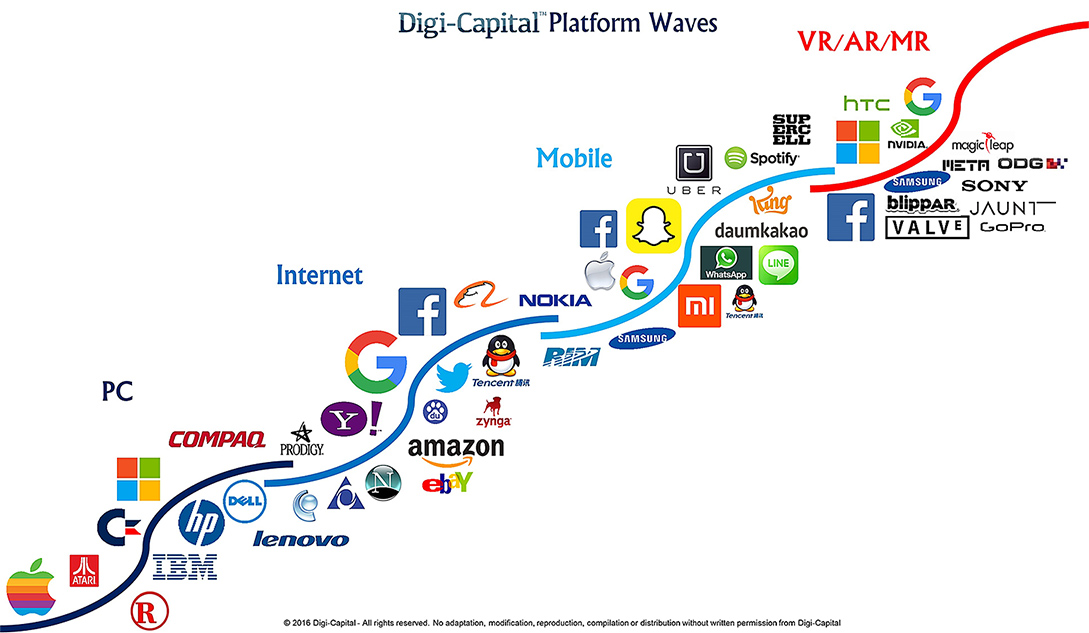
Consumer computing platform changes aren’t straight lines, they’re waves. PC, internet and mobile were the first 3 waves, and each was faster, larger and more disruptive than the last. Now the fourth wave of virtual, augmented and mixed reality is bearing down on us, so let’s dive in. The water’s fine.


Digi-Capital-Platform-Waves-July2016


From DSC:
As you might suppose, waves are best experienced when riding on top of one — versus getting crushed by one or having to try to swim after a wave once it’s passed you by. Though much of this wave is forthcoming, the point in posting this now is to encourage us to put these Human Computer Interaction (HCI)-related changes on our radars…or, to go with the former analogy, to encourage us to grab our surfboards!


Also relevant/see:


Algorithmia-July2016

About:

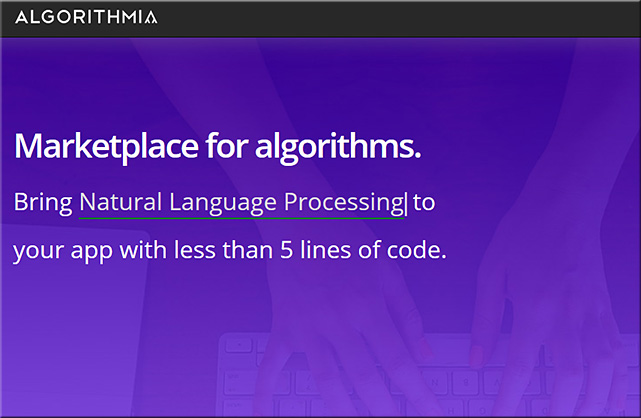
Algorithmia was born in 2013 with the goal of advancing the art of algorithm development, discovery and use. As developers ourselves we believe that given the right tools the possibilities for innovation and discovery are limitless.

Today we build what we believe to be the next era of programming: a collaborative, always live and community driven approach to making the machines that we interact with better.

The community drives the Algorithmia API. One API that exposes the collective knowledge of algorithm developers across the globe.


AI chatbot apps to infiltrate businesses sooner than you think — from searchbusinessanalytics.techtarget.com by Bridget Botelho
Artificial intelligence chatbots aren’t the norm yet, but within the next five years, there’s a good chance the sales person emailing you won’t be a person at all.

Excerpt:

In fact, artificial intelligence has come so far so fast in recent years, Gartner predicts it will be pervasive in all new products by 2020, with technologies including natural language capabilities, deep neural networks and conversational capabilities.

Other analysts share that expectation. Technologies that encompass the umbrella term artificial intelligence — including image recognition, machine learning, AI chatbots and speech recognition — will soon be ubiquitous in business applications as developers gain access to it through platforms such as the IBM Watson Conversation API and the Google Cloud Natural Language API.


3 corporate departments that chatbots will disrupt — from venturebeat.com by Natalie Lambert

Excerpt:

  1. Customer Service
  2. Human Resources
  3. Marketing


Facebook Messenger’s 11,000 chatbots are much more interactive — from androidcentral.com by Harish Jonnalagadda

Excerpt:

Facebook introduced chatbots on Messenger three months ago, and the search giant has shared today that over 11,000 bots are active on the messaging service. The Messenger Platform has picked up an update that adds a slew of new features to bots, such as a persistent menu that lists a bot’s commands, quick replies, ability to respond with GIFs, audio, video, and other files, and a rating system to provide feedback to bot developers.


Chatbots are coming to take over the world — from telecom.economictimes.indiatimes.com

Excerpts:

In another example, many businesses use interactive voice response (IVR) telephony systems, which have limited functionalities and often provide a poor user experience. Chatbots can replace these applications in future where the user will interact naturally to get relevant information without following certain steps or waiting for a logical sequence to occur.
…
Chatbots are a good starting point, but the future lies in more advanced versions of audio and video bots. Apple’s Siri, Amazon’s Alexa, Microsoft’s Cortana, Google with its voice assistance, are working in the same direction to achieve it. Bot ecosystems will become even more relevant in the phase of IoT mass adoption and improvement of input/output (I/O) technology.


With big players investing heavily in AI, Chatbots are likely to be an increasing feature of social media and other communications platforms.


Everything You Wanted to Know About Chatbots But Were Afraid to Ask — from businessinsider.com by Andrew Meola

Excerpt:

Chatbots are software programs that use messaging platforms as the interface to perform a wide variety of tasks—everything from scheduling a meeting to reporting the weather, to helping a customer buy a sweater.

Because texting is the heart of the mobile experience for smartphone users, chatbots are a natural way to turn something users are very familiar with into a rewarding service or marketing opportunity.

And when you consider that the top 4 messaging apps reach over 3 billion global users (MORE than the top 4 social networks), you can see that the opportunity is huge.


chatbotecosystem-businsider-sept2016


We can do nothing to change the past, but we have enormous power to shape the future. Once we grasp that essential insight, we recognize our responsibility and capability for building our dreams of tomorrow and avoiding our nightmares.

–Edward Cornish


From DSC:
This posting represents Part VI in a series of such postings that illustrate how quickly things are moving (Part I, Part II, Part III, Part IV, Part V, and to ask:

  • How do we collectively start talking about the future that we want?
  • How do we go about creating our dreams, not our nightmares?
  • Most certainly, governments will be involved….but who else should be involved in these discussions? Shouldn’t each one of us participate in some way, shape, or form?


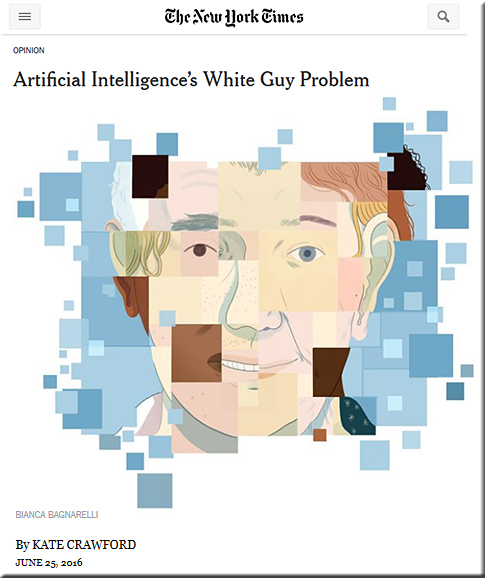
AIsWhiteGuyProblem-NYTimes-June2016


Artificial Intelligence’s White Guy Problem — from nytimes.com by Kate Crawford

Excerpt:

But this hand-wringing is a distraction from the very real problems with artificial intelligence today, which may already be exacerbating inequality in the workplace, at home and in our legal and judicial systems. Sexism, racism and other forms of discrimination are being built into the machine-learning algorithms that underlie the technology behind many “intelligent” systems that shape how we are categorized and advertised to.
…
If we look at how systems can be discriminatory now, we will be much better placed to design fairer artificial intelligence. But that requires far more accountability from the tech community. Governments and public institutions can do their part as well: As they invest in predictive technologies, they need to commit to fairness and due process.


Facebook is using artificial intelligence to categorize everything you write — from futurism.com

Excerpt:

Facebook has just revealed DeepText, a deep learning AI that will analyze everything you post or type and bring you closer to relevant content or Facebook services.


March of the machines — from economist.com
What history tells us about the future of artificial intelligence—and how society should respond

Excerpt:

EXPERTS warn that “the substitution of machinery for human labour” may “render the population redundant”. They worry that “the discovery of this mighty power” has come “before we knew how to employ it rightly”. Such fears are expressed today by those who worry that advances in artificial intelligence (AI) could destroy millions of jobs and pose a “Terminator”-style threat to humanity. But these are in fact the words of commentators discussing mechanisation and steam power two centuries ago. Back then the controversy over the dangers posed by machines was known as the “machinery question”. Now a very similar debate is under way.

After many false dawns, AI has made extraordinary progress in the past few years, thanks to a versatile technique called “deep learning”. Given enough data, large (or “deep”) neural networks, modelled on the brain’s architecture, can be trained to do all kinds of things. They power Google’s search engine, Facebook’s automatic photo tagging, Apple’s voice assistant, Amazon’s shopping recommendations and Tesla’s self-driving cars. But this rapid progress has also led to concerns about safety and job losses. Stephen Hawking, Elon Musk and others wonder whether AI could get out of control, precipitating a sci-fi conflict between people and machines. Others worry that AI will cause widespread unemployment, by automating cognitive tasks that could previously be done only by people. After 200 years, the machinery question is back. It needs to be answered.


As technology changes the skills needed for each profession, workers will have to adjust. That will mean making education and training flexible enough to teach new skills quickly and efficiently. It will require a greater emphasis on lifelong learning and on-the-job training, and wider use of online learning and video-game-style simulation. AI may itself help, by personalising computer-based learning and by identifying workers’ skills gaps and opportunities for retraining.


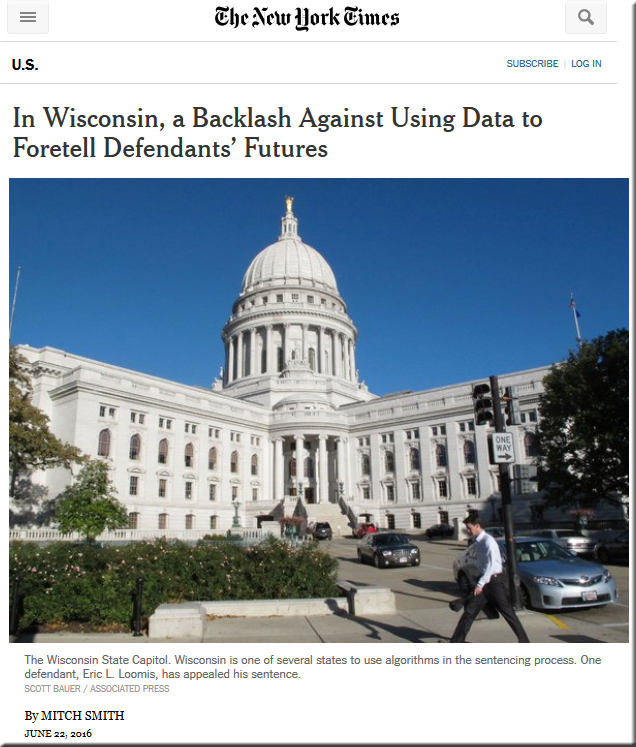
Backlash-Data-DefendantsFutures-June2016


In Wisconsin, a Backlash Against Using Data to Foretell Defendants’ Futures — from nytimes.com by Mitch Smith

Excerpt:

CHICAGO — When Eric L. Loomis was sentenced for eluding the police in La Crosse, Wis., the judge told him he presented a “high risk” to the community and handed down a six-year prison term.

The judge said he had arrived at his sentencing decision in part because of Mr. Loomis’s rating on the Compas assessment, a secret algorithm used in the Wisconsin justice system to calculate the likelihood that someone will commit another crime.
…
Compas is an algorithm developed by a private company, Northpointe Inc., that calculates the likelihood of someone committing another crime and suggests what kind of supervision a defendant should receive in prison. The results come from a survey of the defendant and information about his or her past conduct. Compas assessments are a data-driven complement to the written presentencing reports long compiled by law enforcement agencies.


Google Tackles Challenge of How to Build an Honest Robot — from bloomberg.com by

Excerpt:

Researchers at Alphabet Inc. unit Google, along with collaborators at Stanford University, the University of California at Berkeley, and OpenAI — an artificial intelligence development company backed by Elon Musk — have some ideas about how to design robot minds that won’t lead to undesirable consequences for the people they serve. They published a technical paper Tuesday outlining their thinking.

The motivation for the research is the immense popularity of artificial intelligence, software that can learn about the world and act within it. Today’s AI systems let cars drive themselves, interpret speech spoken into phones, and devise trading strategies for the stock market. In the future, companies plan to use AI as personal assistants, first as software-based services like Apple Inc.’s Siri and the Google Assistant, and later as smart robots that can take actions for themselves.

But before giving smart machines the ability to make decisions, people need to make sure the goals of the robots are aligned with those of their human owners.


Policy paper | Data Science Ethical Framework — from gov.uk
From: Cabinet Office, Government Digital Service and The Rt Hon Matt Hancock MP
First published: 19 May 2016
Part of: Government transparency and accountability

This framework is intended to give civil servants guidance on conducting data science projects, and the confidence to innovate with data.

Detail: Data science provides huge opportunities for government. Harnessing new forms of data with increasingly powerful computer techniques increases operational efficiency, improves public services and provides insight for better policymaking. We want people in government to feel confident using data science techniques to innovate. This guidance is intended to bring together relevant laws and best practice, to give teams robust principles to work with. The publication is a first version that we are asking the public, experts, civil servants and other interested parties to help us perfect and iterate. This will include taking on evidence from a public dialogue on data science ethics. It was published on 19 May by the Minister for Cabinet Office, Matt Hancock. If you would like to help us iterate the framework, find out how to get in touch at the end of this blog.


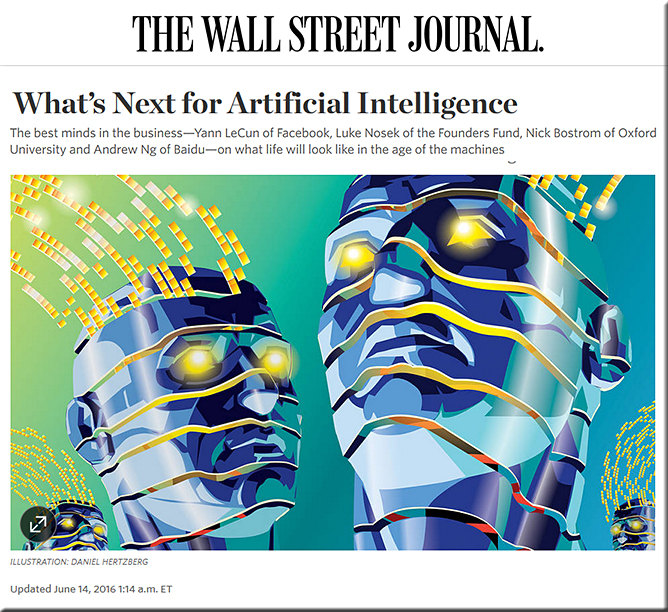
WhatsNextForAI-June2016

Excerpt (emphasis DSC):

We need to update the New Deal for the 21st century and establish a trainee program for the new jobs artificial intelligence will create. We need to retrain truck drivers and office assistants to create data analysts, trip optimizers and other professionals we don’t yet know we need. It would have been impossible for an antebellum farmer to imagine his son becoming an electrician, and it’s impossible to say what new jobs AI will create. But it’s clear that drastic measures are necessary if we want to transition from an industrial society to an age of intelligent machines.
…
The next step in achieving human-level ai is creating intelligent—but not autonomous—machines. The AI system in your car will get you safely home, but won’t choose another destination once you’ve gone inside. From there, we’ll add basic drives, along with emotions and moral values. If we create machines that learn as well as our brains do, it’s easy to imagine them inheriting human-like qualities—and flaws.


DARPA to Build “Virtual Data Scientist” Assistants Through A.I. — from inverse.com by William Hoffman
A.I. will make up for the lack of data scientists.

Excerpt:

The Defense Advanced Research Projects Agency (DARPA) announced on Friday the launch of Data-Driven Discovery of Models (D3M), which aim to help non-experts bridge what it calls the “data-science expertise gap” by allowing artificial assistants to help people with machine learning. DARPA calls it a “virtual data scientist” assistant.

This software is doubly important because there’s a lack of data scientists right now and a greater demand than ever for more data-driven solutions. DARPA says experts project 2016 deficits of 140,000 to 190,000 data scientists worldwide, and increasing shortfalls in coming years.


Robot that chooses to inflict pain sparks debate about AI systems — from interestingengineering.com by Maverick Baker

Excerpt:

A robot built by roboticist Alexander Reben from the University of Berkeley, California has the ability to decide using AI whether or not to inflict pain.

The robot aims to spark a debate on if an AI system can get out of control, reminiscent of the terminator. The robot design is incredibly simple, designed to serve only one purpose; to decide whether or not to inflict pain. The robot was engineered by Alexander Reben of the University of Berkeley and was published in a scientific journal aimed to spark a debate on whether or not artificial intelligent robots can get out of hand if given the opportunity.


The NSA wants to spy on the Internet of Things. Everything from thermostats to pacemakers could be mined for intelligence data. — from engadget.com by Andrew Dalton

Excerpt:

We already know the National Security Agency is all up in our data, but the agency is reportedly looking into how it can gather even more foreign intelligence information from internet-connected devices ranging from thermostats to pacemakers. Speaking at a military technology conference in Washington D.C. on Friday, NSA deputy director Richard Ledgett said the agency is “looking at it sort of theoretically from a research point of view right now.” The Intercept reports Ledgett was quick to point out that there are easier ways to keep track of terrorists and spies than to tap into any medical devices they might have, but did confirm that it was an area of interest.


The latest tool in the NSA’s toolbox? The Internet of Things — from digitaltrends.com by Lulu Chang

Excerpt:

You may love being able to set your thermostat from your car miles before you reach your house, but be warned — the NSA probably loves it too. On Friday, the National Security Agency — you know, the federal organization known for wiretapping and listening it on U.S. citizens’ conversations — told an audience at Washington’s Newseum that it’s looking into using the Internet of Things and other connected devices to keep tabs on individuals.


Addendum on 6/29/16:


Addendums on 6/30/16


Addendum on 7/1/16

  • Humans are willing to trust chatbots with some of their most sensitive information — from businessinsider.com by Sam Shead
    Excerpt:
    A study has found that people are inclined to trust chatbots with sensitive information and that they are open to receiving advice from these AI services. The “Humanity in the Machine” report —published by media agency Mindshare UK on Thursday — urges brands to engage with customers through chatbots, which can be defined as artificial intelligence programmes that conduct conversations with humans through chat interfaces.


© 2025 | Daniel Christian