


W3Techs provides information about the usage of various types of technologies on the web
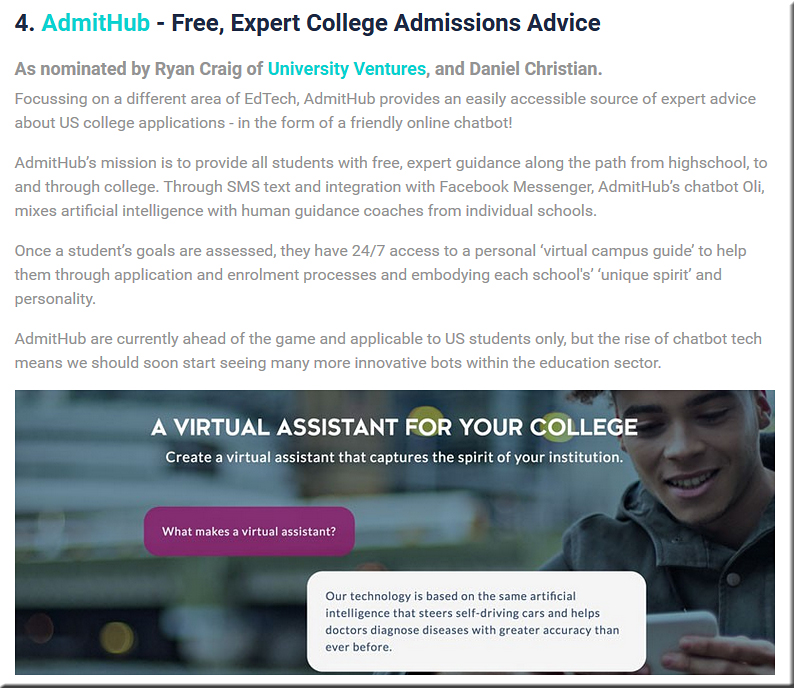
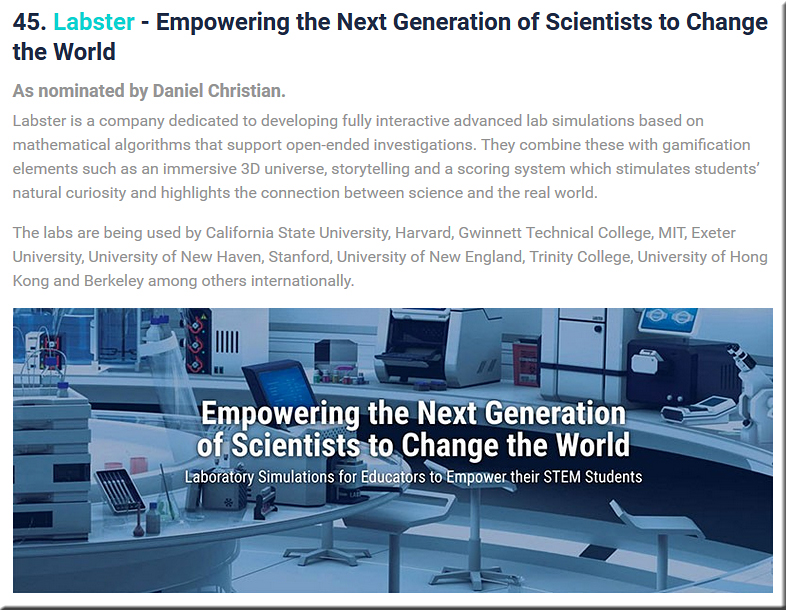
The 82 Hottest EdTech Tools of 2017 According to Education Experts — from tutora.co.uk by Giorgio Cassella
Excerpt:
If you work in education, you’ll know there’s a HUGE array of applications, services, products and tools created to serve a multitude of functions in education.
Tools for teaching and learning, parent-teacher communication apps, lesson planning software, home-tutoring websites, revision blogs, SEN education information, professional development qualifications and more.
There are so many companies creating new products for education, though, that it can be difficult to keep up – especially with the massive volumes of planning and marking teachers have to do, never mind finding the time to actually teach!
So how do you know which ones are the best?
Well, as a team of people passionate about education and learning, we decided to do a bit of research to help you out.
We’ve asked some of the best and brightest in education for their opinions on the hottest EdTech of 2017. These guys are the real deal – experts in education, teaching and new tech from all over the world from England to India, to New York and San Francisco.
They’ve given us a list of 82 amazing, tried and tested tools…
From DSC:
The ones that I mentioned that Giorgio included in his excellent article were:
21 bot experts make their predictions for 2017 — from venturebeat.com by Adelyn Zhou
Excerpt:
2016 was a huge year for bots, with major platforms like Facebook launching bots for Messenger, and Amazon and Google heavily pushing their digital assistants. Looking forward to 2017, we asked 21 bot experts, entrepreneurs, and executives to share their predictions for how bots will continue to evolve in the coming year.
…
From Jordi Torras, founder and CEO, Inbenta:
“Chatbots will get increasingly smarter, thanks to the adoption of sophisticated AI algorithms and machine learning. But also they will specialize more in specific tasks, like online purchases, customer support, or online advice. First attempts of chatbot interoperability will start to appear, with generalist chatbots, like Siri or Alexa, connecting to specialized enterprise chatbots to accomplish specific tasks. Functions traditionally performed by search engines will be increasingly performed by chatbots.”

From DSC:
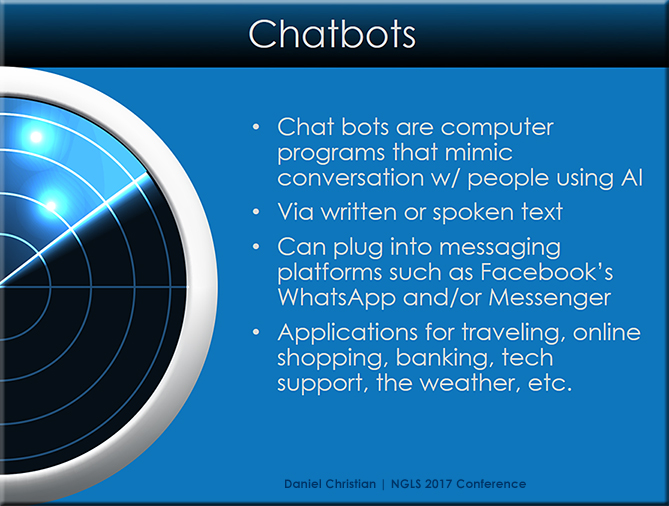
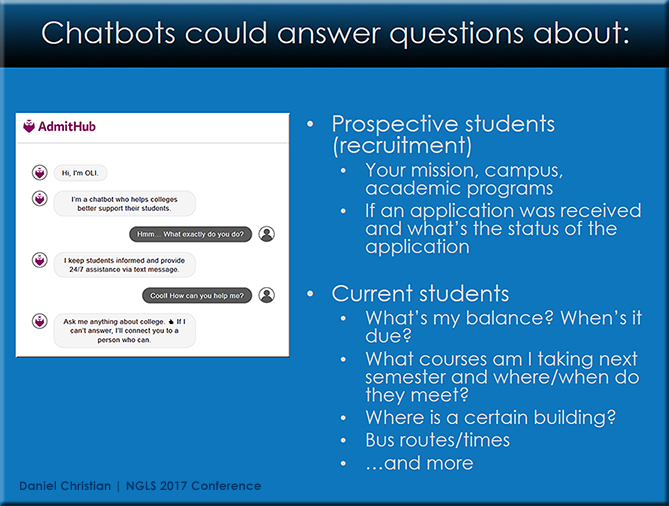
For those of us working within higher education, chatbots need to be on our radars. Here are 2 slides from my NGLS 2017 presentation.
59 impressive things artificial intelligence can do today — from businessinsider.com by Ed Newton-Rex
Excerpt:
But what can AI do today? How close are we to that all-powerful machine intelligence? I wanted to know, but couldn’t find a list of AI’s achievements to date. So I decided to write one. What follows is an attempt at that list. It’s not comprehensive, but it contains links to some of the most impressive feats of machine intelligence around. Here’s what AI can do…
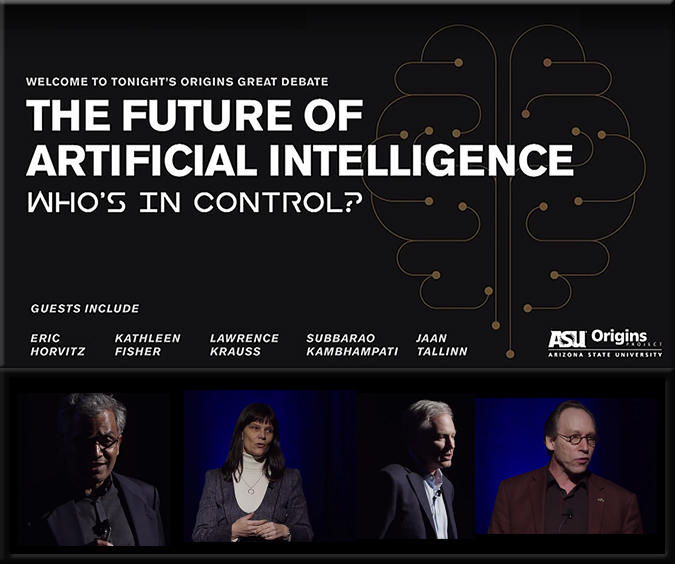
Recorded Saturday, February 25th, 2017 and published on Mar 16, 2017
Description:
Will progress in Artificial Intelligence provide humanity with a boost of unprecedented strength to realize a better future, or could it present a threat to the very basis of human civilization? The future of artificial intelligence is up for debate, and the Origins Project is bringing together a distinguished panel of experts, intellectuals and public figures to discuss who’s in control. Eric Horvitz, Jaan Tallinn, Kathleen Fisher and Subbarao Kambhampati join Origins Project director Lawrence Krauss.
Description:
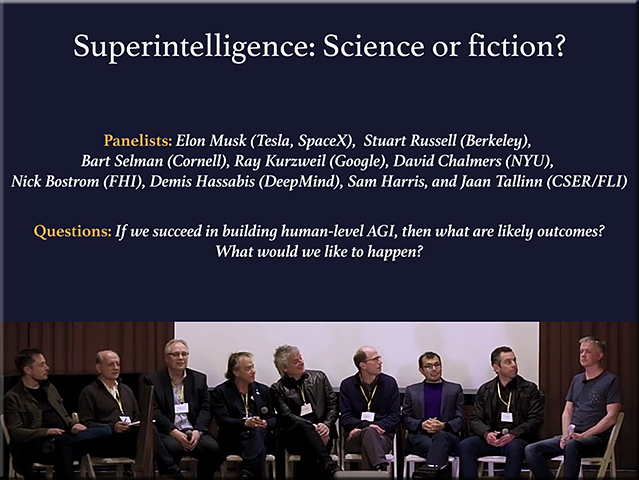
Elon Musk, Stuart Russell, Ray Kurzweil, Demis Hassabis, Sam Harris, Nick Bostrom, David Chalmers, Bart Selman, and Jaan Tallinn discuss with Max Tegmark (moderator) what likely outcomes might be if we succeed in building human-level AGI, and also what we would like to happen. The Beneficial AI 2017 Conference: In our sequel to the 2015 Puerto Rico AI conference, we brought together an amazing group of AI researchers from academia and industry, and thought leaders in economics, law, ethics, and philosophy for five days dedicated to beneficial AI. We hosted a two-day workshop for our grant recipients and followed that with a 2.5-day conference, in which people from various AI-related fields hashed out opportunities and challenges related to the future of AI and steps we can take to ensure that the technology is beneficial.
(Below emphasis via DSC)
IBM and Ricoh have partnered for a cognitive-enabled interactive whiteboard which uses IBM’s Watson intelligence and voice technologies to support voice commands, taking notes and actions and even translating into other languages.
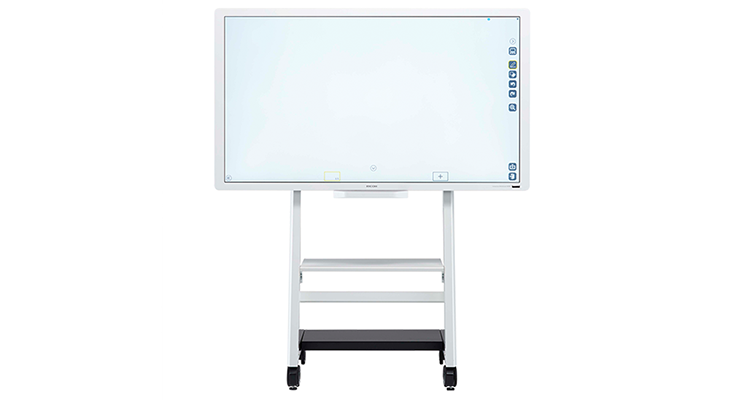
The Intelligent Workplace Solution leverages IBM Watson and Ricoh’s interactive whiteboards to allow to access features via using voice. It makes sure that Watson doesn’t just listen, but is an active meeting participant, using real-time analytics to help guide discussions.
Features of the new cognitive-enabled whiteboard solution include:
From DSC:
Holy smokes!
If you combine the technologies that Ricoh and IBM are using with their new cognitive-enabled interactive whiteboard with what Bluescape is doing — by providing 160 acres of digital workspace that’s used to foster collaboration (and to do so whether you are working remoting or working with others in the same physical space) — and you have one incredibly powerful platform!
#NLP | #AI | #CognitiveComputing | #SmartClassrooms
#LearningSpaces |#Collaboration | #Meetings

AI Market to Grow 47.5% Over Next Four Years — from campustechnology.com by Richard Chang
Excerpt:
The artificial intelligence (AI) market in the United States education sector is expected to grow at a compound annual growth rate of 47.5 percent during the period 2017-2021, according to a new report by market research firm Research and Markets.
Amazon deepens university ties in artificial intelligence race — from by Jeffrey Dastin
Excerpt:
Amazon.com Inc has launched a new program to help students build capabilities into its voice-controlled assistant Alexa, the company told Reuters, the latest move by a technology firm to nurture ideas and talent in artificial intelligence research.
…
Amazon, Alphabet Inc’s Google and others are locked in a race to develop and monetize artificial intelligence. Unlike some rivals, Amazon has made it easy for third-party developers to create skills for Alexa so it can get better faster – a tactic it now is extending to the classroom.
The WebMD skill for Amazon’s Alexa can answer all your medical questions — from digitaltrends.com by Kyle Wiggers
WebMD is bringing its wealth of medical knowledge to a new form factor: Amazon’s Alexa voice assistant.
Excerpt:
Alexa, Amazon’s brilliant voice-activated smart assistant, is a capable little companion. It can order a pizza, summon a car, dictate a text message, and flick on your downstairs living room’s smart bulb. But what it couldn’t do until today was tell you whether that throbbing lump on your forearm was something that required medical attention. Fortunately, that changed on Tuesday with the introduction of a WebMD skill that puts the service’s medical knowledge at your fingertips.
Addendum:
That’s likely truest in Asia, where the manufacturing engine which drove China’s growth is now turning its focus to plumbing the AI mine for gold.
Despite Asia’s relatively low overall investment in AI, the industry is set to grow. Fifty percent of respondents in KPMG’s AI report said their companies had plans to invest in AI or robotic technology.
Investment in AI is set to drive venture capital investment in China in 2017. Tak Lo, of Hong Kong’s Zeroth, notes there are more mentions of AI in Chinese research papers than there are in the US.
China, Korea and Japan collectively account for nearly half the planet’s shipments of articulated robots in the world.
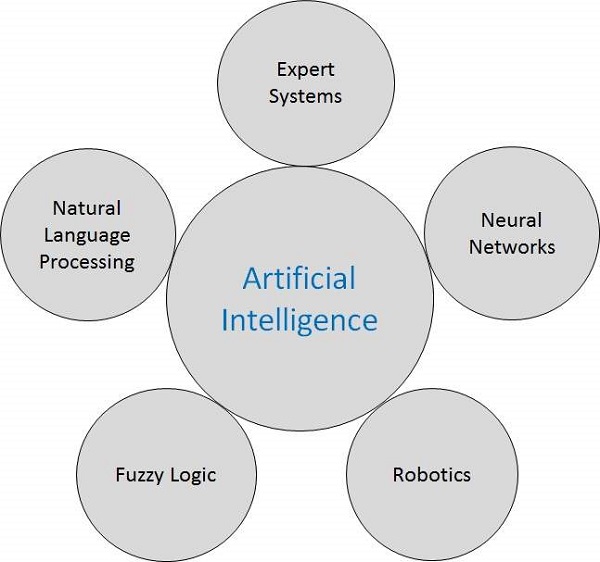
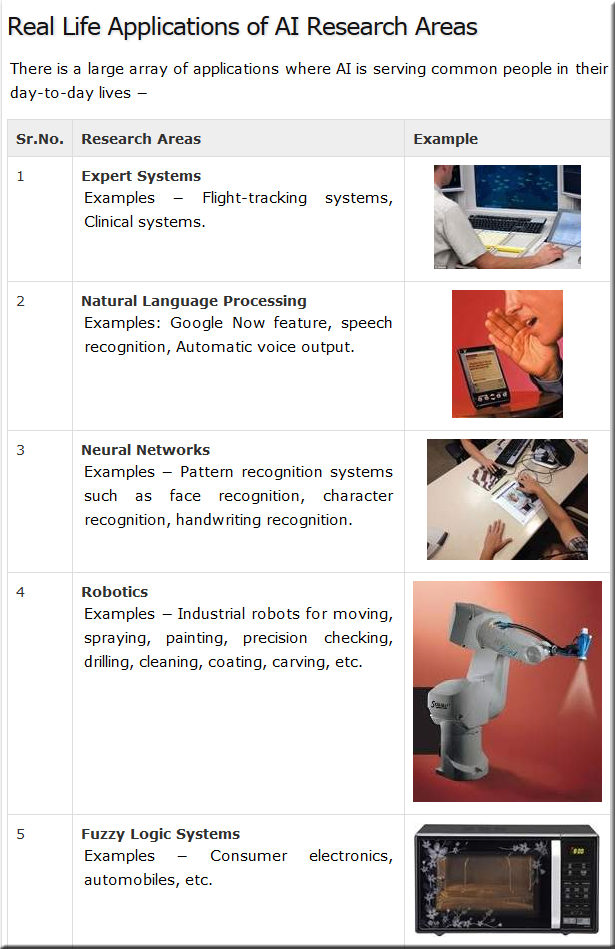
Artificial Intelligence – Research Areas
Blockchain: Letting students own their credentials — from campustechnology.com by Dian Schaffhauser
Very soon this nascent technology could securely enable registrars to help students verify credentials without the hassle of ordering copies of transcripts.
Excerpt:
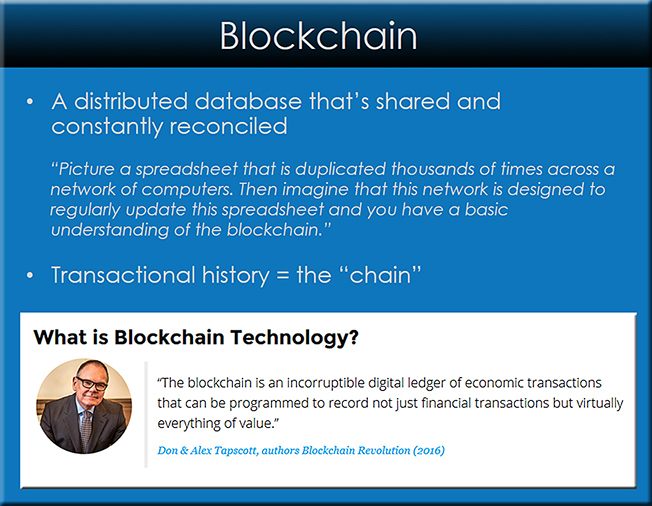
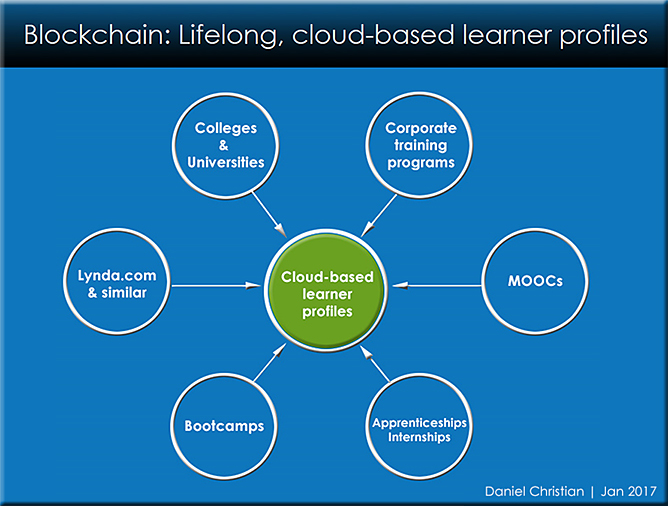
While truth may seem evasive on many fronts, a joint academic and industry effort is underway to codify it for credentialing. At the core of the effort is blockchain, a trust technology developed for bitcoin and used in solving other forms of validation between individuals and organizations. Still in its nascent stage, the technology could, within just a year or two, provide the core services that would enable schools to stop acting as if they own proof of learning and help students verify their credentials as needed — without waiting on a records office to do it for them.
From DSC:
This article reminded me of two of the slides from my NGLS 2017 presentation back from February:
Also see:
Code-Dependent: Pros and Cons of the Algorithm Age — from pewinternet.org by Lee Rainie and Janna Anderson
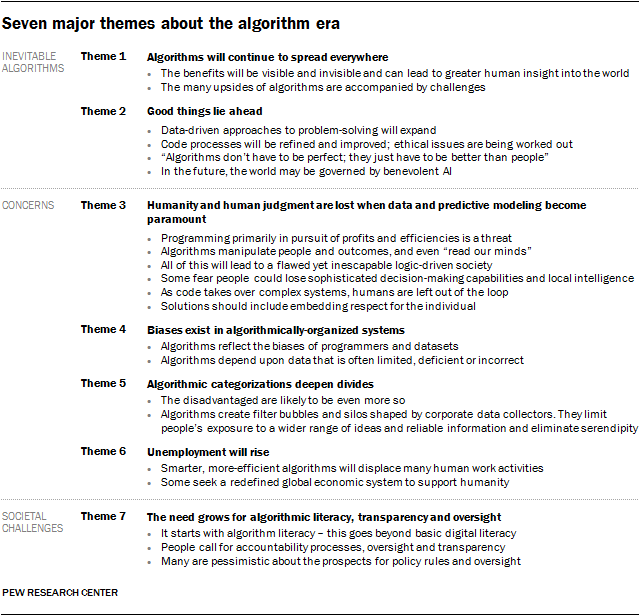
Algorithms are aimed at optimizing everything. They can save lives, make things easier and conquer chaos. Still, experts worry they can also put too much control in the hands of corporations and governments, perpetuate bias, create filter bubbles, cut choices, creativity and serendipity, and could result in greater unemployment
Excerpt:
Algorithms are instructions for solving a problem or completing a task. Recipes are algorithms, as are math equations. Computer code is algorithmic. The internet runs on algorithms and all online searching is accomplished through them. Email knows where to go thanks to algorithms. Smartphone apps are nothing but algorithms. Computer and video games are algorithmic storytelling. Online dating and book-recommendation and travel websites would not function without algorithms. GPS mapping systems get people from point A to point B via algorithms. Artificial intelligence (AI) is naught but algorithms. The material people see on social media is brought to them by algorithms. In fact, everything people see and do on the web is a product of algorithms. Every time someone sorts a column in a spreadsheet, algorithms are at play, and most financial transactions today are accomplished by algorithms. Algorithms help gadgets respond to voice commands, recognize faces, sort photos and build and drive cars. Hacking, cyberattacks and cryptographic code-breaking exploit algorithms. Self-learning and self-programming algorithms are now emerging, so it is possible that in the future algorithms will write many if not most algorithms.
Algorithms are often elegant and incredibly useful tools used to accomplish tasks. They are mostly invisible aids, augmenting human lives in increasingly incredible ways. However, sometimes the application of algorithms created with good intentions leads to unintended consequences. Recent news items tie to these concerns…
The use of algorithms is spreading as massive amounts of data are being created, captured and analyzed by businesses and governments. Some are calling this the Age of Algorithms and predicting that the future of algorithms is tied to machine learning and deep learning that will get better and better at an ever-faster pace.
A world without work — by Derek Thompson; The Atlantic — from July 2015
Excerpts:
Youngstown, U.S.A.
The end of work is still just a futuristic concept for most of the United States, but it is something like a moment in history for Youngstown, Ohio, one its residents can cite with precision: September 19, 1977.
For much of the 20th century, Youngstown’s steel mills delivered such great prosperity that the city was a model of the American dream, boasting a median income and a homeownership rate that were among the nation’s highest. But as manufacturing shifted abroad after World War II, Youngstown steel suffered, and on that gray September afternoon in 1977, Youngstown Sheet and Tube announced the shuttering of its Campbell Works mill. Within five years, the city lost 50,000 jobs and $1.3 billion in manufacturing wages. The effect was so severe that a term was coined to describe the fallout: regional depression.
Youngstown was transformed not only by an economic disruption but also by a psychological and cultural breakdown. Depression, spousal abuse, and suicide all became much more prevalent; the caseload of the area’s mental-health center tripled within a decade. The city built four prisons in the mid-1990s—a rare growth industry. One of the few downtown construction projects of that period was a museum dedicated to the defunct steel industry.
…
“Youngstown’s story is America’s story, because it shows that when jobs go away, the cultural cohesion of a place is destroyed”…
…
“The cultural breakdown matters even more than the economic breakdown.”
…
But even leaving aside questions of how to distribute that wealth, the widespread disappearance of work would usher in a social transformation unlike any we’ve seen.
…
What may be looming is something different: an era of technological unemployment, in which computer scientists and software engineers essentially invent us out of work, and the total number of jobs declines steadily and permanently.
…
After 300 years of people crying wolf, there are now three broad reasons to take seriously the argument that the beast is at the door: the ongoing triumph of capital over labor, the quiet demise of the working man, and the impressive dexterity of information technology.
…
The paradox of work is that many people hate their jobs, but they are considerably more miserable doing nothing.
…
Most people want to work, and are miserable when they cannot. The ills of unemployment go well beyond the loss of income; people who lose their job are more likely to suffer from mental and physical ailments. “There is a loss of status, a general malaise and demoralization, which appears somatically or psychologically or both”…
…
Research has shown that it is harder to recover from a long bout of joblessness than from losing a loved one or suffering a life-altering injury.
…
Most people do need to achieve things through, yes, work to feel a lasting sense of purpose.
…
When an entire area, like Youngstown, suffers from high and prolonged unemployment, problems caused by unemployment move beyond the personal sphere; widespread joblessness shatters neighborhoods and leaches away their civic spirit.
…
What’s more, although a universal income might replace lost wages, it would do little to preserve the social benefits of work.
…
“I can’t stress this enough: this isn’t just about economics; it’s psychological”…
The paradox of work is that many people hate their jobs, but they are considerably more miserable doing nothing.
From DSC:
Though I’m not saying Thompson is necessarily asserting this in his article, I don’t see a world without work as a dream. In fact, as the quote immediately before this paragraph alludes to, I think that most people would not like a life that is devoid of all work. I think work is where we can serve others, find purpose and meaning for our lives, seek to be instruments of making the world a better place, and attempt to design/create something that’s excellent. We may miss the mark often (I know I do), but we keep trying.
IBM Equips Youth with Tech Career Skills in Nationwide Network of High Performing P-TECH Schools — from finance.yahoo.com
Excerpt:
BROOKLYN, N.Y., Jan. 5, 2017 /PRNewswire/ — Today, IBM announced that P-TECH, the IBM-inspired six-year education model that is leading a national wave of career-focused technical education in nearly 60 schools across six states, has already graduated more than 50 students, including a new class of 16 graduates in January. All of these graduates completed the six-year curriculum ahead of schedule, earning both their high school and two-year college tech degrees, with some finishing in as little as 3.5 years. Some of their stories can be found here.
Alexa, Tell Me Where You’re Going Next — from backchannel.com by Steven Levy
Amazon’s VP of Alexa talks about machine learning, chatbots, and whether industry is strip-mining AI talent from academia.
Excerpt:
Today Prasad is giving an Alexa “State of the Union” address at the Amazon Web Services conference in Las Vegas, announcing an improved version of the Alexa Skills Kit, which helps developers create the equivalent of apps for the platform; a beefed-up Alexa Voice Service, which will make it easier to transform third-party devices like refrigerators and cars into Alexa bots; a partnership with Intel; and the Alexa Accelerator that, with the startup incubator Techstars, will run a 13-week program to help newcomers build Alexa skills. Prasad and Amazon haven’t revealed sales numbers, but industry experts have estimated that Amazon has sold over five million Echo devices so far.
Prasad, who joined Amazon in 2013, spent some time with Backchannel before his talk today to illuminate the direction of Alexa and discuss how he’s recruiting for Jeff Bezos’s arsenal without drying up the AI pipeline.
What DeepMind brings to Alphabet — from economist.com
The AI firm’s main value to Alphabet is as a new kind of algorithm factory
Excerpt:
DeepMind’s horizons stretch far beyond talent capture and public attention, however. Demis Hassabis, its CEO and one of its co-founders, describes the company as a new kind of research organisation, combining the long-term outlook of academia with “the energy and focus of a technology startup”—to say nothing of Alphabet’s cash.
…
Were he to succeed in creating a general-purpose AI, that would obviously be enormously valuable to Alphabet. It would in effect give the firm a digital employee that could be copied over and over again in service of multiple problems. Yet DeepMind’s research agenda is not—or not yet—the same thing as a business model. And its time frames are extremely long.
Artificial Intelligence: Silicon Valley’s Next Frontier — from toptechnews.com by Ethan Baron
Excerpt:
Silicon Valley needs its next big thing, a focus for the concentrated brain power and innovation infrastructure that have made this region the world leader in transformative technology. Just as the valley’s mobile era is peaking, the next frontier of growth and innovation has arrived: It’s Siri in an Apple iPhone, Alexa in an Amazon Echo, the software brain in Google’s self-driving cars, Amazon’s product recommendations and, someday, maybe the robot surgeon that saves your life.
It’s artificial intelligence, software that can “learn” and “think,” the latest revolution in tech.
“It’s going to be embedded in everything,” said startup guru Steve Blank, an adjunct professor at Stanford. “We’ve been talking about artificial intelligence for 30 years, maybe longer, in Silicon Valley. It’s only in the last five years, or maybe even the last two years, that this stuff has become useful.”
What Is The Difference Between Artificial Intelligence And Machine Learning? — from forbes.com by Bernard Marr
Excerpt:
Artificial Intelligence (AI) and Machine Learning (ML) are two very hot buzzwords right now, and often seem to be used interchangeably. They are not quite the same thing, but the perception that they are can sometimes lead to some confusion. So I thought it would be worth writing a piece to explain the difference.
…
In short, the best answer is that:
Artificial Intelligence is the broader concept of machines being able to carry out tasks in a way that we would consider “smart”.
And,
Machine Learning is a current application of AI based around the idea that we should really just be able to give machines access to data and let them learn for themselves.
Why we are still light years away from full artificial intelligence — from techcrunch.com by Clara Lu
Excerpt:
Yet, the truth is, we are far from achieving true AI — something that is as reactive, dynamic, self-improving and powerful as human intelligence.
…
Full AI, or superintelligence, should possess the full range of human cognitive abilities. This includes self-awareness, sentience and consciousness, as these are all features of human cognition.
Udacity adds 14 hiring partners as AI, VR and self-driving talent wars heat up — from techcrunch.com by Darrell Etherington
Excerpt:
Udacity is positioned perfectly to benefit from the rush on talent in a number of growing areas of interest among tech companies and startups. The online education platform has added 14 new hiring partners across its Artificial Intelligence Engineer, Self-Driving Car Engineer and Virtual Reality Developer Nanodegree programs, as well as in its Predictive Analytics Nanodegree, including standouts like Bosch, Harma, Slack, Intel, Amazon Alexa and Samsung.
That brings the total number of hiring partners for Udacity to over 30, which means a lot of potential soft landings for graduates of its nanodegree programs. The nanodegree offered by Udacity is its own original form of accreditation, which is based on a truncated field of study that spans months, rather than years, and allows students to direct the pace of their own learning. It also all takes place online, so students can potentially learn from anywhere.
The Ethics of Artificial Intelligence – from livestream.com
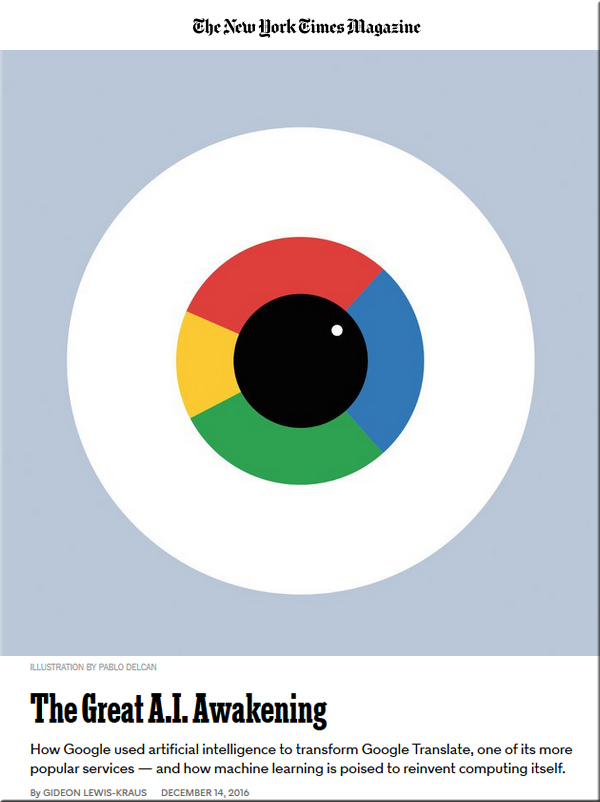
The Great A.I. Awakening — from nytimes.com by Gideo Lewis-Kraus
How Google used artificial intelligence to transform Google Translate, one of its more popular services — and how machine learning is poised to reinvent computing itself.
Excerpt:
Google’s decision to reorganize itself around A.I. was the first major manifestation of what has become an industrywide machine-learning delirium. Over the past four years, six companies in particular — Google, Facebook, Apple, Amazon, Microsoft and the Chinese firm Baidu — have touched off an arms race for A.I. talent, particularly within universities. Corporate promises of resources and freedom have thinned out top academic departments. It has become widely known in Silicon Valley that Mark Zuckerberg, chief executive of Facebook, personally oversees, with phone calls and video-chat blandishments, his company’s overtures to the most desirable graduate students. Starting salaries of seven figures are not unheard-of. Attendance at the field’s most important academic conference has nearly quadrupled. What is at stake is not just one more piecemeal innovation but control over what very well could represent an entirely new computational platform: pervasive, ambient artificial intelligence.
Microsoft bets on AI — from businessinsider.com
Excerpt:
On [December 12th, 2016], Microsoft announced a new Microsoft Ventures fund dedicated to artificial intelligence (AI) investments, according to TechCrunch. The fund, part of the company’s investment arm that launched in May, will back startups developing AI technology and includes Element AI, a Montreal-based incubator that helps other companies embrace AI. The fund further supports Microsoft’s focus on AI. The company has been steadily announcing major initiatives in support of the technology. For example, in September, it announced a major restructuring and formed a new group dedicated to AI products. And in mid-November, it partnered with OpenAI, an AI research nonprofit backed by Elon Musk, to further its AI research and development efforts.
The Growth of Artificial Intelligence in E-commerce — from redstagfulfillment.com by Jake Rheude
Excerpt:
Whether Artificial Intelligence (AI) is something you’ve just come across or it’s something you’ve been monitoring for a while, there’s no denying that it’s starting to influence many industries. And one place that it’s really starting to change things is e-commerce. Below you’ll find some interesting stats and facts about how AI is growing in e-commerce and how it’s changing the way we do things. From personalizing the shopping experience for customers to creating personal buying assistants, AI is something retailers can’t ignore. We’ll also take a look at some examples of how leading online stores have used AI to enrich the customer buying experience.
Will AI built by a ‘sea of dudes’ understand women? AI’s inclusivity problem — from digitaltrends.com by Dyllan Furness
Excerpt:
Only 26 percent of computer professionals were women in 2013, according to a recent review by the American Association of University Women. That figure has dropped 9 percent since 1990.
Explanations abound. Some say the industry is masculine by design. Others claim computer culture is unwelcoming — even hostile — to women. So, while STEM fields like biology, chemistry, and engineering see an increase in diversity, computing does not. Regardless, it’s a serious problem.
Artificial intelligence is still in its infancy, but it’s poised to become the most disruptive technology since the Internet. AI will be everywhere — in your phone, in your fridge, in your Ford. Intelligent algorithms already track your online activity, find your face in Facebook photos, and help you with your finances. Within the next few decades they’ll completely control your car and monitor your heart health. An AI may one day even be your favorite artist.
The programs written today will inform the systems built tomorrow. And if designers all have one worldview, we can expect equally narrow-minded machines.
New journal Science Robotics is established to chronicle the rise of the robots — from techcrunch.com by Devin Coldewey
Excerpt:
Robots have been a major focus in the technology world for decades and decades, but they and basic science, and for that matter everyday life, have largely been non-overlapping magisteria. That’s changed over the last few years, as robotics and every other field have come to inform and improve each other, and robots have begun to infiltrate and affect our lives in countless ways. So the only surprise in the news that the prestigious journal group Science has established a discrete Robotics imprint is that they didn’t do it earlier.
Editor Guang-Zhong Yang and president of the National Academy of Sciences Marcia McNutt introduce the journal:
In a mere 50 years, robots have gone from being a topic of science fiction to becoming an integral part of modern society. They now are ubiquitous on factory floors, build complex deep-sea installations, explore icy worlds beyond the reach of humans, and assist in precision surgeries… With this growth, the research community that is engaged in robotics has expanded globally. To help meet the need to communicate discoveries across all domains of robotics research, we are proud to announce that Science Robotics is open for submissions.
Today brought the inaugural issue of Science Robotics, Vol.1 Issue 1, and it’s a whopper. Despite having only a handful of articles, each is deeply interesting and shows off a different aspect of the robotics research world — though by no means do these few articles hit all the major regions of the field.
See also:
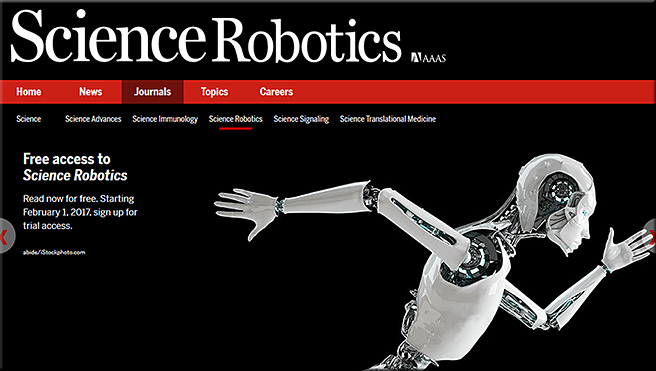
Science Robotics has been launched to cover the most important advances in the development and application of robots, with interest in hardware and software as well as social interactions and implications.
From molecular machines to large-scale systems, from outer space to deep-sea exploration, robots have become ubiquitous, and their impact on our lives and society is growing at an accelerating pace. Science Robotics has been launched to cover the most important advances in robot design, theory, and applications. Science Robotics promotes the communication of new ideas, general principles, and original developments. Its content will reflect broad and important new applications of robots (e.g., medical, industrial, land, sea, air, space, and service) across all scales (nano to macro), including the underlying principles of robotic systems covering actuation, sensor, learning, control, and navigation. In addition to original research articles, the journal also publishes invited reviews. There are also plans to cover opinions and comments on current policy, ethical, and social issues that affect the robotics community, as well as to engage with robotics educational programs by using Science Robotics content. The goal of Science Robotics is to move the field forward and cross-fertilize different research applications and domains.
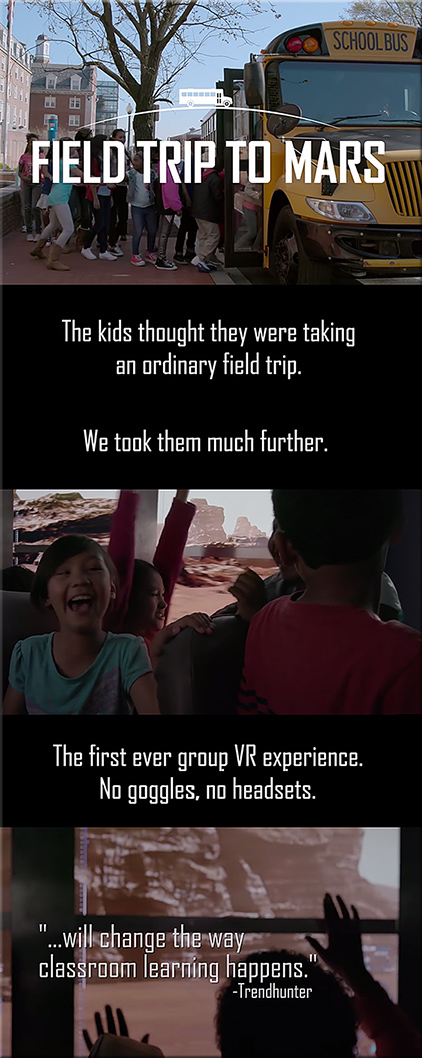
A school bus, virtual reality, & an out-of-this-world journey — from goodmenproject.com
“Field Trip To Mars” is the barrier-shattering outcome of an ambitious mission to give a busload of people the same, Virtual Reality experience – going to Mars.
Excerpt:
Inspiration was Lockheed‘s goal when it asked its creative resources, led by McCann, to create the world’s first mobile group Virtual Reality experience. As one creator notes, VR now is essentially a private, isolating experience. But wouldn’t it be cool to give a busload of people the same, simultaneous VR experience? And then – just to make it really challenging – put the whole thing on wheels?
“Field Trip To Mars” is the barrier-shattering outcome of this ambitious mission.
From DSC:
This is incredible! Very well done. The visual experience tracks the corresponding speeds of the bus and even turns of the bus.
Ed Dept. Launches $680,000 Augmented and Virtual Reality Challenge — from thejournal.com by David Nagel
Excerpt:
The United States Department of Education (ED) has formally kicked off a new competition designed to encourage the development of virtual and augmented reality concepts for education.
Dubbed the EdSim Challenge, the competition is aimed squarely at developing students’ career and technical skills — it’s funded through the Carl D. Perkins Career and Technical Education Act of 2006 — and calls on developers and ed tech organizations to develop concepts for “computer-generated virtual and augmented reality educational experiences that combine existing and future technologies with skill-building content and assessment. Collaboration is encouraged among the developer community to make aspects of simulations available through open source licenses and low-cost shareable components. ED is most interested in simulations that pair the engagement of commercial games with educational content that transfers academic, technical, and employability skills.”
Virtual reality boosts students’ results — from raconteur.net b
Virtual and augmented reality can enable teaching and training in situations which would otherwise be too hazardous, costly or even impossible in the real world
Excerpt:
More recently, though, the concept described in Aristotle’s Nicomachean Ethics has been bolstered by further scientific evidence. Last year, a University of Chicago study found that students who physically experience scientific concepts, such as the angular momentum acting on a bicycle wheel spinning on an axel that they’re holding, understand them more deeply and also achieve significantly improved scores in tests.

Virtual and augmented reality are shaking up sectors — from raconteur.net by Sophie Charara
Both virtual and augmented reality have huge potential to leap from visual entertainment to transform the industrial and service sectors
Microsoft’s HoloLens could power tanks on a battlefield — from theverge.com by Tom Warren
Excerpt:
Microsoft might not have envisioned its HoloLens headset as a war helmet, but that’s not stopping Ukrainian company LimpidArmor from experimenting. Defence Blog reports that LimpidArmor has started testing military equipment that includes a helmet with Microsoft’s HoloLens headset integrated into it.
The helmet is designed for tank commanders to use alongside a Circular Review System (CRS) of cameras located on the sides of armored vehicles. Microsoft’s HoloLens gathers feeds from the cameras outside to display them in the headset as a full 360-degree view. The system even includes automatic target tracking, and the ability to highlight enemy and allied soldiers and positions.
Bring your VR to work — from itproportal.com by Timo Elliott, Josh Waddell 4 hours ago
With all the hype, there’s surprisingly little discussion of the latent business value which VR and AR offer.
Excerpt:
With all the hype, there’s surprisingly little discussion of the latent business value which VR and AR offer — and that’s a blind spot that companies and CIOs can’t afford to have. It hasn’t been that long since consumer demand for the iPhone and iPad forced companies, grumbling all the way, into finding business cases for them. Gartner has said that the next five to ten years will bring “transparently immersive experiences” to the workplace. They believe this will introduce “more transparency between people, businesses, and things” and help make technology “more adaptive, contextual, and fluid.”
If digitally enhanced reality generates even half as much consumer enthusiasm as smartphones and tablets, you can expect to see a new wave of consumerisation of IT as employees who have embraced VR and AR at home insist on bringing it to the workplace. This wave of consumerisation could have an even greater impact than the last one. Rather than risk being blindsided for a second time, organisations would be well advised to take a proactive approach and be ready with potential business uses for VR and AR technologies by the time they invade the enterprise.
In Gartner’s latest emerging technologies hype cycle, Virtual Reality is already on the Slope of Enlightenment, with Augmented Reality following closely.
VR’s higher-ed adoption starts with student creation — from edsurge.com by George Lorenzo
Excerpt:
One place where students are literally immersed in VR is at Carnegie Mellon University’s Entertainment Technology Center (ETC). ETC offers a two-year Master of Entertainment Technology program (MET) launched in 1998 and cofounded by the late Randy Pausch, author of “The Last Lecture.”
MET starts with an intense boot camp called the “immersion semester” in which students take a Building Virtual Worlds (BVW) course, a leadership course, along with courses in improvisational acting, and visual storytelling. Pioneered by Pausch, BVW challenges students in small teams to create virtual reality worlds quickly over a period of two weeks, culminating in a presentation festival every December.
Apple patents augmented reality mapping system for iPhone — from appleinsider.com by Mikey Campbell
Apple on Tuesday was granted a patent detailing an augmented reality mapping system that harnesses iPhone hardware to overlay visual enhancements onto live video, lending credence to recent rumors suggesting the company plans to implement an iOS-based AR strategy in the near future.
A bug in the matrix: virtual reality will change our lives. But will it also harm us? — from theguardian.stfi.re
Prejudice, harassment and hate speech have crept from the real world into the digital realm. For virtual reality to succeed, it will have to tackle this from the start
The latest Disney Research innovation lets you feel the rain in virtual reality — from haptic.al by Deniz Ergurel
Excerpt:
Virtual reality is a combination of life-like images, effects and sounds that creates an imaginary world in front of our eyes.
But what if we could also imitate more complex sensations like the feeling of falling rain, a beating heart or a cat walking? What if we could distinguish, between a light sprinkle and a heavy downpour in a virtual experience?
Disney Research?—?a network of research laboratories supporting The Walt Disney Company, has announced the development of a 360-degree virtual reality application offering a library of feel effects and full body sensations.
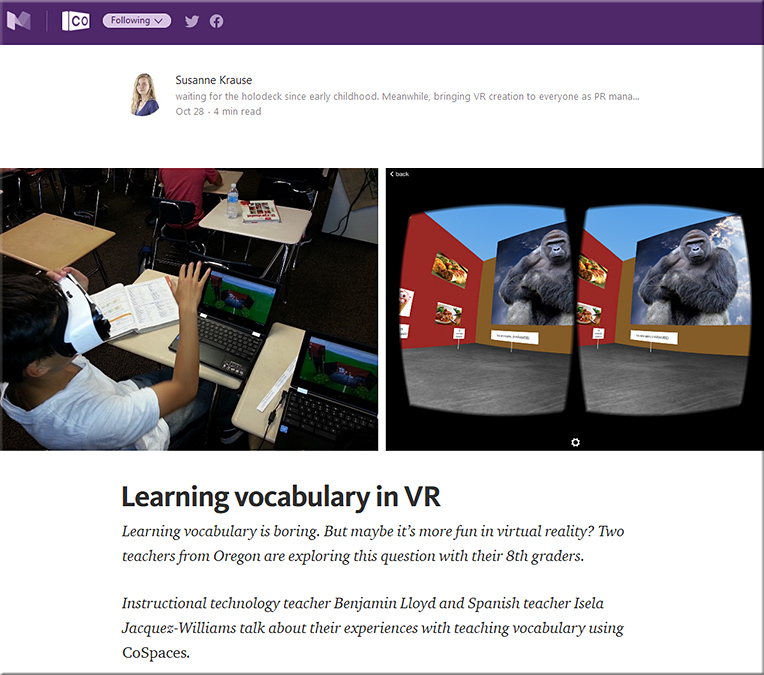
Literature class meets virtual reality — from blog.cospaces.io by Susanne Krause
Not every student finds it easy to let a novel come to life in their imagination. Could virtual reality help? Tiffany Capers gave it a try: She let her 7th graders build settings from Lois Lowry’s “The Giver” with CoSpaces and explore them in virtual reality. And: they loved it.
James Bay students learn Cree syllabics in virtual reality — from cbc.ca by Celina Wapachee and Jaime Little
New program teaches syllabics inside immersive world, with friendly dogs and archery
VRMark will tell you if your PC is ready for Virtual Reality — from engadget.com by Sean Buckley
Benchmark before you buy.
Forbidden City Brings Archaeology to Life With Virtual Reality — from wsj.com
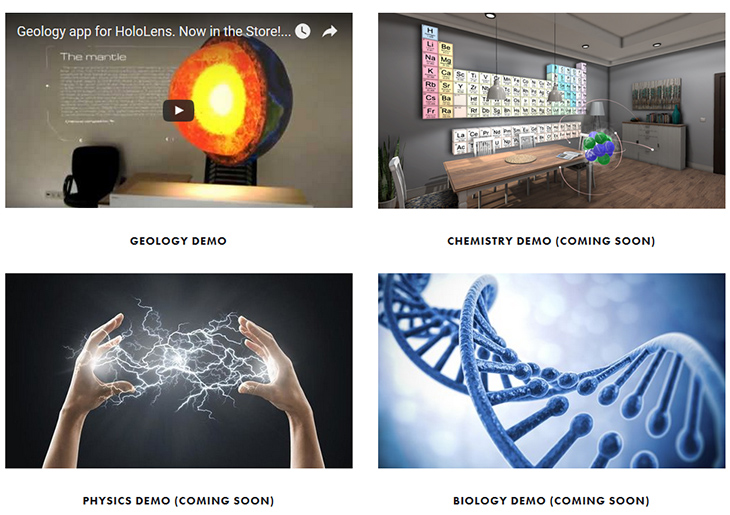
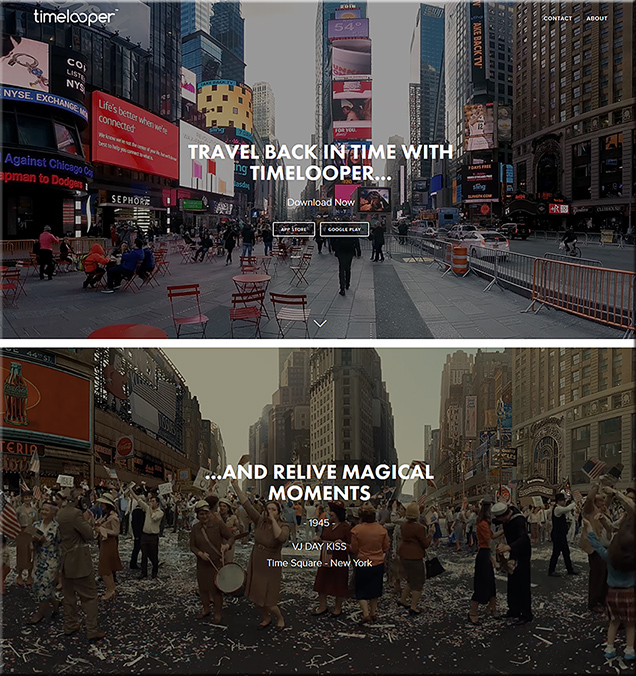
Will virtual reality change the way I see history? — from bbc.co.uk
Scientists can now explore cells in virtual reality — from mashable.com by Ariel Bogle
Excerpt:
After generations of peering into a microscope to examine cells, scientists could simply stroll straight through one.
Calling his project the “stuff of science fiction,” director of the 3D Visualisation Aesthetics Lab at the University of New South Wales (UNSW) John McGhee is letting people come face-to-face with a breast cancer cell.

Can Virtual Reality Make Us Care More? — from huffingtonpost.co.uk by Alex Handy
Excerpt:
In contrast, VR has been described as the “ultimate empathy machine.” It gives us a way to virtually put us in someone else’s shoes and experience the world the way they do.
Stanford researchers release virtual reality simulation that transports users to ocean of the future — from news.stanford.edu by Rob Jordan
Free science education software, available to anyone with virtual reality gear, holds promise for spreading awareness and inspiring action on the pressing issue of ocean acidification.
The High-end VR Room of the Future Looks Like This — from uploadvr.com by Sarah Downey
Excerpt:
This isn’t meant to be an exhaustive list, but if I missed something major, please tell me and I’ll add it. Also, please reach out if you’re working on anything cool in this space à sarah(at)accomplice(dot)co.
Hand and finger tracking, gesture interfaces, and grip simulation:
AR and VR viewers:
Omnidirectional treadmills:
Haptic feedback bodysuits:
Brain-computer interfaces:
Neural plugins:
3D tracking, capture, and/or rendering:
Eye tracking:
VR audio:
Scent creation:
Why deep learning is suddenly changing your life — from fortune.com by Roger Parloff
Excerpt:
Most obviously, the speech-recognition functions on our smartphones work much better than they used to. When we use a voice command to call our spouses, we reach them now. We aren’t connected to Amtrak or an angry ex.
In fact, we are increasingly interacting with our computers by just talking to them, whether it’s Amazon’s Alexa, Apple’s Siri, Microsoft’s Cortana, or the many voice-responsive features of Google. Chinese search giant Baidu says customers have tripled their use of its speech interfaces in the past 18 months.
Machine translation and other forms of language processing have also become far more convincing, with Google, Microsoft, Facebook, and Baidu unveiling new tricks every month. Google Translate now renders spoken sentences in one language into spoken sentences in another for 32 pairs of languages, while offering text translations for 103 tongues, including Cebuano, Igbo, and Zulu. Google’s Inbox app offers three ready-made replies for many incoming emails.
…
But what most people don’t realize is that all these breakthroughs are, in essence, the same breakthrough. They’ve all been made possible by a family of artificial intelligence (AI) techniques popularly known as deep learning, though most scientists still prefer to call them by their original academic designation: deep neural networks.
Even the Internet metaphor doesn’t do justice to what AI with deep learning will mean, in Ng’s view. “AI is the new electricity,” he says. “Just as 100 years ago electricity transformed industry after industry, AI will now do the same.”
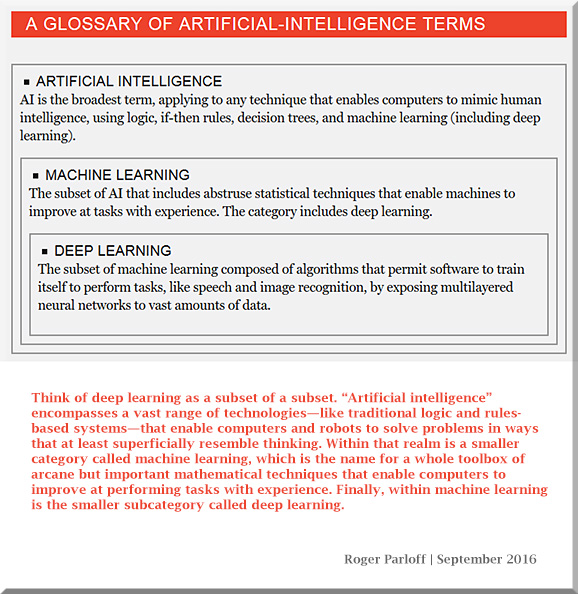
Graphically speaking:
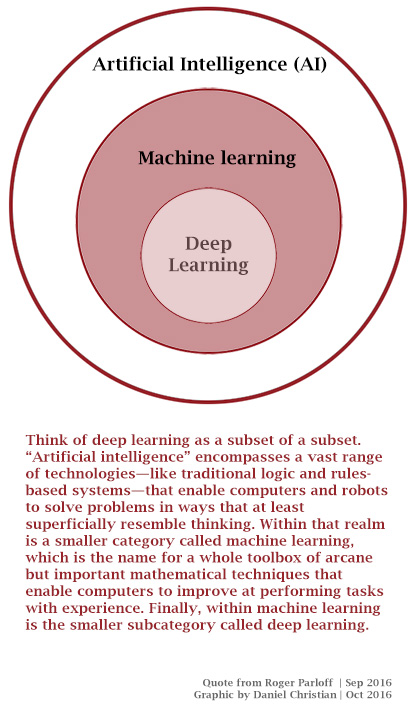
“Our sales teams are using neural nets to recommend which prospects to contact next or what kinds of product offerings to recommend.”
One way to think of what deep learning does is as “A to B mappings,” says Baidu’s Ng. “You can input an audio clip and output the transcript. That’s speech recognition.” As long as you have data to train the software, the possibilities are endless, he maintains. “You can input email, and the output could be: Is this spam or not?” Input loan applications, he says, and the output might be the likelihood a customer will repay it. Input usage patterns on a fleet of cars, and the output could advise where to send a car next.