How chatbots and deep learning will change the future of organizations — from forbes.com by Daniel Newman

Excerpt (emphasis DSC):

Don’t let the fun, casual name mislead you. Chatbots—software that you can “chat with”—have serious implications for the business world. Though many businesses have already considered their use for customer service purposes, a chatbot’s internal applications could be invaluable on a larger scale. For instance, chatbots could help employees break down siloes and provide targeted data to fuel every department. This digital transformation is happening, even in organizational structures that face challenges with other formats of real-time communication.

Still unclear on what chatbots are and what they do? Think of a digital assistant—such as iPhone’s Siri or Alexa, the Artificial Intelligence within the Amazon Echo. A chatbot reduces or eliminates the need for many mobile apps, as the answers are stored inside the chatbot. Need to know what the weather’s like in LA? Ask your chatbot. Is your flight running on time? Ask your chatbot. Is the package you ordered going to be delivered while you’re away? You get the gist.


From DSC:
How might institutions of higher education as well as K-12 school districts benefit from such internal applications of chatbots? How about external applications of chatbots? If done well, such applications could facilitate solid customer service (i.e., self-service knowledgebases) and aid in communications.


Hold Tight: The Chatbot Era Has Begun — from chatbotsmagazine.com by
Chatbots: What they are, and why they’re so important for businesses

Excerpt:

Imagine being able to have your own personal assistant at your fingertips, who you can chat with, give instructions and errands to, and handle the majority of your online research — both personally and professionally.

That’s essentially what a chatbot does.

Capable of being installed on any messenger platform, such as Facebook messenger or text messages, a chat bot is a basic artificial intelligence computer software program that does the legwork for you — and communicates in a way that feels like an intelligent conversation over text or voice messaging.


Once-in-a-decade paradigm shift: Messaging — from chatbotsmagazine.com by Beerud Sheth
In the history of the personal computing industry, we have had a paradigm shift about once every decade.
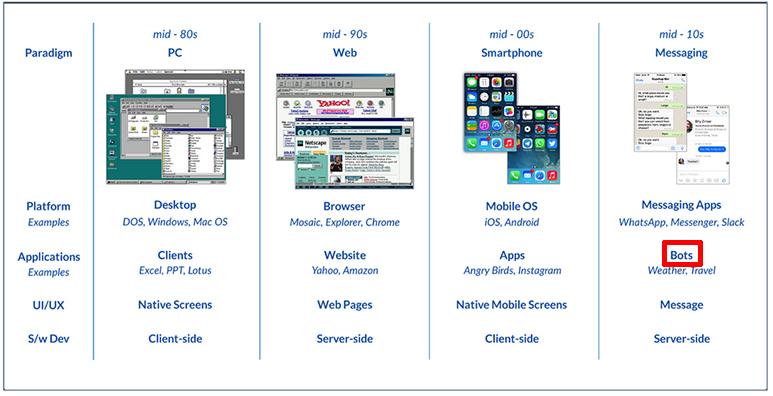
 

Bots-ChatbotMagazine-June2016


Smart assistants and chatbots will be top consumer applications for AI over next 5 years, poll says — from venturebeat.com by Blaise Zerega

Excerpt:

Virtual agents and chatbots will be the top consumer applications of artificial intelligence over the next five years, according to a consensus poll released today by TechEmergence, a marketing research firm for AI and machine learning.

The emphasis on virtual agents and chatbots is in many ways not surprising. After all, the tech industry’s 800-pound gorillas have all made big bets: Apple with Siri, Amazon with Alexa, Facebook with M and Messenger, Google with Google Assistant, Microsoft with Cortana and Tay. However, the poll’s data also suggests that chatbots may soon be viewed as a horizontal enabling technology for many industries.


From DSC:
Might this eventually affect students’ expectations? Blackboard’s partnership with IBM and Amazon may come into play here.


Some like it bot: Why chatbots could be the start of something big — from business.sprint.com
Chatbots are on the rise. With Google, Facebook and Microsoft competing to be the caring voice your customers turn to, what does this mean for your enterprise?

Excerpt:

The most prevalent indicator that the artificial intelligence-driven future is rapidly  becoming reality is the rise of the chatbot – an  A.I. software program designed to chat with people. Well, more accurately, the re-emergence of the bot. Basically, robots talking to humans talking to robots is the tech vision for the future.


Maybe one of the most obvious uses for this technology would be in service. If you can incorporate your self-service knowledge base into a bot that responds directly to questions and uses customer data to provide the most relevant answers, it’s more convenient for customers…


Chatbot lawyer overturns 160,000 parking tickets in London and New York — from theguardian.com by Samuel Gibbs
Free service DoNotPay helps appeal over $4m in parking fines in just 21 months, but is just the tip of the legal AI iceberg for its 19-year-old creator

Excerpt:

An artificial-intelligence lawyer chatbot has successfully contested 160,000 parking tickets across London and New York for free, showing that chatbots can actually be useful.

Dubbed as “the world’s first robot lawyer” by its 19-year-old creator, London-born second-year Stanford University student Joshua Browder, DoNotPay helps users contest parking tickets in an easy to use chat-like interface.


Addendum on 6/29/16:

A New Chatbot Would Like to Help You With Your Bank Account — from wired.com by Cade Metz

Excerpt:

People in Asia are already using MyKai, and beginning today, you can too. Because it’s focused on banking—and banking alone—it works pretty well. But it’s also flawed. And it’s a bit weird. Unsettling, even. All of which makes it a great way of deconstructing the tech world’s ever growing obsession with “chatbots.”
…
MyKai is remarkably adept at understanding what I’m asking—and that’s largely because it’s focused solely on banking. When I ask “How much money do I have?” or “How much did I spend on food in May?,” it understands. But when I ask who won the Spain-Italy match at Euro 2016, it suggests I take another tack. The thing to realize about today’s chatbots is that they can be reasonably effective if they’ve honed to a particular task—and that they break down if the scope gets to wide.
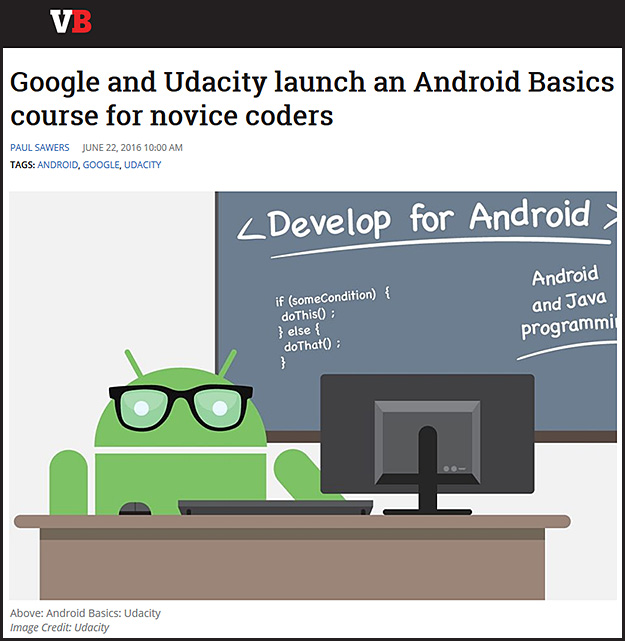
 

Some relatively recent additions to the education landscape include:


GoogleUdacity-CodingJuly2016


treehouse-2016


Teachable-June2016


FutureLeague-2016


StackSocial-July2016


Skillshare-July2016


CenterCentre-June2016


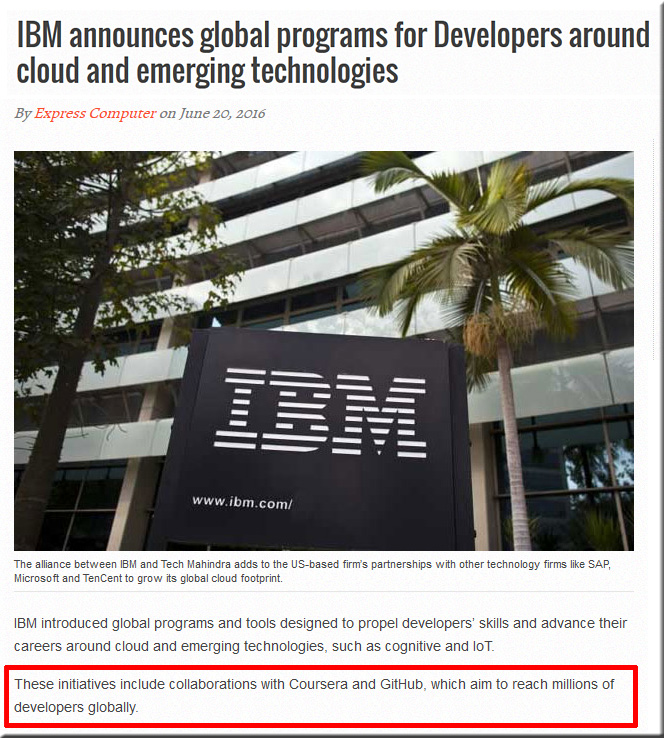
IBMCourseraGitHub-Courses-June2016


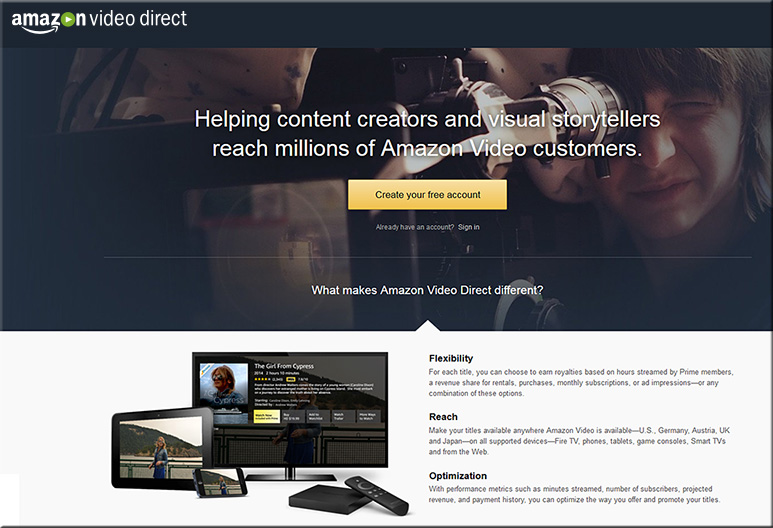
AmazonVideoDirect-June2016


Also see:


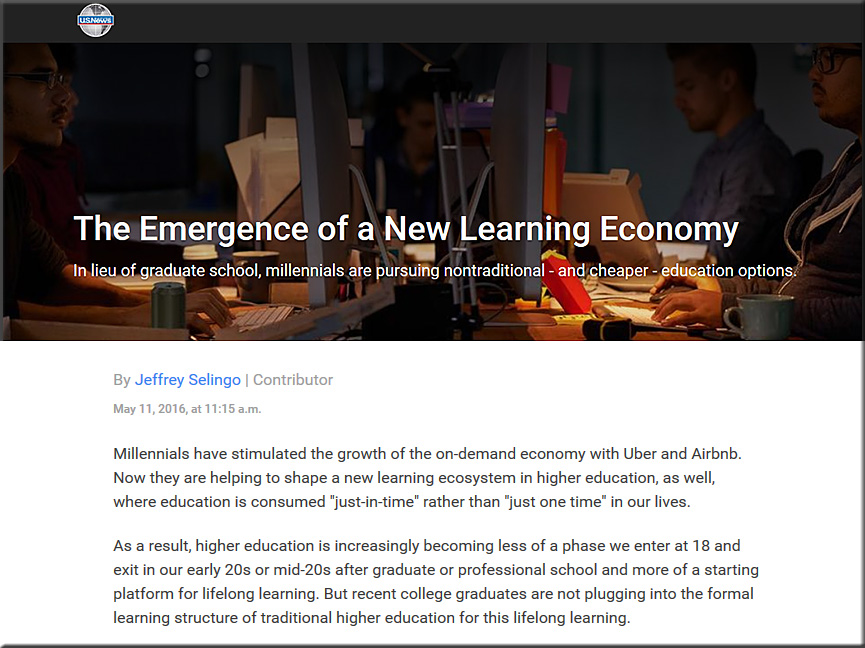
MillennialsPursuingOtherOptions-Selingo-May2016


Taking competency-based credentials seriously in the workforce — from campustechnology.com by John K. Waters
Companies like AT&T and Google are expanding their partnerships with online education providers, creating new educational pathways to real jobs.

Excerpt:

But in the Age of the Internet, for-profit online education providers such as Udacity and Coursera have tweaked that model by collaborating with companies to develop programs tailored to their specific needs.
…
Together the two companies created the Front-End Web Developer Nanodegree program, Udacity’s first branded microcredential. (“Nanodegree” is trademarked.)

“We worked with Udacity to develop curriculum based on tangible hiring and training needs,” said John Palmer, senior vice president and chief learning officer at AT&T, in an e-mail. “Our teams collaborated on determining what skills we needed now to address the needs of our business, but also what skills would be needed five to 10 years from now — not just at AT&T, but at other tech companies.”


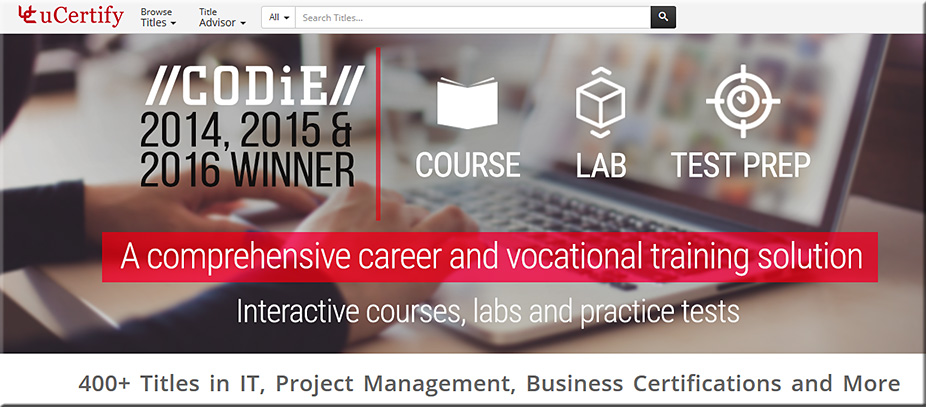
uCertify

uCertify-june2016


Also related:

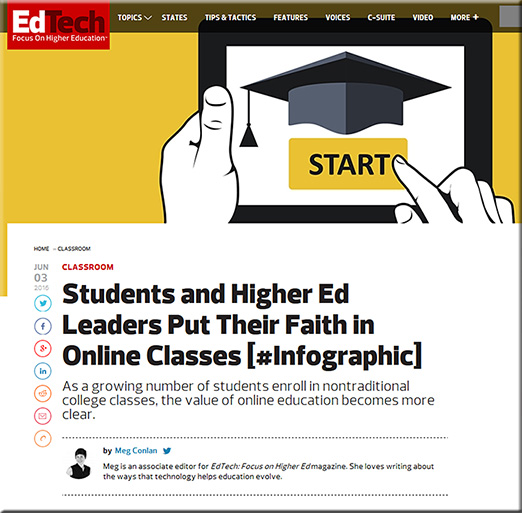
  • Students and higher ed leaders put their faith in online classes [#Infographic] — from edtechmagazine.com by Meg Conlan
    As a growing number of students enroll in nontraditional college classes, the value of online education becomes more clear.
    Excerpt:
    As cost-effective alternatives to traditional college classes, online learning programs continue to gain steam in higher ed.
    According to statistics gathered for an Online Learning Consortium infographic, 5.8 million students are now enrolled in online courses, and the majority put tremendous stock in the quality of their education: 90 percent of students say their online learning experiences are the same or better than in-classroom options.College and university leadership agrees: The infographic states that 71 percent of academic leaders say learning outcomes for online courses are the same or better than that of face-to-face classes.


OnlineLearningAlternativesGrowing-June2016


Related postings:


Acquisitions, mergers and reinvention (not closures) will characterize higher ed’s future — from evolllution.com; an interview with Kenneth Hartman | Past President of Drexel University Online, Drexel University

Excerpts:

We’re going to see a lot of different alternative options popping up at alternative prices with alternative delivery mechanisms offering alternative credentials in the future. I don’t think a lot of institutions will be shutting down. There will be some that close, but it’s more likely that their assets will be acquired by other, stronger institutions.
…
These types of programs are popping up all over the country and I think the market forces tell a story. Colleges that are able to be adaptable and flexible will be the leaders in this new higher education marketplace. Adaptability, vision and flexibility are going to be critical for schools that are not heavily-endowed. If they do not have the will to do that then I think unfortunately Christensen’s prediction will probably come true. However, I’m optimistic that when the pain gets high enough, trustees of these institutions will demand that their senior leadership provide them with the way to prevent closure.


What a Microsoft-owned LinkedIn means for education — from campustechnology.com by Dian Schaffhauser

Excerpt:

Ironically, he suggested, higher ed is also the most vulnerable target of LinkedIn as it continues to work on development of a competency marketplace that could one day replace four-year degrees as the baseline requirement for employment.

The vision of this competency marketplace is that employers can identify candidates who are close matches for positions based on the competencies their jobs require. Likewise, job candidates can get information from LinkedIn about what competencies a given position requires and pursue that through some form of training, whether through a class at a local college, a bootcamp, online learning or some other form of instruction.

“The signal for universities that the world is about to change is when employers begin to drop degree requirements from job descriptions,” said Craig. And by the way, he added, that’s already happening at recognizable companies such as Google, Penguin Random House, EY and PwC, which have either eliminated that requirement from entry-level job descriptions or begun masking a candidate’s degree status from hiring managers because they “think the degrees are actually false or poor or misleading signals of ultimate job performance.”

Not only does LinkedIn have by far the largest collection of candidate profiles, but it has become the leading platform for distributing microcredentials, said Craig.


“You can identify education and training opportunities to remediate gaps between where you are and what the job description says you need to have to qualify. So all the pieces are there,” he said. “Currently, it’s still early, but you can see where this is going. We think that is the story of the next decade in higher education.”


12 promising non-traditional college pathways to attainment — from eddesignlab.org

Excerpt:

We hear a lot about reinventing college and how we might better design the journey from school to work. Some students want faster or more experiential pathways to prosperity, re-entry points after stop-outs or opportunities for lifelong learning. “Non-traditional pathways” is a phrase you’ll hear a lot if you hang around policy and design folks who are thinking about broadening “attainment of degrees” to include meaningful credentials that lead to career readiness. This broader college success definition is not a cop out—it’s a recognition that technology, access to micro-credentials, and access to modular learning generally are blurring the lines between vocational training, liberal arts exploration, and 21st century skill building because, increasingly, students are in a position to order all these off the menu.

Lumina Foundation strategists Holly Zanville and Amber Garrison Duncan are in the thick of these designs, and the Lab caught up with them recently to help us build a list of the most promising ways that institutions, students, and third parties are piecing together non-traditional paths to meaningful credentials. Here’s a take on our “Top 12,” but we welcome your tweaks, additions, and favorite examples.


Top-ranked coding bootcamp, Fullstack Academy, launches first alumni startup investment fund — from prnewswire.com
Will provide seed funding for its graduates to launch their own startups

Excerpt:

NEW YORK, June 15, 2016 /PRNewswire/ — Fullstack Academy, the Y Combinator-backed top coding bootcamp in the U.S.,  today announced  Fullstack Fund, a new initiative to invest in promising startups created by its graduates.  “Students who complete our software engineering program go on to work for great companies like Google and Amazon, but some have opted for the entrepreneurial startup environment,” said David Yang, CEO and co-founder of Fullstack Academy. “So we asked ourselves — how can we better support alumni with a strong entrepreneurial slant? The Fullstack Fund  will empower some of the amazing teams and products that are coming out of our school.”


Addendum on 6/27/16:


Addendum on 6/30/16:


Noodle-June2016


Uncollege-June2016


CodingDojo-June2016


And a somewhat related posting:

More than 90% of institutions offer alternative credentials — from campustechnology.com by Sri Ravipati
The same study to report this statistic also found that millennial students prefer badging and certificates to traditional degrees.

Excerpt:

Millennial students seem to prefer badging and certificate programs to traditional bachelor’s degrees, according to a new study from University Professional and Continuing Education Association (UPCEA), Pennsylvania State University and Pearson that explored the role that alternative credentials play in higher education.

“Demographic Shifts in Educational Demand and the Rise of Alternative Credentials” includes responses from 190 institutions, including community colleges (11 percent), baccalaureate colleges (12 percent), master’s colleges or universities (27 percent) and doctorate-granting universities (50 percent). Of the 190 institutions surveyed, 61 percent were public entities. Across the board, research revealed that programs offering alternative credentialing have become widespread in higher education, with 94 percent of the institutions reporting they offer alternative credentials. Alternative credentials can take the form of digital badges, certificates and micro-credentials.


Addendum on 7/11/16:

A model for higher education where all learning counts — from marketplace.org by Amy Scott

Excerpt:

Imagine it’s 2026, and you’re one of a billion people using a new digital platform called the Ledger.

So begins a new video from the Institute for the Future and ACT Foundation, envisioning a future system that would reward any kind of learning – from taking a course, to reading a book, to completing a project at work.

“Your Ledger account tracks everything you’ve ever learned in units called Edublocks,” the video’s narrator explains. “Each Edublock represents one hour of learning in a particular subject. Anyone can grant Edublocks to anyone else.”

The Ledger would use the same technology that powers bitcoin, the virtual currency, to create a verifiable record of every learning transaction, said Jane McGonigal, director of game research and development at the Institute for the Future, a think tank in Palo Alto, California.


chatbots-wharton-june2016

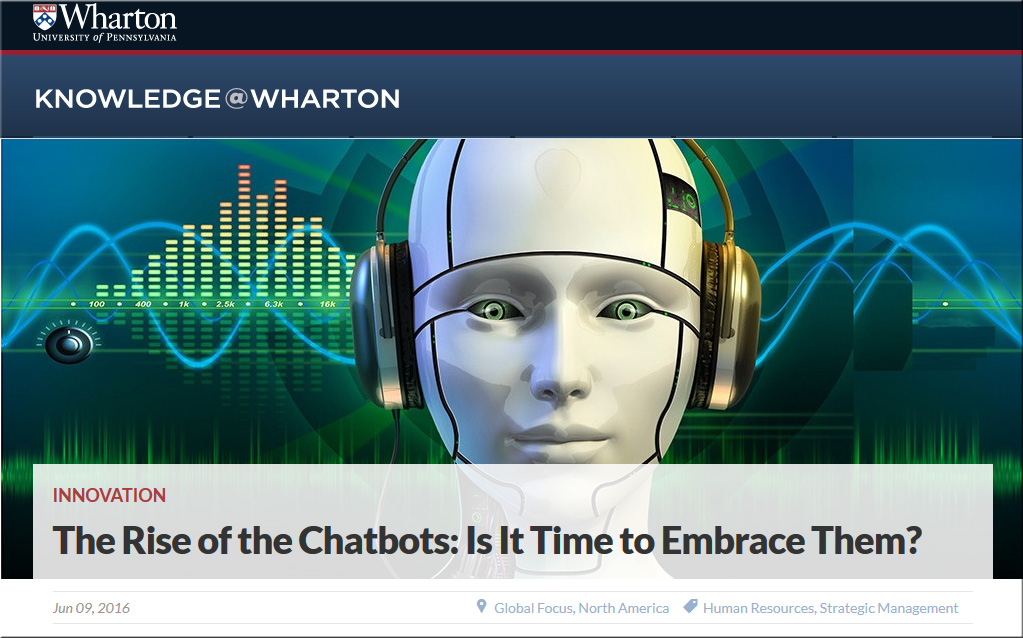
The rise of the chatbots: Is it time to embrace them? — from knowledge.wharton.upenn.edu

Excerpt:

The tech world is all agog these days about chatbots. These are automated computer programs that simulate online conversations with people to answer questions or perform tasks. While chatbots have been around in various rudimentary forms for years — think of Clippy, Microsoft’s paper clip virtual assistant — they have been taking off lately as advances in machine learning and artificial intelligence make them more versatile than ever. Among the most well-known chatbots: Apple’s Siri.

In rapid succession over the past few months, Microsoft, Facebook and Google have each unveiled their chatbot strategies, touting the potential for this evolving technology to aid users and corporate America with its customer-service capabilities as well as business utility features like organizing a meeting. Yahoo joined the bandwagon recently, launching its first chatbots on a chat app called Kik Messenger.


Bill Gates says the next big thing in tech can help people learn like he does — from businessinsider.com by Matt Weinberger

Excerpt (emphasis DSC):

In a new interview with The Verge, Microsoft cofounder and richest man in the world Bill Gates explained the potential for chatbots — programs you can text with like they’re human — in education.

Gates lauds the potential for what he calls “dialogue richness,” where an chatbot can really hold a conversation with a student, essentially making it into a tutor that can walk them through even the toughest, most subjective topics. 

It’s actually similar to how Gates himself likes to learn, he tells The Verge…


The complete beginner’s guide to chatbots — from chatbotsmagazine.com by Matt Schlicht
Everything you need to know.

Excerpt (emphasis DSC):

What are chatbots? Why are they such a big opportunity? How do they work? How can I build one? How can I meet other people interested in chatbots?

These are the questions we’re going to answer for you right now.
…
What is a chatbot?
A chatbot is a service, powered by rules and sometimes artificial intelligence, that you interact with via a chat interface. The service could be any number of things, ranging from functional to fun, and it could live in any major chat product (Facebook Messenger, Slack, Telegram, Text Messages, etc.).
…

A chatbot is a service, powered by rules and sometimes artificial intelligence, that you interact with via a chat interface.

Examples of Chat Bots
Weather bot. Get the weather whenever you ask.
Grocery bot. Help me pick out and order groceries for the week.
News bot. Ask it to tell you when ever something interesting happens.
Life advice bot. I’ll tell it my problems and it helps me think of solutions.
Personal finance bot. It helps me manage my money better.
Scheduling bot. Get me a meeting with someone on the Messenger team at Facebook.
A bot that’s your friend. In China there is a bot called Xiaoice, built by Microsoft, that over 20 million people talk to.


Chatbots explained: Why Facebook and other tech companies think they’re the biggest thing since the iPhone — from businessinsider.com by Biz Carson

Excerpt:

Chatbots are the future, whether we’re ready for them or not.

On Tuesday (April 5, 2016) , Facebook launched Bots for Messenger, a step that could define the next decade in the same way that the Apple App Store launch paved the path for companies like Uber to build a business off your phone. Its new messaging platform will help businesses build intelligent chatbots to let them communicate in Messenger.

“Today could be the beginning of a new era,” said Facebook Messenger chief David Marcus.

So what are these chatbots, and why is everyone obsessed?


Facebook wants to completely revolutionize the way you talk to businesses — from businessinsider.com by Jillian D’Onfro


Bot wars: Why big tech companies want apps to talk back to you — from fastcompany.com by Jared Newman
Can a new wave of chatbots from Facebook and Microsoft upend apps as we know them, or is that just wishful thinking?

Excerpt:

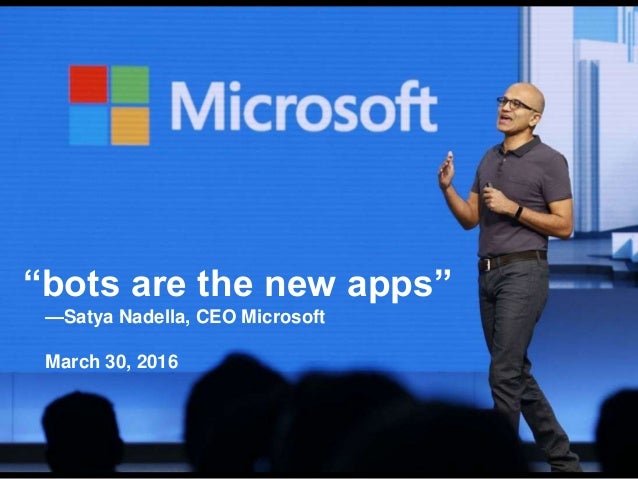
The rise of conversational “chatbots” begins with a claim you might initially dismiss as preposterous. “Bots are the new apps,” Microsoft CEO Satya Nadella declared during the company’s Build developers conference last month. “People-to-people conversations, people-to-digital assistants, people-to-bots, and even digital assistants-to-bots. That’s the world you’re going to get to see in the years to come.”


Microsoft CEO Nadella: ‘Bots are the new apps’

Excerpt:

SAN FRANCISCO – Microsoft CEO Satya Nadella kicked off the company’s Build developers conference with a vision of the future filled with chatbots, machine learning and artificial intelligence.

“Bots are the new apps,” said Nadella during a nearly three-hour keynote here that sketched a vision for the way humans will interact with machines. “People-to-people conversations, people-to-digital assistants, people-to-bots and even digital assistants-to-bots. That’s the world you’re going to get to see in the years to come.”

Onstage demos hammered home those ideas. One involved a smartphone conversing with digital assistant Cortana about planning a trip to Ireland, which soon found Cortana bringing in a Westin Hotels chatbot that booked a room based on the contents of the chat.


Addendums on 6/17/16:


WWDC-2016-Apple


Keynote address:

keynoteaddress-wwdc-2016

From Apple:


These are Apple’s big announcements from WWDC 2016 — from imore.com by Joseph Keller

Excerpt:

Apple made several interesting announcements today during its WWDC 2016 keynote. Here are the major announcements from the event.

  • iOS 10 — the big focus with this release is on Siri.
  • macOS Sierra — The next version of Apple’s operating system for desktops and laptops is dropping the ‘X’, opting instead for the new ‘macOS’ branding. With macOS, Siri makes its debut on Apple’s traditional computers for the first time.
  • watchOS
  • tvOS — The next major version of the Apple TV’s software will offer single sign-on for cable logins, along with its own dark mode. There will also be a number of Siri enhancements, as well as improvements for watching live TV.


Highlights from Apple’s WWDC 2016 Keynote — from fastcompany.com
From Messages to Music, and Siri to Apple Pay on the web, here are the most important announcements from Apple’s event today.


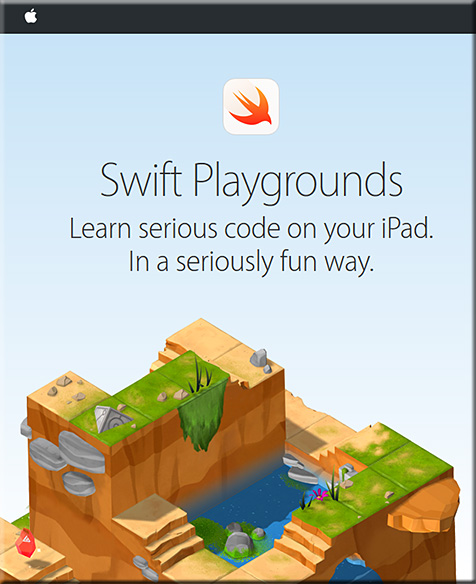
Apple launches Swift Playgrounds for iPad to teach kids to code — from techcrunch.com by Frederic Lardinois

Excerpt:

Apple today announced Swift Playgrounds for the iPad, a new project that aims to teach kids to code in Swift.

When you first open it, Swift Playground presents you with a number of basic coding lessons, as well as challenges. The interface looks somewhat akin to Codecademy, but it’s far more graphical and playful, which makes sense, given that the target audience is kids. Most of the projects seem to involve games and fun little animations to keep kids motivated.

To make coding on the iPad a bit easier, Apple is using a special keyboard with a number of shortcuts and other features that will make it easier to enter code.

Also see:

SwiftPlaygroundsFromApple-6-13-16


What’s new in iOS 10: Siri and Maps open to developers, machine learning and more — from arc.applause.com

Excerpts:

The biggest news for Siri from the WWDC keynote: Apple’s assistant is now open to third party developers.
…
Apple is now opening Siri to all of those potential interactions for developers through SiriKit. Siri will be able to access messaging, photos, search, ride booking through Uber or Lyft etc., payments, health and fitness and so forth. Siri will also be incorporated into Apple CarPlay apps to make it easier to interact with the assistant while driving.


Photos is getting a machine learning boost and automatic ‘Memories’ albums — from imore.com by Dan Thorp-Lancaster

Excerpt:

Speaking at WWDC 2016, Apple announced that it is bringing the power of machine learning to the Photos app in iOS 10. With machine learning, the Photos app will include object and scene recognition thanks to what Apple calls “Advanced Computer Vision.” For example, the app will be able to automatically pick out specific animal, features and more. Facial recognition is also available, all done locally on the iPhone with automatic people albums.


Home is a new way to control all of your HomeKit-enabled accessories — from imore.com by Jared DiPane

Excerpt:

Apple has announced its newest and easiest way to control any and all HomeKit accessories that you may have in your house: Home. With Home, you’ll be able to control all of your accessories, including Air Conditioners, cameras, door locks and other new categories. 3D Touch will be able to give you deeper controls at just a press, and notifications from these will also have 3D Touch functionality as well.


Here’s what Apple is bringing to the Apple TV — from fastcompany.com
tvOS is taking a step forward with updates to Siri, and new features such as single sign on, dark mode, and more.


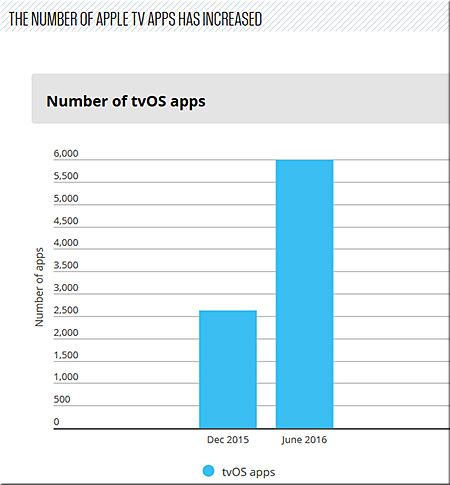
NumbertvOS-Apps-6000

Excerpt:

Less than nine months after the first version of tvOS, there are now over 6,000 native apps for the Apple TV. Of those apps, 1,300 are for streaming video. Popular over-the-top Internet television service Sling TV arrives on the Apple TV today. Live Fox Sports Go streaming will come this summer. Speaking of apps: Apple is introducing a new Apple TV Remote app for iOS that allows people to navigate tvOS using Siri from their iPhone and iPad.
…
Download apps on iPhone and get them on Apple TV
Now when you download an app on your iPad or iPhone, if there is an Apple TV version of the app, it will download to your Apple TV automatically.


tvOS 10 FAQ: Everything you need to know! — from imore.com by Lory Gil Mo


Apple iOS 10 “Memories” turns old photos into editable mini-movies — from techcrunch.com by Josh Constine
Using local, on-device facial recognition and AI detection of what’s in your images, it can combine photos and videos into themed mini-movies complete with transitions and a soundtrack.


Apple announces iOS 10 — from techcrunch.com


Apple launches iMessage Apps so third-party devs can join your convos — from techcrunch.com by Jordan Crook


Don’t brick your iPhone, iPad, Mac, or Apple Watch by installing developer betas — from imore.com by Serenity Caldwell

Excerpt:

As a reminder: You shouldn’t install developer betas on your primary devices if you want them to work.

This is our yearly reminder, folks: Unless you’re a developer with a secondary iPhone or Mac, we strongly, strongly urge you to consider not installing developer betas on your devices.

It’s not because we don’t want you to have fun: iOS 10, watchOS, tvOS, and macOS have some phenomenal features coming this Fall. But they’re beta seeds for a reason: These features are not fully baked, may crash at will, and probably will slow down or crash your third-party applications.


You already have the ultimate Apple TV remote, and it’s in your pocket — from techradar.com by Jon Porter


Apple quietly outs ‘next-generation’ file system destined for full product lineup — from imore.com by Dan Thorp-Lancaster


watchOS 3 FAQ: Everything you need to know — from imore.com by Mikah Sargent


Addendum on 6/15/16:


100 developers in the world


Also from visionmobile.com’s Developer Economics newsletter:


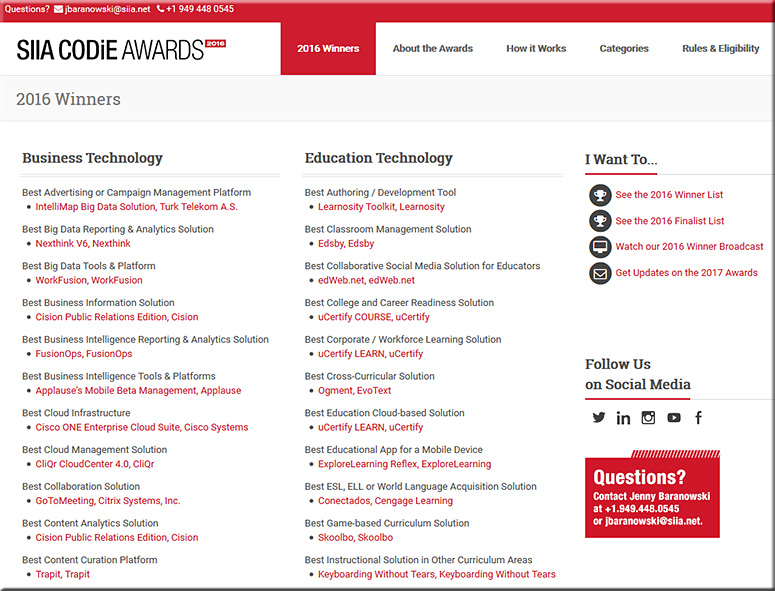
The SIIA CODiE Awards for 2016 — with thanks to Neha Jaiswal from uCertify for this resource; uCertify, as you will see, did quite well

Since 1986, the SIIA CODiE Awards have recognized more than 1,000 software and information companies for achieving excellence. The CODiE Awards remain the only peer-recognized program in the content, education, and software industries so each CODiE Award win serves as incredible market validation for a product’s innovation, vision, and overall industry impact.


SIIA-CODiE-Awards-for-2016


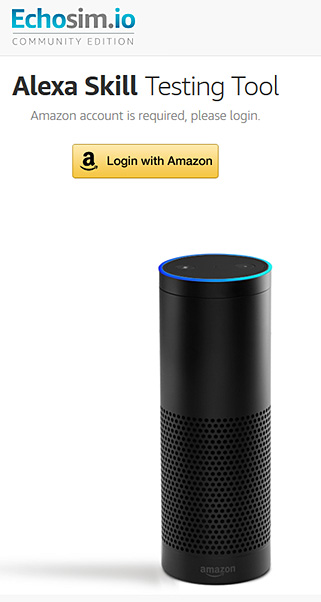
Amazon now lets you test drive Echo’s Alexa in your browser — from by Dan Thorp-Lancaster

Excerpt:

If you’ve ever wanted to try out the Amazon Echo before shelling out for one, you can now do just that right from your browser. Amazon has launched a dedicated website where you can try out an Echo simulation and put Alexa’s myriad of skills to the test.


Echosimio-Amazon-EchoMay2016


From DSC:
The use of the voice and gesture to communicate to some type of computing device or software program represent growing types of Human Computer Interaction (HCI).  With the growth of artificial intelligence (AI), personal assistants, and bots, we should expect to see more voice recognition services/capabilities baked into an increasing amount of products and solutions in the future.

Given these trends, personnel working within K-12 and higher ed need to start building their knowledgebases now so that we can begin offering more courses in the near future to help students build their skillsets.  Current user experience designers, interface designers, programmers, graphic designers, and others will also need to augment their skillsets.


Now you can build your own Amazon Echo at home—and Amazon couldn’t be happier — from qz.com by Michael Coren

Excerpt:

Amazon’s $180 Echo and the new Google Home (due out later this year) promise voice-activated assistants that order groceries, check calendars and perform sundry tasks of your everyday life. Now, with a little initiative and some online instructions, you can build the devices yourself for a fraction of the cost. And that’s just fine with the tech giants.

At this weekend’s Bay Area Maker Faire, Arduino, an open-source electronics manufacturer, announced new hardware “boards”—bundles of microprocessors, sensors, and ports—that will ship with voice and gesture capabilities, along with wifi and bluetooth connectivity. By plugging them into the free voice-recognition services offered by Google’s Cloud Speech API and Amazon’s Alexa Voice Service, anyone can access world-class natural language processing power, and tap into the benefits those companies are touting. Amazon has even released its own blueprint and code repository to build a $60 version of its Echo using Raspberry Pi, another piece of open-source hardware.


From DSC:
Perhaps this type of endeavor could find its way into some project-based learning out there, as well as in:

  • Some Computer Science-related courses
  • Some Engineering-related courses
  • User Experience Design bootcamps
  • Makerspaces
  • Programs targeted at gifted students
  • Other…??


TechCrunch Disrupt 2016 – 7 edtech startups that are changing the education industry — from goodcall.com by Carrie Wiley

Excerpt:

…find out how the EdTech startups we met at TechCrunch Disrupt 2016 are transforming the education landscape and how three education technology startups are already changing education as we know it.


Women in Computer Science: Getting involved in STEM — from computerscience.org; with thanks to Emily French for the resource

Excerpt:

Even with projected growth of 15-20% between 2012 and 2022, the vast majority of computer science jobs will be pursued and filled by men. As STEM-related industries on a whole add over 1.7 million jobs in the coming years, there continues to be a notable absence of women in the field. This trend begins well before entering the job market: girls account for more than half of all Advanced Placement (AP) test-takers, yet boys outnumber girls 4:1 in computer science exams. In Mississippi, Montana and Wyoming, not a single girl took the AP Computer Science examination in 2014.

There is a clear disconnect between the computer science industry and the message girls receive about their ability to succeed in tech organizations. This guide examines the history behind this disparity and how educators, parents, employers and computer scientists can reverse the trend.
…
Due to the marketing strategies of the last three decades, many women have developed misconceptions about computer science. While the notion of the geek coder is alive and well, many young women may be unaware of the myriad jobs available and the opportunity to make a palpable difference.
…
As Smithsonian Magazine reports, a survey conducted by AAUW of 15,000 recent graduates found that, one year after graduation, male and female programmers were earning the same salary.


ScholarshipsWomenCS-April2016


MicrosoftBuild2016


Microsoft Build: the 10 most important announcements — from theverge.com by Ben Popper and Dieter Bohn
Here come the bots!

Excerpt (emphasis DSC):

Every year, Microsoft holds a developer event called “Build.” And recently, those events have gone from snoozers to exciting showcases. Microsoft has a winner with Windows 10 (as long as you ignore the phones), a robust personal assistant in Cortana (that works just fine on a laptop), and a wild holographic future to plan with HoloLens. It’s a lot to take in, and at this year’s Build Microsoft we got updates on all of it. And a few surprises.

Going in, we weren’t totally sure what would be coming next for Windows 10, but it turns out there’s a lot that Microsoft has planned. It’s not just that there are new apps, there are also new bots, which will help people handle all sorts of small tasks. In fact, those bots and Microsoft’s vision of how they should work stole the entire show. Windows, Xbox: you’re cool, but the future is bots.


Why Microsoft wants to help developers build bots — from pcworld.com by Blair Hanley Frank
Conversations are cross-platform and mobile, even when Windows 10 Mobile isn’t winning

Excerpt:

Microsoft CEO Satya Nadella is pushing developers to create virtual assistants and intelligent chatbots to help users do everything from managing their calendars to booking hotel reservations.

To that end, Microsoft has published a new Bot Framework, which makes it easier to build chatbots using either C# or Node.js. Working with the tools isn’t so easy that anyone could do it, but they can help reduce some of the difficulties of conversing with a computer.

It was one of the main announcements from Nadella’s keynote address at Microsoft’s Build developer conference Wednesday.


Also see:


From DSC:
Questions/relevance for those working higher ed:

  • Are Computer Science programs able to keep up with the pace of these Human Computer Interaction (HCI)-related changes?  The changes in AI/cognitive computing? Are courses being created to address these new skills? These developments also impact those teaching about user experience design, application/product design, and more.
    .
  • How will such personal assistants be used by the students? By faculty members?


Now anyone can use Google’s deep learning techniques — from futurism.com by Sarah Marquart

In Brief:

Google announced a new machine learning platform for developers. The company is also open-sourcing tools such as Tensorflow to allow the community to take its internal tools, adapt them for their own uses, and improve them.
…
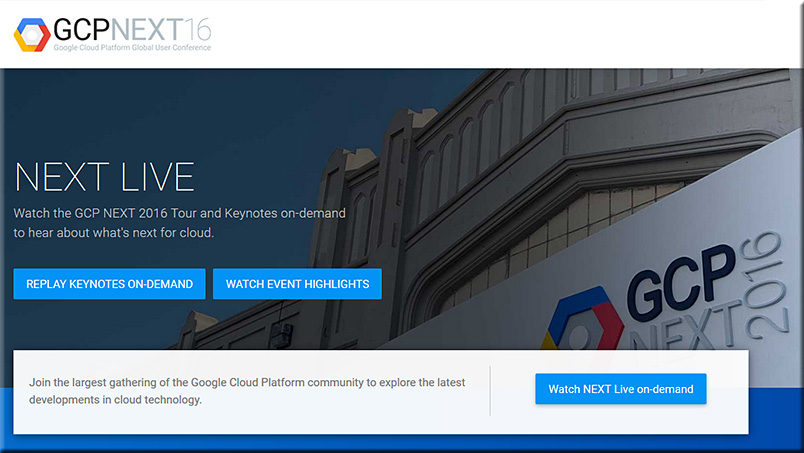
Google has announced a new machine learning platform for developers at its NEXT Google Cloud Platform user conference. Eric Schmidt, Google’s chairman, explained that Google believes machine learning is “what’s next.”


GoogleNEXT16


Using artificial intelligence in the classroom — from educationdive.com by Erin McIntyre

Dive Brief:

  • After Google’s artificially intelligent (AI) computer system beat world champion “Go” player Lee Sedol of South Korea, some are wondering if man-made neural networks can be applied in educational settings to benefit learning.
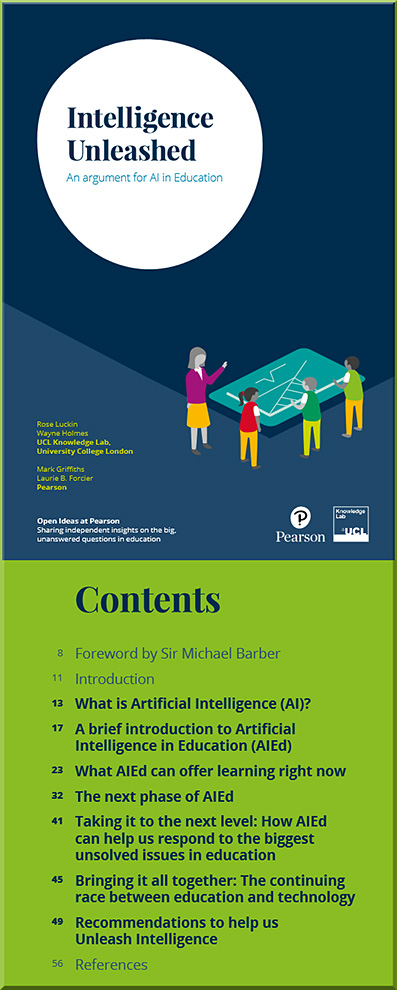
  • Companies like Pearson have begun to examine the subject; the company recently released a pamphlet called Intelligence Unleashed: An argument for AI in Education that argues software may soon be able to provide instant and deeper feedback regarding student progress, eliminating traditional standardized testing.
  • Pearson also conceptualized something called a “lifelong learning companion” for students, which essentially could be seen as an interactive cloud that asked questions, provided encouragement, offered suggestions and connected learners to resources.


AI-in-Education--2016

Excerpts:

ALGORITHM
A defined list of steps for solving a problem. A computer program can be viewed as an elaborate algorithm. In AI, an algorithm is usually a small procedure that solves a recurrent problem.

MACHINE LEARNING
Computer systems that learn from data, enabling them to make increasingly better predictions.

DECISION THEORY
The mathematical study of strategies for optimal decision-making between options involving different risks or expectations of gain or loss depending on the outcome.


It can be difficult to define artificial intelligence (AI), even for experts. One reason is that what AI includes is constantly shifting. As Nick Bostrom, a leading AI expert from Oxford University, explains: “[a] lot of cutting edge AI has filtered into general applications, often without being called AI because once something becomes useful enough and common enough it is not labeled AI anymore.” Instead, it is considered a computer program, or an algorithm, or an app, but not AI.

Another reason for the difficulty in defining AI is the interdisciplinary nature of the field. Anthropologists, biologists, computer scientists, linguists, philosophers, psychologists, and neuroscientists all contribute to the field of AI, and each group brings their own perspective and terminology.

For our purposes, we define AI as computer systems that have been designed to interact with the world through capabilities (for example, visual perception and speech recognition) and intelligent behaviours (for example, assessing the available information and then taking the most sensible action to achieve a stated goal) that we would think of as essentially human.


IBM’s Rometty wants you to know they’re a ‘cognitive solutions cloud platform company’ — from barrons.com by Tiernan Ray

Excerpt:

Rometty says she is the first IBM chief to ever offer a keynote at the show [CES]. Her framework for everything this evening is that the “future is cognitive,” and we’re headed to a “cognitive IoT.”
…
What happens when everyone becomes digital, she asks. What will differentiate people is understanding all that data. That is the “cognitive era.” “Cognitive is an era of business and an era of technology,” she says. 80% of data out here is “black, invisible,” and “that’s what’s changing,” she says.

Rometty clarifies cognitive is not synonymous with A.I. It is not about systems you program. It is about systems that learn.
…
Her point is that all that “vast IoT data is going to do nothing for you unless you can bring cognitive to it.”

Her big point: “IBM is no longer a hardware, software company,” but a “cognitive solutions cloud platform company.”


SoftBank’s Pepper robot to get even brainier with IBM’s Watson technology — from thenextweb.com by Natt Garun

Excerpt:

When it launched last year, SoftBank’s emotion-reading robot Pepper sold out in just one minute despite its limited utility. Now, Pepper’s about to get smarter thanks to a partnership with IBM to integrate Watson cognitive system into its brains.

With Watson, developers hope to help Pepper understand human emotions more thoroughly to appropriately respond and engage with its users. IBM and SoftBank say the collaboration will also allow Pepper to gather new information from social media to learn how people interact with brands so it knows how to personally reach out to people.


Big Data in 2016: Cloudy, with a chance of disappointment, disillusionment, and disruption — from insidebigdata.com by Daniel Gutierrez

Excerpt:

Expect to see many organizations become deeply disillusioned by Big Data in 2016 because they had hoped to get different results from their business, without using Big Data to actually change how they operated. Those who used Big Data to make substantive changes to how they operate will dramatically out-compete those who used Big Data to produce merely-more-detailed reports, but little actual change.


Young entrepreneurs are applying the power of big data to the real world — from entrepreneur.com by John Pilmer

Excerpt:

Two 15-year-old students from Business Technology Early College High School (BTECH) in Queens, New York dazzled me with big-picture thinking about the social implications of harnessing big data while protecting our future. The teens shared very entrepreneurial thoughts of how to deliver genomic big data solutions without diminishing individual self-worth.

One young man used the example of applying genomic big data to people to create a “Superman” in the future. Yet, he noted that if everyone were Superman, no one would be.  In other words, no one would be unique, stand out from the crowd. Wow! That’s big picture thinking that reminds me of a science fiction novel.


The data science industry: a look at the key roles — from dataconomy.com by Darya Niknamian

Here is the infographic from that article:


The art of data science: The skills you need and how to get them — from kdnuggets.com by Joseph Blue
Learn, how to turn the deluge of data into the gold by algorithms, feature engineering, reasoning out business value and ultimately building a data driven organization.


The 22 skills of a Data Scientist…  — from dataconomy.com by Matt Reaney


From DSC:
The items above made me think of trying to excerpt meaning from big data…which made me think of programming…which lead me to think of algorithms…which lead me to think of artificial intelligence (AI).  Then, when I was thinking about AI, I wondered…

  • How might AI and algorithms play into the future of MOOCs — especially in regards to providing automated assessments, scoring, and grading…?

Hmmm….could be helpful…though knowledgeable experts/humans will likely still be needed. But such technologies could help with some of the heavy (and often time-consuming) lifting here.


Google is sharing its powerful AI with everyone in its cloud — from wired.com by Cade Metz

Excerpt:

Google is once again sharing its state-of-art artificial intelligence with the rest of the world.

[On 3/323/16] at an event in San Francisco, the company unveiled a new family of cloud computing services that allow any developer or business to use the machine learning technologies that power some of Google’s most powerful services.


HP announces new machine learning as a service offering — from business-standard.com by
The products were unveiled at the HPE Advanced Analytics World Tour 2016

Excerpt:

Technology major Hewlett-Packard Enterprise (HPE) today announced the commercial launch of Haven OnDemand, a cloud platform that provides advanced machine learning application programme interfaces and services that enable developers, startups and enterprises to build data-rich mobile and enterprise applications.

The company also announced a new version of Idol analytics platform, which applies data analytics and machine learning for organisations to automate and supplement a vast array of manual-based tasks such as trend analysis and video surveillance.


© 2025 | Daniel Christian