Teaching Tools: Using Online Simulations and Games — from Edutopia.org

But why not bring gaming into the classroom? Could teachers tap that same passion to spark learning? Gaming remains new territory for most schools. As the following examples show, educators on the frontiers are eager to share what they’re learning. Here are just a few examples.

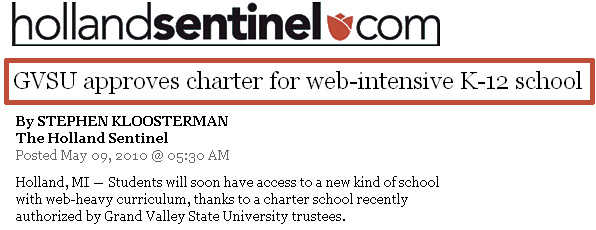
GVSU approves charter for web-intensive K-12 school

Expanding the focus of the Education Program — from Hewlett Foundation

We are delighted to share with you some exciting news from the Hewlett Foundation’s Education Program. Building upon our work in technology and policy, we are expanding our focus to help schools nationwide prepare students to thrive in an increasingly complex, fast-paced, and unpredictable world. The Hewlett Board of Directors approved the added scope at its March meeting.

We call this expanded focus deeper learning – a combination of the fundamental knowledge and practical basic skills students will need to succeed in a fiercely competitive global economy. Specifically, our definition of deeper learning brings together five key elements that work in concert: core academic content; critical thinking and complex problem solving; effective communication; working in collaboration; and learning how to learn (emphasis DSC).  We believe this approach could have a profound effect on how and what the next generation of students learns.

Tagged with:  

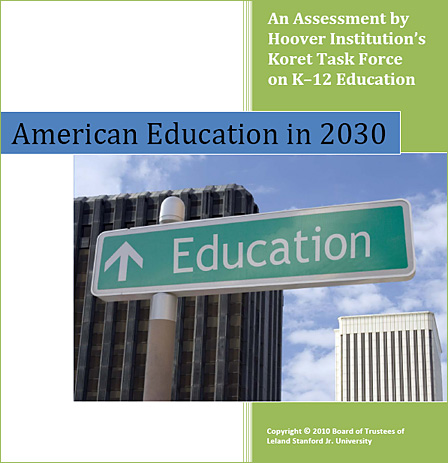
American Education in 2030 - from Stanford

Contents
Foreword …………………………………………………………………………………………. 1
Only if Past Trends Persist Is the Future Dismal ………………………………………… 2
Curriculum Then and Now …………………………………………………………………… 6
Classroom Teaching in 2030 ……………………………………………………………….. 11
Equality and Technology ……………………………………………………………………. 17
Time Spent on Learning ……………………………………………………………………… 24
Standards and Competitive Rigor ………………………………………………………… 30
An Evidence-Based World ………………………………………………………………….. 37
A New Education Federalism ……………………………………………………………… 45
Reinvented School Districts ……………………………………………………………….. 52
A New Politics of Education ……………………………………………………………….. 59
Vouchers Thrive ………………………………………………………………………………. 65
School Choice ………………………………………………………………………………….. 70
What Can Happen in Twenty Years? …………………………………………………….. 77
About the Authors ……………………………………………………………………………. 82
Koret Task Force on K–12 Education ……………………………………………………. 85

Tagged with:  

See:

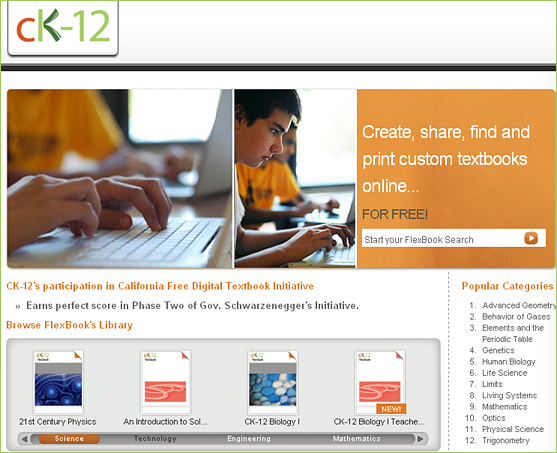
Press Release: CK-12, Leading Non-Profit Provider of Digital Textbooks to Schools, Makes the Grade with California’s Free Digital Textbook Initiative — eSchoolNews.com

CK-12 FlexBooks:

CK-12's flexbooks

CK Foundation

ck12.org

Key Benefits

Access to free textbooks
High quality educational content created by educators
Content customized to reflect “today” and the different needs of students
Quality ensured by CK-12’s Community of Educational Practitioners
Increased pedagogic choice for all teachers, aligned to state standards as well as developmentally correct content
Supported by publishing tools that facilitate quick and easy content creation and distribution
Collaborative learning via a community where authors, teachers, and students create, access, share, rate, recommend, and publish

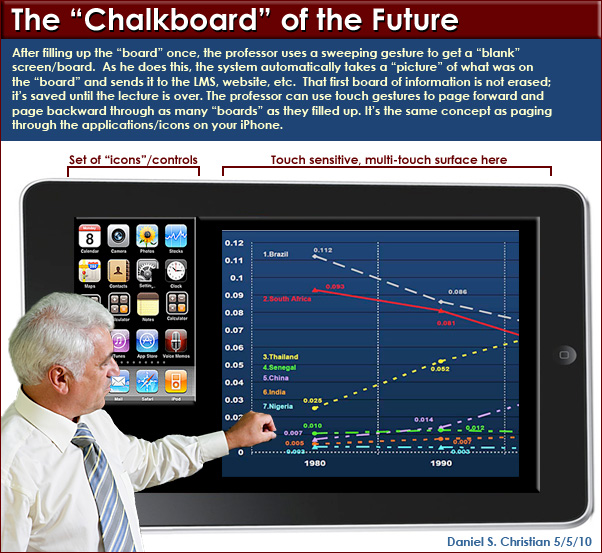
Daniel Christian: The Chalkboard of the Future

This is the type of board — preferably a very large multi-touch surface — that I would
like to see in the Future Smart Classroom. That’s one big giant iPad/iPhone!   🙂

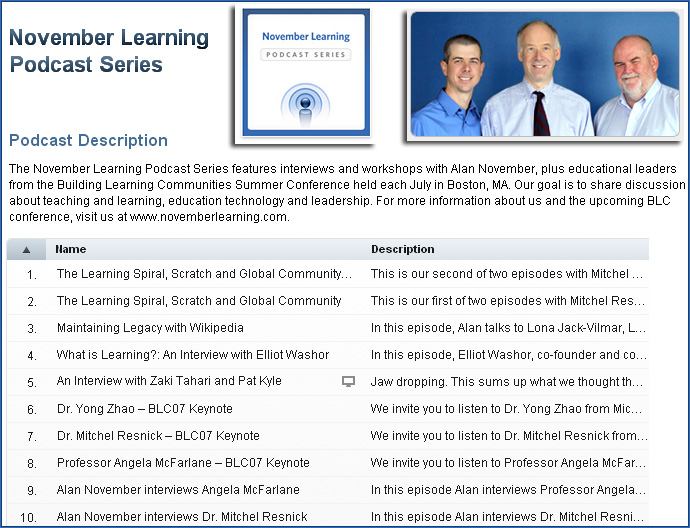
November Learning Website

NovemberLearning.com

November Learning Podcasts Series

November Learning Podcasts Series

Tagged with:  

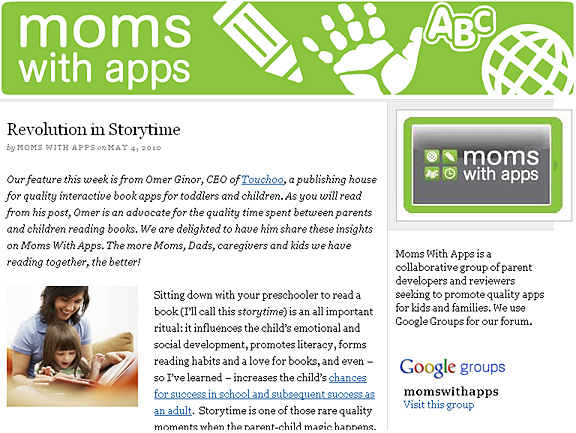
Moms with apps — interesting

momswithapps.com

Tagged with:  

edutecher.net

Tagged with:  

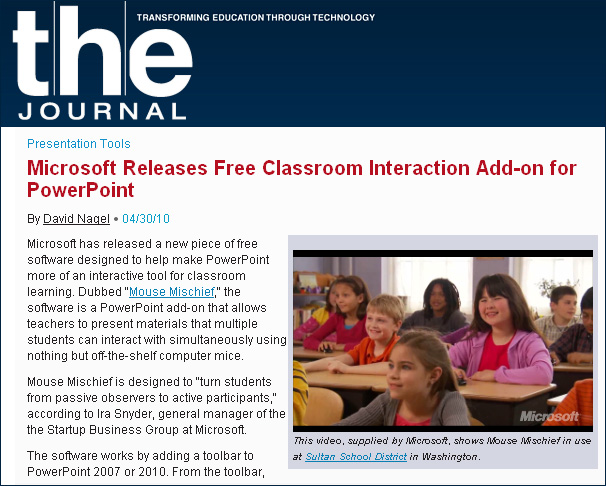
Microsoft releases free classroom interaction add-on for PowerPoint

From DSC:
Note the quote from Ira Snyder that says:

Mouse Mischief is designed to “turn students from passive observers to active participants”

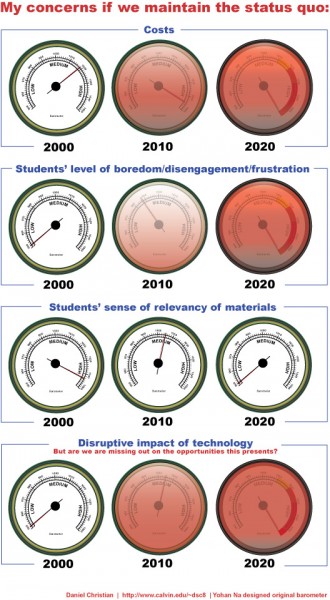
Now let’s play this out a bit. If K-12’rs are starting to use more and more of these types of interactive technologies and are becoming active participants in their learning, how does that affect their expectations when they come into our colleges and universities? To me, change is not an option for those of us in higher ed. Here are my concerns if we follow the status quo:

Daniel S. Christian: My concerns with just maintaining the status quo

Project Dream School — from EducationFutures.com

Project Dream School starts with a simple question:

If you could build a dream school, what would you do?

Furthermore:

What would the building look like? The methods? The teachers? Technology? The mission? …does it need to be a school, or should it be a bootcamp for designing futures… life… the perfect job?

Last Thursday, many great minds assembled to discuss just this… and how to make it happen. Sir Ken Robinson, Jeff Jarvis and I joined the discussion by Skype with Peter de Visser (principal), Marcel Kampman (creative organizer), Ellen Mashhaupt, Bianca Geerts, Fons van den Berg, Rob van der Ploeg, Bram Verhave (Architecture historian STEK, advisor to Chief government Architect), Peter de Visser, Ton Dohle, Bjorn Eerkes, Maurice Mikkers, Lex Hupe, Arjan Dingsté, Hartger Meihuizen (staff Stad&Esch), Roel Fleurke (staff Stad&Esch), Koene Kisjes (student Stad&Esch), Christian Paauwe (student Stad&Esch), Bart Hoekstra (student Stad&Esch), Jan Albert Westenbrink, and Annette Stekelenburg.

The project will have a website up-and-running soon at projectdreamschool.org, and also in Dutch at: projectdroomschool.org. As a Skype (distant) participant, I really cannot report on how the entire discussion went, so make sure to follow the project sites for their take on the meeting and their next actions as they work to transform their dreams into reality.

Stay tuned… more soon!

Postscript: Here is my Dream School…

projectdreamschool.org

Tagged with:  

Adaptive learning: Putting an idea into practice at the School of One — from EducationNext.org by Paul E. Peterson

Time magazine touted “the School of One” as one of the 50 top innovations of 2009—the only educational innovation to be given that honor. As described in Time, “each day, students in the School of One are given a unique lesson plan — a ‘daily playlist’— tailored to their learning style and rate of progress that includes a mix of virtual tutoring, in-class instruction and educational video games (emphasis DSC). I stopped by a New York City middle school using the School of One last week to see how new technologies that help teachers adapt to each student’s learning level actually work in practice.

Educators, like designers, can benefit from identifying the student price point, the material the student is now ready and prepared to learn.  With adaptive testing technologies now available, schools can quickly and efficiently obtain weekly, perhaps daily, information on what a student knows. Teaching can zero in on the price point, so the student is not given something that is either too advanced or too repetitive of what he or she already knows.

School of One takes this idea one step further by also trying to identify student interests and learning styles as well.  If a boy is a Little Leaguer; then baseball statistics may be the best way to teach math.  If a girl plays volleyball, the examples can be modified accordingly.

The 21st-century art teacher — from NorthJersey.com by Stephanie Akin [via Ray’s Schroeder’s Educational Technology Blog)

From DSC:
Not saying that this is the only way to teach art — no way — but this teacher’s “…seventh- and eighth-grade art classes at Eisenhower Middle School use almost no traditional materials. Instead, he teaches students how to work with modern technology, including computers, digital cameras and camcorders. He also guides eighth-grade students through the process of producing their own daily television news program, which is broadcast to the rest of the school and on a local cable channel.”

My bet is that the energy level is high in his classes, as students are allowed to be creative in a variety of ways. If your institution doesn’t have a new media studies program, consider developing one. If you are teaching art, then you need to have at least a portion of your curriculum integrate/utilize such technologies.

Teacher Appreciation Week: Gift Ideas — from Edutopia.org
Educators from our online community share their suggestions for great teacher gifts.

From DSC:
Thank you to all teachers, professors, instructors, coaches, mentors, and trainers out there!

Tagged with:  
© 2025 | Daniel Christian