The folks needed to create the next generation of learning: Computers can’t touch this. [Christian]

From DSC:
What we need is a major hackathon — or an organization with deep pockets — that can bring together folks from a variety of disciplines including:

  • Subject Matter Experts
  • Instructional Designers
  • Cognitive Psychologists
  • Computer Scientists and/or those exerienced with learning analytics/data mining, Artificial Intelligence (AI)
  • Those gifted in film/media/videography/photography
  • Great storytellers/writers (including writing for transmedia-based learning experiences)
  • Folks who can create engaging, educational games
  • Designers
    • Web
    • Graphic
    • Interface
    • User experience
    • User interaction
    • Those gifted in creating multimedia-based content
  • Musicians
  • Human Computer Interaction (HCI) experts
  • Mobile learning experts
  • Those knowledgeable with second screens/M2M communications
  • Animators
  • Illustrators
  • Social media experts
  • Accessibility experts
  • Researchers
  • Those gifted in creating augmented reality-based apps
  • Legal/copyright experts
  • & others

We need for these specialists to collaborate in order to create the next generation of learning.  Anyone who can bring these skillsets together and experiment with creating materials will have significantly contributed something to the current generations and to future generations! 

And, in the words of M.C. Hammer,  computers “can’t touch this!”  Why? Because “learning is messy!”

What fields did I miss?
Please leave your thoughts and
feedback in the comments section.


Beyond the Page: Transmedia Storytelling — from macict.edu.au by Cathie Howe


Below are some excerpted slides from:
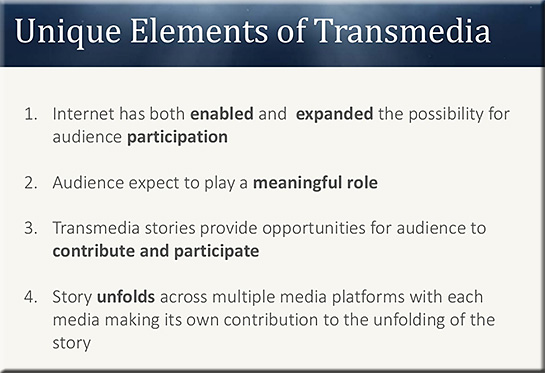
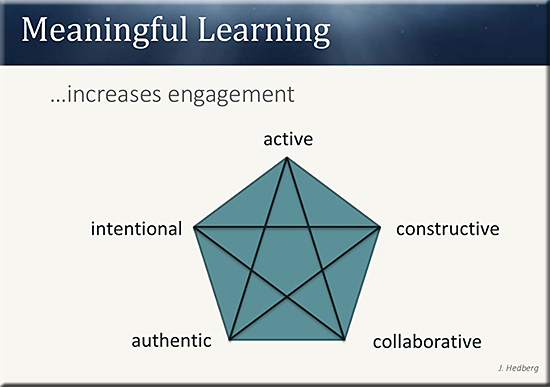
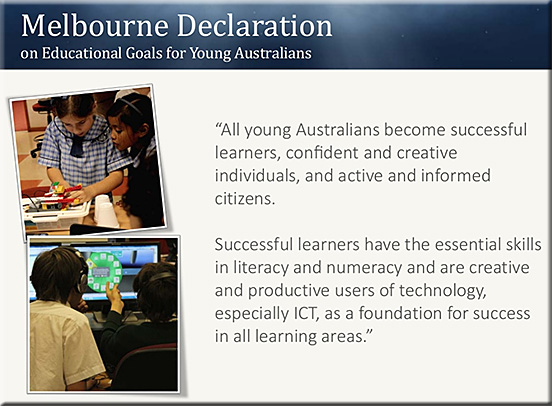
Rethinking literacy through transmedia storytelling final from Cathie Howe and Katy Lumkin

.

TransmediaStorytellingLumkinHowe-April2013

.

TransmediaStorytellingLumkinHowe1-April2013

.

TransmediaStorytellingLumkinHowe2-April2013

.

TransmediaStorytellingLumkinHowe3-April2013


From DSC:
Transmedia storytelling ties in very nicely with my thoughts re: Learning from the Living [Class] Room!

.

The Living [Class] Room -- by Daniel Christian -- July 2012 -- a second device used in conjunction with a Smart/Connected TV


Notes from DSC:

  • Some of the material in this presentation or the website may not be appropriate for a younger audience.
  • Notice how many potential jobs/roles/positions/skillsets can be explored here!

.


TransmediaStoryProductionIntro-April2013

.

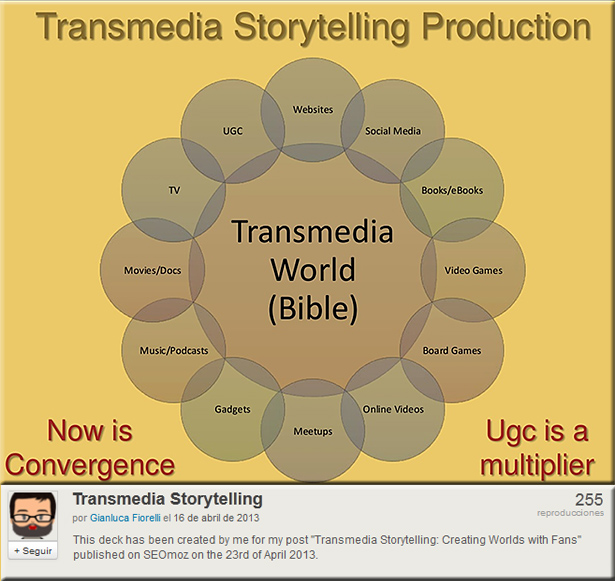
TransmediaStoryProduction-April2013

From DSC:
The word Bible is here not quite I think of as the Bible…but you’ll get the point if you review Gianluca’s presentation.
.

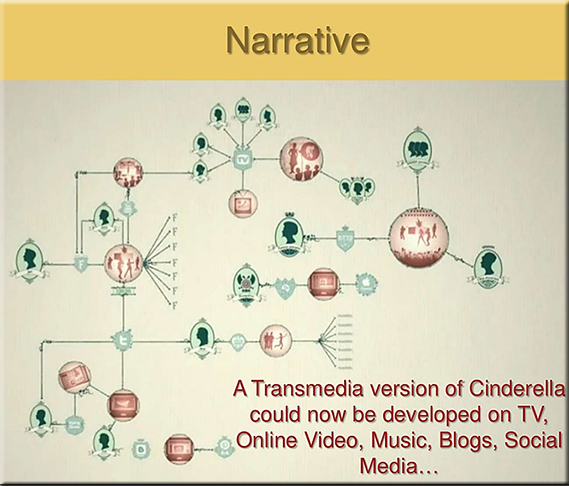
TransmediaStoryProduction2-April2013

.

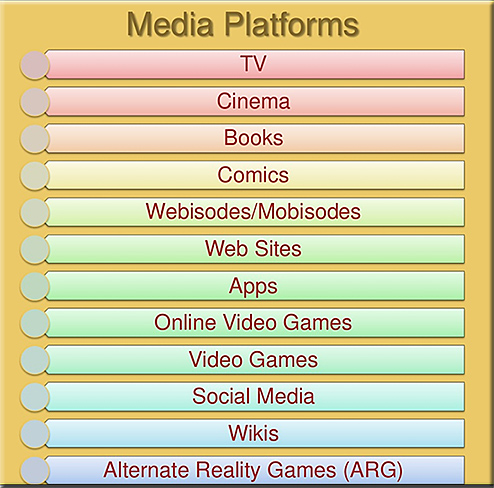
TransmediaStoryProduction3-April2013

.


Questions from DSC:

  • What opportunities might be presented by this type of trend within the worlds of education/training? (i.e. within K-12, higher ed, the corporate world)
  • What sorts of streams of contents could be created for educational/training-related purposes?
  • What sorts of open doors are now present within the world of communications? For a church, a school, a college, a business?
  • How can we incorporate the use of story more effectively in our teaching and learning environments? (If we could do this, we could greatly increase our students’ ROI.)


BII REPORT: Here’s why the “second screen” industry is set to explode — BusinessInsider.com

BII REPORT: Here’s why the “second screen” industry is set to explode — BusinessInsider.com

Excerpt:

Here’s why the second screen industry will ultimately succeed:

  • Usage is growing rapidly
  • And mass acceptance isn’t even necessary
  • Second screen isn’t really a new activity
  • Second screen apps and sites are bridges


From DSC:
As this article alludes to, I wouldn’t rule the living room out in terms of where interactive, multimedia-based, educationally-related, second screen-based applications will turn up (apps backed up by data mining, AI, and opportunities for social learning). This area is poised for some serious growth. 


The Living [Class] Room -- by Daniel Christian -- July 2012 -- a second device used in conjunction with a Smart/Connected TV


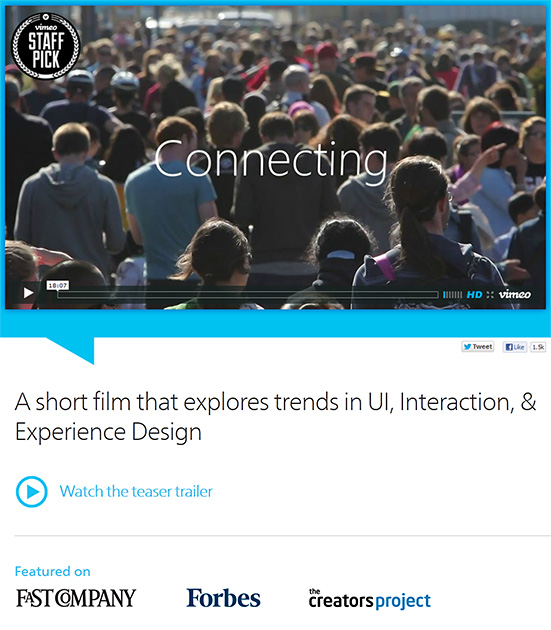
Connecting: A short film that explores trends in UI, Interaction, & Experience Design — from connectingthefilm.com with thanks to siobhan-o-flynn for scooping this!

.

ConnectingShortFilmApril2013


Description:

The 18 minute “Connecting” documentary is an exploration of the future of Interaction Design and User Experience from some of the industry’s thought leaders. As the role of software is catapulting forward, Interaction Design is seen to be not only increasing in importance dramatically, but also expected to play a leading role in shaping the coming “Internet of things.” Ultimately, when the digital and physical worlds become one, humans along with technology are potentially on the path to becoming a “super organism” capable of influencing and enabling a broad spectrum of new behaviors in the world. Available with Chinese, French, Spanish,German, Korean, Portuguese, and Japanese subtitles at on YouTube.

The connected TVs are here… interactive programming & native apps will follow— from venturebeat.com by Habib Kairouz


The connected TVs are here… interactive programming & native apps will follow
.

Excerpt:

Innovative devices have always fueled new application ecosystems. The software industry was enabled by the WinTel PC platform; and hundreds of thousands of websites were built once the PCs became “connected.” In the last few years, we have witnessed the same trend in mobile; more than 700,000 apps have been created for Web-enabled phones. We’ll soon see connected TVs fueling a similar ecosystem of interactive programming and native apps. With nearly a quarter of all U.S. households currently using connected TVs (according to eMarketer), we have reached the tipping point of mass adoption.

As opposed to the disastrous impact the Internet had on the print industry, I see the innovation of the connected TV market as a tremendous, yet accretive, evolution as opposed to a threat. Here’s why:

My reflections on “MOOCs of Hazard” – a well-thought out, balanced article by Andrew Delbanco


From DSC: Below are my reflections on MOOCs of Hazard — from newrepublic.com by Andrew Delbanco — who asks:  Will online education dampen the college experience? Yes. Will it be worth it? Well…


.
While I’m not sure that I agree with the idea that online education will dampen the college experience — and while I could point to some amazing capabilities that online education brings to the table in terms of true global exchanges — I’ll instead focus my comments on the following items:


1) Massively Open Online Courses (MOOCs) are recent experiments — ones that will continue to change/morph into something else.
They are half-baked at best, but they should not be taken lightly. Christensen, Horn, Johnson are spot on with their theories of disruption here, especially as they relate to innovations occurring within the virtual/digital realm.  For example, the technologies behind IBM’s Watson could be mixed into the list of ingredients that will be used to develop MOOCs in the future.  It would be a very powerful, effective MOOC indeed if you could get the following parties/functionalities to the table:

  • IBM — to provide Watson like auto-curation/filtering capabilities, artificial intelligence (AI) capabilities, as well as data mining/learning analytics expertise, joined by
  • Several highly-creative firms from the film/media/novel/storytelling industry, who would be further joined by
  • Experts from Human Computer Interaction (HCI)/user interface/user experience design teams, who would be further joined by
  • Programmers and interaction specialists from educational gaming endeavors (and from those who can design simulations), joined by
  • Instructional designers, joined by
  • The appropriate Subject Matter Experts who can be reached by the students as necessary, joined by
  • Those skilled in research and library services, joined by
  • Legal experts to assist with copyright issues, joined by
  • Other specialists in mobile learning,  3D, web development, database administration, animation, graphic design, musicians, etc.

It won’t be long before this type of powerful team gets pulled together — from some organizations(s) with deep pockets — and the content is interacted with and presented to us within our living rooms via connected/Smart TVs and via second screen devices/applications.

2) The benefits of MOOCs
  • For colleges/universities:
    • MOOCs offer some serious marketing horsepower (rather than sound pedagogical tools, at this point in time at least)
    • They are forcing higher ed to become much more innovative
    • They provide great opportunities to build one’s personalized learning networks, as they bring forth those colleagues who are interested in topic A, B, or C
    • They move us closer to team-based content creation and delivery
      .
  • For students:
    • They offer a much less expensive option to go exploring disciplines for themselves…to see if they enjoy (and/or are gifted in) topic A, B or C
    • They provide great opportunities to build one’s personalized learning networks, as they bring forth those colleagues who are interested in topic A, B, or C
    • They provide a chance to see what it’s like to learn about something in a digital/virtual manner

3)  The drawbacks of MOOCs:
  • MOOCs are not nearly the same thing as what has come to be known as “online learning” — at least in the higher ed industry. MOOCs do not yet offer what more “traditional” (can I say that?) online learning provides: Far more support and pedagogical/instructional design, instructor presence and dialog, student academic support services, advising, more student-to-student and student-to-faculty interaction, etc.
    .
  • MOOCs are like drinking from a firehose — there are too many blogs/RSS feeds, twitter feeds, websites, and other resources to review.

4) It would be wise for all of us to be involved with such experiments and have at least a subset of one’s college or university become much more nimble/responsive.


Also see:

Dual screen: The evolution of the second screen — from blog.brightcove.com by Albert Lai

Excerpt (emphasis DSC):

Educational Gamification
In a previous post, we asked readers to suggest their ideas for dual screen applications. One of the more intriguing responses was the suggestion to create companion educational games to accompany associated video content.

In a dual screen experience, as video content is displayed on the television, the application can engage the viewer with relevant and education activities, from content reinforcement to spelling to trivia to memory “games.” One can imagine an interactive amalgamation of Dora the Explorer, Where in the World Is Carmen Sandiego?, and Schoolhouse Rock!


.


.


The Living [Class] Room -- by Daniel Christian -- July 2012 -- a second device used in conjunction with a Smart/Connected TV


Addendum on 4/8/13:

SXSWi Report: Liquid journalism and dynamic storytelling emerge in 2013 — from waggeneredstrom.com by Eddie Rehfeldt

Excerpt:

Breaking News: the search for a better narrative format for the internet is now available. Ben Decker once said “the internet is not just another TV pipe” and this was made apparent at SXSWi in Austin last week.  “Liquid Journalism” or interactive storytelling hit the Lone Star state with a vengeance.


Items re: multi-screen media — eventually this trend/convergence enables “Learning from the Living [Class] Room”

PayWizard launches first dedicated payment and subscriber management solution for TV and media industry — from PayWizard

Excerpt:

London, 21 February 2013 – PayWizard, specialists in payment and subscription management, has launched the TV and media industry’s first dedicated, end to end payment and subscription solution. The integrated solution brings together a strong heritage in the Pay-TV market with a deep understanding of the challenges TV operators and media companies face in monetising the multiplatform world.

Using its award-winning modular Payment and Subscription platform, PayWizard combines payment processing, intelligent subscriber management technology and real-time customer service operations to tailor-make solutions that enhance the consumer experience across all screens.

With 16.8 billion video-enabled devices set to be in the global marketplace by 2015, content owners are facing the challenge of enhancing existing services while creating compelling experiences that embrace new routes to market. PayWizard’s comprehensive set of products and services has enabled clients, such as the UK’s biggest commercial broadcaster, ITV, to address these commercial challenges by enabling new monetisation strategies to drive revenue and profitability.


Also see:

.

ConnectedTVSummit-London-2013


.


Nagra-Kudelskidotcom-March2013


.

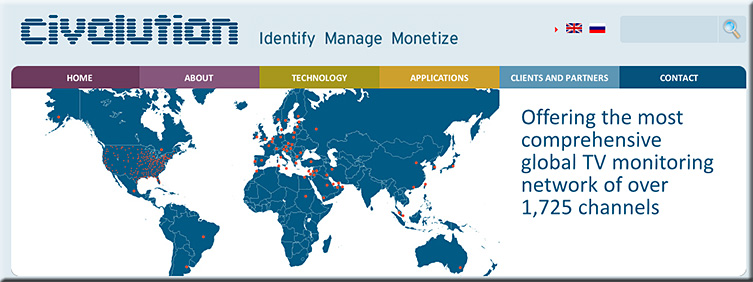
civolution-march2013

.

Also see:


From DSC:
See the categories listed above for the items/topics/disciplines/trends that are relevant here.


Addendum:

Check this out!

Massive Open Online Course offered by UMass Boston to feature the first adaptive MOOC technology
Enables students to be taught according to individual learning strategies

Excerpt from email:

(Boston, MA) – February 27, 2013 – If you’ve ever been in a course and struggled because you just aren’t “getting it,” the reason might be less your ability than the way in which the material is being presented.

New technology is now allowing online course environments to analyze how individual students learn, customizing instruction to individualized learning strategies. The College of Advancing and Professional Studies (CAPS) at the University of Massachusetts Boston has teamed up with USDLA 21st Century Sponsor, Synaptic Global Learning (SGL), to use the new learning management system, Adaptive Mobile Online Learning (AMOL), to deliver the first adaptive Massive Online Open Course (a-MOOC) ever offered. The course launches March 25.

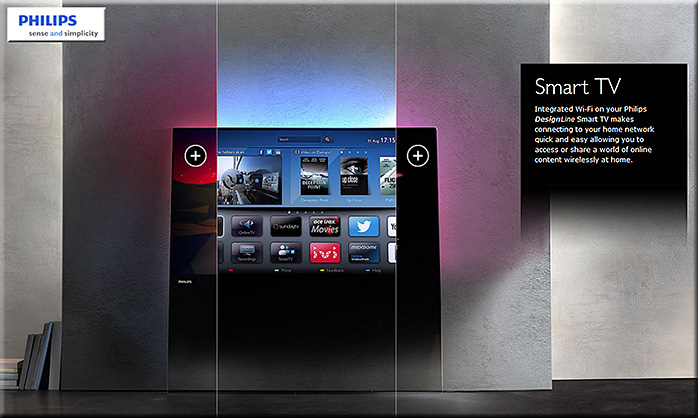
PhilipsSmartTV-March2013

8 apps to turn your iPad into a digital whiteboard — teachthought.com

Also related:


5 ways to add interactive elements to your videos — from freetech4teachers.com by Richard Byrne


Tagged with:  

From DSC:
Some very frustrated reflections after reading:

Excerpt:

Right now, boys are falling out of the kindergarten through 12th grade educational pipeline in ways that we can hardly imagine.


This situation continues to remind me of the oil spill in the Gulf (2010), where valuable resources spilled into the water untapped — later causing some serious issues:
.

From DSC:
What are we doing?!!! We’ve watched the dropout rates grow — it doesn’t seem we’ve changed our strategies nearly enough! But the point that gets lost in this is that we will all pay for these broken strategies — and for generations to come!  It’s time to seriously move towards identifying and implementing some new goals.

What should the new goals look like? Here’s my take on at least a portion of a new vision for K-12 — and collegiate — education:

  • Help students identify their God-given gifts and then help them build up their own learning ecosystems to support the development of those gifts. Hook them up with resources that will develop students’ abilities and passions.
    .
  • Part of their learning ecosystems could be to help them enter into — and build up — communities of practice around subjects that they enjoy learning about. Those communities could be local, national, or international. (Also consider the creation of personalized learning agents, as these become more prevalent/powerful.)
    .
  • Do everything we can to make learning enjoyable and foster a love of learning — as we need lifelong learners these days.
    (It doesn’t help society much if students are dropping out of K-12 or if people struggle to make it through graduation — only to then harbor ill feelings towards learning/education in general for years to come.  Let’s greatly reduce the presence/usage of standardized tests — they’re killing us!  They don’t seem to be producing long-term positive results. I congratulate the recent group of teachers who refused to give their students such tests; and I greatly admire them for getting rid of a losing strategy.)

    .
  • Give students more choice, more control over what their learning looks like; let them take their own paths as much as possible (provide different ways to meet the same learning objective is one approach…but perhaps we need to think beyond/bigger than that. The concern/fear arises…but how will we manage this? That’s where a good share of our thinking should be focused; generating creative answers to that question.)
    .
  • Foster curiosity and wonder
    .
  • Provide cross-disciplinary assignments/opportunities
    .
  • Let students work on/try to resolve real issues in their communities
    .
  • Build up students’ appreciation of faith, hope, love, empathy, and a desire to make the world a better place. Provide ways that they can contribute.
    .
  • Let students experiment more — encourage failure.
    .


© 2025 | Daniel Christian