Amazon is winning the race to the future — from bizjournals.com by

Excerpt:

This is the week when artificially intelligent assistants start getting serious.

On Tuesday, Google is expected to announce the final details for Home, its connected speaker with the new Google Assistant built inside.

But first Amazon, which surprised everyone last year by practically inventing the AI-in-a-can platform, will release a new version of the Echo Dot, a cheaper and smaller model of the full-sized Echo that promises to put the company’s Alexa assistant in every room in your house.

The Echo Dot has all the capabilities of the original Echo, but at a much cheaper price, and with a compact form factor that’s designed to be tucked away. Because of its size (it looks like a hockey puck from the future), its sound quality isn’t as good as the Echo, but it can hook up to an external speaker through a standard audio cable or Bluetooth.
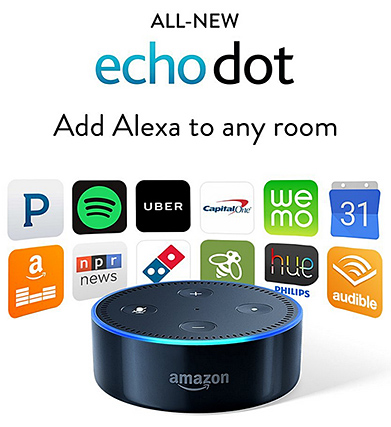
 

amazon-newdot-oct2016


100 bot people to watch #BotWatch #1 — from chatbotsmagazine.com

Excerpt:

100 people to watch in the bot space, in no order.

I’ll publish a new list once a month. This one is #1 October 2016.

This is my personal top 100 for people to watch in the bot space.


Should We Give Chatbots Their Own Personalities? — from re-work.com by Sophie Curtis

Excerpt:

Today, we have machines that assemble cars, make candy bars, defuse bombs, and a myriad of other things. They can dispense our drinks, facilitate our bank deposits, and find the movies we want to watch with a touch of the screen.

Automation allows all kinds of amazing things, but it is all done with virtually no personality. Building a chatbot with the ability to be conversational with emotion is crucial to getting people to gain trust in the technology. And now there are plenty of tools and resources available to rapidly create and launch chatbots with the personality customers want and businesses needs.

Jordi Torras is CEO and Founder of Inbenta, a company that specializes in NLP, semantic search and chatbots to improve customer experience. We spoke to him ahead of his presentation at the Virtual Assistant Summit in San Francisco, to learn about the recent explosion of chatbots and virtual assistants, and what we can expect to see in the future.


How I built and launched my first chatbot in hours — from chatbotsmagazine.com by Max Pelzner
From idea to MVB (Minimum Viable Bot), and launched in 24 hours!


Developing a Chatbot? Do Not Make These Mistakes! — from chatbotsmagazine.com Hira Saeed


This is what an A.I.-powered future looks like — from venturebeat.com by Grayson Brulte

Excerpt:

Today, we are just beginning to scratch the surface of what is possible with artificial intelligence (A.I.) and how individuals will interact with its various forms. Every single aspect of our society — from cars to houses to products to services — will be reimagined and redesigned to incorporate A.I.

A child born in the year 2030 will not comprehend why his or her parents once had to manually turn on the lights in the living room. In the future, the smart home will seamlessly know the needs, wants, and habits of the individuals who live in the home prior to them taking an action.

Before we arrive at this future, it is helpful to take a step back and reimagine how we design cars, houses, products, and services. We are just beginning to see glimpses of this future with the Amazon Echo and Google Home smart voice assistants.


Artificial intelligence created to fold laundry for you — from geek.com by Matthew Humphries

Excerpt:

So, Seven Dreamers Laboratories, in collaboration with Panasonic and Daiwa House Industry, have created just such a machine. However, folding laundry correctly turns out to be quite a complicated task, and so an artificial intelligence was required to make it a reliable process.

Laundry folding is actually a five stage process, including:

Grabbing
Spreading
Recognizing
Folding
Sorting/Storing

The grabbing and spreading seems pretty easy, but then the machine needs to understand what type of clothing it needs to fold. That recognizing stage requires both image recognition and AI. The image recognition classifies the type of clothing, then the AI figures out which processes to use in order to start folding.




2 days of global chatbot experts at Talkabot in 12 minutes — from chatbotsmagazine.com by Alec Lazarescu

Excerpt:

During a delightful “cold spell” in Austin at the end of September, a few hundred chatbot enthusiasts joined together for the first talkabot.ai conference.

As a participant both writing about and building chatbots, I’m excited to share a mix of valuable actionable insights and strategic vision directions picked up from speakers and attendees as well as behind the scenes discussions with the organizers from Howdy.

In a very congenial and collaborative atmosphere, a number of valuable recurring themes stood out from a variety of expert speakers ranging from chatbot builders to tool makers to luminaries from adjacent industries.


Addendum:


alexaprize-2016

The Alexa Prize (emphasis DSC)

The way humans interact with machines is at an inflection point and conversational artificial intelligence (AI) is at the center of the transformation. Alexa, the voice service that powers Amazon Echo, enables customers to interact with the world around them in a more intuitive way using only their voice.

The Alexa Prize is an annual competition for university students dedicated to accelerating the field of conversational AI. The inaugural competition is focused on creating a socialbot, a new Alexa skill that converses coherently and engagingly with humans on popular topics and news events. Participating teams will advance several areas of conversational AI including knowledge acquisition, natural language understanding, natural language generation, context modeling, commonsense reasoning and dialog planning. Through the innovative work of students, Alexa customers will have novel, engaging conversations. And, the immediate feedback from Alexa customers will help students improve their algorithms much faster than previously possible.

Amazon will award the winning team $500,000. Additionally, a prize of $1 million will be awarded to the winning team’s university if their socialbot achieves the grand challenge of conversing coherently and engagingly with humans on popular topics for 20 minutes.
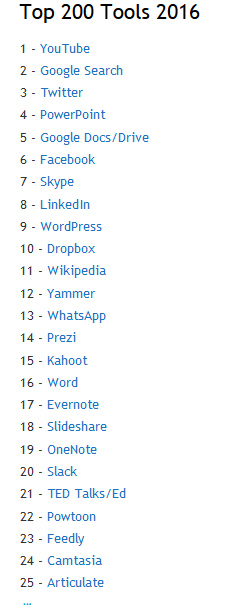


Top 200 Tools for Learning 2016: Overview — from c4lpt.co.uk by Jane Hart

Also see Jane’s:

  1. TOP 100 TOOLS FOR PERSONAL & PROFESSIONAL LEARNING (for formal/informal learning and personal productivity)
  2. TOP 100 TOOLS FOR WORKPLACE LEARNING (for training, e-learning, performance support and social collaboration
  3. TOP 100 TOOLS FOR EDUCATION (for use in primary and secondary (K12) schools, colleges, universities and adult education.)


top200tools-2016-jane-hart


Also see Jane’s “Best of Breed 2016” where she breaks things down into:

  1. Instructional tools
  2. Content development tools
  3. Social tools
  4. Personal tools


10 Incredible Uses of Virtual Reality — from fortune.com by Rose Leadem
It’s not just for video games.

Excerpt:

Virtual reality technology holds enormous potential to change the future for a number of fields, from medicine, business, architecture to manufacturing.

Psychologists and other medical professionals are using VR to heighten traditional therapy methods and find effective solutions for treatments of PTSD, anxiety and social disorders. Doctors are employing VR to train medical students in surgery, treat patients’ pains and even help paraplegics regain body functions.

In business, a variety of industries are benefiting from VR. Carmakers are creating safer vehicles, architects are constructing stronger buildings and even travel agencies are using it to simplify vacation planning.

Check out these 10 amazing uses of VR.


Visit the U.K. Prime Minister’s Home in This Virtual 10 Downing Street Experience — from uploadvr.com by

Excerpt:

Google has unveiled a new interactive online exhibit that take users on a tour of 10 Downing street in London — home of the U.K. Prime Minister.

The building has served as home to countless British political leaders, from Winston Churchill and Margaret Thatcher through to Tony Blair and — as of a few months ago — Theresa May. But, as you’d expect in today’s security-conscious age, gaining access to the residence isn’t easy; the street itself is gated off from the public. This is why the 10 Downing Street exhibit may capture the imagination of politics aficionados and history buffs from around the world.

The tour features 360-degree views of the various rooms, punctuated by photos and audio and video clips.


Microsoft’s HoloLens Now Helps Elevator Technicians Work Smarter — from uploadvr.com by Charles Singletary

Excerpt:

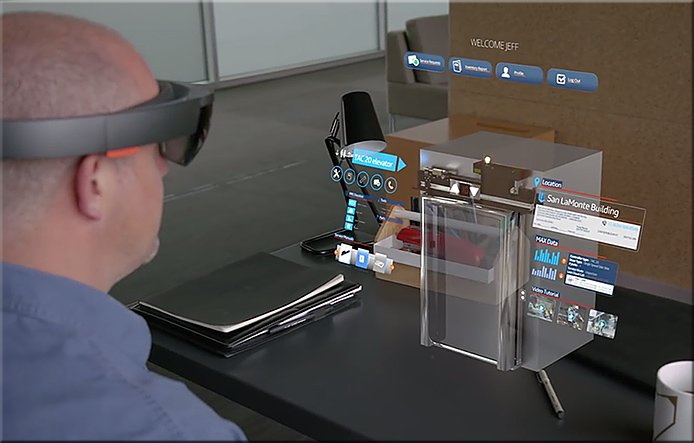
In a slightly more grounded environment, the HoloLens is being used to assist technicians in elevator repairs.

Traversal via elevator is such a regular part of our lifestyles, its importance is rarely recognized…until they’re not working as they should be. ThyssenKrupp AG, one of the largest suppliers for elevators, recognizes how essential they are as well as how the simplest malfunctions can deter the lives of millions. Announced on their blog, Microsoft is partnering with Thyssenkrupp to equip 24,000 of their technicians with HoloLens.


ms-hololens-thyssenkrupp-sept2016

Insert from DSC re: the above piece re: HoloLens:

Will technical communicators need to augment their skillsets? It appears so.


Phiona: A Virtual Reality Portrait of ‘Queen of Katwe’ — from abcnews.com by Angel Canales and Adam Rivera


vr-queenofkatwe-2016


Get a front-row seat in Harvard’s largest class, thanks to virtual reality — from medium.freecodecamp.com by Dhawal Shah

harvard-cs50-sep2016

Intro video here: This is CS50 2016


The future of mobile video is virtual reality — from techcrunch.com by Mike Wadhera

Excerpt:

But in a world where no moment is too small to record with a mobile sensor, and one in which time spent in virtual reality keeps going up, interesting parallels start to emerge with our smartphones and headsets.

Let’s look at how the future could play out in the real world by observing three key drivers: VR video adoption, mobile-video user needs and the smartphone camera rising tide.


Now, a virtual reality programme to improve social skills in autistic kids — from cio.economictimes.indiatimes.com by
The VR training platform creates a safe place for participants to practice social situations without the intense fear of consequence.

Excerpt:

“Individuals with autism may become overwhelmed and anxious in social situations,” research clinician Dr Nyaz Didehbani said.

“The virtual reality training platform creates a safe place for participants to practice social situations without the intense fear of consequence,” said Didehbani.

The participants who completed the training demonstrated improved social cognition skills and reported better relationships, researchers said.


Also see:


From DSC:
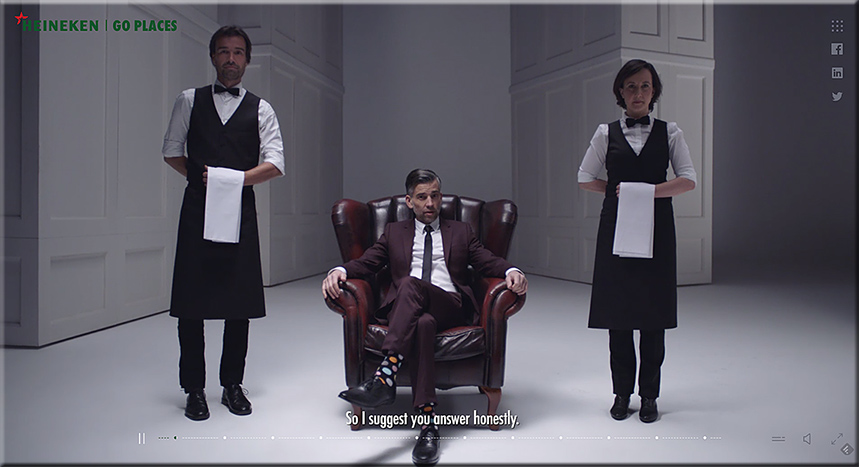
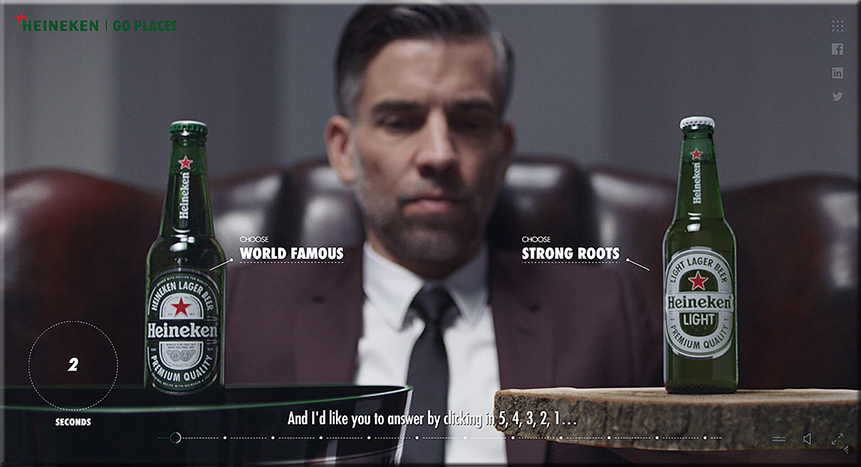
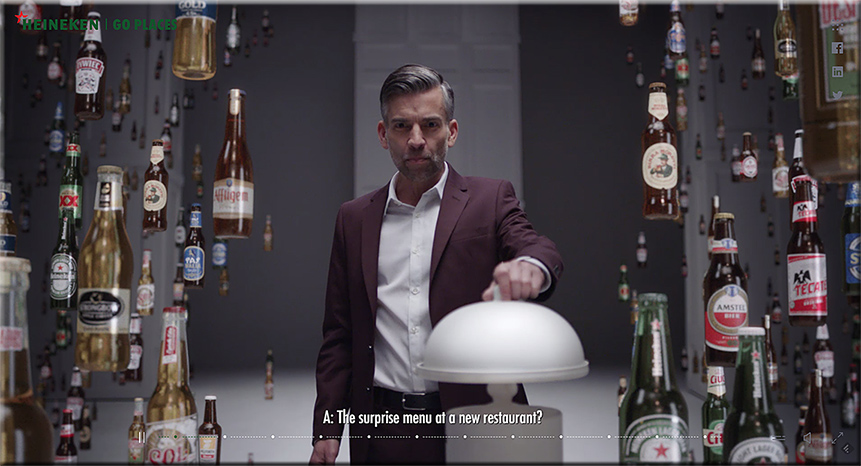
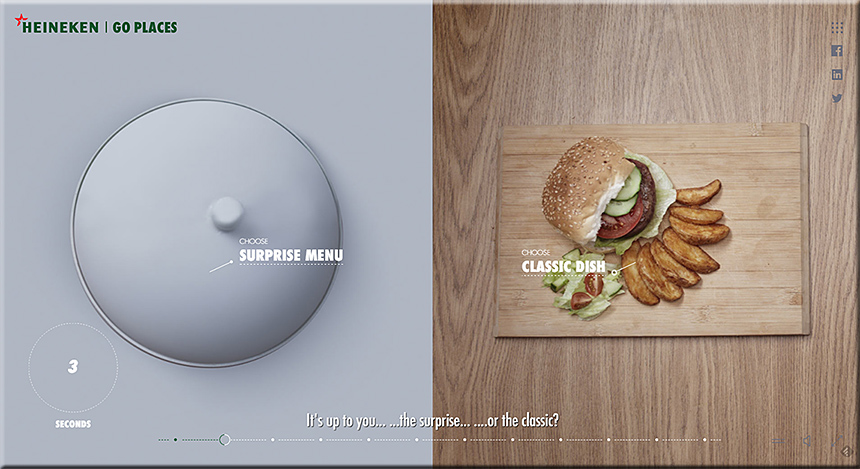
Interactive video — a potentially very powerful medium to use, especially for blended and online-based courses or training-related materials! This interactive piece from Heineken is very well done, even remembering how you answered and coming up with their evaluation of you from their 12-question “interview.”

But notice again, a TEAM of specialists are needed to create such a piece. Neither a faculty member, a trainer, nor an instructional designer can do something like this all on their own. Some of the positions I could imagine here are:

  • Script writer(s)
  • Editor(s)
  • Actors and actresses
  • Those skilled in stage lighting and sound / audio recording
  • Digital video editors
  • Programmers
  • Graphic designers
  • Web designers
  • Producers
  • Product marketers
  • …and perhaps others

This is the kind of work that I wish we saw more of in the world of online and blended courses!  Also, I appreciated their use of humor. Overall, a very engaging, fun, and informative piece!


heineken-interactive-video-cover-sep2016


heineken-interactive-video-first-sep2016


heineken-interactive-video0-sep2016


heineken-interactive-video1-sep2016


heineken-interactive-video2-sep2016


heineken-interactive-video3-sep2016


The first truly awesome chatbot is a talking T. Rex — from fastcodesign.com by John Brownlee
National Geographic uses a virtual Tyrannosaur to teach kids about dinosaurs—and succeeds where other chatbots fail.


Excerpt:

As some have declared chatbots to be the “next webpage,” brands have scrambled to develop their own talkative bots, letting you do everything from order a pizza to rewrite your resume. The truth is, though, that a lot of these chatbots are actually quite stupid, and tend to have a hard time understanding natural human language. Sooner or later, users get frustrated bashing their heads up against the wall of a dim-witted bot’s AI.

So how do you design around a chatbot’s walnut-sized brain? If you’re National Geographic Kids UK, you set your chatbot to the task of pretending to be a Tyrannosaurus rex, a Cretaceous-era apex predator that really had a walnut-sized brain (at least comparatively speaking).


She’s called Tina the T. rex, and by making it fun to learn about dinosaurs, she suggests that education — rather than advertising or shopping — might be the real calling of chatbots.


Also relevant/see:

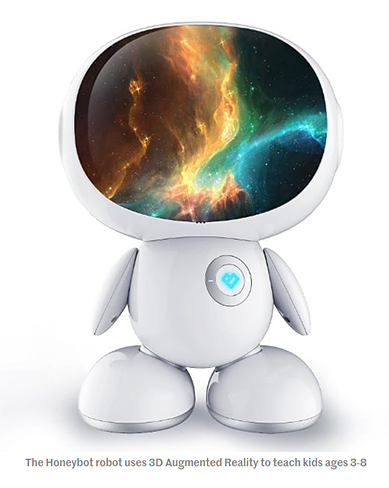
Honeybot-August2016


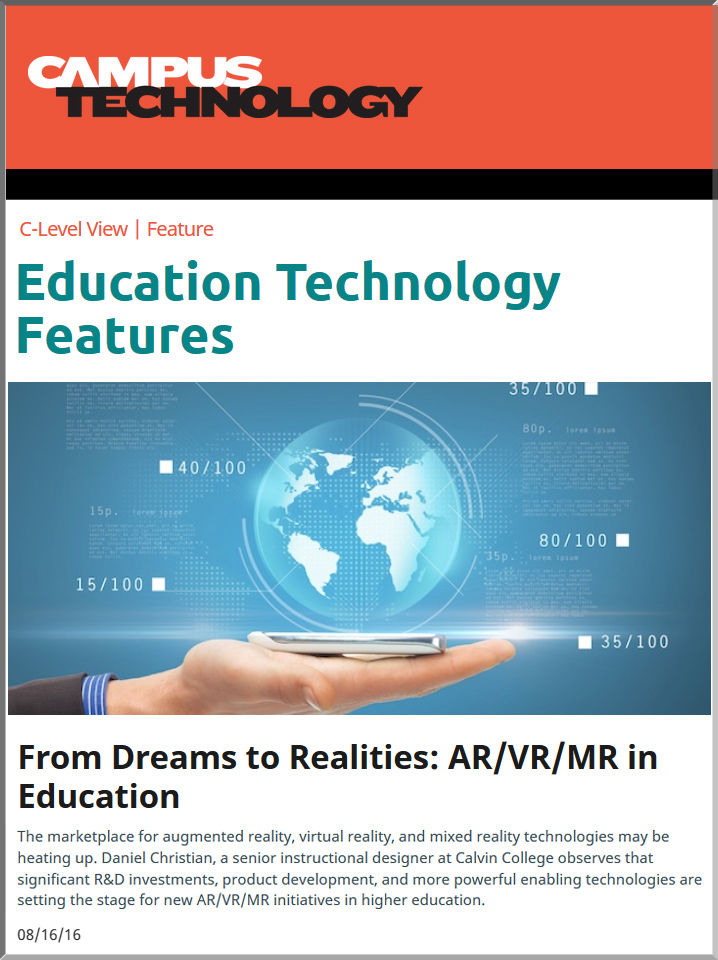
DanielChristian2-ARVRMRCampusTechArticle-8-16-16


From Dreams to Realities: AR/VR/MR in Education | A Q&A with Daniel Christian — from campustechnology.com by Mary Grush; I’d like to thank Jason VanHorn for his contributions to this article

Excerpt:

Grush: Is there a signpost you might point to that would indicate that there’s going to be more product development in AR/VR/MR?

Christian: There’s a significant one. Several major players — with very deep pockets — within the corporate world are investing in new forms of HCI, including Microsoft, Google, Apple, Facebook, Magic Leap, and others. In fact, according to an article on engadget.com from 6/16/16, “Magic Leap has amassed an astounding $1.39 billion in funding without shipping an actual product.” So to me, it’s just not likely that the billions of dollars being invested in a variety of R&D-related efforts are simply going to evaporate without producing any impactful, concrete products or services. There are too many extremely smart, creative people working on these projects, and they have impressive financial backing behind their research and product development efforts. So, I think we can expect an array of new choices in AR/VR/MR.

Just the other day I was talking to Jason VanHorn, an associate professor in our geology, geography, and environmental studies department. After finishing our discussion about a particular learning space and how we might implement active learning in it, we got to talking about mixed reality. He related his wonderful dreams of being able to view, manipulate, maneuver through, and interact with holographic displays of our planet Earth.

When I mentioned a video piece done by Case Western and the Cleveland Clinic that featured Microsoft’s Hololens technology, he knew exactly what I was referring to. But this time, instead of being able to drill down through the human body to review, explore, and learn about the various systems composing our human anatomy, he wanted to be able to drill down through the various layers of the planet Earth. He also wanted to be able to use gestures to maneuver and manipulate the globe — turning the globe to just the right spot before using a gesture to drill down to a particular place.


The next battleground: The 4th Era of Personal Computing — from stevebrownfuturist.com by Steve Brown

Excerpt:

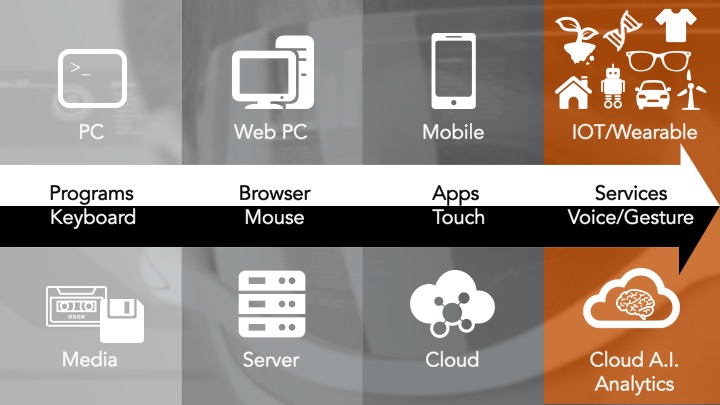
I believe we are moving into the fourth era of personal computing. The first era was characterized by the emergence of the PC. The second by the web and the browser, and the third by mobile and apps.


The fourth personal computing platform will be a combination of IOT, wearable and AR-based clients using speech and gesture, connected over 4G/5G networks to PA, CaaS and social networking platforms that draw upon a new class of cloud-based AI to deliver highly personalized access to information and services.


So what does the fourth era of personal computing look like? It’s a world of smart objects, smart spaces, voice control, augmented reality, and artificial intelligence.


Imagination in the Augmented-Reality Age — from theatlantic.com by Georgia Perry
Pokémon Go may have reached the zenith of its popularity, but the game has far-reaching implications for the future of play.

Excerpt:

For young people today, however, it’s a different story. “They hardly play. If they do play it’s some TV script. Very prescribed,” Levin said. “Even if they have friends over, it’s often playing video games.”

That was before Pokémon Go, though.

The augmented-reality (AR) game that—since its release on July 6, attracted 21 million users and became one of the most successful mobile apps ever—has been praised for promoting exercise, facilitating social interactions, sparking new interest in local landmarks, and more. Education writers and experts have weighed in on its implications for teaching kids everything from social skills to geography to the point that such coverage has become cliché. And while it seems clear at this point that the game is a fad that has peaked—it’s been losing active players for over a week—one of the game’s biggest triumphs has, arguably, been the hope it’s generated about the future of play. While electronic games have traditionally caused kids to retreat to couches, here is one that did precisely the opposite.


What Pokémon Go is, however, is one of the first iterations of what will undeniably be many more AR games. If done right, some say the technology Go introduced to the world could bring back the kind of outdoor, creative, and social forms of play that used to be the mainstay of childhood. Augmented reality, it stands to reason, could revitalize the role of imagination in kids’ learning and development.


From DSC:
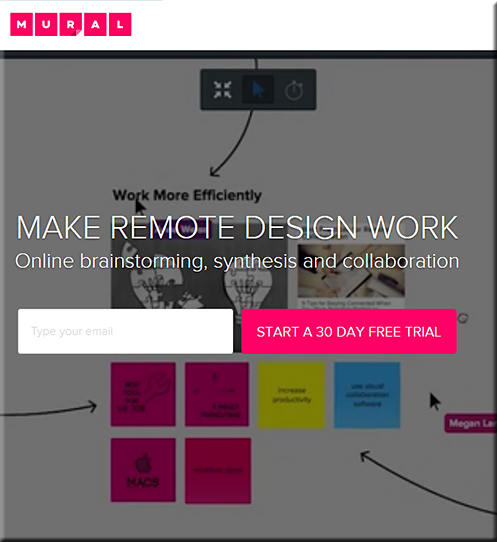
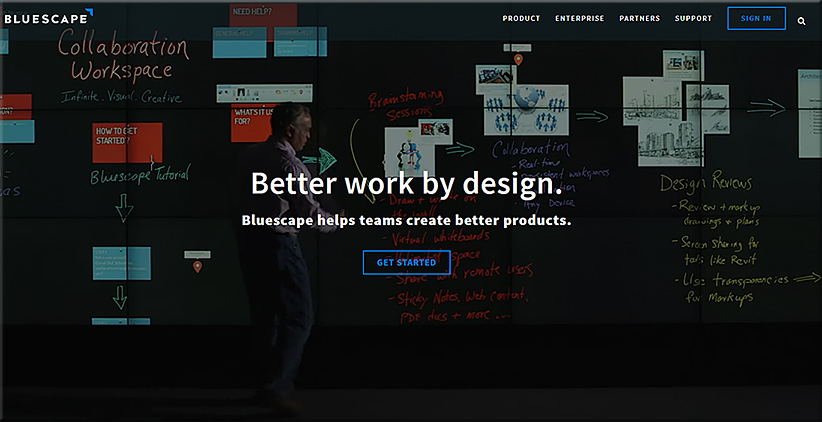
How much longer before the functionalities that are found in tools like Bluescape & Mural are available via tvOS-based devices? Entrepreneurs and VCs out there, take note. Given:

  • the growth of freelancing and people working from home and/or out on the road
  • the need for people to collaborate over a distance
  • the growth of online learning
  • the growth of active/collaborative learning spaces in K-12 and higher ed
  • the need for lifelong learning

…this could be a lucrative market. Also, it would be meaningful work…knowing that you are helping people learn and earn.


Mural-Aug-2016


Bluescape-Aug2016


The Living [Class] Room -- by Daniel Christian -- July 2012 -- a second device used in conjunction with a Smart/Connected TV


Take a step inside the classroom of tomorrow — from techradar.com by Nicholas Fearn
Making learning fun


Excerpt:

But the classroom of tomorrow will look very different. The latest advancements in technology and innovation are paving the way for an educational space that’s interactive, engaging and fun.

The conventions of learning are changing. It’s becoming normal for youngsters to use games like Minecraft to develop skills such as team working and problem solving, and for teachers to turn to artificial intelligence to get a better understanding of how their pupils are progressing in lessons.

Virtual reality is also introducing new possibilities in the classroom. Gone are the days of imagining what an Ancient Egyptian tomb might look like – now you can just strap on a headset and transport yourself there in a heartbeat.

The potential for using VR to teach history, geography and other subjects is incredible when you really think about it – and it’s not the only tech that’s going to shake things up.

Artificial intelligence is already doing groundbreaking things in areas like robotics, computer science, neuroscience and linguistics, but now they’re now entering the world of education too.

London-based edtech firm Digital Assess has been working on an AI app that has the potential to revolutionise the way youngsters learn.

With the backing of the UK Government, the company has been trialing its web-based application Formative Assess in schools in England.

Using semantic indexing and natural language processing in a similar way to social networking sites, an on-screen avatar – which can be a rubber duck or robot – quizzes students on their knowledge and provides them with individual feedback on their work.


Uploaded on Jul 21, 2016


Description:
A new wave of compute technology -fueled by; big data analytics, the internet of things, augmented reality and so on- will change the way we live and work to be more immersive and natural with technology in the role as partner.


Also see:

Excerpt:

We haven’t even scratched the surface of the things technology can do to further human progress.  Education is the next major frontier.  We already have PC- and smartphone-enabled students, as well as tech-enabled classrooms, but the real breakthrough will be in personalized learning.

Every educator divides his or her time between teaching and interacting.  In lectures they have to choose between teaching to the smartest kid in the class or the weakest.  Efficiency (and reality) dictates that they must teach to the theoretical median, meaning some students will be bored and some will still struggle.  What if a digital assistant could step in to personalize the learning experience for each student, accelerating the curriculum for the advanced students and providing greater extra support for those that need more help?  The digital assistant could “sense” and “learn” that Student #1 has already mastered a particular subject and “assign” more advanced materials.  And it could provide additional work to Student #2 to ensure that he or she was ready for the next subject.  Self-paced learning to supplant and support classroom learning…that’s the next big advancement.


From DSC:
Though the title of Ashley Coolman’s blog posting out at smartsparrow.com mentions technology in it, the article is largely not about technology at all — but rather about the benefits of active learning. That’s why I’m highlighting it here.


Enabling active learning through technology — from smartsparrow.com by Ashley Coolman

Excerpts:

To many, it seems as though any learning can be considered active. Is a student taking notes not actively engaged in a class, especially when compared to their peers sleeping or playing on their phones in the back of the room?

The problem here is that while the note-taking student may be engaging with the class and professor, they are not engaging with the material. When furiously scribbling notes, students are more focused on getting every word down rather than evaluating, understanding, and analyzing what it is they are writing. They have engaged with the lecture, but not the material being relayed — which is the most important part.

In a study on active learning called “Active Learning: Creating Excitement in the Classroom”, the researchers stated:

“Surprisingly, educators’ use of the term “active learning” has relied more on intuitive understanding than a common definition. Consequently, many faculty assert that all learning is inherently active and that students are therefore actively involved while listening to formal presentations in the classroom. Analysis of the research literature (Chickering and Camson 1987), however, suggests that students must do more than just listen: They must read, write, discuss, or be engaged in solving problems. Most important, to be actively involved, students must engage in such higher-order thinking tasks as analysis, synthesis, and evaluation.” (Bonwell and Eison 1991)

It is the degree and form by which students are actively engaging that matters. It is “learning by doing” that students really need.


Active learning is any learning activity in which the student INTERACTS or ENGAGES with the material, as opposed to passively taking in the information.


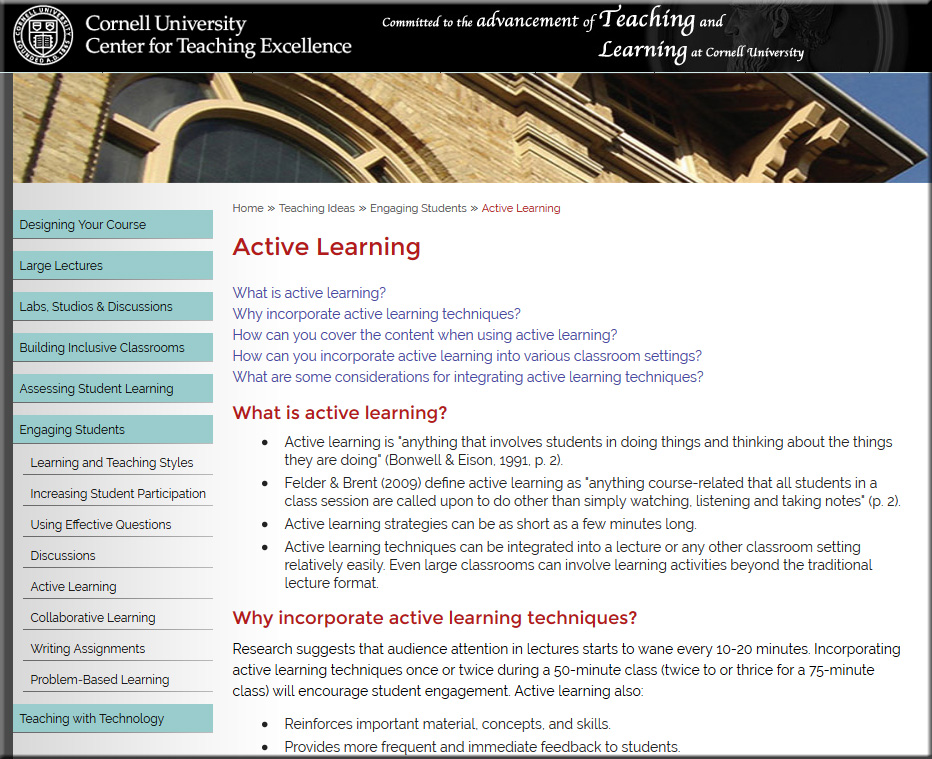
Furthermore, Cornell University found that research suggests learner attention starts to wane every 10–20 minutes during lectures. Incorporating active learning techniques a few times throughout class can encourage more engagement.*

*A side note from DSC:
A tool like
Socrative may come in useful here.


The blog posting from Smart Sparrow also linked to this resource:

Cornell-ActiveLearning-July2016


The problem is that lecture-based learning is not like filling a jug — you just don’t catch it all. Learning from lectures is more like holding out your hands and trying to keep the imparted knowledge from spilling through the cracks in this tidal wave of new information. Ultimately, students will catch some of the water, but most of it will be lost.


A side note from DSC to Calvin College faculty members:
If you doubt the immediately preceding quote, see if you can *fully* recall exactly what last Sunday’s sermon was about — including all examples, details, and wisdom that the preacher was trying to relay.

Ultimately, it’s about impact. What strongly impacts students stays with students — and isn’t that true for all of us?


Ashley lists the following resources re: active learning at the end of her posting:

  1. Using Active Learning Instructional Strategies to Create Excitement and Enhance Learning
  2. Active Learning: Creating Excitement in the Classroom
  3. Where’s the evidence that active learning works?
  4. How Does Active Learning Support Student Success?
  5. How To Retain 90% Of Everything You Learn


How might these enhancements to Siri and tvOS 10 impact education/training/learning-related offerings & applications? [Christian]

From DSC:
I read the article mentioned below.  It made me wonder how 3 of the 4 main highlights that Fred mentioned (that are coming to Siri with tvOS 10) might impact education/training/learning-related applications and offerings made possible via tvOS & Apple TV:

  1. Live broadcasts
  2. Topic-based searches
  3. The ability to search YouTube via Siri

The article prompted me to wonder:

  • Will educators and trainers be able to offer live lectures and training (globally) that can be recorded and later searched via Siri? 
  • What if second screen devices could help learners collaborate and participate in active learning while watching what’s being presented on the main display/”TV?”
  • What if learning taken this way could be recorded on one’s web-based profile, a profile that is based upon blockchain-based technologies and maintained via appropriate/proven organizations of learning? (A profile that’s optionally made available to services from Microsoft/LinkedIn.com/Lynda.com and/or to a service based upon IBM’s Watson, and/or to some other online-based marketplace/exchange for matching open jobs to potential employees.)
  • Or what if you could earn a badge or prove a competency via this manner?

Hmmm…things could get very interesting…and very powerful.

More choice. More control. Over one’s entire lifetime.

Heutagogy on steroids.

Micro-learning.

Perhaps this is a piece of the future for MOOCs…


MoreChoiceMoreControl-DSC


The Living [Class] Room -- by Daniel Christian -- July 2012 -- a second device used in conjunction with a Smart/Connected TV


StreamsOfContent-DSC


Apple TV gets new Siri features in tvOS 10 — from iphonefaq.org by Fred Straker

Excerpt:

The forthcoming update to Apple TV continues to bring fresh surprises for owners of Apple’s set top box. Many improvements are coming to tvOS 10, including single-sign-on support and an upgrade to Siri’s capabilities. Siri has already opened new doors thanks to the bundled Siri Remote, which simplifies many functions on the Apple TV interface. Four main highlights are coming to Siri with tvOS 10, which is expected to launch this fall.


Addendum on 7/17/16:

CBS News Launches New Apple TV App Designed Exclusively for tvOS — from macrumors.com

Excerpt:

CBS today announced the launch of an all-new Apple TV app that will center around the network’s always-on, 24-hour “CBSN” streaming network and has been designed exclusively for tvOS. In addition to the live stream of CBSN, the app curates news stories and video playlists for each user based on previously watched videos.

The new app will also take advantage of the 4th generation Apple TV’s deep Siri integration, allowing users to tell Apple’s personal assistant that they want to “Watch CBS News” to immediately start a full-screen broadcast of CBSN. While the stream is playing, users can interact with other parts of the app to browse related videos, bookmark some to watch later, and begin subscribing to specific playlists and topics.


How chatbots and deep learning will change the future of organizations — from forbes.com by Daniel Newman

Excerpt (emphasis DSC):

Don’t let the fun, casual name mislead you. Chatbots—software that you can “chat with”—have serious implications for the business world. Though many businesses have already considered their use for customer service purposes, a chatbot’s internal applications could be invaluable on a larger scale. For instance, chatbots could help employees break down siloes and provide targeted data to fuel every department. This digital transformation is happening, even in organizational structures that face challenges with other formats of real-time communication.

Still unclear on what chatbots are and what they do? Think of a digital assistant—such as iPhone’s Siri or Alexa, the Artificial Intelligence within the Amazon Echo. A chatbot reduces or eliminates the need for many mobile apps, as the answers are stored inside the chatbot. Need to know what the weather’s like in LA? Ask your chatbot. Is your flight running on time? Ask your chatbot. Is the package you ordered going to be delivered while you’re away? You get the gist.


From DSC:
How might institutions of higher education as well as K-12 school districts benefit from such internal applications of chatbots? How about external applications of chatbots? If done well, such applications could facilitate solid customer service (i.e., self-service knowledgebases) and aid in communications.


Hold Tight: The Chatbot Era Has Begun — from chatbotsmagazine.com by
Chatbots: What they are, and why they’re so important for businesses

Excerpt:

Imagine being able to have your own personal assistant at your fingertips, who you can chat with, give instructions and errands to, and handle the majority of your online research — both personally and professionally.

That’s essentially what a chatbot does.

Capable of being installed on any messenger platform, such as Facebook messenger or text messages, a chat bot is a basic artificial intelligence computer software program that does the legwork for you — and communicates in a way that feels like an intelligent conversation over text or voice messaging.


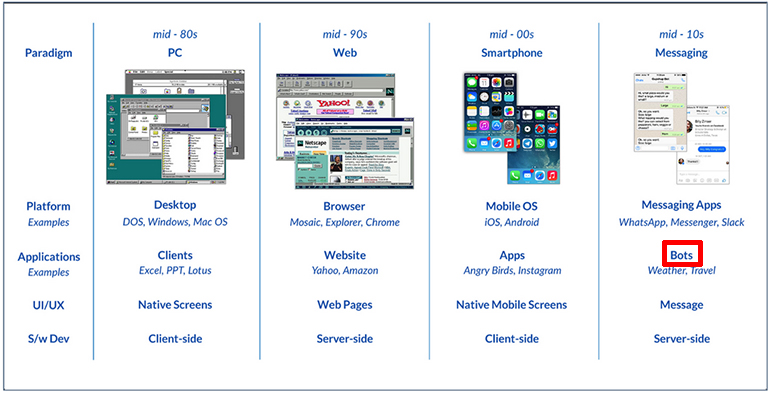
Once-in-a-decade paradigm shift: Messaging — from chatbotsmagazine.com by Beerud Sheth
In the history of the personal computing industry, we have had a paradigm shift about once every decade.


Bots-ChatbotMagazine-June2016


Smart assistants and chatbots will be top consumer applications for AI over next 5 years, poll says — from venturebeat.com by Blaise Zerega

Excerpt:

Virtual agents and chatbots will be the top consumer applications of artificial intelligence over the next five years, according to a consensus poll released today by TechEmergence, a marketing research firm for AI and machine learning.

The emphasis on virtual agents and chatbots is in many ways not surprising. After all, the tech industry’s 800-pound gorillas have all made big bets: Apple with Siri, Amazon with Alexa, Facebook with M and Messenger, Google with Google Assistant, Microsoft with Cortana and Tay. However, the poll’s data also suggests that chatbots may soon be viewed as a horizontal enabling technology for many industries.


From DSC:
Might this eventually affect students’ expectations? Blackboard’s partnership with IBM and Amazon may come into play here.


Some like it bot: Why chatbots could be the start of something big — from business.sprint.com
Chatbots are on the rise. With Google, Facebook and Microsoft competing to be the caring voice your customers turn to, what does this mean for your enterprise?

Excerpt:

The most prevalent indicator that the artificial intelligence-driven future is rapidly  becoming reality is the rise of the chatbot – an  A.I. software program designed to chat with people. Well, more accurately, the re-emergence of the bot. Basically, robots talking to humans talking to robots is the tech vision for the future.


Maybe one of the most obvious uses for this technology would be in service. If you can incorporate your self-service knowledge base into a bot that responds directly to questions and uses customer data to provide the most relevant answers, it’s more convenient for customers…


Chatbot lawyer overturns 160,000 parking tickets in London and New York — from theguardian.com by Samuel Gibbs
Free service DoNotPay helps appeal over $4m in parking fines in just 21 months, but is just the tip of the legal AI iceberg for its 19-year-old creator

Excerpt:

An artificial-intelligence lawyer chatbot has successfully contested 160,000 parking tickets across London and New York for free, showing that chatbots can actually be useful.

Dubbed as “the world’s first robot lawyer” by its 19-year-old creator, London-born second-year Stanford University student Joshua Browder, DoNotPay helps users contest parking tickets in an easy to use chat-like interface.


Addendum on 6/29/16:

A New Chatbot Would Like to Help You With Your Bank Account — from wired.com by Cade Metz

Excerpt:

People in Asia are already using MyKai, and beginning today, you can too. Because it’s focused on banking—and banking alone—it works pretty well. But it’s also flawed. And it’s a bit weird. Unsettling, even. All of which makes it a great way of deconstructing the tech world’s ever growing obsession with “chatbots.”

MyKai is remarkably adept at understanding what I’m asking—and that’s largely because it’s focused solely on banking. When I ask “How much money do I have?” or “How much did I spend on food in May?,” it understands. But when I ask who won the Spain-Italy match at Euro 2016, it suggests I take another tack. The thing to realize about today’s chatbots is that they can be reasonably effective if they’ve honed to a particular task—and that they break down if the scope gets to wide.


What the bot revolution could mean for online learning — from huffingtonpost.com by Daily Bits Of

Excerpt:

We’re embracing the bot revolution
With these limitations in mind, we embrace the bot movement. In short, having our bite-sized courses delivered via messaging platforms will open up a lot of new benefits for our users.

  1. The courses will become social.
  2. It will become easier to consume a course via a channel that fits best for the course.
  3. The courses will become more interactive.
  4. Bots will remove some of the friction


The future of online learning will happen via messaging services.


Also relevant here:


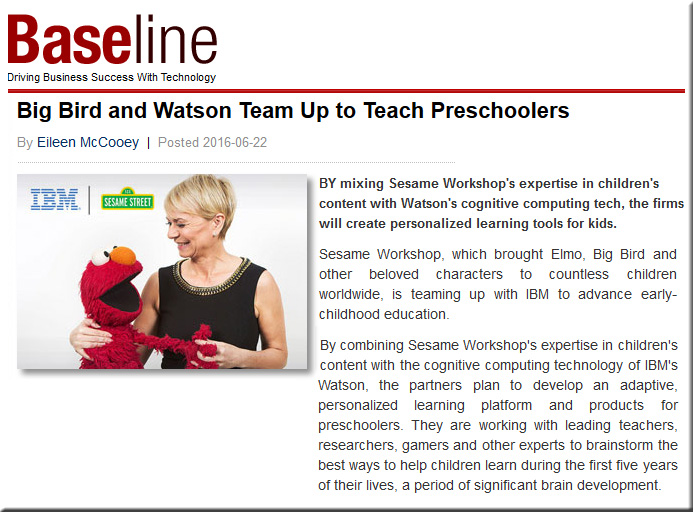
WatsonTrainPreSchoolers-June2016


From DSC:
By posting such items, I’m not advocating that we remove teachers, professors, trainers, coaches, etc. from the education/training equations.  Rather, I am advocating that we use technology as tools for educating and training people — and using technologies to help people of all ages grow, and reinvent themselves when necessary.  Such tools should be used to help our overworked teachers, professors, trainers, etc. of the world in delivering excellent, effective elearning experiences for our students/employees.


© 2025 | Daniel Christian