One from DSC:


What goes up...must come down -- by Daniel S. Christian

Abstract:
A perfect storm has been building within higher education. Numerous, powerful forces have been converging that either already are or soon will be impacting the way higher education is offered and experienced. This paper focuses on one of those forces – the increasing price tag of obtaining a degree within higher education.  It will seek to show that what goes up…must come down.  Some less expensive alternatives are already here today; but the most significant changes and market “corrections” appear to be right around the corner. That is, higher education is a bubble about to burst.

One from CNBC:

Price of Admission: America's College Debt Crisis

— from CNBC on Monday, January 3, 2011

Also see:

From DSC:
Disclosure: I work for Calvin College. However, I publish the above items in the hopes that those of us at Calvin and within higher education as a whole will choose to innovate — that we will think outside the box in order to greatly lower the cost of providing a degree within higher education. It would be very helpful to future students, families, communities, nations.

No matter how you look at it, pain — but also opportunities — are ahead. Change will not be easy, nor will it be comfortable.  It will most likely be very scary and very tough. At least for me, this posting and the topic it discusses evokes major soul and heart searching for me. Nevertheless, the questions remain:

  • What changes do we need to make so that institutions of higher education can become more affordable? Stay relevant? Be sustainable over time?
  • What should we put in place of the current “status quo”?
  • Who receives the pain? Who enjoys the opportunities?

Also see:


Addendum on 1-19-11:

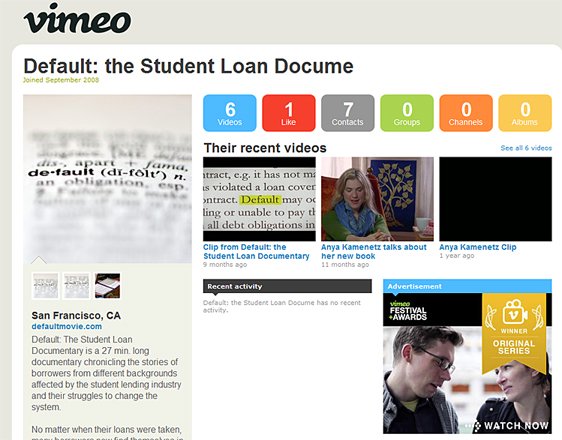
Student Loan Docume -- videos on Vimeo

http://www.defaultmovie.com/


Addendum on 1/22/10:
The Bubble: Higher Education’s Precarious Hold on Consumer Confidence — from National Association of Scholars
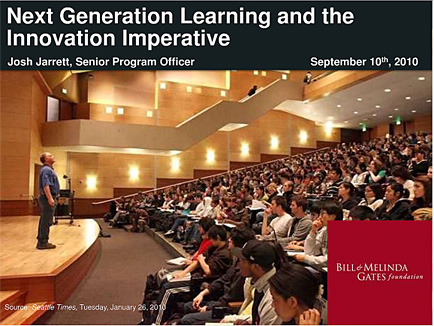

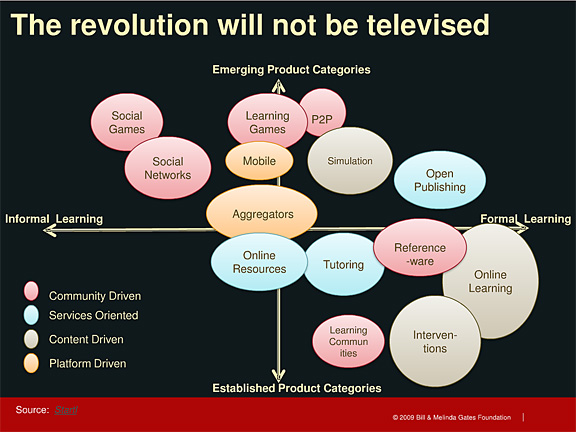
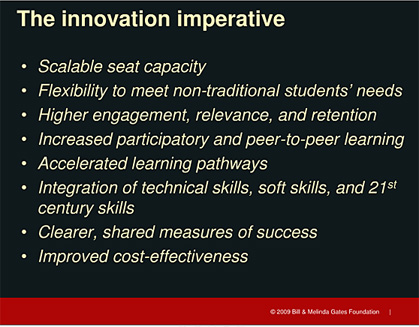
New initiative will advance the best uses of technology to improve college readiness and completion — from the Bill & Melinda Gates Foundation
Multi-year “challenge” grant competition will identify and fund most promising innovations

SEATTLE — The Bill & Melinda Gates Foundation today announced the Next Generation Learning Challenges, a collaborative, multi-year initiative, which aims to help dramatically improve college readiness and college completion in the United States through the use of technology. The program will provide grants to organizations and innovators to expand promising technology tools to more students, teachers, and schools. It is led by nonprofit EDUCAUSE, which works to advance higher education through the use of information technology.

Next Generation Learning Challenges released the first of a series of RFPs today to solicit funding proposals for technology applications that can improve postsecondary education. This round of funding will total up to $20 million, including grants that range from $250,000 to $750,000. Applicants with top-rated proposals will receive funds to expand their programs and demonstrate effectiveness in serving larger numbers of students. Proposals are due November 19, 2010; winners are expected to be announced by March 31, 2011.

Converge Education Funding Report: Classroom Technologies — by Converge and the Center for Digital Education

Also see:

  • Connected Classrooms: Powering the Entire Learning Experience
    Teachers today have to engage students differently than previous generations.
Tagged with:  

Expanding the focus of the Education Program — from Hewlett Foundation

We are delighted to share with you some exciting news from the Hewlett Foundation’s Education Program. Building upon our work in technology and policy, we are expanding our focus to help schools nationwide prepare students to thrive in an increasingly complex, fast-paced, and unpredictable world. The Hewlett Board of Directors approved the added scope at its March meeting.

We call this expanded focus deeper learning – a combination of the fundamental knowledge and practical basic skills students will need to succeed in a fiercely competitive global economy. Specifically, our definition of deeper learning brings together five key elements that work in concert: core academic content; critical thinking and complex problem solving; effective communication; working in collaboration; and learning how to learn (emphasis DSC).  We believe this approach could have a profound effect on how and what the next generation of students learns.

Tagged with:  

Moving the cliff– from InsideHigherEd.com

As state legislators around the country craft their budgets for the 2011 fiscal year, public college officials are afraid that they are about to be thrown off “the cliff” — the steep drop in available funds once the tens of billions of dollars that the federal government made available through last year’s economic recovery legislation run out.

But like a movie character whose vehicle magically grinds to a halt just before it goes over the edge, public higher education could catch a break, in the form of legislation introduced Wednesday by several Democratic senators that essentially move the cliff. The none-too-subtly titled “Keep Our Educators Working Act of 2010,” sponsored by Sen. Tom Harkin (D-Iowa) and others, would provide $23 billion to extend for a year the fund in the American Reinvestment and Recovery Act that gave states money to ward off budget cuts and tuition increases.

Tagged with:  

Digital Wish

Digital Wish

Tagged with:  

The 2011 Budget makes a strong commitment to technology that transforms how educators teach and how students learn. The President strongly believes that technology, when used creatively and effectively, can transform education and training in the same way that it has transformed the private sector. It makes a broad array of Department of Education programs, including the $500 million “Investing in Innovation” Fund, eligible for technology-related investments, encouraging the infusion of educational technology across a broad range of programs in order to improve teaching and learning, and build the capacity at the State and local level to support better uses of technology for efficient and effective transfer of knowledge.

Potential for Transformative Impact:
Last year, the President released A Strategy for American Innovation, highlighting the role of technology in educating the next generation. The strategy outlined the role that educational technology could play to improve our quality of life and establish the foundation for the industries and jobs of the future. For example (emphasis below from DSC):

  • Online learning can allow adults that are struggling to balance the competing demands of work and family to acquire new skills, and compete for higher wage jobs, at a time, place and pace that is convenient for them. It can also improve access to a quality education for students in underserved areas.
  • Digital tutors can provide every student with immediate feedback and personalized instruction, providing them with the information needed to diagnose and correct errors, and providing challenging instruction.
  • Digital learning environments can generate a large volume of data that, if analyzed properly, will support “continuous improvement” by providing rich feedback to learners, teachers, curriculum designers, and researchers in the field of learning science and technology.
  • “Games for learning” that are compelling and engaging have the potential to increase the attentive time on task that students engage in learning. Massive multiplayer games can support the social and team-based dimensions of learning.
  • Simulations, such as a flight simulator for pilots or a “digital human” for medical professionals can allow students to engage in hands-on learning.
  • Open educational resources can be shared, adapted, re-mixed, and re-used.
  • Technology can increase parental involvement, provide new opportunities for students with disabilities and for English Language Learners, allow teachers to participate in “communities of practice,” and enlist professionals and retirees as online mentors.

Mass protests planned for education on March 8th – Erin Vogel, Chicago Flame

Hundreds of professors from the University of Illinois have planned a common furlough day for March 8th in the hopes of educating the public about their problems. They have created a website, uicjointfurlough.wordpress.com, to raise awareness of their cause. They also have a Twitter, a Facebook, and a letter that students can send to their state representatives to request support for UIC.

Parents, students on edge over soaring tuition – Donna Gordon Blankinship, Associated Press

As students around the country anxiously wait for college acceptance letters, their parents are sweating the looming tuition bills at public universities. Florida college students could face yearly 15 percent tuition increases for years, and University of Illinois students will pay at least 9 percent more. The University of Washington will charge 14 percent more at its flagship campus. And in California, tuition increases of more than 30 percent have sparked protests reminiscent of the 1960s.

Dartmouth College Announces Layoffs, Tuition Increase – WMUR New Hampshire (added 2-14-10)

More than 70 people will be laid off at Dartmouth College as the school tries to close a $100 million budget hole over the next two years. The first 38 cuts will begin Tuesday, with a similar number of cuts in the spring. The teaching faculty will not be affected, and 60 percent of the cuts will be managerial positions. The rest are union and nonunion hourly workers.

Postdoctoral researchers at UMass unionize – Tracy Jan, Boston Globe

Nearly 300 postdoctoral researchers at University of Massachusetts campuses in Amherst, Boston, and Dartmouth joined the United Auto Workers union, becoming the first post-doc researchers in the state to unionize. The move triggers a process that will require the university system to negotiate over wages, health insurance, job security, and other workplace issues.

Leader warns of more layoffs at UT-Austin – Jeannie Kever, Houston Chronicle

The president of the University of Texas at Austin warned on Thursday that more layoffs are coming at the flagship campus. Bill Powers, joined by the presidents of other UT System schools, briefed regents as they met in Dallas on cost-cutting efforts now under way. “If we’re going to shed recurring costs, it will mean shedding salaries,” he said.

Brown University considers slashing budget – Associated Press

Brown University President Ruth Simmons says the school is considering $30 million in budget cuts for the next fiscal year in response to financial pressures caused in part by an endowment that has shrunk by $740 million. Simmons said in a letter to faculty, staff and students Tuesday that the cuts could include staff reductions through layoffs, attrition or early retirement.

Yale announces new wave of budget cuts – Noah S. Rayman and Elyssa A. L. Spitzer, Harvard Crimson

Yale President Richard C. Levin announced Wednesday a new round of sweeping budget cuts as part of the university’s ongoing efforts to close a $150 million budget deficit. In a letter to the community, Levin called for salary freezes for top administrators and a 2 percent cap on salary increases for faculty and staff. The Graduate School of Arts and Sciences will take a 10 to 15 percent reduction in the number of accepted students, and funding for research and undergraduate study abroad programs will also be affected.

ISU eliminates estimated 108 positions – Sue Loughlin, The Tribune-Star

Indiana State University’s budget reduction plan calls for the elimination of an estimated 108 positions, including 78 hourly and 30 salaried. The university began informing those affected on Wednesday, and some were still being told Friday. “Tears have been shed. There is anxiety and stress — everything you can imagine that would go along with something like this,” said Roxanne Torrence, chairwoman of the Support Staff Council. “My thoughts are with everyone affected.”

Putting Emerging Technologies to the Test — from CampusTechnology.com by Bridget McCrea
Hope College, a liberal arts institution in Michigan, isn’t afraid to put technology in the classroom and to get faculty involved in the process

To encourage innovation and participation among its faculty, Hope College established its own “Instructional Technology Innovation Fund (emphasis DSC)” in 1999, with the goal of enticing instructors to propose ideas and to get them funded. “Faculty members make a public presentation about their ideas before they can get the financing for them,” said Ludwig. “This has turned out to be an incubator for dozens of exciting, individual faculty projects.”

One of those projects garnered attention from the Fund for the Improvement of Postsecondary Education (FIPSE), which, according to the FIPSE Web site, “supports and disseminates innovative reform projects that promise to be models for improving the quality of postsecondary education and increasing student access.”

© 2025 | Daniel Christian