


On 08/24/2010,
in blended learning, face-to-face, game-changing environment, hybrid learning, K-12 related, online learning,
by Daniel Christian
Also see:
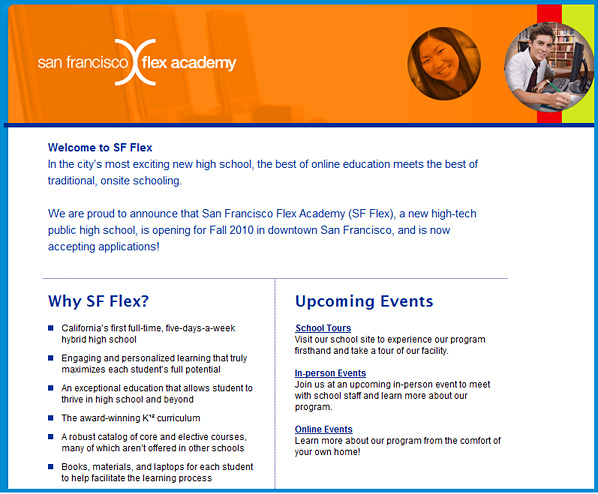
- San Francisco Flex Academy to Open Downtown This Fall — /PRNewswire-USNewswire/
New Public Charter School Now Accepting Enrollments for Students in Grades 9-12
SAN FRANCISCO, Aug. 23 /PRNewswire-USNewswire/ — San Francisco Flex Academy (SF FLEX), an exciting new public charter high school and one of the state’s first full-time “hybrid” schools, will open this fall in downtown San Francisco. SF Flex is currently accepting enrollments for students in grades 9-12 and is expecting to start classes on Tuesday, September 7, 2010.
The school will offer both onsite classroom instruction with highly qualified, credentialed teachers and state-of-the-art online learning provided by K12 Inc., America’s largest provider of online school programs for students in kindergarten through high school. There is no tuition to attend this public charter school.
.
On 08/17/2010,
in 21st century, 24x7x365 access, A/V -- audio/visual, blended learning, change, changing business models, collaboration, convergence, dangers of the status quo, digital audio, digital learning, digital photography, digital storytelling, digital textbooks, digital video, disruption, distance education, education technology, educational games / serious games, elearning, emerging technologies, engagement / engaging students, expectations, face-to-face, future, game-changing environment, global / globalization, hybrid learning, innovation, interactivity, K-12 related, learning ecosystem, learning spaces, multimedia, online learning, online media, social learning / networks, technologies for your home, telecommunications, trends, videoconferencing, virtual field trips, virtual K-12 schools, Virtual Reality (VR) / worlds / learning, virtual tutoring, vision/possibilities,
by Daniel Christian
Online collaboration: New innovations pave the way for convergence — from prnewswire.com
Merger of television and computer takes giant step closer as innovative online tool suite is released
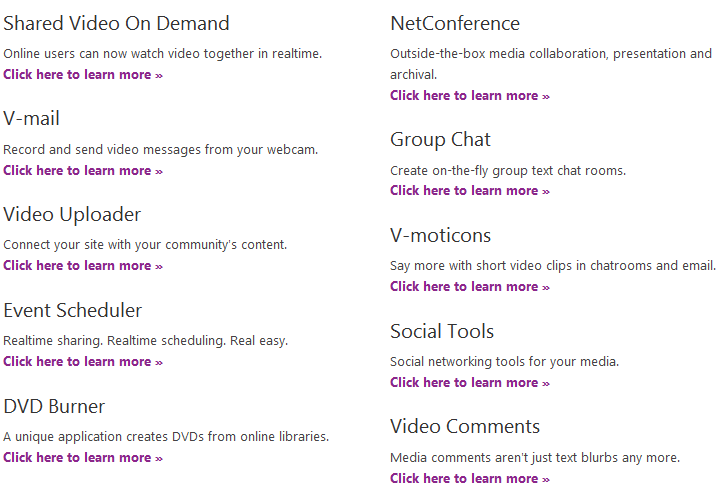
CALABASAS, Calif., Aug. 16 /PRNewswire/ — Anticipating the coming paradigm shift that will merge your television and your computer, NxtGenTV has just released the most cohesive system of online tools to facilitate the ultimate interactive communication platform. Four years of innovating has resulted in NetConference.com, an elegant, easy-to-use online meeting system that supports the diverse requirements of single users, small and medium size businesses as well as enterprise and nonprofit organizations. Creating a new opportunity for the global audience to interact online in even greater and more efficient ways is only one of the many benefits of building a social media broadcasting system that facilitates Communication, Collaboration, Presentation and Education.
An industry leader in online games, apps, widgets, banners and rich media development for major entertainment brands, The Illusion Factory created a new company, NxtGenTV to develop and patent cutting-edge online technologies such as shared synchronized visual media and other key innovations that will further blur the lines between computers and television. “We have been passionate about creating the cumulative new systems that will drive Convergence,” shares Brian Weiner, CEO of The Illusion Factory, “our creation of NxtGenTV will lead the push for truly interactive television.”

.
On 08/13/2010,
in blended learning, hybrid learning,
by Daniel Christian
.
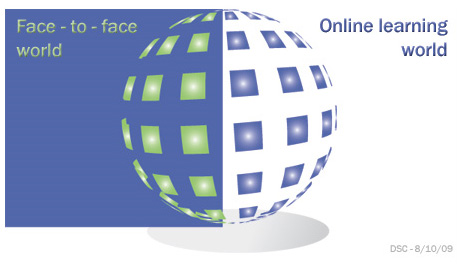
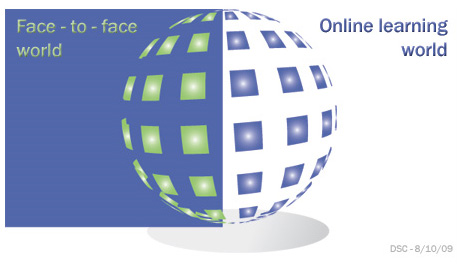
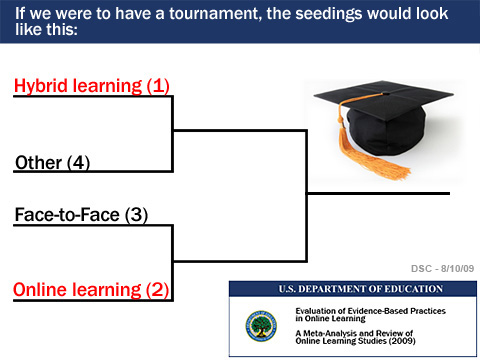
Taking the best of both “worlds” — a relevant graphic from DSC:
On 08/06/2010,
in blended learning, face-to-face, hybrid learning, innovation, physics, teaching & learning,
by Daniel Christian
From Questions to Concepts: Interactive Teaching in Physics — by Physics Professor Eric Mazur at Harvard
How can you engage your students and be sure they are learning the conceptual foundations of a lecture course? In From Questions to Concepts, Harvard University Professor Eric Mazur introduces Peer Instruction and Just-in-Time teaching — two innovative techniques for lectures that use in-class discussion and immediate feedback to improve student learning. Using these techniques in his innovative undergraduate physics course, Mazur demonstrates how lectures and active learning can be successfully combined. This video is also available as part of another DVD, Interactive Teaching, which contains advice on using peer instruction and just-in-time teaching to promote better learning. For more videos on teaching, visit http://bokcenter.harvard.edu
On 07/16/2010,
in blended learning, collaboration, corporate / business world, corporate universities / corporate training, design, distance education, education technology, emerging technologies, engagement / engaging students, face-to-face, higher education, human-computer interaction (HCI), hybrid learning, learning ecosystem, learning spaces, library / librarians, multimedia, productivity / tips and tricks, smart classrooms, social learning / networks, teaching & learning, training / L&D, videoconferencing, virtual field trips, web-based collaboration, workplace,
by Daniel Christian
From DSC:
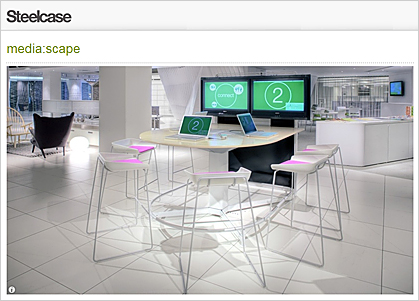
For those of you involved with creating learning labs, smart classrooms, group study areas, etc. — or for those who want to enable more efficient group collaboration within your classrooms — you need to check out Steelcase’s Media:Scape product line.
One of the pieces of this configuration that I love is that they have created an easy-to-use interface in a puck-like device. What I want to see happen is for students to pull up to a movable/reconfigurable table, connect their device, and click the puck to “play” their media for the class (without interrupting the flow of the class).
Also, one monitor on the “totem” can be used for one set of information/data — or even a remote speaker via videoconferencing for example — and the other monitor can be used for someone else’s data/desktop.
Here are some images for you:

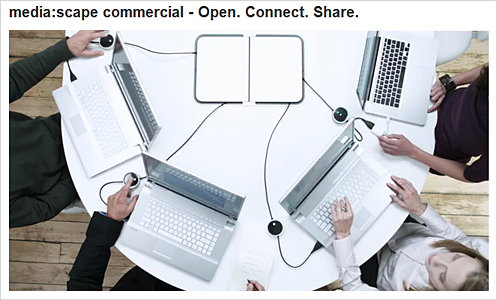
Also see the Media:Scape ad/video:
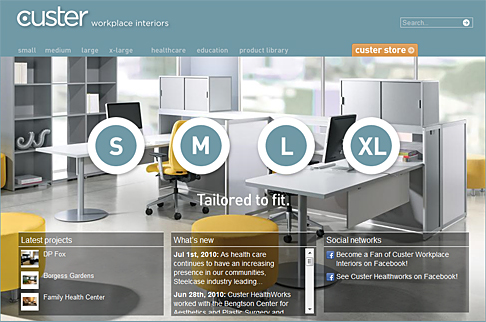
This product line is also available through Custer Workplace Interiors.
From DSC:
Blended learning — also called hybrid learning — offers the best of both worlds. A great way to go!
Also see:
On 05/24/2010,
in blended learning, faculty/staff, hybrid learning, pedagogy, teaching & learning,
by Daniel Christian
Structuring blended courses for maximum student engagement — from Faculty Focus
On 05/07/2010,
in blended learning, elearning, formal learning, hybrid learning, informal learning, training / L&D,
by Daniel Christian
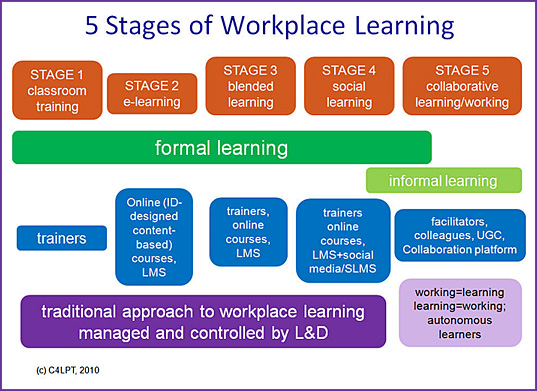
5 Stages of Workplace Learning — from Jane Hart
I interrupt my series of postings on Collaboration Platforms, to talk a little about the stages of Workplace Learnng
As I have read the comments on my recent postings as well as tweets and postings on other blogs, I’ve identified what I think are 5 main stages of workplace learning. I’ve tried to capture these, in a very rough and ready way, in the diagram below.
…
But some of the key mindset changes that will move organisations into Stage 5 are:
- recognising that working=learning; learning=working
- understanding that informal learning needs to be enabled, supported and encouraged – but not designed or managed
- “letting go”, so that there is a move from learner control to learner autonomy
- realising that autonomous, independent and inter-dependent, self-directed learners are essential in an agile organisation
On 04/27/2010,
in blended learning, hybrid learning, K-12 related, online learning, online media, policy,
by Daniel Christian
From DSC:
600 people of Grand Rapids came out to attack, *&^%$& and moan about the movement towards the use of online learning…great. Just great. The GRPS’ School Board was trying to take positive, courageous action and what did they get? An auditorium full of people feeding off each others’ words — words full of emotion but often times unfounded.
Man…do I feel sorry for the school boards of America. School boards — as well as the boards of colleges and universities — are under numerous pressures right now. I commend the school boards — such as that of the Grand Rapids Public Schools — who are trying to take positive and courageous action, and who have to fight a system that is incredibly stuck in “tradition” (i.e. “the way it’s always been done around here” and “that’s how I learned, that’s how you should learn” ). The problem is, tradition just isn’t doing the trick anymore. The world has changed and is leaving behind those folks who are still stuck in tradition. And we haven’t seen anything yet. Just wait a couple of years for those folks who “got it” to pull far away from those still stuck in tradition.
Along these lines…
I’m tired of all the bad-mouthing of elearning / online learning from folks who have never tried it. Several of the folks in the video had tried it and felt it came up short. Fair enough — that’s very valid. But if the materials weren’t good, we need to use the iterative process inherent in instructional design to improve them! Take the feedback from the students and make improvements to the materials — don’t ditch the efforts before they even get off the ground for the rest of the folks. (I do wonder what materials these students were using…? Probably boring, page-turners. We can do much better than that!)
Using blended learning is an excellent and proven way to move forward. Let’s take the best of both worlds to create a world where learning is engaging, fun, and where students can pursue their passions. Let’s let their passions drive learning in other areas/disciplines.
Creating well-done, engaging, sophisticated, interactive, multimedia-based educational materials takes time and money — no doubt about it. That’s why it would be wise to pool resources and create professionally-done, highly-engaging, multimedia-based educational materials (and create supplementary avenues which let the students build materials themselves and/or contribute to the body of knowledge as well). The federal government’s plans to contribute millions of dollars to create these materials is a great idea. If these materials are done well — and create/relay the content via multiple ways — we can leverage these materials across numerous school districts, charter schools, home-schooling situations, etc.
Concluding thoughts:
- Folks, if you want to survive and thrive in the future, ditch the Model T. Start your new engines, and get your car on the race track.
- Burying your heads in the sand and waiting for this perfect storm to just blow over won’t cut it.
- Change is at your doorstep. What’s your plan/response? What would YOU do if you were on these school boards?

P.S. I don’t know enough about the historical decisions of the GRPS School Board to comment on other areas and how GRPS got to be in the situation that it is currently in (which is probably a multi-faceted, complex issue). But an auditorium full of people dogging the online learning world is a step in the wrong direction.
See also:
- A Harlem middle school bets on technology
Attendance, the bane of many schools that serve a community of mostly poor minority kids, is not a problem at Global Technology Preparatory, a new middle school in Harlem, reports the Gotham Gazette. “Tabitha used to hate to go to school, now she loves it,” said Maria Ortiz of her granddaughter Tabitha Colon, who transferred out of a Catholic school to attend Global Tech. As its name implies, this school relies on technology to capture the attention of its students and give them a sense of responsibility and empowerment, as well as to teach academic subjects, such as math and English language arts, in new and more engaging ways. With this approach, Global Tech is a poster child for one of New York City Schools Chancellor Joel Klein’s latest experiments, the so-called Innovation Zone, or iZone. This effort seeks to use new approaches to education, including more flexible class schedules that extend learning throughout the day and calendar year, and digital technology to improve student engagement and performance. This school year, Global Tech is one of 10 pilot schools in the iZone, which will be expanded to 81 public schools in the 2010-11 school year. The education department is hoping that Global Tech and other schools like it can finally do something to improve middle school achievement and solve one of the most intractable problems in the city’s education system…Click here for the full story
- Florida House opens door for more technology in classrooms
On 04/26/2010,
in blended learning, elearning, hybrid learning, online learning,
by Daniel Christian
Make it Blended! — from Designed for Learning by Taruna Goel
Blended learning is not a new thing. It is not a radical concept. It is not a new-age way of thinking about learning. As Elliott Masie puts it: “We are, as a species, blended learners.” So, the blend existed much before we understood and (re)defined it.
What does blended learning mean?
There are many definitions of blended learning. Some focus on the technology (aka Internet) and others focus on the theories to be blended. For yet others, a blend is all about the media – combination of instructor-led and elearning. There are a few who only call it a blend when it’s a combination of different types of elearning:
…
…
There are many things to consider before designing a blended learning intervention for example:
• The learning outcomes or objectives
• The design and content of the course
• The learner analysis – motivation and comfort with multi-media
• Use of technology and new media elements
• The degree of collaboration/interaction
• The degree of feedback and level of instruction
• Assessment and evaluation of training
• The role of the instructor/facilitator
To make blended learning a success think why before you think how.
Interview Podcast: Tanya Joosten with Online and Blended Learning 101 — Educause
This podcast features and interview with Tanya Joosten, Interim Associate Director for the Learning Technology Center at the University of Wisconson-Milwaukee. In this conversation, she talks about what faculty should know about the benefits and strategies for online and blended learning.
On 04/19/2010,
in blended learning, online learning, online tutoring, teachers, teaching & learning, teaching online,
by Daniel Christian
‘Virtual’ internships prepare student teachers for new world of online schooling — from University of Florida, via Virtual School Meanderings blog
From DSC:
This brings up some very interesting points and questions. If K-12 education continues to use more online learning:
- Shouldn’t colleges of education be teaching their students how to teach in an online environment? Or at least in a blended-learning environment?
- Should students who are studying to become educators be asked to specialize in either face-to-face-based teaching, or teaching online, or teaching in blended learning environment?
- Or should they get exposure to f2f, online and blended as part of that education…?
Hmmm…I’m not sure. But I don’t think we can expect to make as much progress if our colleges of education aren’t adapting to the changing learning environment out there.