4 solid pieces re: art & creativity

Colorful New Architectural Watercolors by Maja Wronska — from thisiscolossal.com by Christopher Jobson


maja-1


maja-2

Polish watercolor artist Maja Wronska continues to paint explosively colorful depictions of European architecture, most recently in Pozna?, Poland. Wronska is an architect herself, a skill that greatly enhances her artwork. She first renders each piece as a detailed drawing and then adds layers of watercolor, an unpredictable medium that can be difficult to control, making her paintings all the more incredible. You can see much more over on Behance, and several of these are currently available as prints.


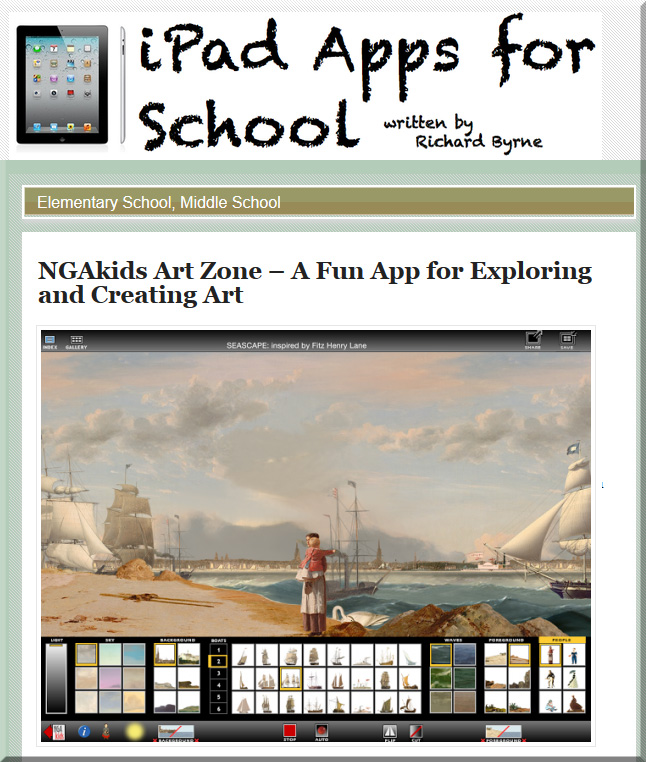
4 awesome arts apps for students of all ages — from thejournal.com by Graphite from Common Sense Media


Modular paper sculptures intracately formed by artist — from interestingengineering.com by Allison Blackburn


Richard-Sweeney_07

[Image Courtesy of Richard Sweeney]


Incredible 3D Optical Illusion Artwork — from icanbecreative.com


Beijing, China


Addendums on 2/5/15:


PowerOfArtsIntegration-Feb2015


The difference between STEM and STEAM — from dailygenius.com by Jeff Dunn; infographic by the University of Florida

Excerpt:

  • Students who study arts for 4 years in high school score 98 points higher on the SATs compared to those who study the same for half a year or less.
  • Students who took up music appreciation scored 61 points higher on the verbal section and 42 points higher on the math section.
  • Of the elementary schools with arts, the most common subjects revolve around music at 94% and visual studies at 83%. Only 3% offer dance instruction while 4% provide theater arts.
  • Training in the arts has been shown to improve creativity and innovation. Students learn to approach issues with a critical mind and a positive attitude towards problem solving. Exposure to the arts enhances communication skills, which are essential tools for collaboration. It develops flexibility and adaptability. The government recognizes these and, indeed, 48 states have adopted standards for art instructions.
  • 51% of art teachers are unhappy about what they see as the decline in art education brought about by the shift in focus. The difficulty in measuring art’s contribution to academic performance has led to its under appreciation.


From DSC:
We continue to see more articles and innovations that involve the Internet of Things (IoT) or the Internet of Everything (IoE). This trend has made me reflect upon what I think will be a future, required subset of needed expertise within the fields of Instructional Design, User Experience Design, User Interface Design, Product Development, Programming, Human Computer Interaction (HCI), and likely other fields such as Artificial Intelligence (AI), Augmented Reality (AR), and Virtual Reality(VR) as well.

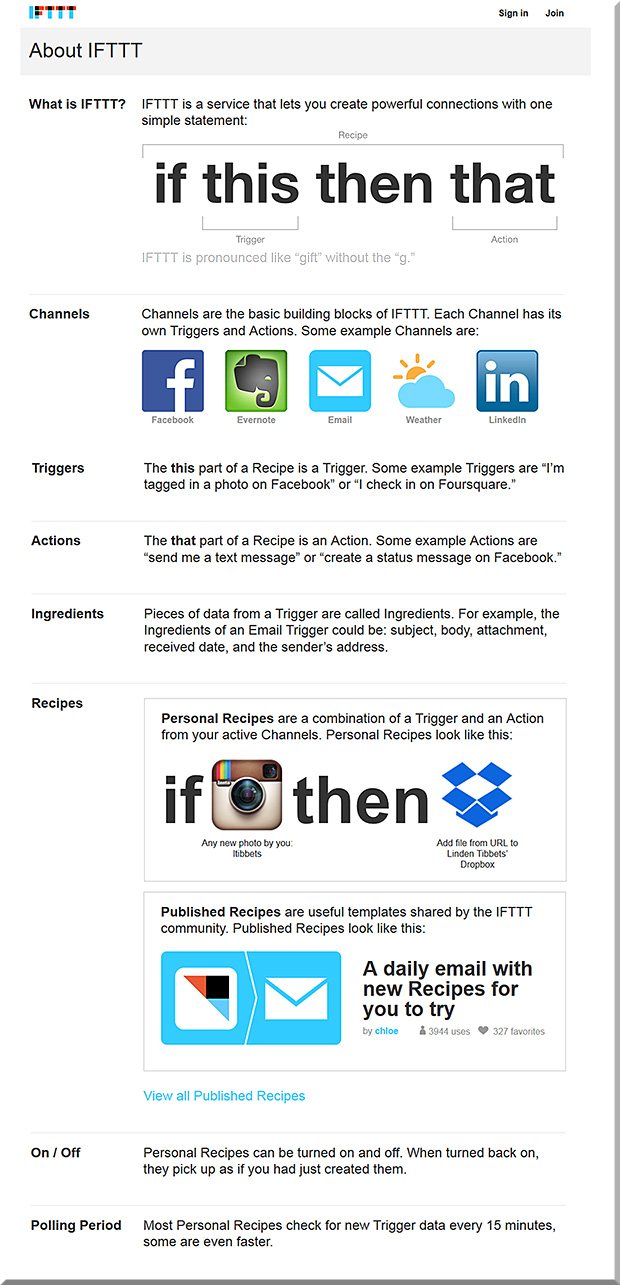
And that is, we will need people who can craft learning experiences from the presence of beacons/sensors and that integrate such concepts as found in “If This Then That” (ifttt.com) whereby one is putting the Internet and cloud/mobile-based applications to work for you. Certainly, those involved in retail are already busy working on these types of projects. But those of us involved with learning, human computer interaction (HCI), and interface design need to get involved as well.


IfThisThenThat-Combined-With-iBeacons


For example, this potential scenario of a K-12 field trip might be fodder for such a learning experience.

So for those individuals who are involved with the aforementioned disciplines…we need to pulse check what new affordances are coming from the rollout and further development of the IoT/IoE.


iPad Art: The Majestic Forgiver — from ipadinsight.com

Excerpt:

It’s titled ‘The majestic forgiver’ and is the work of Woon Tien David Chong. Here are the artist’s own words on this iPad painting:

Isaiah 1:18 “Come now, let us settle the matter,” says the LORD. “Though your sins are like scarlet, they shall be as white as snow; though they are red as crimson, they shall be like wool.


Majectic-Forgiver-iPad-Painting_thumb


Inside Kim Jung Gi’s mesmerising sketchbook — from creativebloq.com by


For the love of wood: 55 amazing wooden sculptures [photos] — fromhongkiat.com


Animal Sculptures from Wood Chips


Bough Houses by Rob Heard


Following up on yesterday’s posting, History Channel bringing online courses to higher ed, I wanted to thank Mr. Rob Kingyens, President at Qubed Education, for alerting me to some related work that Qubed Education is doing. Below is an example of that work:

The University of Southern California, Condé Nast and WIRED launch Master of Integrated Design, Business and Technology — from qubededucation.com
New Learning Model Combines Network and Access of WIRED with Academic Strength and Vision of the USC Roski School of Art and Design

Excerpt (emphasis DSC):

MARIN, Calif., October 1, 2014 – The University of Southern California, Condé Nast and WIRED today announced a partnership to create a new online Master’s degree in Integrated Design, Business and Technology. The partnership creates an unprecedented learning experience, combining the expertise of the editors, writers, and designers at WIRED with the academic rigor of USC, a leading research university known for its pioneering interdisciplinary programs. The aim of the 18-24 month degree is to educate creative thinkers and technologists to better equip them to transform the world of industry and enterprise. The first cohort is scheduled to begin in the 2015-2016 academic year.

…

“The pace of technology development requires higher education to continue to respond with programs that are flexible and adaptable, and that meet the needs of future cultural and business leaders,” said Dean Muhl.

“We’ve been thinking for years about what a university curriculum with WIRED would look like, and now we have a chance to build it with a terrific partner,” said Dadich. “Taking the best from USC and WIRED, we can teach discipline and disruption, business fundamentals, and the very latest innovation models from Silicon Valley. This is going to be thrilling.”

…

USC’s program development and build out will be powered by higher education partners Synergis Education and Qubed Education.


From Qubed’s website:

Qubed is the gateway for world-class, global brands to enter the education market with top tier universities.


From DSC:
I’ve long wondered if institutions of higher education will need to pool resources and/or form more partnerships and collaborations — either with other universities/colleges or with organizations outside of higher education. This reflection grows stronger for me when I:

  • Think that team-based content creation and delivery is pulling ahead of the pack
  • Hear about the financial situations of many institutions of higher education today (example1; example2)
  • See the momentum building up behind Competency Based Education (CBE)
  • Witness the growth of alternatives like Ideo Futures, Yieldr Academy, Lessons Go Where, ClassDo, Udemy, C-Suite TV.com and others
  • Hear about the potential advantages of learning analytics
  • See the pace of change accelerating — challenging higher education to keep up

For some institution(s) of higher education out there with deep pockets and a strong reputation, I could see them partnering up with an IBM (Watson), Google (Deepmind), Apple (Siri), Amazon (Echo), or Microsoft (Cortana) to create some next generation learning platforms. In fact, this is one of the areas I see occurring as lifelong learning/self-directed learning opportunities hit our living rooms. The underlying technologies these companies are working on could be powerful allies in the way people learn in the future — doing some heavy lifting to build the foundations in a variety of disciplines, and leaving the higher-order learning and the addressing of gaps to professors, teachers, trainers, and others.


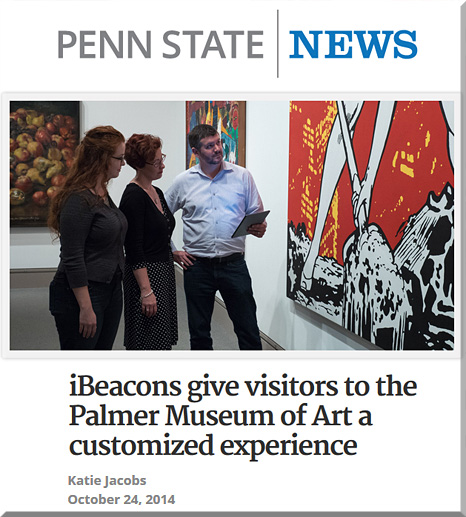
iBeacons-PennSt-Art-Oct2014


iBeacons give visitors to the Palmer Museum of Art a customized experience — from news.psu.edu by Katie Jacobs

Excerpt:

Soon, there will be new, high-tech additions to the Palmer Museum’s galleries — small electronic devices that will be stuck to walls behind paintings, hidden under shelves or concealed in corners. You won’t be able to see them, but your mobile devices will.

The devices ares iBeacons, small transmitters created by Apple that communicate with nearby smartphones. If a visitor has the correct mobile app installed, content will be automatically sent to the phone with more information about the nearby artwork.

…

“Sometimes I’ll lead tours with visitors and focus on the works of art I think are particularly fascinating,” says Kletchka. “I thought it would be wonderful if everyone could have that experience here — they can learn more about the objects they are interested in on their own terms.”


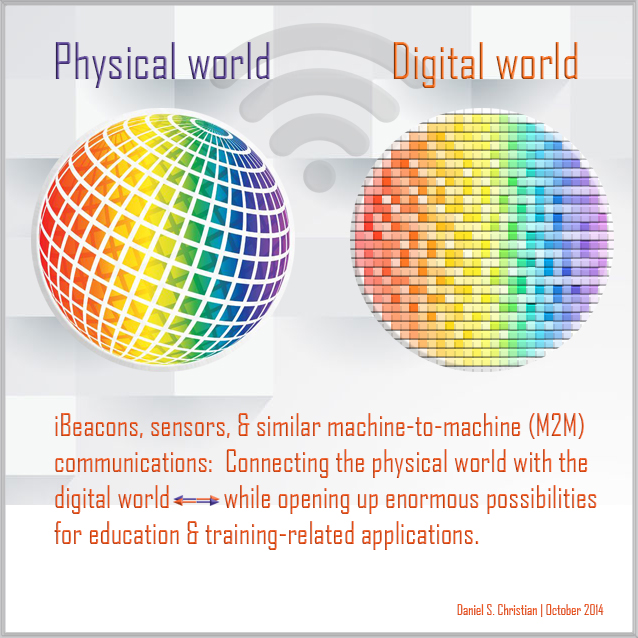
DanielChristian-Combining-Digital-Physical-Worlds-Oct2014


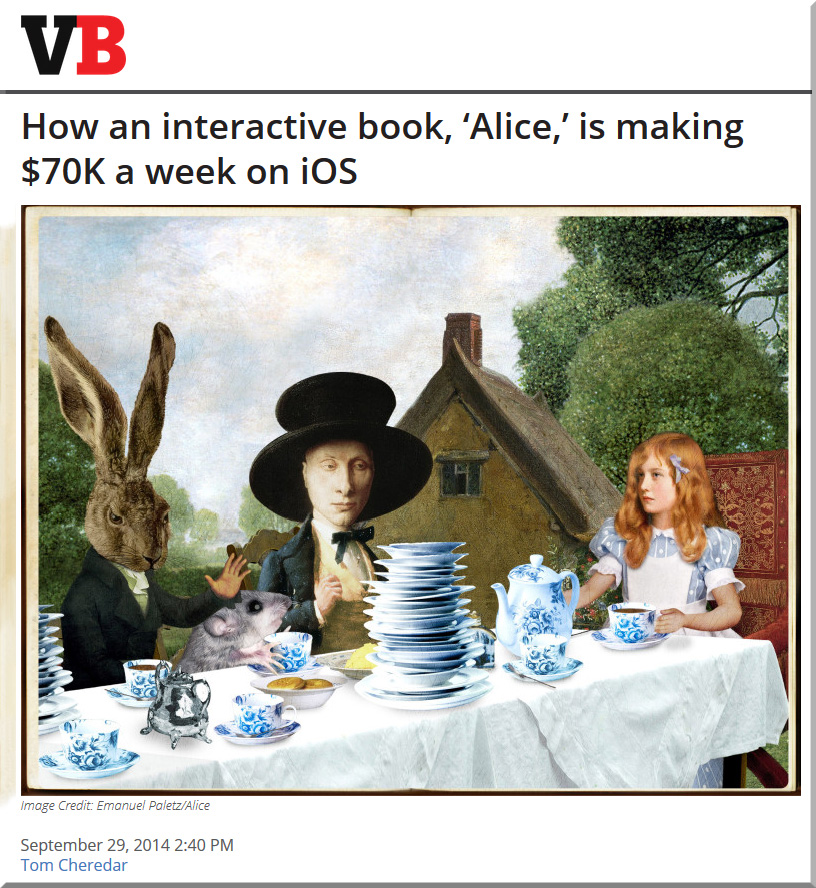
interactivebook-alice-70Kweek-setp2014

.

Excerpt:

Alice is presented as a mobile app, but it’s technically a book that can be read on iPads and Android tablets. The story is based on the classic Alice’s Adventures In Wonderland by Lewis Carroll, and it features beautiful illustrations you can interact with by touching the tablet screen, as well as an engaging narrator reading each page.

“Regular e-books have limitations, and I wanted to create a new level of engagement. I wanted to combine interactive experience along with film ‘feel,’” Paletz said in an interview. “The application is an art book, a conceptual book, and an educational book all in one, so it has something for everyone.”


 From DSC: With a shout out to
Laura Devaney who posted this on Twitter.


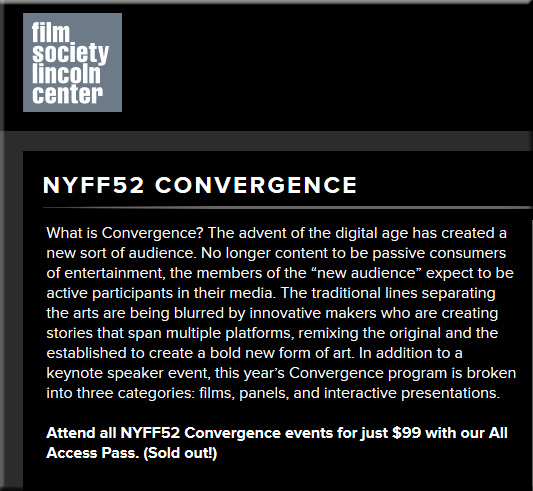
It’s Not Film. It’s Not TV. It’s Convergence. Here’s What It’s All About. –– from indiewire.com by Paula Bernstein
A new wave of creators is blurring the lines of storytelling to span multiple platforms. Here, a handful of those creators from this year’s New York Film Festival Convergence program explain what convergence means to them.


NYFFConvergence-Sept2014


Comment from DSC:
If this trend continues, I would guess that it would affect education as well.  That is, students no longer want to be passive consumers, but active participants.  Hmmm…sounds very familiar to me.  Aren’t we already there (i.e., active learning, project-based learning, makerspaces, and more)?


Also see:


Check out this video! Incredible! — from Front Pictures; a great example of pushing the envelop and refusing to accept that something can’t be done


MMRenaissance-Aug2014


Multimedia Renaissance by Front Pictures — blog.frontpictures.com


Front_Pictures_Art_Mall_realtime_preziv_002


Opening minds to critical knowledge on play, creativity and learning — from legofoundation.com

Cultures of Creativity (foundation research) — from legofoundation.com
Cultures develop when people find ways to play, make, and share. This report describes how human cultures can be characterised by their similarities rather than their differences, and emphasises the importance of recognising playfulness and creativity to develop societies prepared to accommodate the rapid changes associated with technology and globalisation.

Cultures of Creativity, nurturing creative mindsets (video)  — from legofoundation.com
Creativity is one of the most important competencies of the 21st Century. Yet, the puzzling question is how to nurture it? Children are creative from the day they are born and the film describes how to support creativity across cultures. The content is based on the report, Cultures of Creativity, published by the LEGO Foundation, 2013.  Authors: David Gauntlett and Bo Stjerne Thomsen and 20 leading international experts on play, learning and creativity.com

Inviting the world to play –– from cardboardchallenge.com/
This fall, the Imagination Foundation invites the world to participate in our 3rd Annual Global Cardboard Challenge.

.

2014GlobalCardboardChallenge


With a shout out to Mitch Resnick for posting
these resources on Twitter. Mitch is
going to be talking about
“Sowing the Seeds for a More Creative Society” this Wednesday w/ Adobe.


From Calvin College-based staff and faculty:

  • A whack on the side of the head : how to unlock your mind for innovation / Roger von Oech ; foreword by Nolan Bushnell ; illustrated by George Willett.
    Von Oech, Roger. (Author)
  • Sparks of genius : the thirteen thinking tools of the world’s most creative people by Robert and Michele Root-Bernstein
  • The learner-directed classroom : developing creative thinking skills through art — edited by Diane B. Jaquith, Nan E. Hathaway ; foreword by Patrick Fahey.
    Jaquith, Diane B. (Added Author). Hathaway, Nan E. (Added Author).
  • Nurturing creativity in the classroom — edited by Ronald A. Beghetto, James C. Kaufman.
    Beghetto, Ronald A., 1969- (Added Author). Kaufman, James C. (Added Author).
  • Improving Learning of Computational Thinking Using Creative Thinking Exercises in CS-1 Computer Science Courses —  by Miller, Soh, Chiriacescu, et al. (2013)
  • Fostering the Creative Development of Computer Science Students in Programming and Interaction Design — by Ferreira (2013)
  • Integrating Creativity into Computer Networks Course Teaching — by Hsiao, Liang, & Lin (2003)
  • Pixar Cofounder Ed Catmull on failure and why fostering a fearless culture is the key to groundbreaking creative work – from brainpickings.org by Maria Popova
    Why the greatest enemy of creative success is the attempt to fortify against failure.
    Excerpt:
    We need to think about failure differently. I’m not the first to say that failure, when approached properly, can be an opportunity for growth. But the way most people interpret this assertion is that mistakes are a necessary evil. Mistakes aren’t a necessary evil. They aren’t evil at all. They are an inevitable consequence of doing something new (and, as such, should be seen as valuable; without them, we’d have no originality). And yet, even as I say that embracing failure is an important part of learning, I also acknowledge that acknowledging this truth is not enough. That’s because failure is painful, and our feelings about this pain tend to screw up our understanding of its worth. To disentangle the good and the bad parts of failure, we have to recognize both the reality of the pain and the benefit of the resulting growth.
  • How Disney’s Imagineers keep the magic ideas coming – from fastcompany.com by Rebecca Greenfield
    Peter Rummell, the former chairman of Disney’s Imagineers, shares inside stories and secrets about how Disney’s teams work together to make magic happen again and again.
  • 10 ways to teach innovation — from blogs.kqed.org/mindshift by Thom Markham
    Excerpt:
    One overriding challenge is now coming to the fore in public consciousness: We need to reinvent just about everything. Whether scientific advances, technology breakthroughs, new political and economic structures, environmental solutions, or an updated code of ethics for 21st century life, everything is in flux—and everything demands innovative, out of the box thinking. The burden of reinvention, of course, falls on today’s generation of students. So it follows that education should focus on fostering innovation by putting curiosity, critical thinking, deep understanding, the rules and tools of inquiry, and creative brainstorming at the center of the curriculum. This is hardly the case, as we know. In fact, innovation and the current classroom model most often operate as antagonists. The system is evolving, but not quickly enough to get young people ready for the new world. But there are a number of ways that teachers can bypass the system and offer students the tools and experiences that spur an innovative mindset. Here are ten ideas…
  • How schools kill creativity — from TED.com by Sir Ken Robinson
  • Barriers to Creativity in Education: Educators and Parents Grade the System [Adobe]
  • Perhaps some ideas at a Do It Yourself (DIY) type of site could be relevant, such as org/skills/innovator
  • Perhaps have the students use digital storytelling in an assignment, see:
  • Digital Storytelling Helps Students Practice Essential Skills – from elearningindustry.com by Tiziana Saponaro
  • 5 reasons why you should be using storytelling in training – from dashe.com by Ben Nesvig
    Excerpt:
    Storytelling has been a popular tool for learning since the dawn of civilization, but thanks to technology bringing new mediums for storytelling, it has been on the rise in training in the workplace. Despite the fact that storytelling is a powerful vehicle for teaching, some still prefer to do a “data dump” because it’s easier than constructing a narrative, though not more effective. Below I provide 5 reasons why storytelling should be used more frequently in the workplace.
  • Mesmerizing fairy tale on the power of transmedia storytelling – from frametales.com by DRAFTFCB Madrid and posted by Filip Coertjens
  • Expanding learning opportunities with transmedia practices – Parts 1-6 [Laura Fleming]
  • erikjohanssonphoto.com


AdobeMax2013-ErikJohansson


Beacons at the museum: Pacific Science Center to roll out location-based Mixby app next month — from geekwire.com by Todd Bishop

Excerpt:

Seattle’s Pacific Science Center has scheduled an Oct. 4 public launch for a new system that uses Bluetooth-enabled beacons and the Mixby smartphone app to offer new experiences to museum guests — presenting them with different features and content depending on where they’re standing at any given moment.


Also see:


From DSC:
The use of location-based apps & associated technologies (machine-to-machine (M2M) communications) should be part of all ed tech planning from here on out — and also applicable to the corporate world and training programs therein. 

Not only applicable to museums, but also to art galleries, classrooms, learning spaces, campus tours, and more.  Such apps could be used on plant floors in training-related programs as well.

Now mix augmented reality in with location-based technology.  Come up to a piece of artwork, and a variety of apps could be launched to really bring that piece to life! Some serious engagement.

Digital storytelling. The connection of the physical world with the digital world. Digital learning. Physical learning. A new form of blended/hybrid learning.  Active learning. Participation.


Addendum on 9/4/14 — also see:

Aerohive Networks Delivers World’s First iBeacon™ and AltBeacon™ – Enabled Enterprise Wi-Fi Access Points
New Partnership with Radius Networks Delivers IoT Solution to Provide Advanced Insights and Mobile Experience Personalization

Excerpt (emphasis DSC):

SUNNYVALE, Calif.–(BUSINESS WIRE)–Aerohive Networks® (NYSE:HIVE), a leader in controller-less Wi-Fi and cloud-managed mobile networking for the enterprise market today announced that it is partnering with Radius Networks, a market leader in proximity services and proximity beacons with iBeacon™ and AltBeacon™ technology, to offer retailers, educators and healthcare providers a cloud-managed Wi-Fi infrastructure enabled with proximity beacons. Together, Aerohive and Radius Networks provide complementary cloud platforms for helping these organizations meet the demands of today’s increasingly connected customers who are seeking more personalized student education, patient care and shopper experiences.


Also:


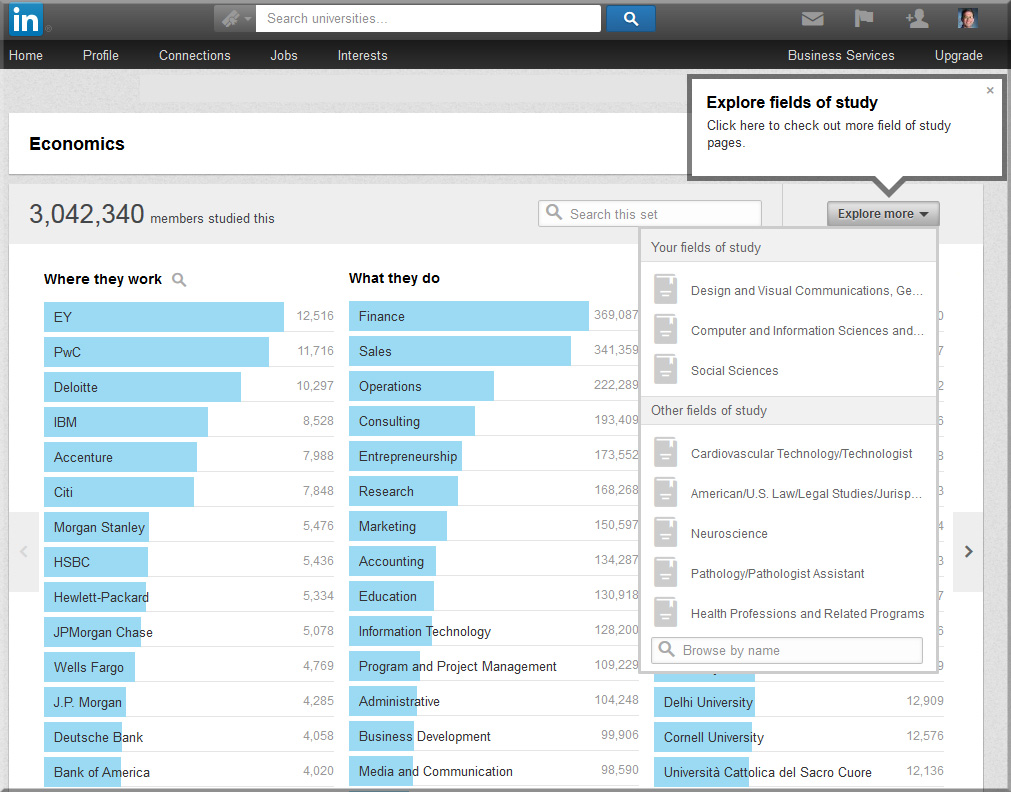
Does Studying Fine Art = Unemployment? Introducing LinkedIn’s Field of Study Explorer — from LinkedIn.com by Kathy Hwang

Excerpt:

[On July 28, 2014], we are pleased to announce a new product – Field of Study Explorer – designed to help students like Candice explore the wide range of careers LinkedIn members have pursued based on what they studied in school.

So let’s explore the validity of this assumption: studying fine art = unemployment by looking at the careers of members who studied Fine & Studio Arts at Universities around the world. Are they all starving artists who live in their parents’ basements?


LinkedInDotCom-July2014-FieldofStudyExplorer


Also see:

The New Rankings? — from insidehighered.com by Charlie Tyson

Excerpt:

Who majored in Slovak language and literature? At least 14 IBM employees, according to LinkedIn.

Late last month LinkedIn unveiled a “field of study explorer.” Enter a field of study – even one as obscure in the U.S. as Slovak – and you’ll see which companies Slovak majors on LinkedIn work for, which fields they work in and where they went to college. You can also search by college, by industry and by location. You can winnow down, if you desire, to find the employee who majored in Slovak at the Open University and worked in Britain after graduation.


Painted Typography by Pawel Nolbert — from thisiscollossal.com by Christopher Jobson

Examples:


© 2025 | Daniel Christian