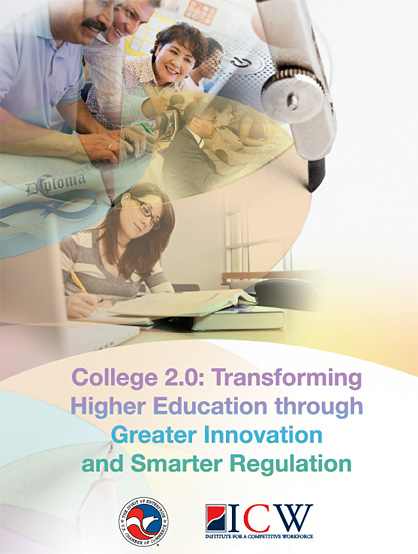
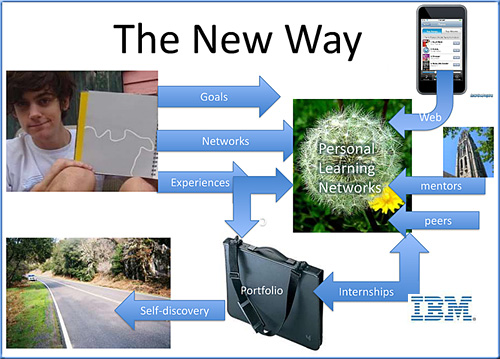
From DSC: First, some articles that caused these reflections


Discounting heads — from insidehighered.com by Kevin Kiley

Excerpt:

Despite spending nearly 43 percent of their gross tuition revenue from first-time, full-time freshmen on institutional aid for those students, many private colleges and universities had a harder time enrolling students last year, with almost half seeing no growth or a decline in enrollment for 2011, according to survey results released today by the National Association of College and University Business Officers.

From DSC:
It seems to me that it’s highly-possible that the higher ed bubble has started to pop — at least at private colleges and universities. So why doesn’t change occur? See the next article for several reasons.

Failure to change — from insidehighered.com by Robert J. Sternberg

Excerpts:

Universities teach about the importance of societal and organizational change, but often have trouble changing themselves in any but the most superficial ways. As a psychology professor interested in both individual and organizational modifiability, I have studied organizations, including universities, and why it is so difficult for them to change. Meaningful organizational change requires five elements, and unless all five of them are present, the organization — whether a department, school, college, or university — remains static.

Change is not always for the better, of course. But a college or university that is static will inevitably fall behind more dynamic, positively changing institutions. And like any institution that fails to compete, it is on the path to stagnation or death. A dynamic institution will change and, if the change proves to be in the wrong direction, will redirect itself until it finds a sustainable path.

From DSC:
As a relevant aside, it’s not just the “younger folk” who are struggling with student loans either:

Student loans saddle both kinds of seniors: graduates and grandparents — from the Washington Post by Michelle Singletary

Excerpt:

Using data from Equifax credit reports, the Federal Reserve Bank of New York found that people 50 and older are carrying nearly $135 billion in student-loan debt. Those 60 or older have student-loan balances of more than $36 billion.


It’s these types of dynamics and trends that are catalysts for what I call:


“Learning from the Living Room”
Though 2-5 years away, signs point to it coming to fruition
(my prediction is that this movement will really gain traction when Apple’s Connected/Smart TV hits the market and as more people get fed up with the current, unresponsive accredidation monopolies within higher ed). Some example/recent articles:

  • The Evolution of the Digital Living Room — from digitalvideospace.blogspot.com by Chuck Parker
    Excerpt:

    Apple with its iPad, Apple TV and iCloud for movies and TV shows has delivered a seamless ecosystem to the consumer’s digital living room for owning and watching content from multiple devices in the home. The rest of the industry (SmartTVs, connected devices, Android tablets) struggles to create a similar experience when they are a single-brand ecosystem and fail miserably when there are devices from multiple manufacturers in the household.
    .
  • Google and Microsoft’s new battleground: Your living room — from ComputerWorld by Preston Gralla
    The upshot will have surprising implications for IT
    .
  • Why the future of Shazam is TV, not music — from readwriteweb.com by Richard MacManus
    Excerpt:

    Shazam is in the midst of a major pivot. Currently it earns most of its revenue off advertising from the music app. But within two years, the company told ReadWriteWeb, TV will provide the majority of Shazam’s revenue. Just how big an opportunity is TV for Shazam? According to statistics from the company, it is already outpacing both Facebook and Twitter in second screen user engagement.

“The Forthcoming Walmart of Education” …which is already happening, but far more significant changes will come in the next 1-5 years as people look for more affordable alternatives. A graphic I created back in 2008 states what I see developing and will be a piece of the higher ed landscape in the future:
.

.


Besides the items mentioned above (i.e. changes in price and delivery mechanisms),
what might some of these innovations look like? Here are some ideas/articles/examples:


  • Be more responsive to real-world/market needs
    Example:
    12 college majors we hope to see soon
    — from bestcollegesonline.com
    While some college majors have been around for decades or even centuries, others are relatively new and some are still waiting on the horizon to be added to college programs around the world as new technologies and demands shape the needs of modern students. While a host of degree programs have been added over the past 10 or 20 years, many related to computers and other forms of technology, many more will be needed in the future to keep up with a world that is rapidly changing.
    .
  • Introduce more innovations and be willing to experiment with different models
    Examples besides MITx, Udemy, U of People, iTunes U, YouTube Edu, etc.:
    ANGELS, a new European research project, a gateway to the future.

    ANGELS project (Augmented Reality Network Generating Learning on Safety), is the training system that will revolutionize education and learning on safety and health at work, particularly in the hospital facilities. This tool aims at innovating in terms of training on health and safety at work with the use of augmented reality (computer system that can superimpose 3D image on a real image to combine real and virtual). ANGELS introduces 4 key innovations: A practice adapted to an innovative new technology, a realistic assessment in tune with the XXIst century in the area of education and training, a large field of application in the health care facilities and the creation of a starter kit for public and private organizations, training centers and academic centers.
    .
  • …and bring the prices WAAAY down!!!


Education 2.0 isn’t coming. It’s here. And the way you’re educated will be changed forever. — from bostinno.com by Dave Balter

Excerpt (emphasis DSC):

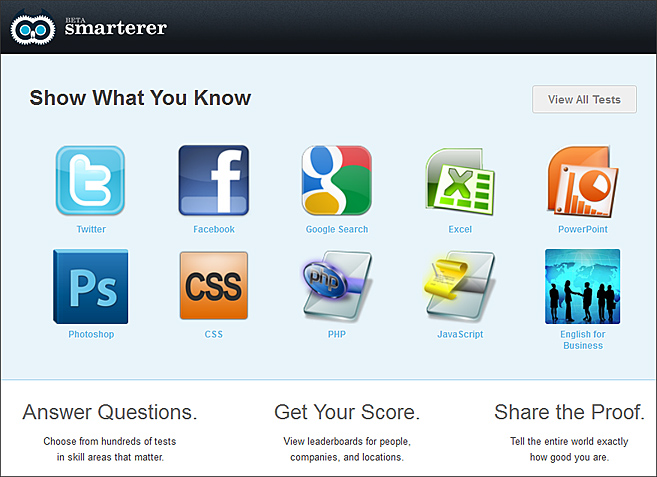
Sometime in late 2010, I sat down with angel investor Josh Abramowitz in NYC.  I asked him to invest in Smarterer, a business whose purpose was to validate people’s digital, social and technical skills.  What I encountered for the next hour wasn’t someone merely evaluating my specific business concept – it was an attack on the entire higher education system.

Josh argued that our higher education system was on the verge of crumbling.  Not because there weren’t marvelous educators or exceptional institutions, but because colleges and universities were charging exorbitant sums that weren’t equal to the return.  Our educators were burying our students with tremendous debt. But increasingly sophisticated learning and credentialing opportunities were emerging online, and they were free or nearly free.  And this disparity would lead to a full-fledged education revolution, he predicted.

What the Universities need to know is that what’s coming for education is something like the shift the music industry failed to see until it was too late.  Things will never be the same again.  Instead of griping about how hard it will be to tap their endowments to pay for education, they should be thinking about how to take advantage of the changes.

To save their universities, here’s the three-pronged ecosystem that every University Leader should start thinking about…

Also see:

smarterer.com -- show what you know


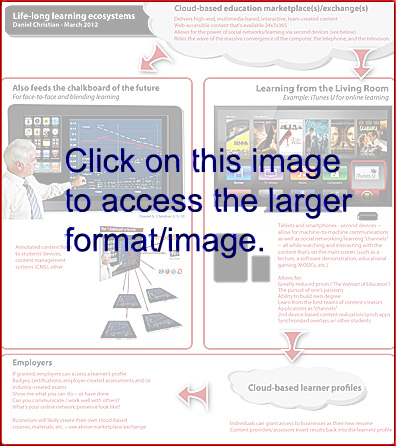
Lifelong learning ecosystems!!! A powerful vision for our future [Daniel Christian]

From DSC:
The vision below involves:
(click on the image below to access it)
 

  • The convergence of the telephone, the television, and the computer
  • Cloud-based education stores/marketplaces/exchanges
  • Second screen devices and machine-to-machine communications
  • Social networking/learning
  • Smart classrooms/learning spaces
  • Content recognition/synchronization applications
  • Apps as “channels”
  • Web-based learner profiles
  • Video overlays
  • New business models in higher ed
  • New jobs/needs for the future
  • A new way for employers to hire highly-effective employees/contractors/consultants
  • …and more


Click this thumbnail image to access the larger image / vision

.


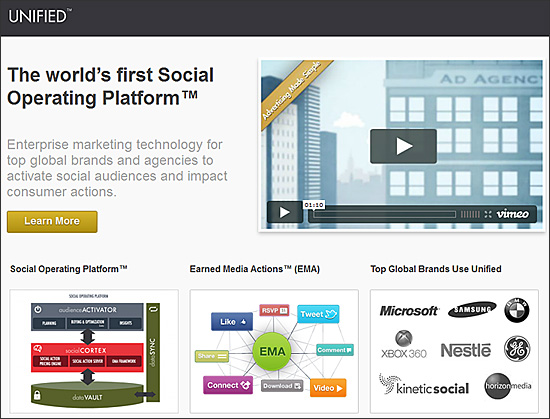
Unified opens an online university for social media marketers — from TechCruch.com by Anthony Ha


unifiedsocial.com

Services > Unified University

The social media landscape is complex and constantly evolving, leaving top global brands and agencies with the challenge of staying on top of the latest trends and best practices. Unified University is a first of its kind – an all-encompassing training, continuing education and certification program, complete with access to the industry leading best practices knowledge base. Unified University is designed to help marketing and agency executives become experts and internal thought leaders on social strategies, platform insights, earned media measurement, and more.

Through Unified University’s comprehensive training program, a social team can get certified on the Unified Social Operating Platform and learn about the latest advances in social advertising. Certification ensures that a team is up to date on the latest options within the social web, including the benefits of advertising across social ecosystems including Facebook, Twitter, LinkedIn, Google+, StumbleUpon and more.

Teams learn that brands may require very different strategies to ultimately achieve similar results. Unified University assures that teams know how to strategically represent brands across all social options while delivering high quality results and maximum ROI.

From DSC:
Is this a part of the future? If higher ed doesn’t respond more forcefully, I’d say so.

Along these lines, from page 408 of the Steve Jobs book:

One of Job’s business rules was to never be afraid of cannibalizing yourself. “If you can’t cannibalize yourself, someone else will,” he said.

Innovate. Reinvent. Staying relevant. This goes for the accreditation agencies as well.

 Also see:


.

Staying Relevant

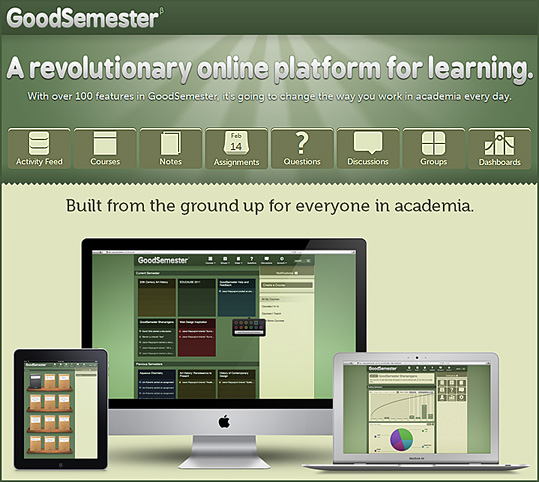
GoodSemester.com

 .

https://www.goodsemester.com/?p=featuretour

From DSC:

  • Tie this type of cloud-based platform in with learning analytics, new types of certifications/assessments/badges, web-based learner profiles, and the ability to continue building your own cloud over a lifetime, and you may find yourself enjoying a very powerful learning ecosystem!!!


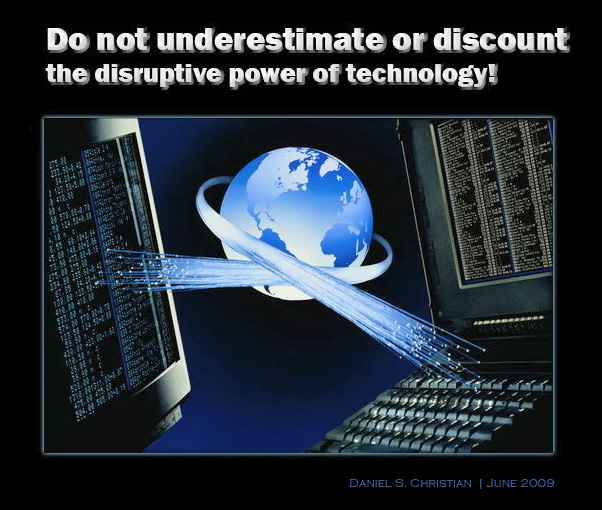
Do not underestimate or discount the disruptive power of technology! Daniel S. Christian -- June 2009


From DSC:
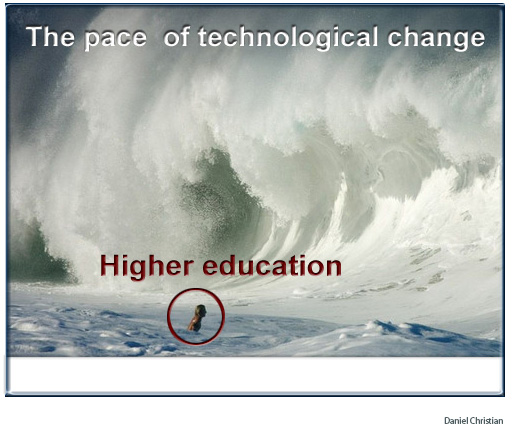
The tidal wave of technological change swept over Blockbuster and the article below shows how it drowned Kodak as well. These players were once at THEE top of their games…now they are either bankrupt or soon to be bankrupt (if things don’t change fast).

This relates to higher education as well, but I don’t think that we’ve seen anything yet (though 2012 may change that). Higher ed may have a limited window of time left before the conversation moves completely out of academia and higher ed as we know it gets left behind. The word “reinvent” and the phrases “staying relevant” as well as “lowering the price” should be at the top of the agendas for boards at most academic institutions of higher education throughout America (and other nations as well). I use the word most here because some folks will likely continue to pay enormous prices to get the name brands that they’ve been paying $50,000+ per year for.

If companies eventually don’t care who accredited your degree but rather what you can DO for them, watch out. The barriers to entry will plummet.


You Press the Button. Kodak Used to Do the Rest. — from technologyreview.com
Kodak saw the shift from analog to digital photography coming. Here’s why it couldn’t win.

.

Excerpt (emphasis from DSC):

But the industry landscape was completely different in the digital era. Barriers to entry were significantly lowered and the industry was flooded by entrants with a background in consumer electronics, such as Casio, Samsung, and Hewlett-Packard, not to mention Japanese camera manufacturers including Canon, Nikon, and Olympus. Large parts of Kodak’s competence base related to chemistry and film manufacturing were rendered obsolete. The vertical integration that had previously been a core asset to Kodak lost its value. Digital cameras became a commodity business with low margins. The problem facing Kodak wasn’t just that film profits had died but that those revenues could not be replaced.

Once images became digital, Kodak’s business model of “doing the rest” was effectively destroyed. Doing the rest used to entail a large and complex process that only a couple of companies in the world could master. Today, it is done by the click of a button.

Related graphic from DSC:

From Daniel S. ChristianAlso see:


12/15/11 addendum re: the conversation moving away from higher ed:

Excerpt (emphasis DSC):

No single blog can adequately capture or represent what was going on at Learning 2011. But if you are intrigued, I suggest you go to www.Learning2011and see what the agenda and the presentations looked like for yourself.
.
What I sensed, and what I am trying to describe here, was an accelerating transition in workforce education from a higher education-centric model to a learner-workplace-centric model. In a world where higher education institutions have dominated, controlled, and driven the conversation about quality, content, access, and results; the balance of power is shifting away from that more monolithic tendency to a far more disaggregated power structure where good information, metrics, and results that can be validated against third party standards are the “coin of the realm”.


Debt to degree: A new way of measuring college success — from educationsector.org by Kevin Carey and Erin Dillon

Excerpt:

The American higher education system is plagued by two chronic problems: dropouts and debt. Barely half of the students who start college get a degree within six years, and graduation rates at less-selective colleges often hover at 25 percent or less. At the same time, student loan debt is at an all-time high, recently passing credit card debt in total volume.1 Loan default rates have risen sharply in recent years, consigning a growing number of students to years of financial misery. In combination, drop-outs and debt are a major threat to the nation’s ability to help students become productive, well-educated citizens.

Gainful Employment Rule is Out: Was it Worth the Wait? — from New America Foundation

Excerpt:

Nearly a year after first proposing it, the Department of Education this morning officially issued the final version of its “Gainful Employment” Rule, which aims to stop for-profit colleges from saddling students with unmanageable levels of debt. As has been noted in numerous news stories, the Department made very large concessions to the for-profit higher education industry. As a result, the initial reaction from consumer advocacy groups has been, for the most part, lukewarm at best. Meanwhile, career college lobbyists remain — unsurprisingly — unsatisfied with the changes.

At Higher Ed Watch, we will provide our own analysis of the final regulation after we have thoroughly reviewed it. In the meantime, though, here are some helpful links to find out more about the rule, and to see what the press and various interested parties are saying about it.

Tagged with:  

Is Higher Education Ready for “The Education Bubble”? — from CampusTechnology.com by Trent Batson

Excerpts:

American higher education–the jewel in the global crown of universal education, with nearly a quarter of the total number of higher education institutions in the world, and including graduate programs that are the envy of the world–is facing the prospect of being the next bubble to burst. Technology is both a culprit and a promising ally.

The spread of information technology, and its infusion into our culture, has opened the world to learning opportunities–raising expectations for college graduates and changing the terms of success.

Is American higher education ready to either prevent the bubble from bursting or to weather the storm when it does burst? And what is the bubble?

The bubble, as we can see by all the dimensions just described, is, in fact, a potential “perfect storm.”

But this effort must also result from a presidential-level decree: “The learning theory that fit so well in our culture and with the dominant technology pre-1995 (print-based and paper-based technologies), now is not working very well for any of us, so we have to change. Each of you on campus has sincerely and devotedly committed yourselves fully to learning, but now we know that our learning epistemology is less and less appropriate. This is not your fault; it is simply a time of incredible human growth; it is a time of rapid evolution in our culture; a time of re-shaping our economy. We must transform or become irrelevant.”


From DSC:
Good to see I have some company in these perspectives; thanks for the article Trent. Also see:

  • The Forthcoming Walmart of Education
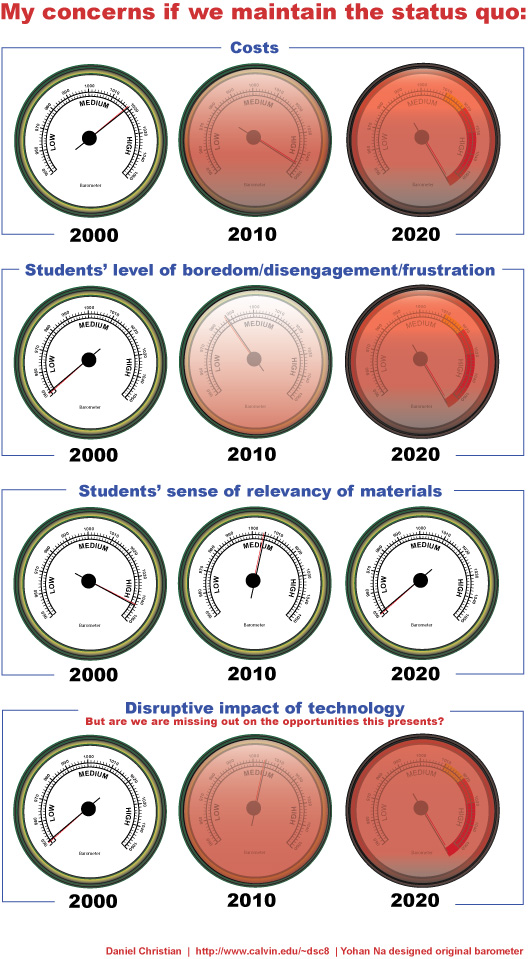
  • The below graphics that I created a while back reflecting on whether there was a bubble building within higher ed (2/16/09) as well some of the elements of “The Perfect Storm in Higher Education” (9/10/10).
  • The point is we need a response to these trends — we don’t want to be broadsided.


The perfect storm in higher ed -- by Daniel S. Christian

Is higher ed the next bubble?


Daniel S. Christian: My concerns with just maintaining the status quo (from 2009).

From 5/21/09

Key education issues dividing public, college presidents, study finds — from the WSJ by Kevin Helliker

The general public and university presidents disagree about the purpose of college, who ought to pay for it and whether today’s students are getting their money’s worth.

But university presidents and the average American agree that the cost of higher education now exceeds the reach of most people.

Those are broad findings from a pair of surveys released late Sunday from the nonprofit Pew Research Center. The surveys took place this March and April, one posing college-related questions to 2,142 American adults, the other to 1,055 presidents of colleges large, small, public, private and for-profit. The two surveys contained some identical questions and some peculiar to each group.

Excerpt of report:

As is the case with all Center reports, our research is not designed to promote any cause, ideology or policy proposal. Our only goal is to inform the public on important topics that shape their lives and their society.

Higher education is one such topic. The debate about its value and mission has been triggered not just by rising costs, but also by hard economic times; by changing demands on the nation’s workforce; by rising global competition; by growing pressures to reduce education funding; and by the ambitious goal set by President Obama for the United States to lead the world by 2020 in the share of young adults who have a college degree.


From DSC:
I submitted the following comment to the solid article “Fixing accreditation, from the inside” (from today’s InsideHigherEd.com posting by Doug Lederman)


Thank you for the article/posting here.

Re: the committee:

  • Where are the students?
  • Where is the representation from those outside academia?
  • That is, can more parties who pay the bills for education be represented?

Re: higher ed as an industry:
I am a liberal arts grad and I work at a liberal arts college; as such, I believe in the value of liberal arts. However, I’ve been reflecting upon why the teaching and learning environment has been changing so much and why higher education has become more of a business.

Actually, I think it’s always been somewhat of a business, but even more so these days. The key reason for me involves the *cost* of obtaining an education.

It’s one thing to charge $3000/yr for tuition and it’s another to charge $25,000+/yr for tuition. If it means essentially having to pay the price of a house to obtain an education for your children, doesn’t the set of expectations change for students? For the parents of those students? For businesses who are helping pay the tuition of their employees?

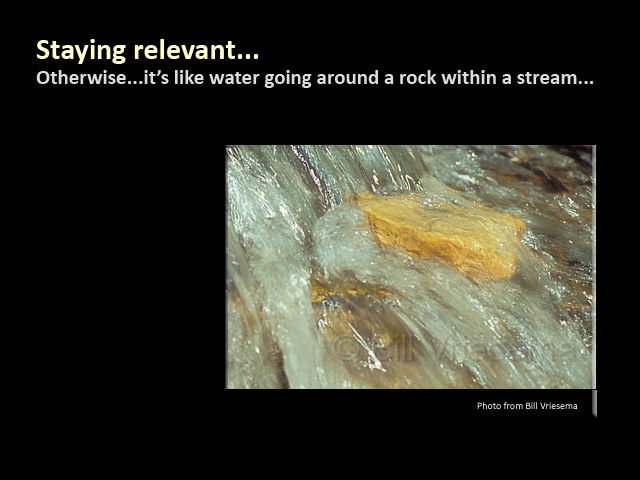
If the accreditation bodies don’t respond to the growing suspicion towards them — and towards higher education as a whole — it will be like water going around a rock in a stream. People will flow right by them — whether the government assumes control or not.


Staying Relevant

Higher education’s toughest test — from by Jon Bischke and Semil Shah

In the debate sparked by Peter Thiel’s “20 Under 20 Fellowship” (which pays bright students to drop out of college), one fact stands out: the cost of U.S. post-secondary education is spiraling upward, out of control. Thiel calls this a “bubble,” similar to the sub-prime mortgage crisis, where hopeful property owners over-leveraged themselves to lay claim to a coveted piece of the American dream: home ownership.

Today, however, the credentialing provided by universities is becoming decoupled from the knowledge and skills acquired by students. The cost of obtaining learning materials is falling, with OpenCourseWare resources from MIT and iTunes U leading the charge. Classes can be taken online on sites like Udemy and eduFire, either for free or a fraction of the cost to learn similar material at a university, and sites like Veri, which recently launched at TechStars NYC Demo Day, aims to organize and spread one’s accumulated knowledge.

The fresh cadavers from the shakeouts in the music and publishing industries should provide motivation to presidents, chancellors, and provosts to look seriously at this problem, as many of the same dynamics that disrupted those industries are now at play in higher education. As students around the world start preparing for their year-end exams, it will be interesting to see how seriously leaders of universities prepare for one of the toughest tests that they’ll ever face.


From DSC:
I have been trying to get these trends/warnings/messages across to others for years — more people are starting to raise the same red flags on some of these same topics as well.

There is great danger in the status quo these days. Don’t get me wrong — I’m a firm believer in education, especially liberal arts education. But the traditional model is simply not sustainable it continually shuts more people out of the system and/or puts such a burden on students’ backs as to significantly influence — if not downright limit — their future options and experiences.

But as the saying goes, “Change is optional — survival is not mandatory.”


Addendum:


Some great items re: whether online learning is disruptive or not


© 2025 | Daniel Christian