What does the ‘metaverse’ mean for education? — from hechingerreport.org by Javeria Salman
Experts warn educators to think twice before jumping on new technologies

Excerpt:

Sometime in the past year or two, you’ve likely heard the word “metaverse.” It’s the future, the next big frontier of the internet, if you ask technology CEOs or researchers.

While the term has become the latest buzzword in education circles, what it means for teaching and learning largely remains to be seen. Experts say much of what we see marketed as the metaverse from education technology companies isn’t actually the metaverse.

In a true metaverse experience, your digital identity travels between the physical and virtual worlds, Platt said. With the help of blockchain technology, that identity — your preferences, your achievements, your educational records, other elements of who you are — is maintained across platforms and applications.


8 Ways to Use QR Codes in Higher Education Classrooms — from er.educause.edu by Tolulope (Tolu) Noah

Excerpt:

QR codes open up a world of possibility in the higher education setting. They provide a quick and easy way for students to access instructional materials, and they complement the design of more interactive and engaging learning experiences.

From DSC:
QR codes can bridge the physical world with the digital world — which is something about to take an exponential leap as more AR and MR-based hardware and software solutions hit the marketplace in the near future.


Apple just quietly gave us the golden key to unlock the Metaverse — from medium.com by Klas Holmlund; with thanks to Ori Inbar out on Twitter for this resource

Excerpt:

But the ‘Oh wow’ moment came when I pointed the app at a window. Or a door. Because with a short pause, a correctly placed 3D model of the window snapped in place. Same with a door. But the door could be opened or closed. RoomPlan did not care. It understands a door. It understands a chair. It understands a cabinet. And when it sees any of these things, it places a model of them, with the same dimensions, in the model.

Oh, the places you will go!
OK, so what will this mean to Metaverse building? Why is this a big deal? Well, to someone who is not a 3D modeler, it is hard to overstate what amount of work has to go into generating useable geometry. The key word, here, being useable. To be able to move around, exist in a VR space it has to be optimized. You’re not going to have a fun party if your dinner guests fall through a hole in reality. This technology will let you create a fully digital twin of any space you are in in the space of time it takes you to look around.

In a future Apple VR or AR headset, this technology will obviuosly be built in. You will build a VR capable digital twin of any space you are in just by wearing the headset. All of this is optimized.

Also with thanks to Ori Inbar:


Somewhat relevant/see:

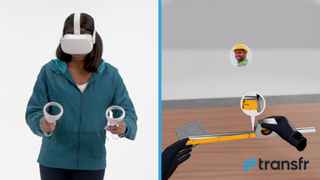
“The COVID-19 pandemic spurred us to think creatively about how we can train the next generation of electrical construction workers in a scalable and cost-effective way,” said Beau Pollock, president and CEO of TRIO Electric. “Finding electrical instructors is difficult and time-consuming, and training requires us to use the same materials that technicians use on the job. The virtual simulations not only offer learners real-world experience and hands-on practice before they go into the field, they also help us to conserve resources in the process.”


Top 5 Developments in Web 3.0 We Will See in the Next Five Years — from intelligenthq.com

Excerpt:

Today, websites have turned highly engaging, and the internet is full of exciting experiences. Yet, web 3.0 is coming with noteworthy trends and things to look out for.

Here are the top 5 developments in web 3.0 expected in the coming five years.
.


European telco giants collaborate on 5G-powered holographic videocalls — from inavateonthenet.net

Excerpt:

Some of Europe’s biggest telecoms operators have joined forces for a pilot project that aims to make holographic calls as simple and straightforward as a phone call.

Deutsche Telekom, Orange, Telefónica and Vodafone are working with holographic presence company Matsuko to develop an easy-to-use platform for immersive 3D experiences that could transform communications and the virtual events market

Advances in connectivity, thanks to 5G and edge computing technology, allow smooth and natural movement of holograms and make the possibility of easy-to-access holographic calls a reality.
.

Top XR Vendors Majoring in Education for 2022 — from xrtoday.com

Excerpt:

Few things are more important than delivering the right education to individuals around the globe. Whether enlightening a new generation of young students, or empowering professionals in a complex business environment, learning is the key to building a better future.

In recent years, we’ve discovered just how powerful technology can be in delivering information to those who need it most. The cloud has paved the way for a new era of collaborative remote learning, while AI tools and automated systems are assisting educators in their tasks. XR has the potential to be one of the most disruptive new technologies in the educational space.

With Extended Reality technology, training professionals can deliver incredible experiences to students all over the globe, without the risks or resource requirements of traditional education. Today, we’re looking at just some of the major vendors leading the way to a future of immersive learning.


3D Scanner Lets You Capture The Real World In VR — from vrscout.com by Kyle Melnick

Excerpt:

VR is about to get a whole lot more real.

Imagine having the power to capture your real-world environment as a hyper-realistic 3D model from the palm of your hand. Well, wonder no more, as peel 3d, a developer of professional-grade 3D scanners, today announced the launch of peel 3 and peel 3.CAD, two new easy-to-use 3D scanners capable of generating high-quality 3D scans for a wide variety of digital mediums, including VR and augmented reality (AR).


NASA & Google Partner To Create An AR Solar System — from vrscout.com by Kyle Melnick

Excerpt:

[On 9/14/22], Google Arts & Culture announced that is has partnered with NASA to further extend its virtual offerings with a new online exhibit featuring a collection of new-and-improved 3D models of our universe brought to life using AR technology.

These 3D models are for more than just entertainment, however. The virtual solar system exhibit features historical annotations that, when selected, display valuable information. Earth’s moon, for example, features landing sites for Apollo 11 and China’s Chang’e-4.


Nurses to trial VR to free up time with patients — from inavateonthenet.net

Excerpt:

UK nurses are set to trial “virtual reality style” goggles to free up time with patients in home visits, transcribing appointments in real time and sharing footage for second opinions.

Nurses from the Northern Lincolnshire and Goole NHS Foundation Trust will trial the technology and be able to transcribe appointment notes directly to electronic records. This will allow nurses to cut down on administrative paperwork and free up more time for home visits.

From DSC:
I wonder if AR will be used in applications like these in the near future…?


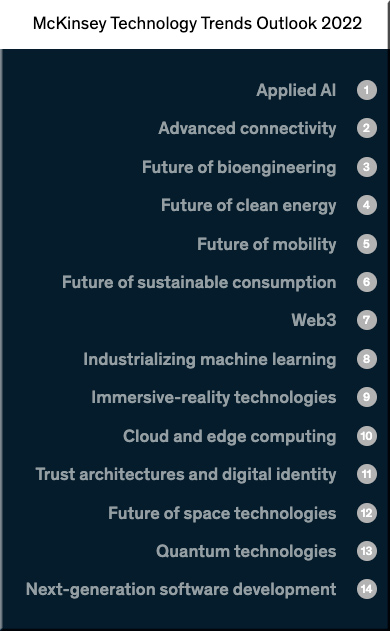
McKinsey Technology Trends Outlook 2022

Excerpt:

Which technology trends matter most for companies in 2022? New analysis by the McKinsey Technology Council highlights the development, possible uses, and industry effects of advanced technologies.

McKinsey Technology Trends Outlook 2022


Augmented Books Are On The Way According To Researchers — from vrscout.com by Kyle Melnick

Excerpt:

Imagine this. You’re several chapters into a captivating novel when a character from an earlier book makes a surprise appearance. You swipe your finger across their name on the page at which point their entire backstory is displayed on a nearby smartphone, allowing you to refresh your memory before moving forward.

This may sound like science fiction, but researchers at the University of Surrey in England say that the technology described above is already here in the form of “a-books” (augmented reality books).

The potential use-cases for such a technology are virtually endless. As previously mentioned, a-books could be used to deliver character details and plot points for a variety of fictional works. The same technology could also be applied to textbooks, allowing students to display helpful information on their smartphones, tablets, and smart TVs with the swipe of a finger.

From DSC:

  • How might instructional designers use this capability?
  • How about those in theatre/drama?
  • Educational gaming?
  • Digital storytelling?
  • Interaction design?
  • Interface design?
  • User experience design?

Also see:


The Metaverse Is Not a Place — from oreilly.com by Tim O’Reilly
It’s a communications medium.

Excerpt:

Foundations of the metaverse
You can continue this exercise by thinking about the metaverse as the combination of multiple technology trend vectors progressing at different speeds and coming from different directions, and pushing the overall vector forward (or backward) accordingly. No new technology is the product of a single vector.

So rather than settling on just “the metaverse is a communications medium,” think about the various technology vectors besides real-time communications that are coming together in the current moment. What news from the future might we be looking for?

  • Virtual Reality/Augmented Reality
  • Social media
  • Gaming
  • AI
  • Cryptocurrencies and “Web3”
  • Identity

#metaverse #AI #communications #gaming #socialmedia #cryptocurrencies #Web3 #identity #bots #XR #VR #emergingtechnologies


Online Learning, From the Margins to the Center — from insidehighered.com by Ray Schroeder
Online learning has evolved over the past 25 years from a niche position on the margins of higher ed to the leading driver of growth in enrollment and innovation.

Excerpt:

Online learning has grown from a marginal niche of higher ed to the largest provider of postsecondary learning in the world. We are now on the cusp of yet another technological evolution in the delivery of online learning. The advent of the metaverse in higher education is closer than many casual observers may think. By 2025, we will begin to see significant numbers of offerings using avatars and immersive technologies such as virtual reality, augmented reality and extended reality engaging learners at a distance.

Do you have developmental immersion laboratories for your faculty and staff to prepare for 2025? Who at your university is advocating for the integration of VR, AR and XR into online delivery? Are you already collaborating with industry and business in developing the most effective and relevant technology-enhanced online programs that will meet their needs? Those who lead in these ventures will set the standards and gain the recruiting advantage in higher education.


Brands Are Already Making Millions in the Metaverse. Here’s What Business Owners Need To Know. — from inc.com by Ben Sherry
Entrepreneurs who follow Gen-Z into the metaverse could gain a competitive advantage.

Excerpt (emphasis DSC):

If you’re still skeptical about the metaverse, you certainly aren’t alone. According to a recent survey, 55 percent of adults with yearly incomes over $100,000 said they were not interested or excited about the concept, while 37 percent said they were primarily worried about it. Only 6 percent of respondents claimed to be excited about the metaverse.

Those numbers might not seem encouraging, but it’s important to remember that one of the most popular metaverse platforms currently available, Roblox, averages more than 54 million daily users, the vast majority of whom are Gen-Z or younger. Those users have cumulatively spent more than $1 billion on digital items such as outfits or accessories designed to be worn by player avatars in addition to in-experience upgrades and various other paid features.

From DSC:
The article stated that over 30 million virtual worlds had been created from scratch using Roblox Studio, the platform’s creation engine. So youth are creating, sharing, and participating in virtual worlds all the time…while experimenting, playing, and practicing their creativity. This all is done outside of school. Hmm…


‘It’s a mess and I’ve never seen anything like it’: global lost luggage crisis mounts — from theguardian.com by Mattha Busby

From DSC:
After seeing the above article, I wondered:

  • How might the future #AR glasses help with this situation?
  • Could such devices help the relevant employees automatically scan each bar code for where to route (or not) the luggage? (As I’m sure is already happening in many situations that occur away from what’s occurring on the tarmac.)

Will AR glasses be used for such training-related applications in the future?  For such logistical applications? Hmmm…time will tell.


I think we’ve run out of time to effectively practice law in the United States of America [Christian]


From DSC:
Given:

  • the accelerating pace of change that’s been occurring over the last decade or more
  • the current setup of the legal field within the U.S. — and who can practice law
  • the number of emerging technologies now on the landscapes out there

…I think we’ve run out of time to effectively practice law in the U.S. — at least in terms of dealing with emerging technologies. Consider the following items/reflections.


Inside one of the nation’s few hybrid J.D. programs — from highereddive.com by Natalie Schwartz
Shannon Gardner, Syracuse law school’s associate dean for online education, talks about the program’s inaugural graduates and how it has evolved.

Excerpt (emphasis DSC):

In May, Syracuse University’s law school graduated its first class of students earning a Juris Doctor degree through a hybrid program, called JDinteractive, or JDi. The 45 class members were part of almost 200 Syracuse students who received a J.D. this year, according to a university announcement.

The private nonprofit, located in upstate New York, won approval from the American Bar Association in 2018 to offer the three-year hybrid program.

The ABA strictly limits distance education, requiring a waiver for colleges that wish to offer more than one-third of their credits online. To date, the ABA has only approved distance education J.D. programs at about a dozen schools, including Syracuse.

Many folks realize this is the future of legal education — not that it will replace traditional programs. It is one route to pursue a legal education that is here to stay. I did not see it as pressure, and I think, by all accounts, we have definitely proven that it is and can be a success.

Shannon Gardner, associate dean for online education  


From DSC:
It was March 2018. I just started working as a Director of Instructional Services at a law school. I had been involved with online-based learning since 2001.

I was absolutely shocked at how far behind law schools were in terms of offering 100% online-based programs. I was dismayed to find out that 20+ years after such undergraduate programs were made available — and whose effectiveness had been proven time and again — that there were no 100%-online based Juris Doctor (JD) programs in the U.S. (The JD degree is what you have to have to practice law in the U.S. Some folks go on to take further courses after obtaining that degree — that’s when Masters of Law programs like LLM programs kick in.)

Why was this I asked? Much of the answer lies with the extremely tight control that is exercised by the American Bar Association (ABA). They essentially lay down the rules for how much of a law student’s training can be online (normally not more than a third of one’s credit hours, by the way).

Did I say it’s 2022? And let me say the name of that organization again — the American Bar Association (ABA).

Graphic by Daniel S. Christian

Not to scare you (too much), but this is the organization that is supposed to be in charge of developing lawyers who are already having to deal with issues and legal concerns arising from the following technologies:

  • Artificial Intelligence (AI) — Machine Learning (ML), Natural Language Processing (NLP), algorithms, bots, and the like
  • The Internet of Things (IoT) and/or the Internet of Everything (IoE)
  • Extended Reality (XR) — Augmented Reality (AR), Mixed Reality (MR), Virtual Reality (VR)
  • Holographic communications
  • Big data
  • High-end robotics
  • The Metaverse
  • Cryptocurrencies
  • NFTs
  • Web3
  • Blockchain
  • …and the like

I don’t think there’s enough time for the ABA — and then law schools — to reinvent themselves. We no longer have that luxury. (And most existing/practicing lawyers don’t have the time to get up the steep learning curves involved here — in addition to their current responsibilities.)

The other option is to use teams of specialists, That’s our best hope. If the use of what’s called nonlawyers* doesn’t increase greatly, the U.S. has little hope of dealing with legal matters that are already arising from such emerging technologies. 

So let’s hope the legal field catches up with the pace of change that’s been accelerating for years now. If not, we’re in trouble.

* Nonlawyers — not a very complimentary term…
I hope they come up with something else.
Some use the term Paralegals.
I’m sure there are other terms as well. 


From DSC:
There is hope though. As Gabe Teninbaum just posted the resource below (out on Twitter). I just think the lack of responsiveness from the ABA has caught up with us. We’ve run out of time for doing “business as usual.”

Law students want more distance education classes, according to ABA findings — from abajournal.com by Stephanie Francis Ward

Excerpt:

A recent survey of 1,394 students in their third year of law school found that 68.65% wanted the ability to earn more distance education credits than what their schools offered.


The Metaverse Will Reshape Our Lives. Let’s Make Sure It’s for the Better. — from time.com by Matthew Ball

Excerpts (emphasis DSC):

The metaverse, a 30-year-old term but nearly century-old idea, is forming around us. Every few decades, a platform shift occurs—such as that from mainframes to PCs and the internet, or the subsequent evolution to mobile and cloud computing. Once a new era has taken shape, it’s incredibly difficult to alter who leads it and how. But between eras, those very things usually do change. If we hope to build a better future, then we must be as aggressive about shaping it as are those who are investing to build it.

The next evolution to this trend seems likely to be a persistent and “living” virtual world that is not a window into our life (such as Instagram) nor a place where we communicate it (such as Gmail) but one in which we also exist—and in 3D (hence the focus on immersive VR headsets and avatars).

 
© 2025 | Daniel Christian