Ways that artificial intelligence is revolutionizing education — from thetechedvocate.org by Matthew Lynch

Excerpt:

I was speaking with an aging schoolteacher who believes that AI is destroying education. They challenged me to come up with 26 ways that artificial intelligence (AI) is improving education, and instead, I came up with. They’re right here.


AI Startup Speeds Healthcare Innovations To Save Lives — from by Geri Stengel

Excerpt:

This project was a light-bulb moment for her. The financial industry had Bloomberg to analyze content and data to help investors uncover opportunities and minimize risk, and pharmaceutical, biotech, and medical device companies needed something similar.


Matthew Ball on the metaverse: We’ve never seen a shift this enormous — protocol.com by Janko Roettgers
The leading metaverse theorist shares his thoughts on the sudden rise of the concept, its utility for the enterprise and what we still get wrong about the metaverse.

Excerpts:

What are the biggest misconceptions about the metaverse?
First, the idea that the metaverse is immersive virtual reality, such as an Oculus or Meta Quest. That’s an access device. It would be akin to saying the mobile internet is a smartphone.

We should think of the metaverse as perhaps changing the devices we use, the experiences, business models, protocols and behaviors that we enjoy online. But we’ll keep using smartphones, keyboards. We don’t need to do all video conferences or all calls in 3D. It’s supplements and complements, doesn’t replace everything.

Also relevant/see:

A former Amazon exec thinks Disney will win the metaverse — from protocol.com by

Excerpt:

This month, Ball is publishing his book, “The Metaverse: And How It Will Revolutionize Everything.” The work explains in detail what the metaverse is all about and which shifts in tech, business and culture need to fall into place for it to come into existence.

How will the metaverse change Hollywood? In his book, Ball argues that people tend to underestimate the changes new technologies will have on media and entertainment.

  • Instead of just seeing a movie play out in 360 degrees around us, we’ll want to be part of the movie and play a more active role.
  • One way to achieve that is through games, which have long blurred the lines between storytelling and interactivity. But Ball also predicts there will be a wide range of adjacent content experiences, from virtual Tinder dates in the “Star Wars” universe to Peloton rides through your favorite movie sets.

Addendum on 7/24/22:

Neurodiversity, Inclusion And The Metaverse — from workdesign.com by Derek McCallum

Excerpt:

Innovation in virtual and augmented reality platforms and the vast opportunities connected to the metaverse are driving innovation in nearly every industry. In the workplace, future-focused companies are increasingly exploring ways to use this nascent technology to offer workers more choices and better support for neurodiverse employees.

It would be nearly impossible to list all the challenges and opportunities associated with this technology in a single article, so I’ll keep things focused on an area that is top-of-mind right now as many of us start to make our way back into the office—the workplace. The truth is, while we can use our expertise and experience to anticipate outcomes, no one truly knows what the metaverse will become and what the wide-ranging effects will be. At the moment, the possibilities are exciting and bring to mind more questions than answers. As a principal and hands-on designer in a large, diverse practice, my hope is that we will be able to collectively harness the inherent opportunities of the metaverse to support richer, more accessible human experiences across all aspects of the built environment, and that includes the workplace.


‘Hologram patients’ and mixed reality headsets help train UK medical students in world first — from uk.news.yahoo.com

Excerpts:

Medical students in Cambridge, England are experiencing a new way of “hands-on learning” – featuring the use of holographic patients.

Through a mixed reality training system called HoloScenarios, students at Addenbrooke’s Hospital, part of the Cambridge University Hospitals NHS Foundation Trust, are now being trained via immersive holographic patient scenarios in a world first.

The new technology is aimed at providing a more affordable alternative to traditional immersive medical simulation training involving patient actors, which can demand a lot of resources.

Developers also hope the technology will help improve access to medical training worldwide.


Top Content Providers For Immersive Learning (2022) — from elearningindustry.com by Christopher Pappas

Summary: 

Immersive learning experiences allow learners to interact by simulating real-life scenarios. Are you ready to offer engaging virtual environments and experiences to your workforce? Dive right into this thoroughly curated top list featuring the best content providers for VR training and bring your teams one step closer to the Metaverse.


From DSC:
The following two items make me wonder how Extended Reality (XR)-related techs will impact theatre, gaming, opera, & other forms of entertainment.


AR Opera Glasses Could Change Broadway Forever — from vrscout.com by Kyle Melnick

Excerpt:

Immersive technology brings the stage to life like never before.

Students from the South Korean Hongik University have developed a pair of reimagined 19th-century opera glasses that utilize AR technology to immerse spectators in Broadway shows in a variety of unique and imaginative ways. The device is compatible with popular shows such as Wicked, Aladdin, Cats, Mamma Mia, and Frozen.

Reddot_Rene from ???/??????? on Vimeo.


What ‘Shakespeare Karaoke’ Teaches About the Virtual Reality Future — from edsurge.com by Rebecca Koenig
Does technology work better as a solo encounter or a group experience?

Excerpt:

To immerse, or not to immerse?

For professors designing virtual reality versions of Shakespeare’s plays, that is the question. The answer(s) may have implications for designing new edtech tools—and VR technology intended to be used beyond the classroom, too.

The Bard’s masterpieces, plays written in the late 1500s and early 1600s, have received all kinds of digital makeovers in the 21st century. Two current efforts designed by academics for use in teaching draw on extended reality tools that invite users to actively participate in scenes from works like “Romeo and Juliet.”

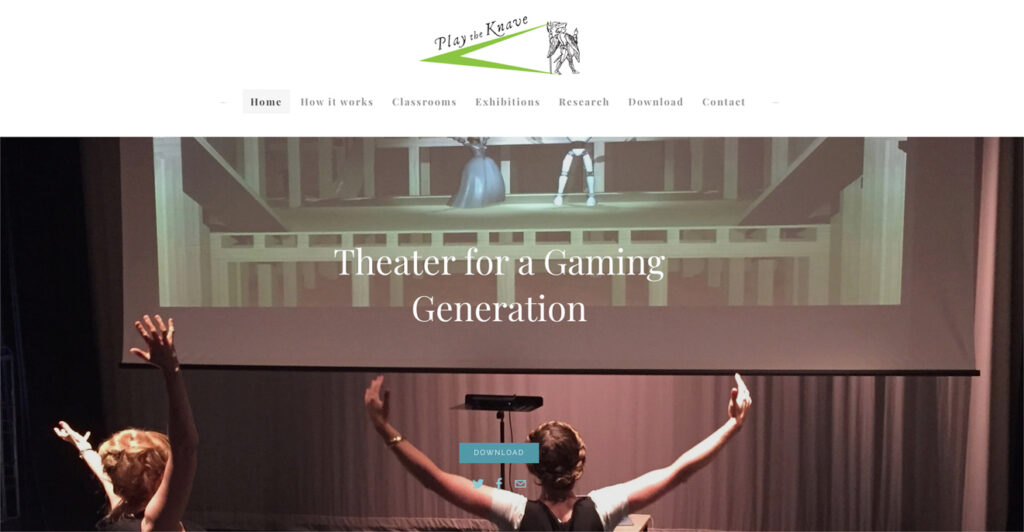
Play the Knave is a video game that helps users design actor-avatars they can direct with their bodies around virtual theater spaces. Shakespeare-VR is a project-in-development that will enable users to don a VR headset, step on to a virtual Elizabethan stage and perform alongside avatars voiced by professional actors.

Play the Knave* is a mixed reality video game that enables virtual design and performance of dramatic scenes from Shakespeare--or any text you choose


Radar Trends to Watch: July 2022 — from oreilly.com
Developments in AI, Metaverse, Programming, and More

Excerpt (emphasis DSC):

The most important issue facing technology might now be the protection of privacy. While that’s not a new concern, it’s a concern that most computer users have been willing to ignore, and that most technology companies have been willing to let them ignore. New state laws that criminalize having abortions out of state and the stockpiling of location information by antiabortion groups have made privacy an issue that can’t be ignored.

Also relevant/see:


The Metaverse in 2040 — from pewresearch.org by Janna Anderson and Lee Rainie
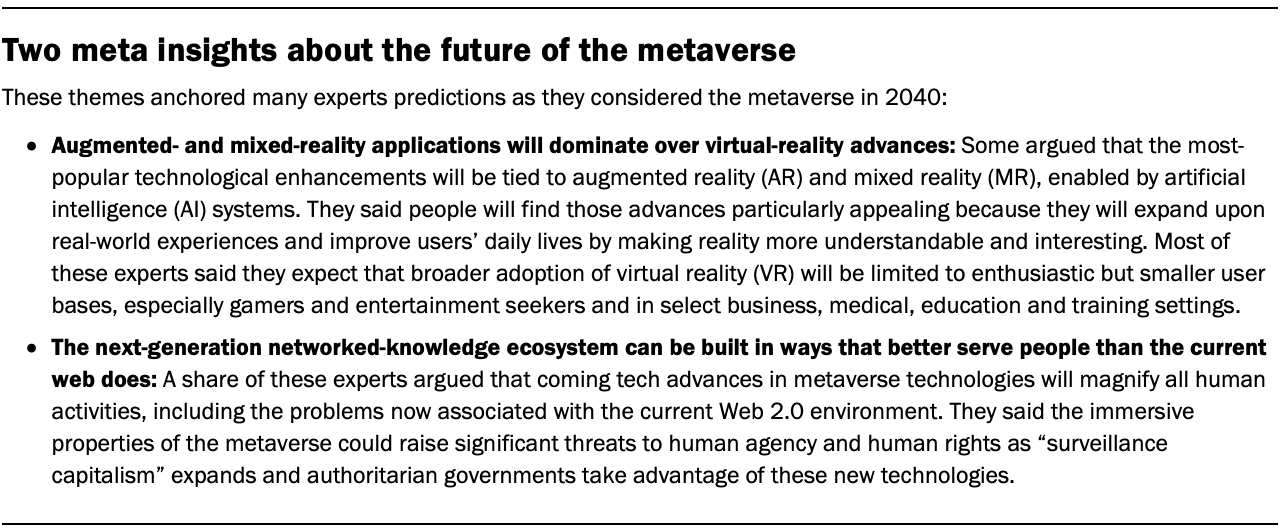
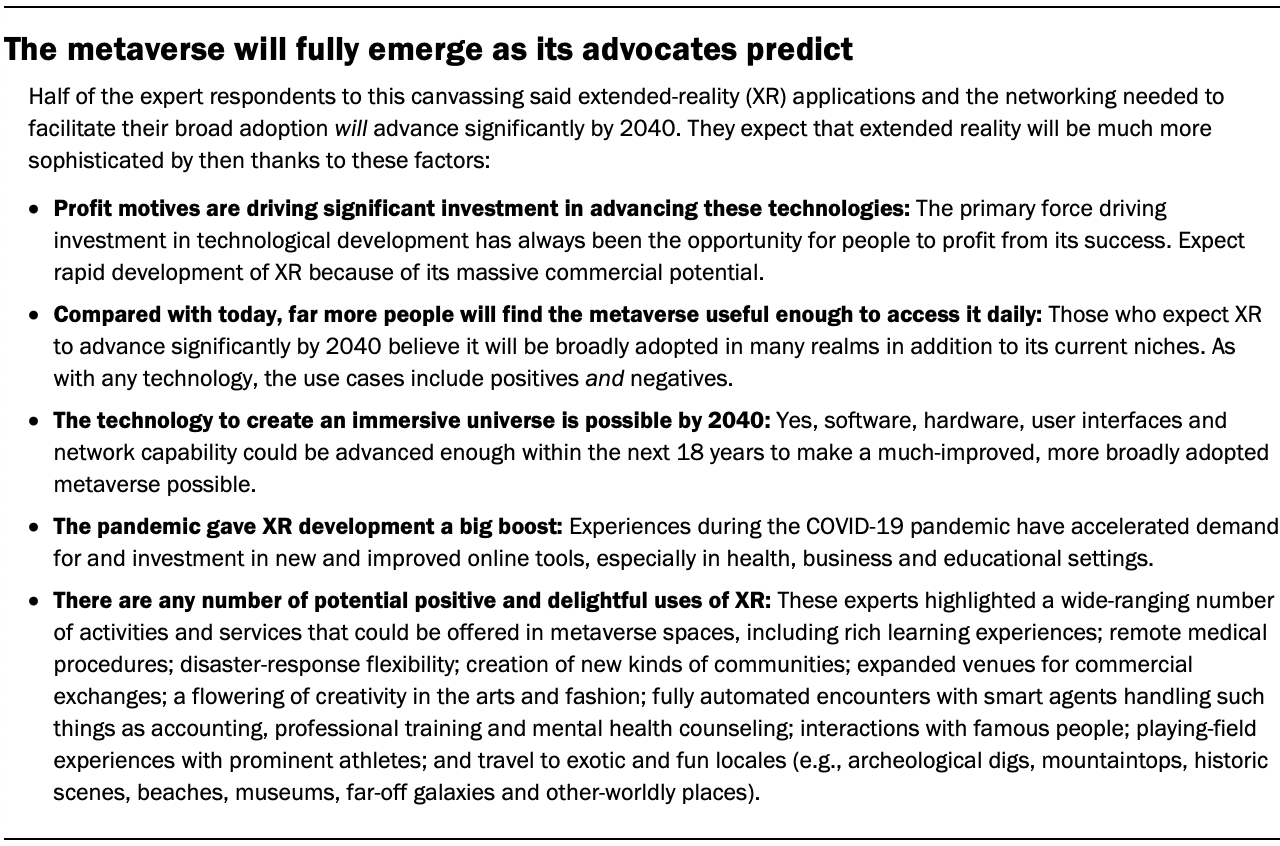
Hype? Hope? Hell? Maybe all three. Experts are split about the likely evolution of a truly immersive ‘metaverse.’ They expect that augmented- and mixed-reality enhancements will become more useful in people’s daily lives. Many worry that current online problems may be magnified if Web3 development is led by those who built today’s dominant web platforms


The metaverse will, at its core, be a collection of new and extended technologies. It is easy to imagine that both the best and the worst aspects of our online lives will be extended by being able to tap into a more-complete immersive experience, by being inside a digital space instead of looking at one from the outside.

Laurence Lannom, vice president at the Corporation for National Research Initiatives

“Virtual, augmented and mixed reality are the gateway to phenomenal applications in medicine, education, manufacturing, retail, workforce training and more, and it is the gateway to deeply social and immersive interactions – the metaverse.

Elizabeth Hyman, CEO for the XR Association


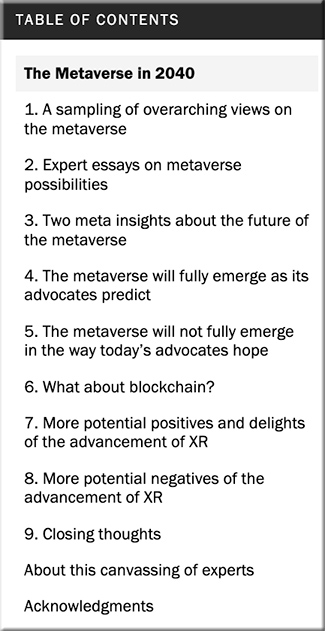
The table of contents for the Metaverse in 2040 set of articles out at Pew Research dot org -- June 30, 2022


AI Plus VR at Purdue University Global — from er.educause.edu by Abbey Elliott, Michele McMahon, Jerrica Sheridan, and Gregory Dobbin
Adding artificial intelligence to virtual reality provides nursing students with realistic, immersive learning experiences that prepare them to treat patients from diverse backgrounds.

Excerpt:

Adding artificial intelligence (AI) to immersive VR simulations can deepen the learning by enabling patient interactions that reflect a variety of patient demographics and circumstances, adjusting patient responses based on students’ questions and actions. In this way, the immersive learning activities become richer, with the goal of providing unique experiences that can help students make a successful transition from student to provider in the workforce. The use of AI and immersive learning techniques augments learning experiences and reinforces concepts presented in both didactic and clinical courses and coursework. The urgency of the pandemic prompted the development of a vision of such learning that would be sustainable beyond the pandemic as a tool for education on a relevant and scalable platform.


Speaking of emerging technologies and education/learning, also see:

NVIDIA's new AI magic turns 2d photos into 3D graphics

Best virtual tours of Ireland


Will Learning Move into the Metaverse? — from learningsolutionsmag.com by Pamela Hogle

Excerpt:

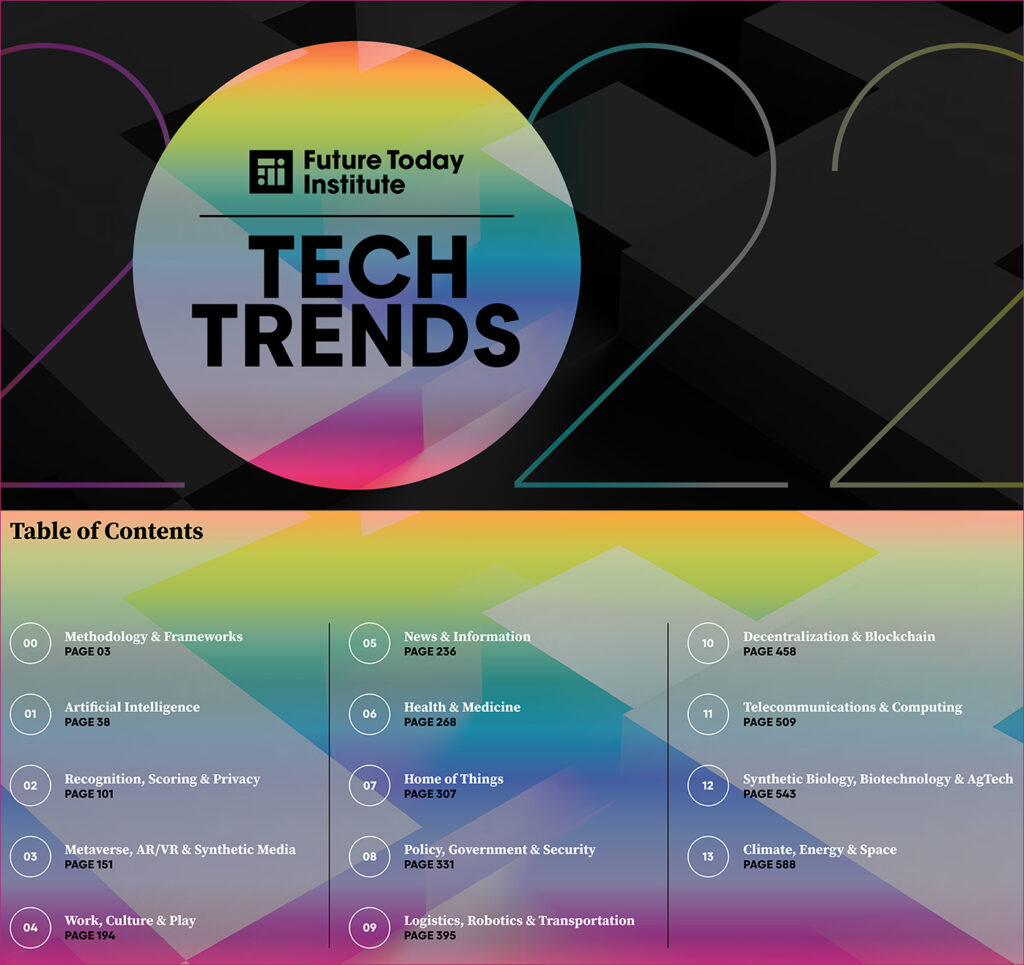
In its 2022 Tech Trends report, the Future Today Institute predicts that, “The future of work will become more digitally immersive as companies deploy virtual meeting platforms, digital experiences, and mixed reality worlds.”

Learning leaders are likely to spearhead the integration of their organizations’ workers into a metaverse, whether by providing training in using the tools that make a metaverse possible or through developing training and performance support resources that learners will use in an immersive environment.

Advantages of moving some workplace collaboration and learning into a metaverse include ease of scaling and globalization. The Tech Trends report mentions personalization at scale and easy multilingual translation as advantages of “synthetic media”—algorithmically generated digital content, which could proliferate in metaverses.

Also see:

Future Institute Today -- Tech Trends 2022


Also from learningsolutionsmag.com, see:

Manage Diverse Learning Ecosystems with Federated Governance

Excerpt:

So, over time, the L&D departments eventually go back to calling their own shots.

What does this mean for the learning ecosystem? If each L&D team chooses its own learning platforms, maintenance and support will be a nightmare. Each L&D department may be happy with the autonomy but learners have no patience for navigating multiple LMSs or going to several systems to get their training records.

Creating common infrastructure among dispersed groups
Here you have the problem: How can groups that have no accountability to each other share a common infrastructure?


Conduct Your Own Virtual Orchestra In Maestro VR — from vrscout.com by Kyle Melnick

Niantic moves beyond games with Lightship AR platform and a social network — from theverge.com by Alex Heath
The maker of Pokémon Go is releasing its AR map for other apps and a location-based social network called Campfire

Excerpt:

Niantic made a name for itself in the mobile gaming industry through the enduring success of Pokémon Go. Now the company is hoping to become something else: a platform for other developers to build location-aware AR apps on top of.

disguise launches Metaverse Solutions division enabling next-level extended reality experiences — from etnow.com

Excerpt:

UK – disguise, the visual storytelling platform and market leader for extended reality (xR) solutions has launched its Metaverse Solutions division to enable the next generation of extraordinary live, virtual production and audiovisual location-based experiences for the metaverse.

The recent rise of real-time 3D graphics rendering capabilities in gaming platforms means that today’s audiences are craving richer, more immersive experiences that are delivered via the metaverse. While the metaverse is already defined as an $8 trillion dollar opportunity by Goldman Sachs, companies are still finding it challenging to navigate the technical elements needed to start building metaverse experiences.

On this item, also see:

disguise.one

disguise launches Metaverse Solutions division — from televisual.com by

Excerpt:

“Our xR technology combines key metaverse building blocks including real-time 3D graphics, spatial technologies and advanced display interfaces – all to deliver a one-of-a-kind gateway to the metaverse,” says disguise CXO and head of Metaverse Solutions Alex Wills.


From DSC:
The report below contains some great examples of a few of the elements in a learning ecosystem! Though there are many other elements in a learning ecosystem, tools and technologies are certainly two key components of one.

Some of the topics in this report at:

  • Knowledge bases and knowledge management technology
  • Microlearning
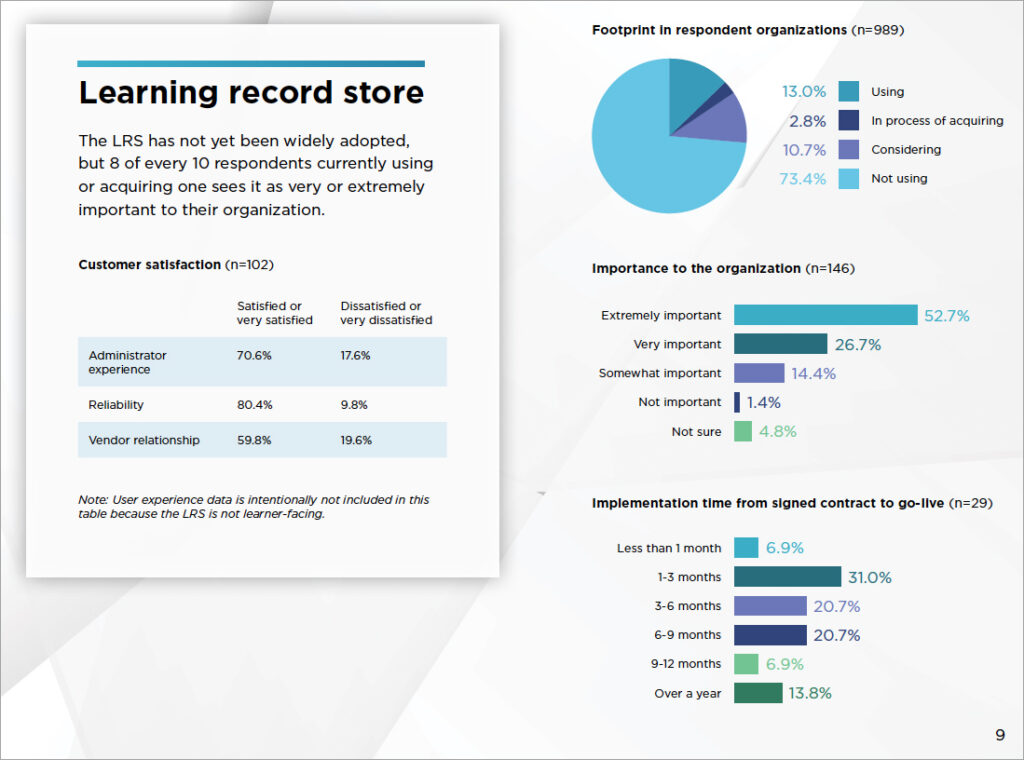
  • Learning record store
  • Learning Experience Platform (LXP)
  • Augmented reality / Virtual reality (AR/VR)
  • Adaptive learning / Intelligent tutor
  • Technology stack

2022 Trends in Learning Technology — from learningguild.com by Steve Foreman

Excerpt:

In this research report, Steve Foreman analyzes recent survey findings to examine eight learning technologies and explore how they impact the L&D space, organizations, customer satisfaction, and more.

This image contains some information regarding the learning record store


SXSW EDU Launch Winner Our Worlds Bringing Native American Culture to Life Through Mobile-Based Immersive Reality — from the74million.org by Tim Newcomb

Excerpt:

Take a stroll along the La Jolla Shores Beach in San Diego, and you might find sand between your toes. But users of the new Our Worlds app, winner of the 2022 SXSW EDU Launch Competition, might also find much more. Through augmented reality, they can look at that same stretch of beach and see handmade tule boats from the local Kumeyaay tribe.

Our Worlds launched to highlight Native American history via modern-day technology, putting what founder and CEO Kilma Lattin calls “code to culture” and pushing Native American civilization forward. Lattin says Our Worlds offers a full suite of technology — virtual reality, augmented reality, artificial intelligence — to capture all the components that make a culture.


Apple’s first AR/VR headset inches closer to launch — from protocol.com by Nat Rubio-Licht
The company reportedly showed off the device to board members as it makes progress on the headset’s operating system.

Camp K12 Launches Hatch Kids, a Metaverse & AR/VR Creation Platform for Kids — from edtechreview.in by Stephen Soulunii

….


© 2025 | Daniel Christian