Visions of the Internet in 2035 — from pewresearch.org

Excerpt:

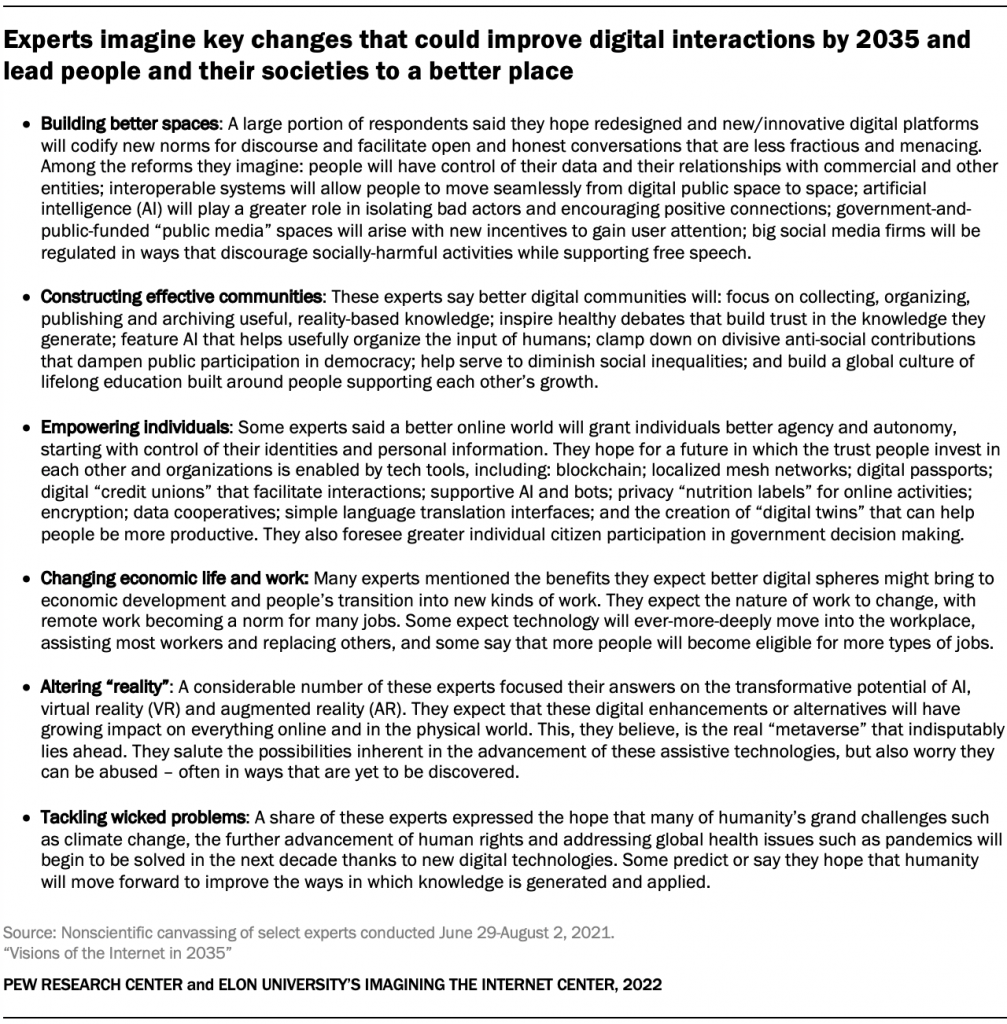
This report is the second of two analyzing the insights of hundreds of technology experts who responded in the summer of 2021 to a canvassing of their predictions about the evolution of online public spaces and their role in democracy in the coming years. In response to the primary research question, many said they expect that these forums will be significantly improved by 2035 if reformers, big technology firms, governments and activists tackle the problems created by misinformation, disinformation and toxic discourse. At the same time, they expressed ongoing concerns about the destructive forces in culture and technology that could continue to plague online life and disrupt beneficial change in the coming years.

Visions of the Internet in 2035


As seen/accessible from this page.

A brief insert from DSC:
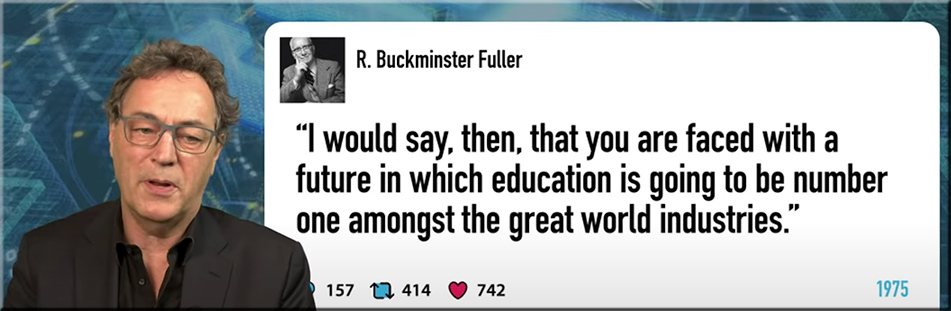
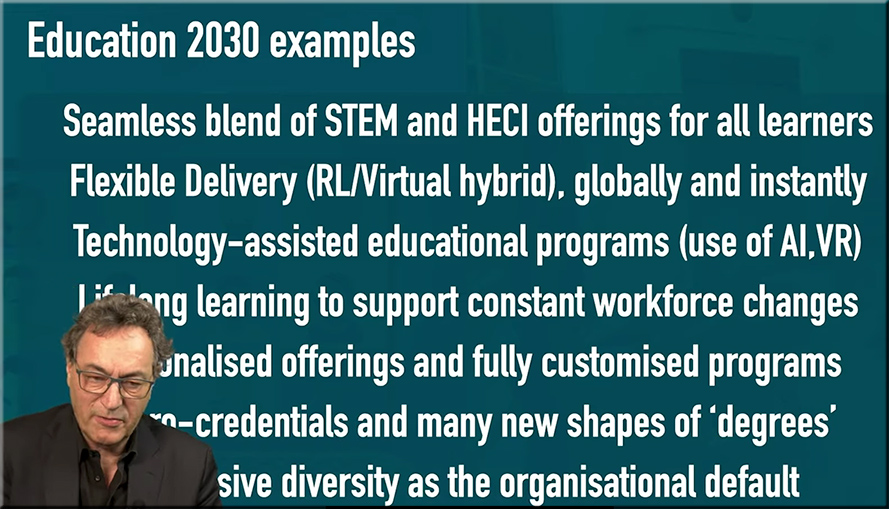
Another futurist Thomas Frey has some thoughts along this same line.

A top futurist predicts the largest internet company of 2030 will be an online school

#Canada #education #future #trends #careerdevelopment #change #paceofchange #automation #robotics #education #AI #learnhowtolearn #unlearn #learningecosystems #lifelonglearning #endofroutine #experientiallearning


Machines are for answers. Humans are for questions. 


Also relevant/see:


The metaverse: three legal issues we need to address — from theconversation.com by Pin Lean Lau

Excerpt:

The “metaverse” seems to be the latest buzzword in tech. In general terms, the metaverse can be viewed as a form of cyberspace. Like the internet, it’s a world – or reality, even – beyond our physical world on Earth.

The difference is that the metaverse allows us to immerse a version of ourselves as avatars in its environment, usually through augmented reality (AR) or virtual reality (VR), which people are and will increasingly be able to access using tools like VR goggles.

While it all seems very exciting, a curious lawyer like me is inclined to ask: who or what governs the metaverse? The way I see it, there are three key areas which, at this stage, are legally murky.

From DSC:
There are a lot more than three legal issues to be addressed with the metaverse, especially as it further develops. That said, I posted this in the hopes of raising the level of awareness within the legal arena on this particular area of emerging technologies. 


22 Augmented Reality Trends to Keep an Eye on for 2022 — from linkedin.com by Tom Emrich

Excerpts:

#1 Metaverse remains at peak hype as the next iteration of the Internet feels so close but is actually much further away

#2 The smartphone continues to become an even more powerful augmented reality machine with advancements in chips, displays and connectivity

#3 Early consumer smartglasses reinforce the need for smartphones rather than attempt to replace them

The metaverse is defined differently by different people but for me, the metaverse is an aha moment. It is a realization by industry that the next wave of computing is comprised of a stack of emerging technologies (including blockchain, AI, IoT, AR and VR) that will all work together to create a fundamental shift in our relationship with technology. 


Also see:


6 Ed Tech Tools to Try in 2022 — from cultofpedagogy.com by Jennifer Gonzalez

Excerpts:

This year, for the very first time, I hired a team of ed tech experts to help me with the update. The task was becoming overwhelming and I knew if I was going to keep it up, I had to have some help. Here they are below: Marnie Diem, Brandie Wright, Lucia Hassell, and Kim Darche.
…

5. EVERFI
everfi.com/k-12

Originally a site that offered free financial literacy courses to students, EVERFI has expanded its course offerings to include career exploration (including one specific to STEM careers), social and emotional learning, diversity and inclusion, and health and wellness. Their newest additions are courses in healthcare literacy, data science and banking fraud, and compassion and empathy.


From DSC:
Here’s a brief example of what teaching & learning could like in the metaverse. I realize this is just one example, and there will likely be a variety of options and formats…but it’s an interesting thought experiment.


School in the metaverse: How tech and the pandemic are changing online education — from protocol.com by David Pierce
Coursera’s CEO and chief content officer see a future of learning that’s more on-demand, more personalized and more immersive.

Excerpts:

Maggioncalda and Coursera Chief Content Officer Betty Vandenbosch joined the Source Code podcast to talk about the chaotic state of online education, what’s next for corporate training, how softer skills are becoming part of the work curriculum, how learning might work in the metaverse and much more.

“We know, broadly, that learning will become more available, it’ll be more online, and there’ll be a lot more people learning for a lot more of their lives,” said Coursera CEO Jeff Maggioncalda.


What’s ahead for AI, VR, NFTs, and more? — from oreilly.com by Mike Loukides
Here are some predictions for tech in 2022.

Excerpt:

Just as we saw new professions and job classifications when the web appeared in the ’90s, we’ll see new professions and services appear as a result of AI—specifically, as a result of natural language processing. We don’t yet know what these new professions will look like or what new skills they’ll require. But they’ll almost certainly involve collaboration between humans and intelligent machines.

Also see:

  • How A.I. is set to evolve in 2022 — from cnbc.com by Sam Shead
    Key Points: 
    * AI can excel at specific narrow tasks such as playing chess but it struggles to do more than one thing well.
    * While AI still has a long way to go before anything like human-level intelligence is achieved, it hasn’t stopped the likes of Google, Facebook and Amazon investing billions of dollars.
 

14 Predictions for Higher Education in 2022 [Schaffhauser]

14 Predictions for Higher Education in 2022

14 Predictions for Higher Education in 2022 — from campustechnology.com by Dian Schaffhauser

Excerpt:

Ask people working in higher education what they expect will happen in the new year, and the outlook is filled with visions that build on what we’ve been experiencing on college and university campuses for the last two years: a major focus on learning formats; continued exploitation of new technology; and the use of new digital models that move users “beyond Zoom.” Here we present the collective predictions of 14 IT leaders, instructional folks and a student about what they anticipate seeing in 2022. As one put it, “Let’s go, 2022! We have work to do!”

From DSC:
I’d like to thank Dian Schaffhauser, Rhea Kelly, and Mary Grush for letting me contribute some thoughts to the various conversations that Campus Technology Magazine hosts and/or initiates. I inserted some reflections into the above article and I hope that you’ll take a moment to read my and others’ thoughts out there.


This wild new display puts a gargantuan 120-inch virtual monitor on your desk — from digitaltrends.com by Drew Prindle

It’s impressive to behold, and honestly a bit difficult to describe. The best comparison I can muster is that it feels like sitting in front of a huge VR headset designed for a giant, but rather than wearing it, you’re peering into the display from a short distance away. The concave screen fills your field of vision much like a large, curved gaming monitor might, but doesn’t block out the outside world entirely as most VR headsets do.


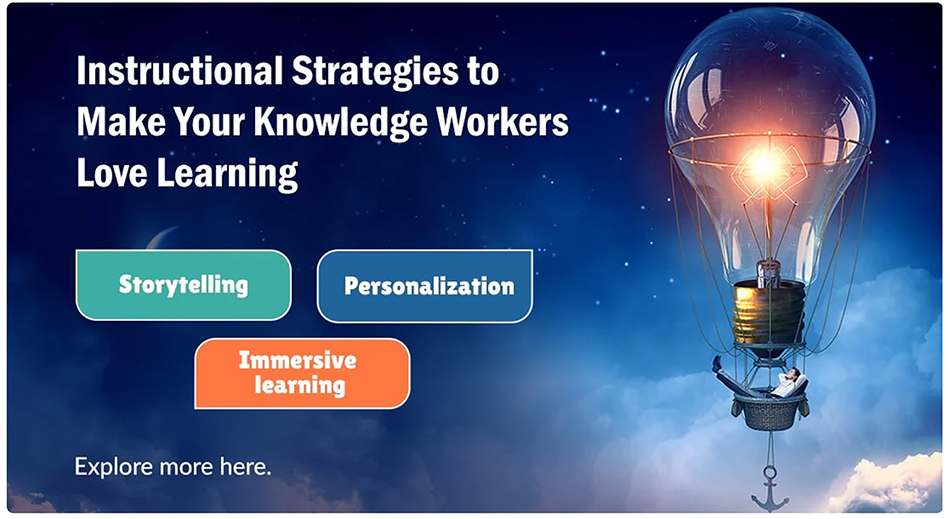
Make your knowledge workers love learning through storytelling, personalization, and immersive learning

Instructional strategies to make your knowledge workers love learning — from blog.commlabindia.com

Excerpt:

As a training manager, you need to step up your game to cater to the corporate training needs of these thinkers. Functional and creative instructional strategies should be used to engage learners and offer sticky learning, in the classroom and online. The strategies need to involve learners emotionally, offer an experiential set up, and appeal to their creative side.


Frequently Asked Questions About Metaverse — from 101blockchains.com by Georgia Weston

You can also discover many other interesting use cases of the metaverse, such as creating virtual learning spaces or virtual tourism. 


Also see:

Top 5 Blockchain And Crypto Projects In The Metaverse — from 101blockchains.com by Georgia Weston


Also see:


Web 3.0 vs Metaverse: What’s the difference? — from homo-digitalis.net by Fabian Schmidt

Excerpt:

So what is Web 3.0?

On Twitter, a user asked if someone could explain the term in baby talk. I thought one answer was good:

    • Web 1.0 = Read
    • Web 2.0 = Read/Write
    • Web 3.0 = Read/Write/Own

This is a sufficient simplification to gain an initial understanding. Yet a bit more information is still important.

Let’s get one thing straight right away. As with all things in the making, there is not yet a clear-cut definition of Web 3.0. Tim Berners-Lee, the inventor of the classic web, thinks of the semantic web as the next big step.
…
Since 2020/2021, there is another idea of Web3, and it is inspired by a new form of technology: Blockchains. At its core is a new wave of decentralization.

Besides decentralization, other key topics related to Web 3.0 include Decentralized Autonomous Organizations (DAO), Non-fungible-tokens (NFT), and Decentralized Finance (DeFi).

The metaverse is a digital world that is meant to feel as real as possible and can represent all concerns of human existence. From leisure to work.

Fabian Schmidt, Homo Digitalis, 2021


Bill Gates: Most Work Meetings Will Happen In The Metaverse In 3 Years — from vrscout.com by Kyle Melnick

Excerpt:

“Within the next two or three years, I predict most virtual meetings will move from 2D camera image grids—which I call the Hollywood Squares model, although I know that probably dates me—to the metaverse, a 3D space with digital avatars,” said Gates in the post. “Both Facebook and Microsoft recently unveiled their visions for this, which gave most people their first view of what it will look like”.


Adidas to enter the metaverse with first NFT products — from dezeen.com by Rima Sabina Aouf

Excerpt:

Adidas has announced its next collection will be a mix of digital and physical items, and will be sold as NFTs produced with collaborators such as Bored Ape Yacht Club.

Titled Into the Metaverse, the collection will comprise virtual wearables that buyers can use in online platforms, but also the physical clothing to match.

It is Adidas’ first collection of NFTs, or non-fungible tokens – essentially, digital collectibles with proven authenticity. NFTs act as a blockchain-based certificate of ownership, allowing pieces to be authenticated, bought and collected.


How Coinbase thinks about the Metaverse — from blog.coinbase.com by Brian Armstrong & Alex Reeve

Excerpt:

Primitive Metaverse platforms are selling virtual land for millions of dollars. Billions more are being invested in Metaverse startups. And Mark Zuckerberg recently renamed his entire company to reflect a focus on building the Metaverse.
…
Recently, our team put together an internal presentation about the Metaverse, who’s working on it, and how crypto will help make it real. I thought the presentation was well done, so I’m sharing most of the slides here.
…
Like Matt[hew Ball], we define the Metaverse as:

The future of the internet: A massively-scaled, persistent, interactive, and interoperable real-time platform comprised of interconnected virtual worlds where people can socialize, work, transact, play, and create.
…
The Metaverse is the distant evolution of Web3. In its most complete form, it will be a series of decentralized, interconnected virtual worlds with a fully functioning economy where people can do just about anything they can do in the physical world.
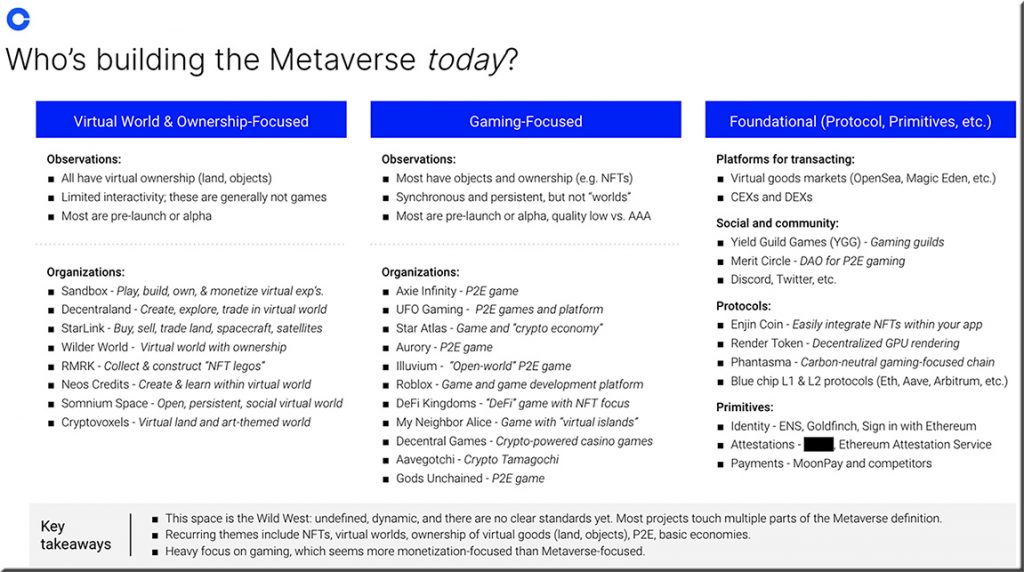
Who is building the Metaverse today?

 
© 2025 | Daniel Christian