Some announcements from NVIDIA today:


Nvidia unveils server CPU to challenge Intel and AMD in the data center — from protocol.com by Max A. Cherney
Nvidia’s CEO Jensen Huang announced the company’s next-generation GPU architecture and a new CPU Tuesday.

The new Grace processor is designed for AI, high-performance computing and hyperscale data center applications.

Nvidia launched a mapping product for the autonomous vehicle industry — from techcrunch.com by Rebecca Bellan

Nvidia has launched a new mapping platform that will provide the autonomous vehicle industry with ground truth mapping coverage of over 300,000 miles of roadway in North America, Europe and Asia by 2024, founder and CEO Jensen Huang said at the company’s GTC event on Tuesday.

NVIDIA Launches AI Computing Platform for Medical Devices — from hitconsultant.net by Jasmine Pennic

Nvidia Unveils AI Chips and Software, Plus Tools for Creating Virtual Worlds — by Eric Savitz and Conor Smith

Excerpt:

Nvidia is doubling down on artificial-intelligence  technology that CEO Jensen Huang predicts will revolutionize every industry.

In the keynote speech for the annual Nvidia GTC conference—the acronym once stood for GPU Technology Conference, a reference to the company’s roots in graphics processing chips—Huang focused specifically on expanding the company’s portfolio of AI-focused chips and software applications.

Nvidia CEO lays out plans after Arm deal fell through, reveals new Hopper GPU — from marketwatch.com by Jeremy C. Owens
Roadmap seems little changed after chip maker ditched $40 billion acquisition of designer Arm, with new GPUs and first server CPU still on track as EV makers sign on for autonomous-driving tech


Addendum 3/26/22:

Nvidia’s Clara Holoscan MGX means to bring high-powered AI to the doctor’s office — from techcrunch.com


Addendum 3/28/22:

Nvidia’s $1 trillion ambitions draw cheers as software becomes a bigger piece of the pie — from marketwatch.com
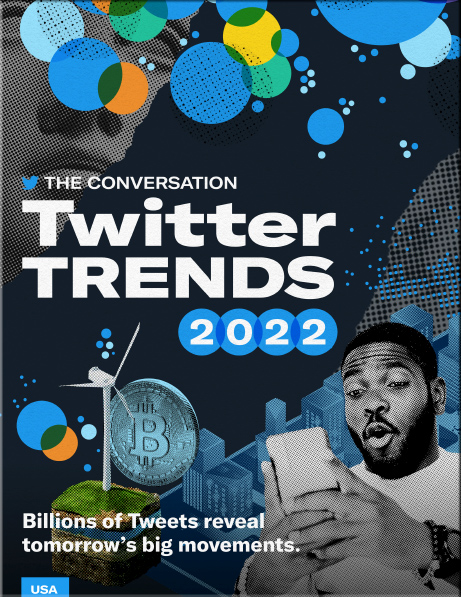
 

The Conversation: Twitter Trends 2022 -- from marketing.twitter.com

The Conversation: Twitter Trends 2022 — from marketing.twitter.com

Excerpt:

Billions of Tweets reveal tomorrow’s big movements. 

The biggest movements start quietly. An idea becomes conversation becomes a seismic cultural shift. And if you want in on what’s next, listen to what people on Twitter are saying right now. 

To help you out, we analyzed1 billions of Tweets over a two-year period to find three must-know trends about to go big. From The Great Restoration to Fan-Built Worlds to Finance Goes Social, the talk on Twitter reveals the underlying shifts in power shaping where the world is going. 


How Virtual Reality Can Be More Accessible with WalkinVR — from equalentry.com by Meryl Evans

Excerpt:

In another scenario, you can’t reach up high. Or maybe you can’t hold the virtual reality controllers or press the buttons.

WalkinVR Driver  fills in the gap. It’s a free driver that enhances virtual reality to work with the person’s abilities and preferences. One option is the Xbox Controller Move , which allows you to connect a standard Xbox video game controller to the game.

Also relevant/see:

Which Types of Colleges Have the Most Undergraduates With Disabilities? — from chronicle.com

Excerpt:

Here’s a sector-by-sector look at the percentage of undergraduates who reported a disability to the campus’s office of disability services, or a similar office, in the academic years 2016-17 to 2019-20. Undergraduate students with disabilities are those who reported that they had one or more of the following conditions: a specific learning disability, a visual impairment, a hearing difficulty or deafness, a speech impairment, an orthopedic impairment, or another health impairment. The diversity and related offices provide these students with such services as note-takers and American Sign Language interpreters.

Addendum later on 3/17/22:

Assistive technology personalizes the learning environment — from thetechedvocate.org by Matthew Lynch

Excerpt:

We talk a lot about personalized learning and how it can benefit learners by providing them with more detailed instruction catered to their needs. It helps them overcome learning challenges and achieve their educational goals.

We’ve also discussed assistive technologies – technologies designed to aid students with learning difficulties and other disabilities, understand and retain knowledge to improve their learning outcomes. The two can go hand-in-hand, as assistive technology can help all students receive a more personalized learning experience.

Let’s take a look at some of the ways that AT is used in the classroom and its personalized learning.


Math worksheets for the learning process — from intelligenthq.com

Excerpt:

If you want to master the subject of mathematics, constant practice of various topics is a must. To ensure that you have the proper grasp of all the topics of the subject, solving worksheets for math is one of the best techniques. Worksheets for math facilitate the stepwise mechanism which enhances the learning process and helps students identify their mistakes. Once they can recognize what their mistakes are, they can work on improving them. Worksheets for math also have visual problems that help in the visualization process of students and make their analyzing and strategic capability high. Take worksheets for math from Cuemath and excel in math.

Also see:

Master Math with Cuemath's live, online-based classes


Also relevant/see:

In New Math Proofs, Artificial Intelligence Plays to Win — from quantamagazine.org; with thanks to Alec Lazarescu on Twitter for this resource
A new computer program fashioned after artificial intelligence systems like AlphaGo has solved several open problems in combinatorics and graph theory.


Universities reimagine teaching labs for a virtual future — from edtechmagazine.com by Renee Morad
Schools are replacing take-home lab kits with more advanced virtual options that allow students to access industry-grade equipment.

Excerpt:

Soon after, engineering professors at Morgan State began using more advanced virtual lab options, which allowed students to access industry-grade lab equipment. The students could use an oscilloscope, a digital multimeter, a power supply and a function generator. The students logged on remotely to a cloud-based platform and followed the instructor’s video feed to get real-time guidance and feedback.

As the global pandemic forced professors and department chairs to adapt to a new learning frontier, it shined a spotlight on new methods to remotely replicate the in-person lab experience. It shifted the university lab from a traditional learning center to a futuristic innovation hub.

From DSC:
Also interesting here, see:

Keysight University courses will advance your knowledge of precision digital and RF measurement approaches, the latest industry standards, compliance, power, and more.

Also relevant here, see:

  • U San Diego Nursing Students to Learn Clinical Skills in VR — from campustechnology.com by Rhea Kelly
    Excerpt:
    The University of San Diego is rolling out virtual reality technology in its nursing curriculum to help prepare students for real-world clinical scenarios. The VR tools will enable students to learn and practice clinical skills in a low-risk setting, as well as reduce their anxiety when interacting with live patients, according to a news announcement.
 

Resetting the learning function to a virtual-first approach — from chieflearningofficer.com by Stephanie Webb, Bob Tweedie

Excerpts:

We recommend embracing a “virtual-first” learning approach, supercharging the empathy in our proven learning toolkit with design thinking, and intentionally incorporating more human connection into learning through the direct involvement of learners’ managers.

“Just as some companies have adopted a “remote-first” employment model, learning teams need to move to a “virtual-first” approach to design to provide the level of predictability needed to produce high-quality work for learners and the business.”


The Metaverse Will Radically Change Content Creation Forever — from forbes.com by Falon Fatemi

Excerpt:

Although the metaverse promises to touch nearly every person in our society, there’s one demographic that will almost certainly see disproportionately strong disruption: creators. The metaverse has the potential to fundamentally disrupt the content creation process.

The metaverse is slated to help creators make more interactive and immersive content, thanks in large part to advances in VR and AR. The stakes will be raised as creators will be expected to build more immersive and interactive content than ever before.

Also related/see:

The Amazing Possibilities Of Healthcare In The Metaverse — from forbes.com by Bernard Marr

Excerpts:

What’s generally agreed on, however, is that it’s effectively the next version of the internet – one that will take advantage of artificial intelligence (AI), augmented reality (AR), virtual reality (VR), and ever-increasing connectivity (for example, 5G networks) to create online environments that are more immersive, experiential and interactive than what we have today.

Metaverse involves the convergence of three major technological trends, which all have the potential to impact healthcare individually. Together, though, they could create entirely new channels for delivering care that have the potential to lower costs and vastly improve patient outcomes. These are telepresence (allowing people to be together virtually, even while we’re apart physically), digital twinning, and blockchain (and its ability to let us create a distributed internet).

From DSC:
That last paragraph could likely apply to our future learning ecosystems as well. Lower costs. A greater sense of presence. Getting paid for one’s teaching…then going to learn something new and paying someone else for that new training/education.


MUHC uses artificial intelligence to train neurosurgery students — from montreal.ctvnews.ca by Rob Lurie

Excerpt:

“I think above all it just provides an opportunity for junior learners to get some hands-on exposure,” said medical student Ali Fazlollahi.
…
“Basically, it was inspired by the idea of how do we prevent error in the operating room,” said Neurosurgeon Dr. Rolando De Maestro. Maestro says virtual reality has been a game-changer when it comes to teaching.


The future of AR — from 900lbs.com

Some of the topics include:

  • Where is #AR today and where’s it going? 
  • What options/deployment methods are available & what are their limitations?
  • Web AR
  •  We’ve heard a lot about AR headsets. Are they the best option?
  • Ok, I’m interested in creating an AR experience. What now? 
  • What is the biggest piece of advice you have for brands diving into AR for the first time?
  • …and more

Also see:


Why the World’s First Virtual Reality High School Changes Everything — from steve-grubbs.medium.com by Steve Grubs

Excerpts:

The recipe required key ingredients to happen. In addition to an accredited school to manage students, admissions and the for-credit learning, it also needed a platform. That’s where EngageVR comes in. There are other platforms that will ultimately host schools, perhaps AltSpace, Horizon or others, but the first is on Engage.
…
The bottom line is this: creators, coders, educators, entrepreneurs, investors, corporations, parents and students all played a role in finally bringing the first global virtual reality high school to life. It won’t be the last school to open in the metaverse, but to all those involved in this inaugural launch — the Neil Armstrongs of your age — a special tip of the hat today for having the vision and the willingness to launch a better and more equitable era of education.

Also see:

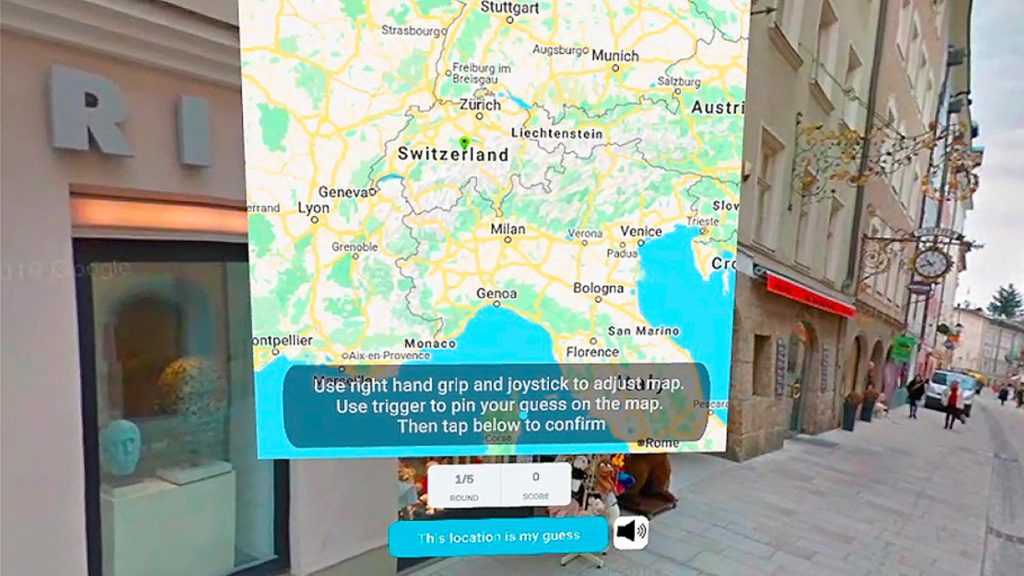
This is a snapshot from the Geo Guesser VR game


A Voice For Virtual Reality: The Advocate’s Role | Accessibility VR Meetup Recap — from equalentry.com by Heather Bucalos

Excerpt:

The discomfort she experienced during cancer treatment led her on a search for better relief of common cancer treatment side effects. The idea to use VR during her own treatment proved beneficial for her as she is now a fierce advocate of VR in healthcare. She has pivoted to consulting in the VR for healthcare space and is excited about the way virtual reality is changing lives one headset at a time.

Here are some of the highlights from this presentation:


A whole new world: Education meets the metaverse — from brookings.edu by Kathy Hirsh-Pasek, Jennifer M. Zosh, Helen Shwe Hadani, Roberta Michnick Golinkoff, Kevin Clark, Chip Donohue, and Ellen Wartella

Excerpt:

The metaverse is upon us. Soon it will be as omnipresent as TikTok, Instagram, and Facebook (now Meta). As technology advances to bring us new immersive and imaginary worlds, how we educate children and prepare teachers must also advance to meet these new opportunities. When education lags the digital leaps, the technology rather than educators defines what counts as educational opportunity. This is largely what happened with the introduction of “educational” apps designed to be used on smartphones and tablets meant for adults. Today, as the metaverse infrastructure is still under construction, researchers, educators, policymakers, and digital designers have a chance to lead the way rather than get caught in the undertow. To leverage the potential of the metaverse as a 3D, global, interconnected, immersive, and real-time online space, we need new ways to connect the physical world with augmented and virtual reality (VR) experiences.

In the end, we challenge those creating educational products for the metaverse to partner with educators and scientists to ensure that children experience real human social interaction as they navigate virtual spaces, children’s agency is supported as they explore these spaces, and there is a real eye to diversity in the representation and access to what is created.  

Also relevant/see:

The metaverse can provide a whole new opportunity for education. Here’s what to consider — from fastcompany.com by Stephen Fromkin
The cofounder of Talespin looks at an existing immersive learning program that delivers results and says our next priority should be getting it into the hands of as many learners as possible through the metaverse.


Holograms? Check! Now what? — from blog.webex.com by Elizabeth Bieniek

Excerpt (emphasis DSC):

Two years ago, I wrote about the Future of Meetings in 2030 and hinted at an effort my team was building to make this a reality. Now, we have publicly unveiled Webex Hologram and brought the reality of a real-time, end-to-end holographic meeting solution to life.

With Webex Hologram, you can feel co-located with a colleague who is thousands of miles away. You can share real objects in incredible multi-dimensional detail and collaborate on 3D content to show perspective, share, and approve design changes in real-time, all from the comfort of your home workspace.

As the hype dies down, the focus on entirely virtual experiences in fanciful environments will abate and a resurgence in focus on augmented experiences—interjecting virtual content into the physical world around you for an enhanced experience that blends the best of physical and virtual—will emerge.

The ability to have curated information at one’s fingertips, still holds an incredible value prop that has yet to be realized. Applying AI to predict, find, and present this type of augmented information in both 2D and 3D formats will become incredibly useful. 

From DSC:
As I think of some of the categories that this posting about establishing a new kind of co-presence relates to, there are many relevant ones:

  • 21st century
  • 24x7x365
  • 3D
  • Audio/Visual (A/V)
  • Artificial Intelligence (AI)
  • Cloud-based
  • Collaboration/web-based collaboration
  • Intelligent tutoring
  • Law schools, legal, government
  • Learning, learning agents, learning ecosystems, Learning from the Living [Class] Room, learning spaces/hubs/pods
  • Libraries/librarians
  • K-12, higher education, corporate training
  • Metaverse
  • Online learning
  • Telelegal, telemedicine
  • Videoconferencing
  • Virtual courts, virtual tutoring, virtual field trips
  • Web3
 

Exploring Virtual Reality [VR] learning experiences in the classroom — from blog.neolms.com by Rachelle Dene Poth

Excerpt:

With the start of a new year, it is always a great time to explore new ideas or try some new methods that may be a bit different from what we have traditionally done. I always think it is a great opportunity to stretch ourselves professionally, especially after a break or during the spring months.

Finding ways to boost student engagement is important, and what I have found is that by using tools like Augmented Reality (AR) and Virtual Reality (VR), we can immerse students in unique and personalized learning experiences. The use of augmented and virtual reality has increased in K-12 and Higher Ed, especially during the past two years, as educators have sought new ways to facilitate learning and give students the chance to connect more with the content. The use of these technologies is increasing in the workplace, as well.

With all of these technologies, we now have endless opportunities to take learning beyond what has been a confined classroom “space” and access the entire world with the right devices.

 
© 2025 | Daniel Christian