2. Concern and excitement about AI — from pewresearch.org by Jacob Poushter,Moira Faganand Manolo Corichi

Key findings

  • A median of 34% of adults across 25 countries are more concerned than excited about the increased use of artificial intelligence in daily life. A median of 42% are equally concerned and excited, and 16% are more excited than concerned.
  • Older adults, women, people with less education and those who use the internet less often are particularly likely to be more concerned than excited.

Also relevant here:


AI Video Wars include Veo 3.1, Sora 2, Ray3, Kling 2.5 + Wan 2.5 — from heatherbcooper.substack.com by Heather Cooper
House of David Season 2 is here!

In today’s edition:

  • Veo 3.1 brings richer audio and object-level editing to Google Flow
  • Sora 2 is here with Cameo self-insertion and collaborative Remix features
  • Ray3 brings world-first reasoning and HDR to video generation
  • Kling 2.5 Turbo delivers faster, cheaper, more consistent results
  • WAN 2.5 revolutionizes talking head creation with perfect audio sync
  • House of David Season 2 Trailer
  • HeyGen Agent, Hailuo Agent, Topaz Astra, and Lovable Cloud updates
  • Image & Video Prompts

From DSC:
By the way, the House of David (which Heather referred to) is very well done! I enjoyed watching Season 1. Like The Chosen, it brings the Bible to life in excellent, impactful ways! Both series convey the context and cultural tensions at the time. Both series are an answer to prayer for me and many others — as they are professionally-done. Both series match anything that comes out of Hollywood in terms of the acting, script writing, music, the sets, etc.  Both are very well done.
.


An item re: Sora:


Other items re: Open AI’s new Atlas browser:

Introducing ChatGPT Atlas — from openai.com
The browser with ChatGPT built in.

[On 10/21/25] we’re introducing ChatGPT Atlas, a new web browser built with ChatGPT at its core.

AI gives us a rare moment to rethink what it means to use the web. Last year, we added search in ChatGPT so you could instantly find timely information from across the internet—and it quickly became one of our most-used features. But your browser is where all of your work, tools, and context come together. A browser built with ChatGPT takes us closer to a true super-assistant that understands your world and helps you achieve your goals.

With Atlas, ChatGPT can come with you anywhere across the web—helping you in the window right where you are, understanding what you’re trying to do, and completing tasks for you, all without copying and pasting or leaving the page. Your ChatGPT memory is built in, so conversations can draw on past chats and details to help you get new things done.

ChatGPT Atlas: the AI browser test — from getsuperintel.com by Kim “Chubby” Isenberg
Chat GPT Atlas aims to transform web browsing into a conversational, AI-native experience, but early reviews are mixed

OpenAI’s new ChatGPT Atlas promises to merge web browsing, search, and automation into a single interface — an “AI-native browser” meant to make the web conversational. After testing it myself, though, I’m still trying to see the real breakthrough. It feels familiar: summaries, follow-ups, and even the Agent’s task handling all mirror what I already do inside ChatGPT.

OpenAI’s new Atlas browser remembers everything — from theneurondaily.com by Grant Harvey
PLUS: Our AIs are getting brain rot?!

Here’s how it works: Atlas can see what you’re looking at on any webpage and instantly help without you needing to copy/paste or switch tabs. Researching hotels? Ask ChatGPT to compare prices right there. Reading a dense article? Get a summary on the spot. The AI lives in the browser itself.

OpenAI’s new product — from bensbites.com

The latest entry in AI browsers is Atlas – A new browser from OpenAI. Atlas would feel similar to Dia or Comet if you’ve used them. It has an “Ask ChatGPT” sidebar that has the context of your page, and choose “Agent” to work on that tab. Right now, Agent is limited to a single tab, and it is way too slow to delegate anything for real to it. Click accuracy for Agent is alright on normal web pages, but it will definitely trip up if you ask it to use something like Google Sheets.

One ambient feature that I think many people will like is “select to rewrite” – You can select any text in Atlas, hover/click on the blue dot in the top right corner to rewrite it using AI.


Your AI Resume Hacks Probably Won’t Fool Hiring Algorithms — from builtin.com by Jeff Rumage
Recruiters say those viral hidden prompt for resumes don’t work — and might cost you interviews.

Summary: Job seekers are using “prompt hacking” — embedding hidden AI commands in white font on resumes — to try to trick applicant tracking systems. While some report success, recruiters warn the tactic could backfire and eliminate the candidate from consideration.


The Job Market Might Be a Mess, But Don’t Blame AI Just Yet — from builtin.com by Matthew Urwin
A new study by Yale University and the Brookings Institution says the panic around artificial intelligence stealing jobs is overblown. But that might not be the case for long.

Summary: A Yale and Brookings study finds generative AI has had little impact on U.S. jobs so far, with tariffs, immigration policies and the number of college grads potentially playing a larger role. Still, AI could disrupt the workforce in the not-so-distant future.


How a Gemma model helped discover a new potential cancer therapy pathway — from blog.google by Shekoofeh Azizi and Bryan Perozzi
We’re launching a new 27 billion parameter foundation model for single-cell analysis built on the Gemma family of open models.

Today, as part of our research collaboration with Yale University, we’re releasing Cell2Sentence-Scale 27B (C2S-Scale), a new 27 billion parameter foundation model designed to understand the language of individual cells. Built on the Gemma family of open models, C2S-Scale represents a new frontier in single-cell analysis.

This announcement marks a milestone for AI in science. C2S-Scale generated a novel hypothesis about cancer cellular behavior and we have since confirmed its prediction with experimental validation in living cells. This discovery reveals a promising new pathway for developing therapies to fight cancer.


Eye implant and high-tech glasses restore vision lost to age — from newscientist.com by Chris Simms
Age-related macular degeneration is a common cause of vision loss, with existing treatments only able to slow its progression. But now an implant in the back of the eye and a pair of high-tech glasses have enabled people with the condition to read again

People with severe vision loss have been able to read again, thanks to a tiny wireless chip implanted in one of their eyes and a pair of high-tech glasses.

“This is an exciting and significant study,” says Francesca Cordeiro at Imperial College London. “It gives hope for providing vision in patients for whom this was more science fiction than reality.”


Amazon’s AWS outage on October 20 knocked services like Alexa, Snapchat, Fortnite, Venmo and more offline for hours — from engadget.com by Kris Holt
A massive outage highlights why relying on a few companies to power much of the internet is far from ideal.

It felt like half of the internet was dealing with a severe hangover on October 20. A severe Amazon Web Services outage took out many, many websites, apps, games and other services that rely on Amazon’s cloud division to stay up and running.

Sites and services that were affected by the AWS outage include:

  • Amazon
  • Amazon Alexa
  • Bank of America
  • Snapchat
  • Reddit
  • Lyft
  • Apple Music
  • Apple TV
  • Pinterest
  • Fortnite
  • Roblox
  • The New York Times
  • Disney+
  • Venmo
  • Doordash
  • Hulu
  • Grubhub
  • PlayStation
  • Zoom

From DSC:
Hmmm…doesn’t this put a bit of alarm in your mind? I can’t help but wonder…if another government wants to wreak havoc on another country — or even the world — that is an increasingly possible situation these days. In fact, its already happened with social media and with cybersecurity-related issues. But taking down banking, commerce, exchanges, utilities, and more is increasingly possible. Or at least that’s my mental image of the state of cyberwarfare. 


The above posting on LinkedIn then links to this document


Designing Microsoft 365 Copilot to empower educators, students, and staff — from microsoft.com by Deirdre Quarnstrom

While over 80% of respondents in the 2025 AI in Education Report have already used AI for school, we believe there are significant opportunities to design AI that can better serve each of their needs and broaden access to the latest innovation.1

That’s why today [10/15/25], we’re announcing AI-powered experiences built for teaching and learning at no additional cost, new integrations in Microsoft 365 apps and Learning Management Systems, and an academic offering for Microsoft 365 Copilot.

Introducing AI-powered teaching and learning
Empowering educators with Teach

We’re introducing Teach to help streamline class prep and adapt AI to support educators’ teaching expertise with intuitive and customizable features. In one place, educators can easily access AI-powered teaching tools to create lesson plans, draft materials like quizzes and rubrics, and quickly make modifications to language, reading level, length, difficulty, alignment to relevant standards, and more.


The State of AI Report 2025 — from nathanbenaich.substack.com by Nathan Benaich

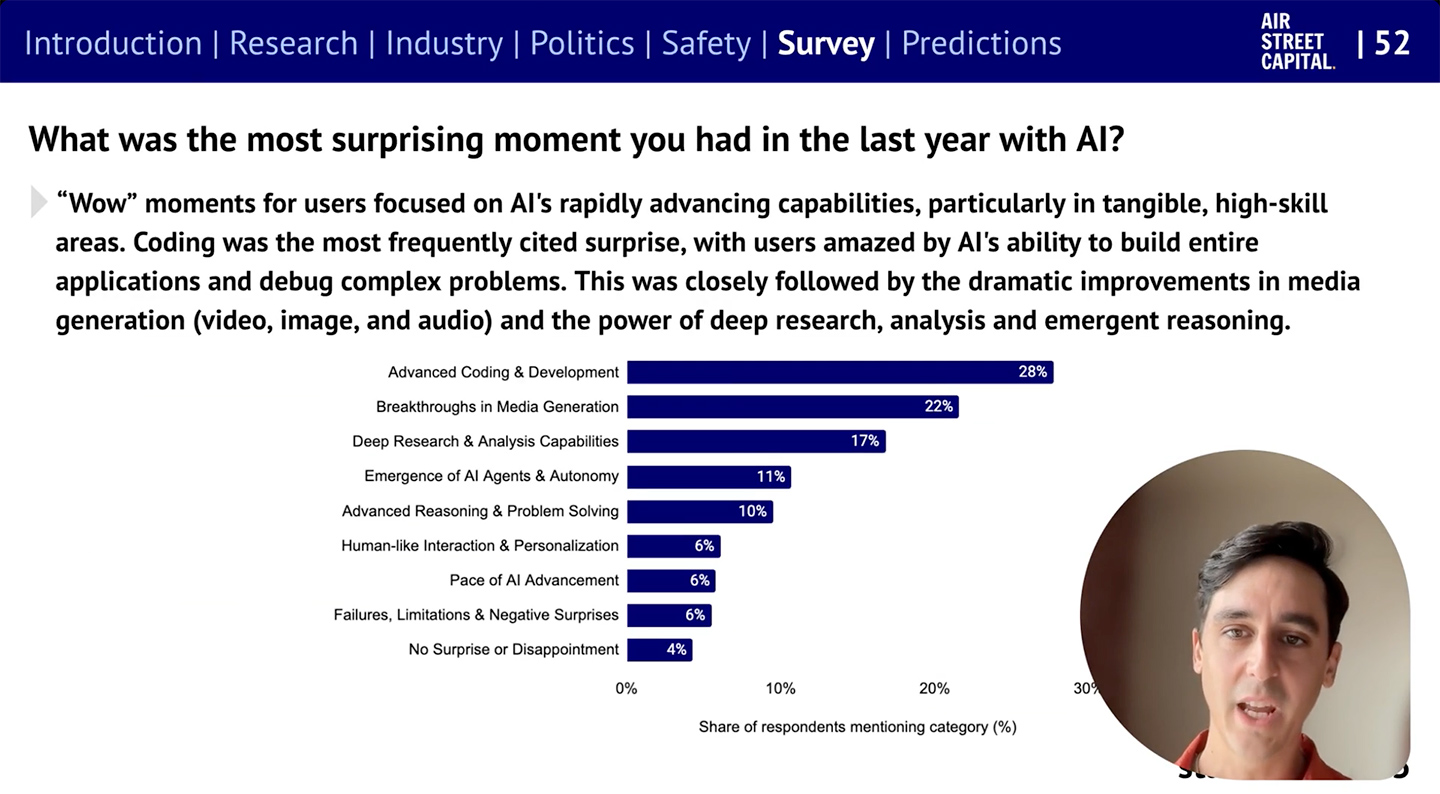
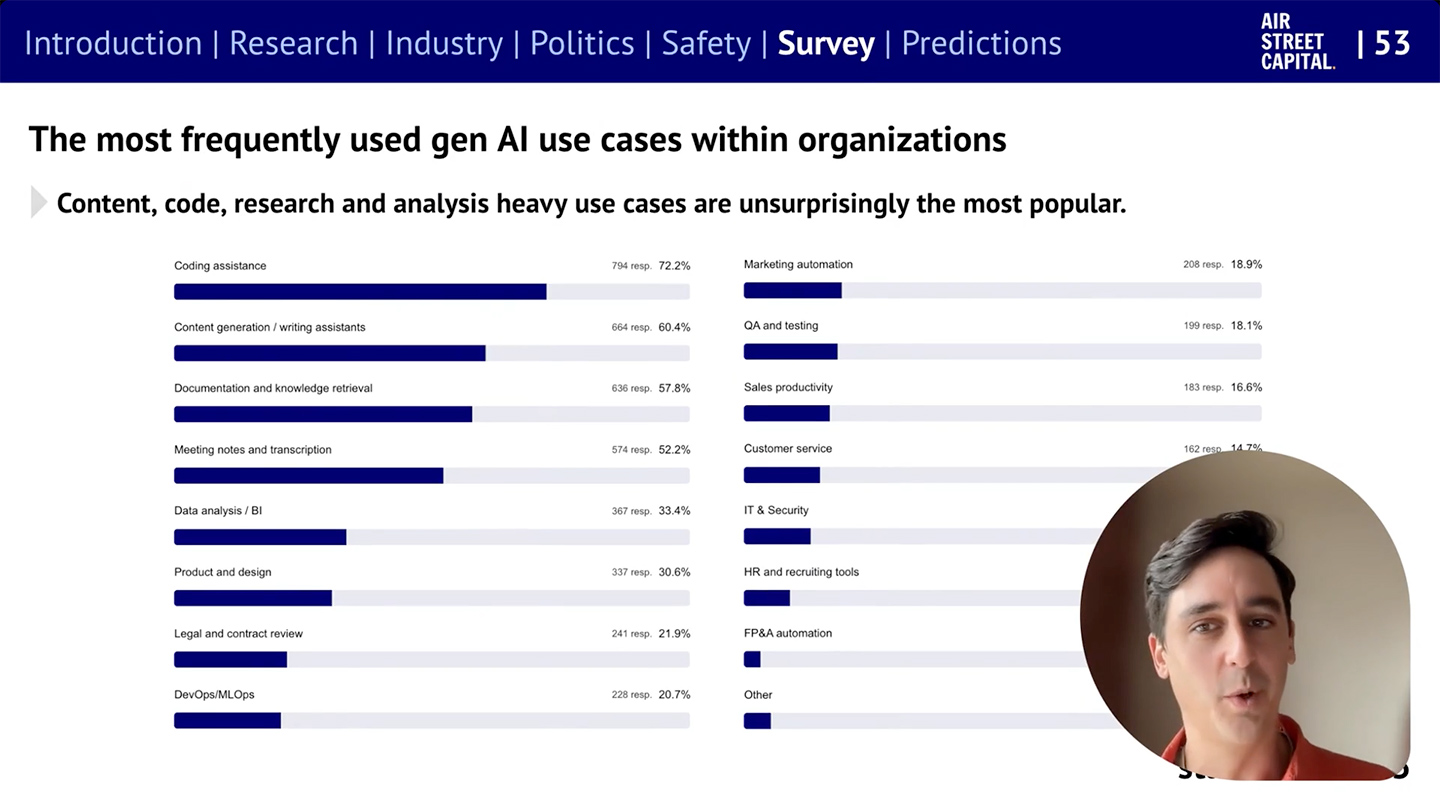
In short, it’s been a monumental 12 months for AI. Our eighth annual report is the most comprehensive it’s ever been, covering what you need to know about research, industry, politics, and safety – along with our first State of AI Usage Survey of 1,200 practitioners.

stateof.ai
.


Sam Altman kicks off DevDay 2025 with a keynote to explore ideas that will challenge how you think about building. Join us for announcements, live demos, and a vision of how developers are reshaping the future with AI.

Commentary from The Rundown AI:

Why it matters: OpenAI is turning ChatGPT into a do-it-all platform that might eventually act like a browser in itself, with users simply calling on the website/app they need and interacting directly within a conversation instead of navigating manually. The AgentKit will also compete and disrupt competitors like Zapier, n8n, Lindy, and others.


AMD and OpenAI announce strategic partnership to deploy 6 gigawatts of AMD GPUs — from openai.com

  • OpenAI to deploy 6 gigawatts of AMD GPUs based on a multi-year, multi-generation agreement
  • Initial 1 gigawatt OpenAI deployment of AMD Instinct™ MI450 Series GPUs starting in 2H 2026

Thoughts from OpenAI DevDay — from bensbites.com by Ben Tossell
When everyone becomes a developer

The event itself was phenomenal, great organisation. In terms of releases, there were two big themes:

  1. Add your apps to ChatGPT
  2. Add ChatGPT to your apps

Everything OpenAI announced at DevDay 2025 — from theaivalley.com by Barsee
PLUS: OpenAI has signed $1T in compute deals

Today’s climb through the Valley reveals:

  • Everything OpenAI announced at DevDay 2025
  • OpenAI has signed $1T in compute deals
  • Plus trending AI tools, posts, and resources

Also relevant/see:


AI agents: Where are they now? From proof of concept to success stories — from hrexecutive.com by Jill Barth

The 4 Rs framework
Salesforce has developed what Holt Ware calls the “4 Rs for AI agent success.” They are:

  1. Redesign by combining AI and human capabilities. This requires treating agents like new hires that need proper onboarding and management.
  2. Reskilling should focus on learning future skills. “We think we know what they are,” Holt Ware notes, “but they will continue to change.”
  3. Redeploy highly skilled people to determine how roles will change. When Salesforce launched an AI coding assistant, Holt Ware recalls, “We woke up the next day and said, ‘What do we do with these people now that they have more capacity?’ ” Their answer was to create an entirely new role: Forward-Deployed Engineers. This role has since played a growing part in driving customer success.
  4. Rebalance workforce planning. Holt Ware references a CHRO who “famously said that this will be the last year we ever do workforce planning and it’s only people; next year, every team will be supplemented with agents.”

Synthetic Reality Unleashed: AI’s powerful Impact on the Future of Journalism — from techgenyz.com by Sreyashi Bhattacharya

Table of Contents

  • Highlights
  • What is “synthetic news”?
  • Examples in action
  • Why are newsrooms experimenting with synthetic tools
  • Challenges and Risks
  • What does the research say
    • Transparency seems to matter. —What is next: trends & future
  • Conclusion

The latest video generation tool from OpenAI –> Sora 2

Sora 2 is here — from openai.com

Our latest video generation model is more physically accurate, realistic, and more controllable than prior systems. It also features synchronized dialogue and sound effects. Create with it in the new Sora app.

And a video on this out at YouTube:

Per The Rundown AI:

The Rundown: OpenAI just released Sora 2, its latest video model that now includes synchronized audio and dialogue, alongside a new social app where users can create, remix, and insert themselves into AI videos through a “Cameos” feature.

Why it matters: Model-wise, Sora 2 looks incredible — pushing us even further into the uncanny valley and creating tons of new storytelling capabilities. Cameos feels like a new viral memetic tool, but time will tell whether the AI social app can overcome the slop-factor and have staying power past the initial novelty.


OpenAI Just Dropped Sora 2 (And a Whole New Social App) — from heneuron.ai by Grant Harvey
OpenAI launched Sora 2 with a new iOS app that lets you insert yourself into AI-generated videos with realistic physics and sound, betting that giving users algorithm control and turning everyone into active creators will build a better social network than today’s addictive scroll machines.

What Sora 2 can do

  • Generate Olympic-level gymnastics routines, backflips on paddleboards (with accurate buoyancy!), and triple axels.
  • Follow intricate multi-shot instructions while maintaining world state across scenes.
  • Create realistic background soundscapes, dialogue, and sound effects automatically.
  • Insert YOU into any video after a quick one-time recording (they call this “cameos”).

The best video to show what it can do is probably this one, from OpenAI researcher Gabriel Peters, that depicts the behind the scenes of Sora 2 launch day…


Sora 2: AI Video Goes Social — from getsuperintel.com by Kim “Chubby” Isenberg
OpenAI’s latest AI video model is now an iOS app, letting users generate, remix, and even insert themselves into cinematic clips

Technically, Sora 2 is a major leap. It syncs audio with visuals, respects physics (a basketball bounces instead of teleporting), and follows multi-shot instructions with consistency. That makes outputs both more controllable and more believable. But the app format changes the game: it transforms world simulation from a research milestone into a social, co-creative experience where entertainment, creativity, and community intersect.


Also along the lines of creating digital video, see:

What used to take hours in After Effects now takes just one text prompt. Tools like Google’s Nano Banana, Seedream 4, Runway’s Aleph, and others are pioneering instruction-based editing, a breakthrough that collapses complex, multi-step VFX workflows into a single, implicit direction.

The history of VFX is filled with innovations that removed friction, but collapsing an entire multi-step workflow into a single prompt represents a new kind of leap.

For creators, this means the skill ceiling is no longer defined by technical know-how, it’s defined by imagination. If you can describe it, you can create it. For the industry, it points toward a near future where small teams and solo creators compete with the scale and polish of large studios.

Bilawal Sidhu


OpenAI DevDay 2025: everything you need to know — from getsuperintel.com by Kim “Chubby” Isenberg
Apps Inside ChatGPT, a New Era Unfolds

Something big shifted this week. OpenAI just turned ChatGPT into a platform – not just a product. With apps now running inside ChatGPT and a no-code Agent Builder for creating full AI workflows, the line between “using AI” and “building with AI” is fading fast. Developers suddenly have a new playground, and for the first time, anyone can assemble their own intelligent system without touching code. The question isn’t what AI can do anymore – it’s what you’ll make it do.


U.S. Law Schools Make AI Training Mandatory as Technology Becomes Core Legal Skill — from jdjournal.com by Fatima E

A growing number of U.S. law schools are now requiring students to train in artificial intelligence, marking a shift from optional electives to essential curriculum components. What was once treated as a “nice-to-have” skill is fast becoming integral as the legal profession adapts to the realities of AI tools.

From Experimentation to Obligation
Until recently, most law schools relegated AI instruction to upper-level electives or let individual professors decide whether to incorporate generative AI into their teaching. Now, however, at least eight law schools require incoming students—especially in their first year—to undergo training in AI, either during orientation, in legal research and writing classes, or via mandatory standalone courses.

Some of the institutions pioneering the shift include Fordham University, Arizona State University, Stetson University, Suffolk University, Washington University in St. Louis, Case Western, and the University of San Francisco.


Beyond the Classroom & LMS: How AI Coaching is Transforming Corporate Learning — from by Dr Philippa Hardman
What a new HBR study tells about the changing nature of workplace L&D

There’s a vision that’s been teased Learning & Development for decades: a vision of closing the gap between learning and doing—of moving beyond stopping work to take a course, and instead bringing support directly into the workflow. This concept of “learning in the flow of work” has been imagined, explored, discussed for decades —but never realised. Until now…?

This week, an article published Harvard Business Review provided some some compelling evidence that a long-awaited shift from “courses to coaches” might not just be possible, but also powerful.

The two settings were a) traditional in-classroom workshops, led by an expert facilitator and b) AI-coaching, delivered in the flow of work. The results were compelling….

TLDR: The evidence suggests that “learning in the flow of work” is not only feasible as a result of gen AI—it also show potential to be more scalable, more equitable and more efficient than traditional classroom/LMS-centred models.


The 10 Most Popular AI Chatbots For Educators — from techlearning.com by Erik Ofgang
Educators don’t need to use each of these chatbots, but it pays to be generally aware of the most popular AI tools

I’ve spent time testing many of these AI chatbots for potential uses and abuses in my own classes, so here’s a quick look at each of the top 10 most popular AI chatbots, and what educators should know about each. If you’re looking for more detail on a specific chatbot, click the link, as either I or other Tech & Learning writers have done deeper dives on all these tools.


…which links to:

Beyond Tool or Threat: GenAI and the Challenge It Poses to Higher Education — from er.educause.edu by Adam Maksl, Anne Leftwich, Justin Hodgson and Kevin Jones

Generative artificial intelligence isn’t just a new tool—it’s a catalyst forcing the higher education profession to reimagine its purpose, values, and future.

As experts in educational technology, digital literacy, and organizational change, we argue that higher education must seize this moment to rethink not just how we use AI, but how we structure and deliver learning altogether.


At This Rural Microschool, Students Will Study With AI and Run an Airbnb — from edsurge.com by Daniel Mollenkamp

Over the past decade, microschools — experimental small schools that often have mixed-age classrooms — have expanded.

Some superintendents have touted the promise of microschools as a means for public schools to better serve their communities’ needs while still keeping children enrolled in the district. But under a federal administration that’s trying to dismantle public education and boost homeschool options, others have critiqued poor oversight and a lack of information for assessing these models.

Microschools offer a potential avenue to bring innovative, modern experiences to rural areas, argues Keith Parker, superintendent of Elizabeth City-Pasquotank Public Schools.


Are We Ready for the AI University? An AI in Higher Education Webinar with Dr. Scott Latham


Imagining Teaching with AI Agents… — from michellekassorla.substack.com by Michelle Kassorla
Teaching with AI is only one step toward educational change, what’s next?

More than two years ago I started teaching with AI in my classes. At first I taught against AI, then I taught with AI, and now I am moving into unknown territory: agents. I played with Manus and n8n and some other agents, but I really never got excited about them. They seemed more trouble than they were worth. It seemed they were no more than an AI taskbot overseeing some other AI bots, and that they weren’t truly collaborating. Now, I’m looking at Perplexity’s Comet browser and their AI agent and I’m starting to get ideas for what the future of education might hold.

I have written several times about the dangers of AI agents and how they fundamentally challenge our systems, especially online education. I know there is no way that we can effectively stop them–maybe slow them a little, but definitely not stop them. I am already seeing calls to block and ban agents–just like I saw (and still see) calls to block and ban AI–but the truth is they are the future of work and, therefore, the future of education.

So, yes! This is my next challenge: teaching with AI agents. I want to explore this idea, and as I started thinking about it, I got more and more excited. But let me back up a bit. What is an agent and how is it different than Generative AI or a bot?


Guest post: IP professionals are enthusiastic about AI but should adopt with caution, report says — from legaltechnology.com by Benoit Chevalier

Aiming to discover more about AI’s impact on the intellectual property (IP) field, Questel recently released the findings of its 2025 IP Outlook Research Report entitled “Pathways to Productivity: AI in IP”, the much-awaited follow-up to its inaugural 2024 study “Beyond the Hype: How Technology is Transforming IP.” The 2025 Report (“the Report”) polled over 500 patent and trademark professionals from various continents and countries across the globe.


With AI, Junior Lawyers Will Excavate Insights, Not Review Docs — from news.bloomberglaw.com by Eric Dodson Greenberg; some of this article is behind a paywall

As artificial intelligence reshapes the legal profession, both in-house and outside counsel face two major—but not unprecedented—challenges.

The first is how to harness transformative technology while maintaining the rigorous standards that define effective legal practice.

The second is how to ensure that new technology doesn’t impair the training and development of new lawyers.

Rigorous standards and apprenticeship are foundational aspects of lawyering. Preserving and integrating both into our use of AI will be essential to creating a stable and effective AI-enabled legal practice.


The AI Lie That Legal Tech Companies Are Selling…. — from jdsupra.com

Every technology vendor pitching to law firms leads with the same promise: our solution will save you time. They’re lying, and they know it. The truth about AI in legal practice isn’t that it will reduce work. It’s that it will explode the volume of work while fundamentally changing what that work looks like.

New practice areas will emerge overnight. AI compliance law is already booming. Algorithmic discrimination cases are multiplying. Smart contract disputes need lawyers who understand both code and law. The metaverse needs property rights. Cryptocurrency needs regulation. Every technological advance creates legal questions that didn’t exist yesterday.

The skill shift will be brutal for lawyers who resist. 


Finalists Named for 2025 American Legal Technology Awards — from lawnext.com by Bob Ambrogi

Finalists have been named for the 2025 American Legal Technology Awards, which honor exceptional achievement in various aspects of legal technology.

The awards recognize achievement in various categories related to legal technology, such as by a law firm, an individual, or an enterprise.

The awards will be presented on Oct. 15 at a gala dinner on the eve of the Clio Cloud Conference in Boston, Mass. The dinner will be held at Suffolk Law School.

Here are this year’s finalists:


OpenAI and NVIDIA announce strategic partnership to deploy 10 gigawatts of NVIDIA systems — from openai.com

  • Strategic partnership enables OpenAI to build and deploy at least 10 gigawatts of AI datacenters with NVIDIA systems representing millions of GPUs for OpenAI’s next-generation AI infrastructure.
  • To support the partnership, NVIDIA intends to invest up to $100 billion in OpenAI progressively as each gigawatt is deployed.
  • The first gigawatt of NVIDIA systems will be deployed in the second half of 2026 on NVIDIA’s Vera Rubin platform.

Also on Nvidia’s site here.

The Neuron Daily comments on this partnership here and also see their thoughts here:

Why this matters: The partnership kicks off in the second half of 2026 with NVIDIA’s new Vera Rubin platform. OpenAI will use this massive compute power to train models beyond what we’ve seen with GPT-5 and likely also power what’s called inference (when you ask a question to chatGPT, and it gives you an answer). And NVIDIA gets a guaranteed customer for their most advanced chips. Infinite money glitch go brrr am I right? Though to be fair, this kinda deal is as old as the AI industry itself.

This isn’t just about bigger models, mind you: it’s about infrastructure for what both companies see as the future economy. As Sam Altman put it, “Compute infrastructure will be the basis for the economy of the future.”

Our take: We think this news is actually super interesting when you pair it with the other big headline from today: Commonwealth Fusion Systems signed a commercial deal worth more than $1B with Italian energy company Eni to purchase fusion power from their 400 MW ARC plant in Virginia. Here’s what that means for AI…

…and while you’re on that posting from The Neuron Daily, also see this piece:

AI filmmaker Dinda Prasetyo just released “Skyland,” a fantasy short film about a guy named Aeryn and his “loyal flying fish”, and honestly, the action sequences look like they belong in an actual film…

What’s wild is that Dinda used a cocktail of AI tools (Adobe FireflyMidJourney, the newly launched Luma Ray 3, and ElevenLabs) to create something that would’ve required a full production crew just two years ago.


The Era of Prompts Is Over. Here’s What Comes Next. — from builtin.com by Ankush Rastogi
If you’re still prompting your AI, you’re behind the curve. Here’s how to prepare for the coming wave of AI agents.

Summary: Autonomous AI agents are emerging as systems that handle goals, break down tasks and integrate with tools without constant prompting. Early uses include call centers, healthcare, fraud detection and research, but concerns remain over errors, compliance risks and unchecked decisions.

The next shift is already peeking around the corner, and it’s going to make prompts look primitive. Before long, we won’t be typing carefully crafted requests at all. We’ll be leaning on autonomous AI agents, systems that don’t just spit out answers but actually chase goals, make choices and do the boring middle steps without us guiding them. And honestly, this jump might end up dwarfing the so-called “prompt revolution.”


Chrome: The browser you love, reimagined with AI — from blog.google by Parisa Tabriz

A new way to get things done with your AI browsing assistant
Imagine you’re a student researching a topic for a paper, and you have dozens of tabs open. Instead of spending hours jumping between sources and trying to connect the dots, your new AI browsing assistant — Gemini in Chrome 1 — can do it for you. Gemini can answer questions about articles, find references within YouTube videos, and will soon be able to help you find pages you’ve visited so you can pick up exactly where you left off.

Rolling out to Mac and Windows users in the U.S. with their language set to English, Gemini in Chrome can understand the context of what you’re doing across multiple tabs, answer questions and integrate with other popular Google services, like Google Docs and Calendar. And it’ll be available on both Android and iOS soon, letting you ask questions and summarize pages while you’re on the go.

We’re also developing more advanced agentic capabilities for Gemini in Chrome that can perform multi-step tasks for you from start to finish, like ordering groceries. You’ll remain in control as Chrome handles the tedious work, turning 30-minute chores into 3-click user journeys.


Agentic AI and the New Era of Corporate Learning for 2026 — from hrmorning.com by Carol Warner

That gap creates compliance risk and wasted investment. It leaves HR leaders with a critical question: How do you measure and validate real learning when AI is doing the work for employees?

Designing Training That AI Can’t Fake
Employees often find static slide decks and multiple-choice quizzes tedious, while AI can breeze through them. If employees would rather let AI take training for them, it’s a red flag about the content itself.

One of the biggest risks with agentic AI is disengagement. When AI can complete a task for employees, their incentive to engage disappears unless they understand why the skill matters, Rashid explains. Personalization and context are critical. Training should clearly connect to what employees value most – career mobility, advancement, and staying relevant in a fast-changing market.

Nearly half of executives believe today’s skills will expire within two years, making continuous learning essential for job security and growth. To make training engaging, Rashid recommends:

  • Delivering content in formats employees already consume – short videos, mobile-first modules, interactive simulations, or micro-podcasts that fit naturally into workflows. For frontline workers, this might mean replacing traditional desktop training with mobile content that integrates into their workday.
  • Aligning learning with tangible outcomes, like career opportunities or new responsibilities.
  • Layering in recognition, such as digital badges, leaderboards, or team shout-outs, to reinforce motivation and progress

Microsoft 365 Copilot AI agents reach a new milestone — is teamwork about to change? — from windowscentral.comby Adam Hales
Microsoft expands Copilot with collaborative agents in Teams, SharePoint and more to boost productivity and reshape teamwork.

Microsoft is pitching a recent shift of AI agents in Microsoft Teams as more than just smarter assistance. Instead, these agents are built to behave like human teammates inside familiar apps such as Teams, SharePoint, and Viva Engage. They can set up meeting agendas, keep files in order, and even step in to guide community discussions when things drift off track.

Unlike tools such as ChatGPT or Claude, which mostly wait for prompts, Microsoft’s agents are designed to take initiative. They can chase up unfinished work, highlight items that still need decisions, and keep projects moving forward. By drawing on Microsoft Graph, they also bring in the right files, past decisions, and context to make their suggestions more useful.


Chris Dede’s comments on LinkedIn re: Aibrary

As an advisor to Aibrary, I am impressed with their educational philosophy, which is based both on theory and on empirical research findings. Aibrary is an innovative approach to self-directed learning that complements academic resources. Expanding our historic conceptions of books, libraries, and lifelong learning to new models enabled by emerging technologies is central to empowering all of us to shape our future.
.

Also see:

Aibrary.ai


Why AI literacy must come before policy — from timeshighereducation.com by Kathryn MacCallum and David Parsons
When developing rules and guidelines around the uses of artificial intelligence, the first question to ask is whether the university policymakers and staff responsible for implementing them truly understand how learners can meet the expectations they set

Literacy first, guidelines second, policy third
For students to respond appropriately to policies, they need to be given supportive guidelines that enact these policies. Further, to apply these guidelines, they need a level of AI literacy that gives them the knowledge, skills and understanding required to support responsible use of AI. Therefore, if we want AI to enhance education rather than undermine it, we must build literacy first, then create supportive guidelines. Good policy can then follow.


AI training becomes mandatory at more US law schools — from reuters.com by Karen Sloan and Sara Merken

Sept 22 (Reuters) – At orientation last month, 375 new Fordham Law students were handed two summaries of rapper Drake’s defamation lawsuit against his rival Kendrick Lamar’s record label — one written by a law professor, the other by ChatGPT.

The students guessed which was which, then dissected the artificial intelligence chatbot’s version for accuracy and nuance, finding that it included some irrelevant facts.

The exercise was part of the first-ever AI session for incoming students at the Manhattan law school, one of at least eight law schools now incorporating AI training for first-year students in orientation, legal research and writing courses, or through mandatory standalone classes.


Workday Acquires Sana To Transform Its Learning Platform And Much More— from joshbersin.com by Josh Bersin

Well now, as the corporate learning market shifts to AI, (read the details in our study “The Revolution in Corporate Learning” ), Workday can jump ahead. This is because the $400 billion corporate training market is moving quickly to an AI-Native dynamic content approach (witness OpenAI’s launch of in-line learning in its chatbot). We’re just finishing a year-long study of this space and our detailed report and maturity model will be out in Q4.
.

.
With Sana, and a few other AI-native vendors (Uplimit, Arist, Disperz, Docebo), companies can upload audios, videos, documents, and even interviews with experts and the system build learning programs in minutes. We use Sana for Galileo Learn (our AI-powered learning academy for Leadership and HR), and we now have 750+ courses and can build new programs in days instead of months.

And there’s more; this type of system gives every employee a personalized, chat-based experience to learn. 

 
© 2025 | Daniel Christian