U.S. Law Schools Make AI Training Mandatory as Technology Becomes Core Legal Skill — from jdjournal.com by Fatima E

A growing number of U.S. law schools are now requiring students to train in artificial intelligence, marking a shift from optional electives to essential curriculum components. What was once treated as a “nice-to-have” skill is fast becoming integral as the legal profession adapts to the realities of AI tools.

From Experimentation to Obligation
Until recently, most law schools relegated AI instruction to upper-level electives or let individual professors decide whether to incorporate generative AI into their teaching. Now, however, at least eight law schools require incoming students—especially in their first year—to undergo training in AI, either during orientation, in legal research and writing classes, or via mandatory standalone courses.

Some of the institutions pioneering the shift include Fordham University, Arizona State University, Stetson University, Suffolk University, Washington University in St. Louis, Case Western, and the University of San Francisco.


Beyond the Classroom & LMS: How AI Coaching is Transforming Corporate Learning — from by Dr Philippa Hardman
What a new HBR study tells about the changing nature of workplace L&D

There’s a vision that’s been teased Learning & Development for decades: a vision of closing the gap between learning and doing—of moving beyond stopping work to take a course, and instead bringing support directly into the workflow. This concept of “learning in the flow of work” has been imagined, explored, discussed for decades —but never realised. Until now…?

This week, an article published Harvard Business Review provided some some compelling evidence that a long-awaited shift from “courses to coaches” might not just be possible, but also powerful.

The two settings were a) traditional in-classroom workshops, led by an expert facilitator and b) AI-coaching, delivered in the flow of work. The results were compelling….

TLDR: The evidence suggests that “learning in the flow of work” is not only feasible as a result of gen AI—it also show potential to be more scalable, more equitable and more efficient than traditional classroom/LMS-centred models.


The 10 Most Popular AI Chatbots For Educators — from techlearning.com by Erik Ofgang
Educators don’t need to use each of these chatbots, but it pays to be generally aware of the most popular AI tools

I’ve spent time testing many of these AI chatbots for potential uses and abuses in my own classes, so here’s a quick look at each of the top 10 most popular AI chatbots, and what educators should know about each. If you’re looking for more detail on a specific chatbot, click the link, as either I or other Tech & Learning writers have done deeper dives on all these tools.


…which links to:

Beyond Tool or Threat: GenAI and the Challenge It Poses to Higher Education — from er.educause.edu by Adam Maksl, Anne Leftwich, Justin Hodgson and Kevin Jones

Generative artificial intelligence isn’t just a new tool—it’s a catalyst forcing the higher education profession to reimagine its purpose, values, and future.

As experts in educational technology, digital literacy, and organizational change, we argue that higher education must seize this moment to rethink not just how we use AI, but how we structure and deliver learning altogether.


At This Rural Microschool, Students Will Study With AI and Run an Airbnb — from edsurge.com by Daniel Mollenkamp

Over the past decade, microschools — experimental small schools that often have mixed-age classrooms — have expanded.

Some superintendents have touted the promise of microschools as a means for public schools to better serve their communities’ needs while still keeping children enrolled in the district. But under a federal administration that’s trying to dismantle public education and boost homeschool options, others have critiqued poor oversight and a lack of information for assessing these models.

Microschools offer a potential avenue to bring innovative, modern experiences to rural areas, argues Keith Parker, superintendent of Elizabeth City-Pasquotank Public Schools.


Are We Ready for the AI University? An AI in Higher Education Webinar with Dr. Scott Latham


Imagining Teaching with AI Agents… — from michellekassorla.substack.com by Michelle Kassorla
Teaching with AI is only one step toward educational change, what’s next?

More than two years ago I started teaching with AI in my classes. At first I taught against AI, then I taught with AI, and now I am moving into unknown territory: agents. I played with Manus and n8n and some other agents, but I really never got excited about them. They seemed more trouble than they were worth. It seemed they were no more than an AI taskbot overseeing some other AI bots, and that they weren’t truly collaborating. Now, I’m looking at Perplexity’s Comet browser and their AI agent and I’m starting to get ideas for what the future of education might hold.

I have written several times about the dangers of AI agents and how they fundamentally challenge our systems, especially online education. I know there is no way that we can effectively stop them–maybe slow them a little, but definitely not stop them. I am already seeing calls to block and ban agents–just like I saw (and still see) calls to block and ban AI–but the truth is they are the future of work and, therefore, the future of education.

So, yes! This is my next challenge: teaching with AI agents. I want to explore this idea, and as I started thinking about it, I got more and more excited. But let me back up a bit. What is an agent and how is it different than Generative AI or a bot?


Guest post: IP professionals are enthusiastic about AI but should adopt with caution, report says — from legaltechnology.com by Benoit Chevalier

Aiming to discover more about AI’s impact on the intellectual property (IP) field, Questel recently released the findings of its 2025 IP Outlook Research Report entitled “Pathways to Productivity: AI in IP”, the much-awaited follow-up to its inaugural 2024 study “Beyond the Hype: How Technology is Transforming IP.” The 2025 Report (“the Report”) polled over 500 patent and trademark professionals from various continents and countries across the globe.


With AI, Junior Lawyers Will Excavate Insights, Not Review Docs — from news.bloomberglaw.com by Eric Dodson Greenberg; some of this article is behind a paywall

As artificial intelligence reshapes the legal profession, both in-house and outside counsel face two major—but not unprecedented—challenges.

The first is how to harness transformative technology while maintaining the rigorous standards that define effective legal practice.

The second is how to ensure that new technology doesn’t impair the training and development of new lawyers.

Rigorous standards and apprenticeship are foundational aspects of lawyering. Preserving and integrating both into our use of AI will be essential to creating a stable and effective AI-enabled legal practice.


The AI Lie That Legal Tech Companies Are Selling…. — from jdsupra.com

Every technology vendor pitching to law firms leads with the same promise: our solution will save you time. They’re lying, and they know it. The truth about AI in legal practice isn’t that it will reduce work. It’s that it will explode the volume of work while fundamentally changing what that work looks like.

New practice areas will emerge overnight. AI compliance law is already booming. Algorithmic discrimination cases are multiplying. Smart contract disputes need lawyers who understand both code and law. The metaverse needs property rights. Cryptocurrency needs regulation. Every technological advance creates legal questions that didn’t exist yesterday.

The skill shift will be brutal for lawyers who resist. 


Finalists Named for 2025 American Legal Technology Awards — from lawnext.com by Bob Ambrogi

Finalists have been named for the 2025 American Legal Technology Awards, which honor exceptional achievement in various aspects of legal technology.

The awards recognize achievement in various categories related to legal technology, such as by a law firm, an individual, or an enterprise.

The awards will be presented on Oct. 15 at a gala dinner on the eve of the Clio Cloud Conference in Boston, Mass. The dinner will be held at Suffolk Law School.

Here are this year’s finalists:


OpenAI and NVIDIA announce strategic partnership to deploy 10 gigawatts of NVIDIA systems — from openai.com

  • Strategic partnership enables OpenAI to build and deploy at least 10 gigawatts of AI datacenters with NVIDIA systems representing millions of GPUs for OpenAI’s next-generation AI infrastructure.
  • To support the partnership, NVIDIA intends to invest up to $100 billion in OpenAI progressively as each gigawatt is deployed.
  • The first gigawatt of NVIDIA systems will be deployed in the second half of 2026 on NVIDIA’s Vera Rubin platform.

Also on Nvidia’s site here.

The Neuron Daily comments on this partnership here and also see their thoughts here:

Why this matters: The partnership kicks off in the second half of 2026 with NVIDIA’s new Vera Rubin platform. OpenAI will use this massive compute power to train models beyond what we’ve seen with GPT-5 and likely also power what’s called inference (when you ask a question to chatGPT, and it gives you an answer). And NVIDIA gets a guaranteed customer for their most advanced chips. Infinite money glitch go brrr am I right? Though to be fair, this kinda deal is as old as the AI industry itself.

This isn’t just about bigger models, mind you: it’s about infrastructure for what both companies see as the future economy. As Sam Altman put it, “Compute infrastructure will be the basis for the economy of the future.”

Our take: We think this news is actually super interesting when you pair it with the other big headline from today: Commonwealth Fusion Systems signed a commercial deal worth more than $1B with Italian energy company Eni to purchase fusion power from their 400 MW ARC plant in Virginia. Here’s what that means for AI…

…and while you’re on that posting from The Neuron Daily, also see this piece:

AI filmmaker Dinda Prasetyo just released “Skyland,” a fantasy short film about a guy named Aeryn and his “loyal flying fish”, and honestly, the action sequences look like they belong in an actual film…

What’s wild is that Dinda used a cocktail of AI tools (Adobe FireflyMidJourney, the newly launched Luma Ray 3, and ElevenLabs) to create something that would’ve required a full production crew just two years ago.


The Era of Prompts Is Over. Here’s What Comes Next. — from builtin.com by Ankush Rastogi
If you’re still prompting your AI, you’re behind the curve. Here’s how to prepare for the coming wave of AI agents.

Summary: Autonomous AI agents are emerging as systems that handle goals, break down tasks and integrate with tools without constant prompting. Early uses include call centers, healthcare, fraud detection and research, but concerns remain over errors, compliance risks and unchecked decisions.

The next shift is already peeking around the corner, and it’s going to make prompts look primitive. Before long, we won’t be typing carefully crafted requests at all. We’ll be leaning on autonomous AI agents, systems that don’t just spit out answers but actually chase goals, make choices and do the boring middle steps without us guiding them. And honestly, this jump might end up dwarfing the so-called “prompt revolution.”


Chrome: The browser you love, reimagined with AI — from blog.google by Parisa Tabriz

A new way to get things done with your AI browsing assistant
Imagine you’re a student researching a topic for a paper, and you have dozens of tabs open. Instead of spending hours jumping between sources and trying to connect the dots, your new AI browsing assistant — Gemini in Chrome 1 — can do it for you. Gemini can answer questions about articles, find references within YouTube videos, and will soon be able to help you find pages you’ve visited so you can pick up exactly where you left off.

Rolling out to Mac and Windows users in the U.S. with their language set to English, Gemini in Chrome can understand the context of what you’re doing across multiple tabs, answer questions and integrate with other popular Google services, like Google Docs and Calendar. And it’ll be available on both Android and iOS soon, letting you ask questions and summarize pages while you’re on the go.

We’re also developing more advanced agentic capabilities for Gemini in Chrome that can perform multi-step tasks for you from start to finish, like ordering groceries. You’ll remain in control as Chrome handles the tedious work, turning 30-minute chores into 3-click user journeys.


Agentic AI and the New Era of Corporate Learning for 2026 — from hrmorning.com by Carol Warner

That gap creates compliance risk and wasted investment. It leaves HR leaders with a critical question: How do you measure and validate real learning when AI is doing the work for employees?

Designing Training That AI Can’t Fake
Employees often find static slide decks and multiple-choice quizzes tedious, while AI can breeze through them. If employees would rather let AI take training for them, it’s a red flag about the content itself.

One of the biggest risks with agentic AI is disengagement. When AI can complete a task for employees, their incentive to engage disappears unless they understand why the skill matters, Rashid explains. Personalization and context are critical. Training should clearly connect to what employees value most – career mobility, advancement, and staying relevant in a fast-changing market.

Nearly half of executives believe today’s skills will expire within two years, making continuous learning essential for job security and growth. To make training engaging, Rashid recommends:

  • Delivering content in formats employees already consume – short videos, mobile-first modules, interactive simulations, or micro-podcasts that fit naturally into workflows. For frontline workers, this might mean replacing traditional desktop training with mobile content that integrates into their workday.
  • Aligning learning with tangible outcomes, like career opportunities or new responsibilities.
  • Layering in recognition, such as digital badges, leaderboards, or team shout-outs, to reinforce motivation and progress

Microsoft 365 Copilot AI agents reach a new milestone — is teamwork about to change? — from windowscentral.comby Adam Hales
Microsoft expands Copilot with collaborative agents in Teams, SharePoint and more to boost productivity and reshape teamwork.

Microsoft is pitching a recent shift of AI agents in Microsoft Teams as more than just smarter assistance. Instead, these agents are built to behave like human teammates inside familiar apps such as Teams, SharePoint, and Viva Engage. They can set up meeting agendas, keep files in order, and even step in to guide community discussions when things drift off track.

Unlike tools such as ChatGPT or Claude, which mostly wait for prompts, Microsoft’s agents are designed to take initiative. They can chase up unfinished work, highlight items that still need decisions, and keep projects moving forward. By drawing on Microsoft Graph, they also bring in the right files, past decisions, and context to make their suggestions more useful.


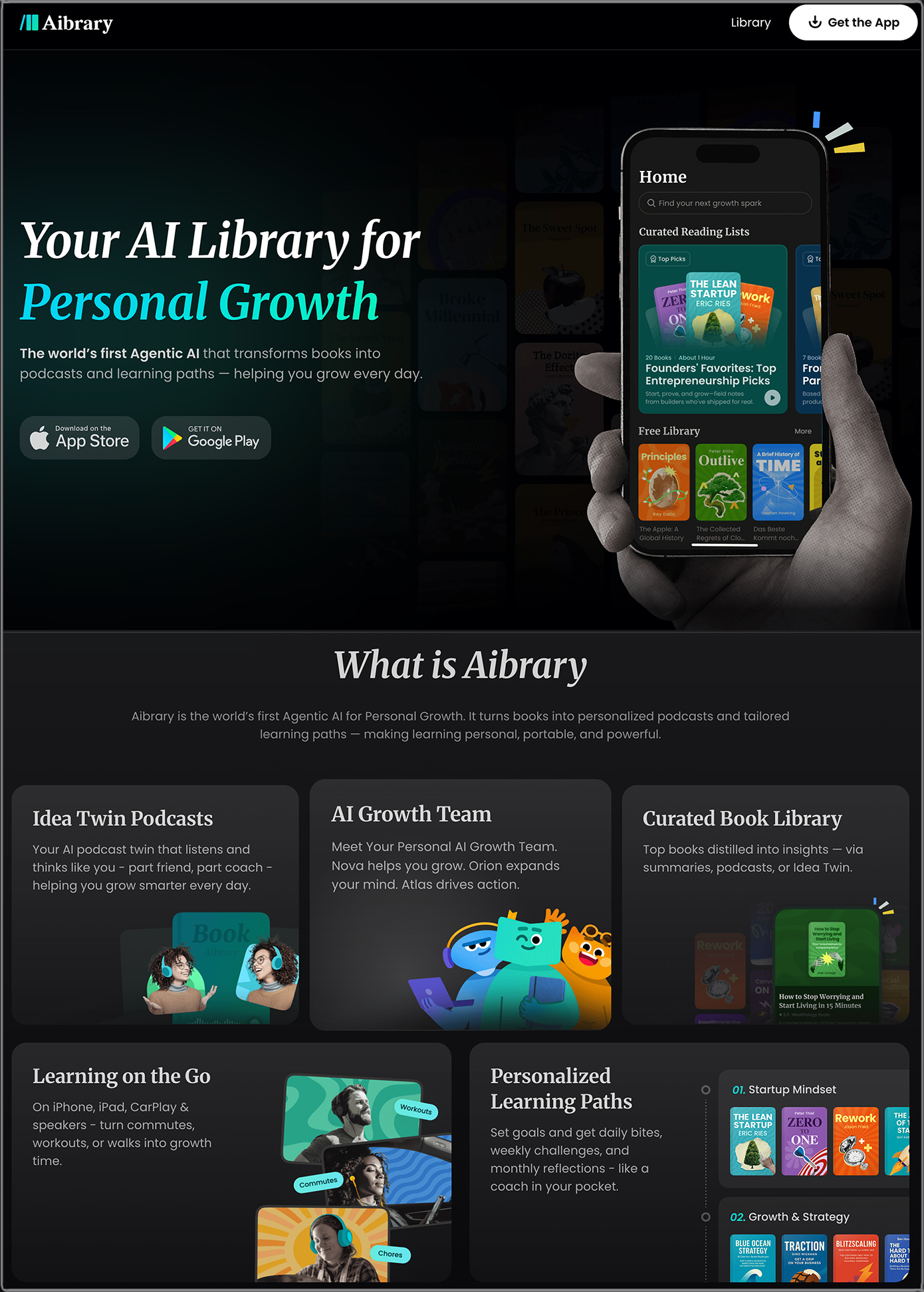
Chris Dede’s comments on LinkedIn re: Aibrary

As an advisor to Aibrary, I am impressed with their educational philosophy, which is based both on theory and on empirical research findings. Aibrary is an innovative approach to self-directed learning that complements academic resources. Expanding our historic conceptions of books, libraries, and lifelong learning to new models enabled by emerging technologies is central to empowering all of us to shape our future.
.

Also see:

Aibrary.ai


Why AI literacy must come before policy — from timeshighereducation.com by Kathryn MacCallum and David Parsons
When developing rules and guidelines around the uses of artificial intelligence, the first question to ask is whether the university policymakers and staff responsible for implementing them truly understand how learners can meet the expectations they set

Literacy first, guidelines second, policy third
For students to respond appropriately to policies, they need to be given supportive guidelines that enact these policies. Further, to apply these guidelines, they need a level of AI literacy that gives them the knowledge, skills and understanding required to support responsible use of AI. Therefore, if we want AI to enhance education rather than undermine it, we must build literacy first, then create supportive guidelines. Good policy can then follow.


AI training becomes mandatory at more US law schools — from reuters.com by Karen Sloan and Sara Merken

Sept 22 (Reuters) – At orientation last month, 375 new Fordham Law students were handed two summaries of rapper Drake’s defamation lawsuit against his rival Kendrick Lamar’s record label — one written by a law professor, the other by ChatGPT.

The students guessed which was which, then dissected the artificial intelligence chatbot’s version for accuracy and nuance, finding that it included some irrelevant facts.

The exercise was part of the first-ever AI session for incoming students at the Manhattan law school, one of at least eight law schools now incorporating AI training for first-year students in orientation, legal research and writing courses, or through mandatory standalone classes.


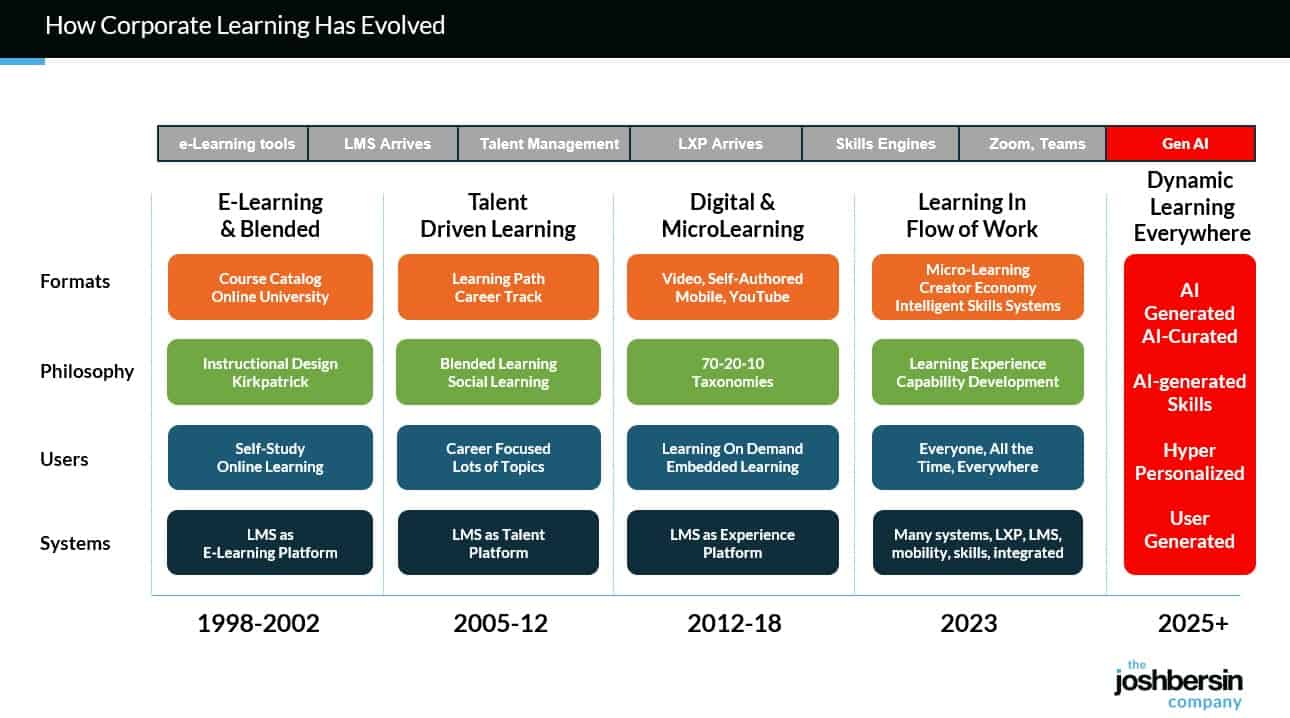
Workday Acquires Sana To Transform Its Learning Platform And Much More— from joshbersin.com by Josh Bersin

Well now, as the corporate learning market shifts to AI, (read the details in our study “The Revolution in Corporate Learning” ), Workday can jump ahead. This is because the $400 billion corporate training market is moving quickly to an AI-Native dynamic content approach (witness OpenAI’s launch of in-line learning in its chatbot). We’re just finishing a year-long study of this space and our detailed report and maturity model will be out in Q4.
.

.
With Sana, and a few other AI-native vendors (Uplimit, Arist, Disperz, Docebo), companies can upload audios, videos, documents, and even interviews with experts and the system build learning programs in minutes. We use Sana for Galileo Learn (our AI-powered learning academy for Leadership and HR), and we now have 750+ courses and can build new programs in days instead of months.

And there’s more; this type of system gives every employee a personalized, chat-based experience to learn. 


ChatGPT: the world’s most influential teacher — from drphilippahardman.substack.com by Dr. Philippa Hardman; emphasis DSC
New research shows that millions of us are “learning with AI” every week: what does this mean for how (and how well) humans learn?

This week, an important piece of research landed that confirms the gravity of AI’s role in the learning process. The TLDR is that learning is now a mainstream use case for ChatGPT; around 10.2% of all ChatGPT messages (that’s ~2BN messages sent by over 7 million users per week) are requests for help with learning.

The research shows that about 10.2% of all messages are tutoring/teaching, and within the “Practical Guidance” category, tutoring is 36%. “Asking” interactions are growing faster than “Doing” and are rated higher quality by users. Younger people contribute a huge share of messages, and growth is fastest in low- and middle-income countries (How People Use ChatGPT, 2025).

If AI is already acting as a global tutor, the question isn’t “will people learn with AI?”—they already are. The real question we need to ask is: what does great learning actually look like, and how should AI evolve to support it? That’s where decades of learning science help us separate “feels like learning” from “actually gaining new knowledge and skills”.

Let’s dive in.


From EdTech to TechEd: The next chapter in learning’s evolution — from linkedin.com by Lev Gonick

A day in the life: The next 25 years
A learner wakes up. Their AI-powered learning coach welcomes them, drawing their attention to their progress and helping them structure their approach to the day.  A notification reminds them of an upcoming interview and suggests reflections to add to their learning portfolio.

Rather than a static gradebook, their portfolio is a dynamic, living record, curated by the student, validated by mentors in both industry and education, and enriched through co-creation with maturing modes of AI. It tells a story through essays, code, music, prototypes, journal reflections, and team collaborations. These artifacts are not “submitted”, they are published, shared, and linked to verifiable learning outcomes.

And when it’s time to move, to a new institution, a new job, or a new goal, their data goes with them, immutable, portable, verifiable, and meaningful.

From DSC:
And I would add to that last solid sentence that the learner/student/employee will be able to control who can access this information. Anyway, some solid reflections here from Lev.


AI Could Surpass Schools for Academic Learning in 5-10 Years — from downes.ca with commentary from Stephen Downes

I know a lot of readers will disagree with this, and the timeline feels aggressive (the future always arrives more slowly than pundits expect) but I think the overall premise is sound: “The concept of a tipping point in education – where AI surpasses traditional schools as the dominant learning medium – is increasingly plausible based on current trends, technological advancements, and expert analyses.”


The world’s first AI cabinet member — from therundown.ai by Zach Mink, Rowan Cheung, Shubham Sharma, Joey Liu & Jennifer Mossalgue

The Rundown: In this tutorial, you will learn how to combine NotebookLM with ChatGPT to master any subject faster, turning dense PDFs into interactive study materials with summaries, quizzes, and video explanations.

Step-by-step:

  1. Go to notebooklm.google.com, click the “+” button, and upload your PDF study material (works best with textbooks or technical documents)
  2. Choose your output mode: Summary for a quick overview, Mind Map for visual connections, or Video Overview for a podcast-style explainer with visuals
  3. Generate a Study Guide under Reports — get Q&A sets, short-answer questions, essay prompts, and glossaries of key terms automatically
  4. Take your PDF to ChatGPT and prompt: “Read this chapter by chapter and highlight confusing parts” or “Quiz me on the most important concepts”
  5. Combine both tools: Use NotebookLM for quick context and interactive guides, then ChatGPT to clarify tricky parts and go deeperPro Tip: If your source is in EPUB or audiobook, convert it to PDF before uploading. Both NotebookLM and ChatGPT handle PDFs best.

Claude can now create and edit files — from anthropic.com

Claude can now create and edit Excel spreadsheets, documents, PowerPoint slide decks, and PDFs directly in Claude.ai and the desktop app. This transforms how you work with Claude—instead of only receiving text responses or in-app artifacts, you can describe what you need, upload relevant data, and get ready-to-use files in return.

Also see:

  • Microsoft to lessen reliance on OpenAI by buying AI from rival Anthropic — from techcrunch.com byRebecca Bellan
    Microsoft will pay to use Anthropic’s AI in Office 365 apps, The Information reports, citing two sources. The move means that Anthropic’s tech will help power new features in Word, Excel, Outlook, and PowerPoint alongside OpenAI’s, marking the end of Microsoft’s previous reliance solely on the ChatGPT maker for its productivity suite. Microsoft’s move to diversify its AI partnerships comes amid a growing rift with OpenAI, which has pursued its own infrastructure projects as well as a potential LinkedIn competitor.

Ep. 11 AGI and the Future of Higher Ed: Talking with Ray Schroeder

In this episode of Unfixed, we talk with Ray Schroeder—Senior Fellow at UPCEA and Professor Emeritus at the University of Illinois Springfield—about Artificial General Intelligence (AGI) and what it means for the future of higher education. While most of academia is still grappling with ChatGPT and basic AI tools, Schroeder is thinking ahead to AI agents, human displacement, and AGI’s existential implications for teaching, learning, and the university itself. We explore why AGI is so controversial, what institutions should be doing now to prepare, and how we can respond responsibly—even while we’re already overwhelmed.


Best AI Tools for Instructional Designers — from blog.cathy-moore.com by Cathy Moore

Data from the State of AI and Instructional Design Report revealed that 95.3% of the instructional designers interviewed use AI in their daily work [1]. And over 85% of this AI use occurs during the design and development process.

These figures showcase the immense impact AI is already having on the instructional design world.

If you’re an L&D professional still on the fence about adding AI to your workflow or an AI convert looking for the next best tools, keep reading.

This guide breaks down 5 of the top AI tools for instructional designers in 2025, so you can streamline your development processes and build better training faster.

But before we dive into the tools of the trade, let’s address the elephant in the room:


3 Human Skills That Make You Irreplaceable in an AI World — from gettingsmart.com/ by Tom Vander Ark and Mason Pashia

Key Points

  • Update learner profiles to emphasize curiosity, curation, and connectivity, ensuring students develop irreplaceable human skills.
  • Integrate real-world learning experiences and mastery-based assessments to foster agency, purpose, and motivation in students.
 

Miro and GenAI as drivers of online student engagement — from timeshighereducation.com by Jaime Eduardo Moncada Garibay
A set of practical strategies for transforming passive online student participation into visible, measurable and purposeful engagement through the use of Miro, enhanced by GenAI

To address this challenge, I shifted my focus from requesting participation to designing it. This strategic change led me to integrate Miro, a visual digital workspace, into my classes. Miro enables real-time visualisation and co-creation of ideas, whether individually or in teams.

The transition from passive attendance to active engagement in online classes requires deliberate instructional design. Tools such as Miro, enhanced by GenAI, enable educators to create structured, visually rich learning environments in which participation is both expected and documented.

While technology provides templates, frames, timers and voting features, its real pedagogical value emerges through intentional facilitation, where the educator’s role shifts from delivering content to orchestrating collaborative, purposeful learning experiences.


Benchmarking Online Education with Bruce Etter and Julie Uranis — from buzzsprout.com by Derek Bruff

Here are some that stood out to me:

  • In the past, it was typical for faculty to teach online courses as an “overload” of some kind, but BOnES data show that 92% of online programs feature courses taught as part of faculty member’s standard teaching responsibilities. Online teaching has become one of multiple modalities in which faculty teach regularly.
  • Three-quarters of chief online officers surveyed said they plan to have a great market share of online enrollments in the future, but only 23% said their current marketing is better than their competitors. The rising tide of online enrollments won’t lift all boats–some institutions will fare better than others.
  • Staffing at online education units is growing, with the median staff size increasing from 15 last year to 20 this year. Julie pointed out that successful online education requires investment of resources. You might need as many buildings as onsite education does, but you need people and you need technology.


From Content To Capability: How AI Agents Are Redefining Workplace Learning — from forbes.com by Nelson Sivalingam

Real, capability-building learning requires three key elements: content, context and conversation. 

The Rise Of AI Agents: Teaching At Scale
The generative AI revolution is often framed in terms of efficiency: faster content creation, automated processes and streamlined workflows. But in the world of L&D, its most transformative potential lies elsewhere: the ability to scale great teaching.

AI gives us the means to replicate the role of an effective teacher across an entire organization. Specifically, AI agents—purpose-built systems that understand, adapt and interact in meaningful, context-aware ways—can make this possible. These tools understand a learner’s role, skill level and goals, then tailor guidance to their specific challenges and adapt dynamically over time. They also reinforce learning continuously, nudging progress and supporting application in the flow of work.

More than simply sharing knowledge, an AI agent can help learners apply it and improve with every interaction. For example, a sales manager can use a learning agent to simulate tough customer scenarios, receive instant feedback based on company best practices and reinforce key techniques. A new hire in the product department could get guidance on the features and on how to communicate value clearly in a roadmap meeting.

In short, AI agents bring together the three essential elements of capability building, not in a one-size-fits-all curriculum but on demand and personalized for every learner. While, obviously, this technology shouldn’t replace human expertise, it can be an effective tool for removing bottlenecks and unlocking effective learning at scale.


Expanding economic opportunity with AI — from openai.com; via The Neuron Daily

First, we’re working to build out the OpenAI Jobs Platform.

If you’re a business looking to hire an AI-savvy employee, or you just need help with a specific task, finding the right person can be hit-or-miss. The OpenAI Jobs Platform will have knowledgeable, experienced candidates at every level, and opportunities for anyone looking to put their skills to use. And we’ll use AI to help find the perfect matches between what companies need and what workers can offer.

We also realize that anyone looking to hire, whether it’s through the Jobs Platform or elsewhere, needs to trust that candidates are actually fluent in AI. Most businesses, including small businesses, think AI is the key to their future. And most of the companies we talk to want to make sure their employees know how to use our tools.

That’s the idea behind our new OpenAI Certifications.

Studies show? that AI-savvy workers are more valuable, more productive, and are paid more than workers without AI skills. That’s why, earlier this year, we launched the OpenAI Academy, a free, online learning platform that has helped connect more than 2 million people with the resources, workshops, and communities they need to master AI tools.


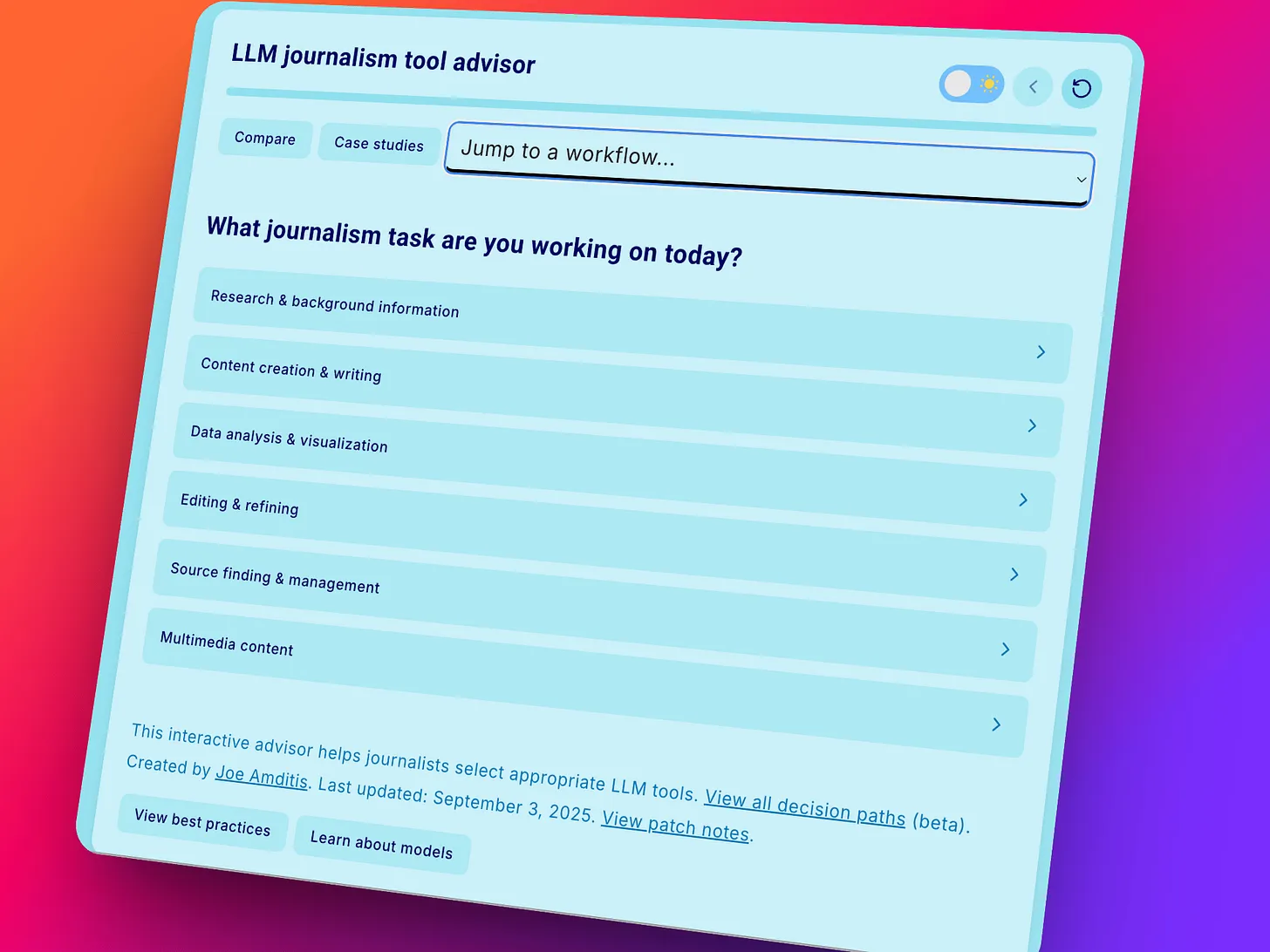
A Journalist’s Toolkit for the AI Era — from wondertools.substack.com by Jeremy Caplan and Joe Amditis
A guest expert shares his practical tools

As news organizations scramble to update their digital toolkits, I invited one of the most tech savvy journalism advisors I know to share his guidance.

In the guest post below, Joe Amditis shares a bunch of useful resources. A former CUNY student of mine, Joe now serves as associate director of operations at the Center for Cooperative Media at Montclair State University.


Midoo AI Launches the World’s First AI Language Learning Agent, Redefining How People Learn Languages — from morningstar.com

SINGAPORE Sept. 3, 2025  /PRNewswire/ — Today, Midoo AI proudly announces the launch of the world’s first AI language learning agent, a groundbreaking innovation set to transform language education forever.

For decades, language learning has pursued one ultimate goal: true personalization. Traditional tools offered smart recommendations, gamified challenges, and pre-written role-play scripts—but real personalization remained out of reach. Midoo AI changes that. Here is the >launch video of Midoo AI.

Imagine a learning experience that evolves with you in real time. A system that doesn’t rely on static courses or scripts but creates a dynamic, one-of-a-kind language world tailored entirely to your needs. This is the power of Midoo’s Dynamic Generation technology.

“Midoo is not just a language-learning tool,” said Yvonne, co-founder of Midoo AI. “It’s a living agent that senses your needs, adapts instantly, and shapes an experience that’s warm, personal, and alive. Learning is no longer one-size-fits-all—now, it’s yours and yours alone.”


Midoo AI Review: Meet the First AI Language Learning Agent — from autogpt.net

Language learning apps have traditionally focused on exercises, quizzes, and progress tracking. Midoo AI introduces a different approach. Instead of presenting itself as a course provider, it acts as an intelligent learning agent that builds, adapts, and sustains a learner’s journey.

This review examines how Midoo AI operates, its feature set, and what makes it distinct from other AI-powered tutors.

Midoo AI in Context: Purpose and Position
Midoo AI is not structured around distributing lessons or modules. Its core purpose is to provide an agent-like partner that adapts in real time. Where many platforms ask learners to select a “level” or “topic,”

Midoo instead begins by analyzing goals, usage context, and error patterns. The result is less about consuming predesigned units and more about co-constructing a pathway.


AI Isn’t Replacing Teachers — It’s Helping Us Teach Better — from rdene915.com by guest author Matthew Mawn

Turning Time Saved Into Better Learning
AI can save teachers time, but what can that time be used for (besides taking a breath)? For most of us, it means redirecting energy into the parts of teaching that made us want to pursue this profession in the first place: connecting with our students and helping them grow academically.

Differentiation
Every classroom has students with different readiness levels, language needs, and learning preferences. AI tools like Diffit or MagicSchool can instantly create multiple versions of a passage or assignment, differentiated by grade level, complexity, or language. This allows every student to engage with the same core concept, moving together as one cohesive class. Instead of spending an evening retyping and rephrasing, teachers can review and tweak AI drafts in minutes, ready for the next lesson.


Mass Intelligence — from oneusefulthing.org by Ethan Mollick
From GPT-5 to nano banana: everyone is getting access to powerful AI

When a billion people have access to advanced AI, we’ve entered what we might call the era of Mass Intelligence. Every institution we have — schools, hospitals, courts, companies, governments — was built for a world where intelligence was scarce and expensive. Now every profession, every institution, every community has to figure out how to thrive with Mass Intelligence. How do we harness a billion people using AI while managing the chaos that comes with it? How do we rebuild trust when anyone can fabricate anything? How do we preserve what’s valuable about human expertise while democratizing access to knowledge?


AI Is the Cognitive Layer. Schools Still Think It’s a Study Tool. — from stefanbauschard.substack.com by Stefan Bauschard

By the time today’s 9th graders and college freshman enter the workforce, the most disruptive waves of AGI and robotics may already be embedded into part society.

What replaces the old system will not simply be a more digital version of the same thing. Structurally, schools may move away from rigid age-groupings, fixed schedules, and subject silos. Instead, learning could become more fluid, personalized, and interdisciplinary—organized around problems, projects, and human development rather than discrete facts or standardized assessments.

AI tutors and mentors will allow for pacing that adapts to each student, freeing teachers to focus more on guidance, relationships, and high-level facilitation. Classrooms may feel less like miniature factories and more like collaborative studios, labs, or even homes—spaces for exploring meaning and building capacity, not just delivering content.

If students are no longer the default source of action, then we need to teach them to:

    • Design agents,
    • Collaborate with agents,
    • Align agentic systems with human values,
    • And most of all, retain moral and civic agency in a world where machines act on our behalf.

We are no longer educating students to be just doers.
We must now educate them to be judgesdesigners, and stewards of agency.


Meet Your New AI Tutor — from wondertools.substack.com by Jeremy Caplan
Try new learning modes in ChatGPT, Claude, and Gemini

AI assistants are now more than simple answer machines. ChatGPT’s new Study Mode, Claude’s Learning Mode, and Gemini’s Guided Learning represent a significant shift. Instead of just providing answers, these free tools act as adaptive, 24/7 personal tutors.


AI Tools for Instructional Design (September, 2025) — from drphilh.gumroad.com by Dr Philippa Hardman

That’s why, in preparation for my next bootcamp which kicks off September 8th 2025, I’ve just completed a full refresh of my list of the most powerful & popular AI tools for Instructional Designers, complete with tips on how to get the most from each tool.

The list has been created using my own experience + the experience of hundreds of Instructional Designers who I work with every week.

It contains the 50 most powerful AI tools for instructional design available right now, along with tips on how to optimise their benefits while mitigating their risks.


Addendums on 9/4/25:


AI Companies Roll Out Educational Tools — from insidehighered.com by Ray Schroeder
This fall, Google, Anthropic and OpenAI are rolling out powerful new AI tools for students and educators, each taking a different path to shape the future of learning.


Rethinking My List of Essential Job Skills in the Age of AI — from michellekassorla.substack.com by Michelle Kassorla

So here’s the new list of essential skills I think my students will need when they are employed to work with AI five years from now:

  1. They can follow directions, analyze outcomes, and adapt to change when needed.
  2. They can write or edit AI to capture a unique voice and appropriate tone in sync with an audience’s needs
  3. They have a deep understanding of one or more content areas of a particular profession, business, or industry, so they can easily identify factual errors.
  4. They have a strong commitment to exploration, a flexible mindset, and a broad understanding of AI literacy.
  5. They are resilient and critical thinkers, ready to question results and demand better answers.
  6. They are problem solvers.

And, of course, here is a new rubric built on those skills:


Introducing the 2025 State of the L&D Industry Report — from community.elearningacademy.io

What’s changing is not the foundation—it’s the ecosystem. Teams are looking to create more flexible, scalable, and diverse learning experiences that meet people where they are.

What Did We Explore?
Everyone seems to have a take on what’s happening in L&D these days. From bold claims about six-figure roles to debates over whether portfolios or degrees matter more, everyone seems to have a take. So, we wanted to get to the heart of it by exploring five of the biggest, most debated areas shaping our work today:

  • Salaries: Are compensation trends really keeping pace with the value we deliver?
  • Hiring: What skills are managers actually looking for—and are those ATS horror stories true?
  • Portfolios: Are portfolios helping candidates stand out, and what are hiring managers actually looking for?
  • Tools & Modalities: What types of training are teams building, and what tools are they using to build it?
  • Artificial Intelligence: Who’s using it, how, and what concerns still exist?

These five areas are shaping the future of instructional design—not just for job seekers, but for team leaders, hiring managers, and the entire ecosystem of L&D professionals.

The takeaway? A portfolio is more than a collection of projects—it’s a storytelling tool. The ones that stand out highlight process, decision-making, and results—not just pretty screens.


© 2025 | Daniel Christian