Count on Apple iTV in 2012, analyst says — from technewsdaily.com by Leslie Meredith

.

apple+tv-100604-02


Excerpt:

  • The rumors that Apple will launch an actual TV have hit the headlines again following comments made today (Nov. 30) by analyst Gene Munster at an industry conference. Munster went so far as to tell his audience at the Ignition: Future of Media conference in New York City to wait to buy a new TV, because Apple’s TV is “going to be awesome.”

Addendum on 12/2/11: 

Next on TV: Data driven programming — from wired.co.uk by Matt Locke

Excerpt:

Quiz shows such as The Million Pound Drop Live on Channel 4 use real-time data from hundreds of thousands of online players to feed interesting stats and observations to host Davina McCall. [From DSC: What if this related to an online-based learning exercise/class/module/training session?]

…

This is the real revolution that is about to hit TV production — data is moving off the servers and in front of the cameras. With this comes a new generation of creative talent — data storytellers for whom the spreadsheet is as important as a script when it comes to content. TV is no longer stuck behind the screen — around 60 per cent of people in the UK watch with a “second screen” (a mobile or laptop) at the same time, and a lot of them are talking online about what they’re watching. TV is now back in the crowd, and if you make, commission or distribute content right now, you’d better learn to love data, and fast.

Also see:

  • What comes after Siri? A web that talks back — from gigaom.com by Stacey Higginbotham
    Siri may be the hottest personal assistant since I Dream of Jeannie, but Apple’s artificial intelligence is only the tip of the iceberg as we combine ubiquitous connectivity, sensor networks, big data and new methods of AI and programming into a truly connected network.
  • Ball State University Center for Media Design to Host Workshop Session — from thetvoftomorrowshow.com
    Entitled “Researching the Second Screen and Social Viewing: Two Recent Studies,” the workshop will see CMD researchers summarizing the findings from: 1) an eye-tracking study of viewers’ distribution of visual attention between the TV and second screen during use of two commercially released second-screen apps; and 2) a study of show-specific Twitter traffic rates during programming and ad pods for multiple episodes of three shows from different genres.

HTML5 program promises to be game changer — from mediapost.com by Diane Mermigas

Also see:

  • Elevation Partners Director and Co-Founder Roger McNamee [Video-based presentation]
    Chapters (full program: 52 min 22 sec)
    01. Introduction
    02. Demise of Microsoft means opportunity
    03. Google in a tough spot
    04. Creativity rules in HTML5
    05.  Apple domination in tablets
    06.  Access from any screen
    07.  The social wave is over
    08.  TV the last protected media
    09.  Economic context and seed investing
    10.  Why Apple supports HTML5
    11.  Privacy regulation
    12.  HTML5 implications for content protection
    13.  Investment in Forbes
    14. Ringback tones
    15. Money in the music industry
    16. Subscription television


  • #1: “Next” web architecture = Hypernet + Hyperweb
  • #2: The decline & fall of Windows unlocks revenue
  • #3: Index search is peaking
  • #4: Apple’s model threatens web
  • #5: HTML5 is game changer for publishers
    HTML5 is not just a programming language; enables new models of web experience
    – Developers will embed audio and video directly in web pages, replacing Adobe’s Flash plug-in; enables much greater differentiation in sites, advertising, etc.
    – Content publishers will redesign their sites to reduce power of Google, ad networks
    HTML5 will be disruptive in ways we cannot imagine today: pendulum swinging to favor content creators and publishers. Imagine Amazon or eBay storefront as an ad.
    – Everything can be an app . . . every piece of content . . . every tweet . . . every ad
    – Ads: create demand and fulfill it at the same time . . . without leaving publisher’s page
    – Other tech (e.g., Wordnik) enables publishers to protect and monetize text onsite and off
  • #6: Tablets are hugely disruptive
  • #7: First wave of “social web” is over
  • #8: Smartphones in US: Apple + 7 Dwarfs
  • #9: Wireless infrastructure is a competitive threat to US
  • #10: Integration of TV & Internet could be disruptive


From DSC:

  • A recommendation that caught my eye:
    Focus 100% on companies that are cloud + multiscreen; HTML 5 as proxy.


Apple plans to revolutionize your living room next, just as Steve Jobs wanted — from readwriteweb.com by John Paul Titlow

Excerpt:

apple-tv-set.jpg“I finally cracked it,” Steve Jobs told his biographer Walter Isaacson just months before his death. He was referring to the design and functionality of television, something Jobs had long wanted his company to reimagine.

In the official biography of the late Apple founder that came out today, one of the last topics discussed before Isaacson touches on Jobs’ summer 2011 resignation is how he had hoped to revolutionize the television set.


From DSC:
Interesting thing about those who innovate…sometimes, others come to them in the hopes that the innovative company will create an X, Y, or Z product line.  Jobs and Ives, by being known as two of the top heads of an innovative company, had an army of people contributing ideas to Apple (and many of them doing so freely through the years). 

So I also give credit to those encouraging Apple to take certain approaches, for submitting potential ideas and suggestions, and for those employees/contractors/suppliers who are working at (or on behalf of) Apple who are working hard to bring those ideas/visions to fruition (Jeff Robbin comes to mind).  Jobs most likely didn’t come to cracking this thing on his own.

Seven ways an integrated Apple TV could change everything — from forbes.com by Louis Bedigian

Sony expects “fight for the living room” — from warc.com

Excerpt:

TOKYO: Sony, the electronics group, believes it is in a “fight for the living room” not only with traditional rivals like Samsung and LG, but also with new players in the TV arena, such as Apple and Google.

 PlayJam Closes Round A Financing for $5 million from Adobe, GameStop and Endeavour for Connected TV Games — from http://appmarket.tv by Richard Kastelein

One More Thing….Does Jobs Have a Final Trick Up His Sleeve? — from http://digitallivingroom.com

Apple Could Release TV Set in 2012 [REPORT] — from Mashable.com by Lauren Indvik

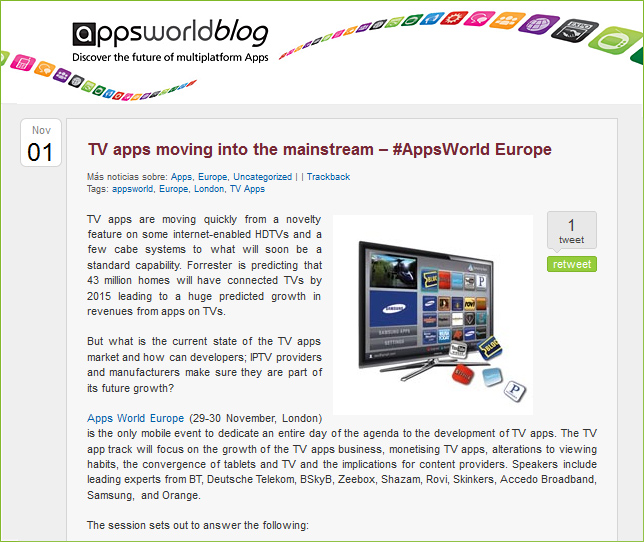
The Cloud & HTML5 — Smart TV’s Dynamic Duo — from itvt.com by Edgar Villalpando

Excerpt:

Why is HTML5 so awesome for smart TV?

  • HTML5 standards are managed by a non-corporate entity (the W3C), and are non-proprietary.
  • HTML5 utilizes the existing skill sets and tools of an enormous, established development community.
  • HTML5 is one of the few technologies that receives nearly ubiquitous support from the big players in technology and media alike. Apple, Google, and even Adobe have endorsed it.
  • HTML5 allows developers to create one application that will run on many different devices, including TVs, STBs, PCs, tablets and mobile devices.

For the smart TV space, HTML5 will speed app development cycles, reduce development costs, provide a much larger reach, and make integration of apps with the Web, and Web-connected devices, much smoother.

We’re about to exit the Walled Garden era of smart TV, and enter the Smart TV Everywhere era.

From DSC: Expectations, today, are getting hard to beat

Since Apple’s event yesterday, I’ve heard some conversations on the radio and reviewed several blog postings and articles about Apple’s announcements…many with a sense of let down (and some with the usual critical viewpoints by the backseat drivers out there who have never tried to invent anything, but who sure like to find fault with everyone else’s inventions and innovations).

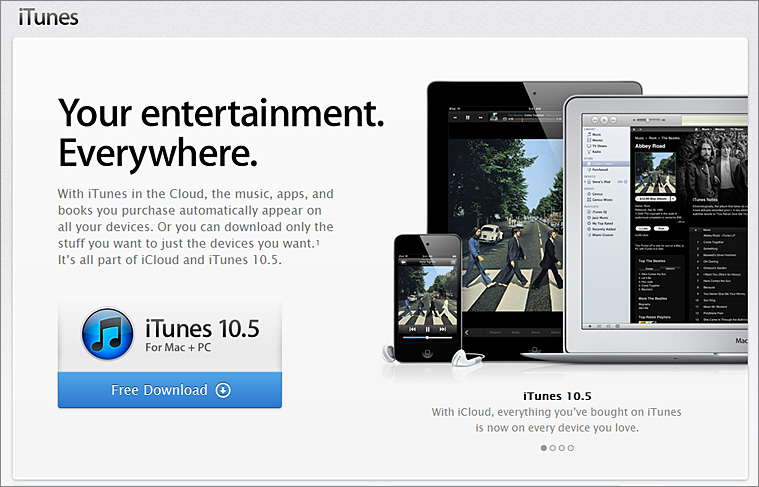
It made me reflect on how high our expectations are becoming these days!  It wasn’t enough that iCloud is coming on 10/12 (and who knows the directions that will take society in). It wasn’t enough to introduce some serious software-based innovations such as Siri (which bring some significant advancements in the world of artificial intelligence) or AirPlay for the iPhone.  It wasn’t enough to enter into the multi-billion dollar card industry with their new Cards app for the iPhone.  Wow…tough crowd.

What might these announcements — and expectations — mean for education? 
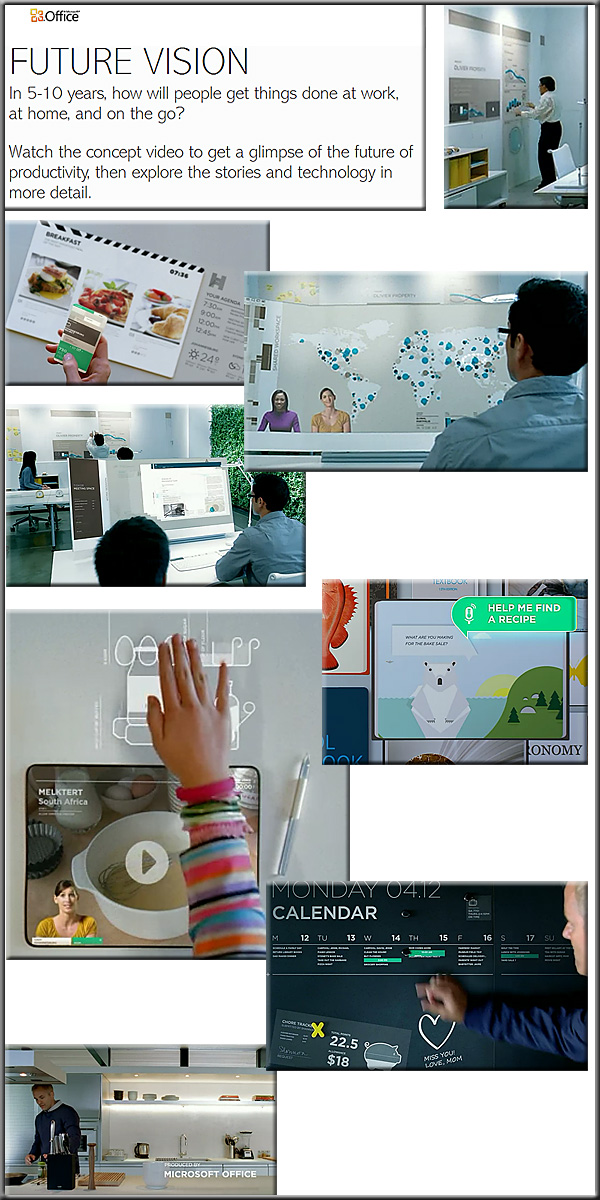
Well…I can see intelligent tutoring, intelligent agents, machine-to-machine communications, the continued growth of mobile learning, learning from the living room, the initiation of programs/events caused by changes in one’s location, continued convergence of the television/computer/telephone, continued use of videoconferencing on handheld devices, cloud-based textbooks/apps, and more.


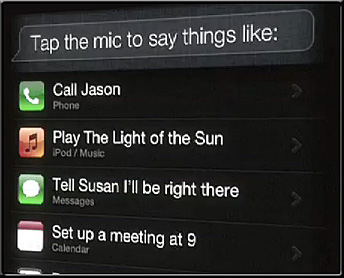
 

Siri on the iPhone 4S -- October 4, 2011


From DSC:
This posting evolved after having read $500 billion TV market new battlefield for Internet companies (from forbes.com and the Trefis Team therein) as well as the posting at Future TV disruption – Forbes says it’s worth half a trillion dollars for Internet companies (from appmarket.tv).

As the convergence — and the movement of data/apps/content/services towards the cloud — continues, I wanted to jot down some thoughts re: the current field:

  • Apple, Google, Cisco and Microsoft seem to be solid players to watch in terms of cloud-based computing architectures, tools, and functionality — something to keep in mind when planning for the future directions of your organization’s set of tools and technologies.
  • Personally, I vote for vendors that “get the web.”  Apple and Google have traditionally been very solid innovators on the web and have turned in solid report cards in terms of innovation, performance, and web-based applications.  (Adobe — with their Macromedia purchase years ago and their current lineup of tools — has also done a pretty good job, but doesn’t have the arsenal to make my top 4 picks here.)
  • I don’t need to say much about Apple in terms of innovation — as they have out innovated every company on the planet while becoming the world’s most valuable company in terms of market cap.   Apple is on the verge of adding enormously powerful, cloud-based functionality and apps to their ecosystem when they introduce iCloud this fall (and perhaps a web-connected/smart TV type of device in the future).  They have proven themselves to be #1 in terms of working with multimedia-based content — its creation and distribution. Given the continuing trend of the convergence taking place with computers, telephones, and televisions, the ability to create and work with multimedia is key for many technology-related vendors, and, in my mind, Apple leads in this area.
  • Google has shown themselves to be solid innovators as well — and they “get the web.”   Their current set of web-based apps — including Google Docs, Calendar, Hangouts, Reader, Alerts, etc. — provide a solid menu of web-based apps to choose from.
  • Cisco has proven themselves to be innovative as well, and owns some powerful technologies in their WebEx Meeting Center, Videoscape, networking infrastructures, and some of its other tools.
  • Though traditionally not a leader/innovator on the web, I think that Microsoft has deep pockets and they are a savvy business (having just purchased Skype as an example).  So with SharePoint, Skype and Office 365, Microsoft is laying the foundation for a solid, web-based collaboration space.

Having said this, one can see that it is getting harder to practice the KISS principle in the IT departments out there.  But where we can do so, it makes sense to do so — as there is less finger pointing and more accountability.  It’s easier to support a fewer amount of tools and, often times, it seems that things simply work better with a reduced amount of vendors/technologies involved.

So I’ll wrap up this posting by listing some of the things that I’m trying to (simultaneously) keep in mind:
  • Web-based collaboration tools such as videoconferencing, shared interactive whiteboards, shared document creation, calendars/scheduling, form creation and reporting tools, chat, other
  • Cloud-based content/data/apps/services
  • Synchronization across multiple types of devices
  • Web-based updates (think publishers’ content in addition to apps)
  • Storage plans and pricing
  • Types of integration and tools a vendor provides on the cloud
  • The end user experience and the usability of proposed solutions
  • A vendor’s strategic direction(s) for the future
 

Content execs at TheGrill warn: Move aside, Netflix — movies are going into the cloud — from thewrap.com (emphasis below from  DSC)

In this digitized world of renting, streaming and downloading, three executives from major content creators agreed on at least one remedy – monetizing ownership.

That is why Sony’s John Calkins, Warner Bros.’ Thomas Gewecke and CBS’ Jim Lazone took the stage on Tuesday at TheGrill, TheWrap’s annual media conference, to discuss, among other subjects, Ultraviolet, the cloud-based home- entertainment system.

…

UltraViolet will let consumers buy a digital copy of a movie at a standard retailer and upload it to the cloud, making it available whenever they want to watch it.

… UltraViolet not only offers the opportunity for repeated viewing but also a “degree of portability and multiple device interactivity you don’t get” when using something like video-on-demand.


 Also see:


Tagged with: • •  

Google spending tons of money turning YouTube into a cable alternative — from dvice.com


Google TV will disrupt television, ready or not — from informitv.com

Excerpt:

Google TV is set to launch in Europe early in 2012, following a reboot in the United States that will help developers to create applications for the platform. Dr Eric Schmidt, the chairman of Google, used his keynote speech at the Edinburgh International Television Festival to call for co-operation with the television industry, between the luvvies and boffins, saying Google seeks to be a friend, not a foe, in addressing an increasingly global opportunity. Yet many in the traditionally territorial television industry may still be wary of geeks bearing gifts, suspiciously viewing Google TV as a Trojan horse at the living room door.

Tagged with: • • • • • •  
© 2025 | Daniel Christian