



On 11/18/2020,
in adjunct faculty, colleges, community colleges, Daniel S. Christian, distance education, education technology, engagement / engaging students, experimentation, faculty/staff, higher education, homeschooling/homeschoolers, human-computer interaction (HCI), ideas, K-12 related, law schools, learning, music, online learning, pedagogy, platforms, productivity / tips and tricks, teachers, teaching & learning, teaching online, tools, universities, vendors, web-based collaboration,
by Daniel Christian

On 11/15/2020,
in collaboration, colleges, community colleges, health, ideas, innovation, instructional design, K-12 related, learning, learning ecosystem, Learning Experience Design, Learning from the Living [Class] Room, liberal arts, music, online tutoring, society, student-related, teachers, teaching & learning, teaching online, United States, vendors, videoconferencing, web-based collaboration, youth,
by Daniel Christian
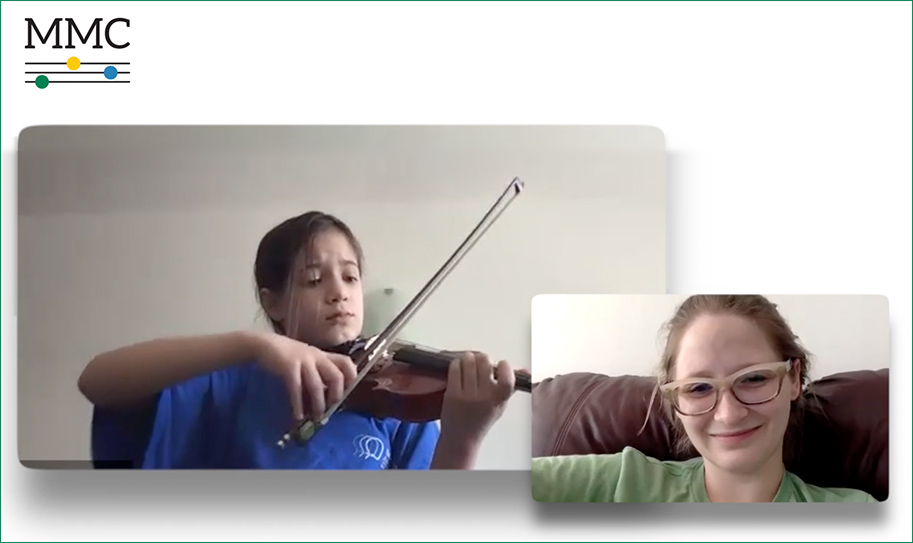
Musical Mentors collaborative mobilizes and expands in response to pandemic — with thanks to Bristol Jones for this resource/information
Organization connects musicians in need of work with students lacking access to music instruction
(Emphasis below from DSC)
New York, NY — November 12, 2020 — Musical Mentors Collaborative (“MMC”), which provides free private music instruction and instruments to students who would not otherwise have access, announced today its Winter Gala to benefit the 1:1 Music Fund which will enable the organization to provide 10,000 more lessons in the years to come.
MMC was founded in 2009 as a partnership between Columbia University students and PS 145, a neighboring elementary school in Morningside Heights, and incorporated as a 501(c)(3) non-profit in New York State in 2011. Since 2009, MMC’s university chapters have provided over 7,500 lessons to more than 450 students in the United States.
The onset of the COVID-19 pandemic in early 2020 caused dramatic and painful changes in the musical community. Many performing arts institutions were forced to close indefinitely, and many talented musicians found themselves out of work.
In response, MMC launched a teaching fellowship in early April to pay professional musicians to teach one-on-one virtual lessons to students without access to private instruction. Teachers include members of the Metropolitan Opera Orchestra, the New York Philharmonic Orchestra, as well as collaborators of Herbie Hancock, Lauryn Hill, and others. The organization has since onboarded over 35 teaching artists and nearly 200 students. Since the onset of the pandemic, MMC has paid more than $150,000 to its Teaching Fellows and shipped over $30,000 worth of instruments to students, collectively in support of over 1,300 virtual lessons.
“We are inspired by the response from the musical community, and immensely grateful for the support musicians have shown MMC students. These students represent our musical future and would otherwise lack access to the instruction and mentorship they deserve,” said Zack Susel, Co-Founder and Executive Director of MMC. “We are excited to announce our Winter Gala in support of our 1:1 Music Fund, through which we aim to provide 10,000 more private lessons in the coming years.”
In support of its growth and response to the pandemic, MMC has recruited 12 Grandmentors to lead pedagogical development, including GRAMMY® award winning pianist Emmanuel Ax, and Tony® award winning composer Jeanine Tesori, social work experts, and faculty from The Juilliard School and Curtis Institute of Music.
About Musical Mentors Collaborative
Musical Mentors Collaborative connects musicians with underserved students around the country. Since launching in 2009, MMC has taught over 8,800 free private lessons across instruments and genres, furthering their goal to support young musicians through one-on-one instruction. MMC operates chapters at universities across the United States, and mobilizes professional musicians through their selective Teaching Fellowship.
For more information, visit www.musical–mentors.org. | Instagram | Twitter
Also see:
MMC is thrilled to announce our newest campaign, the 1:1 Music Fund, which brings free, one-on-one lessons and instruments to kids who wouldn’t otherwise have access.
To learn more about the campaign and to donate, visit the link: https://t.co/A0eDNwJI3Q#1to1music pic.twitter.com/oc7TJqJFEX
— MMC (@musicalmentors_) November 12, 2020
On 11/14/2020,
in blogs / blogging / vlogging, change, curriculum, Daniel S. Christian, digital learning, education, education reform, engagement / engaging students, K-12 related, love of learning, more voice more choice more control, motivation, online learning, participation, remote teaching and learning, student-related, teachers, teaching & learning, teaching online,
by Daniel Christian
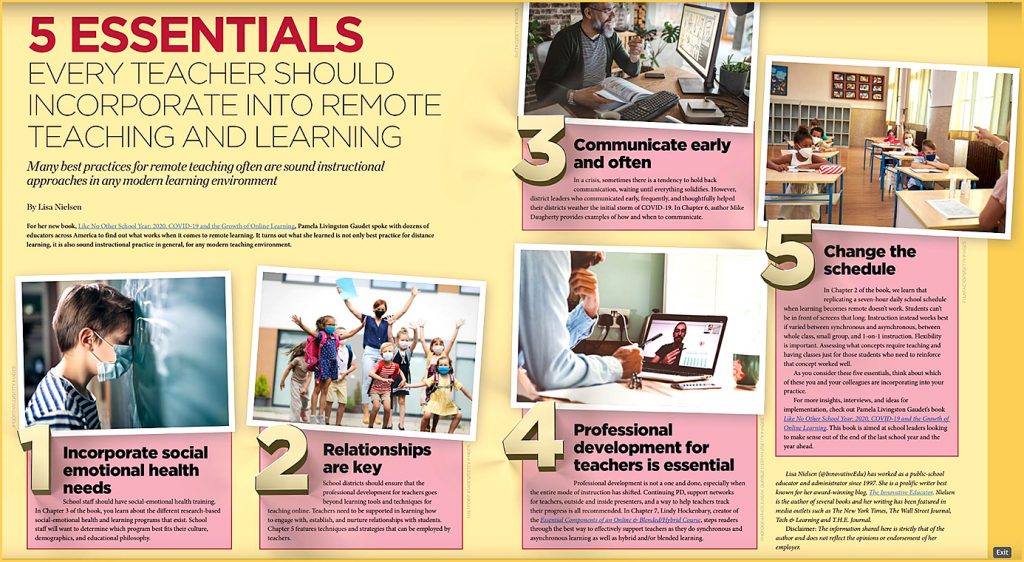
Present and accounted for? Coronavirus-related school closures create attendance challenges — from educationdive.com by Linda Jacobson
Experts say regardless of the method used to track e-learning participation, ongoing contact with students will be essential.
Excerpt:
Alisa Belzer, an education professor at Rutgers University, says K-12 teachers can learn from those who teach online in higher education.
“When instructors stay on top of evaluating the work they are asking learners to complete, they can easily determine who is ‘there’ and who’s not. A key ingredient in this process is creating engaging assignments with clear deliverables,” she says. “When instructors give feedback that is specific, clear, and actionable, students know their instructors are very much a part of their learning process. This also encourages ‘attendance.’”
From DSC:
I also think the more choice we give students will help with their levels of motivation — their sense of purpose. They will chose what’s relevant, enjoyable to them — what they are curious about and want to learn more about. I’ve witnessed this with our daughter, whose spark for writing has ignited. Her imagination is great, and she loves to write. She is going to start her own blog, which will allow her to practice. It’s highly motivating/exciting to her — to have a voice and to be able to share her work with a wider audience.
I think that if we could give students some more leeway to study what they want to study, we wouldn’t have to worry nearly as much about attendance and lack of learning. Naive? Maybe. But I’ve witnessed the K-12 runaway train that won’t stop for anyone. It travels fast, and it doesn’t stop, no matter if mastery is achieved or not.

I’ve also seen controlling K-12 environments that create gameplayers (our son is one of them).
In these rough times, I hope we don’t throw away the chance to change what’s not working within our K-12 systems. Let not this pain go to waste. My vote is to give students more agency.
On 11/07/2020,
in education, education reform, engagement / engaging students, ideas, K-12 related, neurodivergent/special needs, society, student teaching/teacher education, student-related, teachers, teaching & learning, teaching online, United States, youth,
by Daniel Christian
New Resource for Inclusive and Equitable Teaching — from community.acue.org
Excerpt:
Achieving equity requires that we teach with practices that embrace the diversity of our students’ backgrounds. We must also thoughtfully review our instructional approaches to identify—and change—any unintended practices that might limit student expectations and achievements. Just as we approach our disciplines with prior assumptions and theoretical orientations, we must ensure that we approach our teaching, and our students, with equitable beliefs about their ability to learn and the opportunity gaps that we have the ability to close. As ACUE research shows, doing so leads to stronger levels of academic achievement indistinguishable by race, ethnicity and income level.
On 11/05/2020,
in A/V -- audio/visual, adjunct faculty, adult learning, animation, Artificial Intelligence/Agents/LLMs/and Related, attention, colleges, community colleges, corporate universities / corporate training, Daniel S. Christian, digital audio, digital learning, digital storytelling, digital textbooks, distance education, education, engagement / engaging students, faculty/staff, graphics, higher education, homeschooling/homeschoolers, ideas, instructional design, K-12 related, law schools, learning, Learning Experience Design, learning preferences, learning theories, liberal arts, love of learning, media/film, memory, metacognition / metacognitive skills, more voice more choice more control, motivation, online learning, online tutoring, participation, passions, platforms, remote teaching and learning, simulations, student teaching/teacher education, student-related, teachers, teaching & learning, teaching online, training / L&D, universities,
by Daniel Christian
From DSC:
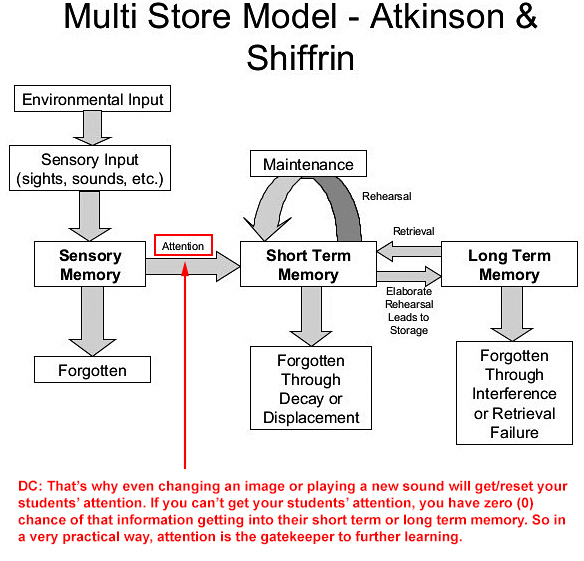
Many people talk about engagement when they discuss learning, and with good reason. It seems to me that what they are really getting at is the topic of getting and maintaining someone’s *attention.* Attention is the gatekeeper to further learning. I wonder if some of the next generation learning platforms that employ some level of Artificial Intelligence (AI)-enabled features, will look to a learner’s preferences (as stored in their cloud-based learner’s profile) in order to help gain/maintain such attention.
And this also helps explain why allowing more learner agency — i.e., more choice, more control — in pursuing their own interests and passions really helps: A motivated learner is paying closer attention to what’s going on.

From DSC:
And along these lines, that’s one of the key reasons I’d like to see more involvement from the Theatre Departments, Computer Science Departments, and from those involved with creative writing across the land — in terms of helping develop content for remote and online-based education. Actors, actresses, set designers, costumer designers, audio/video editors, programmers/software developers, and more who could collaborate on these kinds of ideas.
Last comment on this. I don’t mean that we should present our classes like many advertisements do (i.e., running a thousand images by me within 30 seconds). But changing things up periodically — both visually and audibly — can help regain/reset your students’ attentions.
On 11/02/2020,
in business side of he, change, changing business models, colleges, community colleges, digital learning, distance education, education technology, future of higher education, game-changing environment, higher education, ideas, innovation, IT in HE, law schools, leadership, learning, learning ecosystem, liberal arts, new business models, online learning, remote teaching and learning, strategy, teaching online, United States, universities,
by Daniel Christian
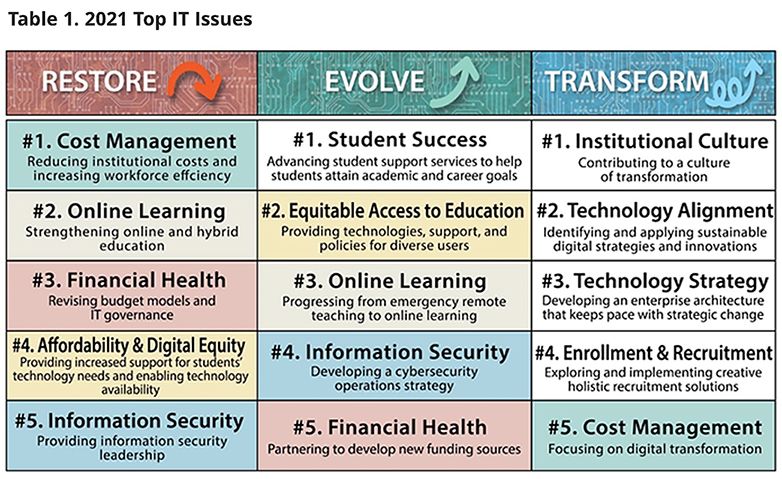
Top IT Issues, 2021: Emerging from the Pandemic — from educause.edu
Excerpt:
The EDUCAUSE Top IT Issues list has been refactored for 2021 to help higher education shape the role technology will play in the recovery from the pandemic. What different directions might institutional leaders take in their recovery strategy? How can technology help our ecosystem emerge stronger and fitter for the future?
The 2021 EDUCAUSE IT Issues project explores these questions using a very different approach from previous years. Anticipating potential ways institutions might emerge from the pandemic, this year we offer three Top IT Issues lists and examine the top 5 issues within three scenarios that may guide institutional leaders’ use of technology: restore, evolve, and transform.
Also see:
- Educause Identifies Top IT Issues for an Uncertain Future — from campustechnology.com by Dian Schaffhauser
On 10/31/2020,
in adjunct faculty, blended learning, colleges, community colleges, hybrid learning, online learning, pedagogy, platforms, remote teaching and learning, teachers, teaching & learning, teaching online, universities,
by Daniel Christian
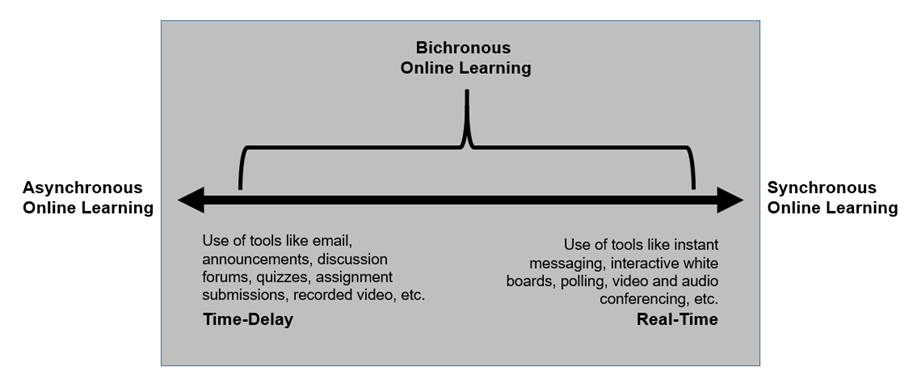
Bichronous Online Learning: Blending Asynchronous & Synchronous Online Learning — from er.educause.edu by Florence Martin, Drew Polly and Albert Ritzhaupt
Excerpt:
Overall, research shows that when synchronous communication features are integrated with asynchronous features, the online course is more engaging, increasing learning outcomes, positive attitudes, and retention.
On 10/30/2020,
in Daniel S. Christian, education, engagement / engaging students, more voice more choice more control, motivation, online learning, parents/guardians, passions, remote teaching and learning, student teaching/teacher education, student-related, teachers, teaching & learning, teaching online,
by Daniel Christian
DC: Throughout this piece I see: “More choice. More control.”#leaning #learningexperiencedesign #education #K12 #educationreform https://t.co/LyKI4mONAG
— Daniel Christian (he/him/his) (@dchristian5) October 30, 2020
From DSC:
Instead of the way I put it in the above graphic, they use words like empowerment and agency. But the bottom line is the same. Huge energy gets released when students own their own learning and are intrinsically motivated (i.e., can pursue their own interests, passions). Parents, teachers, profs should know about this and encourage it.
On 10/29/2020,
in adjunct faculty, CMS/LMS, colleges, community colleges, education technology, engagement / engaging students, faculty/staff, higher education, remote teaching and learning, society, sociology, student teaching/teacher education, student-related, teachers, teaching & learning, teaching online, trends, United States, universities, workplace,
by Daniel Christian
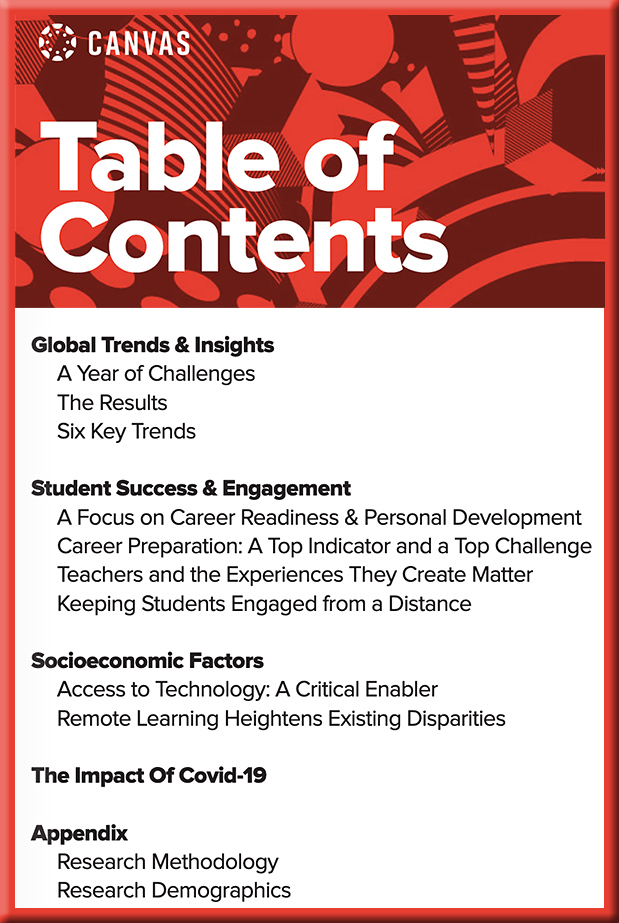
State of Student Success and Trends in Higher Education — from instructure.com
2020 Global Research Study and Trends
Excerpt (emphasis DSC):
In the following report, we’ve identified six leading trends for student success and engagement in today’s world:
- Career readiness is the number one priority for students.
- Institutions need to think beyond the lecture.
- Faculty-student engagement is critical.
- Online learning needs to be intentionally designed.
- Socioeconomic disparities impact engagement.
- Democratisation of education begins with equitable access.
On 10/27/2020,
in collaboration, colleges, communications, community colleges, computer science, higher education, leadership, Learning Experience Design, online learning, participation, platforms, presentations, programming, remote teaching and learning, teaching & learning, teaching online, tools, vendors, videoconferencing, web-based collaboration,
by Daniel Christian
The Advantages of Teaching Soft Skills to CS Undergrads Online — from cacm.acm.org by Orit Hazzan; with thanks to Sarah Huibregtse for posting this out on LinkedIn.
Excerpt:
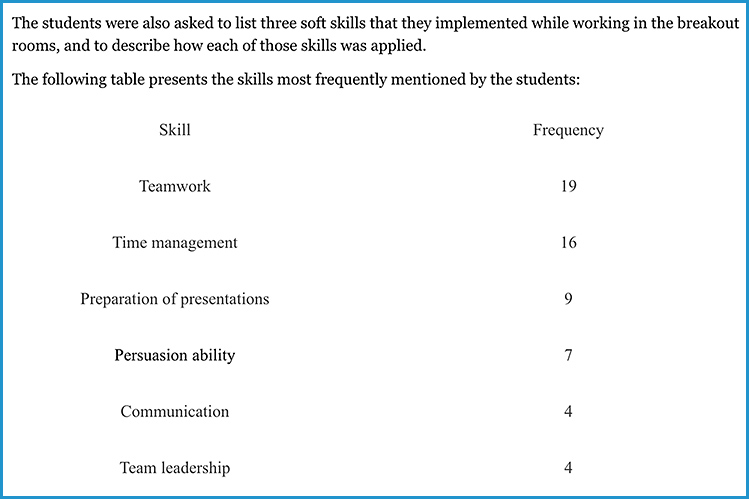
At first, I wondered whether teaching soft skills online is even possible since, unlike theoretical courses, I assumed that close face-to-face (F2F) interaction is required in order to practice such skills. Eventually, I realized that teaching this course online has, in fact, some advantages, that this teaching format opens up new opportunities, and that this medium can even foster several soft skills that I had not previously considered teaching in the F2F format. This blog demonstrates these advantages by focusing on the use of the breakout rooms option available in Zoom, which I used extensively in the course.
On 10/24/2020,
in A/V -- audio/visual, adjunct faculty, colleges, communications, community colleges, corporate universities / corporate training, Daniel S. Christian, digital learning, distance education, Google, K-12 related, law schools, Microsoft, platforms, productivity / tips and tricks, remote teaching and learning, teachers, teaching & learning, teaching online, tools, vendors, videoconferencing, web-based collaboration,
by Daniel Christian
Expert Tips for Using PowerPoint Presenter View (2 screens, Windows) in Zoom or Teams — from thinkoutsidetheslide.com; with thanks to Tamara Kravits for this resource
Except:
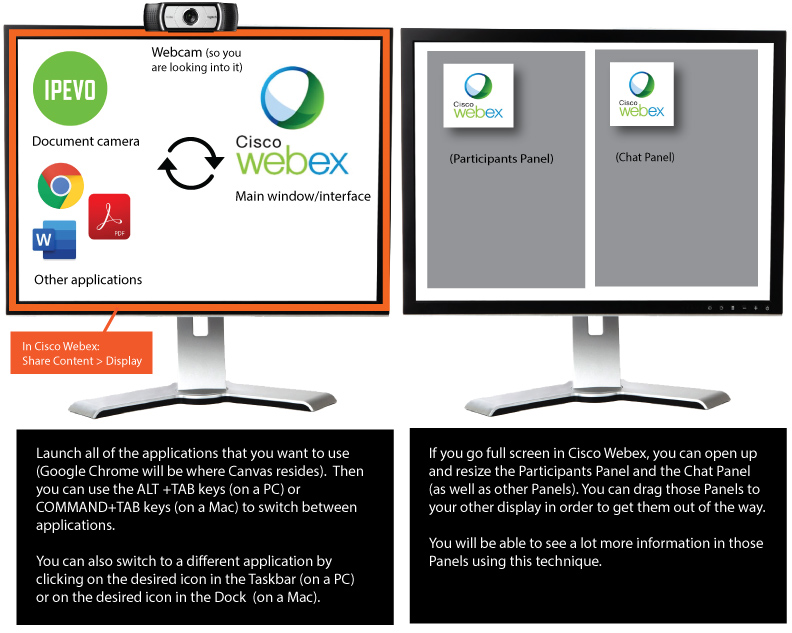
In this article I want to share some of the expert tips for using the features of Presenter View. I will use the common scenario of Presenter View showing on one screen while the slides show on a second screen which is shared in the meeting platform. This allows easy access to all the Presenter View features.
If you need to add a second screen, check out the options in this article and if you want to learn more about using Presenter View in different setups, I have complete guides to using Presenter View in Zoom and in Teams.
From DSC:
Along the lines of using two monitors with a videoconferencing application, below is a graphic I created for our faculty members at the WMU-Cooley Law School.
Also relevant/see:
- 6 Microsoft Teams features Zoom doesn’t have — from legaltechmonitor.com by Jim Calloway
On 10/22/2020,
in 21st century, 24x7x365 access, 3D, A/V -- audio/visual, active learning, adjunct faculty, Adobe, Apple, architecture, art, attention, biology, business side of he, career development, collaboration, colleges, communications, communities of practice, community colleges, competency-based learning/education, computer science, content development, aggregation, repositories, creativity, Daniel S. Christian, design, digital audio, digital learning, digital photography, digital storytelling, digital video, distance education, drama/theater, economics, education, education technology, educational games / serious games, engagement / engaging students, engineering, entrepreneurship, experimentation, face-to-face, faculty/staff, future, game-changing environment, geography / geology, global, graphics, higher education, human-computer interaction (HCI), ideas, immersion, innovation, instructional design, interaction design, interactivity, interface design, journalism, learning, learning ecosystem, Learning Experience Design, Learning from the Living [Class] Room, liberal arts, love of learning, mathematics, media/film, Michigan, MOOCs -- Massive Open Online Courses, multimedia, music, online learning, online media, participation, passions, photography, platforms, project-based learning, reinvent, research, student-related, teachers, teaching & learning, teaching online, United States, universities, vision/possibilities, writing, XR - extended reality,
by Daniel Christian
From DSC…by the way, another title for this blog could have been:
WIN-WIN situations all around! The Theatre Departments out there could collaborate with other depts/disciplines to develop highly engaging, digitally-based learning experiences!
The future of drama and the theatre — as well as opera, symphonies, and more — will likely include a significant virtual/digital component to them. While it’s too early to say that theatre needs to completely reinvent itself and move “the stage” completely online, below is an idea that creates a variety of WIN-WIN situations for actors, actresses, stage designers, digital audio/video editors, fine artists, graphic designers, programmers, writers, journalists, web designers, and many others as well — including the relevant faculty members!
A new world of creative, engaging, active learning could open up if those involved with the Theatre Department could work collaboratively with students/faculty members from other disciplines. And in the end, the learning experiences and content developed would be highly engaging — and perhaps even profitable for the institutions themselves!
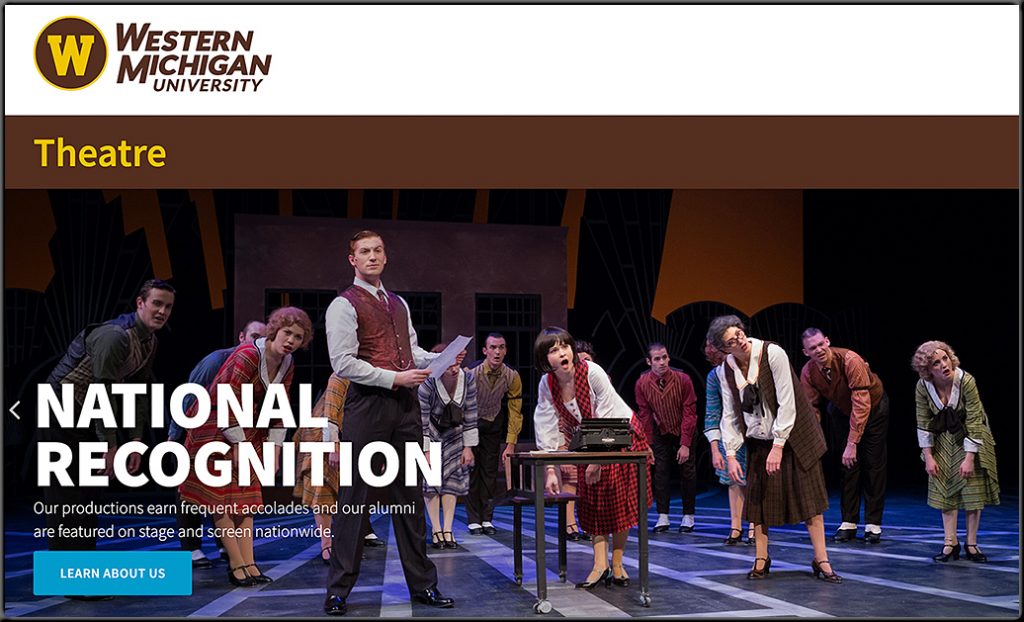
[DC: I only slightly edited the above image from the Theatre Department at WMU]
Though the integration of acting with online-based learning materials is not a new idea, this post encourages a far more significant interdisciplinary collaboration between the Theatre Department and other departments/disciplines.
Consider a “Dealing with Bias in Journalism” type of topic, per a class in the Digital Media and Journalism Major.
- Students from the Theatre Department work collaboratively with the students from the most appropriate class(es?) from the Communications Department to write the script, as per the faculty members’ 30,000-foot instructions (not 1000-foot level/detailed instructions)
- Writing the script would entail skills involved with research, collaboration, persuasion, creativity, communication, writing, and more
- The Theatre students would ultimately act out the script — backed up by those learning about sound design, stage design, lighting design, costume design, etc.
- Example scene: A woman is sitting around the kitchen table, eating breakfast and reading a posting — aloud — from a website that includes some serious bias in it that offends the reader. She threatens to cancel her subscription, contact the editor, and more. She calls out to her partner why she’s so mad about the article.
- Perhaps there could be two or more before/after scenes, given some changes in the way the article was written.
- Once the scenes were shot, the digital video editors, programmers, web designers, and more could take that material and work with the faculty members to integrate those materials into an engaging, interactive, branching type of learning experience.
- From there, the finished product would be deployed by the relevant faculty members.
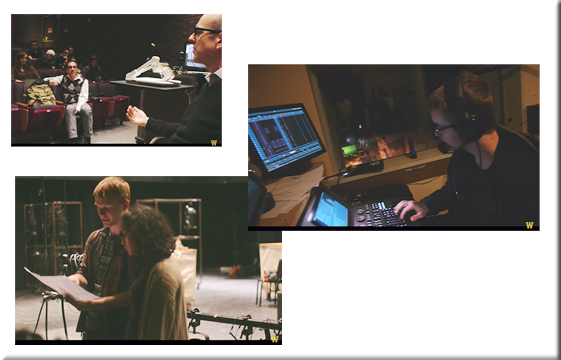
[DC: Above images from the Theatre Department at WMU]
Colleges and universities could share content with each other and/or charge others for their products/content/learning experiences. In the future, I could easily see a marketplace for buying and selling such engaging content. This could create a needed new source of revenue — especially given that those large auditoriums and theaters are likely not bringing in as much revenue as they typically do.
Colleges and universities could also try to reach out to local acting groups to get them involved and continue to create feeders into the world of work.
Other tags/categories could include:
- MOOCs
- Learning from the Living[Class]Room
- Multimedia / digital literacy — tools from Adobe, Apple, and others.
- Passions, participation, engagement, attention.
- XR: Creating immersive, Virtual Reality (VR)-based experiences
- Learning Experience Design
- Interaction Design
- Interface Design
- …and more
Also see:
What improv taught me about failure: As a teacher and academic — from scholarlyteacher.com by Katharine Hubbard

In improv, the only way to “fail” is to overthink and not have fun, which reframed what failure was on a grand scale and made me start looking at academia through the same lens. What I learned about failure through improv comes back to those same two core concepts: have fun and stop overthinking.
…
Students are more engaged when the professor is having fun with the materials (Keller, Hoy, Goetz, & Frenzel, 2016), and teaching is more enjoyable when we are having fun ourselves.