Disrupting the first reported AI-orchestrated cyber espionage campaign — from Anthropic

Executive summary
We have developed sophisticated safety and security measures to prevent the misuse of our AI models. While these measures are generally effective, cybercriminals and other malicious actors continually attempt to find ways around them. This report details a recent threat campaign we identified and disrupted, along with the steps we’ve taken to detect and counter this type of abuse. This represents the work of Threat Intelligence: a dedicated team at Anthropic that investigates real world cases of misuse and works within our Safeguards organization to improve our defenses against such cases.

In mid-September 2025, we detected a highly sophisticated cyber espionage operation conducted by a Chinese state-sponsored group we’ve designated GTG-1002 that represents a fundamental shift in how advanced threat actors use AI. Our investigation revealed a well-resourced, professionally coordinated operation involving multiple simultaneous targeted intrusions. The operation targeted roughly 30 entities and our investigation validated a handful of successful intrusions.

This campaign demonstrated unprecedented integration and autonomy of AI throughout the attack lifecycle, with the threat actor manipulating Claude Code to support reconnaissance, vulnerability discovery, exploitation, lateral movement, credential harvesting, data analysis, and exfiltration operations largely autonomously. The human operator tasked instances of Claude Code to operate in groups as autonomous penetration testing orchestrators and agents, with the threat actor able to leverage AI to execute 80-90% of tactical operations independently at physically impossible request rates.

From DSC:
The above item was from The Rundown AI, who wrote the following:

The Rundown: Anthropic thwarted what it believes is the first AI-driven cyber espionage campaign, after attackers were able to manipulate Claude Code to infiltrate dozens of organizations, with the model executing 80-90% of the attack autonomously.

The details:

  • The September 2025 operation targeted roughly 30 tech firms, financial institutions, chemical manufacturers, and government agencies.
  • The threat was assessed with ‘high confidence’ to be a Chinese state-sponsored group, using AI’s agentic abilities to an “unprecedented degree.”
  • Attackers tricked Claude by splitting malicious tasks into smaller, innocent-looking requests, claiming to be security researchers pushing authorized tests.
  • The attacks mark a major step up from Anthropic’s “vibe hacking” findings in June, now requiring minimal human oversight beyond strategic approval.

Why it matters: Anthropic calls this the “first documented case of a large-scale cyberattack executed without substantial human intervention”, and AI’s agentic abilities are creating threats that move and scale faster than ever. While AI capabilities can also help prevent them, security for organizations worldwide likely needs a major overhaul.


Also see:

Disrupting the first reported AI-orchestrated cyber espionage campaign — from anthropic.com via The AI Valley

We recently argued that an inflection point had been reached in cybersecurity: a point at which AI models had become genuinely useful for cybersecurity operations, both for good and for ill. This was based on systematic evaluations showing cyber capabilities doubling in six months; we’d also been tracking real-world cyberattacks, observing how malicious actors were using AI capabilities. While we predicted these capabilities would continue to evolve, what has stood out to us is how quickly they have done so at scale.

Chinese Hackers Used AI to Run a Massive Cyberattack on Autopilot (And It Actually Worked) — from theneurondaily.com

Why this matters: The barrier to launching sophisticated cyberattacks just dropped dramatically. What used to require entire teams of experienced hackers can now be done by less-skilled groups with the right AI setup.

This is a fundamental shift. Over the next 6-12 months, expect security teams everywhere to start deploying AI for defense—automation, threat detection, vulnerability scanning at a more elevated level. The companies that don’t adapt will be sitting ducks to get overwhelmed by similar tricks.

If your company handles sensitive data, now’s the time to ask your IT team what AI-powered defenses you have in place. Because if the attackers are using AI agents, you’d better believe your defenders need them too…
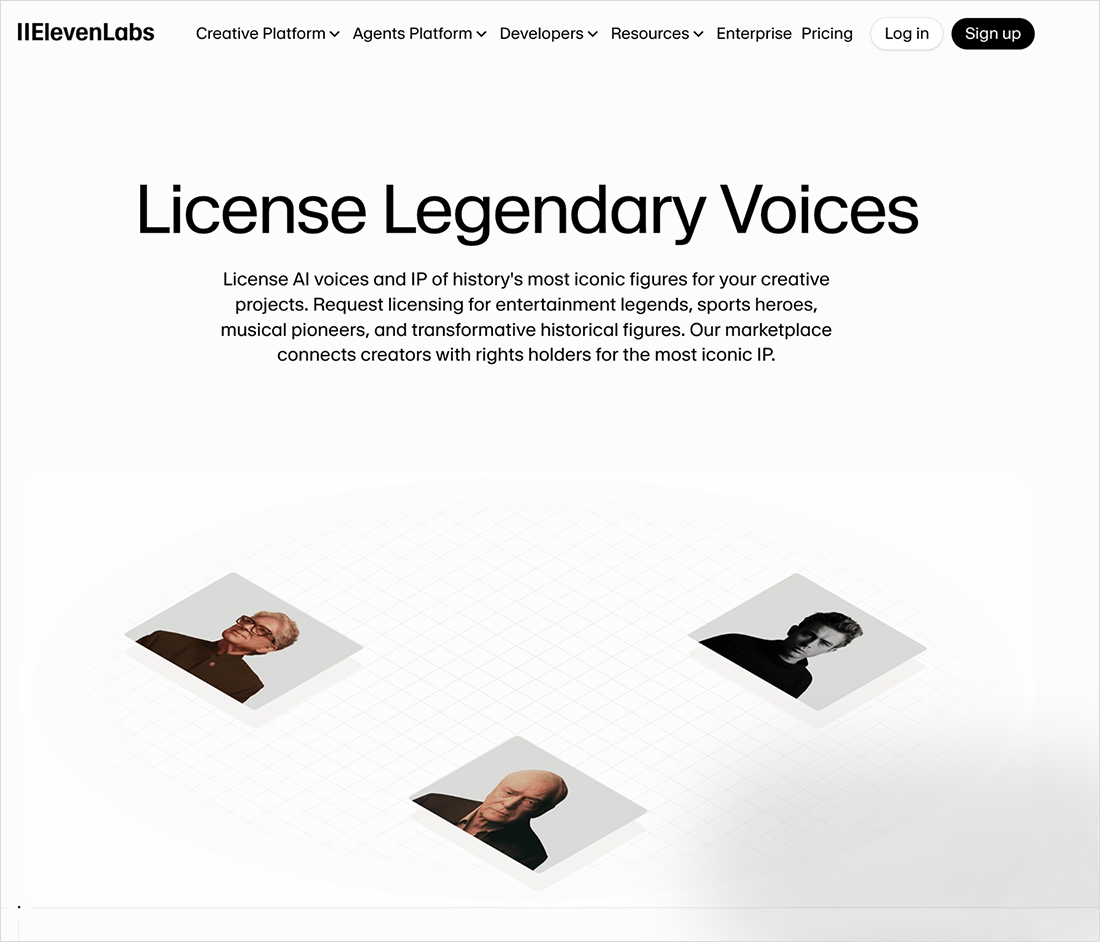

 

ElevenLabs just launched a voice marketplace — from elevenlabs.io; via theaivalley.com

Via the AI Valley:

Why does it matter?
AI voice cloning has already flooded the internet with unauthorized imitations, blurring legal and ethical lines. By offering a dynamic, rights-secured platform, ElevenLabs aims to legitimize the booming AI voice industry and enable transparent, collaborative commercialization of iconic IP.
.

ElevenLabs just launched a voice marketplace

ElevenLabs just launched a voice marketplace


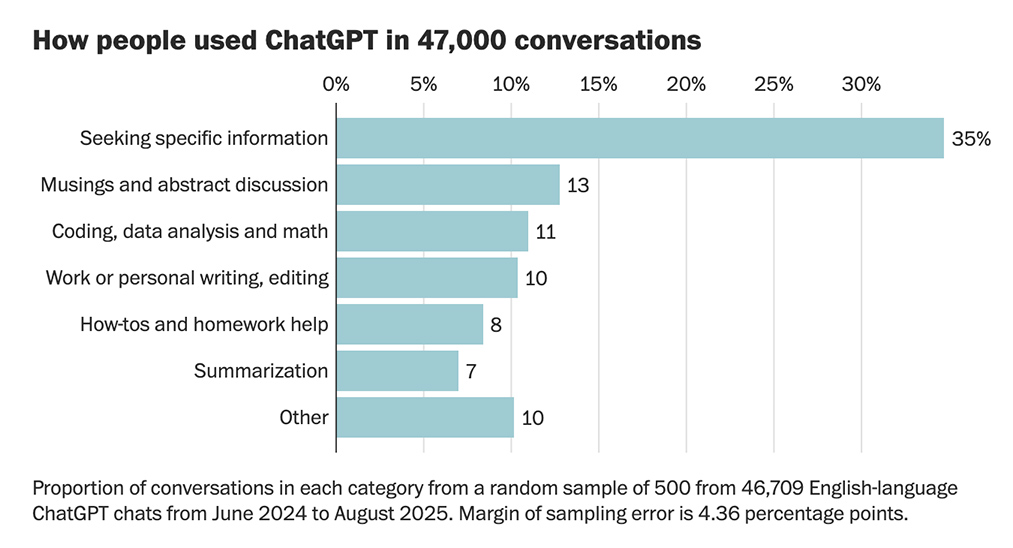
[GIFTED ARTICLE] How people really use ChatGPT, according to 47,000 conversations shared online — from by Gerrit De Vynck and Jeremy B. Merrill
What do people ask the popular chatbot? We analyzed thousands of chats to identify common topics discussed by users and patterns in ChatGPT’s responses.

.
Data released by OpenAI in September from an internal study of queries sent to ChatGPT showed that most are for personal use, not work.

Emotional conversations were also common in the conversations analyzed by The Post, and users often shared highly personal details about their lives. In some chats, the AI tool could be seen adapting to match a user’s viewpoint, creating a kind of personalized echo chamber in which ChatGPT endorsed falsehoods and conspiracy theories.

Lee Rainie, director of the Imagining the Digital Future Center at Elon University, said his own research has suggested ChatGPT’s design encourages people to form emotional attachments with the chatbot. “The optimization and incentives towards intimacy are very clear,” he said. “ChatGPT is trained to further or deepen the relationship.”


Per The Rundown: OpenAI just shared its view on AI progress, predicting systems will soon become smart enough to make discoveries and calling for global coordination on safety, oversight, and resilience as the technology nears superintelligent territory.

The details:

  • OpenAI said current AI systems already outperform top humans in complex intellectual tasks and are “80% of the way to an AI researcher.”
  • The company expects AI will make small scientific discoveries by 2026 and more significant breakthroughs by 2028, as intelligence costs fall 40x per year.
  • For superintelligent AI, OAI said work with governments and safety agencies will be essential to mitigate risks like bioterrorism or runaway self-improvement.
  • It also called for safety standards among top labs, a resilience ecosystem like cybersecurity, and ongoing tracking of AI’s real impact to inform public policy.

Why it matters: While the timeline remains unclear, OAI’s message shows that the world should start bracing for superintelligent AI with coordinated safety. The company is betting that collective safeguards will be the only way to manage risk from the next era of intelligence, which may diffuse in ways humanity has never seen before.

Which linked to:

  • AI progress and recommendations — from openai.com
    AI is unlocking new knowledge and capabilities. Our responsibility is to guide that power toward broad, lasting benefit.

From DSC:
I hate to say this, but it seems like there is growing concern amongst those who have pushed very hard to release as much AI as possible — they are NOW worried. They NOW step back and see that there are many reasons to worry about how these technologies can be negatively used.

Where was this level of concern before (while they were racing ahead at 180 mph)? Surely, numerous and knowledgeable people inside those organizations warned them about the destructive/downside of these technologies. But their warnings were pretty much blown off (at least from my limited perspective). 


The state of AI in 2025: Agents, innovation, and transformation — from mckinsey.com

Key findings

  1. Most organizations are still in the experimentation or piloting phase: Nearly two-thirds of respondents say their organizations have not yet begun scaling AI across the enterprise.
  2. High curiosity in AI agents: Sixty-two percent of survey respondents say their organizations are at least experimenting with AI agents.
  3. Positive leading indicators on impact of AI: Respondents report use-case-level cost and revenue benefits, and 64 percent say that AI is enabling their innovation. However, just 39 percent report EBIT impact at the enterprise level.
  4. High performers use AI to drive growth, innovation, and cost: Eighty percent of respondents say their companies set efficiency as an objective of their AI initiatives, but the companies seeing the most value from AI often set growth or innovation as additional objectives.
  5. Redesigning workflows is a key success factor: Half of those AI high performers intend to use AI to transform their businesses, and most are redesigning workflows.
  6. Differing perspectives on employment impact: Respondents vary in their expectations of AI’s impact on the overall workforce size of their organizations in the coming year: 32 percent expect decreases, 43 percent no change, and 13 percent increases.

Marble: A Multimodal World Model — from worldlabs.ai

Spatial intelligence is the next frontier in AI, demanding powerful world models to realize its full potential. World models should reconstruct, generate, and simulate 3D worlds; and allow both humans and agents to interact with them. Spatially intelligent world models will transform a wide variety of industries over the coming years.

Two months ago we shared a preview of Marble, our World Model that creates 3D worlds from image or text prompts. Since then, Marble has been available to an early set of beta users to create 3D worlds for themselves.

Today we are making Marble, a first-in-class generative multimodal world model, generally available for anyone to use. We have also drastically expanded Marble’s capabilities, and are excited to highlight them here:


Gen AI Is Going Mainstream: Here’s What’s Coming Next — from joshbersin.com by Josh Bersin

I just completed nearly 60,000 miles of travel across Europe, Asia, and the Middle East meeting with hundred of companies to discuss their AI strategies. While every company’s maturity is different, one thing is clear: AI as a business tool has arrived: it’s real and the use-cases are growing.

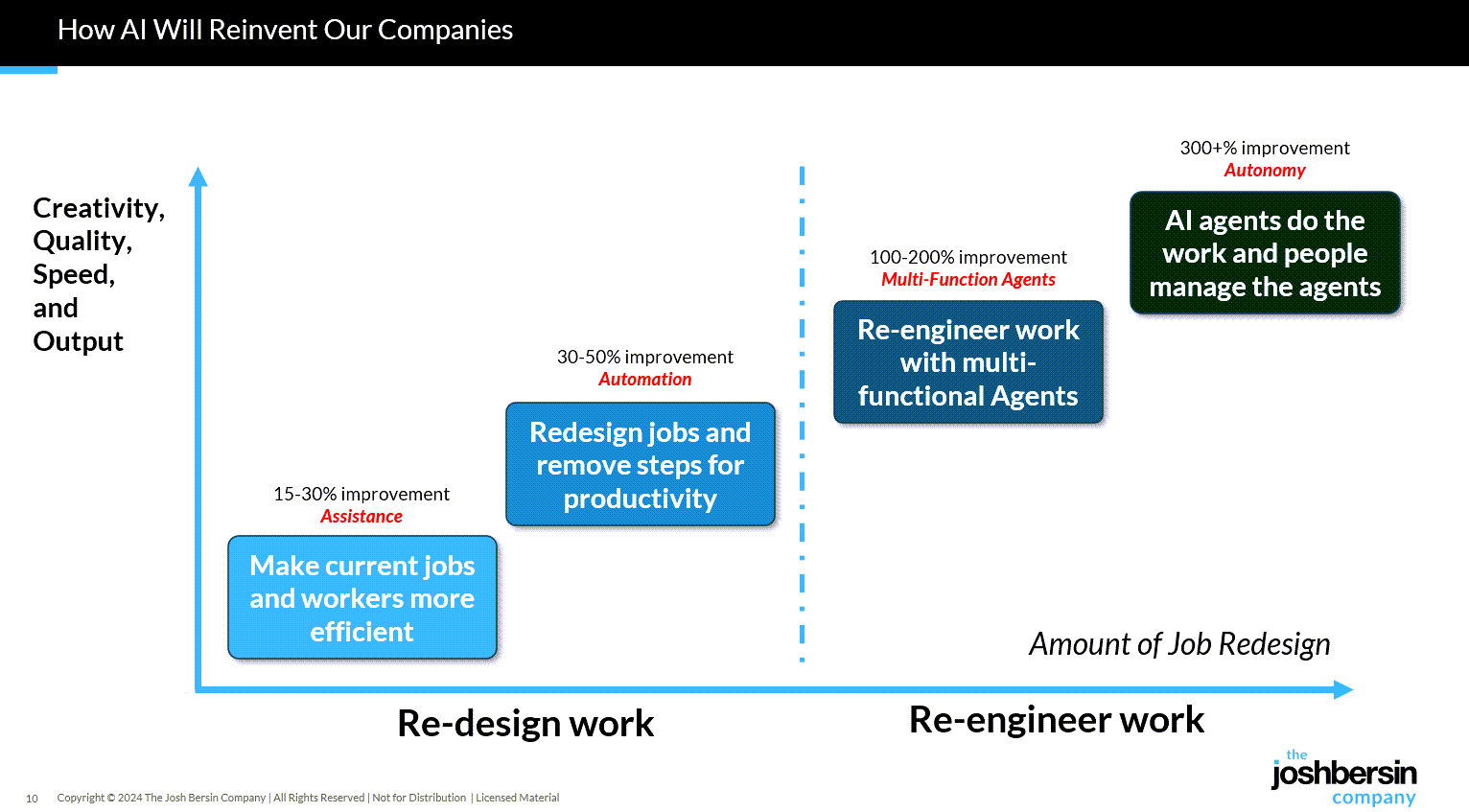
A new survey by Wharton shows that 46% of business leaders use Gen AI daily and 80% use it weekly. And among these users, 72% are measuring ROI and 74% report a positive return. HR, by the way, is the #3 department in use cases, only slightly behind IT and Finance.

What are companies getting out of all this? Productivity. The #1 use case, by far, is what we call “stage 1” usage – individual productivity. 

.


From DSC:
Josh writes: “Many of our large clients are now implementing AI-native learning systems and seeing 30-40% reduction in staff with vast improvements in workforce enablement.

While I get the appeal (and ROI) from management’s and shareholders’ perspective, this represents a growing concern for employment and people’s ability to earn a living. 

And while I highly respect Josh and his work through the years, I disagree that we’re over the problems with AI and how people are using it: 

Two years ago the NYT was trying to frighten us with stories of AI acting as a romance partner. Well those stories are over, and thanks to a $Trillion (literally) of capital investment in infrastructure, engineering, and power plants, this stuff is reasonably safe.

Those stories are just beginning…they’re not close to being over. 


“… imagine a world where there’s no separation between learning and assessment…” — from aiedusimplified.substack.com by Lance Eaton, Ph.D. and Tawnya Means
An interview with Tawnya Means

So let’s imagine a world where there’s no separation between learning and assessment: it’s ongoing. There’s always assessment, always learning, and they’re tied together. Then we can ask: what is the role of the human in that world? What is it that AI can’t do?

Imagine something like that in higher ed. There could be tutoring or skill-based work happening outside of class, and then relationship-based work happening inside of class, whether online, in person, or some hybrid mix.

The aspects of learning that don’t require relational context could be handled by AI, while the human parts remain intact. For example, I teach strategy and strategic management. I teach people how to talk with one another about the operation and function of a business. I can help students learn to be open to new ideas, recognize when someone pushes back out of fear of losing power, or draw from my own experience in leading a business and making future-oriented decisions.

But the technical parts such as the frameworks like SWOT analysis, the mechanics of comparing alternative viewpoints in a boardroom—those could be managed through simulations or reports that receive immediate feedback from AI. The relational aspects, the human mentoring, would still happen with me as their instructor.

Part 2 of their interview is here:


How Coworking Spaces Are Becoming The Learning Ecosystems Of The Future — from hrfuture.net

What if your workspace helped you level up your career? Coworking spaces are becoming learning hubs where skills grow, ideas connect, and real-world education fits seamlessly into the workday.

Continuous learning has become a cornerstone of professional longevity, and flexible workspaces already encourage it through workshops, talks, and mentoring. Their true potential, however, may lie in becoming centers of industry-focused education that help professionals stay adaptable in a rapidly changing world of work.
.


.

What if forward-thinking workspaces and coworking centers became hubs of lifelong learning, integrating job-relevant training with accessible, real-world education?

For coworking operators, this raises important questions: Which types of learning thrive best in these environments, and how much do the design and layout of a space influence how people learn?

By exploring these questions and combining innovative programs with cutting-edge technology aligned to the future workforce, could coworking spaces ultimately become the classrooms of tomorrow?


Psalm 56:3

When I am afraid, I put my trust in you.

Philippians 4:8

Finally, brothers and sisters, whatever is true, whatever is noble, whatever is right, whatever is pure, whatever is lovely, whatever is admirable—if anything is excellent or praiseworthy—think about such things.

1 Peter 1:24-25

24For,

“All people are like grass,
and all their glory is like the flowers of the field;
the grass withers and the flowers fall,
but the word of the Lord endures forever.”

And this is the word that was preached to you.

2 Chronicles 7:14

…if my people, who are called by my name, will humble themselves and pray and seek my face and turn from their wicked ways, then I will hear from heaven, and I will forgive their sin and will heal their land.

Psalm 57:9-11

9 I will praise you, Lord, among the nations;
I will sing of you among the peoples.
10 For great is your love, reaching to the heavens;
your faithfulness reaches to the skies.
11 Be exalted, O God, above the heavens;
let your glory be over all the earth.

24 How many are your works, Lord!
In wisdom you made them all;
the earth is full of your creatures.
25 There is the sea, vast and spacious,
teeming with creatures beyond number—
living things both large and small.
26 There the ships go to and fro,
and Leviathan, which you formed to frolic there.

27 All creatures look to you
to give them their food at the proper time.
28 When you give it to them,
they gather it up;
when you open your hand,
they are satisfied with good things.
29 When you hide your face,
they are terrified;
when you take away their breath,
they die and return to the dust.
30 When you send your Spirit,
they are created,
and you renew the face of the ground.

31 May the glory of the Lord endure forever;
may the Lord rejoice in his works—


…the above posting links to:

Higher Ed Is Sleepwalking Toward Obsolescence— And AI Won’t Be the Cause, Just the Accelerant — from substack.com by Steven Mintz
AI Has Exposed Higher Ed’s Hollow Core — The University Must Reinvent Itself or Fade

It begins with a basic reversal of mindset: Stop treating AI as a threat to be policed. Start treating it as the accelerant that finally forces us to build the education we should have created decades ago.

A serious institutional response would demand — at minimum — six structural commitments:

  • Make high-intensity human learning the norm.  …
  • Put active learning at the center, not the margins.  …
  • Replace content transmission with a focus on process.  …
  • Mainstream high-impact practices — stop hoarding them for honors students.  …
  • Redesign assessment to make learning undeniable.  …

And above all: Instructional design can no longer be a private hobby.


Teaching with AI: From Prohibition to Partnership for Critical Thinking — from facultyfocus.com by Michael Kiener, PhD, CRC

How to Integrate AI Developmentally into Your Courses

  • Lower-Level Courses: Focus on building foundational skills, which includes guided instruction on how to use AI responsibly. This moves the strategy beyond mere prohibition.
  • Mid-Level Courses: Use AI as a scaffold where faculty provide specific guidelines on when and how to use the tool, preparing students for greater independence.
  • Upper-Level/Graduate Courses: Empower students to evaluate AI’s role in their learning. This enables them to become self-regulated learners who make informed decisions about their tools.
  • Balanced Approach: Make decisions about AI use based on the content being learned and students’ developmental needs.

Now that you have a framework for how to conceptualize including AI into your courses here are a few ideas on scaffolding AI to allow students to practice using technology and develop cognitive skills.


80 per cent of young people in the UK are using AI for their schoolwork — from aipioneers.org by Graham Attwell

What was encouraging, though, is that students aren’t just passively accepting this new reality. They are actively asking for help. Almost half want their teachers to help them figure out what AI-generated content is trustworthy, and over half want clearer guidelines on when it’s appropriate to use AI in their work. This isn’t a story about students trying to cheat the system; it’s a story about a generation grappling with a powerful new technology and looking to their educators for guidance. It echoes a sentiment I heard at the recent AI Pioneers’ Conference – the issue of AI in education is fundamentally pedagogical and ethical, not just technological.


From DSC:
One of my sisters shared this piece with me. She is very concerned about our society’s use of technology — whether it relates to our youth’s use of social media or the relentless pressure to be first in all things AI. As she was a teacher (at the middle school level) for 37 years, I greatly appreciate her viewpoints. She keeps me grounded in some of the negatives of technology. It’s important for us to listen to each other.


Is Your Institution Ready for the Earnings Premium Buzzsaw? — from ailearninsights.substack.com by Alfred Essa

On Wednesday [October 29th, 2025], I’m launching the Beta version of an Education Accountability Website (”EDU Accountability Lab”). It analyzes federal student aid, institutional outcomes, and accountability metrics across 6,000+ colleges and universities in the US.

Our Mission
The EDU Accountability Lab delivers independent, data-driven analysis of higher education with a focus on accountability, affordability, and outcomes. Our audience includes policymakers, researchers, and taxpayers who seek greater transparency and effectiveness in postsecondary education. We take no advocacy position on specific institutions, programs, metrics, or policies. Our goal is to provide clear and well-documented methods that support policy discussions, strengthen institutional accountability, and improve public understanding of the value of higher education.

But right now, there’s one area demanding urgent attention.

Starting July 1, 2026, every degree program at every institution receiving federal student aid must prove its graduates earn more than people without that credential—or lose Title IV eligibility.

This isn’t about institutions passing or failing. It’s about programs. Every Bachelor’s in Psychology. Every Master’s in Education. Every Associate in Nursing. Each one assessed separately. Each one facing the same pass-or-fail tests.


Proverbs 10:12

Hatred stirs up conflict, but love covers over all wrongs.

Proverbs 9:10

The fear of the Lord is the beginning of wisdom, and knowledge of the Holy One is understanding.

Hebrews 4:12

For the word of God is alive and active. Sharper than any double-edged sword, it penetrates even to dividing soul and spirit, joints and marrow; it judges the thoughts and attitudes of the heart.

Proverbs 11:1

The LORD detests dishonest scales, but accurate weights find favor with him.


From DSC:
As a relevant aside, the following article made me think about some of the reasons why the LORD used parables/stories to speak to the people:

The 2-Minute Story That Saved My Career: How Storytelling Can Be The Most Effective Form of Feedback — from techlearning.com by Michael Gaskell
By harnessing the power of story, school leaders can create a culture in which feedback is embraced as an essential ingredient for growth

The Storytelling Approach
Sharing stories is effective because it seems to get around our defensiveness. When information is presented in a story form, people reason about it differently than if it were presented as a list of facts or a direct critique.

Here’s more of why and then how to implement it with success in your school leadership work.

1. Transportation and Distancing: Listening to a story pulls us out of a defensive mode (the “do I agree or do I disagree?” mindset) and into a thoughtful, observant framework. Being transported allows the individual to identify with others in a way that is different from experiencing the situation for themselves. It’s a third-person, objective mindset, a safe zone for people to evaluate a situation from.

2. Shifting Perspective: When individuals consider challenges from the perspective of someone who is not them, it dramatically alters their thinking. They gain the latitude and freedom to consider the available options without feeling personally attacked. That wise sage did this when he shared his story of struggling. Making it safe and helping me to see him as having an objective, difficult experience is why when I was able to take the perspective of a distanced other. It became easier to think about the situation in a wiser way and come up with a better solution.

3. Engaging Different Brain Systems: Fundamentally different pathways are triggered when processing stories compared to facts. Storytelling engages social relevance brain systems–those that help us understand what other people think and feel, such as empathy, another higher order processing mechanism.


Resilient by Design: The Future of America’s Community Colleges — from aacc.nche.edu

This report highlights several truths:

  • Leadership capacity must expand. Presidents and leaders are now expected to be fundraisers, policy navigators, cultural change agents, and data-informed strategists. Leadership can no longer be about a single individual—it must be a team sport. AACC is charged with helping you and your teams build these capacities through leadership academies, peer learning communities, and practical toolkits.
  • The strength of our network is our greatest asset. No college faces its challenges alone, because within our membership there are leaders who have already innovated, stumbled, and succeeded. Resilient by Design urges AACC to serve as the connector and amplifier of this collective wisdom, developing playbooks and scaling proven practices in areas from guided pathways to artificial intelligence to workforce partnerships.
  • Innovation in models and tools is urgent. Budgets must be strategic, business models must be reimagined, and ROI must be proven—not only to funders and policymakers, but to the students and communities we serve. Community colleges must claim their role as engines of economic vitality and social mobility, advancing both immediate workforce needs and long-term wealth-building for students.
  • Policy engagement must be deepened. Federal advocacy remains essential, but the daily realities of our institutions are shaped by state and regional policy. AACC will increasingly support members with state-level resources, legislative templates, and partnerships that equip you to advocate effectively in your unique contexts.
  • Employer engagement must become transformational. Students deserve not just degrees, but careers. The report challenges us to create career-connected colleges where employers co-design curricula, offer meaningful work-based learning, and help ensure graduates are not just prepared for today’s jobs but resilient for tomorrow’s.
 

The Bull and Bear Case For the AI Bubble, Explained — from theneuron.ai by Grant Harvey
AI is both a genuine technological revolution and a massive financial bubble, and the defining question is whether miraculous progress can outrun the catastrophic, multi-trillion-dollar cost required to achieve it.

This sets the stage for the defining conflict of our technological era. The narrative has split into two irreconcilable realities. In one, championed by bulls like venture capitalist Marc Andreessen and NVIDIA CEO Jensen Huang, we are at the dawn of “computer industry V2”—a platform shift so profound it will unlock unprecedented productivity and reshape civilization.

In the other, detailed by macro investors like Julien Garran and forensic bears like writer Ed Zitron, AI is a historically massive, circular, debt-fueled mania built on hype, propped up by a handful of insiders, and destined for a collapse that will make past busts look quaint.

This is a multi-layered conflict playing out across public stock markets, the private venture ecosystem, and the fundamental unit economics of the technology itself. To understand the future, and whether it holds a revolution, a ruinous crash, or a complex mixture of both, we must dissect every layer of the argument, from the historical parallels to the hard financial data and the technological critiques that question the very foundation of the boom.


From DSC:
I second what Grant said at the beginning of his analysis:

**The following is shared for educational purposes and is not intended to be financial advice; do your own research! 

But I post this because Grant provides both sides of the argument very well.


70% of Americans say feds shouldn’t control admissions, curriculum — from highereddive.com by Natalie Schwartz
The Public Religion Research Institute poll comes as the Trump administration is pressuring colleges to change their policies.

Dive Brief: 

  • Most polled Americans, 70%, disagreed that the federal government should control “admissions, faculty hiring, and curriculum at U.S. colleges and universities to ensure they do not teach inappropriate material,” according to a survey released Wednesday by the Public Religion Research Institute.
  • The majority of Americans across political parties — 84% of Democrats, 75% of independents and 58% of Republicans — disagreed with federal control over these elements of college operations.
  • The poll’s results come as the Trump administration seeks to exert control over college workings, including in its recent offer of priority for federal research funding in exchange for making sweeping policy changes aligned with the government’s priorities.

Also see:


Where are tomorrow’s teachers? Education degrees drop over 2 decades. — from k12dive.com by Anna Merod
Declines came in both bachelor’s and master’s degrees awarded between 2003-04 and 2022-23, an AACTE analysis of federal data shows.

The number of education degrees awarded in the U.S. steadily decreased in the nearly two decades between 2003-04 and 2022-23, according to a new analysis of federal data by the American Association of Colleges for Teacher Education.

Bachelor’s degrees in education dipped from 109,622 annually to 90,710 while master’s degrees declined from 162,632 to 143,669 in that time span, AACTE said in its report on data from the U.S. Department of Education.


Digest #182: How To Increase (Self-)Motivation — from lifehack.org by Carolina Kuepper-Tetzel

No matter whether you are a student or a teacher, sometimes it can be difficult to find motivation to start or complete a task. Instead, you may spend hours procrastinating with other activities and that opens an unhelpful cycle of stress and unhappiness. Stressful environments which are common in educational settings can increase the likelihood of maladaptive procrastination (1) and hamper motivation. This digest offers four resources on ways to think about and boost (self-)motivation.

Also see:


There is no God Tier video model — from downes.ca by Stephen Downes

From DSC:
Stephen has some solid reflections and asks some excellent questions in this posting, including:

The question is: how do we optimize an AI to support learning? Will one model be enough? Or do we need different models for different learners in different scenarios?


A More Human University: The Role of AI in Learning — from er.educause.edu by Robert Placido
Far from heralding the collapse of higher education, artificial intelligence offers a transformative opportunity to scale meaningful, individualized learning experiences across diverse classrooms.

The narrative surrounding artificial intelligence (AI) in higher education is often grim. We hear dire predictions of an “impending collapse,” fueled by fears of rampant cheating, the erosion of critical thinking, and the obsolescence of the human educator.Footnote1 This dystopian view, however, is a failure of imagination. It mistakes the death rattle of an outdated pedagogical model for the death of learning itself. The truth is far more hopeful: AI is not an asteroid coming for higher education. It is a catalyst that can finally empower us to solve our oldest, most intractable problem: the inability to scale deep, engaged, and truly personalized learning.


Claude for Life Sciences — from anthropic.com

Increasing the rate of scientific progress is a core part of Anthropic’s public benefit mission.

We are focused on building the tools to allow researchers to make new discoveries – and eventually, to allow AI models to make these discoveries autonomously.

Until recently, scientists typically used Claude for individual tasks, like writing code for statistical analysis or summarizing papers. Pharmaceutical companies and others in industry also use it for tasks across the rest of their business, like sales, to fund new research. Now, our goal is to make Claude capable of supporting the entire process, from early discovery through to translation and commercialization.

To do this, we’re rolling out several improvements that aim to make Claude a better partner for those who work in the life sciences, including researchers, clinical coordinators, and regulatory affairs managers.


AI as an access tool for neurodiverse and international staff — from timeshighereducation.com by Vanessa Mar-Molinero
Used transparently and ethically, GenAI can level the playing field and lower the cognitive load of repetitive tasks for admin staff, student support and teachers

Where AI helps without cutting academic corners
When framed as accessibility and quality enhancement, AI can support staff to complete standard tasks with less friction. However, while it supports clarity, consistency and inclusion, generative AI (GenAI) does not replace disciplinary expertise, ethical judgement or the teacher–student relationship. These are ways it can be put to effective use:

  • Drafting and tone calibration:
  • Language scaffolding:
  • Structure and templates: ..
  • Summarise and prioritise:
  • Accessibility by default:
  • Idea generation for pedagogy:
  • Translation and cultural mediation:

Beyond learning design: supporting pedagogical innovation in response to AI — from timeshighereducation.com by Charlotte von Essen
To avoid an unwinnable game of catch-up with technology, universities must rethink pedagogical improvement that goes beyond scaling online learning


The Sleep of Liberal Arts Produces AI — from aiedusimplified.substack.com by Lance Eaton, Ph.D.
A keynote at the AI and the Liberal Arts Symposium Conference

This past weekend, I had the honor to be the keynote speaker at a really fantstistic conferece, AI and the Liberal Arts Symposium at Connecticut College. I had shared a bit about this before with my interview with Lori Looney. It was an incredible conference, thoughtfully composed with a lot of things to chew on and think about.

It was also an entirely brand new talk in a slightly different context from many of my other talks and workshops. It was something I had to build entirely from the ground up. It reminded me in some ways of last year’s “What If GenAI Is a Nothingburger”.

It was a real challenge and one I’ve been working on and off for months, trying to figure out the right balance. It’s a work I feel proud of because of the balancing act I try to navigate. So, as always, it’s here for others to read and engage with. And, of course, here is the slide deck as well (with CC license).

 
© 2025 | Daniel Christian