Is connectivity a human right? — by Mark Zuckerberg

Also see:
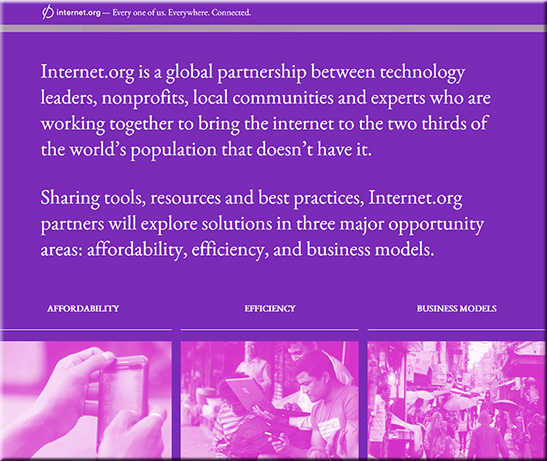
 

internetdotorg-august2013


Obama’s Ratings for Higher Ed — from insidehighered.com by Scott Jaschik

Excerpt (emphasis DSC):

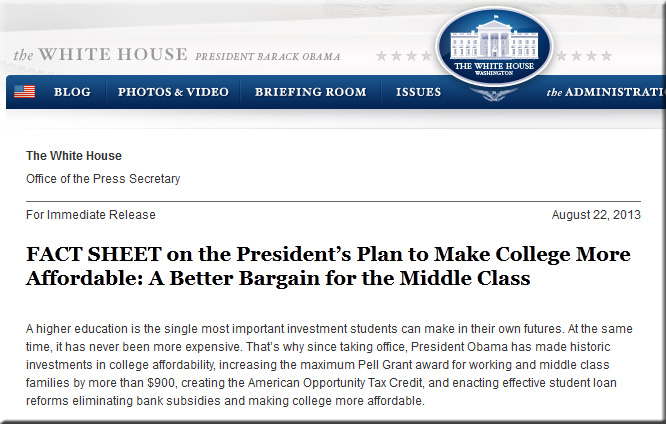
WASHINGTON — President Obama appears to be making good on his vow to propose a “shake-up” for higher education.

Early Thursday, he released a plan that would:

  • Create a new rating system for colleges in which they would be evaluated based on various outcomes…
  • Link student aid to these ratings…
  • Create a new program that would give colleges a “bonus” if they enroll large numbers of students eligible for Pell Grants.
  • Toughen requirements on students receiving aid.
…

The White House also said President Obama is “challenging” colleges to “adopt one or more” of practices he called “promising” to “offer breakthroughs on cost, quality or both.” Among them: competency-based learning that moves away from seat time, course redesign (including massive open online courses), the use of technology for student services, and more efforts to recognize prior learning.


Also see:


ShakingUpHigherEd-Barack-Obama-August-22-2013
 

From DSC:
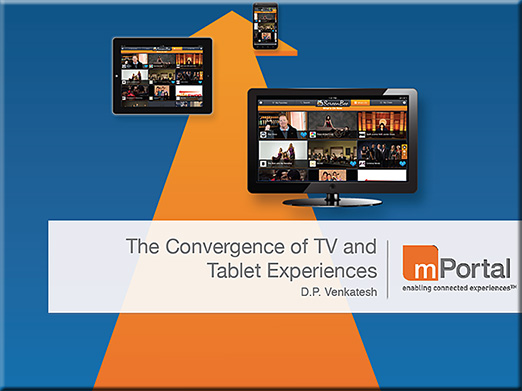
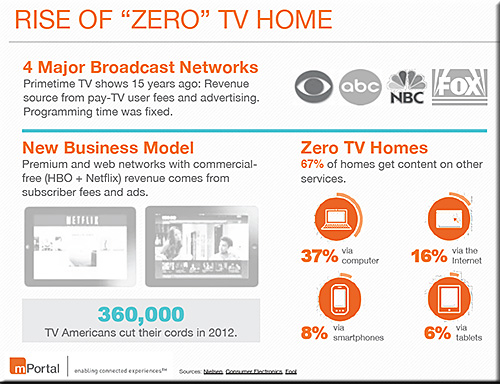
The massive convergence of the telephone, the television, and the computer continues.  How that media gets to us is also changing (i.e. the cord cutting continues). 

What types of innovative learning experiences can be crafted as “TV” becomes more interactive, participatory, and engaging? What happens if technologies like WebRTC make their way into our browsers and we can videoconference with each other without having to download anything?

What doors open for for us when Google, Apple, or an Amazon.com delivers your “shows” vs. NBC/ABC/CBS/etc.?

 The items below cause me to reflect on those questions…


.

Streaming devices lead the way to Smart TV — from nytimes.com by Brian Stelter

Julia Yellow


ConvergenceTVTablet-DPVenkatesh-Aug2013


ConvergenceTVTablet2-DPVenkatesh-Aug2013


.

Is Google ready to buy its way into TV with an NFL deal? — from allthingsd.com by Peter Kafka

Excerpt:

Here’s a fun combination to ponder: The world’s most powerful media company and America’s most popular sport.

That could happen if Google buys the rights to the NFL’s Sunday Ticket package, the all-you-can-eat subscription-TV service currently owned by DirecTV.


Cord Cliff Coming: What happens to TV when Netflix streams live events? — from allthingsd.com by Ben Elowitz, CEO, Wetpaint


 Addendums on 8/22/13:


The tv of tomorrow and the living room of the future

by beutlerink.
Explore more infographics like this one on the web’s largest information design community – Visually.


IBM cranks up big data analytics training programs as government continues cloud moves [infographic] — from cmswire.com by David Roe

Excerpt (emphasis DSC):

IBM is clearly concerned about the big data skills shortage. It has announced the addition of another 9 universities to its big data training program. The economic importance of the program was also underlined this week by the announcement that it has just secured a US$ 1 billion federal contract for cloud computing.

Big Data, Analytics Skills Shortages

The problem for IT giants that are currently muscling into the big data market is that the development of the technology has been so rapid the number of big data/analytics projects currently underway far outweighs the number of people that have appropriate skills.

In fact between now and the end of 2015, IBM estimates that there will be 4.4 million jobs worldwide in big data support. At the moment it is not clear where all the people required to fill these positions are going to come from.


The $4 million teacher — from online.wsj.com by Amanda Ripley
South Korea’s students rank among the best in the world, and its top teachers can make a fortune. Can the U.S. learn from this academic superpower?

Excerpt:

[image]
SeongJoon Cho for The Wall Street Journal
Kim Ki-Hoon, who teaches in a private after-school academy,
earns most of his money from students who watch his lectures online.
‘The harder I work, the more I make,’ he says. ‘I like that.’

.

Kim Ki-hoon earns $4 million a year in South Korea, where he is known as a rock-star teacher—a combination of words not typically heard in the rest of the world. Mr. Kim has been teaching for over 20 years, all of them in the country’s private, after-school tutoring academies, known as hagwons. Unlike most teachers across the globe, he is paid according to the demand for his skills—and he is in high demand.


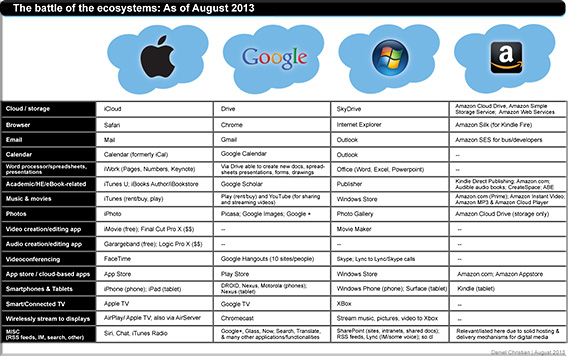
The battle of the ecosystems: Apple, Google, Microsoft, & Amazon.com — by Daniel Christian with thanks to Krista Spahr, Michael Mandeville, Bill Vriesema, and Adam Tozer from Calvin College for their feedback/inputs on this.


BattleOfTheEcosystems-DanielChristian-August2013

PDF version here [1.35MB]


Also see:


Ecosystem value metrics


Ecosystem value metrics - developer perspective


Addendums on 8/13/13:


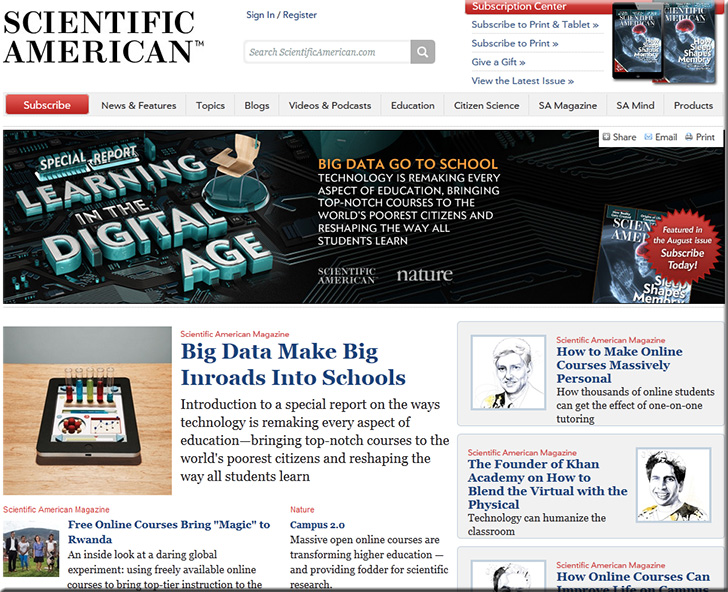
ScientificAmerican-LearningInDigitalAge-August2013


Also see:

  • A “Napster Moment” in Education — from news.yahoo.com
    Excerpt:
    Digital education is like whitewater rafting. Or like the Napster era in music. The two analogies were among many that came up yesterday as panelists considered the future of technology in education at a Scientific American and Macmillan Science & Education summit on “Learning in the Digital Age,” at Google’s New York headquarters.
 

No surprise: Accrediting agency opts to stunt innovation — from disruptingclass.mhprofessional.com by Clayton Christensen

Excerpts:

Several years ago I offered words of praise when Tiffin College partnered with Altius Education to create Ivy Bridge College, a two-year online institution dedicated to providing an affordable higher education option that boosted the transfer rate of two-year students to four-year institutions.

The Higher Learning Commission (HLC), the accrediting body for the North Central region and thus this partnership because Tiffin College is located in an Ohio city that was once populated with industry, agreed strongly, as in 2010 it approved continuing accreditation for Tiffin University and Ivy Bridge College through 2020. At the time, the HLC lauded the partnership.

In the last few weeks, everything changed.


From DSC:
What needs to be done to force accreditation bodies to change who can be on these accreditation teams?  Why is it that the people that institutions of higher education claim to serve can’t be on such boards?  i.e. one must be an “insider” to the higher education industry, but not an “outsider?”

Pursuing the current status quo may have a serious backfiring effect when alternatives present themselves.  In fact, taking steps to insure the status quo only serves to put more energy behind MOOCs and puts yet more heat in higher ed’s kitchen.  I would hope that folks inside higher ed would take the steps to allow for more experimentation and innovation and to take some heat out of the kitchen.


The key, he added, was to try to avoid mistakes like those made by the music industry on its road to iTunes. “This is a Napster moment for education,” he said. “It’s a big opportunity and an existential threat.”

— from A “Napster Moment” in Education


The MOOC Business Plan — from campustechnology.com by David Raths
With millions of students taking high-quality MOOCs for free, schools and course providers are now searching for a viable business model.

Excerpt:

Name a product sold in stores for thousands of dollars that can be obtained for free online. If you’re struggling for an answer, don’t be surprised–no company would last very long under those circumstances. Yet that’s exactly the predicament in which higher education finds itself as MOOCs begin to disrupt the traditional post-secondary model. Schools are giving away what was once their most valued treasure–the intellectual property of their faculty–for nothing.

Obviously, it’s not a sustainable business model, so what’s next? Where will the money come from? While it may seem surprising, no one really seems to know. For many colleges and universities, the current environment more closely resembles a high-stakes game of musical chairs–everyone is terrified of being left without a chair when the music stops. But the game is being played by more than just schools. From a business standpoint, higher education is ripe for reinvention, and it has attracted a slew of companies–both old and new–that smell significant profit.

…

For Coursera, this task is already under way. “Some business models are becoming clear,” says Andrew Ng, cofounder of the for-profit company. “Some we are confident will work; others we are still experimenting with.”

“You could have a certificate of a course completed at Duke University [NC]–that could be a valuable credential,” adds Ng. “We have projected that this alone will lead us to sustainability. In the first quarter of the signature track, we brought in $220,000, and in the second quarter, which hasn’t ended yet, we roughly doubled that amount. So we project that by itself that will make us sustainable.”


Jeff Bezos on Post purchase — from washingtonpost.com


David McNew/Getty Images – The Washington Post Co. has agreed to sell its flagship newspaper
to Amazon.com founder and chief executive Jeff Bezos for $250 million August 5, 2013.


Excerpt of comments:

The Internet is transforming almost every element of the news business: shortening news cycles, eroding long-reliable revenue sources, and enabling new kinds of competition, some of which bear little or no news-gathering costs. There is no map, and charting a path ahead will not be easy. We will need to invent, which means we will need to experiment. Our touchstone will be readers, understanding what they care about – government, local leaders, restaurant openings, scout troops, businesses, charities, governors, sports – and working backwards from there. I’m excited and optimistic about the opportunity for invention.


How to make online courses massively personal — from scientificamerican.com by Peter Norvig
How thousands of online students can get the effect of one-on-one tutoring

Excerpt (emphasis DSC):

Educators have known for 30 years that students perform better when given one-on-one tutoring and mastery learning—working on a subject until it is mastered, not just until a test is scheduled. Success also requires motivation, whether from an inner drive or from parents, mentors or peers.

Will the rise of massive open online courses (MOOCs) quash these success factors? Not at all. In fact, digital tools offer our best path to cost-effective, personalized learning.

I know because I have taught both ways.

…

Inspired by Nobel laureate Herbert Simon’s comment that “learning results from what the student does and thinks and only from what the student does and thinks,” we created a course centered on the students doing things and getting frequent feedback. Our “lectures” were short (two- to six-minute) videos designed to prime the attendees for doing the next exercise. Some problems required the application of mathematical techniques described in the videos. Others were open-ended questions that gave students a chance to think on their own and then to hash out ideas in online discussion forums.

…

That is why a properly designed automated intelligent tutoring system can foster learning outcomes as well as human instructors can, as Kurt van Lehn found in a 2011 meta-analysis in Educational Psychologist.


From DSC:
A potential learning scenario in the future:

  1. “Learning Agent, go find me a MOOC (or what the MOOC will morph into) about ________.”
    Similar to a Google Alert, the Learning Agent returns some potential choices.  I select one.
    .
  2. Once there… “System,  let’s begin.”  I begin taking the online-based course — which is stocked full of a variety of media, some interactive, that I get to choose from for each module/item based upon my personal preferences — and the intelligent tutoring system kicks in and responses at relevant points based upon my questions, answers, responses. The system uses AI, data mining, learning analytics, to see how I’m doing. It tracks this for each student.  Humans regularly review the data to begin noticing patterns and to tweak the algorithms based upon these patterns.
    .
  3. If at any time I find the responses from the automated intelligent tutoring system confusing or weak, I will:
    • Make note of why I’m confused or disagree with the response (via an online-based form entry on the page; this feedback gets instantly sent to the Team of Specialists in charge of the “course.” They will use it to tweak the course/algorithms.)
    • Ask to speak with a person, at which point I am asked to choose whether my inquiry would best be handled by a Subject Matter Expert (SME) at $___/hour/request (more expensive price) or by an entry-level tutor (at a lower $___/hour/request).  I then enter into a videoconference-based tutoring session with them, and they can access my records and even take over my screen (if I let them).  Once I get my questions answered, I return to the course and continue.


From DSC:
A twist on the above scenario would be if a cohorted group of people — not age-based — met in a physical place/room and were able to bounce ideas off of each other before anyone ante’d up for additional expenses by contacting a tutor and/or an SME. They could even share the expenses of the “call” (so-to-speak).


How not to mint more engineers — from linkedin.com by Lynda Weinman

Excerpts (emphasis DSC):

Let’s tackle the economics of the situation head on — and not based on theory, but on experience. When lynda.com opened in 1997, it was a physical school that taught web design. We charged $1,500 per person for a single week of instruction. In those days, the world economy was robust and people came from every continent to study with us, enabling our business to grow and thrive. It was a heady time—until 2001, when the dotcom bubble burst and people and companies lost their budgets.

It was scary to witness the sudden demise of a business model that had worked so incredibly well up until then. In response, we could have simply raised our prices, and targeted a much smaller, more elite audience, hoping to keep our doors open. Instead, we did something crazy. We closed our eyes and leapt into something that was, at that time, unproven: We put our lessons online in video format for $25 per month.

While it took a few years to make as much money as the school did, it eventually far surpassed the earning power of the brick and mortar we started with. Instead of serving 80 people or so a week at our physical school, we started serving thousands in the virtual world, and today that number is in the millions every year.

…

The solution? Take the teachers who are experts and thought leaders and memorialize their lectures and materials via videos and other rich media to share those ideas broadly. Pay them royalties for this, the same as if they published a popular textbook. Leverage in-person class time for projects, collaborations, discussions, reviews, and presentations—the types of activities that are better experienced in person than online.


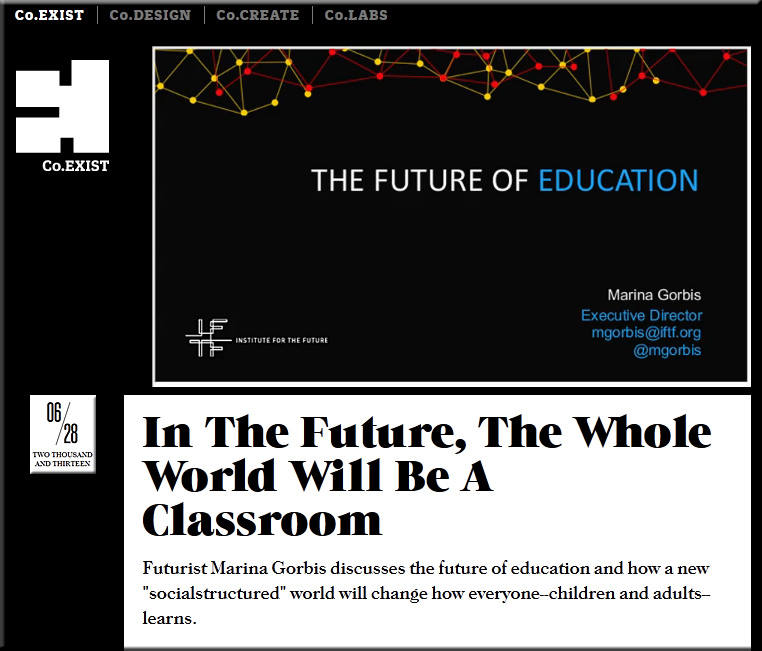
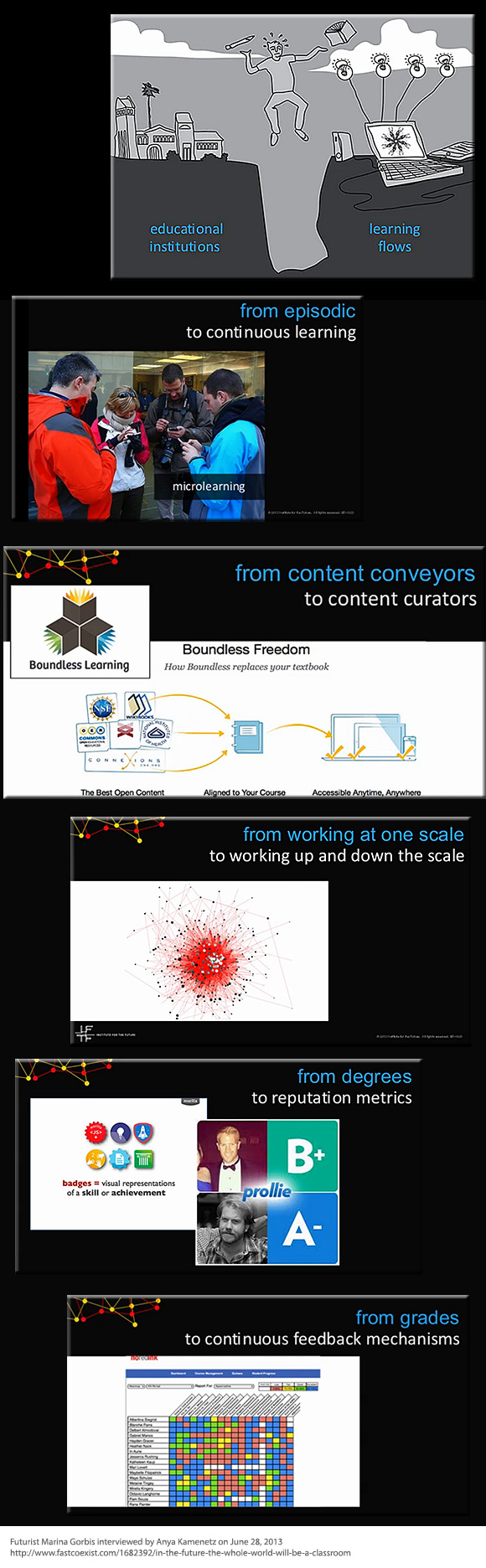
In the future, the whole world will be a classroom — from fastcoexist.com by Marina Gorbis


TheFutureOfEducation-Gorbis-6-28-13

. TheFutureOfEducation3-Gorbis-6-28-13.

From DSC:
What Marina is asserting is what I’m seeing as well. That is, we are between two massive but different means of obtaining an education/learning (throughout our lifetimes I might add).  What she’s saying is also captured in the following graphic:

.

streams-of-content-blue-overlay


Also see:


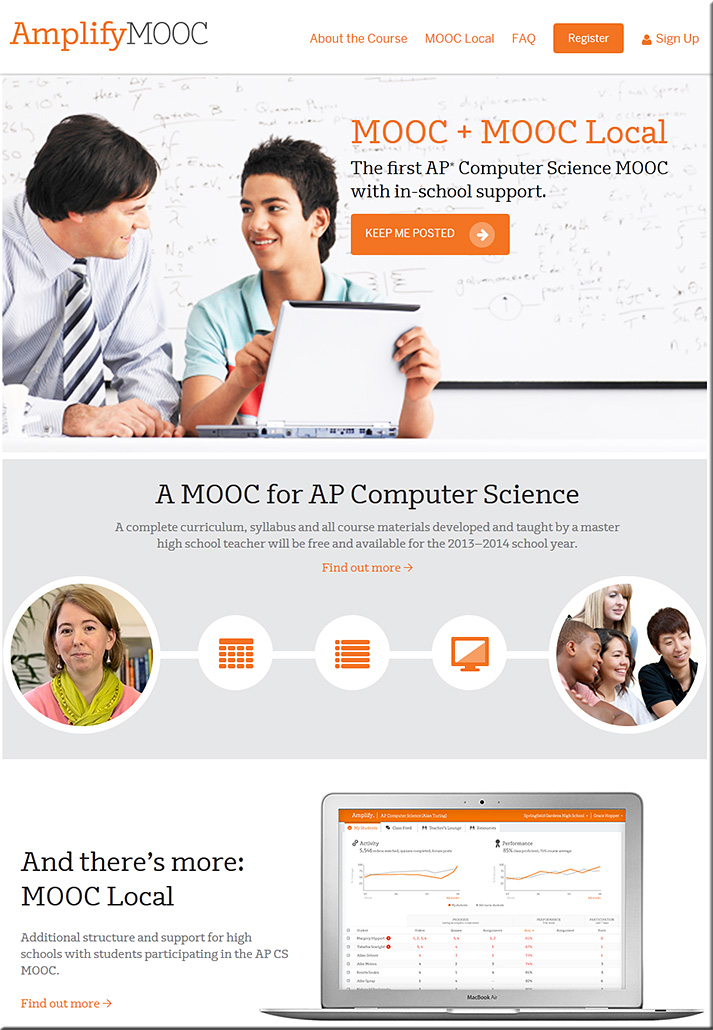
AmplifyMOOC-July2013

.

Also see:

Here’s why the TV apps economy will be a $14 billion business [Wolf]

Here’s why the TV apps economy will be a $14 billion business — from forbes.com by Michael Wolf


.

Excerpt:

According to new research published this week, the TV apps economy is forecasted to reach $14 billion by 2017.

…

Take for example today’s news that Apple will begin selling video advertisements served by iAd through iTunes Radio loaded on Apple TVs. This is only the first move for Apple in this space, and others like Samsung and Google  are already investing heavily in connected TV app advertising.


From DSC:
Why post this? Because:

  • It lays out future directions/careers related to Programming, Computer Science, Data Mining, Analytics, Marketing, Telecommunications, User Experience Design, Digital and Transmedia Storytelling, and more
    .
  • It leads to “Learning from the Living [Class] Room”

.


The Living [Class] Room -- by Daniel Christian -- July 2012 -- a second device used in conjunction with a Smart/Connected TV


From DSC:
And if this does take off,
$14 billion won’t begin to capture the profits from this new industry.

It will be far larger than that.


Relevant addendum on 6/27/13:

  • The future of cinema is on demand — from bitrebels.com by Ben Warner (From DSC: Having just paid $32 for 4 people — 3 of whom were kids — to see Monsters U, I believe it!)
    .

future-of-cinema-on-demand

Via: [The Verge] Image Credits: [Venture Beat] [Home Theater]


© 2025 | Daniel Christian