AUDIO | Looking to the newspaper industry to understand higher education’s transformation — from evoLLLution.com by Byron White | Vice President for University Engagement, Cleveland State University

Except (emphasis DSC):

One of the lessons I do think can be learned is really tailoring a focus to individual students … and moving more toward a reader-driven kind of format, where you really are having to pay attention to individuals who are coming, each one, and having to customize and personalize what they are looking for.

The other thing I think [is] a lesson to learn is to really be focused on the outcomes those individual users … are looking for. I don’t think the newspaper industry ever really redefined the kind of outcome or value newspapers were providing to readers, other than providing them with the news of the day. You know, the New York Times, “All the news that’s fit to print.” In reality, what we should have been shifting toward was helping people make sense and navigate their lives and their worlds. And I think we started talking that way, but we never really developed the evidence we were really helping people do that.

Higher education can learn from that. If we can move from providing students [with] knowledge, information, even a credential, to seeing ourselves as being in the business of developing people to have lifelong success … I think we’ll start to see the ways we provide that might be different than just the traditional ways of sharing knowledge.

That’s a lesson we can learn from what newspapers, I think, weren’t able to transition to.

3. The move to free online content significantly changed journalism, both in terms of the value readers put into written news and their expectations for accessibility and speed of reporting. What kind of an impact do you see the growth of online learning having on students’ expectations of higher education?


Smart Machines: IBM’S Watson and the era of cognitive computing — from cup.columbia.edu by John E. Kelly III, Director of IBM Research, and Steve Hamm, writer at IBM and former business and technology journalist

Excerpt (emphasis DSC):

Computers today are brilliant idiots. They have tremendous capacities for storing information and performing numerical calculations-far superior to those of any human. Yet when it comes to another class of skills, the capacities for understanding, learning, adapting, and interacting, computers are woefully inferior to humans; there are many situations where computers can’t do a lot to help us.

…

But the goal is not to replicate human brains or replace human thinking with machine thinking. Rather, in the era of cognitive systems, humans and machines will collaborate to produce better results, each bringing its own skills to the partnership. The machines will be more rational and analytic-and, of course, possess encyclopedic memories and tremendous computational abilities. People will provide judgment, intuition, empathy, a moral compass, and human creativity.


From DSC:
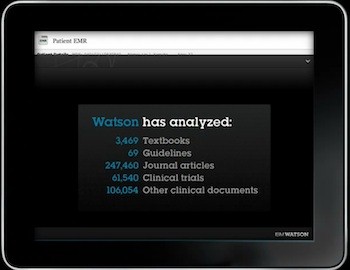
Consider what Watson “read in” to come up with some recommendations:


Watson


Addendum on 10/14/13 (emphasis DSC):

Watson is being used to assist with the treatment of cancer patients. According to an article from medicalnewstoday.com, Watson is “revolutionizing cancer care and research and speeding up progress for patients.”

In that same article, it mentions that, so far, Watson has ingested:

  • Over 600,000 pieces of medical evidence
  • 2,000,000 pages of text from 42 academic journals and clinical trials based on oncology research
  • A huge number of patients’ records spanning decades of cancer treatment history, including medical records and patient outcomes. Watson can sift through 1.5 million pieces of such records and provide doctors with evidence-based treatment options within seconds.

One of IBM’s General Managers who works with Watson said:

“breakthrough capabilities bring forward the first in a series of Watson-based technologies, which exemplifies the value of applying big data and analytics and cognitive computing to tackle the industry’s most pressing challenges.”


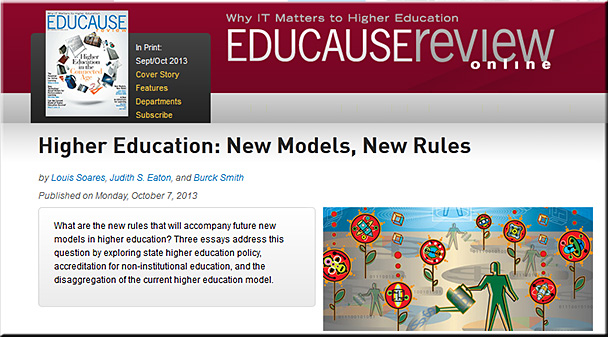
Higher Education: New Models, New Rules — from educause.com by Louis Soares, Judith S. Eaton, and Burck Smith
What are the new rules that will accompany future new models in higher education? Three essays address this question by exploring state higher education policy, accreditation for non-institutional education, and the disaggregation of the current higher education model.


Educause-NewModelsNewRules-Oct72013


Excerpt from Burck’s essay:

Accordingly, the government spurs “supply” by paying for colleges and universities and spurs “demand” by paying for students. Accreditors determine who can receive these funds. All of this worked well for sixty years. Until, suddenly, it doesn’t.


Berklee online degrees would cost half of campus study programs — from bostonglobe.com by Matt Rocheleau

Excerpt (emphasis DSC):

Berklee College of Music announced Wednesday that it will begin offering bachelor’s degrees online in fall 2014 that will cost less than half of what students pay to take courses on its Boston campus.

The college said it will become the first nonprofit music institution to offer accredited bachelor’s degrees online. The degrees include professional studies in music business and music production.

“This is all about expanding access,” said Debbie Cavalier, vice president of online learning and continuing education for Berklee Online. “This is a way to provide access to people across the world who want to learn from Berklee faculty, but aren’t able to study here on our campus in Boston.”

From DSC:
This is yet another example of The Walmart of Education trend that continues to develop.


What colleges will teach in 2025 — from nation.time.com by Jon Meacham (@jmeacham); with thanks to Brian Bailey (@EdTechEmpowers) for posting this resource on Twitter
America must resolve the conflict between knowledge and know-how

Excerpt:

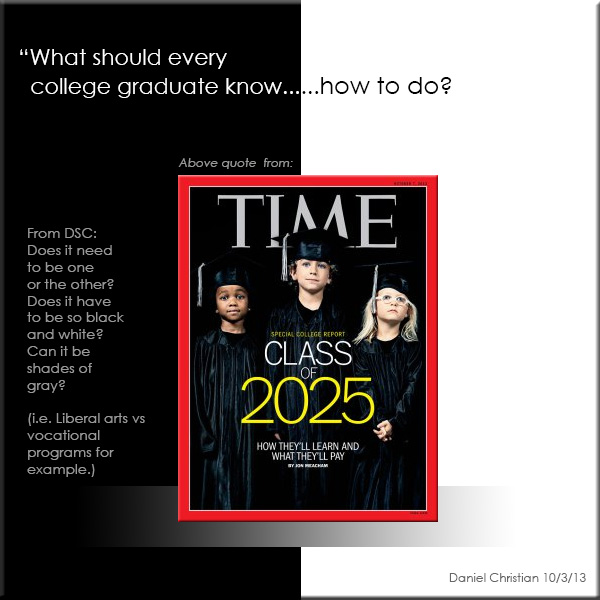
At the heart of the debate between traditionalists (who love a core) and many academics (who prefer to teach more specialized courses and allow students more freedom to set their own curriculums) is a tension between two different questions about the purposes of college. There are those who insist that the key outcome lies in the answer to “What should every college graduate know?”—perhaps minimizing the chances that future surveys will show that poor John Roberts is less recognizable than Lady Gaga. Others ask, What should every college graduate know how to do?

Those three additional words contain multitudes. The prevailing contemporary vision, even in the liberal arts, emphasizes action: active thought, active expression, active preparation for lifelong learning. Engaging with a text or question, marshaling data and arguments and expressing oneself takes precedence over the acquisition of general knowledge.

From DSC:
The article prompted me to create the graphic below, asking…


WhatShouldEveryCollegeGraduateKnowHowToDo-Time-Oct2013


Per Candace Opstvedt from Digital BrinQ:

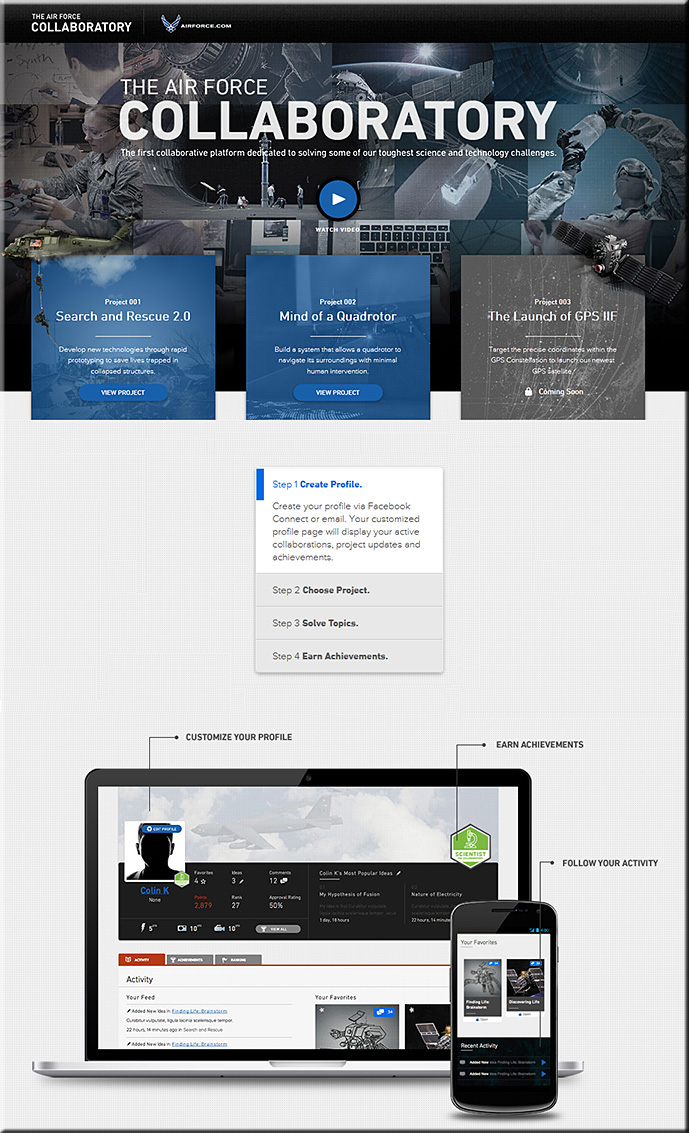
The Air Force Collaboratory is “an interactive online platform that invites STEM inclined students, educators and innovators to solve some of the Air Force’s toughest challenges.  Over 900 ideas have already been submitted by participants in the first project, and we are confident that the “Mind of a Quadrotor” project will be just as successful.

“Mind of a Quadrotor” became active starting on September 1, 2013, and will remain open through October 31.  Anyone with an idea can submit their plan for how quadrotors can be used to perform certain actions autonomously; that is with minimal human intervention.

To give you a little more background, check out The Air Force Collaboratory website. You can also check out project highlights and information at, http://www.good.is/stem.

 AirForceCollaboratory-Sep2013


From DSC:
(At least) a few things strike me as noteworthy here:

  • Note the potential power of a web-based learner profile like this. Create a web-based profile. Choose project. Earn badges/achievements. Solve topics. Follow your activity (i.e. progress).  Hmmmmmmm…..interesting….
  • The use of crowdsourcing to identify/create solutions for existing problems.
  • Presenting real-world problems/projects and asking for real-world solutions.

Tagged with:  

Wharton puts first-year MBA courses online for free — from businessweek.com by Louis Lavelle

Excerpt:

Getting a Wharton MBA involves taking off from work for two years, moving to Philadelphia, and spending about $200,000 on tuition and expenses. Now, with the addition of three new courses on the online learning platform Coursera, you can get much of the course content for free.

While you won’t get the full Wharton on-campus experience—or an internship, career services, or alumni network, for that matter—the new courses in financial accounting, marketing, and corporate finance duplicate much of what you would learn during your first year at the elite business school, says Don Huesman, managing director of the innovation group at Wharton.


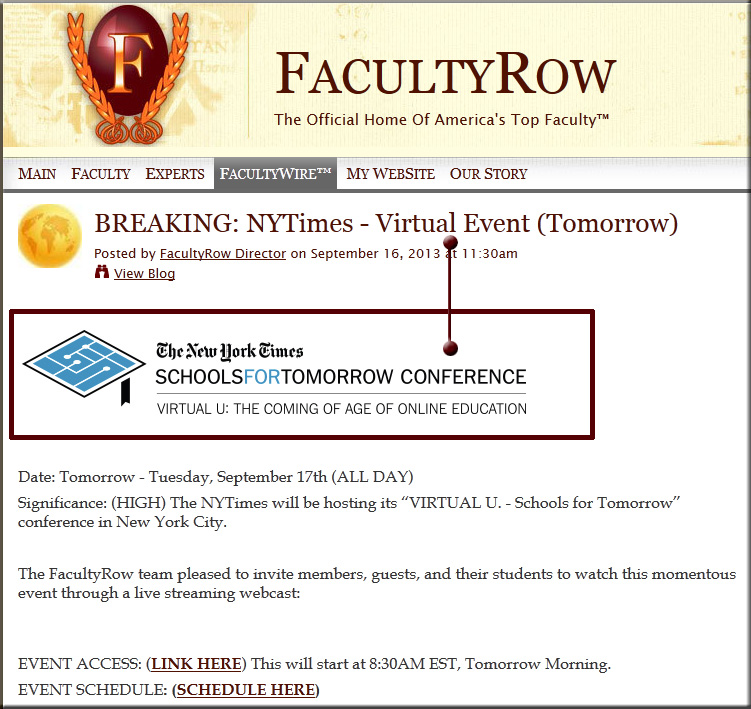
FacultyRow-NYTEvent-9-17-13


Check out the agenda:


7:00 a.m.

REGISTRATION


7:45 – 8:45 a.m. The Hall

BREAKFAST PANEL: BRIDGING THE KNOWLEDGE GAP
Technology is giving educators and students more tools to promote the exchange of ideas and expertise.  That exchange is key to improved knowledge and empowerment, but without a level playing field, equal access and the right tools, we will never take full advantage of the opportunity to connect.  Panelists will discuss the knowledge gap and how new technologies and motivated citizens are bridging that gap to support formal education as well as lifelong learning.
Sponsored by Bank of America

Aditya Bhasin, consumer marketing, analytics and digital banking executive, Bank of America
Gov. Jack Markell, Governor of Delaware
Ted Mitchell, President and C.E.O., NewSchools Venture Fund
Jennifer Tescher, President and C.E.O., The Center for Financial Services Innovation
Joanne Weiss, Former Chief of Staff to the Secretary, U.S. Department of Education

Moderated by John Merrow, Education Correspondent, PBS NewsHour


9 – 9:10 a.m.

WELCOME
Arthur Sulzberger Jr., publisher, The New York Times


9:10 – 9:45 a.m.

KEYNOTE ADDRESS
Sal Khan, founder of the Khan Academy

including 9:30-9:45 audience questions


9:45 – 10:30 a.m.

DEBATE: HAS THE UNIVERSITY AS AN INSTITUTION HAD ITS DAY?
Higher education has always been an array of autonomous institutions, each with their own courses, their own faculty, and their own requirements for their own degrees. But online education is starting to break down those lines in ways that are likely to lead to a lot more shared courses, consortia and credit transfers. In addition, there are a growing number of companies (not schools) providing higher education courses outside of the traditional higher education institutions. As we move towards the possibility of a multi-institution, multicredit qualification, is the traditional higher education institution in danger of losing applicants, income and identity?

Anant Agarwal, president, edX
Sal Khan, founder, The Khan Academy
Biddy Martin, president, Amherst College
Nancy Zimpher, Chancellor, SUNY

Moderated by David Leonhardt, Washington bureau chief, The New York Times

including 10:15 – 10:30 audience questions


10:30 – 11 a.m.

COFFEE BREAK


11 – 11:45 a.m.

THE DEALBOOK PANEL: WHAT’S THE NEW ERA BUSINESS MODEL FOR HIGHER EDUCATION?
The traditional idea that education is something the government provides, free, for the public good, is coming under assault from an increasing assortment of new ventures offering for-profit schools, for-profit online courses, tests, curricula, interactive whiteboard, learning management systems, paid-for verified certificates of achievement, e-books, e-tutoring, e-study groups and more. Which areas have the most potential growth — and where is the smart investment going?

Donn Davis, co-founder, Revolution
Tony Florence, general partner, NEA
Deborah Quazzo, founder and managing partner, GSV Advisors

Moderated by Andrew Ross Sorkin, columnist/editor DealBook, The New York Times

Including 11:30 – 11:45 audience questions


11:45 a.m. – 12:10 p.m.

CONVERSATION: THE DISRUPTION OF HIGHER EDUCATION

Michael Horn, co-founder, The Clayton Christenen Institute for Disruptive Innovation
In conversation with David Leonhardt, Washington bureau chief, The New York Times


12:10 – 12:45 p.m.

AUDIENCE DISCUSSION: INCREASING STUDENT ENGAGEMENT
Student attrition is as high as 90 percent for some of the biggest online courses, and remains a problem even
in smaller-scale courses when compared with traditional face-to-face classes. The problem is exacerbated for
community college students who enroll in online courses, or for low-performing students. How can we increase student engagement in online classes, particularly among students who lack competence or confidence?

Yvonne Chan, principal, Vaughn Next Century Learning Center
John Palfrey Jr, head of school, Phillips Academy, Andover
Diane Tavenner, founder and C.E.O., Summit Public Schools

Moderated by Bill Keller, Op-Ed columnist, The New York Times


12:45 – 1:15 p.m.

COLUMNIST CONVERSATION

Senator Bob Kerrey, executive chairman, Minerva Institute

in conversation with Bill Keller, Op-Ed columnist, The New York Times


1:15 – 3:00 p.m.

LUNCH PANEL A: INCREASING HIGHER EDUCATION AFFORDABILTY AND COMPLETION THROUGH ONLINE INNOVATIONS
A thoughtful conversation about innovative online models that are lowering the cost of degrees and increasing degree completion. How do these models work – and where are they going?
Sponsored by Capella

(Held in The Hall)

Mark Becker, President, Georgia State University
Scott Kinney, President, Capella University
Jamie Merisotis, President and C.E.O., Lumina Foundation
Burck Smith, Founder and C.E.O., StraighterLine

Moderated by Melody Barnes, C.E.O., Melody Barnes Solutions (former Director of the White House Domestic Policy Council)


1:15 – 3:00 p.m.

LUNCH PANEL B: A MATHEMATICIAN, SCIENTIST, DOCTOR, AND SOCIOLOGIST WALK INTO A ZOMBIE APOCALYPSE…WHO SURVIVES?
What skills give you the best shot at surviving a zombie apocalypse? Can you do anything to increase your odds of survival? Get an extended preview of UC Irvine’s MOOC “Society, Science, Survival: Lessons from AMC’s The Walking Dead” as we explore what math, science, public health, and sociology have to do with a zombie apocalypse and, in particular, survival. At the end of the panel, the audience will vote on who stands the best chance of survival: mathematician, scientist, doctor, or sociologist.
Sponsored by Instructure

(Held on 15th Floor)

Joanne Christopherson, Associate Director of the Demographic and Social Analysis M.A. Program, University of California, Irvine
Michael Dennin, Professor of physics and astronomy, University of California, Irvine
Sarah Eichhorn, Assistant Vice Chair for undergraduate studies in the mathematics department, University of California, Irvine
Melissa Loble, Associate Dean of distance learning, University of California, Irvine

Moderated by Josh Coates, CEO, Instructure


3 – 3:30 p.m.

COLUMNIST CONVERSATION
In an increasingly connected world, how do we ensure our students are being prepared to compete in a knowledge-based, global economy? What role does technology play in education, and what does the future of learning look like?

Arne Duncan, US Secretary of Education

interviewed by David Leonhardt, Washington bureau chief, The New York Times


3:30 – 4:15 p.m.

IS ONLINE THE GREAT EQUALIZER?
There is no doubt that we are in the middle of an online education revolution, which offers huge potential to broaden access to education and therefore, in theory, level the playing field for students from lower-income, lower-privileged backgrounds. But evidence to date shows that the increasing number of poorly designed courses could actually have the reverse effect and put vulnerable students at an even bigger disadvantage.

Karen Cator, C.E.O., Digital Promise
Dean Florez, president, 20 Million Minds Foundation
Candace Thille, director of the Open Learning Initiative (OLI) and assistant professor of education, Stanford University
David Wiley, founder, Lumen Learning

Moderated by Tina Rosenberg, Op-Ed Columnist, The New York Times

Including 4:00 – 4:15 p.m. audience questions


4:15 – 4:45 p.m.

COFFEE BREAK  


4:45 – 5 p.m.

COLUMNIST CONVERSATION

Daphne Koller, co-founder, Coursera

in conversation with Ethan Bronner, Deputy National Editor, The New York Times


5 – 5:45 p.m

GAMECHANGERS: HOW WILL ONLINE EDUCATION REVOLUTIONIZE WHAT WE KNOW AND UNDERSTAND ABOUT LEARNING?
Traditionally, pedagogical research has been done in tiny groups; but new-generation classes of 60,000 students make it possible to do large scale testing and provide potentially game-changing research on how students learn best. Using the Big Data from online courses, we have access to new information about what pedagogical approaches work best. MOOCs, and many more traditional online classes, can track every keystroke, every homework assignment and every test answer a student provides. This can produce a huge amount of data on how long students pay attention to a lecture, where they get stuck in a problem set, what they do to get unstuck, what format and pacing of lectures, demonstrations, labs and quizzes lead to the best outcomes, and so on. How can we use Big Data for the good of the education profession, and not for “Big Brother”?

Daphne Koller, co-founder, Coursera
Alec Ross, senior advisor on innovation and former senior advisor to Secretary Hillary Clinton at the U.S. State Department
Paula Singer, C.E.O. Global Products and Services, Laureate Education

Moderated by Ethan Bronner, Deputy National Editor, The New York Times

including 5:30 – 5:45 p.m. audience questions


5:45 – 6 p.m.

COLUMNIST CONVERSATION

Amol Bhave, student, MIT

in conversation with Tina Rosenberg, Op-Ed Columnist, The New York Times


6 p.m.

CLOSING REMARKS

Gerald Marzorati, editorial director and general manager, conferences, The New York Times


Coursera hits $1M in revenue through verified certificates — from gigaom.com by Ki Mae Heussner

Summary:

For the first time, online education startup Coursera is sharing details on how it’s faring on the money-making front: the company said it’s earned $1 million from the verified certificate program it launched in January.


Content as a Service (CaaS) — from knowledgestarblog.wordpress.com by David Grebow

Excerpt:

The etextbook in 2018 will be dramatically different than the etextbook of today. It will be coupled to an app that will provide you with Content as a Service (CaaS). CaaS will include many of the following features (and more that have yet to be imagined):

  • Multimedia
  • Simulations
  • Educational Games
  • Animations
  • Pre- and post-tests
  • Formative and Summative Quizzes
  • Adaptive testing
  • Networked Social Learning
  • Study groups
  • Analytic Datasets
  • Virtual and Flipped classes
  • Communities of Learning and Practice
  • Virtual classes.


Also see:

.

ContentAsAService-Grebow-May2013


Faith Lutheran School in Plano offers free trial of live, online high school classes — from by Amy Crawford


hs snip

Excerpt:

This year, Faith Lutheran High School in Plano, Texas will offer live online high school classes using two-way HD-video streaming through the Internet.  This allows home-schooled students or others across the country to participate in some of the school’s classes in real time.


I originally saw this at etale.org:
Example of a school that embraces the unbundling of education

Excerpt (emphasis by Bernard Bull):

What is new about this latest offering at Faith Lutheran High School is that they are using the two-way video as a tool to offer unbundled services.  This is a private tuition-based school and instead of offering a single package service (full tuition and full participation in the school or nothing), they are offering an à la carte menu.  Choose the courses that interest you, and use them to support your otherwise personalized home school curriculum.

…

I continue to argue that this unbundling provides us with a glimpse into the future of k-12 education, especially k-12 education that provides an alternative to traditional public schools. Separate all of the distinct attributes of a given school and imagine a model where families and students can pick and choose from those services, paying only for what they use (in the case of private schools).


IBM-WatsonAtWork-Sept2013


From DSC:
IBM Watson continues to expand into different disciplines/areas, which currently include:

  • Healthcare
  • Finance
  • Customer Service

But Watson is also entering the marketing and education/research realms.

I see a Watson-type-of-tool as being a key ingredient for future MOOCs and the best chance for MOOCs to morph into something very powerful indeed — offloading the majority of the workload to computers/software/intelligent tutoring/learning agents, while at the same time allowing students to connect with each other and/or to Subject Matter Experts (SME’s) as appropriate.

The price of education could hopefully come way down — depending upon the costs involved with licensing Watson or a similar set of technologies — as IBM could spread out their costs to multiple institutions/organizations.  This vision represents another important step towards the “Walmart of Education” that continues to develop before our eyes.

Taking this even one step further, I see this system being available to us on our mobile devices as well as in our living rooms — as the telephone, the television, and the computer continue to converge.  Blended learning on steroids.

What would make this really powerful would be to provide:

  • The ability to create narratives/stories around content
  • To feed streams of content into Watson for students to tap into
  • Methods of mining data and using that to tweak algorithms, etc. to improve the tools/learning opportunities

Such an architecture could be applied towards lifelong learning opportunities — addressing what we now know as K-12, higher education, and corporate training/development.

.


The Living [Class] Room -- by Daniel Christian -- July 2012 -- a second device used in conjunction with a Smart/Connected TV


E-books could be the future of social media — from fastcolabs.com by Michael Grothaus

Excerpt (emphasis DSC):

Both Apple and Amazon were designing e-book readers by copying the 2,500-year-old idea of books as self-contained collections of words, completely missing how readers share and discuss content online today. While most e-readers allow you to share passages or links to the book you are reading, and sites like Goodreads let you share what you’ve read, their implementations treat the book and the discussions around them as separate collections. Worse, these apps force users to venture into the distracting world of the open Internet when they want to share, making it hard to stay focused on reading.

This didn’t sit well with Berggren, so he came up with an ingenious solution: Make each and every book its own self-contained social network.


From DSC:
When people urge us to do things differently due to the technologies at our disposal, this is a great example of that.  It rethinks what can be done now vs. how it has been done in the past.  I like the increased opportunities this type of big-thinking, innovative solution offers for increased participation, collaboration, and discussion.

Questions that come to my mind:

  • How might this affect what’s possible with digital storytelling? With transmedia?
  • Could each MOOC/course/stream of content be its own social network?
  • “The app itself is free, so the company makes money by selling anonymized data it collects about its users’ consumption habits to publishers.”  Will we see more of this type of business model?


Also see:

.

readmill-Sept2013


Also see:


Addendum on 9/10/13:

Content as a Service (CaaS) — from knowledgestarblog.wordpress.com by David Grebow

Excerpt:

The etextbook in 2018 will be dramatically different than the etextbook of today. It will be coupled to an app that will provide you with Content as a Service (CaaS). CaaS will include many of the following features (and more that have yet to be imagined):

Multimedia
Simulations
Educational Games
Animations
Pre- and post-tests
Formative and Summative Quizzes
Adaptive testing
Networked Social Learning
Study groups
Analytic Datasets
Virtual and Flipped classes
Communities of Learning and Practice
Virtual classes.


Issue #1: Accreditation


OPINION: How to make college better & more affordable — from edsurge.com by Paul Freedman
One powerful answer: Reform the accreditation process

Excerpt (emphasis DSC):

How can our diverse, 4,300 two- and four-year schools collectively be failing to produce the outcomes we need, at the scale we need them, all at the same time?

How can this be?
…
…why have these solutions not yet driven the fundamental change the system needs? Innovators that could bring costs down and help our system stay on the leading-edge are being stifled by little-known organizations that possess tremendous unregulated power in higher education: accreditors. As a result, our system is sick–plagued by an institutionalized lack of adaptation.

…

If they are indeed stewards of the public trust responsible for ensuring the quality of our higher education system, then they are also responsible for its outcomes and therefore share a large portion of the blame for the failures in higher education that we see today. Accreditation is the one constant across all US higher education institutions.

…

The problem? Ivy Bridge wanted to change the status quo.


Also see:


AccreditationKillingInnovation-Freedman-VB-Aug302013


A relevant side note from DSC:
The following statement in Downgrading Elite Colleges (InsideHigherEd.com) shows the impact of this straitjacketing, status quo situation (emphasis mine):

“We do see pressure on small private colleges as a group and that’s primarily because they don’t have a lot of different things they can do, so they are primarily dependent on tuition revenue,” said a Moody’s analyst, Edie Behr.

Moody’s advises institutions to try to diversify their revenue streams.

That is not an easy task, said Oberlin’s vice president for finance, Ronald Watts.

.
…they don’t have a lot of different things they can do…
…that is not an easy task…
.
From DSC:
Are these statements true? If so, why?
Is accreditation part of the issue/solution?
Who should be on the accrediting bodies? Whose agenda(s) do they represent?


(Related) Issue #2: Only doing what one’s peer groups are doing.


titanic-wakpaper-dot-com


From DSC:
If the entire boat is sinking, does it matter what your peers are doing?!? Isn’t it time for bigger thinking? Bolder thinking? More (and careful/well-thought-through) experimentation?

Paul Freedman states this as well in his article:

I have heard people in the industry compare the current state of higher education to a sinking ship. If that is accurate, then accreditors should be viewed as the ones who are literally nailing down the deck chairs to the Titanic. We need to keep the students we are all dedicated to serving from going down with the ship. We, as the education industry and as US citizens, need to fight for accreditation reform.

I ask these questions and pose the above picture not to promote panic — but rather to strongly encourage change. Institutions of higher education need to adapt in order to stay relevant, survive, and to properly equip future generations for the world they will be entering. 

If not, students will find other ways to be successful — and so will corporations.


Addendum on 9/3/13: 

  • Higher Ed Accrediting Commissions: Transparency for thee, not for me — from mfeldstein.com by Phil Hill
    Excerpt:
    Why do I keep covering accreditation issues on e-Literate, a blog nominally about online learning and educational technology? The reason is that accrediting commissions have enormous influence on higher education institutions, particularly as the industry wrestles with questions of which changes are necessary, which changes are worth trying but might not work, and which changes should be avoided. If there really is a shift in the DOE’s views on accreditation or in the accrediting commissions’ interpretation of standards, then that could have fairly profound cascade effects on competency-based learning programs, private online colleges, MOOCs, and online service providers.That is also why the lack of transparency from the accrediting commissions is so troubling. They are making decisions that have profound effects on many institutions, not just the specific schools under review.

 
© 2025 | Daniel Christian