Impacts of MOOCs on Higher Education — from insidehighered.com by Allison Dulin Salisbury

Excerpt:

An international group of higher education institutions—including UT Arlington, Stanford University, Hong Kong University and Davidson College—convened by learning researcher and theorist George Siemens gathered last week to explore the impacts of MOOCs on higher education (full list of participating institutions below).

The takeaway? Higher education is going digital, responding to the architecture of knowledge in a digital age, and MOOCs, while heavily criticized, have proven a much-needed catalyst for the development of progressive programs that respond to the changing world.

After sharing challenges, key innovations and general impacts, we were collectively awed by our similarities. Sure, Harvard and Stanford have larger budgets and teams, and the Texas system is, well, a system, while Davidson College enrolls a little under 2,000 students; yet, these fundamentally different institutions voiced similar challenges in their transitions to digital environments.

During a wide-ranging, engaging conversation, participants focused on themes that have to do with organizational change, the state of higher education, and what it is we want our purpose to be—collectively—over the coming years.

Here are a few of the effects MOOCs have had on our colleges or universities:


From DSC:
Thanks George for your continued work and assistance in helping higher education adapt, change, and improve our outcomes (as well as adding your expertise towards teaching and learning, tools, and/or pedagogies).


15 Calif. community colleges to offer bachelor degrees — from usatoday.com by Kyle Plantz

Excerpt:

Paving the way for one of the largest community college systems in the United States to offer four-year degrees, on Sept. 28 California Gov. Jerry Brown signed into law a bill that will create a pilot program for 15 community colleges across the state to fill a growing workforce demand for college-educated, skilled workers in fields such as health, science and technology.

Also see:

  • Community colleges increasingly adding bachelor’s degrees — from hechingerreport.org by Jon Marcus
    Excerpt:
    It’s St. Petersburg College, formerly St. Petersburg Junior College, one of an increasing number of community colleges around the country that have started offering four-year bachelor’s degrees in fields for which there is high job demand.

.

From DSC:
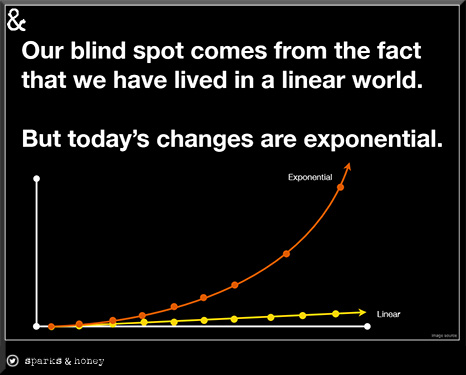
I put a similar item out there on Twitter about this same topic and someone came back with some verbiage that hit me as strange…it caught me off guard.  She mentioned the word “war” between community colleges and other colleges/universities.  I don’t think that’s the word I would use and I think the greater concern for those of us working within higher education might be the dynamics as found in this recent posting. That’s what higher ed should be far more concerned with — i.e. alternatives that keep developing because higher ed is too slow to respond to increasing costs and is not keeping up with a world that’s spinning at speeds that continue to change exponentially, not incrementally.

.

ExponentialNotLinearSparksNHoney-Spring2013


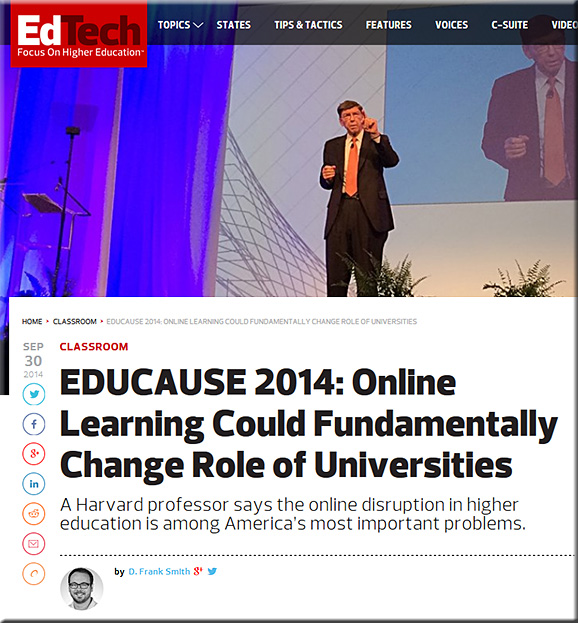
Educause2014-Christensen-Online-Disruption


Excerpt:

Higher education institutions are poised for a massive shake-up, not unlike what tech companies experienced in the 1980s during the rise of the PC, said EDUCAUSE’s first general session speaker.

…

“Disruption is always a great opportunity before it becomes a threat,” he said.

…

“In the future, I don’t think universities themselves will be nearly as prominent as they have been in the past,” he said.


Also see:


Ed-Tech advances poised to revolutionize higher ed from all angles — from evolllution.com by Michael Horn

Excerpt:

There’s a flip side to unbundling, however, that receives far less attention. As a service’s architecture becomes modular, its performance becomes determined by the raw performance of its subcomponents, which consequently become interdependent — or re-bundled — as the entities making these subcomponents need to wring every ounce of performance out of them. In other words, as one stage becomes modular, an adjacent stage becomes interdependent.

In education, as elements such as content become unbundled, there will exist a need for subcomponents that bundle together — coaching, mentoring, communities, personal learning plans and employer connections, for example, as these areas are critical for student success, but the ways in which they fit together are not yet well enough understood such that there can be clear standards at their various interfaces. Standalone, modular solutions in these areas will struggle to succeed. Creating standards at their interfaces before we know what the standards should be will similarly suffer.
..
Similarly, too few are thinking about how to help students make sense of and navigate this emerging, unbundled world and integrate the modular pieces together in ways that help them carve out a coherent and sensible life path. This is critical because it appears that in a personalized learning future, every single learner will have a custom-fit educational pathway.


Bundling and Re-bundling — from elearnspace.com by George Siemens

Excerpt:

There are a few things wrong with the idea of unbundling in education:

1. Unbundling is different in social systems than it is in a content only system. An album can be unbundled without much loss. Sure, albums like The Wall don’t unbundle well, but those are exceptions. Unbundling a social system has ripple effects that cannot always be anticipated. The parts of a social system are less than the whole of a social system. Unbundling, while possible in higher education, is not a zero sum game. The pieces on the board that get rearranged will have a real impact on learners, society, and universities.

2. When unbundling happens, it is only temporary. Unbundling leads to rebundling. And digital rebundling results in less players and less competition. What unbundling represents then is a power shift. Universities are today an integrated network of products and services. Many universities have started to work with partners like Pearson (ASU is among the most prominent) to expand capacity that is not evident in their existing system.
.
Rebundling is what happens when the pieces that are created as a sector moves online become reintegrated into a new network model. It is most fundamentally a power shift. The current integrated higher education system is being pulled apart by a range of companies and startups. Currently the university is in the drivers seat. Eventually, the unbundled pieces will be integrated into a new network model that has a new power structure. For entrepreneurs, the goal appears to be to become part of a small number of big winners like Netflix or Google. When Sebastian Thrun stated that Udacity would be one of only 10 universities in the future, he was exhibiting the mentality that has existed in other sectors that have unbundled. Unbundling is not the real story: the real issue is the rebundling and how power structures are re-architected. Going forward, rebundling will remove the university from the drivers seat and place the control into the re-integrated networks.


————

Addendums:


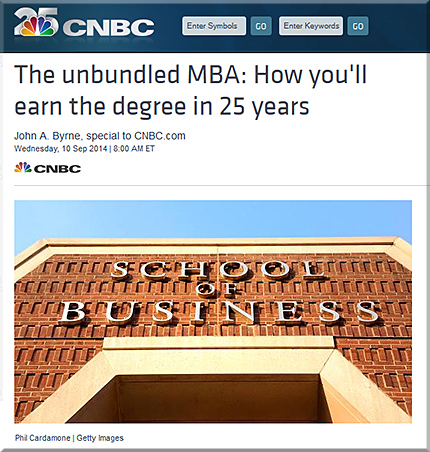
unbundledMBA-CNBC-Sept2014


Addendum on 9/17/14:
Ed tech’s next wave rolls into view — from by Roger Novak

Excerpt:

If the second wave was about the unbundling of colleges and providing learning as a service, the third wave of companies will be involved in reassembling educational component pieces from various sources to help make students’ learning portfolios more meaningful to both individuals and employers. While we are starting to see colleges taking similar steps to become more student-centered, private-sector companies can act nimbly to fill gaps and create new technologies to help accomplish these goals.


From DSC:
First of all, let me say that I’m a big fan and supporter of a liberal arts education — my degree was in economics (from Northwestern University’s College of Arts & Sciences, as the school was called at the time) and I currently work at a Christian liberal arts college. 

That said, within the current higher education landscape, we’re already seeing and hearing more and more about competency-based education, credits for prior learning, and other forms of obtaining a credential in less time.  I don’t have data on this, but my mental picture of these things is that such initiatives have had a limited impact, at least so far. 

However, as the pace of change has increased, I wonder…what if hiring decisions move significantly more towards “Show me what you can DO…?  That’s already taking place to a significant degree in many hiring situations, but my reflection revolves around questions such as:

  • What if it takes too long to wait for someone to get a 2 or 4-year degree? Will employers start looking more towards what competencies someone has today or can acquire much more quickly? 
  • Will people look outside of traditional higher education to get those skills?

Again, these reflections involve the increasing pace of change.

The pace has changed significantly and quickly


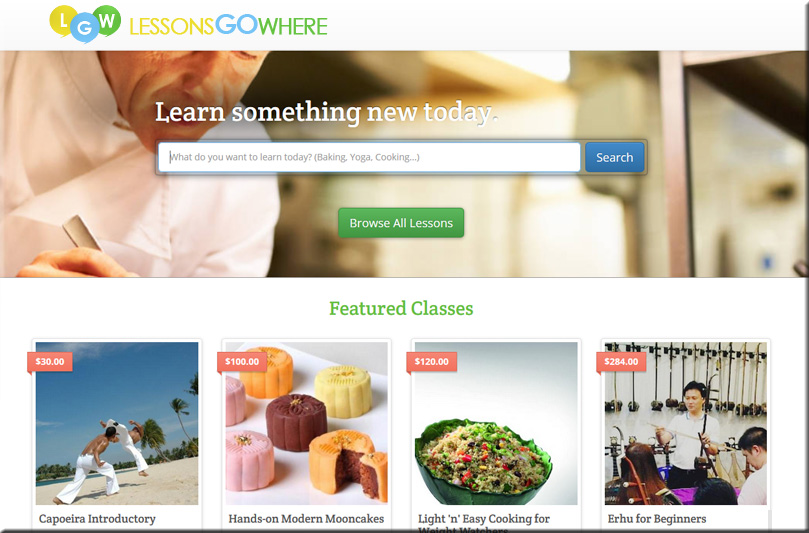
Anyway, such a shift could open doors for new “providers” such as:  


LessonsGoWhere


ClassDo


iUniv-August2014


udemy


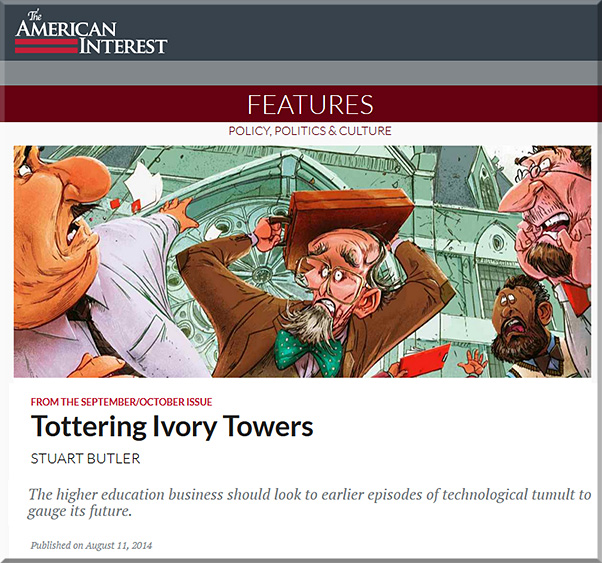
Then, consider some quotes from the following article, Tottering Ivory Towers:


TotteringTowers-August112014

Excerpts:

…there is growing interest in new ways of measuring the quality of a degree. The variety of scorecards now available, for instance, means students and their parents have much better and more granular measures of quality than accreditation provides. For another, employers are gradually making greater use of independent, competency-based measures and credentialed courses rather than relying on accredited degrees and credit hours (derided as “seat time” by its critics). Try getting a job in computer network management if you can’t show which Microsoft Certified Systems Engineer courses you have passed. Meanwhile, Udacity is partnering with Google, AT&T, and other technology firms in an “Open Education Alliance” to provide top-level technical skills. Nevertheless, when it comes to alternatives to accreditation, the United States is generally playing catch-up with some other countries. In Britain, for instance, students can earn employer-union certified City & Guilds qualifications while studying at almost any institution, and there are standard competency measures in a variety of professional fields.

…

In a New York Times interview, Google’s senior vice president for people operations, Laszlo Bock, admitted that transcripts, test scores, and even degrees are less useful than other data as predictors of employee success.3 In this environment, an industry-led move to create a more dependable measure of knowledge and ability than a transcript will become increasingly attractive.

…

The critical lesson from the transformation of other industries is that it is likely to be a disastrous mistake to assume you can just tweak an existing business model and be all right. That can work only for a while.


Dmitry Sheynin writes in his article, Is innovation outpacing education? “With the ever-increasing pace of innovation, traditional colleges and universities are failing to train and retrain workers quickly enough. The model of two and four-year degrees, [futurist Thomas Frey] says, is largely incompatible with an industry that gets flipped on its head every couple of quarters.”  Again, according to Frey, “The main factor driving change in the labor force is new innovations rendering old jobs obsolete, but no mechanism is in place yet to help workers grow at the pace of evolving technology.”

Self-directed learning, or heutagogy, is key in this fast-paced environment. We all need to be constantly learning, growing, and reinventing ourselves.  However, not everyone is comfortable with such an approach.  So there are some gaps/opportunities opening up for those organizations who are innovative enough to experiment and to change.


Also see:


Addendum on 9/17/14:

Excerpt:

Argosy University System is among the first institutions in a movement toward competency-based education, creating new models of direct assessment that promise to reduce time-to-degree and offer greater relevance for graduates in the job market. CT talked with Argosy University System’s vice chancellor for academic affairs to learn how that institution tackled competency-based education — creating the first WASC-accredited MBA in its region based on a direct assessment, competency model. Now, Argosy is developing hybrid approaches that combine direct assessment with traditional seat time-based courses.

Addendum on 10/2/14:


Addendum on 10/8/14:


Addendum on 10/13/14:

.


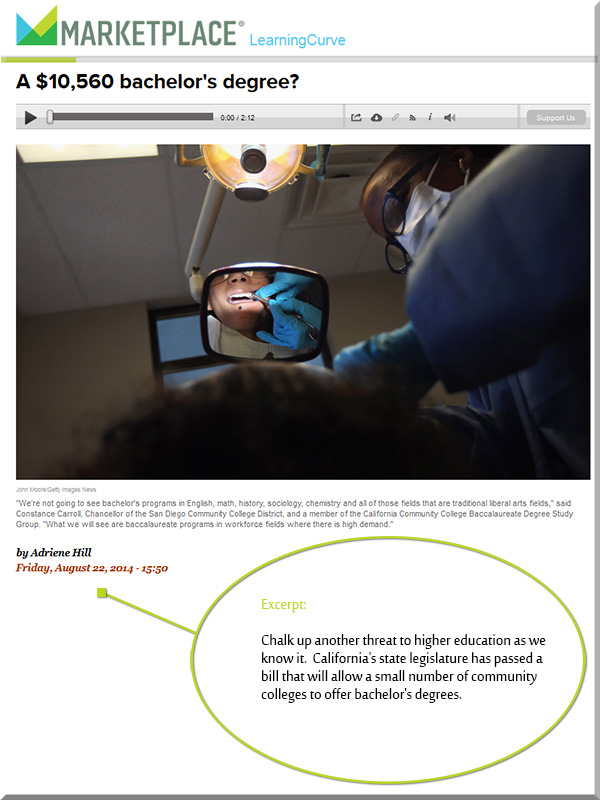
A10560Bachelors-Aug2014


Excerpt:

“We’re not going to see bachelor’s programs in English, math, history, sociology, chemistry and all of those fields that are traditional liberal arts fields,” said Constance Carroll, Chancellor of the San Diego Community College District, and a member of the California Community College Baccalaureate Degree Study Group. “What we will see are baccalaureate programs in workforce fields where there is high demand.”

Fields like dental hygiene, information technology, and automotive-technology management.


Reflections on “C-Suite TV debuts, offers advice for the boardroom” [Dreier]

C-Suite TV debuts, offers advice for the boardroom — from streamingmedia.com by Troy Dreier
Business leaders now have an on-demand video network to call their own, thanks to one Bloomberg host’s online venture.

Excerpt:

Bringing some business acumen to the world of online video, C-Suite TV is launching today. Created by Bloomberg TV host and author Jeffrey Hayzlett, the on-demand video network offers interviews with and shows about business execs. It promises inside information on business trends and the discussions taking place in the biggest boardrooms.


MYOB-July2014


The Future of TV is here for the C-Suite — from hayzlett.com by Jeffrey Hayzlett

Excerpt:

Rather than wait for networks or try and gain traction through the thousands of cat videos, we went out and built our own network.


See also:

  • Mind your own business
    From the About page:
    C-Suite TV is a web-based digital on-demand business channel featuring interviews and shows with business executives, thought leaders, authors and celebrities providing news and information for business leaders. C-Suite TV is your go-to resource to find out the inside track on trends and discussions taking place in businesses today. This online channel will be home to such shows as C-Suite with Jeffrey Hayzlett, MYOB – Mind Your Own Business and Bestseller TV with more shows to come.


From DSC:
The above items took me back to the concept of Learning from the Living [Class] Room.

Many of the following bullet points are already happening — but what I’m trying to influence/suggest is to bring all of them together in a powerful, global, 24 x 7 x 365, learning ecosystem:

  • When our “TVs” become more interactive…
  • When our mobile devices act as second screens and when second screen-based apps are numerous…
  • When discussion boards, forums, social media, assignments, assessments, and videoconferencing capabilities are embedded into our Smart/Connected TVs and are also available via our mobile devices…
  • When education is available 24 x 7 x 365…
  • When even the C-Suite taps into such platforms…
  • When education and entertainment are co-mingled…
  • When team-based educational content creation and delivery are mainstream…
  • When self-selecting Communities of Practice thrive online…
  • When Learning Hubs combine the best of both worlds (online and face-to-face)…
  • When Artificial Intelligence, powerful cognitive computing capabilities (i.e., IBM’s Watson), and robust reporting mechanisms are integrated into the backends…
  • When lifelong learners have their own cloud-based profiles…
  • When learners can use their “TVs” to tap into interactive, multimedia-based streams of content of their choice…
  • When recommendation engines are offered not just at Netflix but also at educationally-oriented sites…
  • When online tutoring and intelligent tutoring really take off…

…then I’d say we’ll have a powerful, engaging, responsive, global education platform.


The Living [Class] Room -- by Daniel Christian -- July 2012 -- a second device used in conjunction with a Smart/Connected TV


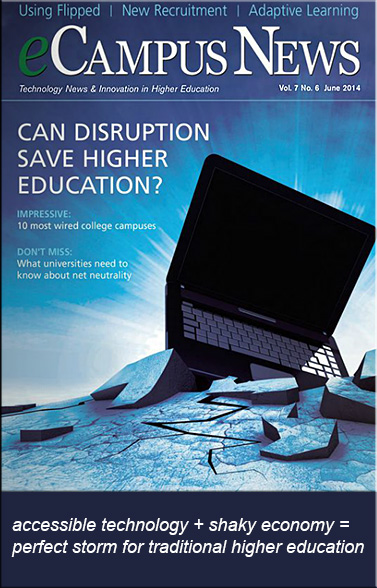
CanDisruptionSaveHigherEducation-June2014


Can disruption save higher education? — from eCampus News by Meris Stansbury

Excerpts (emphasis DSC):

Christensen: “The question now is: ‘Is there something that can’t be displaced within a traditional university’s value offering?'”

…

However, Christensen outlined three ways traditional colleges and universities, like his own Harvard Business school, could survive into the future:

Focus on professors
[when recruiting faculty]…focus less on their publishing capabilities and expert knowledge of material, and more on their ability to connect to others.

Understand why technology, like online learning, is disruptive.

Don’t try to change from the inside — you will fail.  [Use offsets.]


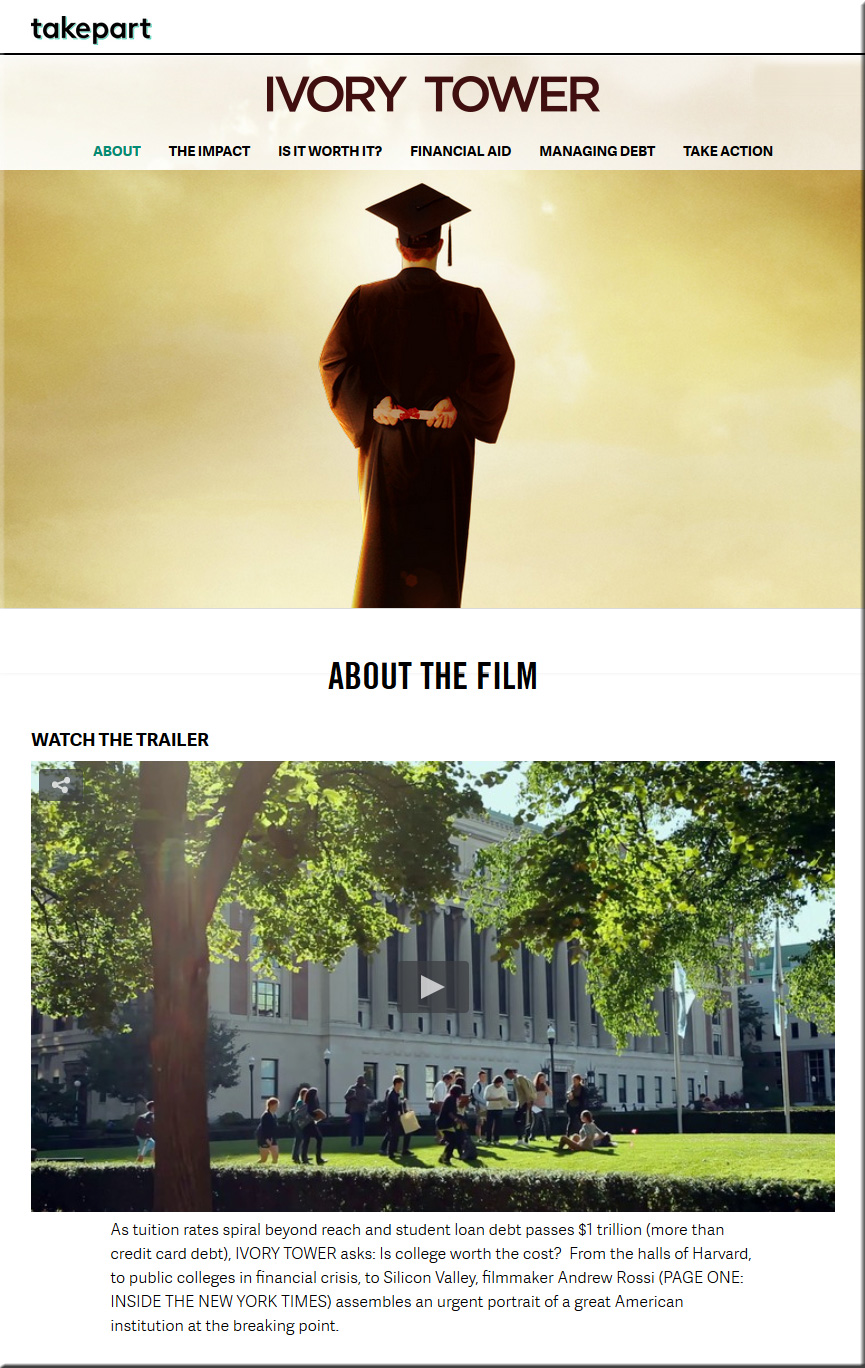
TheIvoryTower-AboutTheFilm-June2014


What price will society pay if higher education cannot revolutionize college as we know it and evolve a sustainable economic model?


The Ivory Tower — description from Wikipedia.org

Excerpt:

Ivory Tower is a 2014 American documentary film written, directed and produced by Andrew Rossi.  The film premiered in competition category of U.S. Documentary Competition program at the 2014 Sundance Film Festival on January 18, 2014.

After its premiere at Sundance Film Festival, Participant Media, Paramount Pictures and Samuel Goldwyn Films acquired distribution rights of the film. The film is scheduled to have a theatrical release in June 2014 in United Sates by Samuel Goldwyn Films. Paramount Pictures will handle the international release of the film, while Participant Media will handle the campaign for film’s theatrical release.


Class, Cost and College — from nyt.com by Frank Bruni

Excerpt:

Scheduled for theatrical release next month, “Ivory Tower” does an astonishingly thorough tour of the university landscape in a brisk 90 minutes, touching on the major changes and challenges, each of which could sustain its own documentary.

But as I watched it, one theme in particular kept capturing my attention. One set of questions kept coming to mind. How does our current system of higher education square with our concerns about social mobility? What place do the nation’s universities have in our intensifying debate about income inequality? What promise do they hold for lessening it?

The answers in “Ivory Tower” and beyond it aren’t reassuring. Indeed, the greatest crisis may be that while college supposedly represents one of the surest ladders to, and up through, the middle class, it’s not functioning that way, at least not very well.


ivory-tower-june2014


From DSC:
I graduated with a liberal arts degree. I work at a Christian liberal arts college. I believe in the liberal arts. However, I see our current business models as broken.  I, along with many others, see issues and problems that need to be dealt with — whereas many within higher education see no need to change at all.  “What’s the problem?” they ask rhetorically…not wanting their great ride of the last 20-30 years to end.

But such individuals aren’t seeing the invisible devastation that’s taking place, such as the mounting/crushing debt on our students’ backs that stays with them for YEARS after they graduate. Such debt loads affect graduates’ ability to purchase a home or to save for retirement (then there’s those who didn’t graduate but spent a great deal of $$ in the attempt to get a degree).  I’m also hearing that it’s delaying marriage in some cases.  And unlike a car or a house, you can’t realistically refinance many student loans. (Although Elizabeth Warren is seeking to change that situation, thankfully.)

So while I strongly believe in obtaining a college education, we have to get the price down!  We have to recognize that there’s an issue. Change must occur.


Business School, Disrupted — from nytimes.com by Jerry Useem

Excerpt:

The question: Should Harvard Business School enter the business of online education, and, if so, how?

Universities across the country are wrestling with the same question — call it the educator’s quandary — of whether to plunge into the rapidly growing realm of online teaching, at the risk of devaluing the on-campus education for which students pay tens of thousands of dollars, or to stand pat at the risk of being left behind.


 Ecclesiastes 11:1-6

From DSC:
The bolded text is what I want to highlight in this posting/reflection:


Ship your grain across the sea;
    after many days you may receive a return.
2 Invest in seven ventures, yes, in eight;
    you do not know what disaster may come upon the land.

3 If clouds are full of water,
    they pour rain on the earth.
Whether a tree falls to the south or to the north,
    in the place where it falls, there it will lie.
4 Whoever watches the wind will not plant;
    whoever looks at the clouds will not reap.

5 As you do not know the path of the wind,
    or how the body is formed[a] in a mother’s womb,
so you cannot understand the work of God,
    the Maker of all things.

6 Sow your seed in the morning,
    and at evening let your hands not be idle,
for you do not know which will succeed,
    whether this or that,
    or whether both will do equally well.


From DSC:
This advice may prove incredibly beneficial for businesspeople, entrepreneurs, freelancers, and innovators. 

But I have it that these words could also apply to the future of education — especially to those of us trying to determine/influence the future of higher education.   TRIMTAB Groups within higher ed will need to live by those words.


TheTrimtabInHigherEducation-DanielChristian


Harvard MOOCs up ante on production quality — from educationnews.org by Grace Smith

Excerpt (emphasis DSC):

It’s called HarvardX, a program begun two years ago, that films professors who are creating lessons that act as an adjunct to their coursework.   The catch is, the production value is equally proportioned to the subject matter.  The underproduced in-class lecture being filmed by a camera at the back of the lecture hall is being updated, in a big way.

Two video studios, 30 employees, producers, editors, videographers, composers, animators, typographers, and even a performance coach, make HarvardX a far cry from a talking head sort of online class.

The Harvard idea is to produce excellent videos, on subject matters that might be difficult to pull off in a lecture hall or class.  Then, to bring these videos into the class for enrichment purposes.  An example is Ulrich’s online class, “Tangible Things”.


Also see:

Sea change of technology: Education — from the Harvard Gazette, Christina Pazzanese, May 26, 2014

Excerpt (emphasis DSC):

After centuries of relative torpor, technology breakthroughs have begun to reshape teaching and learning in ways that have prompted paradigm shifts around pedagogy, assessment, and scholarly research, and have upended assumptions of how and where learning takes place, the student-teacher dynamic, the functions of libraries and museums, and the changing role of scholars as creators and curators of knowledge.

“There are massive changes happening right now,” said Robert A. Lue, the Richard L. Menschel Faculty Director of the Derek Bok Center for Teaching and Learning and faculty director of HarvardX (harvardx.harvard.edu). “What has brought it into particularly tight focus now is that the revolution in online education has raised a whole host of very important questions about: What do students do with faculty face-to-face; what is the value of the brick-and-mortar experience; and how does technology in general really support teaching and learning in exciting, new ways? It’s been a major catalyst, if you will, for a reconsideration of how we teach in the classroom.”

…

Classrooms of the future are likely to resemble the laboratory or studio model, as more disciplines abandon the passive lecture and seminar formats for dynamic, practice-based learning, Harvard academicians say.

“There’s a move away from using the amphitheater as a learning space … toward a room that looks more like a studio where students sit in groups around tables, and the focus is on them, not on the instructor, and the instructor becomes more the ‘guide outside’ rather than the ‘sage onstage,’ facilitating the learning process rather than simply teaching and hoping people will learn,” said Eric Mazur, Balkanski Professor of Physics and Applied Physics at the Harvard School of Engineering and Applied Sciences.

It’s a shift that’s changing teaching in the humanities as well. “It’s a project-based model where students learn by actually being engaged in a collaborative, team-based experience of actually creating original scholarship, developing a small piece of a larger mosaic — getting their hands dirty, working with digital media tools, making arguments in video, doing ethnographic work,” said Jeffrey Schnapp, founder and faculty director of metaLAB (at) Harvard, an arts and humanities research and teaching unit of the Berkman Center for Internet & Society.


From DSC:
HarvardX is a great example of using teams to create and deliver learning experiences.

Also, the “Sea change…” article reminded me of the concept of learning hubs — whereby some of the content is face-to-face around a physical table, and whereby some of the content is electronic (either being created by the students or being consumed/reviewed by the students).  I also appreciated the work that Jeff Schnapp is doing to increase students’ new media literacy skills.


A Case for Applied Liberal Arts: Adapting to Disruption — from evollution.com by Michelle Rhee-Weise | Senior Research Fellow, Clayton Christensen Institute for Disruptive Innovation

Excerpt:

This is neither another defense of the liberal arts nor another piece that pits the liberal arts against vocational training. We’ve all grown weary of commentators who ennoble without question the ideal of the liberal arts while denigrating vocation as factory work or corporate training.

In lieu of these tired tropes, I would suggest the notion of applied liberal arts. It’s time we shed vocation of its connotations of career education, corporate training and utility. Vocation does not preclude the liberal arts but can fuse a liberal education with the application of knowledge, effective citizenship, well roundedness and even artistry.

…

The instinct for some institutions might be to give into the “threat rigidity,” or to cease being flexible in the face of such major, systemic shifts. If, however, traditional institutions double down on a static curriculum, then how will they compete with these lower-cost, briefer and targeted programs that lead directly to high-skills opportunities at desirable companies? The oncoming disruption must be viewed as an opportunity to tie education to economic relevance — to offer more than a trajectory, but a well-defined pathway, to employment.


The $10,000 Degree: Fundamentally Changing the Way Universities Do Business — from evollution.com by Jean Floten | Chancellor, Western Governors University Washington

Excerpt (emphasis DSC):

The reset button has been pushed in this country. We have the choice to either participate in the reshaping of higher education to help more prospective students reach for their aspirations or live in denial.

Most Americans have changed how they do business and manage their personal finances. We must, too. The recession of the last decade spawned more leery consumers and led far too many to question the value of an investment in education.

That’s the importance of the $10,000-degree challenge. It recognizes the need for fundamental change in higher education. Furthermore, it provides a tangible finish line to which the academy may strive.

It’s time we, the leaders of colleges and universities, raise educational attainment levels — not costs.


MOOCs’ disruption is only beginning — from studentforce.wordpress.com; reposted from The Boston Globe written by Clayton M. Christensen and Michelle R. Weise

Excerpt:

JOURNALISTS, as 2013 ended, were busy declaring the death of MOOCs, more formally known as massive open online courses. Silicon Valley startup Udacity, one of the first to offer the free Web-based college classes, had just announced its pivot to vocational training — a sure sign to some that this much-hyped revolution in higher education had failed. The collective sigh of relief from more traditional colleges and universities was audible.

The news, however, must have also had the companies that had enthusiastically jumped on the MOOC train feeling a bit like Mark Twain. When newspapers confused Twain for his ailing cousin, the writer famously quipped, “The report of my death was an exaggeration.” Undoubtedly pronouncements over MOOCs’ demise are likewise premature. And their potential to disrupt — on price, technology, even pedagogy — in a long-stagnant industry is only just beginning to be seen.

Tuition costs have been ballooning faster than general inflation and even faster than health care. And what do we get in return? Nearly half of all bachelor’s-degree holders do not find employment or are underemployed upon graduation. At the same time, employers have not been satisfied with degree candidates. Two recent Gallup polls showed that although 96 percent of chief academic officers believe they’re doing a good job of preparing students for employment, only 11 percent of business leaders agree that graduates have the requisite skills for success in the workforce. And this is all occurring while higher education leaders were convinced that they were innovating all along.

It was just the wrong kind of innovation.


Education-as-a-Service: 5 ways higher ed must adapt to a changing market — from venturebeat.com by Ryan Craig, University Ventures

 Excerpt:

Within a few years, some students will come to higher education with an understanding of their current competencies, the competencies required for their dream job, and the resulting gap. Colleges will need to respond to these students with more than just a course catalog.

For example, for an 18-year-old who wants to start a career in video game design, colleges will offer courses that produce the requisite skills for an entry-level position – in addition to some general education – and will award a meaningful credential at completion of those courses (a process that will be completed likely in less than four years).

Or a laid-off marketing manager, whose time-to-job is six months rather than four years, may come to a university for reskilling in social media marketing, taking four targeted courses and earning a credential that employers can understand.


5 reasons the college student loan debt crisis could top subprime mortgages — from educationdive.com by Keith Button

Excerpt:

As the U.S. higher ed student loan debt continues its ascent, more warnings are sounding about the consequences.

Student debt currently amounts to $1.08 trillion owed by nearly 37 million borrowers. Richard Cordray, president of the Consumer Financial Protection Bureau, has warned that the student loan problem is comparable to the home mortgage market prior to the Great Recession that began in 2008.

Could the economic impact of the student debt crisis one day match (or even exceed) the credit crunch created by subprime mortgages? Here are five reasons for concern…


Taking the Liberal Arts Online in the Summer — from chronicle.com by William Pannapacker
New ways of delivering courses can be compatible with small-college values

Excerpt:

A major reason we created the program was to assist students in completing their degrees within four years. Several of our preprofessional programs have demanding sequences that do not mesh easily with the schedules of courses in our core curriculum. In addition, a growing proportion of our students want to spend a semester off-campus, which places even greater constraints on their academic schedules.

…

Adopted cautiously, in a critical, evolutionary, decentralized way, a variety of online approaches to learning—beyond what we already have—can allow faculty members to improve their teaching by placing lecture content online and using classes for high-impact experiences, allowing professors and students to become more interactive with each other. And—by making it less necessary for students to transfer credit for entire courses from outside parties—online courses developed within an institutional context can preserve rather than undermine our unique missions as liberal-arts colleges.


Also see:

.

The State of Digital Education Infographic

Created by Knewton and Column Five Media


From DSC:
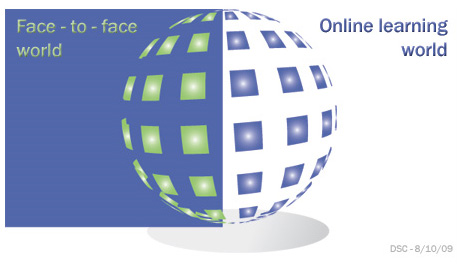
The idea of a learning hub — where some of the learning content is accessed electronically and where some of the learning takes place in a face-to-face manner — seems to be picking up steam. Conceptually, it makes a huge amount of sense, especially if it’s done well. It combines the best of online learning and face-to-face learning. Though not new, blended or hybrid learning, has often been said to be the Holy Grail of learning. So some of the learning could be accessed remotely — via a live videoconference or via a previously recorded lecture — and some of the learning could take place around a table.


Let's take the best of both worlds -- online learning and face-to-face learning


With that in mind, it was interested to see the following postings:

  • N.Y. Public Library Plans Face-to-Face ‘Classes’ for MOOC Students — from chronicle.com by Steve Kolowich
    Excerpt:
    In a pilot program with Coursera, the New York Public Library plans to organize meet-ups at which people taking massive open online courses can gather and discuss the courses with help from “trained facilitators.”The partnership is part the MOOC company’s effort to build an infrastructure for in-person learning around its free online courses. Research has suggested that MOOC students who receive offline help earn higher scores on their assessments.
    .
  • New Learning Hubs Locations Hosted by The New York Public Library and Seven Other International Partners– — coursera.com
    Excerpt:
    [On April 30th] we are happy to announce eight new Learning Hubs partners including The New York Public Library, the largest library system in the US and our first domestic Learning Hubs network. Fitting we think that one of our first US Learning Hubs partners is located in New York, Coursera’s most popular city in the world by enrollment with more than 50,000 users located in New York City and 160,000 in the greater state of New York!
    …
    We launched the Learning Hubs program last year to give communities around the world the ability to access online courses for free, and also to engage with others in a blended learning setting. We’ve since partnered with a total of 17 trusted institutions around the world including the US Department of State to establish physical spaces where students can access the necessary technology and a global community of learners.


From DSC:
Combine that vision with the vision that I’ve put forth on this blog before — and which the recent blog posting discusses below – and you have one pumped up learning environment!


What will the active learning classroom look like in the not-so-distant future? — from lakelandlearningtechnologies.wordpress.com

The next generation interactive classroom…

1) will support students bringing their smartphones and tablets (BYOD) into the classroom. Students can expect to interact with their peers and the content / media on-the-fly, at the same time, discovering new ways to use classroom and web-based technologies to support their own learning.

2) will be increasingly wireless. Apple TV is already being used in classrooms where students and their teachers share their assignments and class projects on high definition TV screens. Emerging wireless technologies such as 802.11 ac, mean faster connection speeds and improved quality of shared media.

3) will mean classrooms are more configurable around the people using them rather than the fixtures and technology in the room. The use of multiple surfaces fosters collaboration, creativity and design, permitting students and instructors the ability to display, capture and share these interactions.

New learning spaces are emerging as a blend of the formal and informal – with flexibility driving design.


From DSC:
This posting is especially meant for two audiences (but also has wider ramifications for the vast majority of us living in the United States)

  1. Those students who are majoring in economics
  2. Those of us working within higher education


To the students studying economics out there:

  • What parts from the articles listed below are true? False? Is anything being minimized or exaggerated — or is the information factual and accurate?
  • How are the topics of these articles/discussions relevant to your lives today? In the future?.
  • Do ethics come into play here? If so, how?
    .


Fed to the Sharks, Part 2: Housing & the Death of the Middle Class  — from oftwominds.com by Charles Hugh Smith

Excerpts:

The Fed sacrificed the foundation of middle class wealth — stable housing values — to boost bank profits.

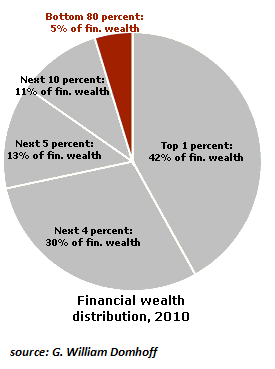
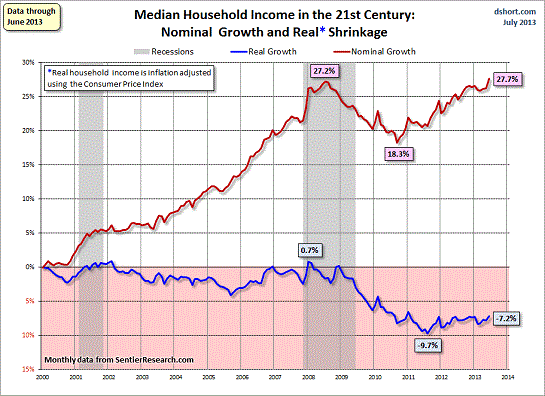
Lest you think the phrase “death of the middle class” is hyperbole, please examine these two charts, keeping in mind the middle class by definition must be in the middle of income/wealth distribution — conventionally, between 40% and 80%, i.e. the 40% between the bottom 40% and the top 20%.


See that little red wedge?
That’s the bottom 80% — the entire middle class
and everyone below the middle class.


Fed to the Sharks, Part 1: The Fed takes our money, gives it to banks who loan it back to us at 16%  — from oftwominds.com by Charles Hugh Smith

Excerpt:

We’re being Fed to the sharks, every day, one morsel at a time. What a way to go….

What can we say about the Federal Reserve’s policies that hasn’t been said a million times? How about simplifying the two primary purposes of Fed policies? I will cover one today and the second one tomorrow. Both involve feeding the 99.5% to the financier/ Wall Street/bank sharks.


To institutions of higher education:

  • If what Charles Hugh Smith is saying is true and the middle class continues to be hollowed out, how does — or should — this affect us?
  • How might this impact our strategies? Our offerings? Our pricing structures?

 
© 2025 | Daniel Christian