2021 EDUCAUSE Horizon Report® | Teaching and Learning Edition

2021 EDUCAUSE Horizon Report® | Teaching and Learning Edition

 
This report profiles key trends and emerging technologies and practices shaping the future of teaching and learning and envisions a number of scenarios and implications for that future. It is based on the perspectives and expertise of a global panel of leaders from across the higher education landscape.


Unbundled law firms find success offering virtual legal services — from abajournal.com by Lyle Moran; with thanks to Gabe Teninbaum for this resource

Excerpt (emphasis DSC):

The Law Shop by Skogerson McGinn in Van Meter, Iowa, provides unbundled legal services, which means it helps clients with specific legal tasks rather than assisting them with their entire cases or matters.

In the family law realm, its unbundled offerings include coaching self-represented litigants on filling out divorce forms and preparing child support worksheets.

By emphasizing this nontraditional approach, also known as limited-scope representation, The Law Shop has attracted inquiries from consumers across the state seeking affordable legal assistance.


The art of the pivot — from chieflearningofficer.com by Jay Campbell and Doug Glener
Try these four tactics the next time you have to change direction.

Excerpt:

The ”first pancake” metaphor — a test to see if the batter and heat are just right — is an example of framing. The results are informative, but not pretty. Framing an experiment as a first pancake lowers the stress and pressure while simultaneously making the experiment fun and playful. Leaders who successfully frame a situation can shift people’s attitudes about even the most intimidating changes.

Supporting healthier minds through learning and development — from chieflearningofficer.com by Elizabeth Loutfi
L&D teams have helped to alleviate some of the stress and anxieties people are feeling as their organizations grapple with pandemic-related changes and challenges.

Meet the CLO Advisory Board: Bob Mosher — from chieflearningofficer.com by Elizabeth Loutfi
Meet longtime CLO advisory board member Bob Mosher, CEO and chief learning evangelist for APPLY Synergies.

CLO: What lessons did you learn back in 2020 that you’ve taken with you into 2021?
For me, it’s the art of listening. As educators, we’re supposed to have answers and we’re supposed to be the owners of content and the developers of programs. We get help from the business, but we’re very locked in our ways. Understandably so, but all of our ways were thrown out last year. My instinct, and many, was to rush to solution, rush to help. That was fairly humbling for me. It was a year to reflect and sit back and examine my commitment to things over doing the right thing. It taught me that — which L&D should do well anyway, but when you get senior like me and you’ve done it a bunch of times — you guess people’s right answer, or think you can. Because there was no normal and we weren’t making courses like we always used to, it was a year of reflection and listening for me to kind of rekindle that skill.

5 ways to foster a learning culture — from chieflearningofficer.com by Jonathan Finkelstein
By placing importance on growth at all levels of the organization, you can foster a learning culture that serves your people and helps your business grow.


All Eyes on Utah: Launching the ‘First Nonlawyer-Owned’ Law Firm — from law.com by Alaina Lancaster
Daniel Wilde, an attorney for Law On Call, which claims to be the first nonlawyer-owned law firm in the nation, says the entire country can benefit from the innovative business models coming out of Utah.

Excerpt:

[The week of April 5], a registered agent service provider announced that it launched the first nonlawyer-owned law firm in the United States.

The move comes after the Utah Supreme Court approved a pilot program that would allow nonlawyers to provide certain legal services—a proposition that’s been kicked around in California, Arizona, Illinois and the District of Columbia. Under Northwest Registered Agent’s Law On Call model, clients can pay a $9 monthly subscription, where they can ring up lawyers directly. They can also hire Law on Call’s attorneys for legal work at discounted rates.


Report Maps Growing ‘Justice Tech’ Market, Urges VCs To Invest — from lawsitesblog.com by Bob Ambrogi; with thanks to Gabe Teninbaum and his Lawtomatic Newsletter for the resource

Excerpts:

A report issued yesterday documents the growing market for “justice tech” — startups focused on reducing inequities in the criminal and civil justice systems — and urges venture capitalists to invest in these startups.
…
The report, Justice Tech for All: How Technology Can Ethically Disrupt the US Justice System, was published by two VC firms that focus on impact investing: Village Capital and the American Family Insurance Institute for Corporate and Social Impact (AmFam Institute).


5 Ways to Marry Higher Ed to Work — from campustechnology.com by Dian Schaffhauser

Excerpts:

  1. Treat employers as customers.
  2. Move beyond the idea of the bachelor degree as the end-all.
  3. Link coursework with competences.
  4. Develop a “shared vocabulary of skills” that can be used by employers and peer institutions.
  5. Design for equity and inclusion.

From DSC:
It’s great to see more articles like this that promote further collaboration — and less siloing — between the worlds of higher education and the workplace.

My guess is that those traditional institutions of higher education who change/adapt quickly enough have a much greater chance at surviving (and even thriving). Those that don’t will have a very rough road ahead. They will be shadows of  what they once were — if they are even able to keep their doors open.

Disruption is likely ahead — especially if more doors to credentialing continue to open up and employers hire based on those skills/credentials. One can feel the changing momentums at play. The tide has been turning for the last several years now (history may show the seeds of change were planted in times that occurred much longer ago).


It’s Time to Rethink Higher Education: What if our goal was creating social impact, not preserving the status quo? — from chronicle.com by Brian Rosenberg (president emeritus of Macalester College and president in residence of the Harvard Graduate School of Education)

Excerpts (emphasis DSC):

Higher education should in its ideal form lead to more economic security for more people, a more equitable and innovative society, and a well-functioning democracy. Add whatever goals you would like, but these seem like a reasonable starting point and, given the present state of the country, more than a little aspirational.
…
But if we fail to explore — if we fail to go beyond superficial change and interrogate our most fundamental assumptions about how and what we teach, how and why we organize ourselves in the current way — we will have no one but ourselves to blame if the system as we know it shrivels to the point where it collapses from within or is painfully disrupted from without.

Also see:

The Pandemic May Have Permanently Altered Campuses. Here’s How. — from chronicle.com by Francie Diep
Trends accelerated by Covid-19 may make more sense than ever in the future, experts say.

Excerpt:

The Covid-19 crisis has transformed all aspects of higher education, and the physical campus is no exception. The Chronicle recently released a special report, Rethinking Campus Spaces, that offers strategies for doing more with less space, to save money and prepare for an uncertain future. Here is an adapted excerpt from the report.

The Chronicle asked more than 40 architects, campus planners, and leaders in student life and housing about how several categories of campus spaces might look different in the future. As colleges navigate difficult financial straits, many interviewees predicted more public-private partnerships, and renovations instead of new construction — which can be less costly and more environmentally friendly. Overall, their answers paint a picture of future campuses that are more adaptable, perhaps smaller, and focused on what’s most valuable about seeing one’s peers in person.


Coursera’s IPO Filing Shows Growing Revenue and Loss During a Pandemic — from edsurge.com by Tony Wan

Excerpt:

Coursera reported $293.5 million in revenue in 2020, marking a 59 percent increase from the previous year. That comes from over 77 million registered learners, along with more than 2,000 businesses (including 25 percent of Fortune 500 companies) and 100 government agencies that paid for its enterprise offerings. More than half (51 percent) of its revenue came from outside the U.S.
…
Despite recording a revenue jump in 2020, Coursera posted a net loss of $66.8 million, up 43 percent from the previous year.

“We have experienced a significant increase in our operating costs associated with our services, primarily driven by our freemium offerings and marketing efforts” during the pandemic, the filing stated.


New Opportunities in 2021: Improved Academic Mobility, Flexible Degree Attainment and Skills Verification — from campustechnology.com by Stan Novak
The pandemic has accelerated trends in alternative credentials that will be essential to student success in an evolving higher education landscape.

Excerpt:

Interoperable learning records (ILRs) are being studied as an achievable way to communicate skills between workers, employers, and education and training institutions with the goal of creating a single profile that represents all of an individual’s abilities. The value of an ILR is that it would allow efficient and consistent comparison of a person’s capabilities to fulfill specific job requirements.

These opportunities represent only a slice of what lies ahead for higher education as the world emerges from the pandemic. The dramatic shift in the learning landscape highlights the ways that higher education must adapt to make degree attainment more flexible, achievable and relevant for the future workforce. 

From DSC:
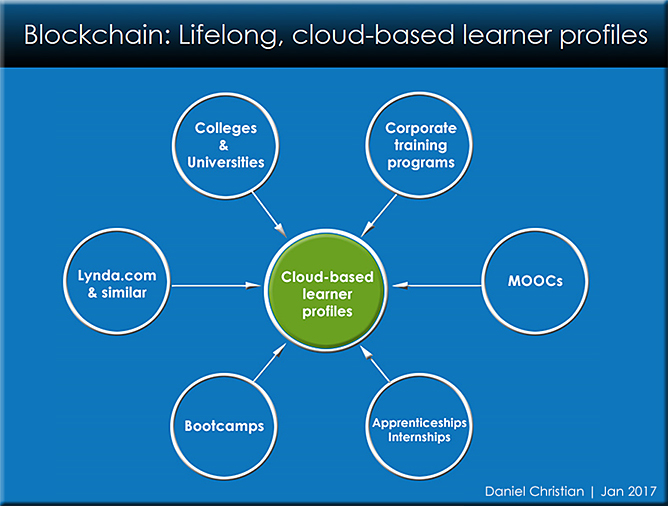
I’ve often thought there could be real benefits in cloud-based learner profiles — which could store our learning preferences, our past learning experiences, certificates, programs, courses, etc.


Southern New Hampshire buys Kenzie Academy to grow alternative credentials — from highereddive.com by Hallie Busta

Dive Brief:

  • Southern New Hampshire University announced Tuesday that it has acquired boot camp provider Kenzie Academy to grow its alternative credential offerings. SNHU did not disclose the transaction price.
  • The university, which enrolls around 150,000 students mostly online, will get Kenzie’s programs and students. Kenzie, a for-profit company, will become a division of SNHU led by Kenzie CEO Chok Ooi.
  • The deal comes as more colleges work with boot camp providers in an effort to diversify their programming, particularly with more short-format options.


Today’s Teens Questioning the Status Quo When It Comes to College — from prnewswire.com by with thanks to Ryan Craig for this resource
National survey finds high schoolers want lower-cost, quicker paths to careers: 50 percent are open to something other than a four-year degree

Excerpt:

For those who have been following the discussion, it will not come as a shock that this demographic is extremely concerned about the cost of higher education. In fact, the number one thing teens would change about college is the price tag. Their second top concern is making sure the path they take directly connects them to a future career. Specifically, the top three things Gen Z teens are most concerned about:

  • 50 percent—graduating with a high amount of debt
  • 44 percent—not getting a job after they graduate
  • 40 percent—not being prepared for a job after school ends

From DSC:
I sometimes use the tag “surviving” and it often has to do with individuals and families. But over the last few years, I have found myself using it for institutions of traditional higher education (as I did for this posting).

It’s time for reinvention if we want those institutions to survive. Those who can’t wait until the status quo returns are likely in for a disappointment, if not outright shock. Over the last several years, many people have already lost their jobs throughout higher ed, positions have gone unfilled, and early retirement offers were made (and often snatched up). The headcounts have been decreasing for years and the workloads have increased for the survivors of such cuts. The use of adjunct faculty members has been on the increase for many years now. 

Those institutions that have cultures that support experimentation, innovation, and support strategic, nimble, entrepreneurial thinking have a better chance of surviving.


From DSC:
This is what we’re up against –> Reskilling 1 billion people by 2030” — from saffroninteractive.com by Jessica Anderson

Excerpts:

According to the World Economic Forum, this statistic is a critical economic imperative.

Does this shock or scare you? Perhaps you’re completely unflappable? Whatever your reaction, this situation will undoubtedly impact your organisation and the way you tackle skills development.
…
What are the roadblocks?

So, we’ve laid down the gauntlet; an adaptable, agile, multi-skilled workforce. What stands in the way of achieving this? A recent survey of the top 5 challenges facing learning leaders sheds some light:

1. Building a learning culture
2. Learning in the flow of work
3. Digital transformation
4. Learner engagement and ownership
5. Keeping informed of best practices

From DSC:
The article mentions that nations could lose billions in potential GDP growth. And while that is likely very true, I think a far bigger concern is the very peace and fabric of our societies — the way of living that billions of people will either enjoy or have to endure. Civil unrest, increased inequality, warfare, mass incarcerations, etc. are huge concerns.

The need for a next-gen learning platform is now! The time for innovation and real change is now. It can’t come too soon. The private and public sectors need to collaborate to create “an Internet for learning” (in the sense that everyone can contribute items to the platform and that the platform is standards based). Governments, corporations, individuals, etc. need to come together. We’re all in the same boat here. It benefits everyone to come together. 

Learning from the living class room -- a next generation, global learning platform is needed ASAP


Time for Reinvention, Not Just Replication or Revision — from insidehighered.com by Ray Schroeder
With enrollments falling, college budgets under strain and employers dissatisfied with the relevance of graduates’ learning, now is a time for more than replication or revision — it is time for reinvention.

Excerpt:

We are at the confluence of massive economic, technologic and social changes that demand higher education do more than small fixes. We will not thrive if we merely tweak the system to replicate practices of the lecture hall in an online delivery system. This is not an empty warning — universities across the country are closing programs, laying off staff and faculty, and teetering on the brink of bankruptcy. I have personally been tracking these economic disadvantages for some time now.

Here are the key factors we must consider…(see rest of article)

Our centuries-old model of admitting 18-year-old high school graduates for a four-, five- or six-year baccalaureate, then sending them out for lifelong careers in business and industry is no longer relevant.


Legaltech Careers Guide: roles, organisations and routes into legaltech jobs — from lawtomated.com

Excerpt:

This guide includes our most frequent FAQs and advice based on our experiences and those of others working in legaltech, legal ops, and innovation who made the jump from a traditional lawyer role into this space, or who entered the space from outside of legal.


U of Minnesota System makes tuition free for low-income students — from highereddive.com by Jeremy Bauer-Wolf

Dive Brief:

  • The University of Minnesota System greenlit a program eliminating tuition costs for students whose families earn $50,000 or less in a year.
  • The system’s regent board approved the move unanimously on Friday, according to local media reports. It’s a part of its five-year strategic plan, which also set the goal of reducing the average debt of undergraduates with loans to $25,000 at graduation.
  • President Joe Biden touted free college proposals on the campaign trail. Such arrangements have also seen renewed interest in the wake of the economic tumult of the pandemic.
 
© 2025 | Daniel Christian