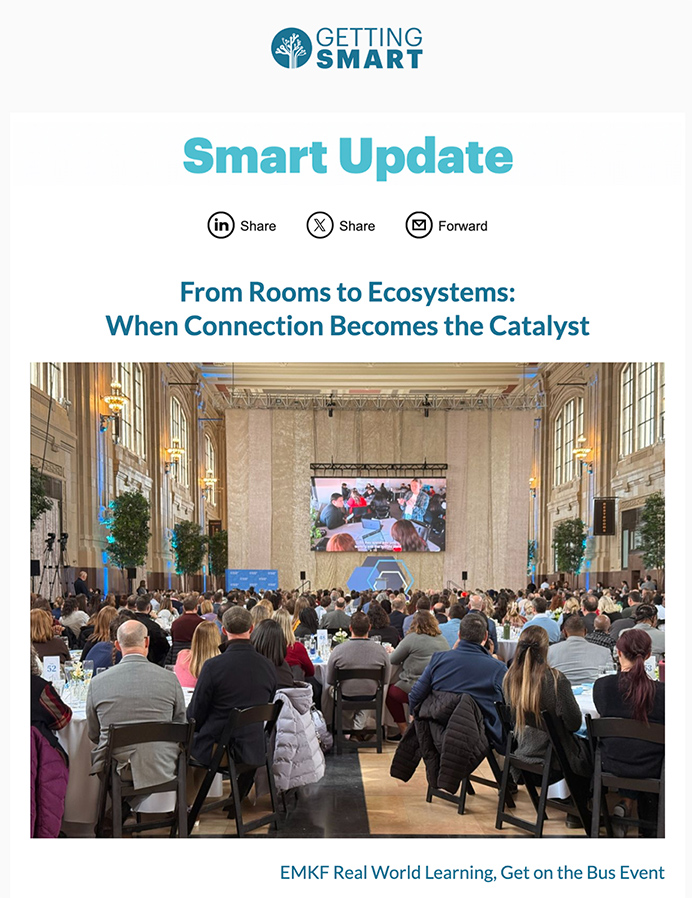
The Public Microschool Playbook — from gettingsmart.com

School systems today face a complex challenge: how to personalize learning while responding to the rapidly shifting needs of students, families, and communities. Enter the Public Microschool Playbook—a new, field-tested resource co-created by Getting Smart, Learner-Centered Collaborative, and Transcend to help public education leaders reimagine learning from the ground up.

This isn’t just about launching new schools. It’s about designing dynamic, student-centered ecosystems that live inside our public systems and reflect the aspirations of the communities they serve. With an intentional focus on access and opportunity, microschools offer more than just flexibility—they offer a path to more relevant, sustainable, and empowering learning for all.

Grounded in three key phases—Planning, Designing, and Implementing—the Playbook equips district leaders, charter networks, and innovators with real-world tools and insights to launch microschools that meet local needs and drive systemic transformation. From policy navigation and budgeting to learner-centered design elements like advisory, PBL, and multi-age cohorts, this guide is a blueprint for creating purpose-built environments that make learning personal and powerful.


Also from Getting Smart, see:

The Reboot of Readiness: It’s Time to Take Action in Renovating CTE from the Ground Up — from gettingsmart.com by Adam Kulaas

Key points:

  • CTE programs need to move beyond traditional frameworks and adopt the Career Clusters Framework to better prepare students for real-world opportunities.
  • It’s crucial to integrate career readiness into the entire educational experience, making it an intentional and structured pathway from early education through high school.


Rethinking Accreditation for Emerging Models — from permissionlessed.substack.com by Raphael Gang

What’s Next: Middle States’ Next Generation Accreditation
Inspired by the Iowa project, we teamed up with the Middle States Association (MSA)—a national accreditor that shared our belief that the process had become more of a hurdle than a help.

Together with partners like the National Microschooling CenterKaipod, and Getting Smart, we’ve built something new: Next Generation Accreditation (NGA)—a faster, more flexible, more affordable process that respects school founders’ time, budgets, and models.

  • Flexible evidence: Schools can demonstrate quality in ways that fit their model.
  • More relevant standards: Built for founders, not bureaucrats.
  • Affordable: Annual dues of $650–$775 and a flat $500 site visit fee—no upsells or hidden costs.
  • Narrative-driven: Focused on how schools serve families and students, not just ticking boxes.
  • Fast: We’re piloting this in 2025, aiming to accredit schools in time for ESA eligibility for the 2026–27 school year.
 

What Happened When Trump Altered the Deal With Law Firms and Universities — from nytimes.com by Amanda Taub; this is a gifted article
Does the prisoner’s dilemma still apply when the rules break down?

A few weeks ago, several prominent American universities and law firms found themselves in what seemed to be a classic prisoner’s dilemma, courtesy of President Trump.

His campaign of retribution against law firms that represented or hired his political opponents, and against universities that engaged in “woke” policies or purportedly fostered antisemitism, was forcing them to make an unappealing choice.

Those who capitulated and struck an early deal with the White House, it seemed, might be spared the worst of Mr. Trump’s wrath, but at the cost of jeopardizing their independence. Standing up to the president risked even harsher punishment, particularly if other institutions stayed silent.

Columbia University made a deal with the administration. So did some of the largest law firms in the country. Recent changes, however, suggest that the dilemma is starting to look very different.

In the real world, however, instead of rewarding those who capitulated early, the Trump administration pressured them even more.

“Capitulation has a track record,” said Ms. Saunders, “and it’s not pretty.”


In many traditional school buildings, the design sends an unspoken message: “Sit down. Follow instructions. Stay within the lines.”

But imagine what students might believe about themselves and the world if their learning environment said instead:

“You belong here. Your ideas matter. Explore freely.”


For another item related to learning spaces, see:

Choosing the Right Technology for Today’s HyFlex Classroom — from edtechmagazine.com by Gaurav Bradoo
Long-lasting adoption of the HyFlex learning modality means higher education institutions shouldn’t be afraid to invest in tools that can enhance the student experience.

The answer? Solutions built for quick and easy installation, designed to work across multiple platforms and equipped with remote update and troubleshooting features. Anything we can do to reduce the number of cords, components and required steps during installation will assist AV staff. Prioritizing user-friendly design will cut down on help tickets across the lifespan of a device, and choosing features such as remote update capability can streamline maintenance. The bottom line is that simplicity and ease of deployment are not nice-to-haves. They are essential.

I’ve visited universities where instructors are faced with control panels with laminated cheat sheets next to them. These panels are often overloaded, acting as the room system as well, and not designed with simplicity or teaching flow in mind as it relates to capturing and streaming content for HyFlex teaching.


Along the lines of learning and working/office spaces…I’d like to thank Daan van Rossum for this next article (below emphasis from DSC). Daan mentioned that:

  • Phil Kirschner (ex-McKinsey, WeWork, JLL, Forbes contributor) just published a sharp piece on The Workline entitled Vibe Officing: The Antidote to Office Mandates.
  • In it, Phil introduces “Vibe Officing”—challenges the mandate-vs-flexibility debate with a third way: designing office spaces people want to return to, not because they’re told to, but because they actually enjoy being there. He also touches on how AI can enable personalized nudges to improve workplace journeys.


2025 EDUCAUSE Teaching and Learning Workforce in Higher Education — from library.educause.edu

This report is the first in a series that examines three distinct workforce domains in higher education in 2025 (teaching and learning, cybersecurity and privacy, and IT leadership) to determine the priorities and challenges facing the profession. The findings in this report, taken from a survey of teaching and learning professionals in higher education, highlight their perspectives on a range of topics:

  • Flexible work arrangements
  • Integration of technologies
  • Workload and staffing
  • Job satisfaction and transition/succession planning
  • Mental health and well-being
  • Culture of belonging
  • Professional development


Encouraging Students’ Curiosity With Animal Observations — from edutopia.org by Shelby Guthrie
Watching animals—either outdoors or via an online live cam—is an engaging way for students to build their critical thinking skills.

A moment of stillness can spark a lifetime of curiosity. Watching animals—whether it’s a bird outside or a zoo cam online—helps learners slow down, notice patterns, and ask questions. Structured observation builds patience, critical thinking, and a stronger connection to nature.

More than just engaging, these small moments contribute to bigger ideas—like understanding ecosystems, animal behavior, and the ever-changing world. Observation teaches learners to care, question, and conserve. These skills are foundational not only for scientific thinking but also for fostering empathy and awareness. When students observe closely, they begin to notice patterns, ask better questions, and connect deeply with the natural world. This kind of curiosity-driven learning empowers them to take informed action, whether that means advocating for a local habitat, participating in citizen science, or simply seeing their environment through a more thoughtful lens.


3 Ways to Help Students Build Attention Stamina — from edutopia.org by Donna Phillips
These simple tools and strategies can improve focus in the classroom.

I set out to create some helpful tools and strategies for my students, who have diverse learning profiles, including processing delays, anxiety, attention challenges, and autism. I knew going in that whatever I came up with needed to be flexible. The goal was never perfection; it was access and agency.

What’s resulted are three classroom strategies that don’t feel like extra work for students. Instead, they help students own their attention. I named the strategies “The Listening Gym,” “The Noise Diet,” and “Focus GPS.”


Keeping Students Engaged During Long Class Periods — from edutopia.org by Maggie Espinola
By chunking class time using gradual release of responsibility, teachers can vary their teaching strategies to help students maintain focus.

For a new teacher, figuring out how to manage a long class period can feel particularly daunting. In order to maximize the attention of your students during longer class periods, consider the following tips.

Creating a Student Leadership Program — from edutopia.org by Danica Derksen
These strategies for building leadership skills can be implemented as an elective or by creating other opportunities for students.

Running an effective student leadership program takes structure and vision from all levels of a school. When we create opportunities for students to lead, we are building competencies that they will take with them for the rest of their lives.

I currently co-teach a middle school student leadership elective each semester. I am passionate about teaching my students to lead by example, find solutions to problems, and make their school a place where all students know they belong. Here are four ideas to create a strong student leadership program or other student leadership opportunities.


2025: The Year the Frontier Firm Is Born — from Microsoft

We are entering a new reality—one in which AI can reason and solve problems in remarkable ways. This intelligence on tap will rewrite the rules of business and transform knowledge work as we know it. Organizations today must navigate the challenge of preparing for an AI-enhanced future, where AI agents will gain increasing levels of capability over time that humans will need to harness as they redesign their business. Human ambition, creativity, and ingenuity will continue to create new economic value and opportunity as we redefine work and workflows.

As a result, a new organizational blueprint is emerging, one that blends machine intelligence with human judgment, building systems that are AI-operated but human-led. Like the Industrial Revolution and the internet era, this transformation will take decades to reach its full promise and involve broad technological, societal, and economic change.

To help leaders understand how knowledge work will evolve, Microsoft analyzed survey data from 31,000 workers across 31 countries, LinkedIn labor market trends, and trillions of Microsoft 365 productivity signals. We also spoke with AI-native startups, academics, economists, scientists, and thought leaders to explore what work could become. The data and insights point to the emergence of an entirely new organization, a Frontier Firm that looks markedly different from those we know today. Structured around on-demand intelligence and powered by “hybrid” teams of humans + agents, these companies scale rapidly, operate with agility, and generate value faster.

Frontier Firms are already taking shape, and within the next 2–5 years we expect that every organization will be on their journey to becoming one. 82% of leaders say this is a pivotal year to rethink key aspects of strategy and operations, and 81% say they expect agents to be moderately or extensively integrated into their company’s AI strategy in the next 12–18 months. Adoption is accelerating: 24% of leaders say their companies have already deployed AI organization-wide, while just 12% remain in pilot mode.

The time to act is now. The question for every leader and employee is: how will you adapt?


On a somewhat related note, also see:

Exclusive: Anthropic warns fully AI employees are a year away — from axios.com by Sam Sabin

Anthropic expects AI-powered virtual employees to begin roaming corporate networks in the next year, the company’s top security leader told Axios in an interview this week.

Why it matters: Managing those AI identities will require companies to reassess their cybersecurity strategies or risk exposing their networks to major security breaches.

The big picture: Virtual employees could be the next AI innovation hotbed, Jason Clinton, the company’s chief information security officer, told Axios.


Higher Ed Institutions Rely Less on OPMs While Increasingly Hiring Fee-For-Service Models — from iblnews.org

market report from Validated Insights released this month notes that fewer colleges and universities hire external online program management (OPM) companies to develop their courses.

For 2024, higher education institutions launched only 81 new partnerships with OPMs —  a drop of 42% and the lowest number since 2016.

The report showed that institutions increasingly pay OPMs a fee-for-service instead of following a revenue-sharing model with big service bundles and profit splits.

Experts say revenue-sharing models, which critics denounce as predatory arrangements, incentivize service providers to use aggressive recruiting tactics to increase enrollments and maximize tuition revenue.

According to the report, fee-for-service has become the dominant business model for OPMs.


6 Online Edtech Professional Learning Communities & Resources for Teachers — from techlearning.com by Stephanie Smith Budhai, Ph.D.
These resources can help provide training, best practices, and advice, for using digital tools such as Canva, Curipod, Kahoot!, and more

While school-led professional development can be helpful, there are online professional learning communities on various edtech websites that can be leveraged. Also, some of these community spaces offer the chance to monetize your work.

Here is a summary of six online edtech professional learning spaces.


4 ways community colleges can boost workforce development — from highereddive.com by Natalie Schwartz
Higher education leaders at this week’s ASU+GSV Summit gave advice for how two-year institutions can boost the economic mobility of their students.

SAN DIEGO — How can community colleges deliver economic mobility to their students?

College leaders at this week’s ASU+GSV Summit, an annual education and technology conference, got a glimpse into that answer as they heard how community colleges are building support from business and industry and strengthening workforce development.

These types of initiatives may be helping to boost public perception of the value of community colleges vs. four-year institutions.


From DSC:
We had better not lose the rule of law in the United States! Donald Trump is an enormous threat to our constitutional democracy! He has NO respect for the rule of law, the judicial branch of our government, our constitution, telling the truth, or having virtues and strong character. He is a threat to the entire world. People are already feeling that in their wallets, purses, and 401(k)s. Supply chains throughout the globe have been negatively impacted. Many have lost their jobs, and more people will likely lose their jobs as a recession is becoming increasingly likely as each day passes.

At minimum, the USA has lost the respect and goodwill of many nations. And I understand why


From Bloomberg on 4/11/25:

The Trump administration, which admitted to wrongly sending a man to a notorious prison in El Salvador (violating a court order in the process) and declined to try and get him back, on Friday went a step further. Lawyers for Trump, despite an order by the US Supreme Court, refused to tell a federal judge where the man was or what it’s doing to get him back. A federal judge, following the Supreme Court’s direction, set a deadline today for Trump’s lawyers to explain how the government planned to follow the high court’s ruling. Trump’s lawyers rejected the court’s order, saying it didn’t have enough time, and questioned her authority.

The Supreme Court ruling against Trump was one of his first defeats tied to the administration’s attempt to broadly expand executive powers. It followed a series of recent procedural rulings that saw the Republican-appointee controlled court rule in his favor. But this latest refusal by Justice Department lawyers to fully comply with court orders, unlike previous cases tied to Trump policies, directly implicates a ruling from the highest court in the land, intensifying an ongoing and unprecedented constitutional crisis between the two branches of government.


Link to this item on LinkedIn


Addendum on 4/17 from DSC:
And speaking of the rule of law…what in the world does a President of the U.S. have to do with which cases law firms can and can’t take up? That’s not his job. Yet he threatens people, law firms, universities, and others to do his will or face the consequences (normally, that has to do with withdrawing funding or getting fired). One billion dollars worth of legal services donated to causes that Trump supports?!?!?! WHAT? 

Trump announces deals with more law firms for a combined $600 million — from washingtonpost.com by Mark Berman
Firms seeking to avoid sanctions from President Donald Trump have agreed to provide nearly ***$1 billion*** in legal services to causes he supports.

President Donald Trump on Friday announced that he had reached agreements with five more law firms pledging to provide a combined $600 million in legal services for causes he supports, the latest deals firms have struck with him in apparent bids to avoid punishment.

Since February, Trump has issued several executive orders sanctioning prominent law firms with ties to his political adversaries or that had opposed his policies, seeking to strip them of government contracts and block them from federal buildings. Three firms targeted by Trump have sued to fight back, while several others made deals with Trump that some framed as necessary to keep their businesses afloat. A fourth firm filed a lawsuit Friday evening challenging Trump’s actions.


Addendum from Above the Law on 4/17/25:

Biglaw Is Under Attack. Here’s What The Firms Are Doing About It.
Introducing the Biglaw Spine Index.

The President of the United States is using the might and power of the office to attack Biglaw firms and the rule of law. It’s pretty chilling stuff that is clearly designed to break major law firms and have them bend a knee to Trump or extract a tremendous financial penalty. This is an assault not just on the firms in the crosshairs, but on the very rule of law that is the backbone of our nation, without which there’s little to check abuses of power.

But in the face of financial harm, too many firms are willing to proactively seek out Trump’s seal of approval and provide pro bono payola, that is, free legal services on behalf of conservative clients or causes in order to avoid Trumpian retribution. So we here at Above the Law have decided to track what exact Biglaw firms are doing in response to the bombardment on Biglaw and the legal system. Some have struck a deal with Trump, some are fighting in court, some have signed an amicus brief in the Perkins Coie case, but the overwhelming majority have stayed silent.


Addendum from Bloomberg on 4/16/25:

The Trump administration’s resistance to and in some cases rejection of the federal judiciary’s constitutional powers has earned it its first finding of contempt, a grave escalation in the deepening crisis at the heart of American government. A federal judge who had been repeatedly attacked by Trump and his aides found there is “probable cause” to hold administration officials in criminal contempt of court for sending scores of men and boys to an El Salvador prison despite his order to halt the deportations. The administration has claimed without providing evidence that the deportees are gang members. A Bloomberg investigation revealed the vast majority had never been charged in the US with anything other than immigration or traffic violations. A Maryland US senator meanwhile was turned away from meeting with a man imprisoned in El Salvador who the Trump administration illegally deported and now refuses to bring back—despite a US Supreme Court order that it facilitate his return.


The following resource was from Roberto Ferraro:

Micromanagement — from psychsafety.com by Jade Garratt

Psychological Safety and Micromanagement
Those who have followed our work at Psych Safety for a while will know that we believe exploring not just what to do – the behaviours and practices that support psychological safety – but also what to avoid can be hugely valuable. Understanding the behaviours that damage psychological safety, what not to do, and even what not to say can help us build better workplaces.

There are many behaviours that damage psychological safety, and one that almost always comes up in our workshops when discussing cultures of fear is micromanagement. So we thought it was time we explored micromanagement in more detail, considering how and why it damages psychological safety and what we can do instead.

Micromanagement is a particular approach to leadership where a manager exhibits overly controlling behaviours or an excessive and inappropriate focus on minor details. They might scrutinise their team’s work closely, insist on checking work, refrain from delegating, and limit the autonomy people need to do their jobs well. It can also manifest as an authoritarian leadership style, where decision-making is centralised (back to themselves) and employees have little say in their work.


From DSC:
I was fortunate to not have a manager who was a micromanager until my very last boss/supervisor of my career. But it was that particular manager who made me call it quits and leave the track. She demeaned me in front of others, and was extremely directive and controlling. She wanted constant check-ins and progress reports. And I could go on and on here. 

But suffice it to say that after having worked for several decades, that kind of manager was not what I was looking for. And you wouldn’t be either. By the way…my previous boss — at the same place — and I achieved a great deal in a very short time. She taught me a lot and was a great administrator, designer, professor, mentor, and friend. But that boss was moved to a different role as upper management/leadership changed. Then the micromanagement began after I reported to a different supervisor.

Anyway, don’t be a micromanager. If you are a recent graduate or are coming up on your graduation from college, learn that lesson now. No one likes to work for a micromanager. No one. It can make your employees’ lives miserable and do damage to their mental health, their enjoyment (or lack thereof) of work, and several other things that this article mentions. Instead, respect your employees. Trust your employees. Let them do their thing. See what they might need, then help meet those needs. Then get out of their way.


Reflections on “Are You Ready for the AI University? Everything is about to change.” [Latham]

.
Are You Ready for the AI University? Everything is about to change. — from chronicle.com by Scott Latham

Over the course of the next 10 years, AI-powered institutions will rise in the rankings. US News & World Report will factor a college’s AI capabilities into its calculations. Accrediting agencies will assess the degree of AI integration into pedagogy, research, and student life. Corporations will want to partner with universities that have demonstrated AI prowess. In short, we will see the emergence of the AI haves and have-nots.

What’s happening in higher education today has a name: creative destruction. The economist Joseph Schumpeter coined the term in 1942 to describe how innovation can transform industries. That typically happens when an industry has both a dysfunctional cost structure and a declining value proposition. Both are true of higher education.

Out of the gate, professors will work with technologists to get AI up to speed on specific disciplines and pedagogy. For example, AI could be “fed” course material on Greek history or finance and then, guided by human professors as they sort through the material, help AI understand the structure of the discipline, and then develop lectures, videos, supporting documentation, and assessments.

In the near future, if a student misses class, they will be able watch a recording that an AI bot captured. Or the AI bot will find a similar lecture from another professor at another accredited university. If you need tutoring, an AI bot will be ready to help any time, day or night. Similarly, if you are going on a trip and wish to take an exam on the plane, a student will be able to log on and complete the AI-designed and administered exam. Students will no longer be bound by a rigid class schedule. Instead, they will set the schedule that works for them.

Early and mid-career professors who hope to survive will need to adapt and learn how to work with AI. They will need to immerse themselves in research on AI and pedagogy and understand its effect on the classroom. 

From DSC:
I had a very difficult time deciding which excerpts to include. There were so many more excerpts for us to think about with this solid article. While I don’t agree with several things in it, EVERY professor, president, dean, and administrator working within higher education today needs to read this article and seriously consider what Scott Latham is saying.

Change is already here, but according to Scott, we haven’t seen anything yet. I agree with him and, as a futurist, one has to consider the potential scenarios that Scott lays out for AI’s creative destruction of what higher education may look like. Scott asserts that some significant and upcoming impacts will be experienced by faculty members, doctoral students, and graduate/teaching assistants (and Teaching & Learning Centers and IT Departments, I would add). But he doesn’t stop there. He brings in presidents, deans, and other members of the leadership teams out there.

There are a few places where Scott and I differ.

  • The foremost one is the importance of the human element — i.e., the human faculty member and students’ learning preferences. I think many (most?) students and lifelong learners will want to learn from a human being. IBM abandoned their 5-year, $100M ed push last year and one of the key conclusions was that people want to learn from — and with — other people:

To be sure, AI can do sophisticated things such as generating quizzes from a class reading and editing student writing. But the idea that a machine or a chatbot can actually teach as a human can, he said, represents “a profound misunderstanding of what AI is actually capable of.” 

Nitta, who still holds deep respect for the Watson lab, admits, “We missed something important. At the heart of education, at the heart of any learning, is engagement. And that’s kind of the Holy Grail.”

— Satya Nitta, a longtime computer researcher at
IBM’s Watson
Research Center in Yorktown Heights, NY
.

By the way, it isn’t easy for me to write this. As I wanted AI and other related technologies to be able to do just what IBM was hoping that it would be able to do.

  • Also, I would use the term learning preferences where Scott uses the term learning styles.

Scott also mentions:

“In addition, faculty members will need to become technologists as much as scholars. They will need to train AI in how to help them build lectures, assessments, and fine-tune their classroom materials. Further training will be needed when AI first delivers a course.”

It has been my experience from working with faculty members for over 20 years that not all faculty members want to become technologists. They may not have the time, interest, and/or aptitude to become one (and vice versa for technologists who likely won’t become faculty members).

That all said, Scott relays many things that I have reflected upon and relayed for years now via this Learning Ecosystems blog and also via The Learning from the Living [AI-Based Class] Room vision — the use of AI to offer personalized and job-relevant learning, the rising costs of higher education, the development of new learning-related offerings and credentials at far less expensive prices, the need to provide new business models and emerging technologies that are devoted more to lifelong learning, plus several other things.

So this article is definitely worth your time to read, especially if you are working in higher education or are considering a career therein!


Addendum later on 4/10/25:

U-M’s Ross School of Business, Google Public Sector launch virtual teaching assistant pilot program — from news.umich.edu by Jeff Karoub; via Paul Fain

Google Public Sector and the University of Michigan’s Ross School of Business have launched an advanced Virtual Teaching Assistant pilot program aimed at improving personalized learning and enlightening educators on artificial intelligence in the classroom.

The AI technology, aided by Google’s Gemini chatbot, provides students with all-hours access to support and self-directed learning. The Virtual TA represents the next generation of educational chatbots, serving as a sophisticated AI learning assistant that instructors can use to modify their specific lessons and teaching styles.

The Virtual TA facilitates self-paced learning for students, provides on-demand explanations of complex course concepts, guides them through problem-solving, and acts as a practice partner. It’s designed to foster critical thinking by never giving away answers, ensuring students actively work toward solutions.


Online higher education is projected to pass an impressive if little-noticed milestone this year: For the first time, more American college students will be learning entirely online than will be learning 100 percent in person.


Most college students are taking online classes, but they’re paying just as much as in-person students — from hechingerreport.org by Jon Marcus
Rather than lowering the price, some universities use online courses to subsidize everything else

Online higher education is projected to pass an impressive if little-noticed milestone this year: For the first time, more American college students will be learning entirely online than will be learning 100 percent in person.

Bittner’s confusion about the price is widespread. Eighty percent of Americans think online learning after high school should cost less than in-person programs, according to a 2024 survey of 1,705 adults by New America.


Cultivating Speaking and Listening Skills in the Primary Grades — from edutopia.org by Rachel Scheer
Early elementary teachers can use these strategies to help students improve their oral communication skills.

The good news? There are many engaging and effective strategies to develop these interpersonal skills, and most are easy to incorporate into daily classroom routines. I use the strategies below to directly teach, model, and practice these essential communication skills at a developmentally appropriate level: turn-taking, small group speaking and listening, whole group speaking and listening, and accountable talk.

From DSC:
I love the parts about practicing how to LISTEN. We need more of that in our communications with one another…as well as when we are praying to God.


Teaching Students About Corporate Influences in a Curriculum — from edutopia.org by Elaine Alvey
By uncovering any hidden interests in a curriculum, teachers can open important discussions about media literacy with students.

These instances underscore the need for educators to be vigilant in vetting materials, recognizing that even seemingly reputable sources can harbor hidden agendas, necessitating a robust approach to media and information literacy both for ourselves and for students.

How to Spot Corporate Influences in Your Curriculum
So, how do we, as educators, navigate this minefield? Media literacy strategies offer important tools to equip ourselves and our students to analyze information landscapes intentionally, including the curricular resources we evaluate for use in our classrooms.
.

From DSC:
I would encourage you to take a look at the work my sister Sue Ellen Christian has been doing re: media literacy, news literacy, and more. She created the Wonder Media website to discuss those topics. Plus she collaborated with several other people and organizations to develop a large, professionally-done exhibit re: these important topics.
.


Boosting Engagement in World Language Classes With Games — from edutopia.org by Rachelle Dené Poth
Middle school teachers can use a variety of tech and no-tech games to help students build skills in the target language.

As a world language educator, I’ve always sought innovative ways to engage my students through meaningful learning experiences as they build their language skills. One way we do this is through gameplay. The benefits of games go far beyond simply learning and increased retention of vocabulary or grammar. Games can also foster collaboration, critical thinking, creativity, and problem-solving skills, making learning fun for students.


How Administrators Can Respond—Instead of React—in Tough Situations — from edutopia.org by Jessica Cabeen
These strategies can help school leaders stay self-regulated in the middle of frustrating and stressful moments.

Conversations That Might Be Better Left for Later
Not every conversation needs to happen in the heat of the moment. Some of the most productive conversations happen after we’ve given ourselves time to regulate. Here are a few categories of conversations that might benefit from a pause:

  • Difficult feedback conversations. If emotions are running high, it might be best to wait until you can approach the discussion with clarity and empathy. A rushed or reactive conversation can shut down dialogue rather than encourage growth.
  • Conflict resolution. When two parties are upset, stepping in immediately to mediate can sometimes escalate tensions. A brief pause allows for perspective-taking and a calmer, solution-oriented approach.
  • Big-picture decisions. When stress is high, it’s easy to make decisions based on immediate pressures rather than long-term goals. Giving yourself space to step back ensures that decisions align with your leadership vision.
  • Personal or emotional responses. If you feel personally triggered by a comment, criticism, or situation, take time to process before responding. Self-awareness in these moments can prevent regretful words or actions.

So the next time frustration creeps in, take a breath. Pause before you speak, type, or react. Because more often than not, the best response isn’t the fastest one—it’s the one that comes from a place of clarity, patience, and purpose.

 
© 2025 | Daniel Christian