From DSC:
I virtually attended the Law 2030 Conference (Nov 3-4, 2022). Jennifer Leonard and staff from the University of Pennsylvania’s Carey Law School put together a super conference! It highlighted the need for change within the legal industry. A major shout out to Jennifer Leonard, Theodore Ruger (Law School Dean), and others!

I really appreciate Jen’s vision here, because she recognizes that the legal industry needs to involve more disciplines, more specialists, and others who don’t have a JD Degree and/or who haven’t passed the Bar. On Day 1 of the conference (in the afternoon), Jen enlisted the help of several others to use Design Thinking to start to get at possible solutions to our entrenched issues.

America, our legal system is being tightly controlled and protected — by lawyers. They are out to protect their turf — no matter the ramifications/consequences of doing so. This is a bad move on many lawyers part. It’s a bad move on many Bar Associations part. Lawyers already have some major PR work to do — but when America finds out what they’ve been doing, their PR problems are going to be that much larger. I’d recommend that they change their ways and really start innovating to address the major access to justice issues that we have in the United States.

One of the highlights for me was listening to the powerful, well-thought-out presentation from Michigan’s Chief Justice Bridget McCormack — it was one of the best I’ve ever heard at a conference! She mentioned the various stakeholders that need to come to the table — which includes law schools/legal education. I also appreciated Jordan Furlong’s efforts to deliver a 15-minute presentation (virtual), which it sounded like he worked on most of the night when he found out he couldn’t be there in person! He nicely outlined the experimentation that’s going on in Canada.

Here’s the recording from Day 1:


Jeff Selingo’s comments this week reminded me that those of us who have worked in higher education for much of our careers also have a lot of work to do as well.


Addendum on 11/8/22:


“Unleash all this creativity”: Google AI’s breathtaking potential — from axios.com by Jennifer Kingson

Excerpt:

Google’s research arm on Wednesday showed off a whiz-bang assortment of artificial intelligence (AI) projects it’s incubating, aimed at everything from mitigating climate change to helping novelists craft prose.

Why it matters: AI has breathtaking potential to improve and enrich our lives — and comes with hugely worrisome risks of misuse, intrusion and malfeasance, if not developed and deployed responsibly.

Driving the news: The dozen-or-so AI projects that Google Research unfurled at a Manhattan media event are in various stages of development, with goals ranging from societal improvement (such as better health diagnoses) to pure creativity and fun (text-to-image generation that can help you build a 3D image of a skirt-clad monster made of marzipan).
…
The “1,000 Languages Initiative”: Google is building an AI model that will work with the world’s 1,000 most-spoken languages.

  • AI “can have immense social benefits” and “unleash all this creativity,” said Marian Croak, head of Google Research’s center of expertise on responsible AI.
  • “But because it has such a broad impact on people, the risk involved can also be very huge. And if we don’t get that right … it can be very destructive.”
    …
    And as Axios’ Scott Rosenberg has written, society is only just beginning to grapple with the legal and ethical questions raised by AI’s new capacity to generate text and images.
 

How to Stanch Enrollment Loss — from chronicle.com by Jeff Selingo
It’s time to stop pretending the problem will fix itself.

Excerpt:

The latest enrollment numbers from the National Student Clearinghouse Research Center, for the fall of 2022, paint an ominous picture for higher education coming out of the pandemic. Even in what many college leaders have called a “normal” fall on campuses, enrollment was down 1.1 percent across all sectors. And while the drop was smaller than the past two Covid-stricken fall semesters, colleges across every sector still have lost more than a million students since the fall of 2019.

At some point, colleges need to stop blaming the students who sat out the pandemic or the economic factors and social forces buffeting higher education for enrollment losses. Instead, institutions should look at whether the student experience they’re offering and the outcomes they’re promising provide students with a sense of belonging in the classroom and on campus and ultimately a purpose for their education.


The Key Podcast | Ep.91: The Pros and Cons of HyFlex Instruction — from insidehighered.com with Doug Lederman, Enilda Romero-Hall and Alanna Gillis

Excerpt:

During the pandemic, many colleges and universities embraced a form of blended learning called HyFlex, to mixed reviews. Is it likely to be part of colleges’ instructional strategy going forward?

This week’s episode of The Key explores HyFlex, in which students in a classroom learn synchronously alongside a cohort of peers studying remotely. HyFlex moved from a fringe phenomenon to the mainstream during the COVID-19 pandemic, and the experience was imperfect at best, for professors and students alike.

This conversation about the teaching modality features two professors who have both taught in the HyFlex format and done research on its impact.

From DSC:
When I worked for a law school, we had a Weekend Blended Learning Program.  Student evaluations of these courses constantly mentioned that these WBLP-based courses saved many students hundreds of dollars for each particular class that we offered online (i.e., cost savings in flights, hotels, meals, rental cars, parking fees, etc.).

Another thought/idea:

  • What if traditional institutions of higher education were to offer tiered pricing? That is, perhaps students participating remotely could listen in and even audit classes, but pay less.

Colleges should use K-12 performance assessments for course placement, report says — from highereddive.com by Jeremy Bauer-Wolf

Dive Brief:

  • Colleges should use K-12 performance assessments like capstone papers or portfolios for student course placements and advising, according to a recent report.
  • Typical methods of determining students’ placement in early college classes — like standardized tests — don’t fully illustrate their interests and academic potential, according to the report, which was published by postsecondary education access group Complete College America. Conversely, K-12 performance assessments ask students to demonstrate real-world skills, often in a way that ends with a tangible product.
  • The organizations recommend colleges and K-12 schools mesh their processes, such as by mutually developing a high school graduation requirement around performance assessments. This would help strengthen the K-12 school-college relationship and ease students’ transition from high school to college, the report states.

From DSC:
I post this particular item because I like the tighter integration that’s being recommended between K12 and higher education. It seems like better overall learning ecosystems design, design thinking, and on-ramping.

Along these lines, also see:

How Higher Ed Can Help Remedy K-12 Learning Losses — from insidehighered.com by Johanna Alonso
Low national scores have spurred discussion of how K-12 schools can improve student performance. Experts think institutions of higher education can help.

Excerpt:

Now educators at all levels are talking about ways to reverse the declines. Higher education leaders have already added supports for college students who suffered pandemic-related learning losses; many now aim to expand their efforts to help K-12 students who will eventually arrive on their campuses potentially with even more ground to make up.

It’s hard to tell yet what these supports will look like, but some anticipate they will involve strengthening the developmental education infrastructure that already exists for underprepared students. Others believe universities must play a role in the interventions currently ongoing at the K-12 level.


Also see:

CIN EdTech Student Survey | October 2022 — from wgulabs.org

Excerpt:

Our report shares three key takeaways:

  1. Students’ experiences with technology-enabled learning have improved since 2021.
  2. Students want online learning but institutions must overcome perceptions of lower learning quality.
  3. Students feel generally positive about an online-enabled future for higher education, but less so for themselves..

5 things colleges can do to help save the planet from climate change — from highereddive.com by Anthony Knerr
A strategy consultant explores ways colleges can improve sustainability.

Overwhelming demand for online classes is reshaping California’s community colleges — from latimes.com by Debbie Truongs; with thanks to Ray Schroeder out on LinkedIn for this resource

Excerpt:

Gallegos is among the thousands of California community college students who have changed the way they are pursuing higher education by opting for online classes in eye-popping numbers. The demand for virtual classes represents a dramatic shift in how instruction is delivered in one of the nation’s largest systems of public higher education and stands as an unexpected legacy of the pandemic.

Labster Hits Milestone of 300 Virtual Science Lab Simulations — from businesswire.com
Award-winning edtech pioneer adds new STEM titles and extensive product enhancements for interactive courseware for universities, colleges, and high schools

Excerpt:

Labster provides educators with the ability to digitally explore and enhance their science offerings and supplement their in-classroom activities. Labster virtual simulations in fields such as biology, biochemistry, genetics, biotechnology, chemistry, and physics are especially useful for pre- and post-lab assignments, so science department leads can fully optimize the time students spend on-site in high-demand physical laboratories.

AAA partners with universities to develop tech talent — from ciodive.com by Lindsey Wilkinson
Through tech internships and for-credit opportunities, the auto club established a talent pipeline that has led to new feature development.

5 enrollment trends to keep an eye on for fall 2022 — from highereddive.com by Natalie Schwartz
Although undergraduate and graduate enrollment are both down, some types of institutions saw notable increases, including HBCUs and online colleges.


How lawyers can unlock the potential of the metaverse — from abajournal.com by Victor Li

Excerpt:

One such firm is Grungo Colarulo, a personal injury law firm with offices in New Jersey and Pennsylvania. Last December, the firm announced that it had set up shop in the virtual world known as Decentraland.

Users can enter the firm’s virtual office, where they can interact with the firm’s avatar. They can talk to the avatar to see whether they might need legal representation and then take down a phone number to call the firm in the physical world. If they’re already clients, they can arrive for meetings or consultations.

Richard Grungo Jr., co-founder and name partner at Grungo Colarulo, told the ABA Journal in December 2021 that he could see the potential of the metaverse to allow his firm to host webinars, CLEs and other virtual educational opportunities, as well as hosting charity events.

Grungo joined the ABA Journal’s Victor Li to talk about how lawyers can use the metaverse to market themselves, as well as legal issues relating to the technology that all users should be aware of.

From DSC:
I post this to put this on the radars of legal folks out there. Law schools should join the legaltech folks in pulse-checking and covering/addressing emerging technologies. What the Metaverse and Web3 become is too early to tell. My guess is that we’ll see a lot more blending of the real world with the digital world — especially via Augmented Reality (AR).

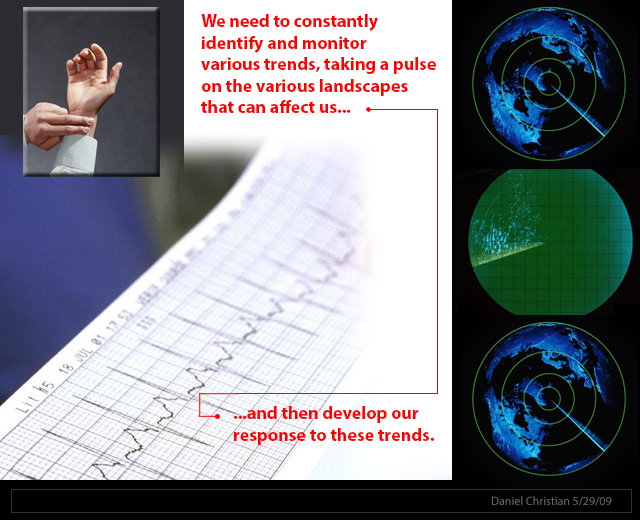
We need to constantly be pulse-checking the landscapes out there and developing scenarios and solutions to such trends


7 Technologies that are Changing Healthcare — from digitalsalutem.com by João Bocas

In this article we are going to talk about the seven technologies that are changing healthcare:

  1. Artificial Intelligence
  2. Blockchain
  3. Virtual Reality
  4. Robots
  5. Mapping technologies
  6. Big Data
  7. Neurotechnology

This startup 3D prints tiny homes from recyclable plastics — from interestingengineering.com by Nergis Firtina; with thanks to Laura Goodrich for this resource

A 3D printed house by Azure

Satellite Billboards Are a Dystopian Future We Don’t Need — from gizmodo.com by George Dvorsky; with thanks to Laura Goodrich for this resource
Brightly lit ads in orbit are technologically and economically viable, say Russian scientists. But can we not?

Artist’s conception of a cubesat ad showing the Olympic rings. Image: Shamil Biktimirov/Skoltech

South Korea to Provide Blockchain-based Digital Identities to Citizens by 2024 — from blockchain.news by Annie Li; with thanks to Laura Goodrich for this resource

Excerpt:

South Korea plans to provide digital identities encrypted by blockchain with smartphones to citizens in 2024 to facilitate its economic development., Bloomberg reported Monday.

The South Korean government stated that with the expansion of the digital economy, the ID embedded in the smartphone is an indispensable emerging technology to support the development of data.

From DSC:
Interesting to see blockchain show up in the first item above on healthcare and also on this item coming out of South Korea for digital identities.

The Bruce Willis Deepfake Is Everyone’s Problem — from wired.com by Will Bedingfield; with thanks to Stephen Downes for this resource
There’s a fight brewing over how Hollywood stars can protect their identities. But it’s not just actors who should be paying attention.

Excerpts:

Yet the question of “who owns Bruce Willis,” as Levy put it, isn’t only a concern for the Hollywood star and his representatives. It concerns actors unions across the world, fighting against contracts that exploit their members’ naivety about AI. And, for some experts, it’s a question that implicates everyone, portending a wilder, dystopian future—one in which identities are bought, sold, and seized.

“This is relevant not just to AI contracts [for synthetic performances], but any contract involving rights to one’s likeness and voice,” says Danielle S. Van Lier, assistant general counsel, intellectual property and contracts at SAG-AFTRA. “We have been seeing contracts that now include ‘simulation rights’ to performers’ images, voices, and performances. These contract terms are buried deep in the boilerplate of performance agreements in traditional media.”


Addendum on 10/26/22:


The Technology That Is Revolutionising How Business Gets Done — from artificiallawyer.com

Excerpt:

We are on the cusp of a revolution. Contract negotiation, with all the associated document redlines and email threads, is about to get a whole lot quicker. Today, artificial intelligence has the potential to save lawyers hours of intense editing – but only if they embrace the sector-wide behaviour change this could ignite.
…
Technology has reached the point that much of the initial legwork of perusing a contract can be done by a piece of software. Precision AI can scan a document and create a list of issues based on how a lawyer typically contracts. It is then up to the lawyer to accept or disregard those issues, but the point is that the initial editing time is greatly reduced.


From DSC:
This is another area where the slow pace of the American legal system is having a negative effect. The American Bar Association and the majority of the law school graduates (i.e., those who passed the Bar and have been practicing law in one form or another) for the last 30 years have a lot to do with this situation. They have stimied innovation and have protected their turf — at the increasing expense of the American people. 

Online learning has been going on since the late 1990’s, yet the ABA STILL doesn’t let law schools have 100% online-based learning without their special consent. 


Artists say AI image generators are copying their style to make thousands of new images — and it’s completely out of their control — from businessinsider.com by Beatrice Nolan

Excerpt:

  • OpenAI, a company founded by Elon Musk, just made its DALL-E image generator open to the public.
  • Artists say they work for years on their portfolios and people can now make copycat images in seconds.
  • But some AI companies argue that the new artworks are unique and can be copyrighted.

People are creating thousands of artworks that look like his using programs called AI-image generators, which use artificial intelligence to create original artwork in minutes or even seconds after a user types in a few words as directions.

Rutkowski’s name has been used to generate around 93,000 AI images on one image generator, Stable Diffusion — making him a far more popular search term than Picasso, Leonardo Da Vinci, and Vincent van Gogh in the program.


From DSC:
Many of the items below are from Laurence Colletti’s posting, Clio Cloud Conference – The Big Return


Clio Cloud 2022: Innovation in the Courts with Judge Schlegel — from legaltalknetwork.com by Laurence Colletti and Judge Scott Schlegel

Episode notes:

The pandemic was a driver for change in justice systems around the globe, but one court’s innovative and inexpensive approach is worth a closer look. Judge Scott Schlegel manages what may be one of the most advanced courts in the United States for delivering justice online. Tune in for his tips on how any jurisdiction in the country can modernize its justice system for under a thousand dollars. Go to https://www.onlinejudge.us/ for all of Judge Schlegel’s recommendations.

Clio Cloud 2022: The Benefits of a Legal Blog — from legaltalknetwork.com by Laurence Colletti and Teresa Matich, Kevin O’Keefe, and Iffy Ibekwe
Legal blog posts are great tools for building relationships with potential clients because they build trust, credibility, and allow you to create a personal connection with your clients.

LawNext Podcast: What Is Justice Tech? A Conversation with Maya Markovich — from lawnext.com by

Excerpt:

An increasing number of startups are defining themselves not as legal tech, but as justice tech. So what, exactly, is justice tech, who are some of the companies that represent it, and what is the business opportunity they present for potential investors? Our guest this week is Maya Markovich, executive director of the Justice Technology Association, an organization formed earlier this year to support companies in the justice tech sector.

Clio Cloud 2022: Insights from Clio’s 2022 Legal Trends Report — from legaltalknetwork.com by Laurence Colletti, Joshua Lenon, and Rio Peterson
Amid Inflation, Rising Interest Rates, and Volatile Employment Markets, Clio takes a look at How Global Trends have Impacted Business and Productivity among law firms.

Clio Cloud 2022: What Lies Ahead for Legal with Jack Newton — from legaltalknetwork.com by Laurence Colletti and Jack Newton

Episode notes:

The world of lawyering has surged in spite of the pandemic, but new adversity looms. Fears over inflation, war, hiring markets, and a recession have left many attorneys wondering how to prepare for the coming months. Jack Newton discusses the concept of anti-fragility and its place as a mental model for law firms as they face an uncertain future. Jack outlines how deliberate preparation can help your law firm thrive in the midst of opposition.

Jack Newton is CEO and co-founder of Clio.

Clio Cloud 2022: How Content Creation Can Grow Your Law Firm — from legaltalknetwork.com by Laurence Colletti


Also related, see:

Virtual Courts Are Not Going Away — from news.bloomberglaw.com by Jon David Kelley
As the pandemic winds down, courts are shifting to a hybrid approach that incorporates remote with live proceedings. Jon David Kelley of Kirkland says virtual courts can expand access to justice, but care should be taken to maintain credible representation.


How Long Should a Branching Scenario Be?— from christytuckerlearning.com by Christy Tucker
How long should a branching scenario be? Is 45 minutes too long? Is there an ideal length for a branching scenario?

Excerpt:

Most of the time, the branching scenarios and simulations I build are around 10 minutes long. Overall, I usually end up at 5-15 minutes for branching scenarios, with interactive video scenarios being at the longer end.

From DSC:
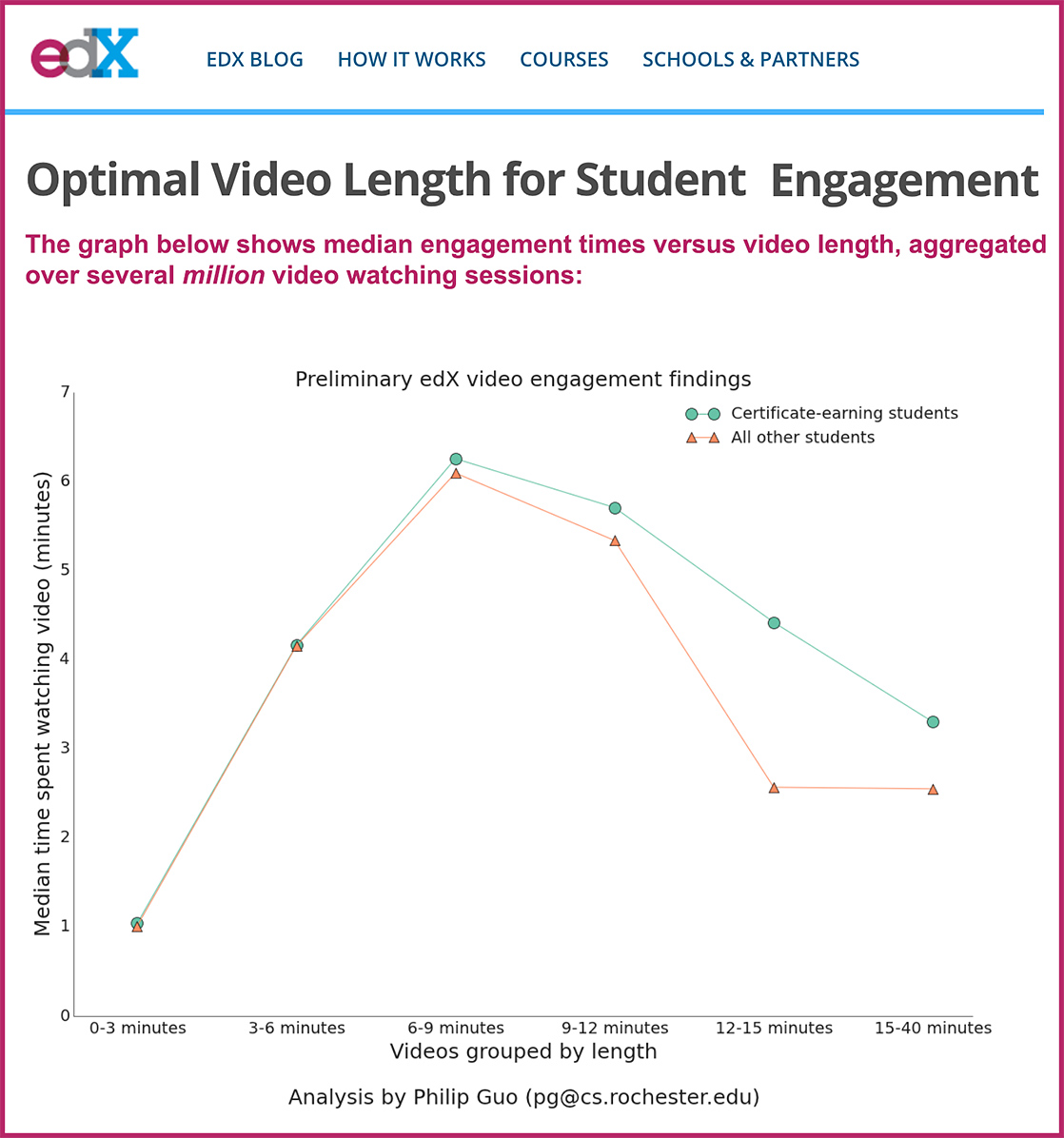
This makes sense to me, as (up to) 6 minutes turned out to be an ideal length for videos.

Excerpt from Optimal Video Length for Student Engagement — from blog.edx.org

The optimal video length is 6 minutes or shorter — students watched most of the way through these short videos. In fact, the average engagement time of any video maxes out at 6 minutes, regardless of its length. And engagement times decrease as videos lengthen: For instance, on average students spent around 3 minutes on videos that are longer than 12 minutes, which means that they engaged with less than a quarter of the content. Finally, certificate-earning students engaged more with videos, presumably because they had greater motivation to learn the material. (These findings appeared in a recent Wall Street Journal article, An Early Report Card on Massive Open Online Courses and its accompanying infographic.)

The take-home message for instructors is that, to maximize student engagement, they should work with instructional designers and video producers to break up their lectures into small, bite-sized pieces.


Clio’s 2022 Legal Trends Report
Learn how lawyers are balancing the flexibility of hybrid work, and what clients look for when hiring a lawyer.

Also relevant/see:

Clio’s 2022 Legal Trends Report Finds Lawyers’ Business Growing But Fees Fail to Keep Pace — from lawnext.com by Bob Ambrogi

Top law schools have been slow to add women faculty members, research finds — from highereddive.com

Excerpt:

Law schools have increasingly sorted along gender lines, and the makeup of faculties has become a reflection of schools’ student population, according to preprint research published on the SSRN, an open access platform for early-stage research.

Five digital trends to watch in the legal tech sector — from information-age.com by Leanne Aldrich

Excerpt:

Technology is changing the legal sector. The UK government has recently announced that it is investing £4m to modernise the UK legal industry through its LawTechUK programme. The initiative is a part of a drive to keep the UK at the global forefront of legal services..

ILTA’s Annual Technology Survey: Highlights — from legaltechnology.com

What does it take to be a legal technologist? — legalfutures.co.uk

Excerpt:

When the first seeds of the legal technologist role were planted in the early 2010s, they took some time to germinate. A decade later, after a seemingly slow start, there has been an explosion of investment, awareness and new job opportunities in legal technology.

But as this new strand of the legal profession sets its roots deeper in the industry, what exactly does it take to be a legal technologist?

Shearman & Sterling Launches Legal Ops Service In Sign of the Times — from artificiallawyer.com

Excerpt:

In another sign of the changing times we are in, leading New York law firm Shearman & Sterling is formally launching a Legal Operations capability. The move follows fellow elite rival Cleary Gottlieb launching Cleary X, its innovation-focused legal delivery arm.

A decade ago many would not have expected New York’s top firms to be that bothered with anything other than high-end legal advisory and disputes work, but the legal world is evolving.

‘Legal Operations by Shearman’ will offer a range of services including legal tech help, data analytics, and inhouse department design, but may work with ALSPs and other groups when it comes to CLM onboarding, with these other providers handling actual implementation and with Shearman focused on the bigger legal ops picture.

#legal #trends #legaltech #lawyers #law #lawschools


What might the ramifications be for text-to-everything? [Christian]

From DSC:

  • We can now type in text to get graphics and artwork.
  • We can now type in text to get videos.
  • There are several tools to give us transcripts of what was said during a presentation.
  • We can search videos for spoken words and/or for words listed within slides within a presentation.

Allie Miller’s posting on LinkedIn (see below) pointed these things out as well — along with several other things.


This raises some ideas/questions for me:

  • What might the ramifications be in our learning ecosystems for these types of functionalities? What affordances are forthcoming? For example, a teacher, professor, or trainer could quickly produce several types of media from the same presentation.
  • What’s said in a videoconference or a webinar can already be captured, translated, and transcribed.
  • Or what’s said in a virtual courtroom, or in a telehealth-based appointment. Or perhaps, what we currently think of as a smart/connected TV will give us these functionalities as well.
  • How might this type of thing impact storytelling?
  • Will this help someone who prefers to soak in information via the spoken word, or via a podcast, or via a video?
  • What does this mean for Augmented Reality (AR), Mixed Reality (MR), and/or Virtual Reality (VR) types of devices?
  • Will this kind of thing be standard in the next version of the Internet (Web3)?
  • Will this help people with special needs — and way beyond accessibility-related needs?
  • Will data be next (instead of typing in text)?

Hmmm….interesting times ahead.


The Future of Virtual Legal Proceedings Just Became More Certain with the Launch of Calloquy — from businesswire.com by Calloquy
Hundreds gathered in Atlanta to celebrate and hear from leading legal innovation voices about The Next Era of Litigation

Excerpts:

The event celebrated the launch of Calloquy’s new virtual legal proceeding platform, which offers distinct usability benefits on a foundation of world-class security and industry-specific videoconferencing technology, including:

  • The platform’s intuitive design delivers a virtual experience that is akin to conventional legal proceedings, with clearly marked titles for all participants and traditional seating arrangements. The participants in a remote deposition, for example, are organized with plaintiffs on one side and defendants on the other.
  • Robust collaboration tools, combined with role-based security, ensure that only the right people have access to only the right information—and only at the right time. Documents or comments cannot accidentally be passed to an adversary.
  • The platform’s integrated case management tools streamline the complex litigation process by enabling meetings and proceedings to be scheduled, exhibits to be managed and transcripts to be created and archived all in one place.

“My goal in starting Calloquy is to help drive ‘the next era of litigation’, which means improving the way all people experience the legal system, from the most high-profile commercial litigator to the most underserved defendant and the lawyer who works pro bono on their behalf.”


Utah’s reforms offer model for serving low-income and indigent people, report suggests — from abajournal.com by Matt Reynolds

Excerpt:

The Utah model of reform allowing nonlawyers to offer legal services could be “critical” to serving people who can’t afford them, according to a Stanford Law School study published Tuesday.

The 59-page report by the school’s Deborah L. Rhode Center on the Legal Profession offers an early look at how regulatory changes in Arizona and Utah have impacted the delivery of legal services. It also examined who is being served by innovations in those states.


Also relevant, see this upcoming webinar:

Upcoming webinar -- licensing legal paraprofessionals

Two neighboring states — Oregon and California — have recently come to different conclusions on whether to license paralegals to provide some legal services.

In July, the Oregon Supreme Court, with the support of the Oregon State Bar’s Board of Governors, approved a proposal to allow licensed paralegals to provide limited legal services in family law and landlord/tenant cases — two areas of law with large numbers of self-represented litigants. In August, the California legislature, after opposition from some lawyers’ groups, prohibited the State Bar of California from implementing, or even proposing, any loosening of existing restrictions on the unauthorized practice of law before 2025, effectively killing a proposal to permit licensing of paraprofessionals to provide limited legal services.

This webinar will explore how and why Oregon and California reached conflicting results and identify lessons learned from both experiences.

Register >>


Also relevant/see:

IAALS Panel Explores Alternative Paths to Legal Licensure — from iaals.du.edu

Redesigning Legal: Redesigning How We License New Lawyers from IAALS on Vimeo.


Also see the following items from Natalie Anne Knowlton (@natalalleycat) on Twitter


HSF embraces the metaverse with new digital law course for students — from legalcheek.com by Thomas Connelly

Excerpt:

The global law firm has launched a series of free workshops exploring how lawyers help clients navigate novel legal and regulatory issues relating to techy-topics including the metaverse, non-fungible tokens (NFTs), robotics and artificial intelligence (AI).

From DSC:
This kind of thing needs to happen in law schools across many countries.

 
© 2025 | Daniel Christian