From DSC:
I’d like to thank Sarah Huibregtse for her post out on LinkedIn where she commented on and referenced the following item from Nicholas Thompson (CEO at The Atlantic):


Also relevant/see:


Also related/see the following item which I thank Sam DeBrule’s Machine Learnings newsletter for:


Also, somewhat related, see the following item that Julie Johnston mentioned out on LinkedIn:

Top 10 conversational AI trends for 2023 — from linkedin.com by Kane Simms and  Tim Holve, Tarren Corbett-Drummond, Arte Merritt, and Kevin Fredrick.

Excerpt:

In 2023, businesses will realise that, in order to get out of FAQ Land, they need to synchronise business systems together to deliver personalised transactional experiences for customers.

“We finally have the technologies to do all the things we imagined 10 years ago.”


Tech Survey 2022 — from lawtechnologytoday.org

Excerpt:

The ABA Legal Technology Survey Report is the most comprehensive study available of lawyers’ actual technology use, spanning a vast range of topics from security and basic office software to technology budgets, marketing tools, and much more. The survey has been published annually for more than 20 years. The 2022 edition features five volumes, each with detailed charts, tables, and trends.

TechReport 2022: Technology Budget and Planning — from lawtechnologytoday.org by Taylor Young

Excerpt:

Each year the American Bar Association’s Legal Technology Resource Center surveys ABA members to discover how lawyers are using technology in their practices nationwide. The 2022 ABA Legal Technology Survey Report is published in five volumes:  Online Research, Technology Basics & Security, Law Office Technology, Marketing & Communication Technology, Litigation Technology & E-Discovery. The published results represent one of the most comprehensive technology surveys of lawyers available.

2022 ABA Tech Survey provides information on attorney use of iPhones and iPads — from legaltechmonitor.com by Jeff Richardson

Excerpt:

For over three decades, the ABA has conducted an annual survey of lawyers to find out what legal technology they use.   These results are released every year by the ABA Legal Technology Resource Center.  The 2022 report was just released (edited by Taylor Young, and researched by Taylor Young and Joshua Poje).  There are five volumes, and you can purchase a copy using this page of the ABA website.

I have been looking at these reports every year since 2010 because they have been the best source of statistics on the use of mobile technology by lawyers.  (My reports on the prior ABA surveys are located here: 2021, 2020, 2019, 2018, 2017, 2016, 2015, 2014, 2013, 2012, 2011, 2010.)

AALS Selects 2023 Scholarly Papers Competition Winner — from aals.org

Excerpt (emphasis DSC):

Washington, DC (November 22, 2022) – The Association of American Law Schools (AALS) has announced the winner of the 2023 AALS Scholarly Papers Competition for law school faculty members in the field for five years or fewer.

The competition’s selection committee recognized the following outstanding paper:

    • Nicole Summers, Associate Professor, Georgetown University Law Center, “Civil Probation.”  

In “Civil Probation,” Summers investigates the outcomes of eviction settlements. Based on her empirical findings, she advances a novel theory of “civil probation” within the eviction legal system. The article will be published in an upcoming issue of Stanford Law Review.
…
“With eviction complaints comprising nearly a quarter of all civil filings, it’s crucial we develop policies that address the myriad ways tenants are systemically disadvantaged in the cases and ultimately harmed. I am very grateful to my mentors and colleagues for encouraging and supporting me in this project.”


Understanding the Overlap Between UDL and Digital Accessibility — from boia.org

Excerpt:

Implementing UDL with a Focus on Accessibility
UDL is a proven methodology that benefits all students, but when instructors embrace universal design, they need to consider how their decisions will affect students with disabilities.

Some key considerations to keep in mind:

  • Instructional materials should not require a certain type of sensory perception.
  • A presentation that includes images should have accurate alternative text (also called alt text) for those images.
  • Transcripts and captions should be provided for all audio content.
  • Color alone should not be used to convey information, since some students may not perceive color (or have different cultural understandings of colors).
  • Student presentations should also follow accessibility guidelines. This increases the student’s workload, but it’s an excellent opportunity to teach the importance of accessibility.
 

From DSC:
I received an email the other day re: a TytoCare Exam Kit. It said (with some emphasis added by me):

With a TytoCare Exam Kit connected to Spectrum Health’s 24/7 Virtual Urgent Care, you and your family can have peace of mind and a quick, accurate diagnosis and treatment plan whenever you need it without having to leave your home.

Your TytoCare Exam Kit will allow your provider to listen to your lungs, look inside your ears or throat, check your temperature, and more during a virtual visit.

Why TytoCare?

    • Convenience – With a TytoCare Exam Kit and our 24/7/365 On-Demand Virtual Urgent Care there is no drive, no waiting room, no waiting for an appointment.
    • Peace of Mind – Stop debating about whether symptoms are serious enough to do something about them.
    • Savings – Without the cost of gas or taking off work, you get the reliable exams and diagnosis you need. With a Virtual Urgent Care visit you’ll never pay more than $50. That’s cheaper than an in-person urgent care visit, but the same level of care.

From DSC:
It made me reflect on what #telehealth has morphed into these days. Then it made me wonder (again), what #telelegal might become in the next few years…? Hmmm. I hope the legal field can learn from the healthcare industry. It could likely bring more access to justice (#A2J), increased productivity (for several of the parties involved), as well as convenience, peace of mind, and cost savings.


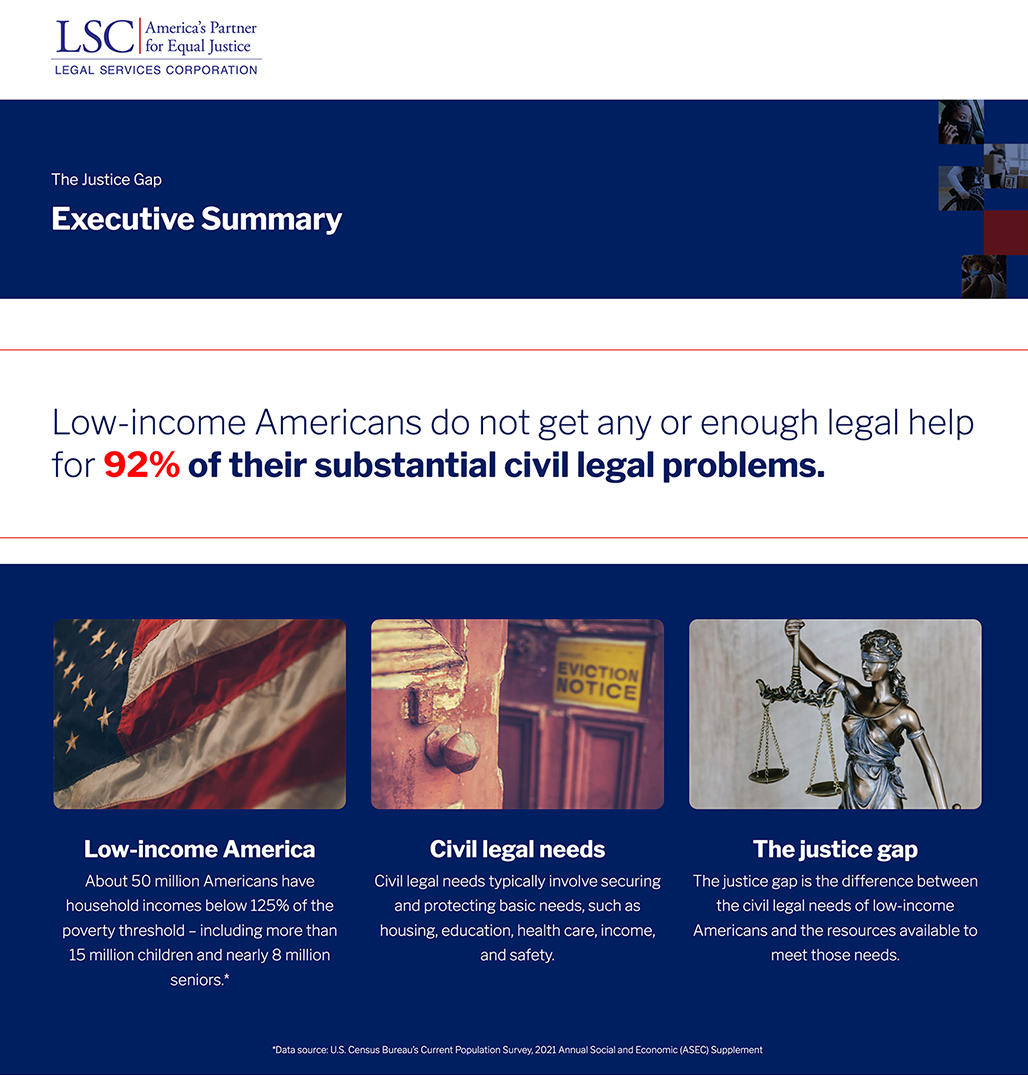
The Justice Gap: The Unmet Civil Legal Needs of Low-income Americans — from the Legal Services Corporation

Legal Services Corporation’s 2022 Justice Gap Report provides a comprehensive look at the differences between the civil legal needs of low-income Americans and the resources available to meet those needs. LSC’s study found that low-income Americans do not get the help they need for 92% of their civil legal problems, even though 74% of low-income households face at least one civil legal issue in a single year.

The consequences that result from a lack of appropriate counsel can be life-altering – low-income Americans facing civil legal problems can lose their homes, children and healthcare, among other things. Help can be hard to access, so LSC is working to bridge this “justice gap” by providing pro bono civil legal aid for those in need. Find out more about LSC’s work to ensure equal justice for all by tuning in to the rest of the Justice Gap video series.

For more information on the Justice Gap, visit https://justicegap.lsc.gov/.

Also relevant/see:

.

Legal Services Corporation’s 2022 Justice Gap Report provides a comprehensive look at the differences between the civil legal needs of low-income Americans and the resources available to meet those needs.


This Copyright Lawsuit Could Shape the Future of Generative AI — from wired.com by Will Knight
Algorithms that create art, text, and code are spreading fast—but legal challenges could throw a wrench in the works.

Excerpts:

A class-action lawsuit filed in a federal court in California this month takes aim at GitHub Copilot, a powerful tool that automatically writes working code when a programmer starts typing. The coder behind the suit argues that GitHub is infringing copyright because it does not provide attribution when Copilot reproduces open-source code covered by a license requiring it.
…
Programmers have, of course, always studied, learned from, and copied each other’s code. But not everyone is sure it is fair for AI to do the same, especially if AI can then churn out tons of valuable code itself, without respecting the source material’s license requirements. “As a technologist, I’m a huge fan of AI ,” Butterick says. “I’m looking forward to all the possibilities of these tools. But they have to be fair to everybody.”

Whatever the outcome of the Copilot case, Villa says it could shape the destiny of other areas of generative AI. If the outcome of the Copilot case hinges on how similar AI-generated code is to its training material, there could be implications for systems that reproduce images or music that matches the style of material in their training data. 

Also legal-related, see:


Also related to AI and art/creativity from Wired.com, see:


Learning in the brain — from sites.google.com by Efrat Furst; with thanks to 3-Star Learning Experiences for this resource

Excerpts:

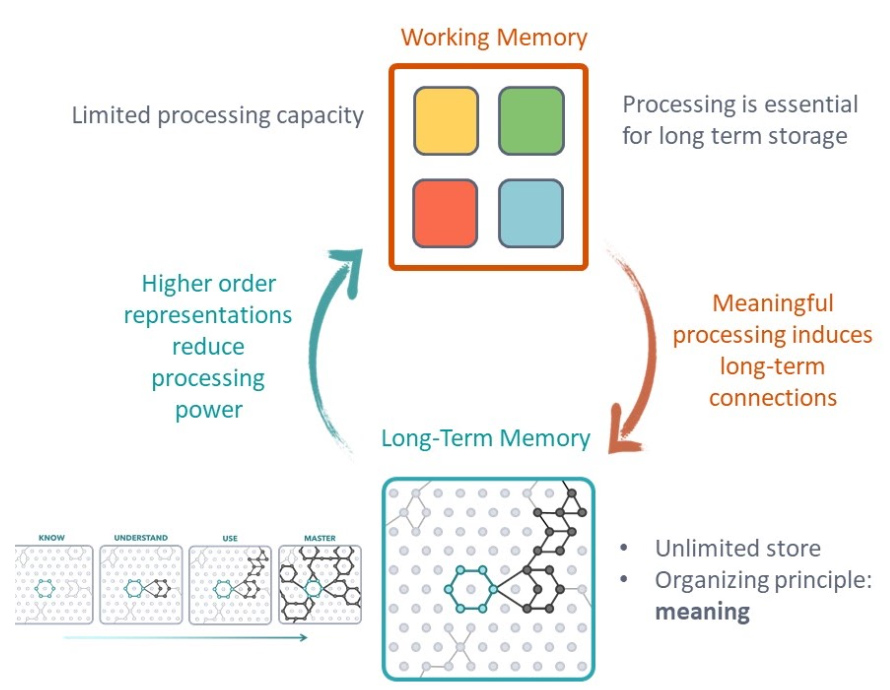
Think of working memory as the reception counter to a huge archive.

To summarize, working memory processing resources are highly limited, and yet meaningful processing is essential for storage in long-term memory. It is therefore important to use these resources effectively when learning. There are many tested and proven effective teaching strategies, but a question that often comes up is when to apply each strategy for the best results?

Long-term memory and working memory interactions


Table of Experts: Trends in Higher Education — from bizjournals.com by Holly Dolezalek. The Minneapolis-St. Paul Business Journal held a panel discussion recently about trends in higher education.

Excerpts (which focus on law schools/the legal profession):

Anthony Niedwiecki: The legal profession and legal education are very conservative. Covid showed they can, and we as institutions can, change. At Mitchell Hamline, we were the first law school in the country to offer a partially online JD degree. We’ve had that experience since 2015, which has really helped us through Covid. But I think the biggest thing I’ve learned from our students through this process is the need for flexibility. We thought students would want to go back into the classroom at some point and be around people. No! They voted by the classes they signed up for: They signed up for the classes that were online. Some students want to be on campus, some online. So we’ve had to develop our program around different types of modalities we may not have given any thought to before. The students in the online program range in age all the way up to 73 years old. They’ve been in careers, they’re accountants, they’re doctors, they’re health care professionals, elected officials. The other thing is office hours — students like online office hours because it’s convenient, and they can be in an office where other people are talking and learn from it.

 The lesson I take from that, in some ways, even applying it to the law school, is having that partnership with people who want to hire students to make sure that they’re actually involved with the students. We’re finding they help mentor those students, help us make sure we have the right courses in place, and give them opportunities to do internships and externships. So we’ve been starting to partner with some national professional organizations that are attached to the law.
 

2022 Winners of the LegalTech Breakthrough Awards — from legaltechbreakthrough.com

Categories include:

  • Case Management
  • Client Relations
  • Data & Analytics
  • Documentation
  • Legal Education
  • Practice Management
  • Legal Entity Management
  • Legal Research
  • Online Dispute Resolution
  • Contract Management
  • eDiscovery
  • Marketplaces
  • RegTech
  • Leadership

Also see:

With the cost of international air travel rising sharply, remote hearings are a practical alternative to in-person proceedings. International travel is expensive, and the virtual option means that it is no longer necessary to count travel as a “cost of doing business” when pursuing an international dispute. The widespread use of technology in global dispute resolution proceedings gives attorneys and their clients the option to participate remotely, which is a compelling cost saver for all parties. 

  • Most debt lawsuits get decided without a fight. Michigan leaders want to change the rules. — from mlive.com by Matthew Miller
    Excerpt:
    Most of the 1.9 million debt collection cases filed in Michigan’s district courts over the past decade or so never went to trial. Usually, the defendants don’t show up to court, and debt collectors win by default, according to data compiled by the Michigan Justice for All Commission. In most cases, the courts end up garnishing defendants’ wages, income tax returns or other assets, sometimes on the basis of complaints that include little more than the name of the creditor, an account number and the balance due.

And both debt lawsuits and garnishment are more common for people living in primarily Black neighborhoods, regardless of their income.

Members of the Commission say Michigan’s rules around debt collection lawsuits don’t do enough to protect regular people, who sometimes don’t find out they’ve been sued until they see money coming out of their paychecks.

They say those rules need to change.

An early participant in the Law Society of BC’s Innovation Sandbox, the Clinic offers the in-person and virtual help of 25 articling students located in 15 different BC communities —from Tofino to Cranbrook— with the support of 15 supervising lawyers, four staff and dozens of local mentors. Together, they provide fixed-fee services in a wide range of areas covering everyday legal problems.


Yale and Harvard’s Law Schools Are Ditching the ‘U.S. News’ Rankings. Will Others Follow? — from chronicle.com by Francie Diep

Excerpt:

Yale Law School — long ranked No. 1 by U.S. News & World Report — is quitting the magazine’s rankings, it announced Wednesday. Hours after that announcement, which was first reported by The Wall Street Journal, Harvard Law School said it would do the same.

“U.S. News stands in the way of progress for legal education and the profession,” said Heather Gerken, Yale Law School’s dean. “It’s made it harder for law schools to admit and support low-income students, and it’s undermining efforts to launch a generation to serve. Now is the time to take a step.”

Also related/see:

Some other legal-related items include:

IAALS Releases New Allied Legal Professionals Landscape Report and Resource Center in an Effort to Increase Legal Options for the Public — iaals.du.edu

Excerpt:

IAALS, the Institute for the Advancement of the American Legal System at the University of Denver, announced today that it released its new Allied Legal Professionals landscape report, along with an accompanying online Knowledge Center. With generous support from the Sturm Family Foundation, this project seeks to help standardize a new tier of legal professionals nationally, with the goal of increasing the options for accessible and affordable legal help for the public.

“Today, the majority of Americans are faced with a very serious access to justice problem—not only low-income populations, as many people believe. And the pandemic has only made matters worse in recent years,” says Jim Sandman, chair of IAALS’ board of advisors and President Emeritus of the Legal Services Corporation. “For example, studies show that around 40–60% of the middle class have legal needs that remain unmet. Simply put: people want legal help, and they are not getting the help they need.”

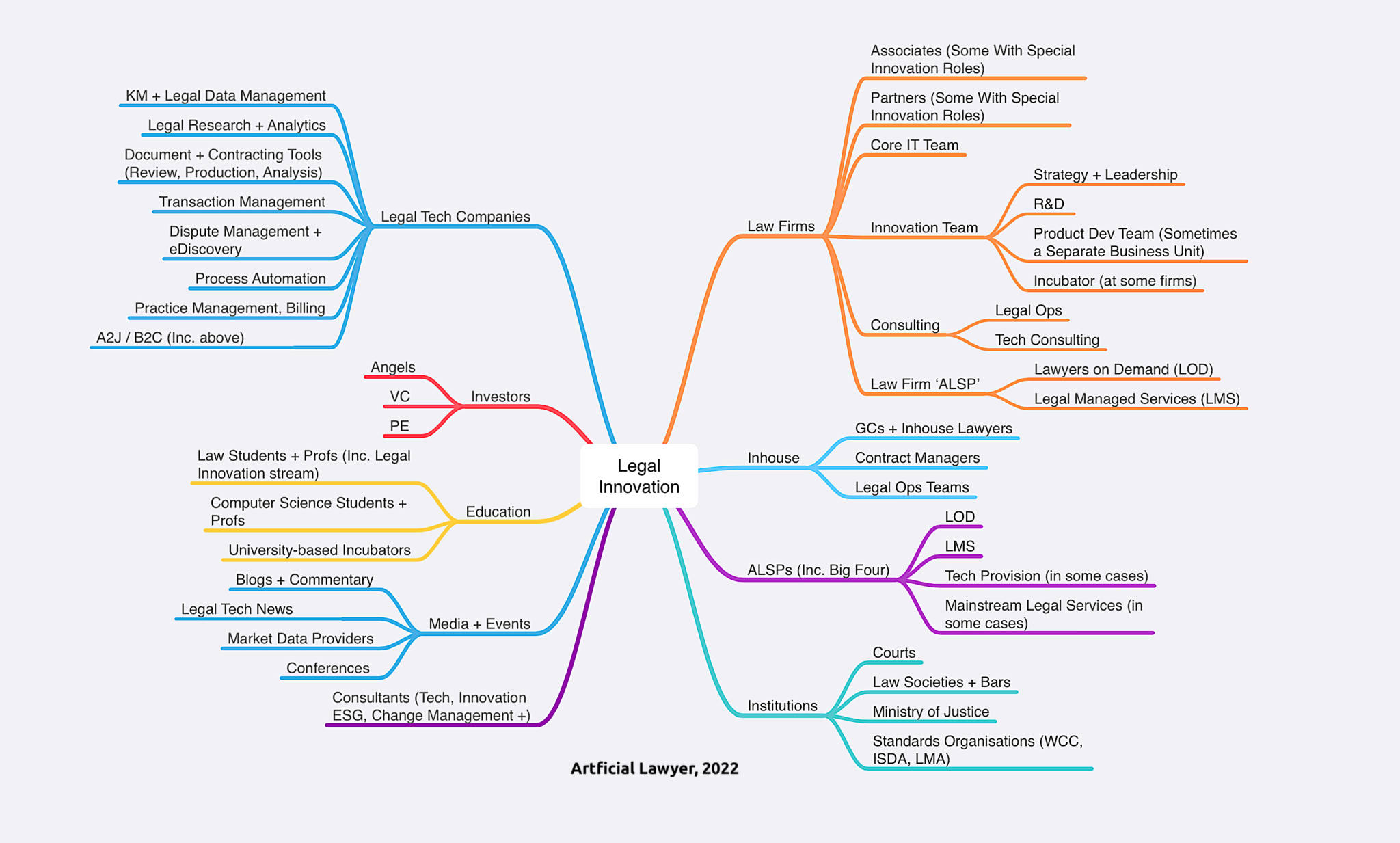
Legal Innovators: An Ecosystem of Change Agents! — from artificiallawyer.com

The expanding role of technology in the law firm business model (338) — from legalevolution.org by Kenneth Jones
Legal technology is slowly becoming core to the legal business. It’s time to commit to a cross-functional team approach.

Excerpt:

The premise of this post is that individual capabilities and excellence (either legal or technical) standing alone are not enough to ensure long-term, sustainable success.  No superstar technologist or lawyer is equipped to do it all, as there are too many specialties and functional roles which need to be filled.  Rather, a better approach is to construct team-based, cross-functional units that offer greater operational efficiency while building in layers of redundancy that reduce the potential for surprises, errors, or disruption.  Cf Post 323 (Patrick McKenna’s “rules of engagement” for high-performing legal teams).


You Don’t Need a Law Degree to Transform Legal Operations — from news.bloomberglaw.com by Memme Onwudiwe and Tom Stephenson

Excerpt:

While the future of legal innovation remains unclear, it is apparent that law schools must evolve to meet students’ technological needs. At the very least, lawyers and legal professionals must have more collaborative conversations on the broader educational need for legal technology.

Legal operations professionals have a unique opportunity to emphasize the importance of designing and implementing a business solution ecosystem to guide greater efficiency and decision-making. If data and trends tell us anything, law firms and corporate law departments must adapt to achieve better business outcomes, while law schools have to change the way they teach in our modern digital economy.

Also relevant/see:


The Law Of The Metaverse — from forbes.com by Charles Lew

Excerpts:

As the metaverse becomes a fully realized, interoperable and persistent platform, the need for a codified and clearly defined system of applicable laws will be tremendous.
…
The applicability and sufficiency of existing intellectual property laws are being tested as we speak in the metaverse. Heavyweight companies such as Walmart, Hermès, Nike and Roblox are all actively seeking judicial determinations as to their respective trademark rights in the metaverse.

Also relevant/see:

Virtual rights for virtual goods? — from lexology.com

Excerpt:

Why does this matter to you?
If you buy a music album and receive a digital file, is this a purchase of digital goods? What if you listen to the same album on a streaming service? If you buy virtual sneakers for your metaverse avatar, is this a purchase of digital goods or just a part of the service provided by the metaverse operator? As purchasing habits increasingly move online or into the digital space, and especially with the rise in popularity of “metaverses”, the need for clarity and regulation in this area will become more and more apparent.

Brick by Brick: Understanding IP Rights in Metaverse Buildings — from mayerbrown.com

Building a virtual world often involves just that—buildings. But developers of metaverse properties may not know which legal rights are at issue. Can a virtual world incorporate a rendition of a real-life building without infringing on the rights of real-life property owners? Does the architect, owner, or user of a brick-and-mortar building have any rights to assert against a twin building in the metaverse? How does the developer of a virtual building take the building from one virtual world to another?

The answer depends on—and may vary based on—who is asserting the rights, whether copyrights or trademarks are at issue, and whether any of these rights have been assigned to another party.
…
These questions all remain unsettled in the context of the metaverse, so developers should proceed with caution until courts put their own stake in the ground on these issues.


Also relevant/see:


Teaching: Flipping a Class Helps — but Not for the Reason You’d Think — from the Teaching newsletter out at The Chronicle of Higher Education by Beckie Supiano

Excerpt:

The authors propose a different model of flipping that gives their paper its title, “Fail, Flip, Fix, and Feed — Rethinking Flipped Learning: A Review of Meta-Analyses and a Subsequent Meta-Analysis.”

Their model:

  • Fail: Give students a chance to try solving problems. They won’t have all the information needed to arrive at the solution, but the attempt activates their prior learning and primes them for the coming content.
  • Flip: Deliver the content ahead of class, perhaps in a video lecture.
  • Fix: During class time, a traditional lecture can deepen understanding and correct misperceptions.
  • Feed: Formative assessment lets students check their level of understanding.

I find this paper interesting for a number of reasons. It ties into a challenge I’d like to dig into in the future: the gap that can exist between a teaching approach as described in research literature and as applied in the classroom.

From DSC:
Though I haven’t read this analysis (please accept my apology here), I would hope that it would also mention one of the key benefits of the flipped classroom approach — giving students more control over the pacing of the content. Students can stop, fast-forward, rewind, and pause the content as necessary. This is very helpful for all students, but especially for students who don’t have English as their primary language.

I like this approach because if students fail to solve the problem at first, they will likely be listening more/very carefully as to how to solve it:

Drawing on related research, we proposed a more specific model for flipping, “Fail, Flip, Fix, and Feed” whereby students are asked to first engage in generating solutions to novel problems even if they fail to generate the correct solutions, before receiving instructions.

Plus, students will begin to recall/activate their prior knowledge on a subject in order to try to solve the problem. That retrieval practice in and of itself can be helpful.


ABA advances proposal to end LSAT requirements — from highereddive.com by Jeremy Bauer-Wolf

Dive Brief:

  • An American Bar Association governing body will vote next week whether to ax a requirement that ABA-accredited law schools use an entrance exam, like the Law School Admission Test, or LSAT, eroding the assessment’s long-standing influence in admissions.
  • A key ABA committee, the Strategic Review Committee, on Friday recommended the association end admissions test requirements.
  • If the governing board votes Nov. 18 to repeal assessment mandates, the ABA House of Delegates will be in line to finalize the new policy at its February meeting.
 

How AI will change Education: Part I | Transcend Newsletter #59 — from transcend.substack.com by Alberto Arenaza; with thanks to GSV’s Big 10 for this resource

Excerpt:

You’ve likely been reading for the last few minutes my arguments for why AI is going to change education. You may agree with some points, disagree with others…

Only, those were not my words.

An AI has written every single word in this essay up until here.

The only thing I wrote myself was the first sentence: Artificial Intelligence is going to revolutionize education. The images too, everything was generated by AI.

 
© 2025 | Daniel Christian