On 06/12/2012,
in human-computer interaction (HCI), interactivity, interface design, user experience (UX), user interface design,
by Daniel Christian
On 06/12/2012,
in change, education technology, interactivity, mobile learning, mobile technologies, trends, TVs,
by Daniel Christian
The following is a guest post from Lindsey Harper Mac*
How Smartphones make us Smarter: The Changing Face of Education
Considering how many opportunities online institutions have offered to non-traditional students, it’s no surprise that the technological advancement of mobile learning is also transforming higher education as we know it. Mobile education is an excellent tool for learners of all different backgrounds, schedules, and ages because it makes learning more accessible and engaging for those who may not flourish as much in a traditional classroom setting. Whether you’re a non-traditional or a traditional student, attending an industry-current degree program with a focus on mobile learning can enhance your overall experience while accommodating your busy schedule.
How Mobile Learning Devices are Improving Education
According to a report by Blackboard and Project Tomorrow, 98 percent of students in U.S. high schools have access to some kind of smartphone. With older students, empirical evidence shows that this statistic is probably even higher. For instructors who may lament the growing popularity of smartphones, it should be noted that these devices are beneficial for more than just playing Angry Birds.
Abilene Christian University (ACU) recently provided students with iPods, iPhones, and even iPads to improve the learning experience from multiple angles. One example of how this institution has enhanced learning through mobile devices is through the theater department at the university, which recently used these devices to present an interactive performance of the play Othello. The student newspaper also launched an iPad version of each publication, while instructors throughout the school have used mobile phones to facilitate more enriching discussions on controversial subjects.
Mobile Devices and Smart TV
Smart televisions are another notable advancement in the tech industry that improve accessibility to the web and education-improving apps. With these new smart TVs, you can more effectively connect multiple devices to one another for a more holistic user experience. For example, say you wanted to watch a TED talk on the political climate in Afghanistan by accessing it through your TED mobile application. With a smart TV, you can stream these educational videos right onto your television screen for a more engaging and all-encompassing viewing experience.
Students can even access the Internet from their smart TVs, so they can always keep up with communication from their instructors and be alerted of any updates regarding upcoming assignments. Since online programs often require a great deal of self-discipline and a constant flow of communication, smart TVs can provide an excellent solution for students trying to balance school life with personal life.
We live in an exciting time where everything comes with a portable alternative. The mobility of education in particular has enabled many non-traditional students to better themselves and achieve higher degrees through alternative media. With the proliferation of mobile devices among students and professionals alike, opportunities for enhancing learning have also been discovered through these tools. As more and more devices get “smarter,” so do we.
*Author Bio:
Lindsey Harper Mac (@HarperMac11) is a professional writer living in the Indianapolis area. She specializes in writing guest posts covering social media and education. Currently, Lindsey is completing work on her master’s degree.
On 05/11/2012,
in 21st century, A/V -- audio/visual, future, interactivity, Learning from the Living [Class] Room, mobile learning, television, TVs,
by Daniel Christian
Ensequence secures $26 million to help accelerate the Future of TV — from marketwatch.com
Excerpt (emphasis DSC):
NEW YORK, May 10, 2012 (BUSINESS WIRE) — Ensequence, a leader in transforming TV into a more interactive and engaging experience, has secured commitments for a $25,994,279 investment that will help accelerate its expansion into mobile and connected TV.
.
From DSC:
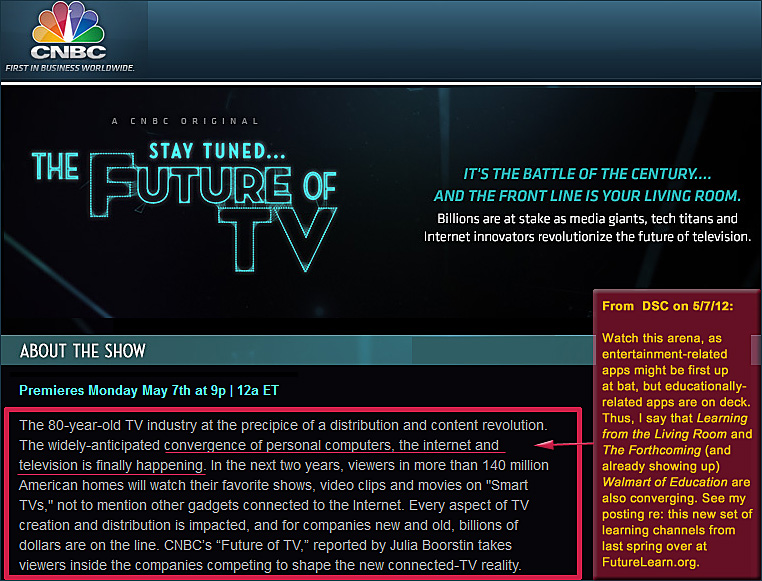
We can begin to see why educational apps are on deck here…
On 05/07/2012,
in 21st century, A/V -- audio/visual, cloud-based computing / apps / other cloud-related, convergence, dangers of the status quo, Daniel S. Christian, digital audio, digital learning, digital storytelling, digital textbooks, digital video, disruption, distance education, future, future of higher education, game-changing environment, higher education, innovation, intelligent systems, intelligent tutoring, interactivity, internet, K-12 related, learning, learning ecosystem, Learning from the Living [Class] Room, learning spaces, multimedia, online learning, online media, technologies for your home, television, trends, TVs,
by Daniel Christian
.
Also see:
- A new learning “channel” is developing — posted on April 30, 2011 at FutureLearn.org by Daniel Christian
and…
- Aereo.com
- NimbleTV.com
- Samsung launches their interactive Smart TVs in India
- Why IPTV is the Future
- Interactive eBook Apps: The Reinvention of Reading and Interactivity
- The 5 C’s of connected TV
- Research and Markets: The 2012 Battle for Dominance in the Digital Living Room Report: 400 Bn Households Worldwide to have some form of Smart TV by 2016
DUBLIN–(BUSINESS WIRE)–Research and Markets (http://www.researchandmarkets.com/research/55tgll/the_battle_for_dom) has announced the addition of the “The Battle for Dominance in the Digital Living Room” report to their offering. A growing number of devices are starting to connect television sets to the Internet allowing for the delivery of a wide variety of new entertainment services. The Battle for Dominance in the Digital Living Room looks at the battle to connect televsion sets in consumers’ homes to the Internet and the impact this will have on the media industry. The focus is on providing an introduction to the issues involved with connected TVs and a look at the baseline forecasts for connected households. Over 400 million households worldwide to have some form of Smart TV by 2016. - The future of TV isn’t TV, it’s broadband.
- Future of the book for IDEO
Addendums on 5/8/12:
Double vision: TV gets interactive — from thetowntalk.com by Fraizer Moore
Piers Fawkes: The future of TV — from psfk.com by Piers Fawkes
A solid Q&A with such questions as:
- The old hierarchical vertical order of: channel – series – episode, seems to be in danger, letting the horizontal disorder take its place. What do you think broadcasters can do to serve people during this shift?
- The TV channel is being challenged, first by VOD and now by internet based services. How do you think the TV channels’ role will evolve in the next 5 years? Will the traditional push-based model maintain its centrality or will users be looking for search-only and pull-based alternatives?
- A new form of TV means new revenue models. Who do you think will finance the next successful TV show in 10 years and how? Will the new channels’ role generate new business models? How you imagine them?
- To protect our brain from information overload we need to filter and recommendations are a form of filtering. How do you think people’s recommendations will shape the future role of TV channels in the next years to come?
- Artificial Intelligence, Smart Agents and algorithms are directing us into a world of Adaptive User Interfaces capable of recognizing different users and provide them with an anticipated, personalized experience. How do you think the future TV will shape around people’s habits and tastes?
On 04/24/2012,
in Adobe, animation, cloud-based computing / apps / other cloud-related, content development, aggregation, repositories, creativity, design, digital audio, digital learning, digital photography, digital storytelling, digital textbooks, digital video, e-publishing related items (EPUB and more), education technology, elearning, graphics, interactivity, multimedia, productivity / tips and tricks, tools, vendors,
by Daniel Christian
.
.Also see:
- The Global Creativity Gap — an infographic from Adobe
.
. -

Pantone unveils 336 new colors — from PSFK.com by Kyana Gordon
-
Education system stifles creativity, survey finds — from The Journal by David Nagel
Is the American education system stifling creativity? That’s the attitude held by a majority of Americans, according to a new worldwide survey focused on attitudes toward creativity in schools, the workplace, and the home.
From DSC:
- This last piece from David Nagel addresses my fears and concerns with our current emphasis on standardized tests, common core standards, etc. The emphasis is on STEM and can lead to a one-size-fits-all type of education that doesn’t allow each student to identify and pursue their own passions enough.
Addendum on 5/2/12:
- Adobe Dreamweaver CS6 — reviewed at PCMag.com
.
On 04/17/2012,
in cloud-based computing / apps / other cloud-related, digital learning, interactivity, mathematics, physics,
by Daniel Christian
Comments (emphasis DSC)
- If you ever wanted to know what four dimensional geometry could be like, install this app. For the low, low price of $2.99, you’ll take an exciting journey into the Fourth Dimension. “Textbook” doesn’t do this app justice, virtually every page is interactive. — Nicholas Nguyen March 19, 2012
- “The app is very cool, and it’s unlike pretty much anything we’ve seen in the App Store.” — Sam Byford, The Verge
- “This is one of my most favorite iOS apps ever.” — George Musser, senior editor at Scientific American and author of The Complete Idiot’s Guide to String Theory
- “Fantastic! This is what someone really smart, and who really knows how to teach well, can do with a tablet. And the authors are funny, too, which is a neat bonus.” — DNY
- “Blew my mind. I generally don’t use ‘learning’ apps as they’re mostly gimmicks. This one, though, truly made me think. I hope this developer comes out with more outstanding apps such as this one. Bravo!” — Iceitic
- “Fantastic app. I work at a leading UK university. If only all our material was this well written and presented. Definitely worth buying and then spending a bit of time with over a day or two to get your head around the fourth dimension. Great app!” — JulesFM
Also see:
- fourthdimensionapp.com
- ‘The Fourth Dimension’ for iOS: learn to see in 4D (hands-on) — from the Verge.com by Sam Byford
It’s priced fairly low ($2.99 for a universal iPhone/iPad app) and uses innovative design to explore a single, focused concept, and while you’ll be done with it after twenty minutes or so that actually adds to the appeal. It’s a bite-sized chunk of brain training that’s a lot of fun to wrap your head around, and it probably couldn’t have been produced any other way. That’s about the most you can ask for in an app these days.
On 04/16/2012,
in art, career development, interaction design, interactivity, interface design, programming, user experience (UX), user interface design, visualizing information,
by Daniel Christian
In Silicon Valley, designers emerge as rock stars — from Reuters.com by Gerry Shih
Excerpt:
The new breed of “user experience” designers – part sketch artist, part programmer, with a dash of behavioral scientist thrown in – are some of the most sought-after employees in technology. Entry-level interactive designers at startups are commanding salaries easily topping $80,000, almost twice the median pay for primarily print designers of about $45,000, according to a recent survey by the American Institute of Graphic Arts.
From DSC:
From my experience with Internet-related work and careers, most people are either gifted in the front end of things (interface design, graphic design, web design, etc.) or in the back end of things (programming, databases, scripting, e-commerce, security, etc.). I have seen individuals who can do both…but it’s rare that someone is deeply versed in both sides of the coin.
What are we doing in higher ed to foster more cross-disciplinary skills/assignments/projects/teams like this?
On 04/02/2012,
in 21st century, 24x7x365 access, 3D, A/V -- audio/visual, analytics, Apple, Artificial Intelligence/Agents/LLMs/and Related, business side of he, changing business models, cloud-based computing / apps / other cloud-related, convergence, corporate universities / corporate training, dangers of the status quo, Daniel S. Christian, digital audio, digital learning, digital storytelling, digital textbooks, digital video, disruption, distance education, e-publishing related items (EPUB and more), education technology, educational games / serious games, elearning, emerging technologies, engagement / engaging students, flipping -- inverted learning, future of higher education, game-changing environment, higher education, homeschooling/homeschoolers, human-computer interaction (HCI), innovation, intelligent tutoring, interactivity, internet, K-12 related, learner profiles, learning agents, learning ecosystem, Learning from the Living [Class] Room, multimedia, new business models, new media literacies, online learning, online media, online tutoring, personalized/customized learning, podcasting, reinvent, social learning / networks, staying relevant, streams of content, student-related, teaching & learning, teaching online, technologies for your home, telepresence, television, the downsides of how people use tech, trends, TVs, videoconferencing, virtual field trips, virtual K-12 schools, Virtual Reality (VR) / worlds / learning, virtual tutoring,
by Daniel Christian
The human voice, as game changer — from nytimes.com by Natasha Singer

Matthew Cavanaugh for The New York Times
Vlad Sejnoha demonstrated Nuance’s Dragon TV system, which obeys spoken commands to
flip channels, for example, or shop on screen on Amazon.com.
Apple’s iCloud will teach Apple’s Smart TV remote new tricks — from patentlyapple.com
6 answers about your next TV, with or without Apple — from forbes.com by Michael Humphrey
10 tech commandments for the TV industry — from thenextweb.com by Martin Bryant
Smart TVs are growing in popularity — from business-news.thestreet.com by Steve Adams

Image from Gary Higgins/The Patriot Ledger
Paul Berrini, a salesman at Hancock T.V.& Appliance in Quincy, demonstrates
some of the new features of “smart” televisions, Wednesday, March 21.
some of the new features of “smart” televisions, Wednesday, March 21.
.
10 AirPlay-ready iPad apps that make Apple TV worth it — from readwriteweb.com by John Paul Titlow
Entertainment and Streaming Media – The Recent Past and the Future — from homesystemintegration.com by Alan Ruby

.
TVs may soon be used to spy on you — from smartplanet.com by Tuan C. Nguyen

Will Microsoft beat Apple and Google to make Connected TV work? –– from econsultancy.com by Sam Dwyer
On 03/14/2012,
in 21st century, 24x7x365 access, A/V -- audio/visual, accreditation, active learning, adult learning, analytics, Apple, blended learning, business side of he, changing business models, cloud-based computing / apps / other cloud-related, CMS/LMS, content development, aggregation, repositories, convergence, corporate / business world, corporate universities / corporate training, cost of getting a degree, dangers of the status quo, Daniel S. Christian, digital learning, digital textbooks, disruption, distance education, e-publishing related items (EPUB and more), education technology, educational games / serious games, elearning, emerging technologies, engagement / engaging students, face-to-face, future of higher education, game-changing environment, higher education, homeschooling/homeschoolers, innovation, intelligent systems, intelligent tutoring, interactivity, internet, K-12 related, learner profiles, learning agents, learning ecosystem, Learning from the Living [Class] Room, learning spaces, lifelong learning, love of learning, machine-to-machine communications, marketplaces, mobile learning, mobile technologies, MOOCs -- Massive Open Online Courses, multimedia, Near Field Communication (NFC), new business models, online learning, online media, online tutoring, passions, personalized/customized learning, reinvent, smart classrooms, social learning / networks, social media, staying relevant, student-related, surviving, teachers, teaching & learning, teaching online, technologies for your home, telepresence, television, training / L&D, trends, TVs, ubiquitous learning, videoconferencing, virtual field trips, virtual K-12 schools, Virtual Reality (VR) / worlds / learning, virtual tutoring, vision/possibilities, web-based collaboration, workplace,
by Daniel Christian
From DSC:
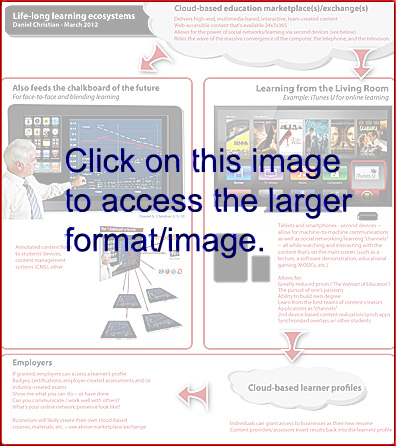
The vision below involves:
(click on the image below to access it)
- The convergence of the telephone, the television, and the computer
- Cloud-based education stores/marketplaces/exchanges
- Second screen devices and machine-to-machine communications
- Social networking/learning
- Smart classrooms/learning spaces
- Content recognition/synchronization applications
- Apps as “channels”
- Web-based learner profiles
- Video overlays
- New business models in higher ed
- New jobs/needs for the future
- A new way for employers to hire highly-effective employees/contractors/consultants
- …and more
.
On 03/02/2012,
in creativity, human-computer interaction (HCI), innovation, interaction design, interactivity, machine-to-machine communications, Near Field Communication (NFC), usability, user experience (UX), user interface design,
by Daniel Christian
On 02/20/2012,
in 3D, architecture, interactivity, virtual field trips, virtual K-12 schools, Virtual Reality (VR) / worlds / learning, virtual tutoring,
by Daniel Christian

.
My thanks to Mr. Steven Chevalia for this resource
.
On 02/03/2012,
in 21st century, A/V -- audio/visual, art, Augmented Reality (AR), corporate / business world, creativity, education technology, emerging technologies, higher education, human-computer interaction (HCI), innovation, interaction design, interactivity, internet, K-12 related, learning ecosystem, learning spaces, presentations, smart classrooms, technologies for your home, technology (general), telecommunications, television, trends, TVs, vendors, videoconferencing, web-based collaboration,
by Daniel Christian
Is this the future of touchscreen tech? New video [from Corning] will blow your mind — from Mashable! by Samantha Murphy
Excerpt:
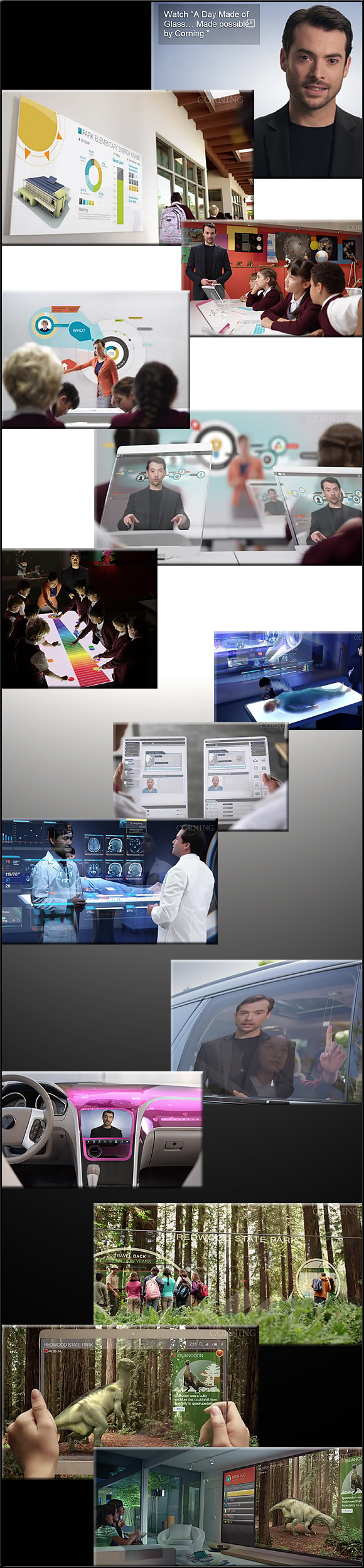
Gorilla Glass manufacturer Corning has unveiled a follow-up YouTube video to its wildly successful “A Day Made of Glass,” providing another look into what the future could be like with the growth of glass touchscreen interfaces, from innovative chalkboards and activity tables in classrooms to uses for it in hospitals.
Corning released two versions of “A Day Made of Glass 2? — one with a narrator and another, abbreviated version without commentary — the video follows the life of young Amy and her family as they go through their day using various products made of glass. Amy does classwork on a glass tablet, controls the temperature of the car from the backseat and even attends a field trip at the Redwood Forrest with an interactive signage that brings learning to life. Her teacher also works with students on interactive touchscreen activity tables. Corning expects these activity tables to be rolled out in the near future.
Sample images (by DSC):