Bringing the Wonder of the Web to Video (emphasis DSC)
Our mission is to usher in a new age of expression.

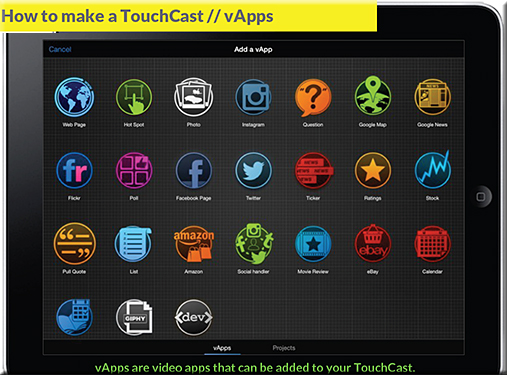
Anyone can easily create professional-quality videos combined with all the interactivity you expect to find inside a browser. We call these TouchCasts, a new medium that looks like video, but feels like the web.

— Per TouchCast.com


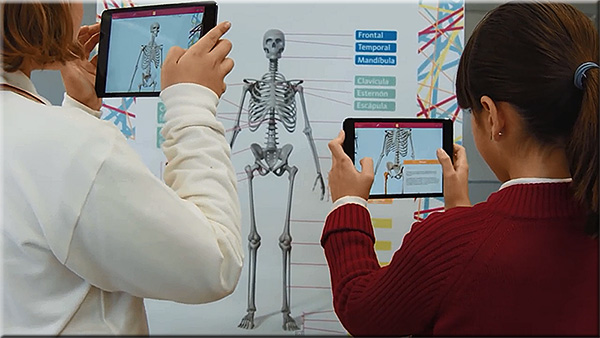
TouchCast in Education


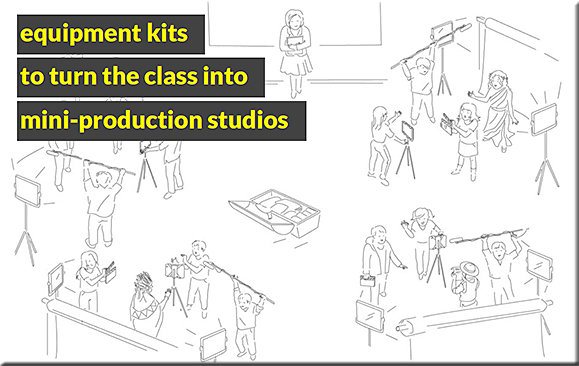
TouchCast-in-Education1


TouchCast-in-Education2


TouchCast-in-Education3


Also see:


TVs are becoming the next app battleground — from by Emily Adler

Excerpt:

The app store phenomenon, centered on smartphones and tablets, has been the biggest story in software for the past five years.

Its next logical destination: the living room, via smart TVs and set-top boxes connected to the Internet.

  • The smart TV app revolution is inevitable: People spend four hours in front of their TVs in the U.S., and 63% of all global ad spending goes to TVs. The old guard, represented by cable and entertainment conglomerates, will not be able to fend off improvements like those that apps are bringing to mobile phones.
    .
  • The smart TV revolution will not just be led by new TVs with built-in Internet connections, it will also result from consumer adoption of less expensive game consoles or set-top boxes like Roku and Apple TV, which transform traditional TVs into smart TVs with access to app stores. At least 20% of U.S. consumers already have their TVs connected in one of these ways.


From DSC:

  1. Keep an eye on the convergence of the telephone, the television, and the computer.
    .
  2. Start thinking of ways that you could provide learning/educationally-based experiences with second screen apps. What would that experience look and act like?
    .
  3. If such “channels” come to fruition — and happen to coincide with MOOCs and advances in cognitive computing (such as IBM’s Watson) — the word disruption comes to mind.
    .
  4. The trick, then, will be to offer streams of content that are relevant, and up-to-date.
    .
  5. Such a platform could be used in learning hubs throughout the world, as well as in hybrid/blended classrooms — while also addressing lifelong learners from their living rooms.
    .
  6. Such a platform could take Communities of Practice to an entirely new level.


The Living [Class] Room -- by Daniel Christian -- July 2012 -- a second device used in conjunction with a Smart/Connected TV


streams-of-content-blue-overlay


Addendum/also see:


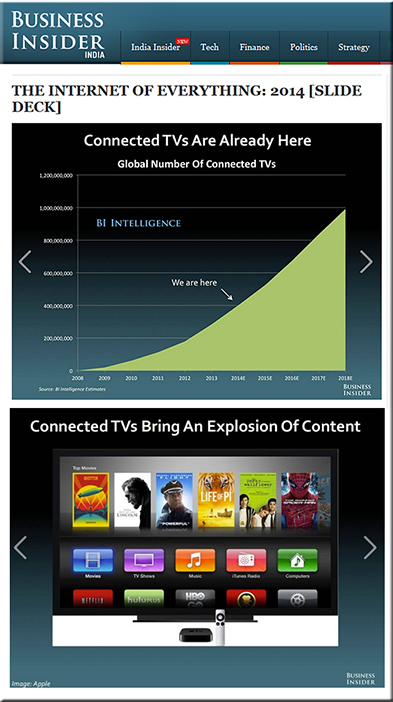
IoE-SmartTVs-Feb2014


 Some potential tools to display information on an iPad at an art gallery/small museum:


  • InDesign:
    “Use interactive PDFs with hyperlinks to achieve an app-like behaviour. We created the presentation with all buttons and target pages in Adobe InDesign CS5 and exported the whole thing as an interactive PDF.”  (From https://discussions.apple.com/thread/4573715)
  • Keynote for the iPad – though it doesn’t look like you can lock things down; though you can have a password on a file.
  • Book Creator
  • In the gallery, provide an iPad on a mount/stand and link to a blog or webpage, then lock the browser.  If you want to use this method to display several pages, one could build a series of webpages and insert META-HTTP-EQUIV tags in the header sections of the HTML.  That tag could be used to time how long a web page was on the screen and then redirect people to another web page after a period of time.


From DSC:
The above listing doesn’t address the numerous design & development firms out there that could create an app for you.

Where I could easily see this sort of thing going is towards a machine-to-machine type of communication whereby a chip on the piece of artwork “talks” to mobile devices to bring up additional information (re: that piece of art) on the patron’s device.  iBeacon-like technology comes to mind; or NFC.


Practical ideas for using augmented reality in contextual mobile learning — from blog.commlabindia.com by Aruna Vayuvegula

Excerpt:

Using Augmented Reality for contextual mLearning sounds too futuristic – a phenomenon that is being experimented in universities and research centers across the world. Wikipedia defines Augmented reality (AR) as a live, copy, view of a physical, real-world environment whose elements are augmented (or supplemented) by computer-generated sensory input such as sound, video, graphics or GPS data. It is rather hard for a non-technical person to perceive the implication of this definition in a learning situation.

However, when you come across a report that says

  • 864 million high-end cell phones could be AR enabled in 2014,
  • 103 million automobiles will have AR technology by 2020, (Ref: Semico)

You can’t ignore Augmented Reality (AR). You need to stop, to understand what it all means. That’s when I came across an article by Jason Haag, who spoke at DevLearn 13 on Augmented Reality in mobile learning. Published at Advanced Distributed Learning website, it lists some cool examples in the form of videos about AR in action. The video from the link given below is one of them; it truly helped me conceive the idea of AR in a learning context.


AR Music APP Enchantium by DAQRI — from realareal.com by Kiran Voleti

Excerpt:

In the 21st century classroom: Students can see the shape of knowledge, Students can hear the shape of knowledge, students can TOUCH the shape of knowledge.


Zientia: Changing the Way We Learn with Augmented Reality — from realareal.com by Kiran Voleti


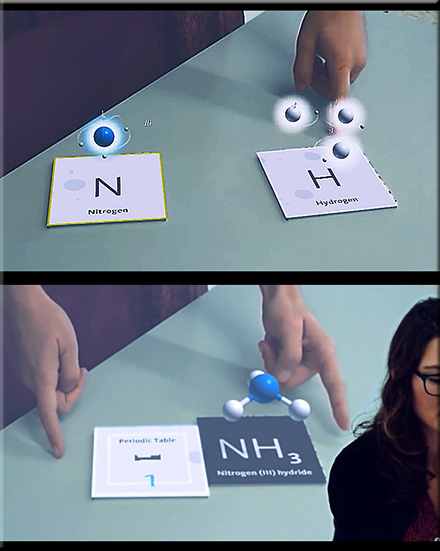
AR-in-learning


AR-in-learning2


Enchantium is a 4D platform that uses augmented reality — from realareal.com by Kiran Voleti

Excerpt:

Discover a New Dimension of Play™ in a magical world of curated, kid-safe content where play sets can come to life and toys can talk, interact and learn new things.

Toys Become Enchanted

So much more than an app, Enchantium is a 4D platform that uses augmented reality and cutting edge technology to connect games and toys with interactive experiences.


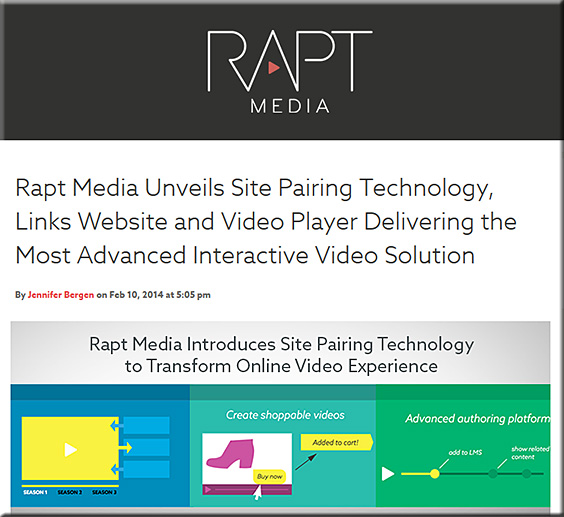
RaptMedia-NewSitePairingTech-Feb2014


Excerpt (emphasis DSC):

Today, we’re thrilled to announce that our patent-pending Site Pairing technology is officially out of beta and into the hands of creatives, marketers, brands, and agencies. Our new Site Pairing technology, which creates a link between your video and your website, allows your creative or content team to quickly and easily build a scalable Interactive Video (IV) framework that enables communication between your videos and your website.

“Online Videos have traditionally been dead ends to brands and marketers,” said Erika Trautman, CEO and co-founder of Rapt Media. “Viewers can’t navigate from them, and often leave a site altogether if the content isn’t exactly what they’re looking for.”

Taking a step back, we see that the website and its embedded media are having a true conversation. “There is nothing that you’ve come to expect on a website, that we can’t duplicate in a video,” said Trautman. “And now the two are talking.”


Some items/resources regarding gaming/video games as it pertains to education:


Bypassing the Textbook: Video Games Transform Social Studies Curriculcum

Teaching With Digital Games: a Video Case Study and Teacher Q&A with the Joan Ganz Cooney Center and Lisa Parisi

State Senate bill encourages learning via video games — from Murrow News Service by Matt Benoit

Higher Education Is a Massively Multiplayer Game — from educause

BETT 2014: Exploring the classroom of the future
From 3D gesture control to augmented reality textbooks, the classroom of the future will be more connected that ever before

Jane McGonigal.com

Learning Games Network

.

Play to Learn: 100- Great sites on gamification — from top5onlinecolleges.org/gamification by Emily Newton

Play to Learn: 100 Great Sites on Gamification


Learning at Home: Families’ Educational Media Use in America — from joanganzcooneycenter.org by Victoria Rideout, January 24, 2014

Do Games Have a Future in Education?— from learndash.com by Justin Ferriman

Excerpt:

With the growing popularity in gamification and game-based learning, more and more conversations are being held about the viability of games in the educational sector (particularly K-12). Many are wondering to what extent should K-12 education use gamification in their learning.

The simple answer is that there really isn’t an exact answer. I think that using game theory in learning environments can prove useful (it’s been done in some capacity for years), but relying too much on it to drive home a lesson, or to teach the content, can be a mistake.

6 Lessons from the Trenches of Digital Learning Game Design at #ASTDTK14


However, excessive amounts of game playing can lead to addictions.  This is a real concern.  Consider the items below.


Video Game Addiction No Fun– from WebMd.com
Compulsive video gaming is a modern-day psychological disorder that experts tell WebMD is becoming more and more popular.

How to stop video game addiction?

Video game addiction.org

End a Video Game Addiction

Avoid Video Game Addiction 

Online gaming addiction similar to alcoholism, gaming industry should pay for treatment, says new S Korea proposal

How to prevent and deal with video game addiction  — from shelbycounselingassociates.org


Bottom line: Balance, boundaries, and limits will likely be needed here — at least in some/certain cases.


Addendum on 2/3/14:

  • Gamification in the Classroom — from seriousgames.msu.edu by Lissy Torres
    Excerpt:
    MSU’s meaningful play faculty and students came together on Wednesday to listen to Scott Nicholson, a game designer and board game enthusiast, give a talk on gamification. Nicholson currently teaches at Syracuse University, where he employs gamification in big ways through his undergraduate courses. But before we go into that, let’s have some more on the man himself.


From DSC:
I see the following items in the classrooms/learning spaces/”learning hubs” of the future:

  • iBeacon-like technology, quickly connecting the physical world with the online world (i.e. keep an eye on the Internet of Things/Everything  in the classroom); this may take place via wearable technology or via some other means of triggering events
  • Remote presence
  • Access to Artifical Intelligence (AI)-based resources
  • Greatly enhanced Human Computer Interactions (HCI) such as gesture-based interactions as well as voice and facial recognition
  • Interactive walls
  • BYOD baked into almost everything (requiring a robust networking infrastructure)
  • More makerspaces (see below for examples)
  • Tables and chairs (all furniture really) are on wheels to facilitate room configuration changes
  • Setups that facilitate collaborative/group work


Below are some other recent items on this topic:


To Inspire Learning, Architects Reimagine Learning Spaces — from MindShift by Allison Arieff


MakerLab_web

Excerpt:

As K–12 schools refocus on team-based, interdisciplinary learning, they are moving away from standardized, teach-to-test programs that assume a one-size-fits-all approach to teaching. Instead, there is a growing awareness that students learn in a variety of ways, and the differences should be supported. The students often learn better by doing it themselves, so teachers are there to facilitate, not just to instruct. Technology is there as a tool and resource, not as a visual aid or talking head.


3D printers and laser cutters?… it’s the classroom of the future — from standard.co.uk by Miranda Bryant


Rethinking our learning spaces — from rtschuetz.blogspot.com by Robert Schuetz


ClassroomMoveableFurnitureITESMCCM 02
CC Wikimedia – Thelmadatter

Excerpt:

Heutagogy, unlike pedagogy, focuses on self-directed learning. As learning and education become more heutaogical, shouldn’t our learning spaces accommodate this shift? What are the features and characteristics that define a modern learning space? Notice, that I have not used the word classroom. Several days of researching this topic has challenged my thinking on the concept of classroom. This verbiage has been replaced with terms like; ideation lab, innovation space, maker pods, gamer zone, and learning sector. The concept of specific learning zones is not new.


Transmedia Storytelling: Trends for 2014 —  from Robert Pratten, CEO  at Transmedia Storyteller Ltd on Dec 06, 2013

Excerpt:

Pratten-TransmediaStorytellingIn2014


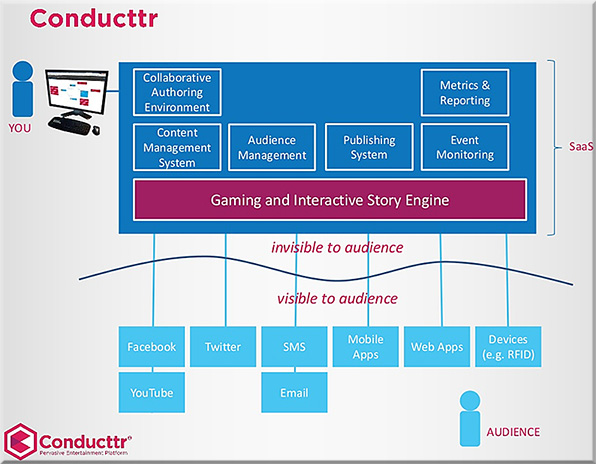
Conducttr-Jan2014


From DSC:
Something here for education/learning? With the creativity, innovation, interactivity, participation, and opportunities for more choice/more control being offered here, I would say YES!


Also see:


Also see:
  • Clarity Matrix MultiTouch
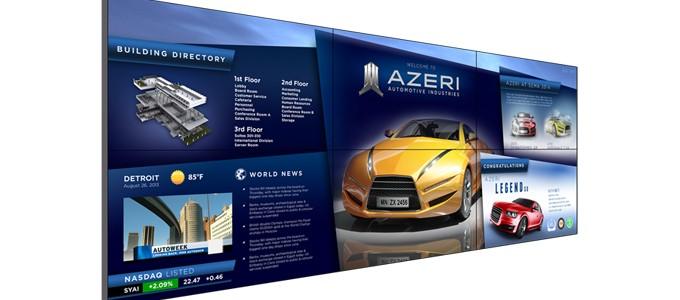
    Interactive LCD Video WallThe Clarity™ Matrix MultiTouch LCD Video Wall is an ultra-slim profile touch screen video wall ideal for public spaces or collaboration environments. Utilizing the latest touch technology, Clarity Matrix MultiTouch enables up to 32 touch points and allows multiple users to simultaneously interact with video wall without affecting other users.
Clarity-Matrix-MultiTouch-1-13


From DSC:
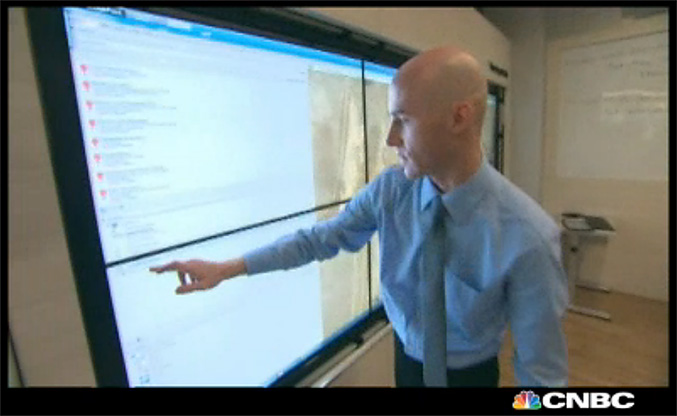
In addition to video walls and large multitouch surfaces…we need to start thinking about how we might integrate the Internet of Things (IoT) into the classroom.  For example,  what might occur if technologies like Apple’s iBeacon were in the blended/hybrid classroom?  Tony goes to corner A, and up pops a video re: XYZ for him to check out on the large multitouch display.  Tony then moves across the room, to another corner of the room, and up pops a quiz or an assignment related to what Tony saw in the first corner of the room.  Available on one of the windows on the video wall is of a remote specialist on the subject.  Tony clicks on the “Connect with specialist” button and finds himself in a videoconference with this remote specialist/tutor on a portion of the video wall.

As learning hubs* grow, these technologies might be very useful.

* where some of the content is electronically
delivered 
and where some of the content
is discussed in a face-to-face manner


HarperCollins, Google’s Niantic Labs, 20th Century Fox collaborate w/ bestselling author on next gen cross-media project, Endgame — from corporate.harpercollins.com, w/ thanks to @myweb2learn for the resource

Excerpt of Press Release (emphasis DSC):

ENDGAME is a fully integrated, multimedia experience that will combine a trilogy of young adult novels, fifteen original e-book novellas, YouTube videos, search and image results, mapping coordinates, social media, and interactive gaming in one revolutionary creative project. Each book in the ENDGAME trilogy will feature an interactive puzzle comprised of clues and riddles throughout the text.

“We are excited to work with James Frey and Full Fathom Five on this groundbreaking series,” said Brian Murray, President and CEO, HarperCollins Publishers. “This is a spectacular story that embodies the future of publishing—great content, interactivity and a multimedia experience.”  

Google’s Niantic Labs is developing a location-based augmented reality game that will bring ENDGAME to life in the real world.  The game builds on the success of “Ingress,” which defined a new category of entertainment that marries video games with the physical world.  The mobile experience will allow players around the world to join in the battle to unlock the mysteries and secrets of ENDGAME.  Google Niantic will also be publishing six ENDGAME novellas exclusively at the Google Play store.  The game is expected to launch on Android and iOS devices in late 2014.

“James has a great vision for telling stories in an integrated way across books, film, social media, and mobile games,” John Hanke, VP of Product, Niantic Labs at Google, said. “We are delighted to bring our technology and expertise to bear on a project that is helping to define the future of entertainment.”


From DSC:
If successful, I’d love to see some applications of this sort of experiment applied towards education/learning — i.e. towards K-12, higher ed, and the corporate training/L&D departments.  The experiment emphasizes where I think successful learning is also going — towards the use of TEAM-based content creation and delivery.


Human Computer Interaction & the next generation of exhibits — from ideum.com by one of my former instructors at SFSU’s Multimedia Studies Program, Mr. Jim Spadacini


HCI Science Center Exhibits

Excerpt:

Computer-based technology continues to evolve at an ever-accelerating rate, creating both opportunities and challenges for science centers and museums. We are now seeing computing enter new realms, one that are potentially more promising for exhibit development than earlier ones.


Split screen interactivity and finger motion control on 2014 Samsung Smart TVs — from v-net.tv

Excerpt:

Samsung has made some incremental improvements to its Smart TV platform for 2014. During International CES the company unveiled the Multi-Link feature, which lets you split the screen and use one half to get more information about content you are watching. For example, you can watch live TV on half the screen and get search results from a web browser on the other or seek out relevant YouTube content. In effect, the company is enabling ‘companion’ or Second Screen activities but on the main screen.


Items re: IBM and Watson:


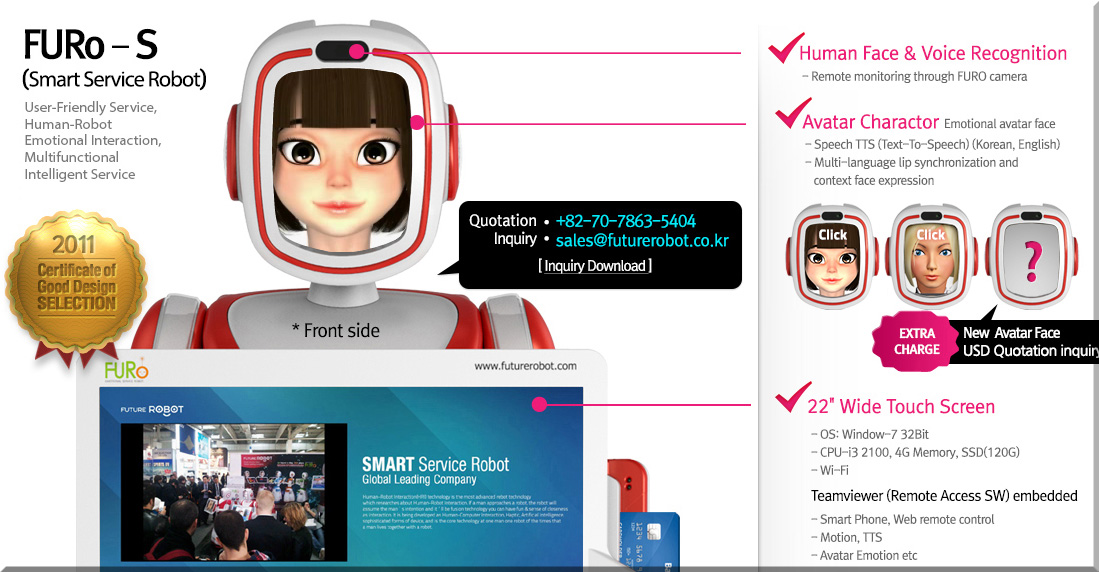
FURo-S and also see FutureRobot


FURo-S-Jan2014


Nuance unlocks personalized content for Smart TVs with voice biometrics for Dragon TV — from online.wsj.com

Excerpt:

Nuance Communications, Inc. (NASDAQ: NUAN) today announced that its Dragon TV platform now includes voice biometrics for TVs, set-top boxes and second screen applications, creating an even more personalized TV experience through voice. Upon hearing a person’s unique voice, Dragon TV not only understands what is being said, but authenticates who is saying it, and from there enables personalized content for different members of a household. As a result, individuals can have immediate access to their own preferred channels and content, customized home screens and social media networks.

From DSC:
Re: this last one from Nuance, imagine using this to get rid of the problem/question in online learning — is it really Student A taking that quiz?  Also, this type of technology could open up possibilities for personalized playlists/content for each learner.


Rapt Media: 9 Predictions for Online Video in 2014 — from adotas.com

  1. There will be a push to replicate the “TV experience” on the web.
  2. Interactive video is going to redefine traditional broadcasting.
  3. Video will be the GIF of 2014.
  4. Web video series will use PWYW pricing model.
  5. Online content producers will create more original series.
  6. We’ll see at least one high-profile crowd-funded season of television.
  7. Videos will become the primary shopping vehicles for tablet users around the world.
  8. A few innovative companies will start leveraging Interactive Video to replace costly in-person training. Higher education and corporate training will see a huge disruption as animated avatars and Interactive Video pair up to present personalized online training to hundreds of thousands of users without anyone ever leaving the comfort of their home or office.
  9. Video with choice is going to revolutionize customer service.
 

Behind the immersiveness trend: Why now? — from deepmediaonline.com by Frank Rose with a thanks to Digital Rocking Chair for the Scoop on this

Excerpt (emphasis DSC):

 When JWT Intelligence announced its “10 Trends for 2014 and Beyond” recently, trend #1 was “immersive experiences.” Certainly you can feel this in New York: From Punchdrunk’s Sleep No More (now running for nearly three years) to MoMA’s Rain Room to Yayoi Kusama’s Infinity Mirrored Room, people are willing to pay top dollar or line up for hours to experience something all-encompassing and beyond the ordinary. But why?

The new report—based on a survey of Internet users in the US and the UK, on as­sessments from JWT planners around the world, and on in­terviews with outside observers (myself includ­ed)—lists six key reasons. Interestingly, only two have anything to do with advances in technology or production techniques. The re­maining four stem from broad societal shifts—shifts that are tied to, but in many cases a re­action against, the always-on nature of the digital world.


From DSC:
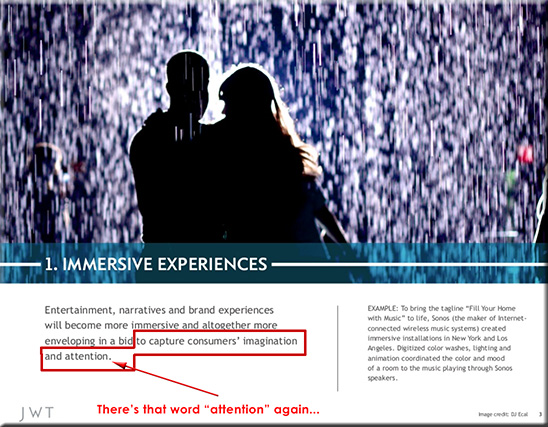
Notice one of the first slides.

ImmersiveExperiences-Dec182013

It mentions the word attention. I submit to you that these types of immersive experiences will impact how easy it is or hard it is to get our students’ attentions.  If we can’t get our students’ attentions, we have zero (0) chance of getting the information into their short term and/or long term memories. 

This is why I’d like to see more transmedia-based storytelling and digital storytelling occurring within K-20.  We should have students create the experiences using content taken directly from the course’s learning objectives. Such as course could be multidisciplinary in nature, helping students find roles that they enjoy doing while learning the content.

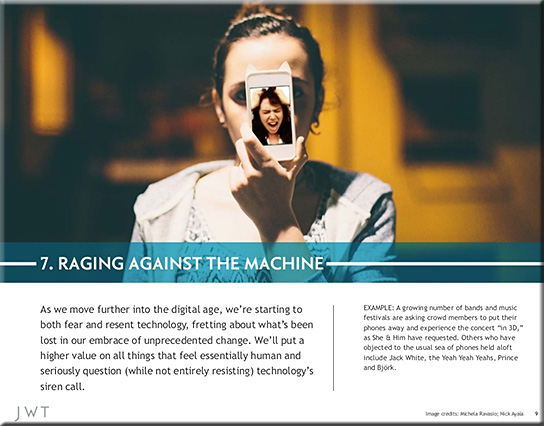
However, on the other side of things…I need to post another slide (below) as well.  Some students might not like this type of learning experience at all.  Thus, we need to offer more choice, more control to our students…letting them pick the assignments/pathways to their learning that work best for them.


FrankRoseRagingAgainstMachine-Dec182013


From DSC:
First some recent/relevant postings:


IFTTT’s ingenious new feature: Controlling apps with your location
— from wired.com by Kyle VanHemert


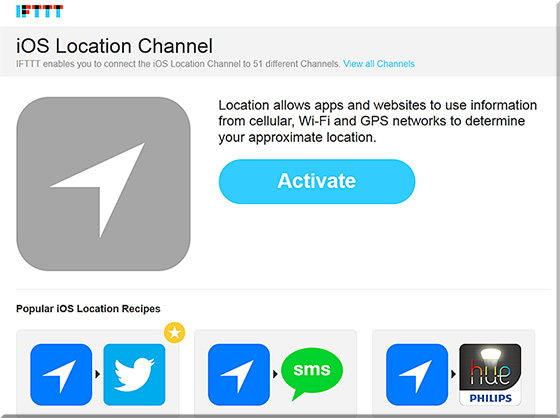
An update to the IFTTT app lets you use your location in recipes. Image: IFTTT


Excerpt:

IFTTT stands athwart history. At a point where the software world is obsessed with finding ever more specialized apps for increasingly specific problems, the San Francisco-based company is gleefully doing just the opposite. It simply wants to give people a bunch of tools and let them figure it out. It all happens with simple conditional statements the company calls “recipes.” So, you can use the service to execute the following command: If I take a screenshot, then upload it to Dropbox. If this RSS feed is updated, then send me a text message. It’s great for kluging together quick, automated solutions for the little workflows that slip into the cracks between apps and services.


If This, Then That (IFTTT)
IFTTT-Dec2013


4 reasons why Apple’s iBeacon is about to disrupt interaction design — from wired.com by Kyle VanHemert

Excerpt:

You step inside Walmart and your shopping list is transformed into a personalized map, showing you the deals that’ll appeal to you most. You pause in front of a concert poster on the street, pull out your phone, and you’re greeted with an option to buy tickets with a single tap. You go to your local watering hole, have a round of drinks, and just leave, having paid—and tipped!—with Uber-like ease. Welcome to the world of iBeacon.

It sounds absurd, but it’s true: Here we are in 2013, and one of the most exciting things going on in consumer technology is Bluetooth. Indeed, times have changed. This isn’t the maddening, battery-leeching, why-won’t-it-stay-paired protocol of yore. Today we have Bluetooth Low Energy which solves many of the technology’s perennial problems with new protocols for ambient, continuous, low-power connectivity. It’s quickly becoming big deal.


The Internet of iThings: Apple’s iBeacon is already in almost 200 million iPhones and iPads — from forbes.com by Anthony Kosner

Excerpt (emphasis DSC):

Because of iBeacons’ limited range, they are well-suited for transmitting content that is relevant in the immediate proximity.


From DSC:
Along the lines of the above postings…I recently had a meeting whereby the topic of iBeacons came up. It was mentioned that museums will be using this sort of thing; i.e. approaching a piece of art will initiate an explanation of that piece on the museum’s self-guided tour application. 

That idea made me wonder whether such technology could be used in a classroom…and I quickly thought, “Yes!” 

For example, if a student goes to the SW corner of the room, they approach a table. That table has an iBeacon like device on it, which triggers a presentation within a mobile application on the student’s device.  The students reviews the presentation and moves onto the SE corner of the room whereby they approach a different table with another/different iBeacon on it.  That beacon triggers a quiz on the material they just reviewed, and then proceeds to build upon that information.  Etc. Etc.   Physically-based scaffolding along with some serious blended/hybrid learning. It’s like taking the concept of QR codes to the next level. 

Some iBeacon vendors out there include:

Data mining, interaction design, user interface design, and user experience design may never be the same again.

 
© 2025 | Daniel Christian