LearningNowTV-Nov2014


From their website:
(emphasis DSC)

LEARNING NOW tv is a live-streamed internet tv channel bringing you inspirational interviews, debates and round tables, and advice and guidance on real world issues to keep you up-to date in the world of learning and development.

Membership to the channel is FREE. You will be able to interact with us on our social channel during the live stream as well as having a resource of the recorded programmes to refer to throughout the year.

Learning Now tv is run and produced by some of the L&D world’s leading experts who have many years’ experience of reporting the real-world issues for today’s learning and development professionals.


I originally saw this at Clive Sheperd’s posting:
TV very much alive for learning professionals


Also see:


MYOB-July2014


This new service makes me think of some related graphics:


MoreChoiceMoreControl-DSC


StreamsOfContent-DSC


The Living [Class] Room -- by Daniel Christian -- July 2012 -- a second device used in conjunction with a Smart/Connected TV


Addendum on 12/2/14 — from Learning TRENDS by Elliott Masie – December 2, 2014 | #857

Idea – Courses in the Air:
There were representatives from airlines, Aviation Authorities and even Panasonic – which makes the interactive movie and TV systems on long distance airplanes.  So, I rolled out one of my “aha ideas” that I would love to see invented sometime: Courses in the Air.

What if a passenger could choose to take a mini-course on a 4 to 14 hour flight. It would be a MOOC in the Sky – with video, reading and interactive elements – and someday might even include a real time video chat function as well.  The learner could strive to earn a “badge” or roll them up into a certificate or degree program – that they pursued over several years of flights.  It would be an intriguing element to add to international travel.


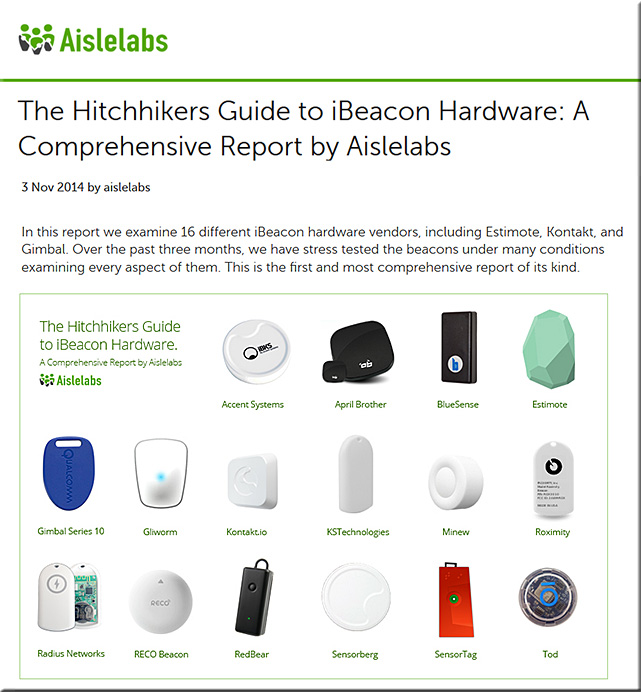
The Hitchhikers Guide to iBeacon Hardware: A Comprehensive Report by Aislelabs

Excerpt:

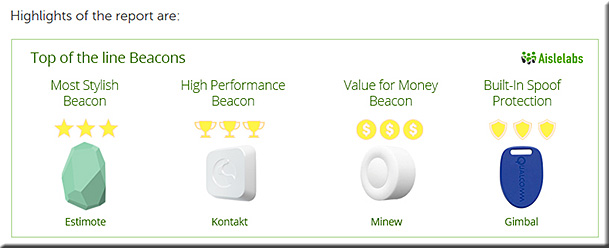
In this report we examine 16 different iBeacon hardware vendors, including Estimote, Kontakt, and Gimbal. Over the past three months, we have stress tested the beacons under many conditions examining every aspect of them. This is the first and most comprehensive report of its kind.


GuideToiBeaconHW-Nov2014


GuideToiBeaconHW--Hiighlights-Nov2014


Addendum on 11/19/14:


Excerpt:

We’re really excited to unveil an enormous new set of software tools and services that make deploying and managing a beacon network easier than ever. A fallacy in the market right now is that all beacon hardware is created equal. It’s not. But although well-designed hardware is important, the real differentiation comes down to how tightly integrated that hardware is with software up the stack—from firmware to mobile SDKs to APIs to web services.Our flexible and extensible software allows remote configuration and management, enterprise-grade security, and rich analysis of data in real time for your entire beacon network.


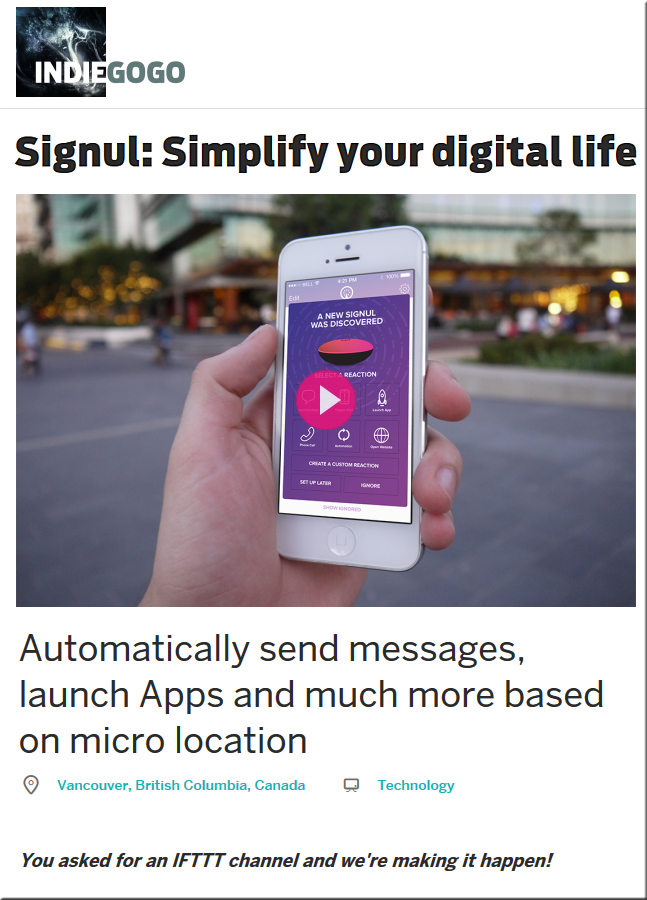
signul-oct2014


Also, from the press release (emphasis DSC):

  • Signul, the World’s First Complete Consumer iBeacon Solution, Unveils IFTTT Integration
    VANCOUVER, BRITISH COLUMBIA–(Marketwired – Oct. 28, 2014) – IoT Design Shop, the Internet of Things innovation centre at Finger Food Studios, today announced that it is actively developing an IFTTT Channel for Signul, the world’s first personal consumer iBeacon solution. IFTTT is an online service that allows users to create tasks that combine different Internet-based services from one platform.

Signul is a complete package of hardware and an easy-to-use App. By integrating with IFTTT, Signul users will be able to easily initiate automation in other IFTTT Channels. For example, Signul will turn on your lights as you pull into your garage or turn on your home’s air conditioner or heater when you leave work.

“Our goal is to help people simplify and automate their digital lives and integrating with IFTTT dramatically expands the potential of Signul. Based on the simple premise of ‘IF This Then That’, IFTTT is quickly becoming the leading web-based automation service. And with our own Channel, users can easily use Signul to connect with some of the most popular Internet of Things devices in the marketplace,” said Trent Shumay, CTO of Finger Food Studios.


From DSC:
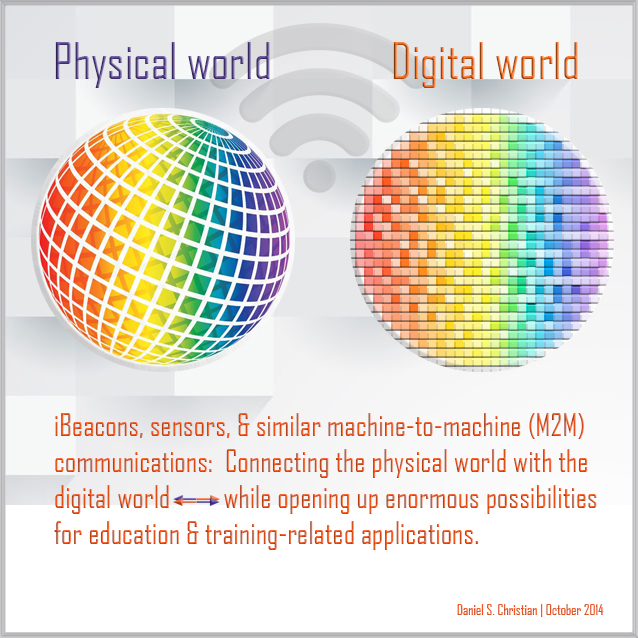
This is the same concept that I was trying to get at my “What if we were to combine “If This Then That” with iBeacons/sensors?” blog posting. This concept has enormous potential for learning at all levels — K-12, higher ed, and in the corporate/business world.  It gets at the intersection/blending of the physical world with the digital world.  Where you are and what you are near will allow you to automatically bring up relevant resources. 

One can see this concept being played out in things like campus tours, in setting up and running chemistry or physics experiments, in touring art galleries, and more.  And if it’s implemented with a level of intrigue and digital storytelling baked into it, this could be a very powerful way to engage our students (as well as employees)!  In fact, such a concept has implications for ubiquitous, lifelong learning.


DanielChristian-Combining-Digital-Physical-Worlds-Oct2014


Oculus Connect Videos and Presentations Online — from oculus.com


Excerpt:

All the keynotes, panels, and developer sessions from Connect are now available to watch online. The slides from each session are also available for download from the Connect site under the “Schedule” section.  Complete list of the keynotes, panels, and developer sessions from Connect:

Keynotes:

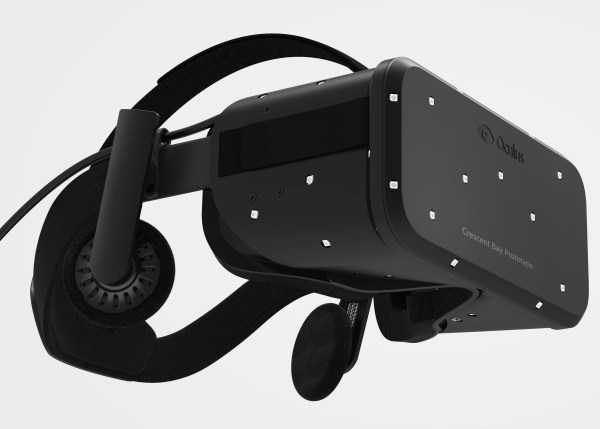
  • Brendan Iribe and Nate Mitchell — Oculus CEO Brendan Iribe and VP of Product Nate Mitchell officially open Connect with their Keynote discussing Oculus, the Gear VR, and the newest prototype: Crescent Bay.
  • Michael Abrash  — Oculus Chief Scientist Michael Abrash discusses perception in virtual reality, the future of VR, and what that means for developers.
  • John Carmack — Oculus CTO John Carmack discusses the Gear VR and shares development stories at Oculus Connect.

.

Keynote Panel:

.

Developer Sessions:


Related items:


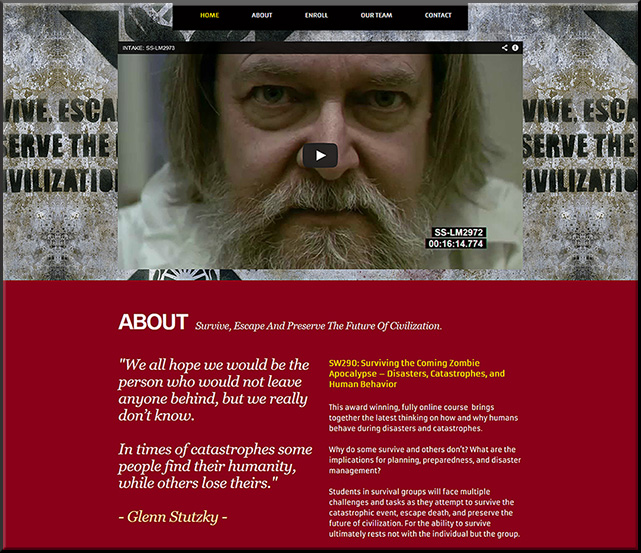
Last week I attended the 20th Annual Online Learning Consortium International Conference.  While there, I was inspired by an excellent presentation entitled, A Disruptive Innovation: MSU’s Surviving the Coming Zombie Apocalypse – Are You Ready to Survive a New Way of Learning?   The four team members from Michigan State University included:

  • Glenn R. Stutzky | Course Instructor
  • Keesa V. Muhammad | Instructional Designer
  • Christopher Irvin | Instructional Designer
  • Hailey Mooney | Course Librarian

Check out the intro clip on the website about the course:
 

MSUZombie-Oct2014


From the description for the presentation:

This session highlights MSU’s award winning, groundbreaking online course that fuses social theory, filmmaking, social media, and viral marketing while students survive an apocalyptic event. http://zombie.msu.edu/

MSU created and used powerful digital storytelling and multimedia to overlay real, experiential, immersive learning. Important content was relayed, but in a way that drew upon your emotions, your ability to solve problems and navigate in a world where you didn’t have all of the information, your ability to work with others, and more.

“This innovative course integrates current research and science on catastrophes and human behavior together with the idea of a zombie apocalypse. In doing so, we actively engage with students as they think about the nature, scope, and impact of catastrophic events on individuals, families, societies, civilizations, and the Earth itself.”

“Our innovative approach to teaching and learning features: students as active participants, the instructor becomes the facilitator, storytelling replaces lectures, zombies become the catalyst of teaching, a “zombrarian” (librarian) drives research, and the students emerge as digital storytellers as a way of assessing their own learning.”

Others outside MUS have found out about the course and have requested access to it. As a result of this, they’ve opened it up to non-credit seeking participants and now various people from police forces, Centers for Disease Control, and others are able to take the course. To make this learning experience even more accessible, the cost has been greatly reduced: from $1600+ to just $500. (So this talented team is not only offering powerful pedagogies, but also significant monetary contributions to the university as well.)

For me, the key thing here is that this course represents what I believe is the direction that’s starting to really pull ahead of the pack and, if done well, will likely crush most of the other directions/approaches.  And that is the use of teams to create, deliver, teach, and assess content – i.e., team-based learning approaches.

So many of the sessions involved professional development for professors and teachers – and much of this is appropriate. However, in the majority of cases, individual efforts aren’t enough anymore.  Few people can bring to the table what a talented, experienced group of specialists are able to bring.  Individual efforts aren’t able to compete with team-based content creation and delivery anymore — and this is especially true online, whereby multiple disciplines are immediately invoked once content hits the digital realm.

In this case, the team was composed of:

  • The professor
  • Two Instructional Designers
  • and a librarian

The team:

  • Developed websites
  • Designed their own logo
  • Marketed the course w/ a zombie walking around campus w/ brochures and a walking billboard
  • Used a Twitter stream
  • Used a tool called Pensu for their students’ individual journals
  • Made extensive use of YouTube and digital storytelling
  • Coined a new acronym called MOLIE – multimedia online learning immersive experience
  • Used game-like features, such as the development of a code that was found which revealed key information (which was optional, but was very helpful to those who figured it out).  The team made it so that the course ended differently for each group, depending upon what the teams’ decisions were through the weeks
  • Used some 3D apps to make movies more realistic and to create new environments
  • Continually presented new clues for students to investigate.  Each team had a Team Leader that posted their team’s decisions on YouTube.

They encouraged us to:
THINK BIG!  Get as creative as you can, and only pull back if the “suits” make you!  Step outside the box!  Take risks!  “If an idea has life, water it. Others will check it out and get involved.”

In their case, the idea originated with an innovative, risk-taking professor willing to experiment – and who started the presentation with the following soliloquy:

Syllabi are EVIL

Syllabi are EVIL and they must die!
Listen to me closely and I’ll tell you why.
Just want students to know what is known?
See what’s been seen?
Go – where we’ve been going?
Then the Syllabus is your friend,
cuz you know exactly where you’ll end.
But if you want to go somewhere new,
see colors beyond Red, Green, and Blue.
Then take out your Syllabus and tear-it-in-half,
now uncertainty has become your path.
Be not afraid because you’ll find,
the most amazing things from Creative Minds,
who have been set free to FLY,
once untethered from the Syllabi.

Glenn Stutzky
Premiered at the 2014
Online Learning Consortium International Conference
October 29, 2014


They started with something that wasn’t polished, but it’s been an iterative approach over the semesters…and they continue to build on it.

I congratulated the team there — and do so again here. Excellent, wonderful work!


By the way, what would a creative movie-like trailer look like for your course?


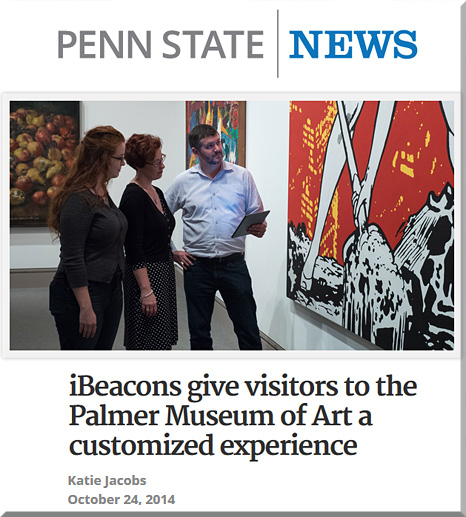
iBeacons-PennSt-Art-Oct2014


iBeacons give visitors to the Palmer Museum of Art a customized experience — from news.psu.edu by Katie Jacobs

Excerpt:

Soon, there will be new, high-tech additions to the Palmer Museum’s galleries — small electronic devices that will be stuck to walls behind paintings, hidden under shelves or concealed in corners. You won’t be able to see them, but your mobile devices will.

The devices ares iBeacons, small transmitters created by Apple that communicate with nearby smartphones. If a visitor has the correct mobile app installed, content will be automatically sent to the phone with more information about the nearby artwork.

“Sometimes I’ll lead tours with visitors and focus on the works of art I think are particularly fascinating,” says Kletchka. “I thought it would be wonderful if everyone could have that experience here — they can learn more about the objects they are interested in on their own terms.”


DanielChristian-Combining-Digital-Physical-Worlds-Oct2014


The amazing ways new tech shapes storytelling — from stuff.tv by Stephen Graves

Excerpt:

From the moment some singer-poet livened up his verse performances with a musical instrument, technology has changed entertainment. The printing press, theatrical lighting, the cinema, radio, cinematic sound – they’ve all either impacted on existing storytelling forms, or created whole new ones.

In recent years, the arrival of digital formats and non-linear editing changed TV. Existing TV formats like drama benefited from the same level of technical polish as films; and at the same time, the ability to shoot and edit large amounts of footage quickly and cheaply created a whole new form of storytelling – reality TV.

Streaming media’s one thing – but the biggest tech leap in years is, of course, your smartphone. Texting during films may infuriate but whipping your phone out in the cinema may become an integral part of the story: the 2013 film App used a second-screen app to display extra layers of narrative, synced to the film’s soundtrack. There are books that use second-screen apps: last year’s Night Film lets you scan tags in the physical book to unlock extra content, including mocked-up websites and trailers.


The amazing ways new tech shapes storytelling


Also see:


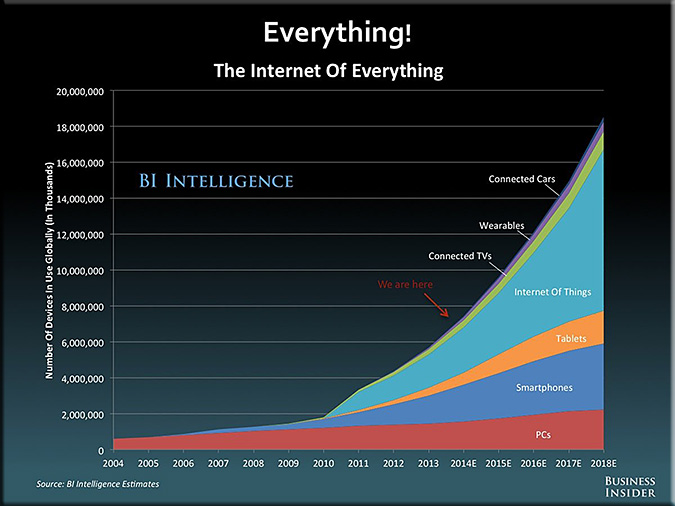
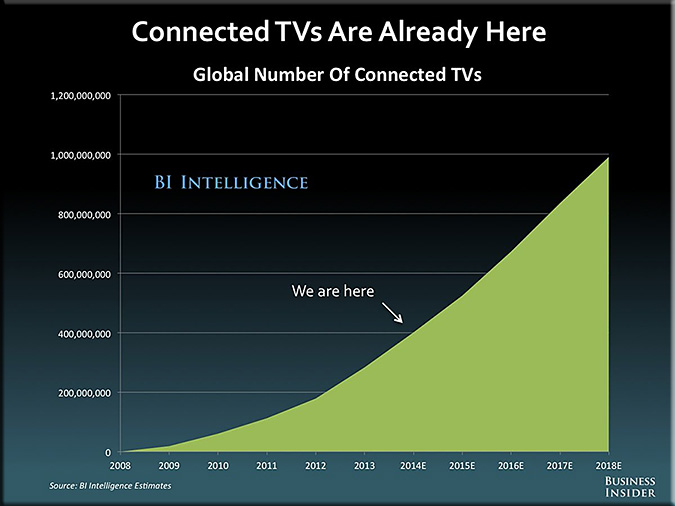
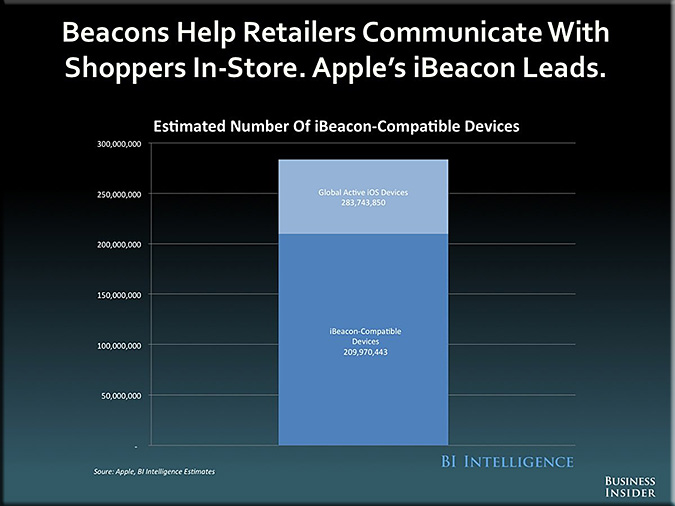
InternetOfEverything-BI-Oct2014


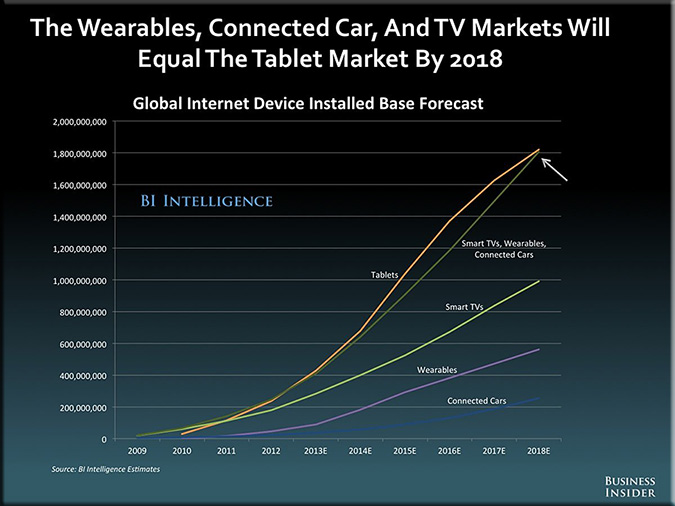
Some excerpted slides:


wearehere-bi-oct2014


wearehere2-bi-oct2014


wearehere3-bi-oct2014


wearehere4-bi-oct2014


From DSC:
Educators/eduprenuers should be watching what happens in the living room…or better yet, let’s create some second-screen-based learning applications that ride the Smart/Connected TV wave.


The Living [Class] Room -- by Daniel Christian -- July 2012 -- a second device used in conjunction with a Smart/Connected TV


From DSC:
I’m thinking out loud again…

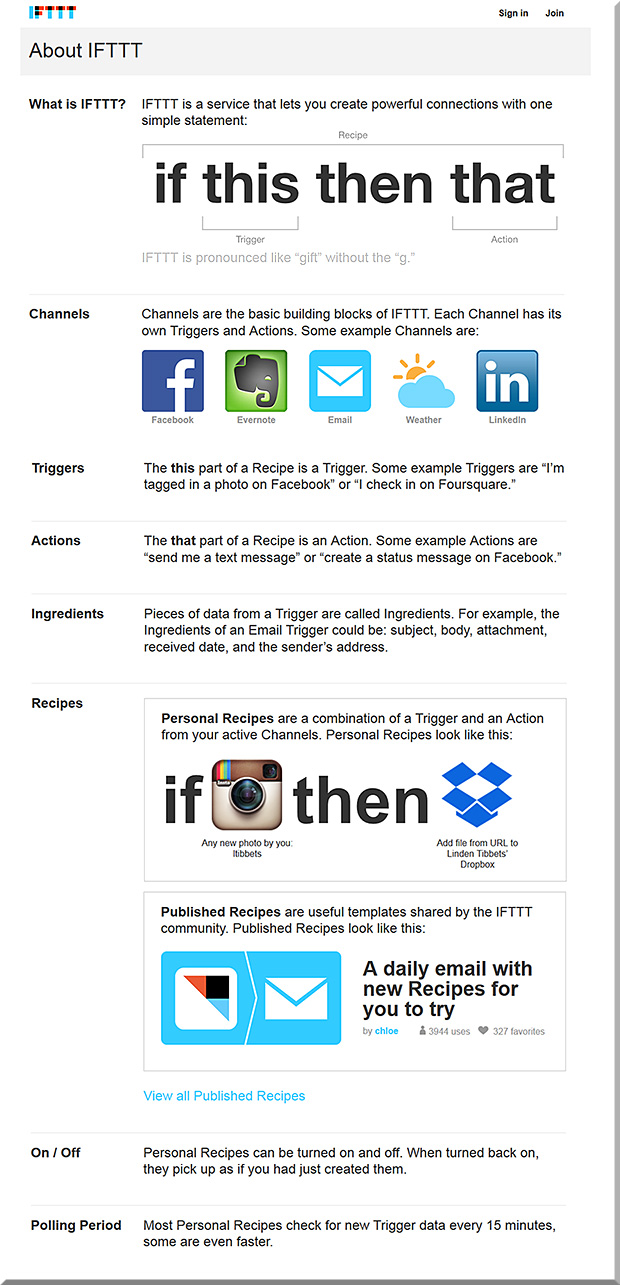
What if were were to be able to take the “If This Then That (IFTTT)” concept/capabilities and combine it with sensor-based technologies?  It seems to me that we’re at the very embryonic stages of some very powerful learning scenarios, scenarios that are packed with learning potential, engagement, intrigue, interactivity, and opportunities for participation.

For example, what would happen if you went to one corner of the room, causing an app on your mobile device to launch and bring up a particular video to review?  Then, after the viewing of the video, a brief quiz appears after that to check your understanding of the video’s main points. Then, once you’ve submitted the quiz — and it’s been received by system ABC — this triggers an unexpected learning event for you.

Combining the physical with the digital…

Establishing IFTTT-based learning playlists…

Building learning channels…learning triggers…learning actions…

Setting a schedule of things to do for a set of iBeacons over a period of time (and being able to save that schedule of events for “next time”).

Hmmm…there’s a lot of potential here!


IfThisThenThat-Combined-With-iBeacons


IfThisThenThat


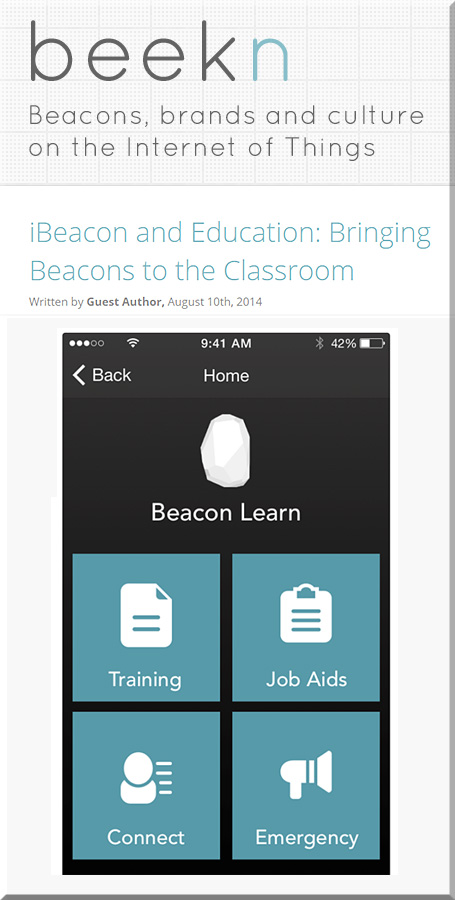
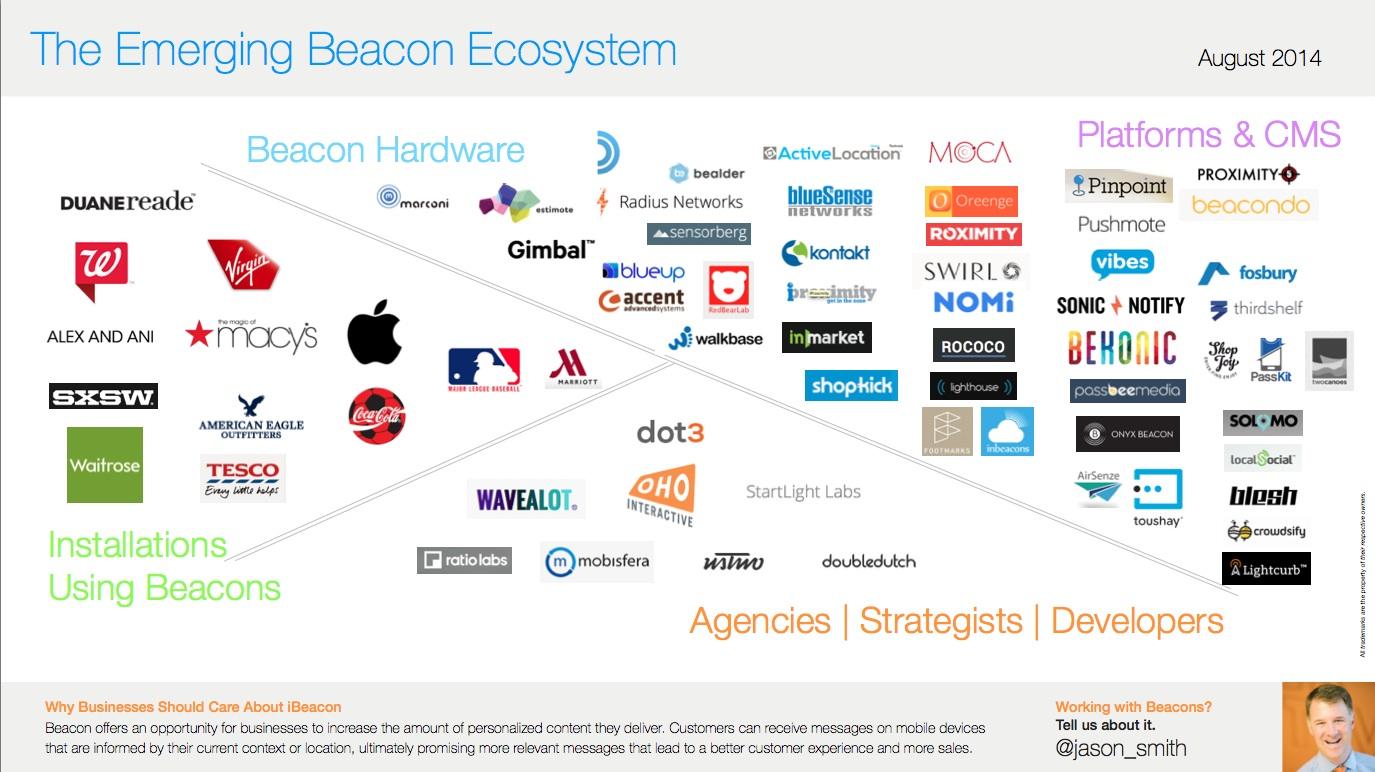
iBeaconsAndEducation-8-10-14


Now throw augmented reality, wearables, and intelligent tutoring into the equation! Whew!

We need to be watching out for how machine-to-machine (M2M) communications can be leveraged in the classrooms and training programs across the globe.

One last thought here…
How are we changing our curricula to prepare students to leverage the power of the Internet of Things (IoT)?


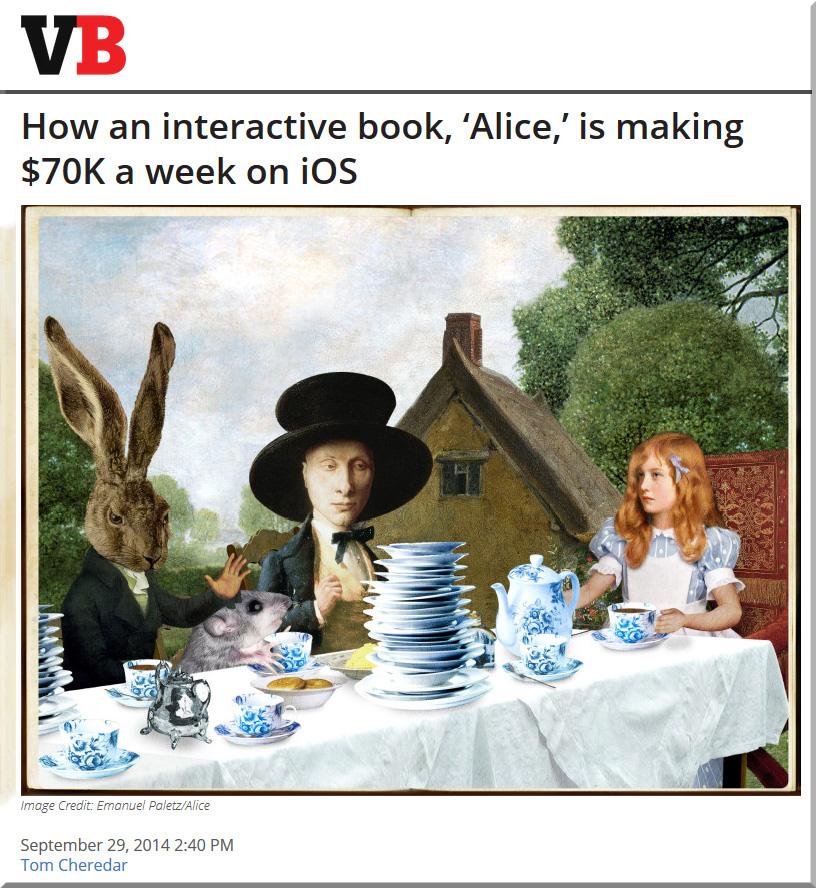
interactivebook-alice-70Kweek-setp2014

.

Excerpt:

Alice is presented as a mobile app, but it’s technically a book that can be read on iPads and Android tablets. The story is based on the classic Alice’s Adventures In Wonderland by Lewis Carroll, and it features beautiful illustrations you can interact with by touching the tablet screen, as well as an engaging narrator reading each page.

“Regular e-books have limitations, and I wanted to create a new level of engagement. I wanted to combine interactive experience along with film ‘feel,’” Paletz said in an interview. “The application is an art book, a conceptual book, and an educational book all in one, so it has something for everyone.”


 From DSC: With a shout out to
Laura Devaney who posted this on Twitter.


Beacons at the museum: Pacific Science Center to roll out location-based Mixby app next month — from geekwire.com by Todd Bishop

Excerpt:

Seattle’s Pacific Science Center has scheduled an Oct. 4 public launch for a new system that uses Bluetooth-enabled beacons and the Mixby smartphone app to offer new experiences to museum guests — presenting them with different features and content depending on where they’re standing at any given moment.


Also see:


From DSC:
The use of location-based apps & associated technologies (machine-to-machine (M2M) communications) should be part of all ed tech planning from here on out — and also applicable to the corporate world and training programs therein. 

Not only applicable to museums, but also to art galleries, classrooms, learning spaces, campus tours, and more.  Such apps could be used on plant floors in training-related programs as well.

Now mix augmented reality in with location-based technology.  Come up to a piece of artwork, and a variety of apps could be launched to really bring that piece to life! Some serious engagement.

Digital storytelling. The connection of the physical world with the digital world. Digital learning. Physical learning. A new form of blended/hybrid learning.  Active learning. Participation.


Addendum on 9/4/14 — also see:

Aerohive Networks Delivers World’s First iBeacon™ and AltBeacon™ – Enabled Enterprise Wi-Fi Access Points
New Partnership with Radius Networks Delivers IoT Solution to Provide Advanced Insights and Mobile Experience Personalization

Excerpt (emphasis DSC):

SUNNYVALE, Calif.–(BUSINESS WIRE)–Aerohive Networks® (NYSE:HIVE), a leader in controller-less Wi-Fi and cloud-managed mobile networking for the enterprise market today announced that it is partnering with Radius Networks, a market leader in proximity services and proximity beacons with iBeacon™ and AltBeacon™ technology, to offer retailers, educators and healthcare providers a cloud-managed Wi-Fi infrastructure enabled with proximity beacons. Together, Aerohive and Radius Networks provide complementary cloud platforms for helping these organizations meet the demands of today’s increasingly connected customers who are seeking more personalized student education, patient care and shopper experiences.


Also:


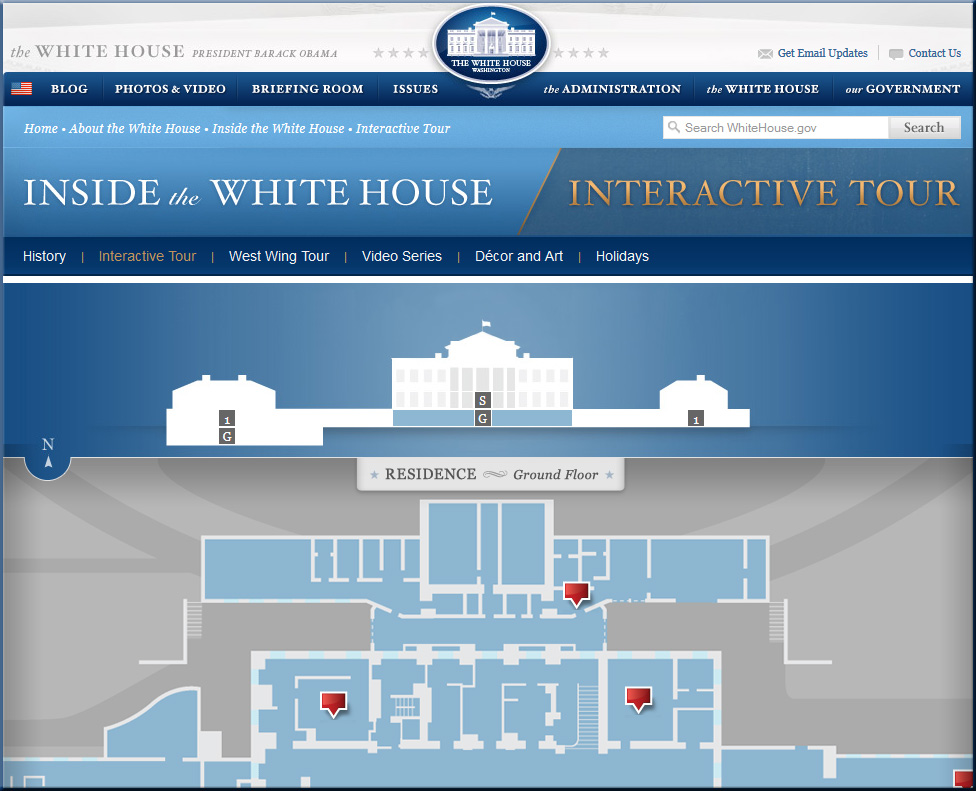
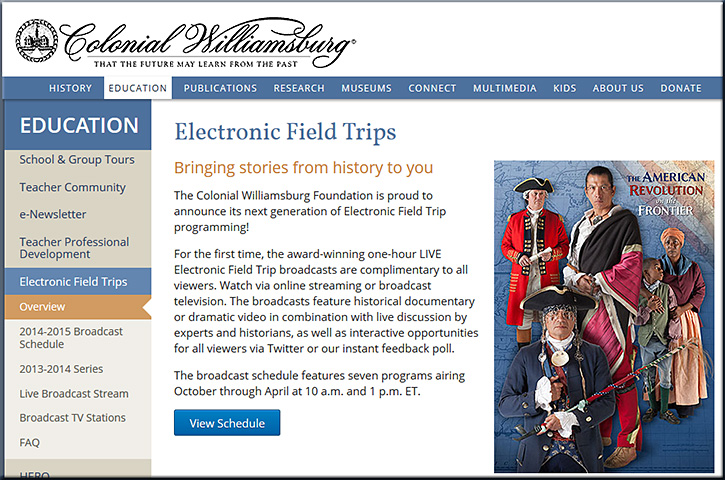
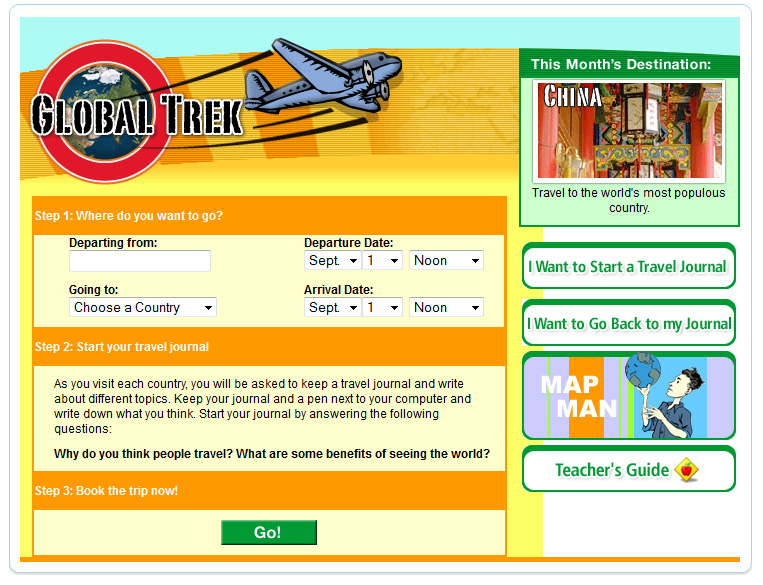
6 virtual field trips to give lesson plans a boost — from educationdive.com by Allie Gross

Excerpts:

These resources can be used to take students on “virtual” field trips from the comfort of the classroom. For schools facing tight budgets, or just not feasibly close enough to a location of interest, these trips are valuable opportunities to expand students’ horizons.

Let’s check out some of our favorite trips that can be incorporated into curriculum for the upcoming school year.


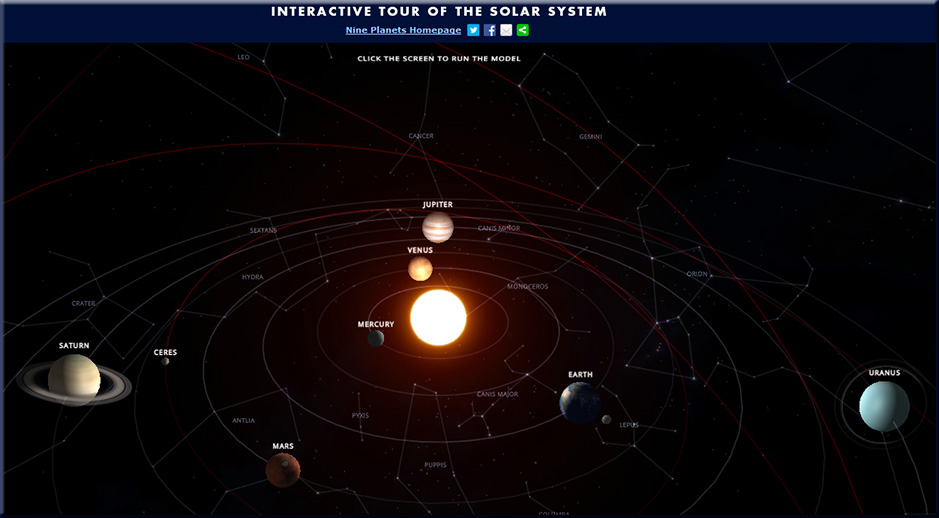
VirtualFieldTrips-nineplanets-July2014


VirtualFieldTrips-WhiteHouse-July2014


VirtualFieldTrips-ColonialWilliamsburg-July2014


VirtualFieldTrips-GlobalTrek-May2014


Reflections on “C-Suite TV debuts, offers advice for the boardroom” [Dreier]

C-Suite TV debuts, offers advice for the boardroom — from streamingmedia.com by Troy Dreier
Business leaders now have an on-demand video network to call their own, thanks to one Bloomberg host’s online venture.

Excerpt:

Bringing some business acumen to the world of online video, C-Suite TV is launching today. Created by Bloomberg TV host and author Jeffrey Hayzlett, the on-demand video network offers interviews with and shows about business execs. It promises inside information on business trends and the discussions taking place in the biggest boardrooms.


MYOB-July2014


The Future of TV is here for the C-Suite — from hayzlett.com by Jeffrey Hayzlett

Excerpt:

Rather than wait for networks or try and gain traction through the thousands of cat videos, we went out and built our own network.


See also:

  • Mind your own business
    From the About page:
    C-Suite TV is a web-based digital on-demand business channel featuring interviews and shows with business executives, thought leaders, authors and celebrities providing news and information for business leaders. C-Suite TV is your go-to resource to find out the inside track on trends and discussions taking place in businesses today. This online channel will be home to such shows as C-Suite with Jeffrey Hayzlett, MYOB – Mind Your Own Business and Bestseller TV with more shows to come.


From DSC:
The above items took me back to the concept of Learning from the Living [Class] Room.

Many of the following bullet points are already happening — but what I’m trying to influence/suggest is to bring all of them together in a powerful, global, 24 x 7 x 365, learning ecosystem:

  • When our “TVs” become more interactive…
  • When our mobile devices act as second screens and when second screen-based apps are numerous…
  • When discussion boards, forums, social media, assignments, assessments, and videoconferencing capabilities are embedded into our Smart/Connected TVs and are also available via our mobile devices…
  • When education is available 24 x 7 x 365…
  • When even the C-Suite taps into such platforms…
  • When education and entertainment are co-mingled…
  • When team-based educational content creation and delivery are mainstream…
  • When self-selecting Communities of Practice thrive online…
  • When Learning Hubs combine the best of both worlds (online and face-to-face)…
  • When Artificial Intelligence, powerful cognitive computing capabilities (i.e., IBM’s Watson), and robust reporting mechanisms are integrated into the backends…
  • When lifelong learners have their own cloud-based profiles…
  • When learners can use their “TVs” to tap into interactive, multimedia-based streams of content of their choice…
  • When recommendation engines are offered not just at Netflix but also at educationally-oriented sites…
  • When online tutoring and intelligent tutoring really take off…

…then I’d say we’ll have a powerful, engaging, responsive, global education platform.


The Living [Class] Room -- by Daniel Christian -- July 2012 -- a second device used in conjunction with a Smart/Connected TV


© 2025 | Daniel Christian