LearningNowTV-Nov2014


From their website:
(emphasis DSC)

LEARNING NOW tv is a live-streamed internet tv channel bringing you inspirational interviews, debates and round tables, and advice and guidance on real world issues to keep you up-to date in the world of learning and development.

Membership to the channel is FREE. You will be able to interact with us on our social channel during the live stream as well as having a resource of the recorded programmes to refer to throughout the year.

Learning Now tv is run and produced by some of the L&D world’s leading experts who have many years’ experience of reporting the real-world issues for today’s learning and development professionals.


I originally saw this at Clive Sheperd’s posting:
TV very much alive for learning professionals


Also see:
 

MYOB-July2014


This new service makes me think of some related graphics:



MoreChoiceMoreControl-DSC


StreamsOfContent-DSC


The Living [Class] Room -- by Daniel Christian -- July 2012 -- a second device used in conjunction with a Smart/Connected TV


Addendum on 12/2/14 — from Learning TRENDS by Elliott Masie – December 2, 2014 | #857

Idea – Courses in the Air:
There were representatives from airlines, Aviation Authorities and even Panasonic – which makes the interactive movie and TV systems on long distance airplanes.  So, I rolled out one of my “aha ideas” that I would love to see invented sometime: Courses in the Air.

What if a passenger could choose to take a mini-course on a 4 to 14 hour flight. It would be a MOOC in the Sky – with video, reading and interactive elements – and someday might even include a real time video chat function as well.  The learner could strive to earn a “badge” or roll them up into a certificate or degree program – that they pursued over several years of flights.  It would be an intriguing element to add to international travel.
 

IBM-UK-Watson-Nov2014


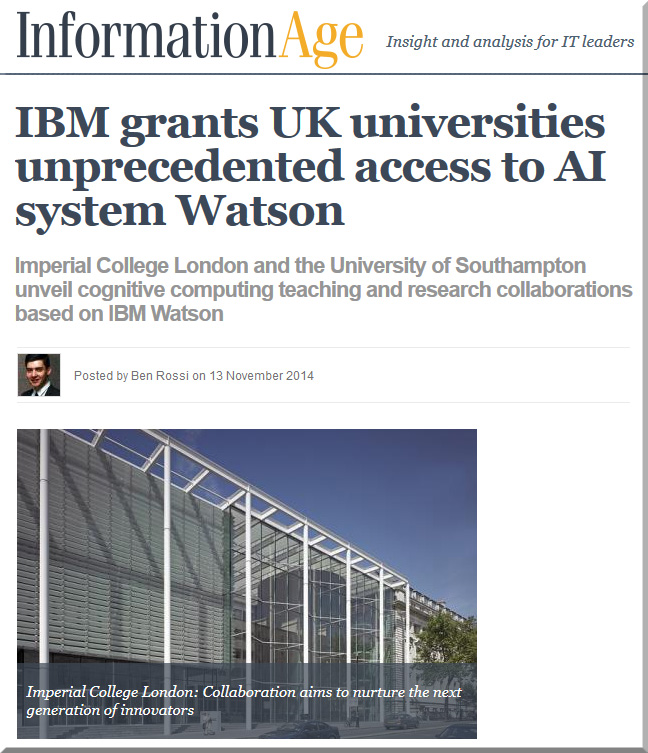
Excerpt from IBM grants UK universities unprecedented access to AI system Watson — from information-age.com by Ben Rossi


The University of Southampton and Imperial College London have today announced partnerships with IBM to offer students and staff cognitive computing education with unprecedented access to IBM‘s Watson technology and experts.

Imperial College London will offer new courses to provide students with opportunities for hands-on learning as they work to develop cognitive computing solutions to address business and societal challenges.

The partnership extends cognitive systems activities in Imperial’s Department of Computing as well as in other college departments already involved in related interdisciplinary research.


Also see:


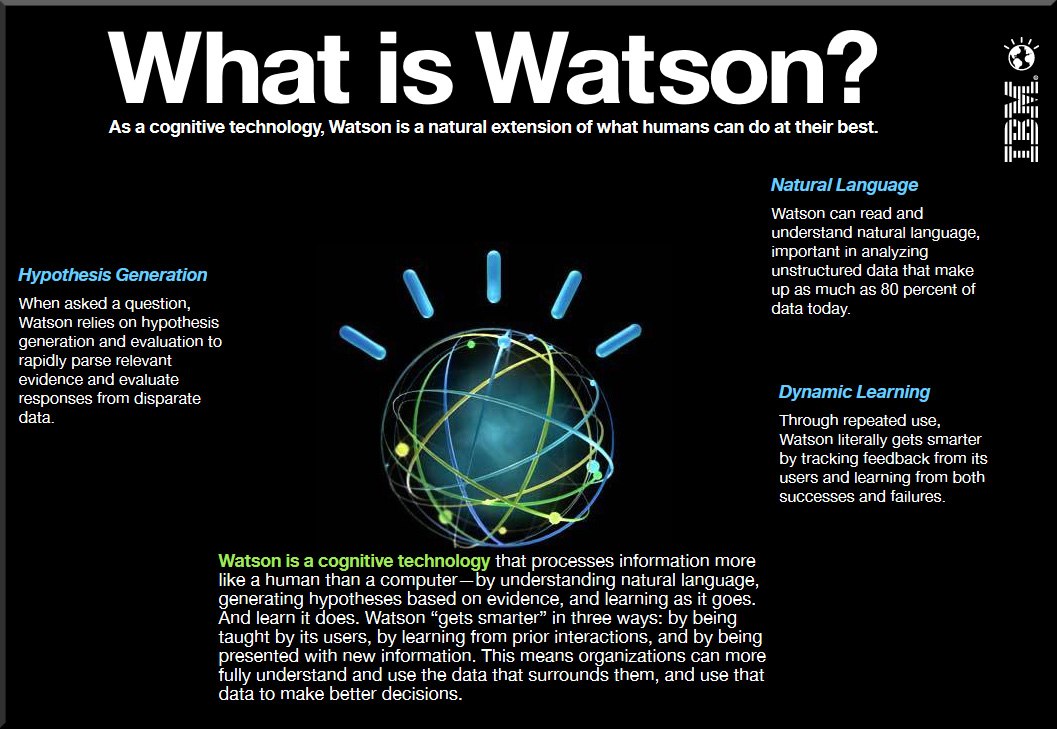
WhatIsWatson-Nov2014
 

Gartner: Top 10 Strategic IT Trends For 2015 — from forbes.com by Peter High

Summary:

  1. Computing Everywhere
  2. The Internet of Things (IoT)
  3. 3D Printing
  4. Advanced, Pervasive, Invisible Analytics
  5. Context-Rich Systems
  6. Smart Machines
  7. Cloud/Client Architecture
  8. Software-Defined Infrastructure and Applications
  9. Web-Scale IT
  10. Risk-Based Security and Self-Protection


Gartner2015TopTrends


EDUCAUSE 2014: What IBM’s Watson could bring to higher education — from edtechmagazine.com by D. Frank Smith
Cognitive computing-powered tutors could spark a new age of discovery for students.

Excerpt:

IBM’s Watson, a cognitive computing system that simulates the human thought process, could soon be peering over teacher’s shoulders in classrooms, the company said at EDUCAUSE 2014 on Wednesday.

Several of IBM’s top education leaders hosted a panel at the conference laying out Watson’s trajectory in higher education. The cognitive computer’s ability to digest large data sets and communicate with humans could open new avenues for teaching, said Michael D. King, vice president, IBM Global Education Industry.

“I think the real impact on learning will start to come in the classroom, if you can imagine intelligent tutors — a system that can truly be interactive with the learner as they’re engaging and learning the materials,” King said.


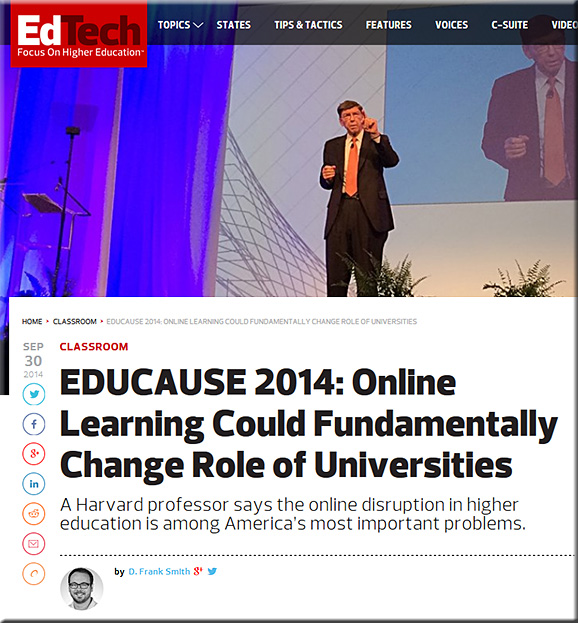
Educause2014-Christensen-Online-Disruption


Excerpt:

Higher education institutions are poised for a massive shake-up, not unlike what tech companies experienced in the 1980s during the rise of the PC, said EDUCAUSE’s first general session speaker.

…

“Disruption is always a great opportunity before it becomes a threat,” he said.

…

“In the future, I don’t think universities themselves will be nearly as prominent as they have been in the past,” he said.


Also see:


Beacons at the museum: Pacific Science Center to roll out location-based Mixby app next month — from geekwire.com by Todd Bishop

Excerpt:

Seattle’s Pacific Science Center has scheduled an Oct. 4 public launch for a new system that uses Bluetooth-enabled beacons and the Mixby smartphone app to offer new experiences to museum guests — presenting them with different features and content depending on where they’re standing at any given moment.


Also see:


From DSC:
The use of location-based apps & associated technologies (machine-to-machine (M2M) communications) should be part of all ed tech planning from here on out — and also applicable to the corporate world and training programs therein. 

Not only applicable to museums, but also to art galleries, classrooms, learning spaces, campus tours, and more.  Such apps could be used on plant floors in training-related programs as well.

Now mix augmented reality in with location-based technology.  Come up to a piece of artwork, and a variety of apps could be launched to really bring that piece to life! Some serious engagement.

Digital storytelling. The connection of the physical world with the digital world. Digital learning. Physical learning. A new form of blended/hybrid learning.  Active learning. Participation.


Addendum on 9/4/14 — also see:

Aerohive Networks Delivers World’s First iBeacon™ and AltBeacon™ – Enabled Enterprise Wi-Fi Access Points
New Partnership with Radius Networks Delivers IoT Solution to Provide Advanced Insights and Mobile Experience Personalization

Excerpt (emphasis DSC):

SUNNYVALE, Calif.–(BUSINESS WIRE)–Aerohive Networks® (NYSE:HIVE), a leader in controller-less Wi-Fi and cloud-managed mobile networking for the enterprise market today announced that it is partnering with Radius Networks, a market leader in proximity services and proximity beacons with iBeacon™ and AltBeacon™ technology, to offer retailers, educators and healthcare providers a cloud-managed Wi-Fi infrastructure enabled with proximity beacons. Together, Aerohive and Radius Networks provide complementary cloud platforms for helping these organizations meet the demands of today’s increasingly connected customers who are seeking more personalized student education, patient care and shopper experiences.


Also:


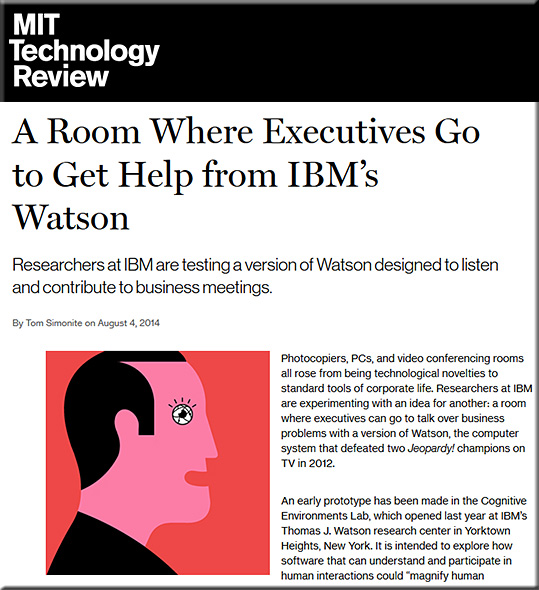
WatsonInBoardRoomMeetingsMIT-Aug2014


Excerpt:

First, Watson was brought up to speed by being directed, verbally, to read over an internal memo summarizing the company’s strategy for artificial intelligence. It was then asked by one of the researchers to use that knowledge to generate a long list of candidate companies. “Watson, show me companies between $15 million and $60 million in revenue relevant to that strategy,” he said.

After the humans in the room talked over the results Watson displayed on screen, they called out a shorter list for Watson to put in a table with columns for key characteristics. After mulling some more, one of them said: “Watson, make a suggestion.” The system ran a set of decision-making algorithms and bluntly delivered its verdict: “I recommend eliminating Kawasaki Robotics.” When Watson was asked to explain, it simply added. “It is inferior to Cognilytics in every way.”


Reflections on “C-Suite TV debuts, offers advice for the boardroom” [Dreier]

C-Suite TV debuts, offers advice for the boardroom — from streamingmedia.com by Troy Dreier
Business leaders now have an on-demand video network to call their own, thanks to one Bloomberg host’s online venture.

Excerpt:

Bringing some business acumen to the world of online video, C-Suite TV is launching today. Created by Bloomberg TV host and author Jeffrey Hayzlett, the on-demand video network offers interviews with and shows about business execs. It promises inside information on business trends and the discussions taking place in the biggest boardrooms.


MYOB-July2014


The Future of TV is here for the C-Suite — from hayzlett.com by Jeffrey Hayzlett

Excerpt:

Rather than wait for networks or try and gain traction through the thousands of cat videos, we went out and built our own network.


See also:

  • Mind your own business
    From the About page:
    C-Suite TV is a web-based digital on-demand business channel featuring interviews and shows with business executives, thought leaders, authors and celebrities providing news and information for business leaders. C-Suite TV is your go-to resource to find out the inside track on trends and discussions taking place in businesses today. This online channel will be home to such shows as C-Suite with Jeffrey Hayzlett, MYOB – Mind Your Own Business and Bestseller TV with more shows to come.


From DSC:
The above items took me back to the concept of Learning from the Living [Class] Room.

Many of the following bullet points are already happening — but what I’m trying to influence/suggest is to bring all of them together in a powerful, global, 24 x 7 x 365, learning ecosystem:

  • When our “TVs” become more interactive…
  • When our mobile devices act as second screens and when second screen-based apps are numerous…
  • When discussion boards, forums, social media, assignments, assessments, and videoconferencing capabilities are embedded into our Smart/Connected TVs and are also available via our mobile devices…
  • When education is available 24 x 7 x 365…
  • When even the C-Suite taps into such platforms…
  • When education and entertainment are co-mingled…
  • When team-based educational content creation and delivery are mainstream…
  • When self-selecting Communities of Practice thrive online…
  • When Learning Hubs combine the best of both worlds (online and face-to-face)…
  • When Artificial Intelligence, powerful cognitive computing capabilities (i.e., IBM’s Watson), and robust reporting mechanisms are integrated into the backends…
  • When lifelong learners have their own cloud-based profiles…
  • When learners can use their “TVs” to tap into interactive, multimedia-based streams of content of their choice…
  • When recommendation engines are offered not just at Netflix but also at educationally-oriented sites…
  • When online tutoring and intelligent tutoring really take off…

…then I’d say we’ll have a powerful, engaging, responsive, global education platform.


The Living [Class] Room -- by Daniel Christian -- July 2012 -- a second device used in conjunction with a Smart/Connected TV


PewResearchIoTThriveBy2025


Also see:

Where the Internet of Things could take society by 2025 — from centerdigitaled.com by Tanya Roscorla

Excerpt:

The Pew Research Center Internet Project and Elon University’s Imagining the Internet Center released the report on Wednesday, May 14, as part of an ongoing future of the Internet series inspired by the Web’s 25th anniversary. Eighty-three percent of these experts, which included education leaders, agreed that the Internet of Things would have “widespread and beneficial effects on the everyday lives of the public by 2025.” The remaining 17 percent said it would not, and both camps elaborated on their answers in paragraph form.

Their explanations fall under six major points:
  1. The Internet of Things and wearable computing will take major steps forward in the next 11 years.
  2. Increased data from connected things will cause privacy concerns to come to the forefront and encourage the growth of profiling and targeting people, which will greatly inflame conflicts in various arenas.
  3. Despite advancement in information interfaces, most people won’t be connecting their brains to the network.
  4. Complicated, unintended consequences will arise.
  5. A digital divide could deepen and disenfranchise people who don’t choose to connect to the network.
  6. Relationships will change depending on people’s response to the Internet of Things.


From DSC:
As with most technologies, there will be positives and negatives about the Internet of Things.  To me, the technologies are tools — neutral, not value-laden — and it’s how we use them that adds moral, political, legal, ethical, or social perspectives/elements to them.  With that said, I’m quite sure that the IoT will have unintended consequences (#4 above).  Also, item #5 — “A digital divide could deepen and disenfranchise people who don’t choose to connect to the network” — is especially troublesome to me, along with the topic of privacy concerns as mentioned in #2.


From DSC:
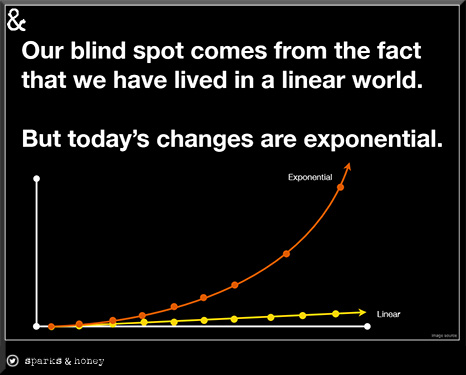
Last spring, I saw the following graphic from Sparks & Honey’s presentation entitled, “8 Exponential Trends That Will Shape Humanity“:


ExponentialNotLinearSparksNHoney-Spring2013


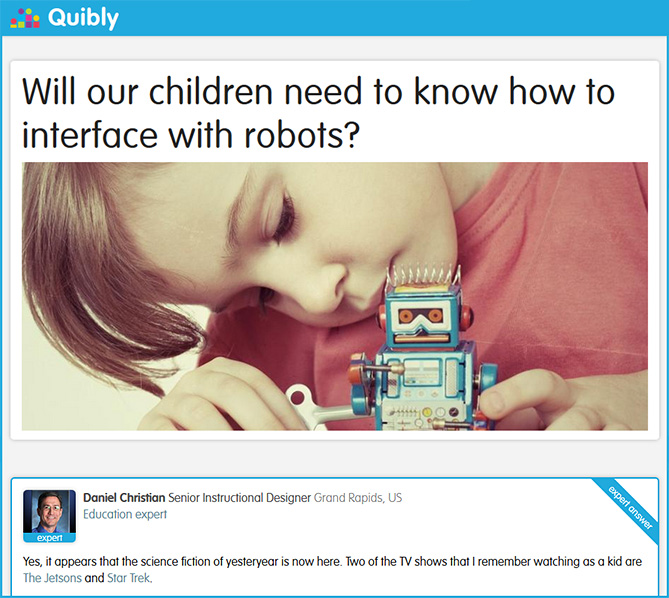
If today’s changes are truly exponential — and I agree with Sparks & Honey that they are, especially as they relate to technological changes — how soon will it be before each of us is interacting with a robot?

This is not an idle idea or question, nor is it a joke. It will be here sooner than most of us think!  The science fiction of the past is here (at least in part).  Some recent items I’ve run across come to my mind, such as:


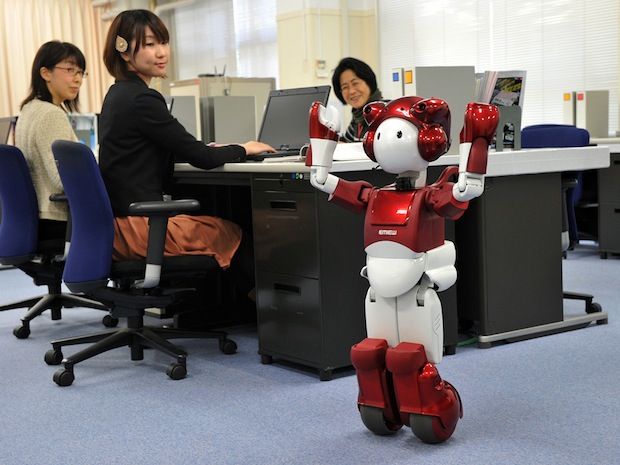
Hitachi’s EMIEW Robot Learns to Navigate Around the Office — from spectrum.ieee.org by Jason Falconer


Photo: Hitachi

Excerpt:

Now EMIEW 2 still relies on maps of its surroundings, but its navigation software has a new feature: It uses designated zones that make the robot change its speed and direction.


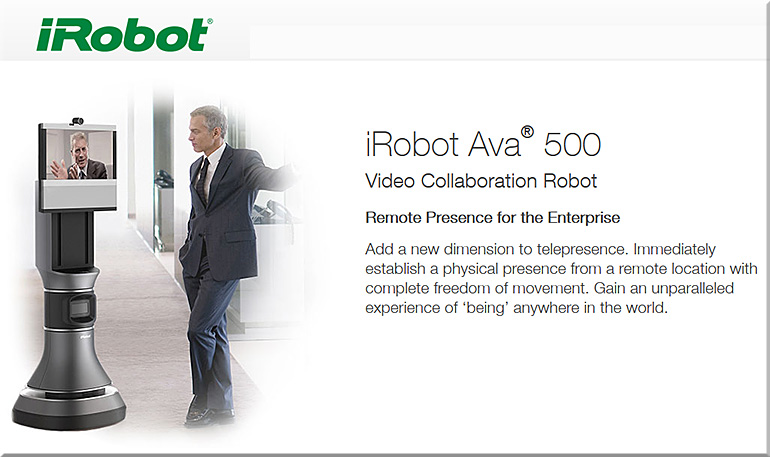
iRpobot Ava 500 

iRobotAva-2014


Excerpt:

Ava 500 enables this new dimension in telepresence with:

  • autonomous navigation and mobility – remote users simply specify a destination and the robot automatically navigates to the desired location without any human intervention.
  • standards-based videoconferencing – built-in Cisco Telepresence® solutions deliver enterprise-class security and reliability.
  • an easy-to-use client application – an iPad mini™ tablet enables remote users to schedule and control the robot.
  • scheduling and management -seamlessly handled through an iRobot managed cloud service.


Also see:


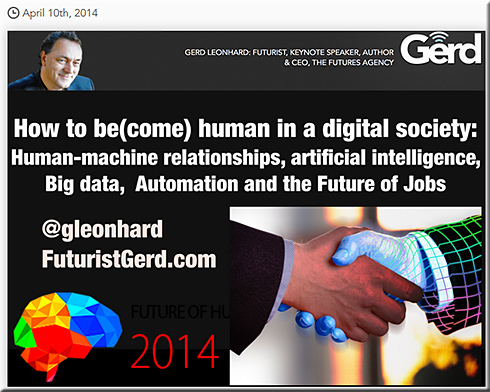
HowToBeHumanInADigitalSociety-April2014


 Excerpt:

‘Intelligent machines’ are increasingly interconnecting. The Internet of Things is imminent, with sensor networks and mobile devices connecting everyone and everything everywhere in the near future., Singularity’ – the moment of when machines become as capable as humans – is quickly becoming a buzzword that rivals Social Media. Artificial Intelligence (AI) is certain to play a role everywhere, and robots are dropping in price dramatically while gaining quickly in functionality and skills. Exponential technological progress is evident everywhere – but how will we – as linear beings – cope with this increasing empowerment of software and machines, the tremendous gain in the flow of real-time information, and the far-reaching implications that these developments will have? How will we keep up with thousands of real-time datafeeds, the ever-increasing volume, variety and depth of input, the tsunami of incoming communications and the rapidly improving smartness – and increasingly deep intelligence – of software, devices and machines? Will humans need to be ‘augmented’, soon, in order to keep up, and if so, where will this take us? What will happen to our ethics in a world of ultra-smart intelligent agents, artificial intelligence and the coming ‘trans-humanism’?


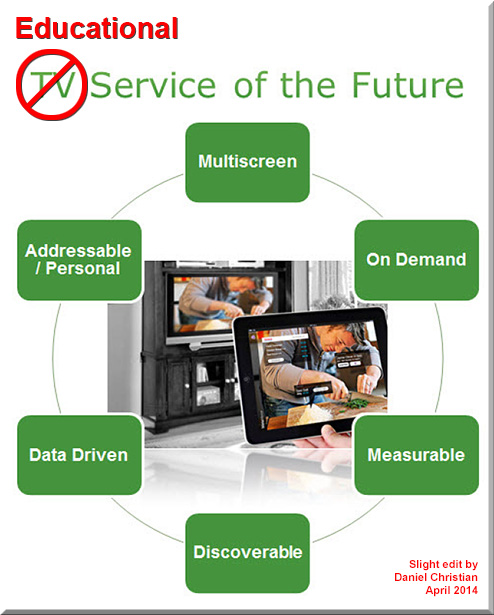
What educationally-related affordances might we enjoy from these TV-related developments?

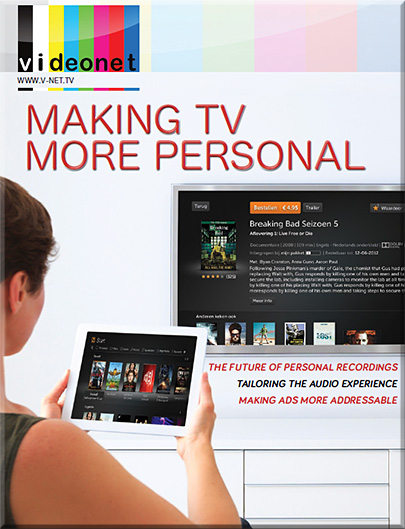
MakingTVMorePersonal-V-NetTV-April2014


EducationServiceOfTheFutureApril2014


CONTENTS

  • Content discovery and synchronization
    With access to rich data about their subscribers and what they do, operators can improve recommendation, encourage social TV and exploit second screen synchronization.
  • Recordings get more personal
    One of the next big steps in multiscreen TV is giving people access to their personal recordings on every screen. This is the moment for nPVR to finally make its entrance.
  • Evolving the User Experience
    As service providers go beyond household level and address individuals, the role of log-ins or context will become important. There is a place for social TV and big data.
  • The role of audio in personalization
    Audio has a huge impact on how much we enjoy video services. Now it can help to personalize them. ‘Allegiance’ based audio choices are one possibility.
  • Making advertising more targeted
    Addressable advertising is in its infancy but has a bright future, helping to fund the growth of on-demand and multiscreen viewing.


Some excerpts from this report:

Good content should be matched by good content discovery , including recommendations. The current state-of -the-art is defined by Netflix.

…

Today’s TV experience is worlds apart from the one we were talking about even five years ago. We’ve witnessed exponential growth in services such as HD and have moved from a model in which one screen is watched by many, to many screens (and devices) being available to the individual viewer, what is today called TV Everywhere.  Having multiscreen access to content is driving the demand for a more personalised experience, in which the viewer can expect to see what they want, where, and when. While video on-demand (VOD) has been a great method for delivering compelling content to viewers, it is not always a truly seamless TV-like experience, and traditionally has been limited to the living room. The growing demand for the personalised experience is driving seismic change within the TV industry, and we’ve seen great strides made already, with time-shifted TV and nPVR as just two examples of how we in the industry can deliver content in the ways viewers want to watch. The next step is to move towards more advanced content discovery, effectively creating a personalised channel or playlist for the individual user.

…

As the tools become available to deliver personalized experiences to consumers, content owners can better create experiences that leverage their content. For example, for sports with multiple points of action, like motor racing, multiple camera angles and audio feeds will allow fans to follow the action that is relevant to their favourite racing team. And for movies, access to additional elements such as director’s commentaries, which have been available on Blu-ray discs for some time, can be made available over broadcast networks.


From DSC:
Some words and phrases that come to my mind:

  • Personalization.
  • Data driven.
  • Content discovery and recommendation engines (which could easily relate to educational playlists)
  • Training on demand
  • Learning agents
  • Web-based learner profiles
  • Learning hubs
  • What MOOCs morph into
  • More choice. More control.
  • Virtual tutoring
  • Interactivity and participation
  • Learning preferences
  • Lifelong learning
  • Reinventing oneself
  • Streams of content
  • Learning from The Living [Class] Room


The Living [Class] Room -- by Daniel Christian -- July 2012 -- a second device used in conjunction with a Smart/Connected TV


streams-of-content-blue-overlay


TVs are becoming the next app battleground — from by Emily Adler

Excerpt:

The app store phenomenon, centered on smartphones and tablets, has been the biggest story in software for the past five years.

Its next logical destination: the living room, via smart TVs and set-top boxes connected to the Internet.

…

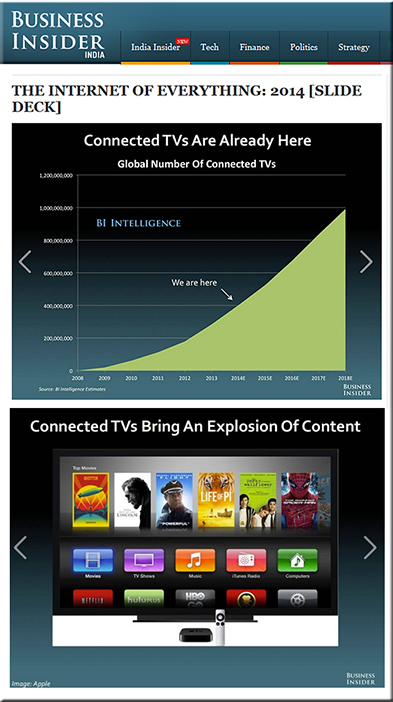
  • The smart TV app revolution is inevitable: People spend four hours in front of their TVs in the U.S., and 63% of all global ad spending goes to TVs. The old guard, represented by cable and entertainment conglomerates, will not be able to fend off improvements like those that apps are bringing to mobile phones.
    .
  • The smart TV revolution will not just be led by new TVs with built-in Internet connections, it will also result from consumer adoption of less expensive game consoles or set-top boxes like Roku and Apple TV, which transform traditional TVs into smart TVs with access to app stores. At least 20% of U.S. consumers already have their TVs connected in one of these ways.


From DSC:

  1. Keep an eye on the convergence of the telephone, the television, and the computer.
    .
  2. Start thinking of ways that you could provide learning/educationally-based experiences with second screen apps. What would that experience look and act like?
    .
  3. If such “channels” come to fruition — and happen to coincide with MOOCs and advances in cognitive computing (such as IBM’s Watson) — the word disruption comes to mind.
    .
  4. The trick, then, will be to offer streams of content that are relevant, and up-to-date.
    .
  5. Such a platform could be used in learning hubs throughout the world, as well as in hybrid/blended classrooms — while also addressing lifelong learners from their living rooms.
    .
  6. Such a platform could take Communities of Practice to an entirely new level.


The Living [Class] Room -- by Daniel Christian -- July 2012 -- a second device used in conjunction with a Smart/Connected TV


streams-of-content-blue-overlay


Addendum/also see:


IoE-SmartTVs-Feb2014


RiseOfSmartMachines-Gartner-2-13-14


Description:
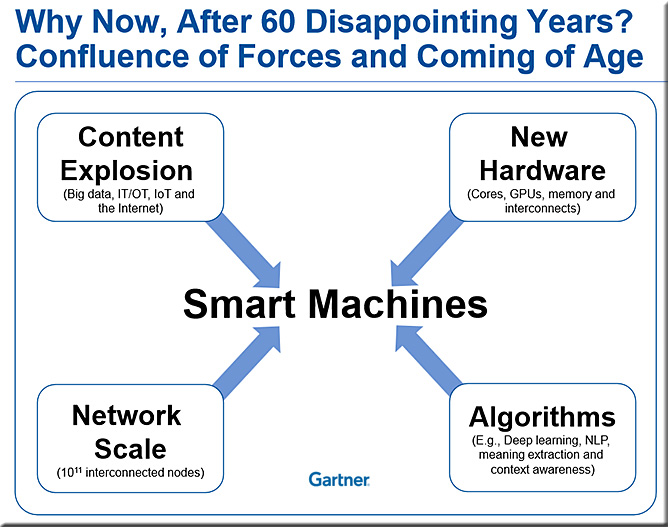
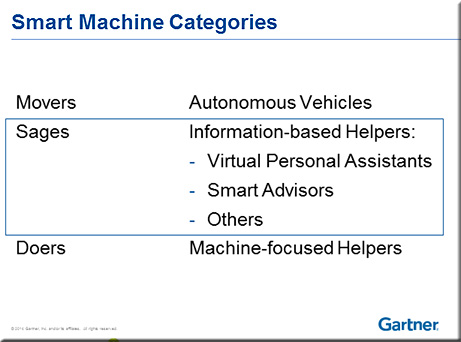
Smart machines do what we thought only people could do. They include conversational assistants like GoogleNow that know how you work, understand written content and make recommendations based on what you’re doing; advisors like IBM’s Watson that can help clinicians keep up with medical literature and suggest courses of action; software that writes sports stories from box scores; and cars that drive themselves.

Key Issues
1. What are smart machines?
2. How will smart machines impact business, technology, economies and society?
3. What should you do about it?


RiseOfSmartMachines2-Gartner-2-13-14


RiseOfSmartMachines3-Gartner-2-13-14


RiseOfSmartMachines4-Gartner-2-13-14

 
© 2025 | Daniel Christian