Gartner reveals top predictions for IT organizations & users for 2016 and beyond — from gartner.com

Excerpts:

  1. By 2018, 20 percent of business content will be authored by machines.
  2. By 2018, six billion connected things will be requesting support.
  3. By 2020, autonomous software agents outside of human control will participate in five percent of all economic transactions.
  4. By 2018, more than 3 million workers globally will be supervised by a “robo-boss.”
  5. By year-end 2018, 20 percent of smart buildings will have suffered from digital vandalism.
  6. By 2018, 45 percent of the fastest-growing companies will have fewer employees than instances of smart machines.
  7. By year-end 2018, customer digital assistant will recognize individuals by face and voice across channels and partners.
  8. By 2018, two million employees will be required to wear health and fitness tracking devices as a condition of employment.
  9. By 2020, smart agents will facilitate 40 percent of mobile interactions, and the postapp era will begin to dominate.
  10. Through 2020, 95 percent of cloud security failures will be the customer’s fault.


From DSC:
Some of these are pretty bold predictions.  Is this the future we want?  Do you want to be supervised by a “robo-boss?” Perhaps, perhaps not.  Likely, given the pace of technological change, we will need to be flexible and be able to change/adapt in order to remain marketable. Lifelong learning has become a must have ingredient in our lives — for all of us in the workforce. Learning how to learn will pay off, big time.

I’m working on another posting that talks about the ethics, morals, and potential policies that need to be considered now before we get too much further down some of these pathways.


The pace has changed significantly and quickly


Introducing Coursera for Apple TV: Bringing Online Learning to Your Living Room — from blog.coursera.org


Apple TV


Excerpt (emphasis DSC):

We’re thrilled to announce that Coursera content will now be available on Apple TV.

Since our beginning, one of our primary goals has been to make learning more accessible for everyone. Our mobile platform brought an on-demand learning experience to people’s busy, on-the-go lifestyles, and now, we’re extending availability to your home. Regardless of where in the world you are located, you’ll now be able to learn from top university professors and renowned experts without the expense of travel or tuition.

TV availability isn’t only a first for Coursera—it marks Apple TV’s first ever introduction of online learning to its platform. Everything you can do online at Coursera, you’ll now be able to do from the comfort of your own living room: browse our entire catalogue of courses, peruse new topics, and watch videos from some of the top academic and industry experts.


From DSC:
Coursera takes us one step closed to a very powerful learning platform — one that in the future will provide a great deal of intelligence behind the scenes.  It’s likely that we will be using personalized, adaptable, digital learning playlists while enjoying some serious levels of interactivity…while also making use of web-based learner profiles (the data from which will either be hosted at places like LinkedIn.com or will be fed into employers’ and universities’ competency-based databases).  The application development for tvOS should pick up greatly, especially if the collaboration capabilities are there.

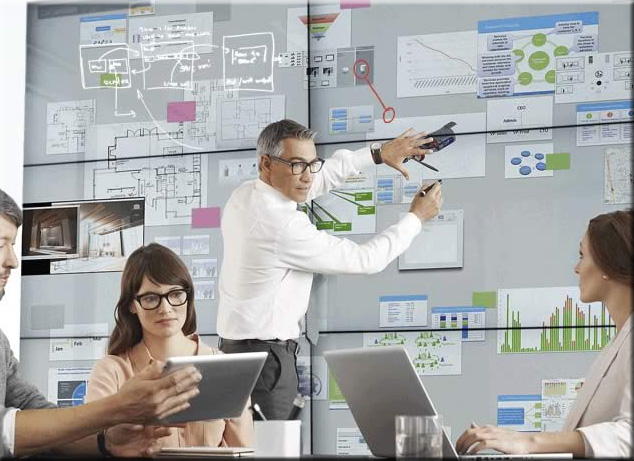
For example, can you imagine marrying the functionalities that Bluescape provides with the reach, flexibility, convenience, and affordances that are unfolding with the new Apple TV?

Truly, some mind-blowing possibilities are developing.  In the not too distant future, lifelong learning won’t ever be the same again (not to mention project-related work).

This is why I’m big on the development and use of
team of specialists — as an organization may have
a harder time competing in the future without one.


BlueScape-2015


The Living [Class] Room -- by Daniel Christian -- July 2012 -- a second device used in conjunction with a Smart/Connected TV


FutureOfTV-Apple-Oct2015


The New Apple TV Invigorates the Set-Top Box — from nytimes.com by Brian Chen

Excerpt:

I NEVER imagined I would get hooked on reading comic books on a TV screen. That changed last week after I picked up a new Apple TV.

The new device, which is similar to a set-top box and brings video and music from the Internet to a television, now has an app store. So I downloaded Madefire, one of the first apps available for the new device. Madefire adds a twist to digital comics with sound effects, music and motion, bringing the panels to life on the big screen. Within minutes, I was bingeing on a series about Superman turning into a corrupt dictator.

Playing with apps is just one new feature of the revamped Apple TV, which will ship this week. It’s that plethora of innovations and apps that leads me to conclude that the upgraded $149 box is now the best TV streaming device you can get for your money.


Apple TV challenges developers to take apps to the big screen — from http://finance.yahoo.com by Julia Love

Excerpt:

(Reuters) – Apple’s loyal army of software developers is joining the tech giant in its bid to conquer the living room with a new version of Apple TV, creating apps for the big screen that they hope will attract users and unlock a rich source of revenue.

A long-awaited update to Apple TV, which launched in 2007, will start shipping in 80 countries on Friday.

Apple views apps as the future of television. An App Store is the centerpiece of the new device, and hundreds of apps will be ready at launch, including gaming, shopping and photography.

Although developers have already been able to make apps for smart TV rivals, Apple’s vast base of developers will set the device apart, analysts say. And developers say they relish the opportunity to reach users in a more intimate setting.


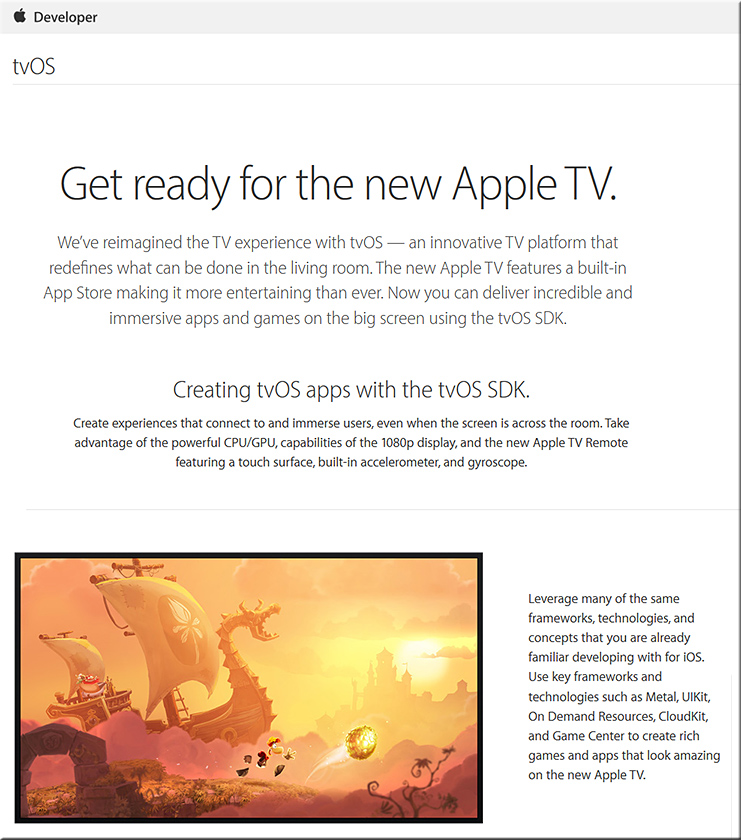
tvOS > Developer information


AppleTV-tvOS-Oct2015


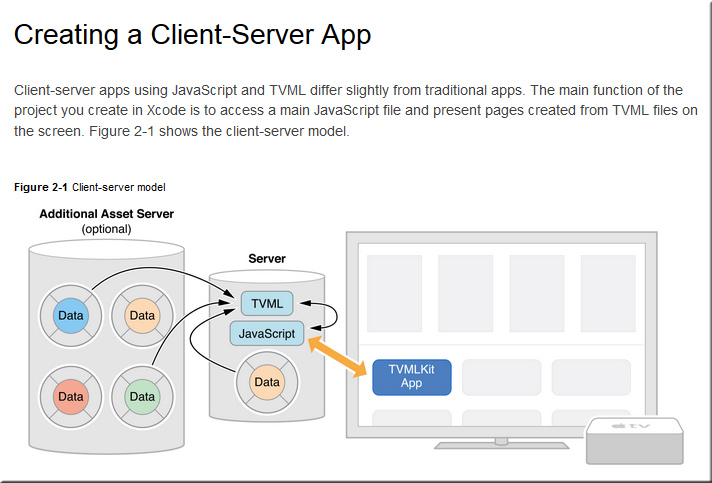
Building Apple TV Apps > Creating a Client-Server App


ClientServerApp-tvOS-Oct2015


Which Apple TV Should You Buy? — from wired.com

Excerpt:

Pre-orders for the new Apple TV have begun. Well, technically, the new Apple TVs; the latest model comes in two sizes. Oh, and the previous version remains available too. For the first time in Apple TV history, you’ve got options. Now it’s time to figure out which one’s right for you.


‘Aerial’ brings beautiful Apple TV video screensavers to your Mac — from 9to5mac.com


screensavers-oct2015


Addendum:


Back to the Future Day: A look at our technology in 2045 — from zdnet.com by David Gewirtz
The classic geek movie Back to the Future Part II sent Marty McFly 30 years forward to October 21, 2015. We asked top technology experts to check their digital crystal balls and describe what they see in store for us 30 years from now.

Excerpts/topics include:

  • Robots, for those who can afford them
  • The personal network and the future of the smartphone
  • Wearable biometric sensor networks
  • The future of the data center
  • The future of shipping
  • Our changing lifestyle
  • Microsoft and the future of the PC


tvOS: The days of developing for a “TV”-based OS are now upon us.

Apple puts out call for Apple TV apps — from bizjournals.com by Gina Hall

Excerpt:

The company put out the call for app submissions on Wednesday for tvOS. The Apple TV App Store will debut as Apple TV units are shipped out next week.
…
The main attraction of Apple TV is a remote with a glass touch surface and a Siri button that allows users to search by voice. Apple tvOS is capable of running apps ranging from Airbnb to Zillow and games like Crossy Road. Another major perk of Apple TV will be universal search, which allows users to scan for movies and television shows and see results from multiple sources, instead of having to conduct the same search within multiple apps.

Apple CEO Tim Cook hopes the device will simplify how viewers consume content.


From DSC:
The days of developing for a “TV”-based OS are now upon us:  tvOS is here.  I put “TV” in quotes because what we know of the television in the year 2015 may look entirely different 5-10 years from now.

Once developed, things like lifelong learning, web-based learner profiles, badges and/or certifications, communities of practice, learning hubs, smart classrooms, virtual tutoring, virtual field trips, AI-based digital learning playlists, and more will never be the same again.


The Living [Class] Room -- by Daniel Christian -- July 2012 -- a second device used in conjunction with a Smart/Connected TV


MoreChoiceMoreControl-DSC


Also see:


Addendum on 10/26/15:
The article below discusses one piece of the bundle of technologies that I’m trying to get at via my Learning from the Living [Class] Room Vision:

  • No More Pencils, No More Books — from by Will Oremus
    Artificially intelligent software is replacing the textbook—and reshaping American education.
    Excerpt:
    ALEKS starts everyone at the same point. But from the moment students begin to answer the practice questions that it automatically generates for them, ALEKS’ machine-learning algorithms are analyzing their responses to figure out which concepts they understand and which they don’t. A few wrong answers to a given type of question, and the program may prompt them to read some background materials, watch a short video lecture, or view some hints on what they might be doing wrong. But if they’re breezing through a set of questions on, say, linear inequalities, it may whisk them on to polynomials and factoring. Master that, and ALEKS will ask if they’re ready to take a test. Pass, and they’re on to exponents—unless they’d prefer to take a detour into a different topic, like data analysis and probability. So long as they’ve mastered the prerequisites, which topic comes next is up to them.
 

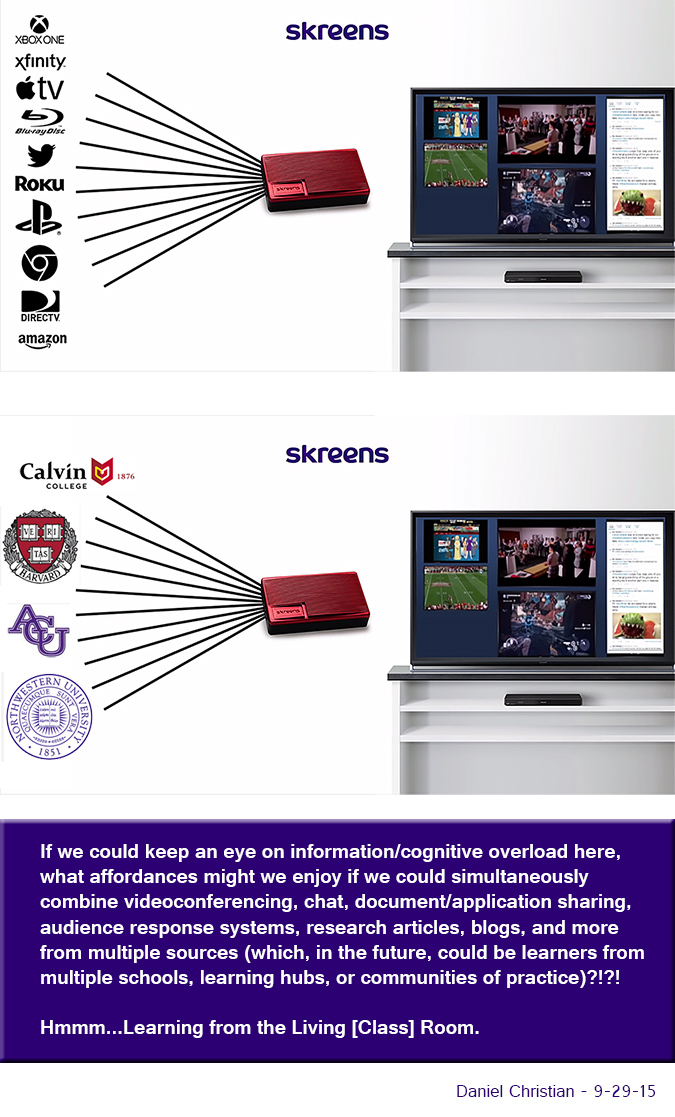
Imagine what learning could look like w/ the same concepts found in Skreens!


From DSC:
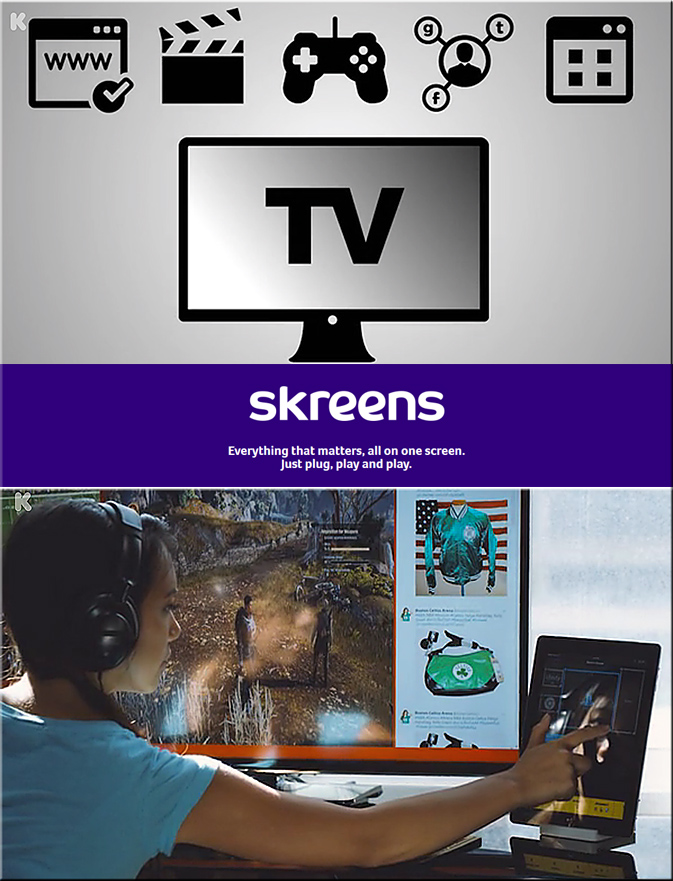
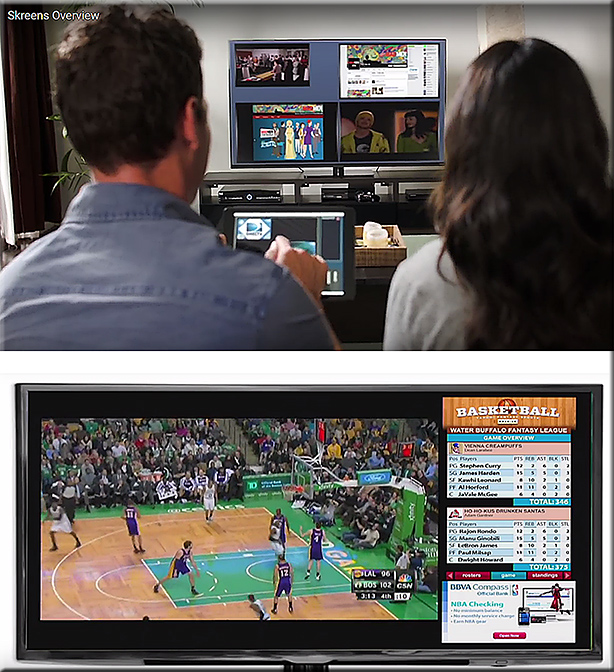
Imagine what learning could look like w/ the same concepts found in the
Skreens kickstarter campaign?  Where you can use your mobile device to direct what you are seeing and interacting with on the larger screen?  Hmmm… very interesting indeed! With applications not only in the home (and on the road), but also in the active classroom, the boardroom, and the training room.


See
Skreens.com
&
Learning from the Living [Class] Room


DanielChristian-AVariationOnTheSkreensTheme-9-29-15


Skreens-Sept2015Kickstarter


Skreens2-Sept2015Kickstarter


The Living [Class] Room -- by Daniel Christian -- July 2012 -- a second device used in conjunction with a Smart/Connected TV

From DSC:
Some of the phrases and concepts that come to my mind:

  • tvOS-based apps
  • Virtual field trips while chatting or videoconferencing with fellow learners about that experience
  • Virtual tutoring
  • Global learning for K-12, higher ed, the corporate world
  • Web-based collaborations and communications
  • Ubiquitous learning
  • Transmedia
  • Analytics / data mining / web-based learner profiles
  • Communities of practice
  • Lifelong learning
  • 24×7 access
  • Reinvent
  • Staying relevant
  • More choice. More control.
  • Participation.
  • MOOCs — or what they will continue to morph into
  • Second screens
  • Mobile learning — and the ability to quickly tie into your learning networks
  • Ability to contact teachers, professors, trainers, specialists, librarians, tutors and more
  • Language translation
  • Informal and formal learning, blended learning, active learning, self-directed learning
  • The continued convergence of the telephone, the television, and the computer
  • Cloud-based apps for learning
  • Flipping the classroom
  • Homeschooling
  • Streams of content
  • …and more!


Addendum:

Check out this picture from Meet the winners of #RobotLaunch2015

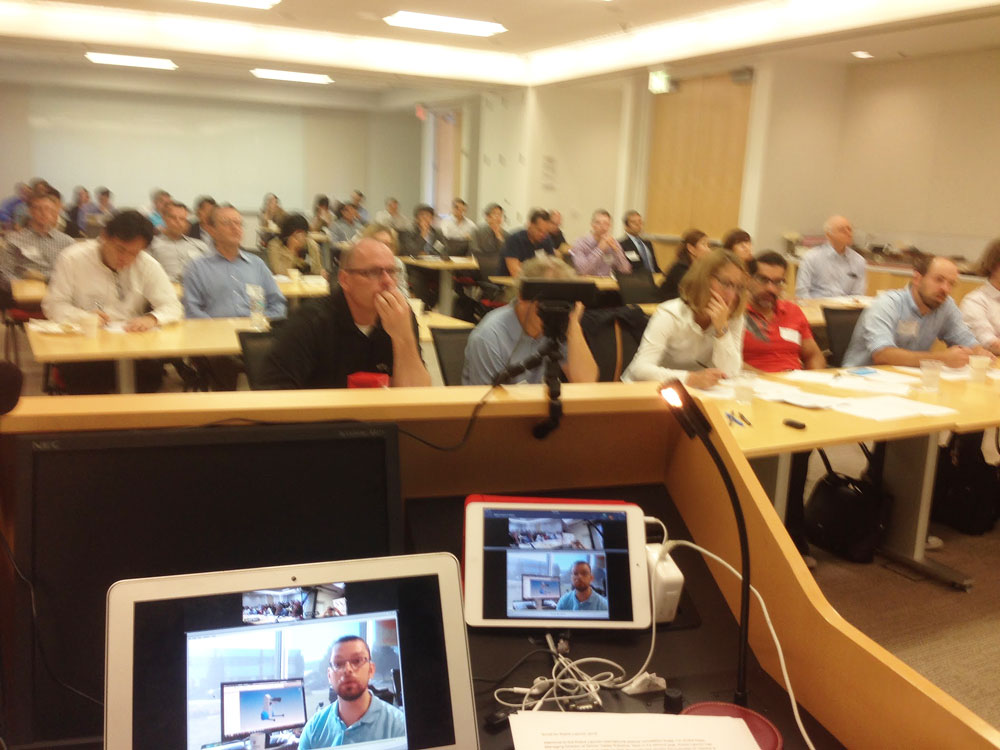
Packed house at WilmerHale for the Robot Launch 2015 judging – although 2/3rds of the participants were attending and pitching remotely via video and web conferencing.


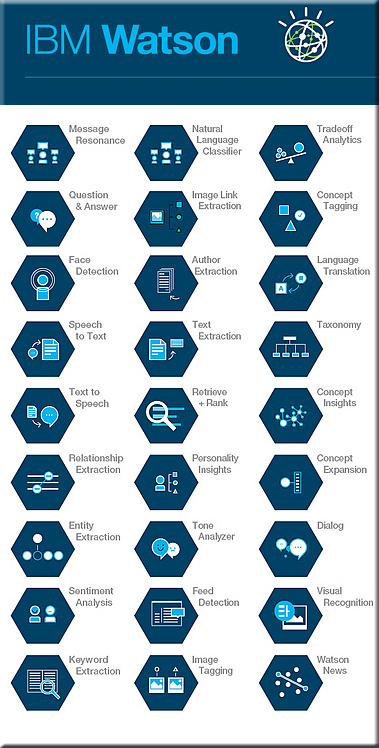
IBM Expands Watson Platform for Next Generation of Builders; Extends Industry’s Largest Portfolio of Cognitive APIs — from ibm.com

– New APIs Broaden Watson’s Language, Vision and Speech Capabilities
– Developer Tools Simplify Combining APIs and Data
– Upcoming Platform Innovations Previewed including Industry Data Sets & Robotics Integration
– New Watson Hub to Open in San Francisco

Excerpt:

SAN FRANCISCO – 24 Sep 2015: IBM (NYSE: IBM) today expanded the industry’s largest and most diverse set of cognitive APIs, technologies and tools for developers who are creating products, services and applications embedded with Watson.

The announcement was made by IBM during its forum on cognitive computing and Artificial Intelligence, where the company announced a new Watson location in San Francisco. IBM also previewed new platform innovations and research projects that will extend its industry-leading cognitive portfolio.


Excerpts from IBM Watson Ecosystem Partners in Market Building Businesses:

Student Career Counseling: Carney Labs is an education technology company that provides a platform embedded with Watson language capabilities to help schools learn about a student’s personality characteristics in order to build them a career roadmap. The Commonwealth of Virginia adopted a policy for all high schools in the state to leverage this app to use with students entering their freshman year.

Knowledge Management: Bloomfire  is a cloud-based knowledge network platform that helps employees within a company easily find the information they need to do their jobs. By scanning posts within the platform and automatically creating tags via the Watson data insights API, employees at companies including Whole Foods, Dun & Bradstreet and Etsy spend less time searching for information and more time doing meaningful work to improve company performance.

Research & Development: Inno360, an enterprise research and innovation management platform provider, is embedding a powerful combination of 7 Watson APIs for language and data insights into its SaaS platform to transform the way its clients, including Fortune 50 companies, conduct research and process big data. Inno360 is able to provide its clients advanced analysis of their R&D data to resolve product issues quickly and bring new products to market more rapidly.

Talent Sourcing and Matching: UnitesUs is a cloud based hiring & recruitment platform utilizing cognitive computing and big data analysis to match prospective employees to hiring organizations based on personality, company cultural fit, and core qualifications. By analyzing the personalities of job candidates leveraging Watson language capabilities and characterizing a company’s work environment, UnitesUs uses proprietary, automated matching algorithms to help companies, including imaging and electronics company Ricoh USA and fitness gym chain 24 Hour Fitness, make better hiring decisions.


ibmwatson-sept2015


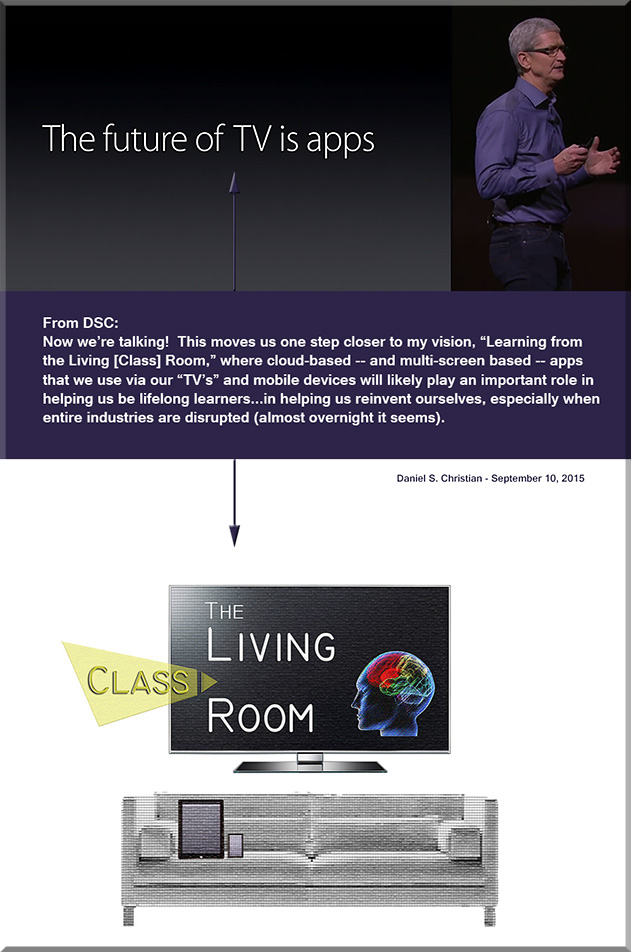
Now we’re talking! One step closer! “The future of TV is apps.” — per Apple’s CEO, Tim Cook

OneStepCloser-DanielChristian-Sept2015


From DSC:
We’ll also be seeing the integration of the areas listed below with this type of “TV”-based OS/platform:

  • Artificial Intelligence (AI)
  • Data mining and analytics
  • Learning recommendation engines
  • Digital learning playlists
  • New forms of Human Computer Interfaces (HCI)
  • Intelligent tutoring
  • Social learning / networks
  • Videoconferencing with numerous other learners from across the globe
  • Virtual tutoring, virtual field trips, and virtual schools
  • Online learning to the Nth degree
  • Web-based learner profiles
  • Multimedia (including animations, simulations, and more)
  • Advanced forms of digital storytelling
  • and, most assuredly, more choice & more control.

Competency-based education and much lower cost alternatives could also be possible with this type of learning environment. The key will be to watch — or better yet, to design and create — what becomes of what we’re currently calling the television, and what new affordances/services the “TV” begins to offer us.


MoreChoiceMoreControl-DSC


From Apple’s website:

Apple Brings Innovation Back to Television with The All-New Apple TV
The App Store, Siri Remote & tvOS are Coming to Your Living Room

Excerpt:

SAN FRANCISCO — September 9, 2015 — Apple® today announced the all-new Apple TV®, bringing a revolutionary experience to the living room based on apps built for the television. Apps on Apple TV let you choose what to watch and when you watch it. The new Apple TV’s remote features Siri®, so you can search with your voice for TV shows and movies across multiple content providers simultaneously.

The all-new Apple TV is built from the ground up with a new generation of high-performance hardware and introduces an intuitive and fun user interface using the Siri Remote™. Apple TV runs the all-new tvOS™ operating system, based on Apple’s iOS, enabling millions of iOS developers to create innovative new apps and games specifically for Apple TV and deliver them directly to users through the new Apple TV App Store™.

…

tvOS is the new operating system for Apple TV, and the tvOS SDK provides tools and APIs for developers to create amazing experiences for the living room the same way they created a global app phenomenon for iPhone® and iPad®. The new, more powerful Apple TV features the Apple-designed A8 chip for even better performance so developers can build engaging games and custom content apps for the TV. tvOS supports key iOS technologies including Metal™, for detailed graphics, complex visual effects and Game Center, to play and share games with friends.


Addendum on 9/11/15:


What might our learning ecosystems look like by 2025? [Christian]

This posting can also be seen out at evoLLLution.com (where LLL stands for lifelong learning):
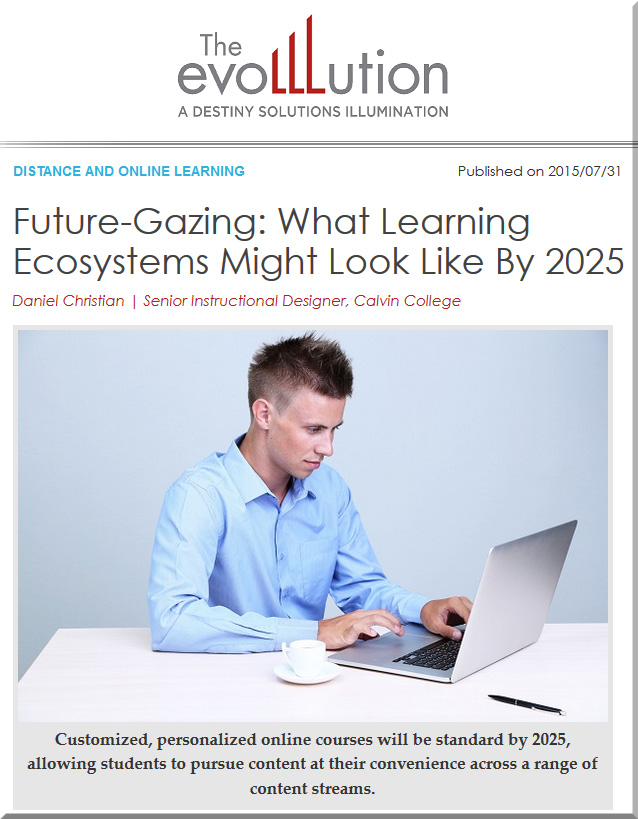
DanielChristian-evoLLLutionDotComArticle-7-31-15


From DSC:
What might our learning ecosystems look like by 2025?

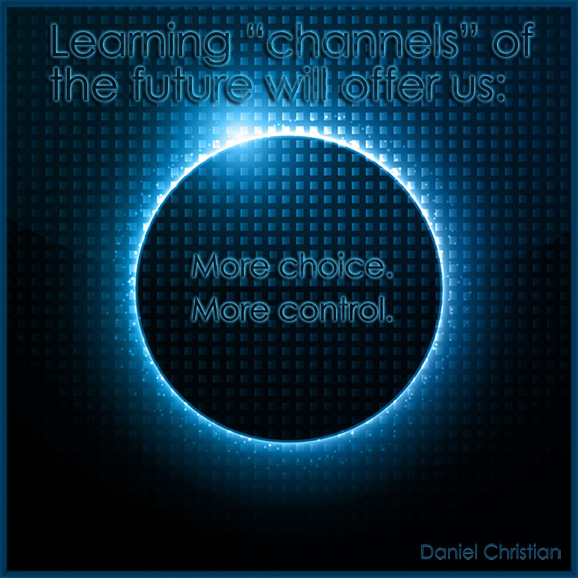
In the future, learning “channels” will offer more choice, more control.  They will be far more sophisticated than what we have today.
 

MoreChoiceMoreControl-DSC


That said, what the most important aspects of online course design end up being 10 years from now depends upon what types of “channels” I think there will be and what might be offered via those channels. By channels, I mean forms, methods, and avenues of learning that a person could pursue and use. In 2015, some example channels might be:

  • Attending a community college, a college or a university to obtain a degree
  • Obtaining informal learning during an internship
  • Using social media such as Twitter or LinkedIn
  • Reading blogs, books, periodicals, etc.

In 2025, there will likely be new and powerful channels for learning that will be enabled by innovative forms of communications along with new software, hardware, technologies, and other advancements. For examples, one could easily imagine:

  • That the trajectory of deep learning and artificial intelligence will continue, opening up new methods of how we might learn in the future
  • That augmented and virtual reality will allow for mobile learning to the Nth degree
  • That the trend of Competency Based Education (CBE) and microcredentials may be catapulted into the mainstream via the use of big data-related affordances

Due to time and space limitations, I’ll focus here on the more formal learning channels that will likely be available online in 2025. In that environment, I think we’ll continue to see different needs and demands – thus we’ll still need a menu of options. However, the learning menu of 2025 will be more personalized, powerful, responsive, sophisticated, flexible, granular, modularized, and mobile.


Highly responsive, career-focused track


One part of the menu of options will focus on addressing the demand for more career-focused information and learning that is available online (24×7). Even in 2015, with the U.S. government saying that 40% of today’s workers now have ‘contingent’ jobs and others saying that percentage will continue climbing to 50% or more, people will be forced to learn quickly in order to stay marketable.  Also, the 1/2 lives of information may not last very long, especially if we continue on our current trajectory of exponential change (vs. linear change).

However, keeping up with that pace of change is currently proving to be out of reach for most institutions of higher education, especially given the current state of accreditation and governance structures throughout higher education as well as how our current teaching and learning environment is set up (i.e., the use of credit hours, 4 year degrees, etc.).  By 2025, accreditation will have been forced to change to allow for alternative forms of learning and for methods of obtaining credentials. Organizations that offer channels with a more vocational bent to them will need to be extremely responsive, as they attempt to offer up-to-date, highly-relevant information that will immediately help people be more employable and marketable. Being nimble will be the name of the game in this arena. Streams of content will be especially important here. There may not be enough time to merit creating formal, sophisticated courses on many career-focused topics.

 

StreamsOfContent-DSC


With streams of content, the key value provided by institutions will be to curate the most relevant, effective, reliable, up-to-date content…so one doesn’t have to drink from the Internet’s firehose of information. Such streams of content will also offer constant potential, game-changing scenarios and will provide a pulse check on a variety of trends that could affect an industry. Social-based learning will be key here, as learners contribute to each other’s learning. Subject Matter Experts (SMEs) will need to be knowledgeable facilitators of learning; but given the pace of change, true experts will be rare indeed.

Microcredentials, nanodegrees, competency-based education, and learning from one’s living room will be standard channels in 2025.  Each person may have a web-based learner profile by then and the use of big data will keep that profile up-to-date regarding what any given individual has been learning about and what skills they have mastered.

For example, even currently in 2015, a company called StackUp creates their StackUp Report to add to one’s resume or grades, asserting that their services can give “employers and schools new metrics to evaluate your passion, interests, and intellectual curiosity.” Stackup captures, categorizes, and scores everything you read and study online. So they can track your engagement on a given website, for example, and then score the time spent doing so. This type of information can then provide insights into the time you spend learning.

Project teams and employers could create digital playlists that prospective employees or contractors will have to advance through; and such teams and employers will be watching to see how the learners perform in proving their competencies.

However, not all learning will be in the fast lane and many people won’t want all of their learning to be constantly in the high gears. In fact, the same learner could be pursuing avenues in multiple tracks, traveling through their learning-related journeys at multiple speeds.


The more traditional liberal arts track


To address these varied learning preferences, another part of the menu will focus on channels that don’t need to change as frequently.  The focus here won’t be on quickly-moving streams of content, but the course designers in this track can take a bit more time to offer far more sophisticated options and activities that people will enjoy going through.

Along these lines, some areas of the liberal arts* will fit in nicely here.

*Speaking of the liberal arts, a brief but important tangent needs to be addressed, for strategic purposes. While the following statement will likely be highly controversial, I’m going to say it anyway.  Online learning could be the very thing that saves the liberal arts.

Why do I say this? Because as the price of higher education continues to increase, the dynamics and expectations of learners continue to change. As the prices continue to increase, so do peoples’ expectations and perspectives. So it may turn out that people are willing to pay a dollar range that ends up being a fraction of today’s prices. But such greatly reduced prices won’t likely be available in face-to-face environments, as offering these types of learning environment is expensive. However, such discounted prices can and could be offered via online-based environments. So, much to the chagrin of many in academia, online learning could be the very thing that provides the type of learning, growth, and some of the experiences that liberal arts programs have been about for centuries. Online learning can offer a lifelong supply of the liberal arts.

But I digress…
By 2025, a Subject Matter Expert (SME) will be able to offer excellent, engaging courses chocked full of the use of:

  • Engaging story/narrative
  • Powerful collaboration and communication tools
  • Sophisticated tracking and reporting
  • Personalized learning, tech-enabled scaffolding, and digital learning playlists
  • Game elements or even, in some cases, multiplayer games
  • Highly interactive digital videos with built-in learning activities
  • Transmedia-based outlets and channels
  • Mobile-based learning using AR, VR, real-world assignments, objects, and events
  • …and more.

However, such courses won’t be able to be created by one person. Their sophistication will require a team of specialists – and likely a list of vendors, algorithms, and/or open source-based tools – to design and deliver this type of learning track.


Final reflections


The marketplaces involving education-related content and technologies will likely look different. There could be marketplaces for algorithms as well as for very granular learning modules. In fact, it could be that modularization will be huge by 2025, allowing digital learning playlists to be built by an SME, a Provost, and/or a Dean (in addition to the aforementioned employer or project team).  Any assistance that may be required by a learner will be provided either via technology (likely via an Artificial Intelligence (AI)-enabled resource) and/or via a SME.

We will likely either have moved away from using Learning Management Systems (LMSs) or those LMSs will allow for access to far larger, integrated learning ecosystems.

Functionality wise, collaboration tools will still be important, but they might be mind-blowing to us living in 2015.  For example, holographic-based communications could easily be commonplace by 2025. Where tools like IBM’s Watson, Microsoft’s Cortana, Google’s Deepmind, and Apple’s Siri end up in our future learning ecosystems is hard to tell, but will likely be there. New forms of Human Computer Interaction (HCI) such as Augmented Reality (AR) and Virtual Reality (VR) will likely be mainstream by 2025.

While the exact menu of learning options is unclear, what is clear is that change is here today and will likely be here tomorrow. Those willing to experiment, to adapt, and to change have a far greater likelihood of surviving and thriving in our future learning ecosystems.


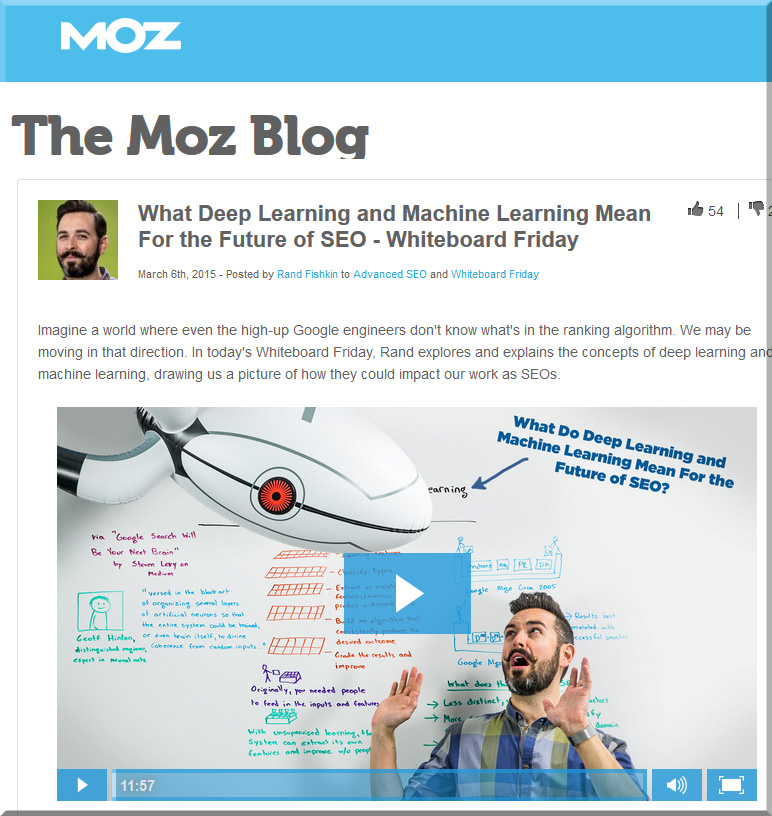
Part 3: Google Search will be your next brain — from medium.com by Steven Levy
Inside Google’s massive effort in Deep Learning, which could make already-smart search into scary-smart search

Excerpt:

But about ten years ago, in Hinton’s lab at the University of Toronto, he and some other researchers made a breakthrough that suddenly made neural nets the hottest thing in AI. Not only Google but other companies such as Facebook, Microsoft and IBM began frantically pursuing the relatively minuscule number of computer scientists versed in the black art of organizing several layers of artificial neurons so that the entire system could be trained, or even train itself, to divine coherence from random inputs, much in a way that a newborn learns to organize the data pouring into his or her virgin senses. With this newly effective process, dubbed Deep Learning, some of the long-standing logjams of computation (like being able to see, hear, and be unbeatable at Breakout) would finally be untangled. The age of intelligent computers systems?—?long awaited and long feared?—?would suddenly be breathing down our necks. And Google search would work a whole lot better.

This breakthrough will be crucial in Google Search’s next big step: understanding the real world to make a huge leap in accurately giving users the answers to their questions as well as spontaneously surfacing information to satisfy their needs. To keep search vital, Google must get even smarter.

This is very much in character for the Internet giant. From its earliest days, the company’s founders have been explicit that Google is an artificial intelligence company. It uses its AI not just in search?—?though its search engine is positively drenched with artificial intelligence techniques?—?but in its advertising systems, its self-driving cars, and its plans to put nanoparticles in the human bloodstream for early disease detection.

…

Indeed, as of now, all Google’s deep learning work has yet to make a big mark on Google search or other products. But that’s about to change.


Also see the other parts in this series:

Part 1: The never ending search

Excerpt:

Google’s flagship product has been part of our lives for so long that we take it for granted. But Google doesn’t. Part One of a study of Search’s quiet transformation.


Part 2: How Google knows what you want to know
Eight times a day Google asks test subjects about their information needs. Their replies can be sobering.

Excerpt:

Google search really isn’t threatened by competition from other search engines. But the people on the search team constantly worry that they may be falling short in satisfying the needs of their users. To address that problem, of course, Google needs to know what those needs are. One way to do this is by examining the logs to see what queries are unsatisfied. But there are lots of things people want to know that they aren’t asking Google about.

How does Google know what those needs are?

It asks them.

Every year since 2011 Google has run an annual study to learn what people really, really want to know, whether it’s something Google provides or not. It’s called Daily Information Needs, but the psychologists at Google involved with the project just call it DIN.


Part 4: The Deep Mind of Demis Hassabis — from medium.com by Steven Levy
Google’s prize AI prodigy tells all. In the race to recruit the best AI talent, Google scored a coup by getting the team led by a former video game guru and chess prodigy

Excerpt:

From the day in 2011 that Demis Hassabis co-founded DeepMind—with funding by the likes of Elon Musk—the UK-based artificial intelligence startup became the most coveted target of major tech companies. In June 2014, Hassabis and his co-founders, Shane Legg and Mustafa Suleyman, agreed to Google’s purchase offer of $400 million. Late last year, Hassabis sat down with Backchannel to discuss why his team went with Google—and why DeepMind is uniquely poised to push the frontiers of AI. The interview has been edited for length and clarity.


Addendum on 3/16/15:


DeepLearning-Moz-March2015


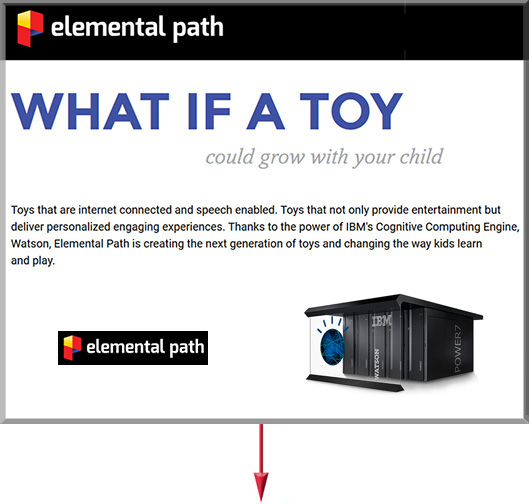
Cognitoy-ElementalPath-March2015
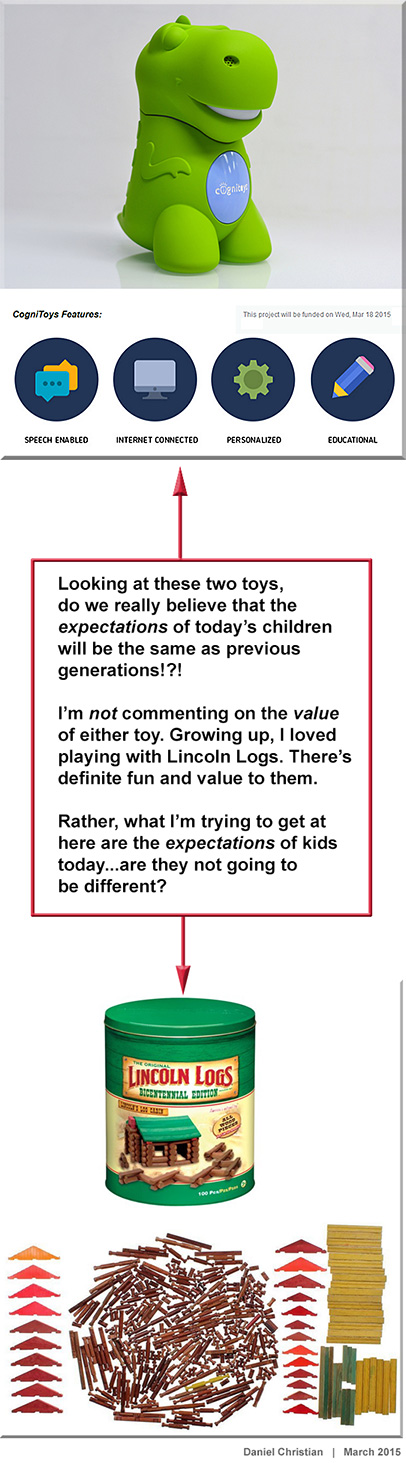
CognitoyFramed-March2015


From DSC:
Given the above…what are the ramifications of that in our/your work?


Also see:


A related addendum on 3/11/15
Look at the different expectations of the generations found in this article:


A related addendum on 3/17/15:

Excerpt:
The overall goal for DragonBot (which, as far as I can tell, is a common platform used for many different projects) is to develop “personalized learning companions” for children. In other words, MIT is finding ways in which robots like DragonBot can effectively help kids learn.

DragonBot isn’t intended to work like that IBM Watson-based dinosaur robot; it’s not a primary source of knowledge, and it’s not actively teaching a whole bunch of new facts to kids who use it. Rather, DragonBot is intended to help with the process of learning itself, encouraging kids to be interactively engaged in whatever they happen to be learning about.


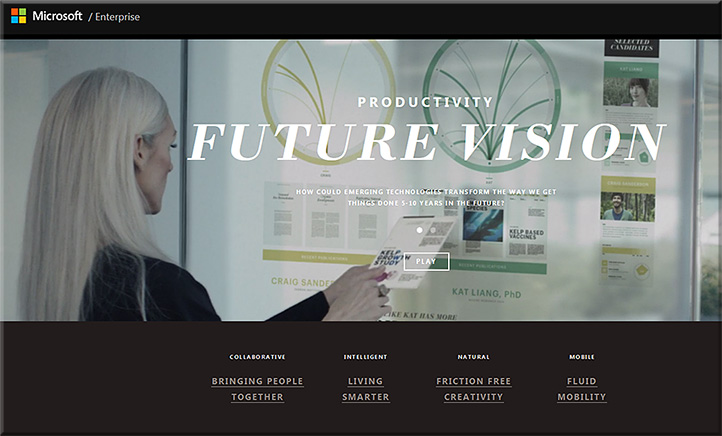
MicrosoftProductivityVision2015


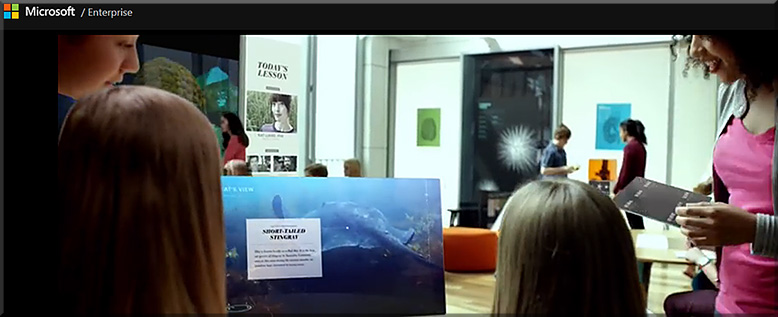
Example snapshots from
Microsoft’s Productivity Future Vision


MicrosoftProductivityVision2-2015


MicrosoftProductivityVision3-2015


MicrosoftProductivityVision5-2015


MicrosoftProductivityVision6-2015


MicrosoftProductivityVision7-2015


MicrosoftProductivityVision8-2015


MicrosoftProductivityVision4-2015


From DSC:
We continue to see more articles and innovations that involve the Internet of Things (IoT) or the Internet of Everything (IoE). This trend has made me reflect upon what I think will be a future, required subset of needed expertise within the fields of Instructional Design, User Experience Design, User Interface Design, Product Development, Programming, Human Computer Interaction (HCI), and likely other fields such as Artificial Intelligence (AI), Augmented Reality (AR), and Virtual Reality(VR) as well.

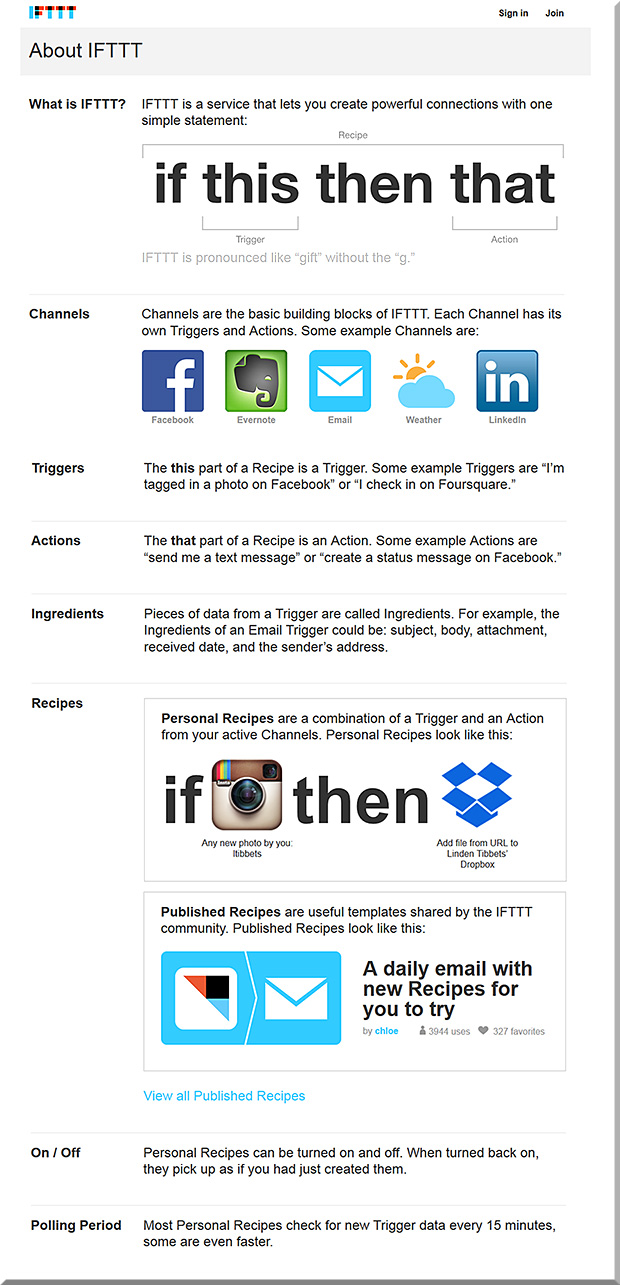
And that is, we will need people who can craft learning experiences from the presence of beacons/sensors and that integrate such concepts as found in “If This Then That” (ifttt.com) whereby one is putting the Internet and cloud/mobile-based applications to work for you. Certainly, those involved in retail are already busy working on these types of projects. But those of us involved with learning, human computer interaction (HCI), and interface design need to get involved as well.


IfThisThenThat-Combined-With-iBeacons


For example, this potential scenario of a K-12 field trip might be fodder for such a learning experience.

So for those individuals who are involved with the aforementioned disciplines…we need to pulse check what new affordances are coming from the rollout and further development of the IoT/IoE.


A vision for radically personalized learning | Katherine Prince | TEDxColumbus

Description:

Could we transform today’s outmoded education system to a vibrant learning ecosystem that puts learners at the center and enables many right combinations of learning resources, experiences, and supports to help each child succeed? Creating personalized learning for all young people will require a paradigm shift in education and a deep commitment to providing each student with the right experiences at the right time.

As Senior Director of Strategic Foresight at KnowledgeWorks, Katherine Prince leads the organization’s work on the future of learning. Since 2007, she has helped a wide range of education stakeholders translate KnowledgeWorks’ future forecasts into forward-looking visions and develop strategies for bringing those visions to life. She also writes about what trends shaping the future of learning could mean for the learning ecosystem.


Learning Ecosystems mentioned again2


Context-Evernote


Excerpt from Context: Your Work Enriched by the Smartest Minds — from blog.evernote.com

Good research happens in three phases. You recall what you know. You consult with someone. You search external sources. We’re applying our machine learning and augmented intelligence expertise to present you with all three research phases automatically, at the moment you need them, without ever leaving your workspace. As you work, Evernote is automatically looking for other information and content that might help you connect the dots/see the big picture. This content can take the form of other notes, people you might talk to or even relevant news sources.

In Evernote, every phrase informs our algorithms about what other content might help you further your project. We call this Context. It’s an extremely powerful new Premium feature coming soon to Evernote.

…

Your knowledge

Your team’s knowledge

Your network

The professionals: Possibly the most powerful new benefit that Context brings is a look at related information from premier news and information sources, including…

  • The Wall Street Journal
  • Factiva
  • LinkedIn
  • TechCrunch
  • CrunchBase
  • Fast Company
  • Inc. Magazine
  • PandoDaily


Also see:

  • Evernote’s CEO: Siri and wearables are doing it wrong — from engadget.com by Devindra Hardawar; with thanks to Mr. Emory Craig for posting this on Twitter
    Excerpt:
    You can see this methodology in place with Context, the new Evernote feature that fetches articles related to your work. Links automatically appear at the bottom of your notes as you’re typing, alongside your past notes and those from your coworkers.
    …
    When you talk about anticipatory computing, it’s only a matter of time until the broader notion of augmented intelligence comes up.
    …
    There are already glimpses of it in Google Now, which is more of an anticipatory notification platform than a friendly assistant like Siri.
 
© 2025 | Daniel Christian